
Get in Touch with SINOFUDE Company

Jelly Candy Production Line By Sinofude
Select a jelly candy production line around the formula, piece geometry, cooling load, plant utilities and accepted output, not capacity alone. SINOFUDE offers five CLM models covering a client-listed rated range of 40–600 kg/h for pectin, gelatin, carrageenan, starch-free and centre-filled projects.
Start with six inputs: working formula, target piece weight, product format, required packed output, available utilities and plant layout. That brief lets our engineering team distinguish a rated machine number from an accepted production plan.
The CLM Family at a Glance
The figures below come from the project source document. They describe an equipment family listing rather than a specific recipe or a commitment to pack output. SINOFUDE uses them to start a buyer review; the risk is treating one listed number as the complete production decision.
5
Models
CLM40 through CLM600
40–600
kg/h
Client-listed rated range
34–300
m²
Listed equipment footprint
78–400
kW
Installed power range
2–4
People
Listed operator range
Reply Within 24 Hours
40–600 KG/H Rated Output
Pectin, Gelatin & Starch-Free
Five Models, CLM40 to CLM600
Jelly Candy Production Capabilities
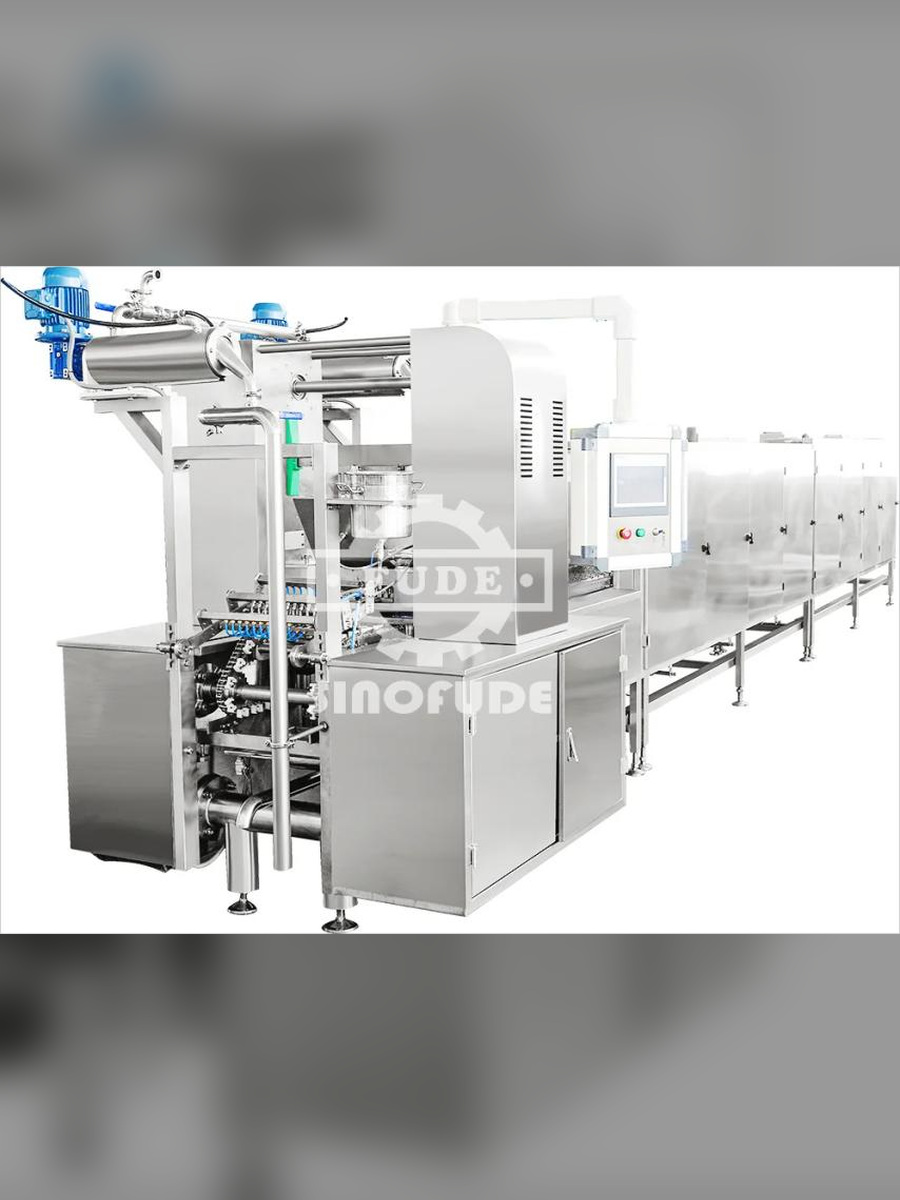
This candy production line connects cooking, controlled ingredient addition, servo depositing, cooling, demoulding and optional oil or sugar coating. We size the line as a connected process because a larger depositor cannot rescue a formula that gels too early, a cooling stage that cannot accept the load or a packaging machine that receives product faster than it can handle.
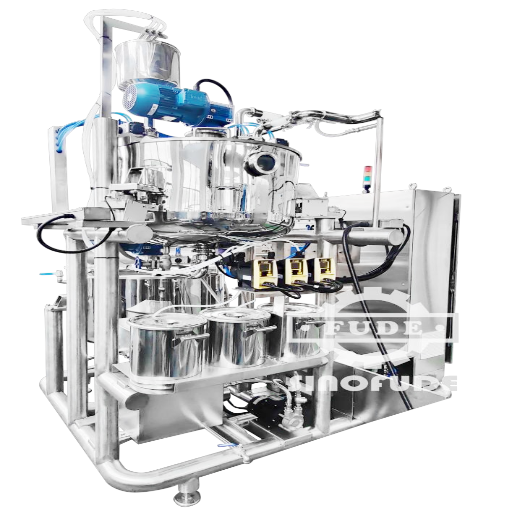
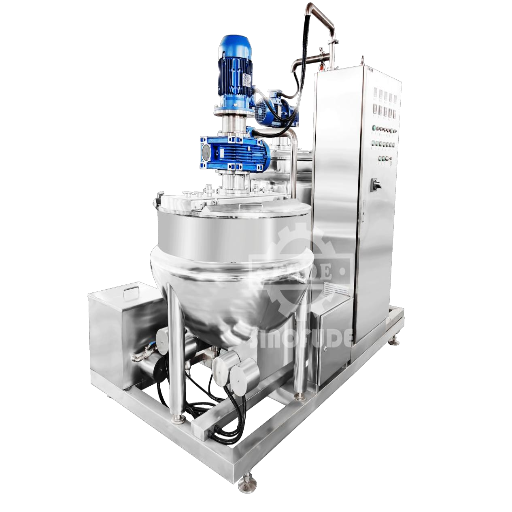
The jelly cooking system heats and mixes the candy mixture. We review the kettle, heating method, batch size, solids target and hold sequence against the buyer’s raw materials.
We map where flavorings and colorings enter and where acid meets the cooked mass. For a pectin product, timing after acid addition belongs in the recipe-transfer plan.7
The servo depositor transfers the mass into a candy mold. We review nozzle layout, cavity count, target weight, gummy shapes and single, two-color or centre-filled forming needs.
Depositing and cooling must be balanced with setting, demolding and coating. We treat the cooling tunnel as a process stage, not an accessory added after the production capacity is chosen.
Automation with named boundaries
Buyers comparing automatic gummy equipment need to know which actions the control system runs and which tasks still need an operator. We state the listed labor count by model and review ingredient loading, inspection, changeover and packaging work separately.
Product change review
We connect mold changes, recipe cleaning, color change and coating change to the schedule. The goal is not a vague high level of automation; it is a line sequence your plant can staff, clean and accept.
Packaging interface
The CLM scope ends at an agreed handoff. Candy packaging therefore needs the finished product condition, buffer plan and packaging equipment interface in the request for quotation.
Control and output questions behind the machine search
There are overlapping terms that buyers use like gummy candy production line, gummy production line, and gummy candy machine. The label does not define the limits of the engineering scope. Each gummy manufacturing project will need to connect the recipe state to each of the production process’s transfer points, the jelly candies’ accepted condition, and the output definition used by operations.
Decision check:
list the current jelly candies and the next two planned products. For each one, record formula family, piece weight, cavities, colors or fill, coating, accepted yield and campaign length. That simple portfolio view shows whether the real requirement is more rated output, faster product change, another mould set, more cooling residence or a different packaging handoff.
Control boundary
The PLC can coordinate an agreed automatic sequence, alarms and setpoints, but the automation level needs a task list. Ask who loads ingredients, confirms dissolution, changes moulds, inspects jelly candies, clears a stop, records rejects and transfers accepted pieces. Those answers turn “fully automatic” from a sales phrase into a reviewable operating plan.
Product boundary
For jelly candies, define appearance, weight, texture, release and any fill or coating check. Maintaining consistent output means holding the accepted formula and test conditions, not assuming the candy machine corrects every raw-material or room change. The trial record should show how the team samples jelly candies across nozzles, mould rows and time.
Business boundary
Growth in the candy market can justify a capacity study, but market demand is not a machine setting. Finance should model labor costs, accepted yield, scheduled hours, changeovers and packed inventory with its own data. The line review can then show which physical stage supports or limits that plan.
Gummy production will also change when the team adds new jelly candies to the range. A small piece can increase the pieces per minute while keeping the mass flow the same, while larger and center-filled pieces can change the behaviors of setting and depositing. The product mix should be included along with kg/h in the equipment brief. This is especially important when a business expects one candy production line to make several varieties of jelly candies across short campaigns.
Recipe Systems and Candy Formats
SINOFUDE’s project document lists pectin, gelatin, carrageenan, starch-free, and centre-filled line options. It also lists single-color, top-bottom two-color, left-right two-color, and centre-filled formats. Those are equipment and product-format capabilities; each commercial formula still needs its own process review.7
The Recipe-to-Utilities Handshake:
the working formula sets viscosity, temperature history, depositing window, set behavior and cleaning needs. Those conditions then shape the cooker, mixer, nozzle path, cooling duty, mould plan and available utility load.
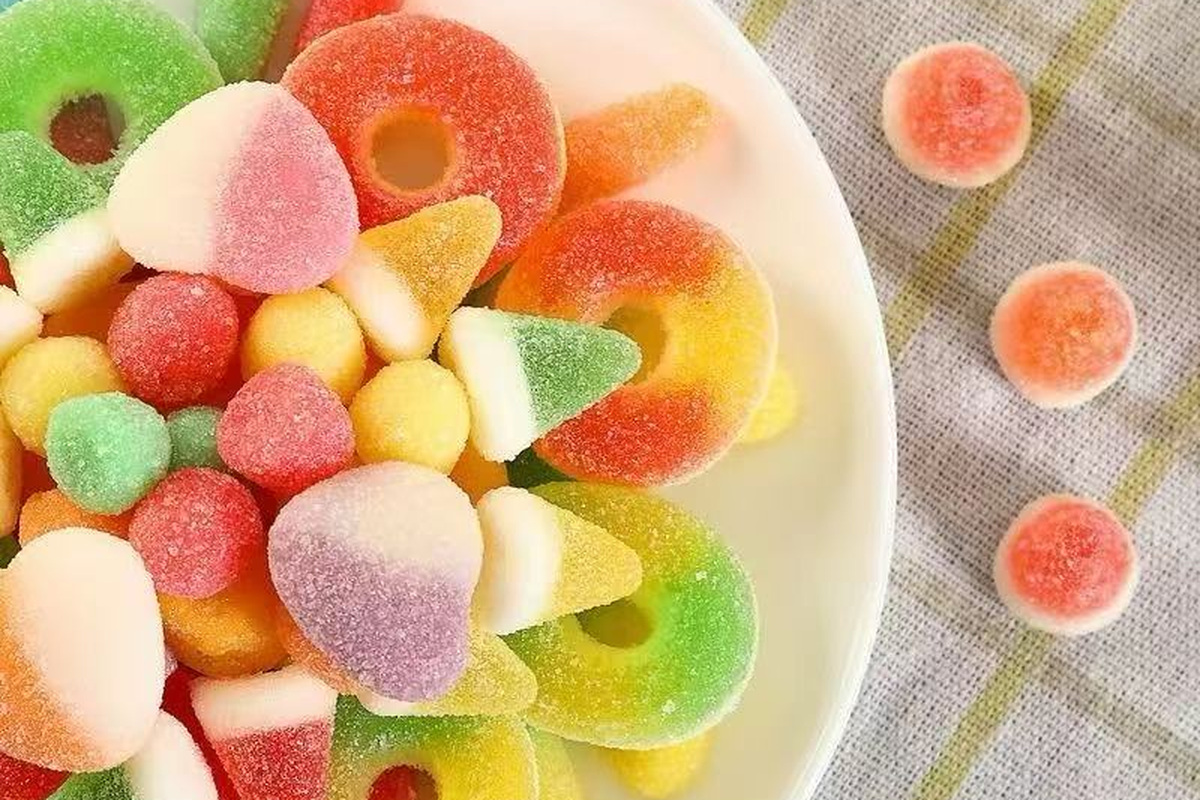
Pectin Formula Variables
provide the gelling system, sugar or alternative solids, target pH, acid type, acid concentration, addition point and expected time from acid addition to deposit.
Gelatin Formula Variables
specify the method of hydration and dissolution, hold conditions, target texture and temperature for flavors or functional ingredients.
Carrageenan Formula Variables
rather than naming carrageenan, specify grade, ion system, solids target, cooking and setting.
Starch-free Production Details
give details of mould material, release method, cooling, demoulding conditions and any subsequent conditioning.
Functional Gummy Integrations
name the active ingredient, addition temperature, method for uniformity of dose and other expectations of the quality team.
Single and two-color candy
Color orientation changes the depositing arrangement and mould presentation. A top-bottom product and a left-right product should not be grouped under “two color” without the target cross-section and sample.
Centre-filled gummies
Centre-filled products add fill rheology, shell thickness, concentricity and leakage checks. The option is not evidence of a leak-free commercial run; the factory acceptance test should state how pieces are cut, stored and inspected.
Shape and surface
Gummy bears, 3D jelly, flat pieces and other candy shapes change cavity layout and release behavior. Silicone or another mould route must be confirmed against temperature, geometry, release and cleaning needs.
When a recipe transfer fails, it is often due to a familiar bench instruction hiding a variable related to scale. “Mix until dissolved” does not communicate the required shear, time, temperature, or solids endpoint to the machine manufacturer. “Deposit before it sets” does not define the limits. We turn those phrases into variables to describe a working process before we design a line.
Depositing, Cooling, and Finishing Options
The line sequence in the client source covers cooking; color, flavor, and acid addition; servo depositing; cooling; demoulding; oil or sugar coating. SINOFUDE uses that sequence to expose the buyer risk at each production handoff, rather than describing every making machine as one closed black box.
01
Depositor and nozzle plan
The candy depositor must match the mass condition at the nozzle. We ask for target piece weight, cavity drawing, row count, shot sequence and acceptable variation, then place the measurement method in the trial plan.
02
Cooling and setting
The product must pass through a cooling tunnel under formula-specific conditions. Tunnel temperature is only one input; residence time, air behavior, mould load and the point at which the candy can demould also matter.8
03
Oil or sugar coating
The coating machine receives product after release. We review surface condition, carryover, coating addition, recirculation and the transfer to the next process instead of treating the coating label as a complete scope.
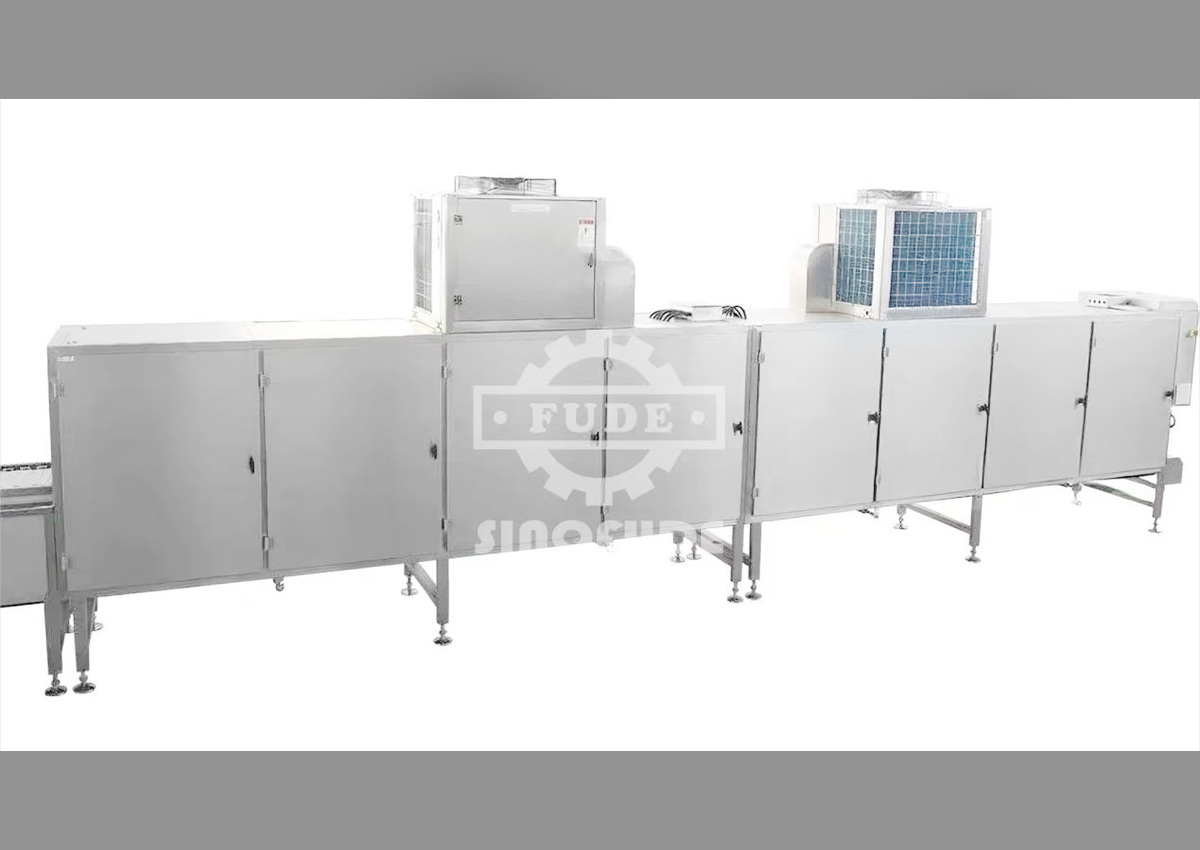
Cooling tunnel section.
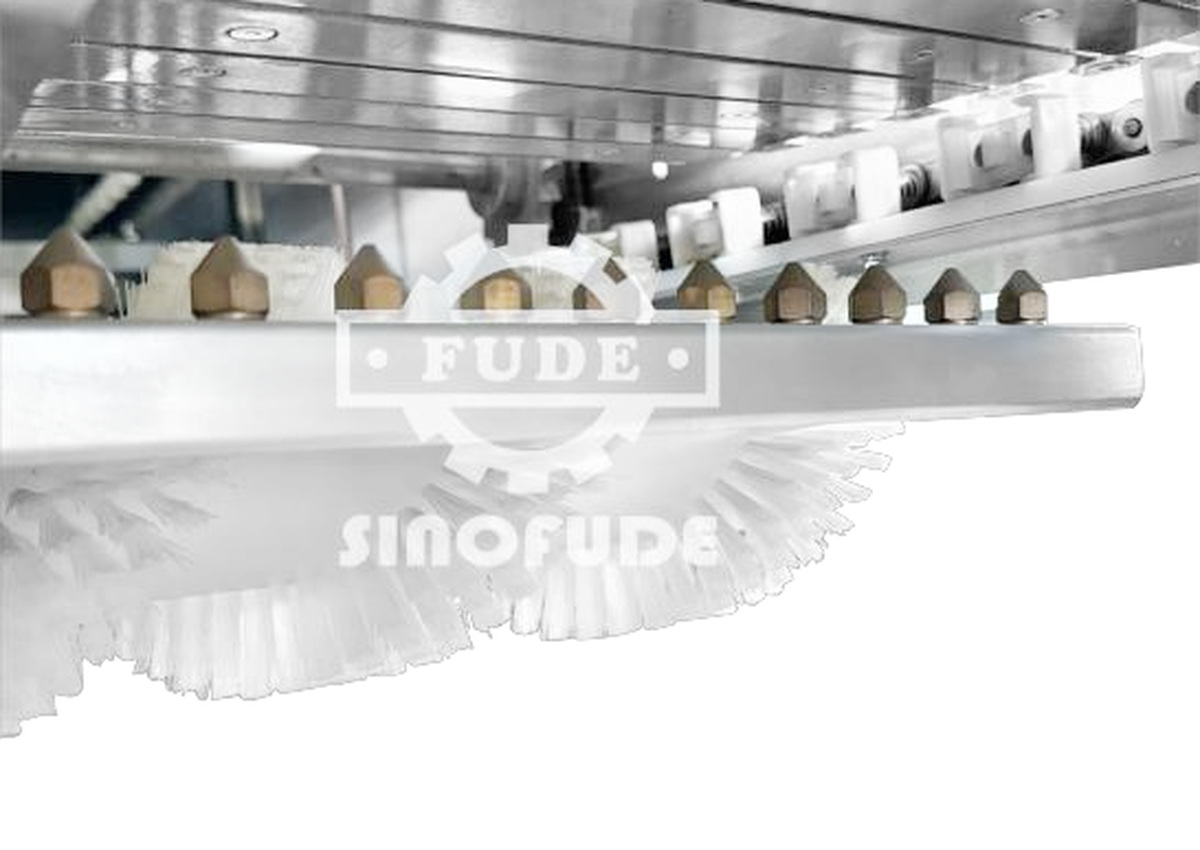
Demoulding section.
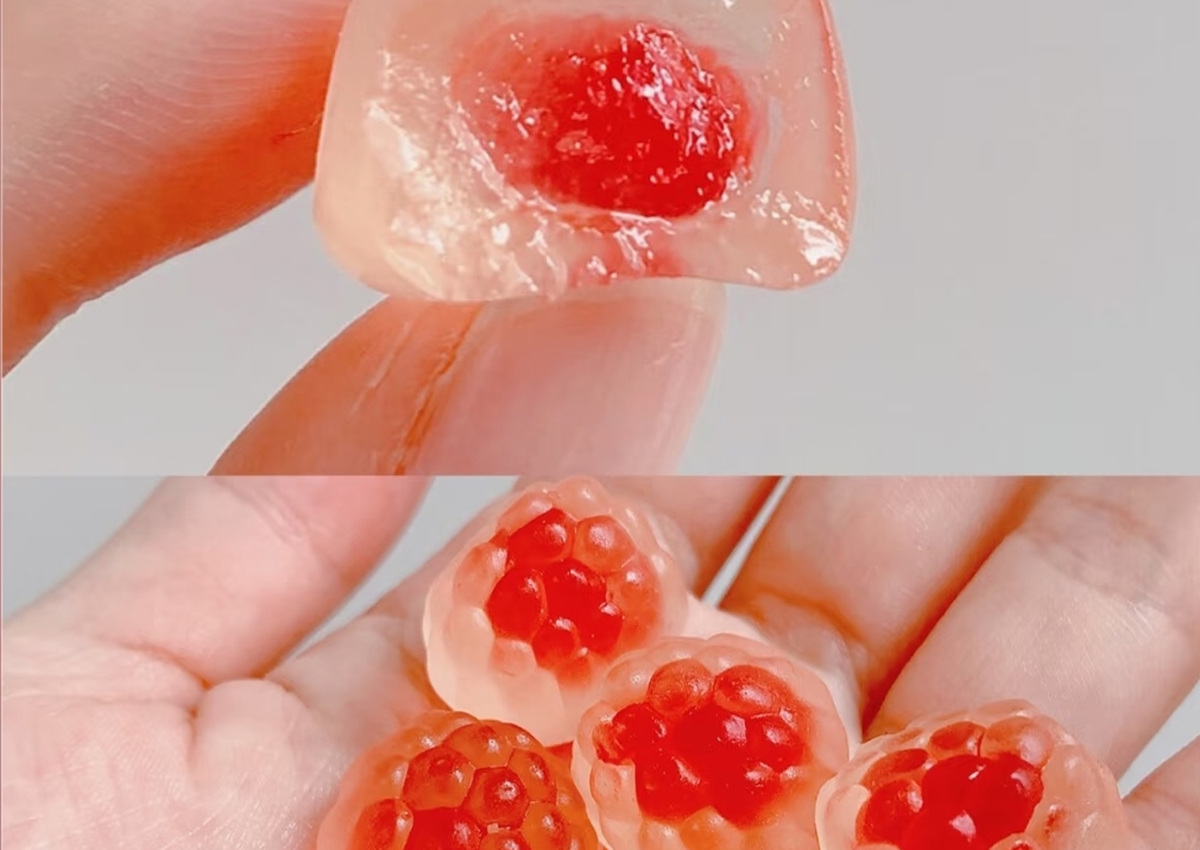
Centre-filled product example; formula acceptance remains project-specific.
TECH SPEC
The client process reference gives pectin cooking at 108–115 °C and a cooling-tunnel setting of 5–10 °C. We carry those values as starting windows from the supplied process description, then revalidate them with the actual jelly candy formula, piece weight, mould and acceptance plan. They are not universal setpoints for every gelatin or pectin product.
CLM40 to CLM600 Jelly Candy Line Specifications
The CLM family covers five models for different production needs. The table shows all client document values. “Up to” describes the rated line in the source document; the project acceptance record must define separately the formula, piece, speed, method of sampling, and good output.
| Model | Rated capacity | Moulds per stroke | Listed footprint | Installed power | Listed operators | Listed weight deviation |
|---|---|---|---|---|---|---|
| CLM40 | Up to 40 kg/h | 10 | 34 m² | 78 kW | 2 | ±0.1 g |
| CLM80 | Up to 80 kg/h | 20 | 40 m² | 100 kW | 4 | ±0.1 g |
| CLM150 | Up to 150 kg/h | 20 | 65 m² | 150 kW | 4 | ±0.1 g |
| CLM300 | Up to 300 kg/h | 40 | 121.5 m² | 300 kW | 4 | ±0.1 g |
| CLM600 | Up to 600 kg/h | 80 | 300 m² | 400 kW | 4 | ±0.1 g |
| Family span | 40–600 kg/h | 10–80 | 34–300 m² | 78–400 kW | 2–4 | - |
Trial condition required
Weight-deviation boundary: ±0.1 g is a table-listed value in the supplied document. It becomes a project acceptance criterion only after recipe, target piece weight, cavity, line speed, sample size, measuring instrument and treatment of start-up or changeover pieces are agreed.
Rated-to-Saleable Output Bridge
This worksheet separates four rates: rated mass flow; trial-demonstrated total output; accepted good output; and packed saleable output. Cooling and setting can be the hidden bottleneck in this situation because cleaning, coating, inspection, and candy packing all reduce the time available for saleable production in the buyer’s own case. SINOFUDE engineers use the separate fields to propose a trial; a smaller-capacity model may be the more prudent commercial choice when the recipe has a narrow depositing window or the plant runs frequent changes.
| Stage | Buyer input | Acceptance evidence | Hidden constraint to expose |
|---|---|---|---|
| Recipe preparation | Batch size, ingredient sequence, dissolution endpoint | Recorded formula and batch sheet | Undissolved solids or inconsistent feed condition |
| Cooking and hold | Solids, temperature, residence and discharge condition | Recorded batch profile | Heat-transfer change after scale-up |
| Acid and flavor addition | Addition point, concentration, mixing time | Timed process observation | Short pectin working window |
| Candy depositing | Piece weight, cavities, strokes, nozzle plan | Defined sample and weight record | Nozzle variation or pre-gelation |
| Cooling and setting | Mould load, air condition, residence, release point | Release and texture checks | Residence exceeds depositor cycle |
| Demoulding and coating | Release condition, coating recipe, transfer rate | Reject and surface record | Sticky pieces or transfer accumulation |
| Cleaning and changeover | Product sequence, allergen rule, inspection access | Agreed inspection record | Lost scheduled hours |
| Packaging handoff | Product temperature, buffer, packer demand | Packed good-output count | Downstream stop or product conditioning |
| Commercial period | Scheduled hours, utilization, yield and days | Buyer-owned planning model | Nameplate output mistaken for saleable output |
Screen the model family first.
Filter all five rows by rated output, listed footprint, installed power and operator limit.
Jelly Candy Line Pricing and Project Schedule
Candy making machine pricing is closely related to the agreed scope. SINOFUDE invites the buyer to define the risk for each open interface. We will not make a price band or a fixed production schedule if we do not have the formula, model, modules, mold set, utilities, interfaces, and the acceptance work that form the quote.
Equipment boundary
State the CLM model, cooking system, mixer or dosing modules, depositor arrangement, cooling tunnel, demoulding, coating, transfer and packaging interface. Separate included equipment from buyer-supplied systems.
Project work
List drawing review, mould work, formula trial, factory acceptance test, shipment boundary, installation support, training, commissioning and site acceptance. Each item needs an owner and an acceptance record.
Handover package
We provide an operation manual, maintenance guide, and electrical schematics. The quotation should state the language, revision point and delivery stage for the agreed documentation.
Search term versus buying scope:
a listing called a small jelly candy making machine can omit the cooking, cooling, demoulding or coating work that your plant expects. A commercial gummy making machine can bundle those stages but leave moulds, utilities or packaging outside the offer. A gummy depositor machine can refer only to the forming section. Normalize the physical modules and project work before comparing any headline price.
Schedule review follows the same logic. Dates make sense only after scope approval, buyer inputs, mold information, formulation availability, drawing review, manufacturing, and the logistics of the trial. If one of the preceding is not complete, it should not be hidden in a single lead-time number. It is an open dependency.
Purchasing can address this concretely with a line by line scope. Each module should have a status of included, excluded, or buyer-supplied; an interface should be defined at both ends; and the drawing and test that define the item should be included. This exposes disparities that a single total price cannot show without assuming that the longest manufacturing list is correct.
Model your own output and commercial assumptions.
Use rated output, utilization, accepted yield, scheduled time and changeover time without treating the result as a supplier promise.
Factory Acceptance Testing and Documentation
When considering your factory acceptance test, ask whether the agreed line, running the agreed test material under the recorded conditions, met the agreed acceptance criteria. It should not convert an unrecorded, unapproved demonstration into a broad claim about every gummy candy formula.
Protocol field
What to record before the test
What the record prevents
Formula identity
Ingredients, lot references, target solids and pH
A different test mass being treated as the commercial recipe
Product definition
Shape, target weight, colors, fill and coating
Acceptance of an easier piece than the intended product
Utilities
Power and process-utility conditions at the test point
A result that cannot be compared with the buyer site
Line state
Warm-up, steady run, stoppage and restart rules
Start-up pieces being mixed with steady output
Run plan
Speed, duration, moulds and sample intervals
A short peak being reported as sustained production
Measurement
Instrument, sample size, locations and calculation
Weight or output figures with no repeatable method
Good output
Accept/reject definitions for appearance, release and fill
Total discharged mass being called saleable product
Cleaning review
Access points, sequence and post-clean inspection
A cleanability question being replaced by a visual claim
Open items
Owner, evidence required and closure date
Unresolved points disappearing after the test
US plant review
Title 21, section 117.40 of the Code of Federal Regulations discusses equipment cleanability, installation that permits cleaning of equipment and adjacent spaces, food-contact surfaces, seams and instruments. Section 117.80 addresses process controls, contamination and allergen cross-contact.
These references help a buyer build an inspection list; they do not certify this line or replace a site-specific regulatory review.12
Evidence for pectin and centre fill
For pectin, record the interval from acid addition to depositing, the mass condition at the nozzle, and the interruption and clean-out rules. For centre fill, define shell thickness, leakage check, fill ratio, concentricity, and time after coating and storage when pieces are checked.
Quality and food safety teams
Quality and food safety teams should describe the product sequence, allergen changeover rule, inspection access, and evidence the team needs to review before releasing the product. Unless the scope states so, “easy to clean” and “food-grade equipment” are labels. They are not acceptance methods.
SINOFUDE Factory and Equipment Evidence
SINOFUDE was founded in 1998. The company information supplied for this project states three factories, more than 30 acres in total and more than 200 employees. The source package also contains 14 client-supplied photographs covering the factory, cooking, forming, cooling, demoulding, coating and finished candy.
We use these facts as company proof for this page. The photos show pieces of equipment and products from a supplied library. These are not examples of a customer case study, a test result, or a certification.1
Ask for an evidence-based line review
Turn the evidence into a project brief.
Use the non-contact scorecard to identify missing formula, utility, layout and acceptance inputs before opening a sales conversation.
Check the brief without contacting sales
Factory photograph from the client-supplied project library.
Production machinery connects the line sequence to physical equipment.
Factory imagery identifies the supplied manufacturing environment without making an unverified output claim.
Product images show possible candy formats, and recipe acceptance is project-specific.
Suitable Applications and Configuration Boundaries
The CLM line is a good choice when someone is looking for deposited jelly or gummy candies, and can define the recipe, product geometry, capacity, and the way to accept the product. SINOFUDE considers the wrong choice of equipment family a project risk. The CLM line is not a complete solution for all sweet or confectionery products.
01
Good fit to review
- Pectin, gelatin or carrageenan deposited products
- Starch-free moulding routes
- Single-color, top-bottom or left-right two-color pieces
- Centre-filled products with a trial plan6
- Oil- or sugar-coated finished product
02
Needs another equipment family
Hard candy or lollipop projects have a different forming and process brief. Starch mogul or mogul line projects also follow a different moulding route. Do not force those production requirements into a deposited starch-free jelly line comparison.
03
Not ready for model selection
Pause the model decision if the formula is unknown, saleable output is being copied from nameplate capacity, the plant has no utility or layout record, or the acceptance method is still “looks good.” Close those inputs first.
Contrarian selection check
the common assumption that nameplate output equals saleable output is not always valid. The smallest listed footprint is not necessarily the smallest site project, and the cheapest line is not always the best documented scope. Rated output is not a substitute for accepted output, and equipment families are not interchangeable. Some requests sit beyond our scope for this equipment family; a dedicated hard-candy line is where to look instead. Put each trade-off in the buyer record before model approval.
Having limited space does not mean you need the smallest machine. A small equipment footprint can leave too little room for ingredient staging, product conditioning, or packaging. The plant decision should consider the entire material and operator flow and service paths, not just the production equipment rectangle.
Jelly Candy Line Project Planning & Evaluation Tools
01
CLM Model Constraint Selector
Enter your required rated mass flow and plant limits. The selector returns the smallest listed CLM model that meets every entered constraint. It is a screening aid, not a production guarantee: recipe, piece weight, cooling, conditioning, rejects, cleaning and packaging still need a trial-based review.
Launch Selector02
Rated-to-Saleable Output Scenario
Translate a rated line number into a planning scenario using your own utilization, accepted yield, schedule and changeover assumptions. This calculation does not predict SINOFUDE performance. It makes the assumptions visible so operations, finance and procurement can discuss the same boundary.
Calculate Scenario03
RFQ Readiness Scorecard
Systematically evaluate your project requirements, site specifications, and compliance standards. This scorecard is an essential preparatory tool that aligns internal engineering and commercial teams, ensuring seamless procurement and accurate quoting for your advanced Jelly Candy Line.
Start AssessmentJelly Candy Production Line FAQs
Which CLM model fits our required production capacity?
Start with the required rated mass flow, then filter the five rows by plant power, table-listed footprint and operator limit. CLM40, CLM80, CLM150, CLM300 and CLM600 are listed at up to 40, 80, 150, 300 and 600 kg/h. Finish the choice with formula trials, cooling and setting load, changeover time, accepted yield and packaging demand; otherwise a larger number can hide the real bottleneck.
Why did our pectin batch turn cold and sticky when we scaled it up?
Scale changes can alter heating, dissolution, mixing, transfer time and the interval between acid addition and deposit. Pectin has a formula-dependent working window, so the larger batch should be reviewed with actual temperatures, solids, pH, acid concentration, addition sequence and nozzle residence. The question should lead to a controlled recipe-transfer trial, not an assumed machine fault or a universal recipe correction.7
Why do some depositor nozzles fill heavier than others?
Possible investigation points include mass condition at the manifold, nozzle temperature, pre-gelation, air, blockage, cavity presentation and the measurement plan itself. Record which nozzles, mould rows and time intervals are sampled. The listed ±0.1 g value should only become an acceptance target under a defined recipe, piece weight, line speed, sample and instrument protocol.
Can one jelly candy machine run pectin, gelatin and carrageenan recipes?
The client source lists all three recipe families, but that does not mean one unchanged process runs every formula. Compare cooking and holding, ingredient addition, temperature control, depositing window, cooling, setting, cleaning and change parts. The line option becomes a usable recipe route after the buyer formula and test plan are reviewed.
Can the line make single-color, two-color and centre-filled gummies?
The supplied scope lists single-color, top-bottom two-color, left-right two-color and centre-filled formats. Two-color orientation changes the depositing arrangement. Centre fill adds shell and fill behavior, concentricity, shell thickness and leakage checks after setting, coating and storage. Send a target cross-section, piece weight and product sample or drawing with the request.
Is rated kg/h the same as packed gummy output?
This page defines them as separate planning fields. Rated mass flow is the source-table equipment figure, while the calculator derives a packed-output scenario only from the buyer’s utilization, accepted yield, schedule and changeover entries. Use the result to make assumptions visible, then turn the important ones into factory and site acceptance measurements.
How much plant space should we reserve?
The client table lists equipment footprints from 34 to 300 m² across the five models. Add service and maintenance clearance, ingredient preparation, operator movement, quality checks, cleaning access, conditioning, buffer space and candy packaging. Confirm doorways, floor loading and utility routes on the buyer layout before freezing the line position.
What information changes the jelly candy making machine price?
Price follows scope: model, recipe system, cooker and dosing needs, depositor format, mould sets, cooling, demoulding, coating, control and data needs, inspection or transfer interfaces, documentation, trial work, installation support, training and commissioning. Compare quotations only after every supplier marks inclusions, exclusions and buyer-supplied items against the same brief.
What should a factory acceptance test measure?
Define the formula and lot, product, utilities, line state, test speed and duration, sample intervals, instrument, weight method, output method, reject rules, cleaning review and open-item closure. Sustained and recorded trials are more useful than a short display run. Keep total output, accepted good output and packed output as separate fields.
How should we plan cleaning and allergen changeover?
Map the product sequence and identify contact points, hold-up areas, removable parts, access points and inspection steps. State who supplies the cleaning method and how release is recorded. The US regulatory references in this page describe cleanability and cross-contact control as plant responsibilities to address; they do not provide a machine-specific approval.
What documents are included with a SINOFUDE line?
We provide an operation manual, maintenance guide, and electrical schematics. Put language, revision timing and any project-specific drawing list in the quotation so the handover package is measurable. Training, commissioning, spare parts and any additional records should also be listed as scope items rather than assumed from the word “documentation.”
How do we compare SINOFUDE with another gummy machine supplier?
Use one controlled scorecard. Compare formula evidence, product formats, rated and accepted output definitions, mould plan, utilities, footprint boundary, cleaning access, controls, interfaces, acceptance protocol, documentation and commercial inclusions. Reject empty labels such as high-quality, fully automated, easy operation, efficient production, consistent quality or consistent product quality unless the supplier connects each label to a function, boundary and test record.
Is this the same as a gummy bear candy, soft candy or jelly candy making machine?
Those search labels can point to overlapping deposited confectionery equipment. The decisive facts are the gelling system, product geometry, moulding route and process sequence. Gummy bear or soft candy projects that use deposited pectin or gelatin can enter this review. Starch gummy products made on a starch mogul, or hard-candy forming projects, need a different production-line boundary.
Can we use this line for collagen or other functional gummy candies?
Functional ingredients add product and process questions. Supply the ingredient form, addition point, temperature exposure, target dose, sample method and stability requirement. The production line can then be assessed against those inputs. The word “functional” alone does not establish active retention, dose uniformity, taste and texture or shelf-life performance.



