Get in Touch with SINOFUDE Company



A gummy depositor is the machine that meters, deposits, and shapes liquid gel mass into individual gummy pieces, using a heated hopper, a nozzle-and-pump assembly, and either a starch tray or a solid mold to set the final shape. It offers greater insight into the production line than its price tag suggests. In the first 50 words of a search for the term “gummy depositor,” most buyers tend to ask one of three questions: what does the machine do, which of the types would be applicable to my batch size, and what do you think would fail first. This guide aims to answer those questions as well as the one question equipment catalogs tend to avoid addressing head-on: the gel chemistry you use will typically determine whether or not the depositing line functions as designed, irrespective of the automation tier purchased.
What a Gummy Depositor Actually Does: Hopper, Nozzles, and Molds
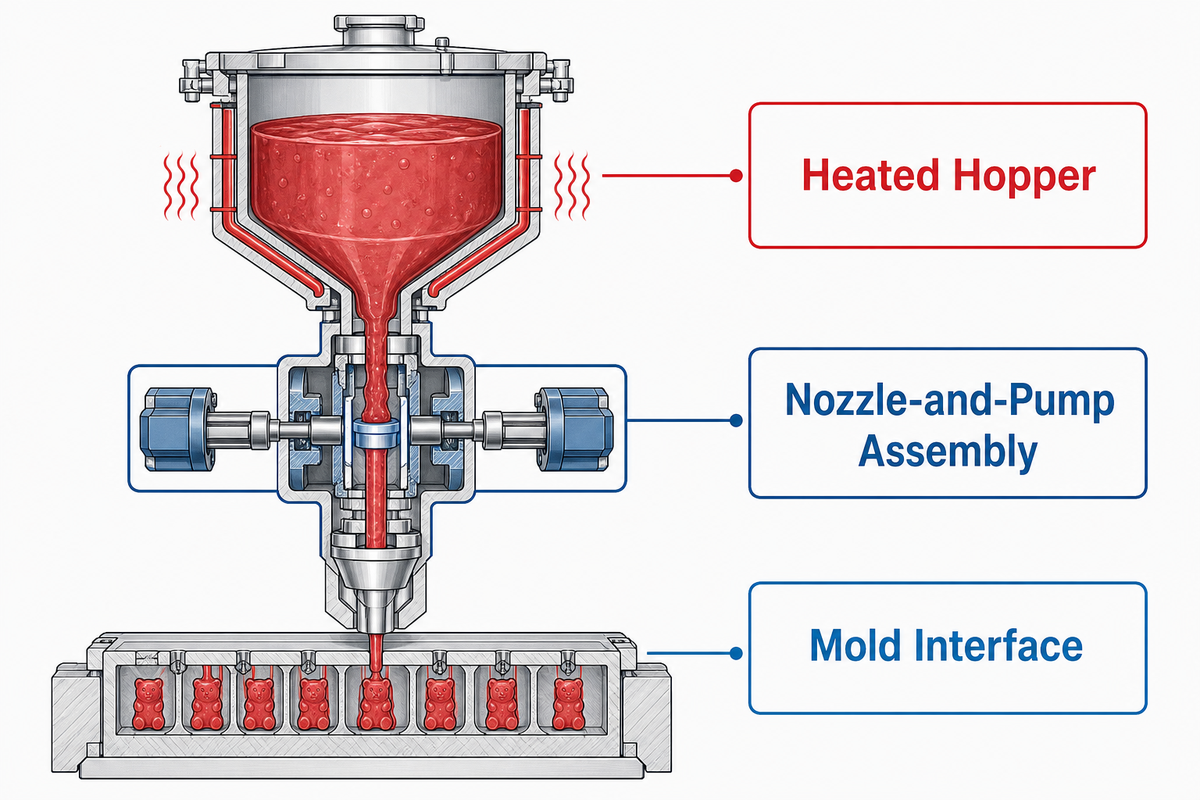
A gummy depositor is a food-grade machine built from three connected subsystems: a heated hopper that holds the gel mixture at the right temperature, a nozzle-and-pump assembly that dispenses the exact dose, and a mold interface (mould in British English) that fills each cavity without spilling into its neighbor. It is also called a candy depositor when the same platform runs hard candy or other confectionery alongside standard fruit-gum recipes.
All of that design work exists for one reason: keeping the dispensed dose accurate while the gel is still liquid enough to pour and thick enough not to drip.
The hopper is usually constructed with heated panels in stainless steel as most gummy mixtures, whether pectin- or gelatin-based, must remain above their gelling temperature until the moment of deposit. Below the hopper, the pump stage is different for each machine class; a fixed volume of liquid is forced through adjustable nozzles by mechanical pistons, servo motors, or rotary wheels. This piston-and-nozzle logic traces back to an early confectionery-depositing patent, which described simultaneous operation of the pistons controlling flow from the nozzles so every mold cavity fills at the same time — still the basic mechanism modern multi-nozzle depositors scale up. Above the pump, the hopper itself is usually a funnel-shaped reservoir feeding a short conveyor or auger into the pump inlet. The nozzle count and arrangement is matched to the mold cavity and is expressed in pieces per minute, as opposed to a single, flat output. Almost always, molds are silicone molds or polycarbonate molds because both of these materials are able to withstand repeated thermal cycling and, once set, release the finished gummies cleanly. A food-contact surface made of stainless steel houses the pump and the hopper, whereas the mold remains non-metallic to avoid rust and to flex on release.
Precision at this phase compounds. Even a slight overfilling at a single nozzle on a multi-cavity mold will change the weight of finished pieces, which in turn will change the number of pieces in a batch. This affects cost per unit and is why prospective buyers of a depositor should request the nozzle to nozzle fill-weight tolerance from a supplier, as opposed to just the output per hour figure.
💡 Pro Tip
In this case, one should ask the supplier for fill-weight tolerance across the entire nozzle bank rather than the average. The use of a wide fill weight across the nozzles is not visible in average fill weight, but is seen in the weight consistency of the finished product.
Manual, Semi-Automatic, and Full Industrial Depositors Compared
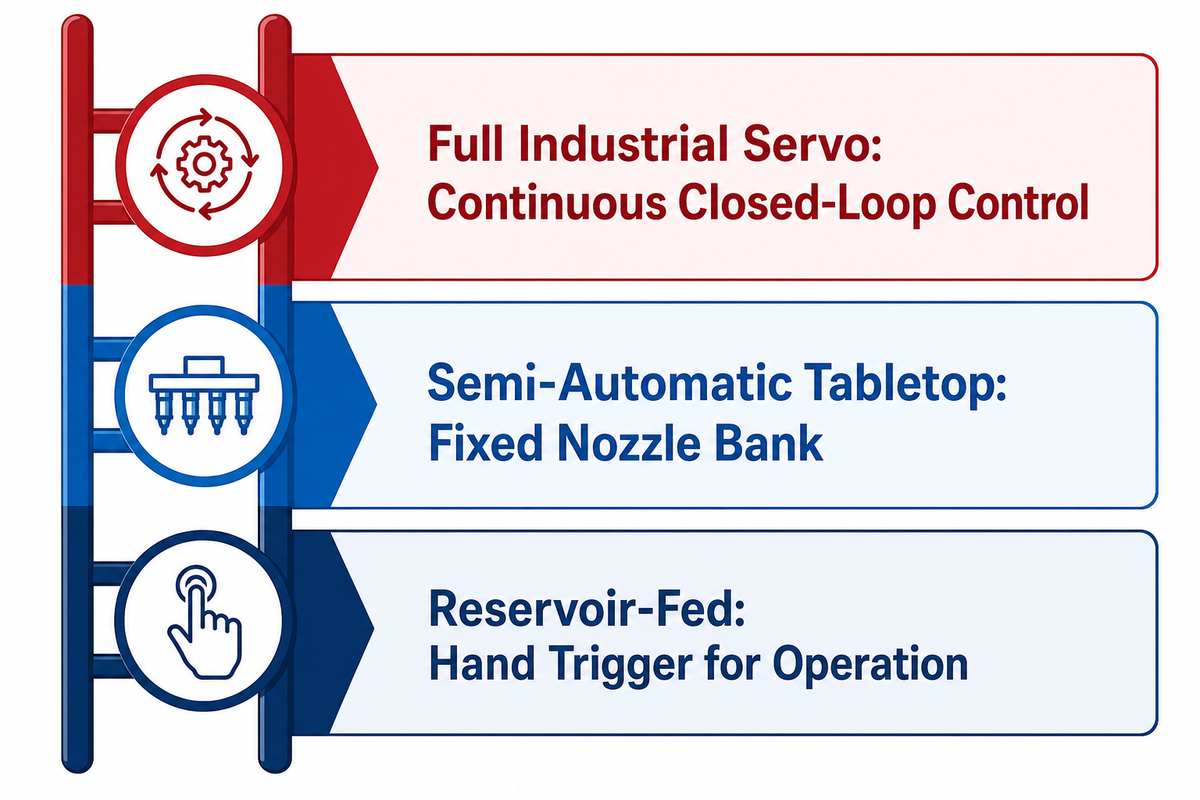
All types of depositor equipment are differentiated by how much of the fill-and-index cycle a human completes. There’s equipment for larger, commercial operations, and equipment for smaller, hobbyist operations. Reservoir-fed units marketed to hobbyists have a hand trigger for operation and are the least expensive, easiest to use. However, operators must trigger the unit, move, and position it for each mold, and compressed-air and utility consumption become significant once a line moves up to servo or pneumatic actuation. Semi-automatic tabletop machine units fix the nozzle bank and index the mold. Operator involvement is reduced to loading and unloading and monitoring the user interface for cycle counts and faults. Full industrial servo systems provide continuous closed-loop temperature control and multi-nozzle synchronized dosing and are the only systems built to run unattended for extended periods of time.
The limiting factor isn’t how much you’re willing to spend, but how many pieces can be produced per hour or how many shifts are needed. A tabletop machine used with one operator is far inferior to a single industrial line when used without attendants. Buyers who focus on undersize automation often realize the gap too late as they’ve dedicated operation space and staff for the smaller unit. SINOFUDE’s full depositor model lineup spans this same range, from tabletop units to full servo lines. Chocolate and hard candies fill on the same platform as gummy depositing. Many industrial lines switch fill types with a hopper and nozzle change, so no separate machine is needed for each candy category. That platform flexibility builds on the same continuous co-deposition principle described in a patent covering liquid center-filled confection production, where a single mold-indexing line is engineered to run multiple fill configurations without a separate machine per product type.
| Class / Model | Automation Tier | Output per Cycle | Installed Power | Typical Fit |
|---|---|---|---|---|
| Manual / handheld | Manual | 1 mold per hand trigger | None (hand-operated) | Hobbyist, recipe development, sub-1,000-piece batches |
| Semi-automatic tabletop | Semi-Automatic | Fixed nozzle bank, indexed mold | Low (single-phase) | Small commercial runs, single-shift operation |
| CLM40 | Full Industrial Servo | 20 moulds per stroke | 78 kW | Entry-level industrial line, 2 operators |
| CLM80 | Full Industrial Servo | 20 moulds per stroke | 100 kW | Growing-volume industrial line, 4 operators |
| CLM150 | Full Industrial Servo | 20 moulds per stroke | 150 kW | Mid-volume industrial line, 4 operators |
| CLM300 | Full Industrial Servo | 40 moulds per stroke | 300 kW | High-volume industrial line, 4 operators |
| CLM600 | Full Industrial Servo | 80 moulds per stroke | 400 kW | Maximum-volume industrial line, 4 operators |
| Starch mogul line | Full Industrial (Starch) | Board-dependent, batch cycle | Varies with tray/board count | Traditional high-volume standard shapes |
| Starchless servo (generic) | Full Industrial Servo | Model-dependent | Varies by model | Faster changeover, cleaner production, functional gummies |
CLM40-CLM600 figures are SINOFUDE’s own published model specifications (five models, moulds per stroke and installed power as listed on the manufacturer’s product page).
The Two-Chemistry Rule: Pectin vs Gelatin Depositing
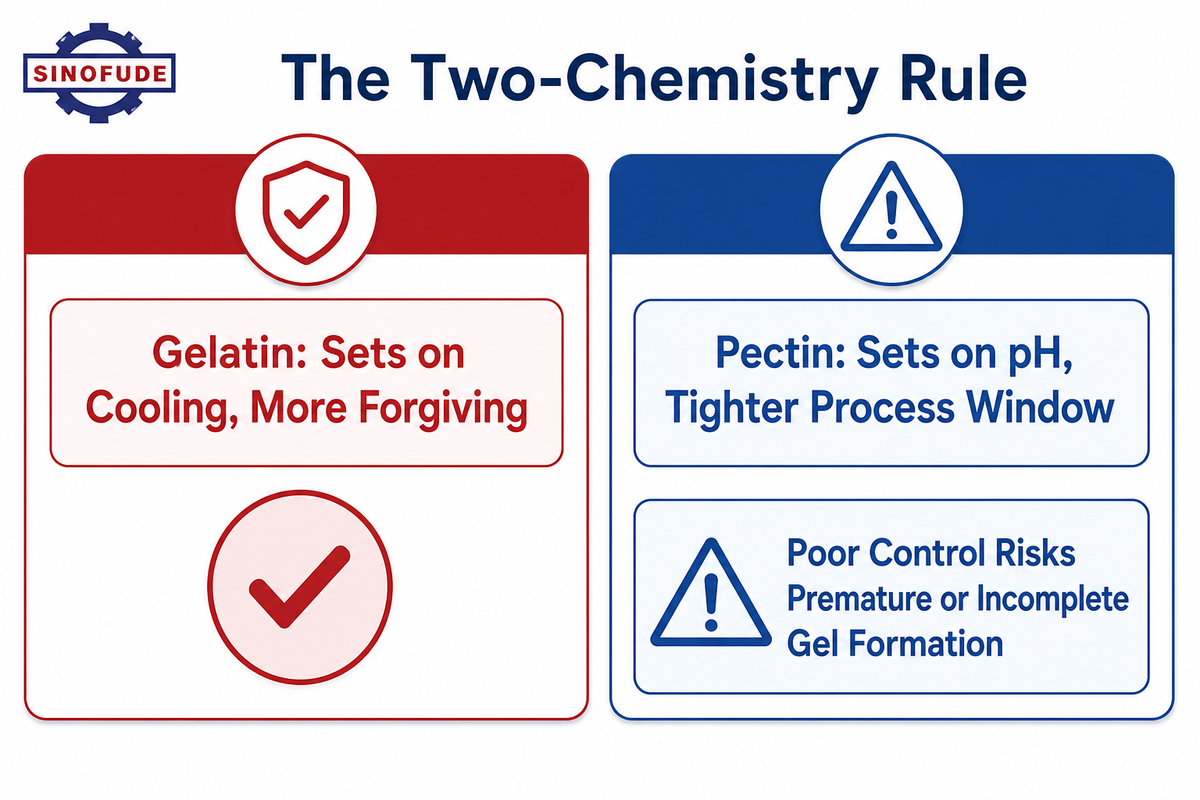
Gel chemistry, not automation tier, determines the operating window your depositor actually runs inside. Pectin sets on pH rather than on cooling, and poor temperature and pH control on a pectin line risks premature setting in the lines and hopper, or an incomplete gel that never firms in the mold. Gelatin will set when the mixture cools and is more forgiving in the process, taking longer, however, to reach a firm starchless mold compared to pectin.
This is the single biggest practical decision a buyer glosses over. Pectin’s rapid set after depositing is an advantage only when the line is well-tuned; on a poorly optimized system, that same speed causes blockages or inconsistent fill because material starts gelling before every nozzle has finished dosing. Baker Perkins provides a direct process guide for gummy and jelly depositing lines and cites this as the reason gelatin and pectin recipes are adjusted to different cycle speeds on the same machinery and aren’t the same.
“Pectin sets on pH rather than cooling, and the process window is much more restricted than for gelatin. Poor control can cause premature setting or incomplete gel formation.”
Buyers running a mixed pectin-and-gelatin product line need a depositor whose cycle timing and hopper temperature set-point can be reprogrammed recipe to recipe, not a machine calibrated once for a single chemistry and left alone. Ask a supplier how quickly the line’s cycle timing and hopper set-point can switch between a pectin batch and a gelatin batch; the answer says more about real-world flexibility than any single throughput number.
Starch Mogul vs Starchless (Servo) Depositing: What Actually Changes
A traditional starch mogul line deposits gummy masses into cavities by using starch that’s stamped into a bed of dry, granular starch rather than squeezing into a fixed mold. Starch plays a role in mass cooling and moisture absorption and aids in solidification of the gummy before the molded starch pieces and print board are separated from the mold starch. In a starchless (servo) route, which omits starch from the process, the cooling and moisture work is shifted from the deposited mass to the depositor’s cooling tunnel and the gelling behavior of the recipe.
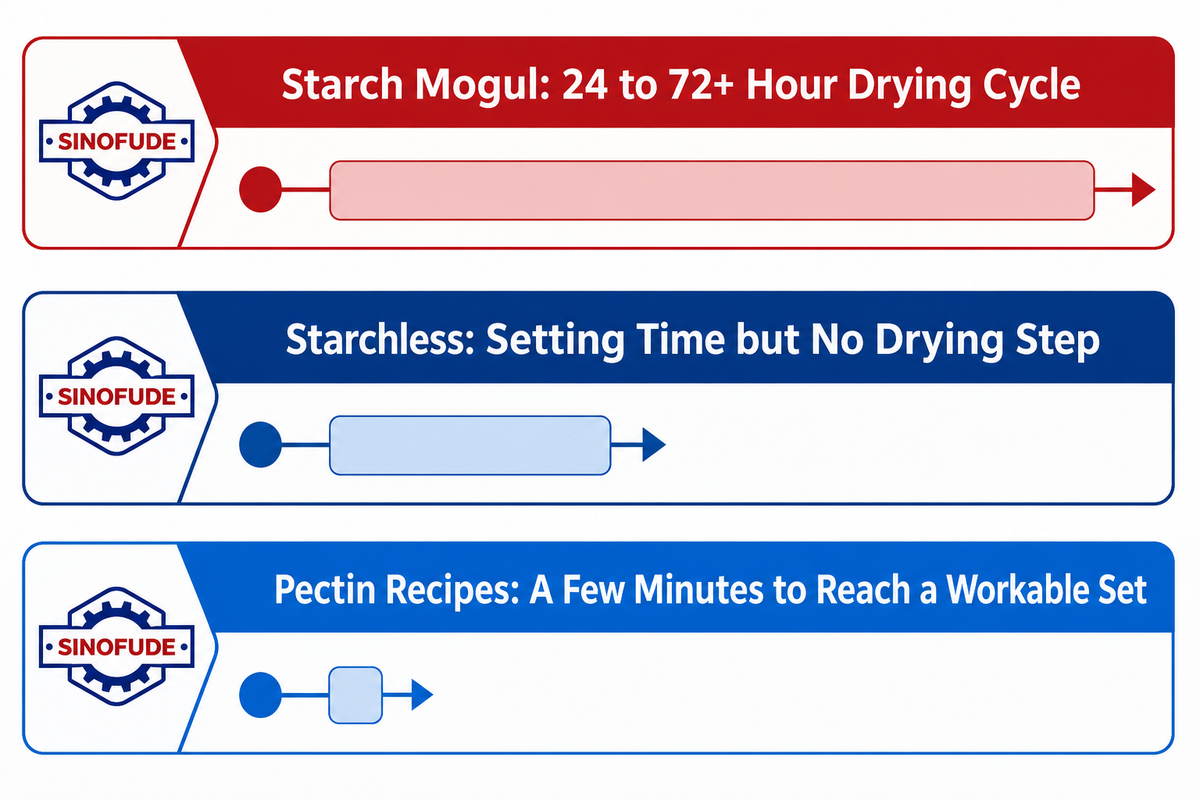
The clearest operational distinction is time. Published confectionery process research describes starch-molded drying periods of 24 to 72 hours or longer before the batch is ready for the next stage. By comparison, a completely starch-free line needs setting time but no drying step at all. One manufacturer’s own launch report put pectin recipes at a few minutes and gelatin recipes at up to four hours to reach a workable set. There are many benefits to using a completely starch-free line, however, the time saved from having to wait to use the next portion of the line is the greatest. The floor space and work in process (WIP) inventory is tied up for days with a complete starch-based line, while a starch-free line uses the space for no more than a few hours.
⚠️ Important
Dry starch handling is not a straightforward choice for the mogul route. United States facilities dealing with dry starch conform to an OSHA 8-hour permissible exposure limit (an 8 hour time-weighted average) of 15 mg/m³ total dust and 5 mg/m³ for the respirable fraction, and NIOSH classifies dispersed starch dust as a dust capable of forming an explosive mixture with air and achieving a minimum explosive concentration of 50 g/m³. These numbers are buyer facility planning numbers, not confirmation that any mogul installation is compliant or explosion-proof. These numbers should be evaluated by the facility engineer prior to committing to the starch route.
The committed floor space to a drying cycle of several days and the compressed air and dust control systems of a mogul starch room are some of the main reasons most gummy and jelly lines built in the last decade use depositing starchless unless there’s a specific need for the desired texture of mogul set pieces. Buyers who still need the mogul route for texture reasons can review SINOFUDE’s starch mogul line specifications, which cover the tray cycle and starch conditioning window in more detail than fits in this comparison.
Hygienic Design Basics Buyers Should Ask About

US food-contact equipment must meet cleanability and contamination-control requirements that apply to a gummy depositor the same way they apply to any other food-manufacturing machine. As per 21 CFR 117.40, equipment design, construction, and use must enable adequate cleanability and protection against allergen cross-contact, while avoiding adulteration of food with lubricants, fuels, metal, and/or other contaminants during filling and equipment operation. Seams on food-contact surfaces of hoppers, pump housings, or any other equipment must be bonded and/or designed to minimize build-up of food and organic matter; the surfaces must be easily cleanable between food recipes to ensure no trace of lubricant or hydraulic oil contamination reaches the food. Temperature, pH, acidity, and water activity measuring instruments must be accurate and precise, and sufficient in number for their intended use.
“(a)(1) All plant equipment and utensils used in manufacturing, processing, packing, or holding food must be so designed and of such material and workmanship as to be adequately cleanable, and must be adequately maintained to protect against allergen cross-contact and contamination… (b) Seams on food-contact surfaces must be smoothly bonded or maintained so as to minimize accumulation of food particles, dirt, and organic matter…”
Nothing a supplier includes with a certification is a design-and-buyer-validation standard. The equipment either supports the standard or it doesn’t. One question you can ask any suitable depositor manufacturer: which food-contact surfaces are precision-machined, corrosion-resistant stainless; how are seams finished; and what’s the documented cleaning-in-place or manual teardown procedure for the hopper and nozzle bank between recipe changes? A line that is genuinely easy to clean should flush hoppers, manifolds, and nozzles with hot water and sanitizer in minutes rather than hours, and that cleaning efficiency compounds across every recipe change over the machine’s service life. Any reputable machine maker should be able to walk you through that teardown step by step, not just point to a spec sheet.
Depositing Vitamin and Supplement Gummies: What Part 111 Does and Doesn’t Cover
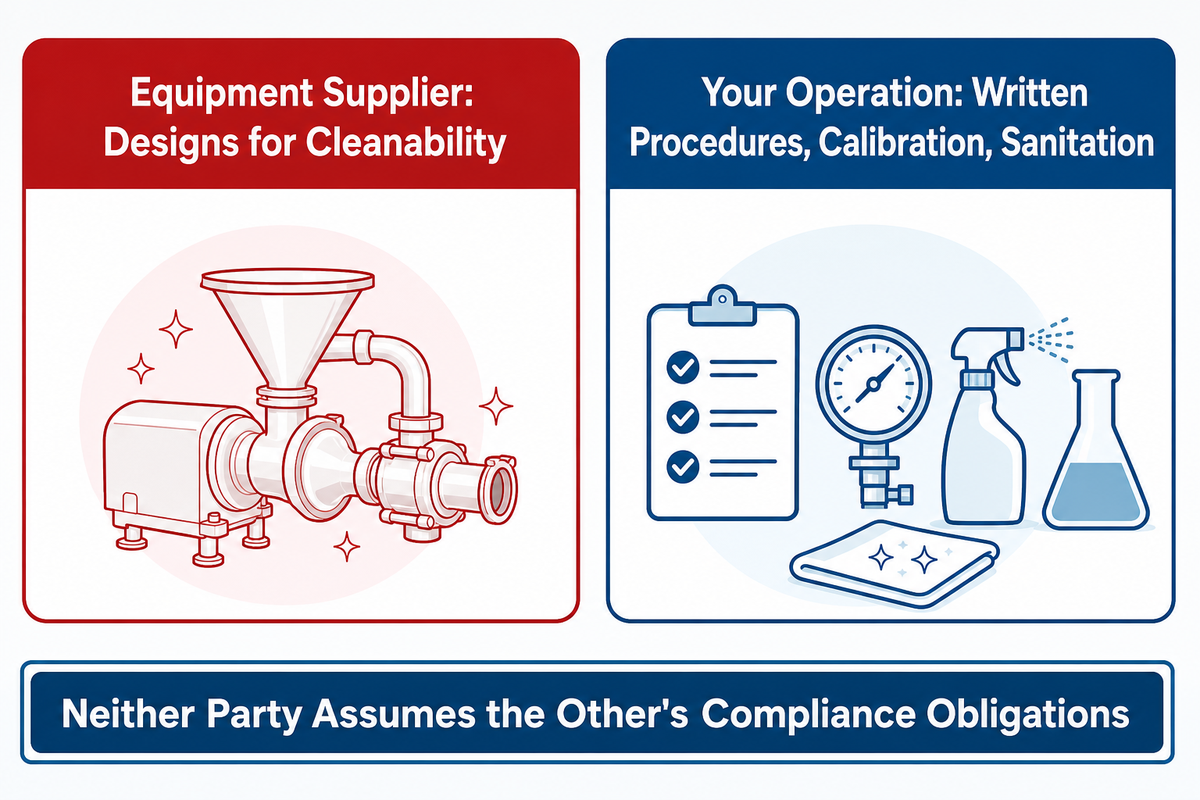
Another federal framework applies, in addition to the general food-equipment regulations, if your gummy line produces vitamins or supplements gummies instead of confectionery: 21 CFR Part 111, the dietary-supplement current good manufacturing practice regulation. Equipment design under Part 111 Subpart D sets requirements for suitability, design, and maintenance that make cleaning of the equipment easier. While these requirements can help a buyer evaluate a machine, they don’t mean that the equipment meets all the requirements of Part 111.
The design checklist is less important than the division of responsibility. Part 111 Subpart D also assigns ongoing duties, written procedures, calibration, inspection, sanitation, quality-control review, automated-system controls, and recordkeeping, to the operation running the equipment, not to the equipment supplier. Subpart E goes further and requires the manufacturer to put in place and verify control of component specifications, in-process, packaging, label, and finished product. Suppliers can build design features and provide documentation support, but buying a depositor that looks compliant doesn’t ensure that your finished supplement gummies satisfy Part 111. SINOFUDE’s nutraceutical gummy line equipment is built around active-ingredient dosing accuracy and the documentation a quality team needs for exactly this division of responsibility.
Who owns what, in plain terms:
- Equipment supplier: designs for cleanability, suitable materials, and documentation to support your validation
- Your manufacturing operation: written procedures, calibration, sanitation, and finished-product specification testing
- Neither party: assumes the other’s compliance obligations by virtue of the purchase itself
Maintenance, Spare Parts, and Common Failure Points
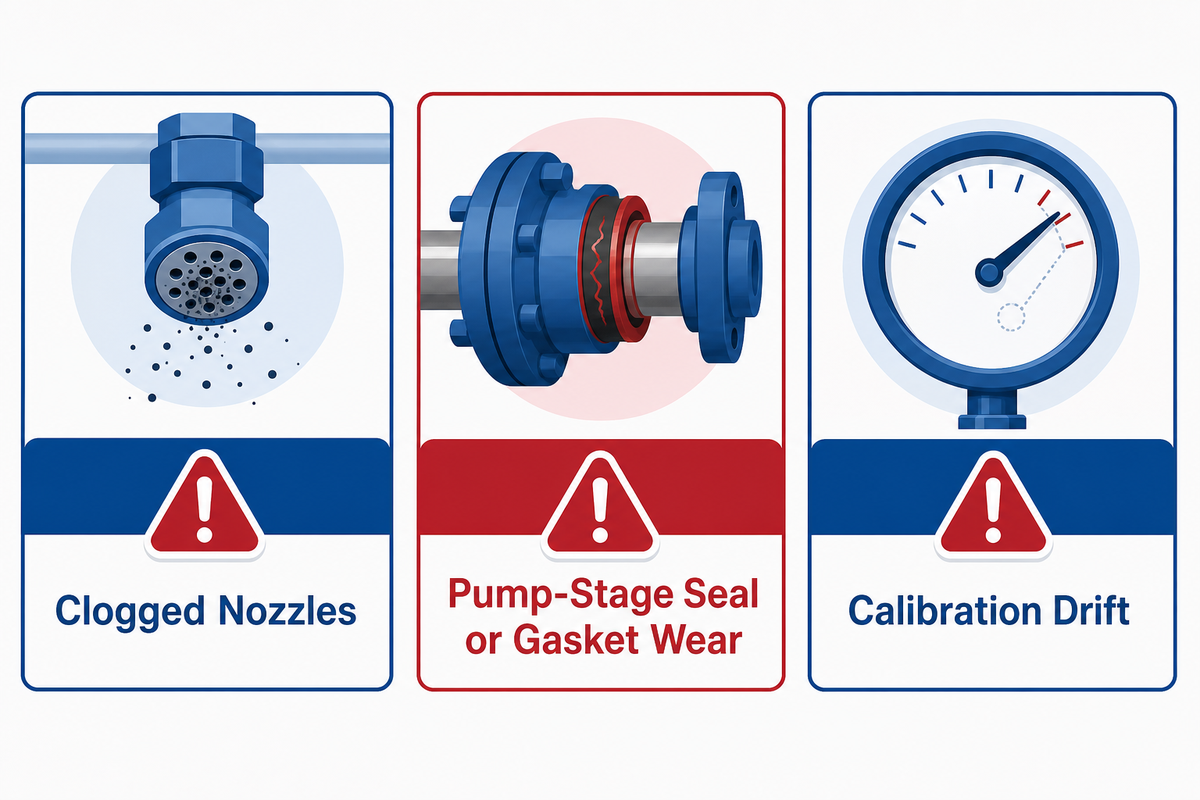
Depositor failure modes concentrate on three points: clogged nozzles, pump-stage seal or gasket wear, and calibration drift. Clogged nozzles occur from changes in recipes that aren’t compensated by changes in the related cleanability cycles. Residue from pectin with high viscosity remaining in nozzles causes nozzle bore clogging and skews the volume of the next dose. Slow weeping around the pump housing usually signals seal or gasket wear first, typically caught by regular inspections done before production runs. The other failure mode, which is also the least visible, is drift in calibration. For this reason, calibration of a reference standard should be done regularly, and not just as a factory routine — 21 CFR 117.165 requires food manufacturers to define the method and frequency of calibrating process-monitoring instruments for exactly this reason.
Scheduling a technical maintenance routine, a regular flush of hoppers and lines, along with a pump seal wear check, is the only way to combat the gap between a depositor’s rated output versus actual field output. Most confectionery machinery suppliers that specialize in gummy lines can give a seal’s life in hours, which provides a better expectation for replacement than a typical maintenance interval.
Planning for spare parts is the result of insight gained from failure points. Nozzles, nozzle tips, pump seals and gaskets, and any wear parts of the mold-indexing mechanism are candidates for stocking. They would be the most economical to hold stock of instead of ordering as a spare after failure. The time required by the supplier to deliver spare parts usually defines the actual productivity of the machine during its service life, especially when compared to the cost of ordering spare parts. A two-week delivery time for nozzle assembly can result in greater costs of lost production than the parts themselves.
💡 Pro Tip
When considering purchases, ask for the supplier’s typical spare parts lead time for nozzles and pump seals and not a general “spare parts available”, because that single number is a better estimate of your future downtime than the machine’s rated output-per-hour.
Beyond Single-Fill: Centre-Filled and Active-Ingredient Depositing Capability
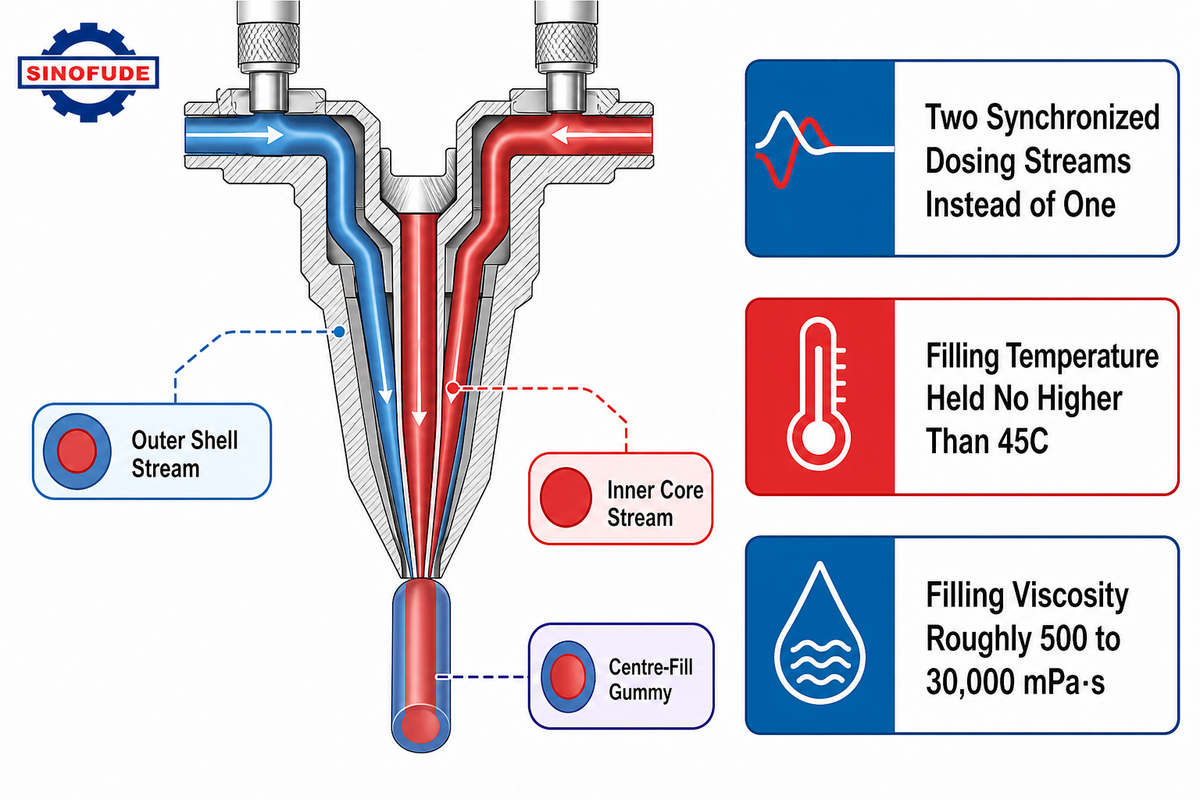
A single-fill depositor runs into a real limit once a functional-gummy producer wants an active ingredient that can’t tolerate the base recipe’s mixing conditions. A probiotic strain, a volatile flavor oil, or a heat-sensitive vitamin blended straight into a warm gel batch loses potency before it ever reaches the mold. Some lines address this by depositing a centre-filled gummy: an outer shell formed around a separate active-ingredient core, coordinated through the same pump-and-nozzle logic covered earlier but with two synchronized dosing streams instead of one.
Published centre-filled gummy patent disclosures describe bounded process conditions for this kind of coordinated shell-and-fill depositing, including a filling temperature held no higher than 45°C and a filling-viscosity range of roughly 500 to 30,000 mPa·s for the active-ingredient core. Those figures explain why formulation-specific temperature and viscosity trials matter before committing to a centre-fill run; they show why the process needs tight control, not that any given line will hit those numbers automatically. Centre-filled and active-ingredient depositing is consequently an exclusive capability tier, not a standard feature on every machine; prospective buyers should confirm with a supplier that the specific line under consideration supports coordinated shell-and-fill depositing before assuming any gummy depositor can be adapted to it after purchase.
Where the Gummy Market Is Headed (and What It Means for Buyers)
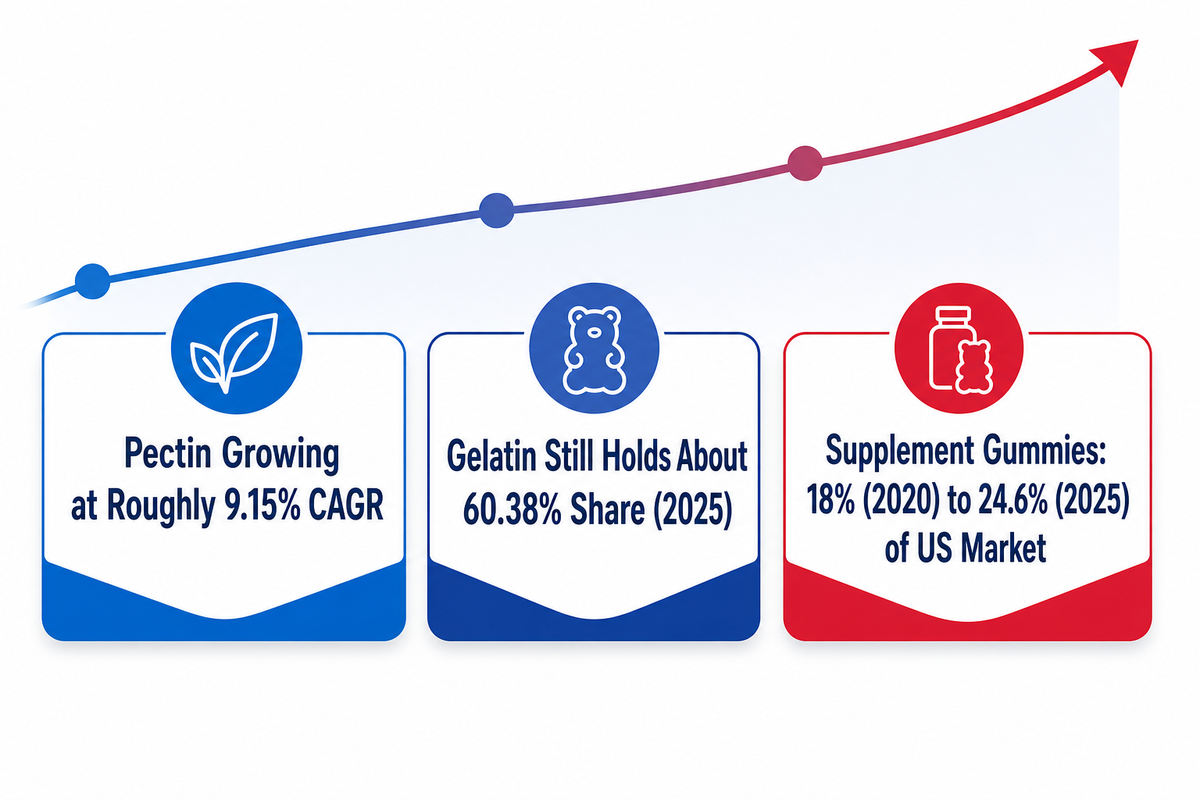
The changing composition of gummy demand is causing a shift in the needs of depositor buyers, who now require a line that can perform fast, pH-driven pectin cycles, followed by slow, cooling-driven gelatin cycles, with no (or minimal) mechanical changeover between the two. With this shift, line versatility and not just a higher raw materials throughput, is required. This is a direct consequence of two simultaneous events in the market.
First, formulation is shifting: pectin-based gummies are growing at roughly a 9.15% compound annual rate even though gelatin still held about 60.38% of the gummy market by ingredient in 2025, according to Mordor Intelligence’s 2026-2031 gummy market analysis. Second, the buyer base is broadening beyond confectionery: gummies made up about 24.6% of the United States supplement market in 2025, up from roughly 18% in 2020, per the same research. This shift is driven by formulation trends the buyer doesn’t control, which is exactly why a depositor line specified only for one gel chemistry, or only for confectionery-grade throughput, is a narrower purchase than the demand mix now supports. A buyer sizing a new line in 2026 is more likely than a 2020 buyer to need it to handle both a pectin confectionery SKU and a gelatin or pectin supplement SKU on the same equipment. A brand that specs a single-chemistry line in year one and picks up a second gel system in year two runs into a real gap: it either buys a second machine or is stuck re-tuning cycle timing on hardware that was never speced for both chemistries at once. That cross-chemistry flexibility question is worth resolving with a supplier before finalizing a specification, not after installation.
The seasonal nature of the interest in confectionery equipment search also indicates when peak interest may occur. Buyer inquiries to set up candy and depositing equipment clusters occur in the October to December time frame, as expected for the holiday production and shipping ramp. A buyer setting up starch mogul to starchless equipment conversion would need to plan for supplier lead times and not order during the months leading to the peak season.
Buy Your Own Depositor or Use a Contract Manufacturer?
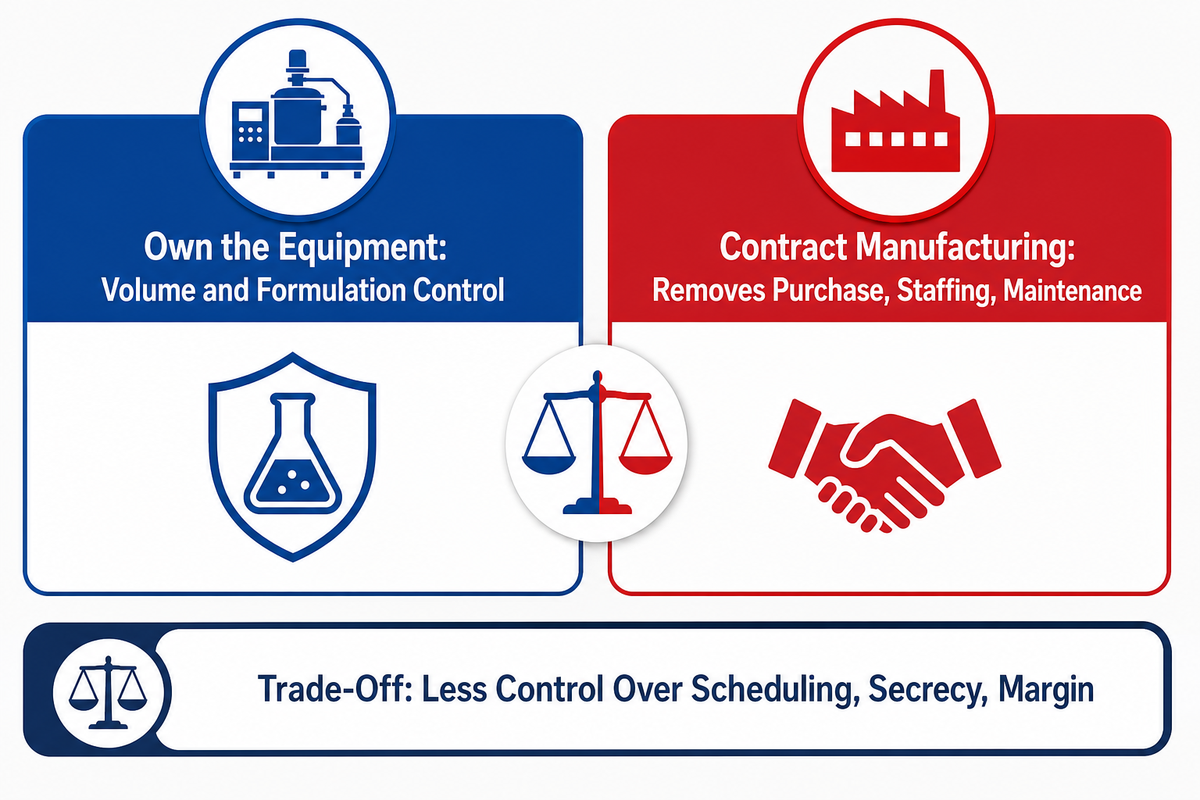
Owning a depositor makes sense once production volume and formulation control matter more than avoiding capital expenditure. Contract manufacturing — paying an existing gummy producer to run your formula on their equipment — removes the equipment purchase, staffing, and maintenance planning covered throughout this guide, in exchange for less control over batch scheduling, formulation secrecy, and per-unit margin at scale.
A supplement brand testing a new SKU with an unproven demand forecast typically can’t justify the capital cost and multi-month lead time of a dedicated line before it knows the product will sell; committing to equipment too early is a common, expensive mistake, and it is exactly the risk a co-packer’s existing equipment is built to absorb. This is the same reason universities run dedicated food-science pilot plants: small-scale evaluation of a new formulation or process doesn’t imply the operation is ready for commercial-scale production, and a brand should treat contract manufacturing the same way — as the pilot-scale step before an equipment purchase, not a substitute for evaluating whether the product is ready to scale. SINOFUDE’s small-scale and pilot gummy line is built for exactly that in-between stage, once a brand has outgrown a co-packer’s trial run but isn’t ready for a full industrial commitment. Search interest in private-label and contract gummy manufacturing carries meaningfully higher commercial value than searches for the machines themselves, which signals a real, distinct buyer group: brands that want a gummy product without ever operating a depositor at all.
The main questions anyone considering contract manufacturing must ask are how much formulation IP you’re willing to sacrifice, how much volume you need to justify equipment ownership and the subsequent staffing, and how much scheduling flexibility you need in case the co-packer has limited capacity. Those who answer “high,” “yes,” and “a lot,” respectively, are best served by owning equipment, while buyers who are earlier in the product development stage, particularly if they’re still iterating on a formula, typically get to market the fastest through a contract manufacturing option.
What to Evaluate Before You Request a Quote
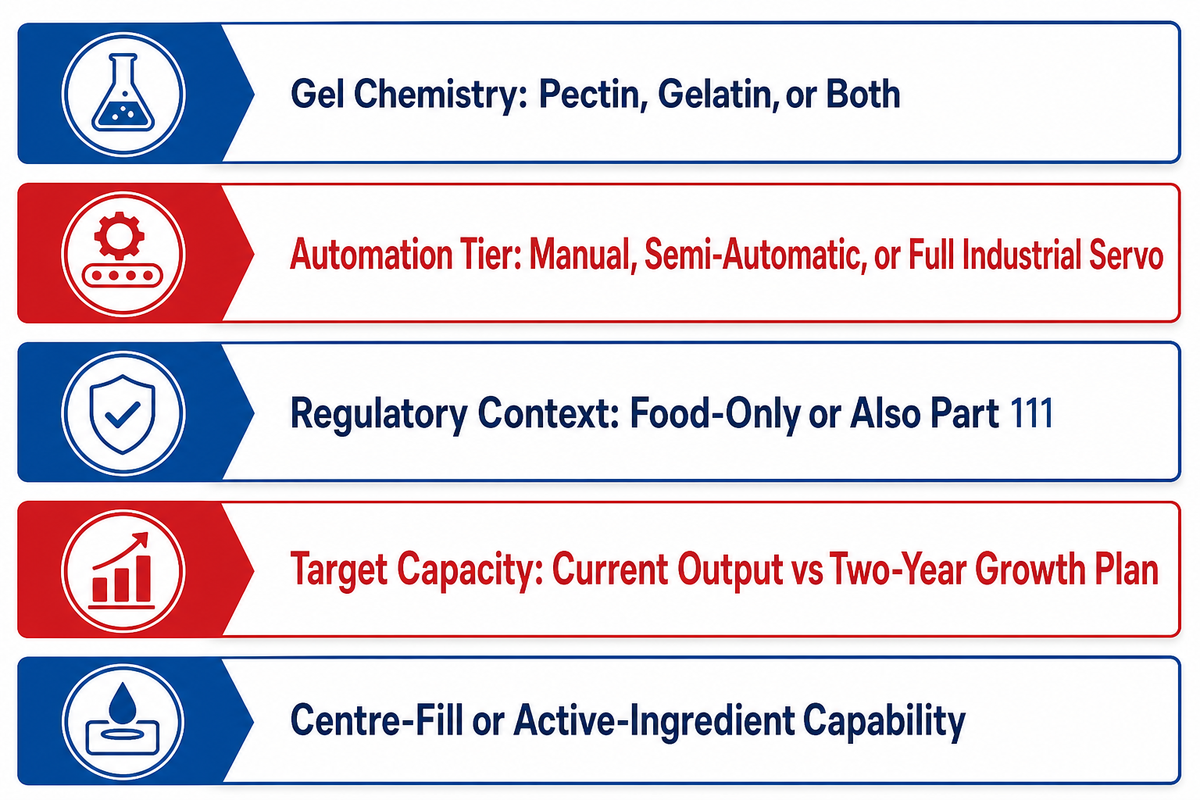
The route-selection logic in this guide reduces to four questions: which gel chemistry will you actually run, what automation tier matches your real output need, does your product fall under general food rules or also Part 111, and what capacity do you need on day one versus in two years. Answering these before a supplier call turns a generic quote request into a specification a supplier can price accurately.
Before You Request a Quote
- Gel chemistry: pectin, gelatin, or both on one line
- Automation tier: manual, semi-automatic, or full industrial servo
- Regulatory context: food-only (21 CFR 117.40) or also dietary supplement (21 CFR Part 111)
- Target capacity: current shift output vs. two-year growth plan
- Centre-fill or active-ingredient capability, if your product roadmap needs it
| Citation | Requirement | Applies To |
|---|---|---|
| 21 CFR 117.40(a)(1) | Adequate cleanability, allergen cross-contact protection | All food-contact equipment |
| 21 CFR 117.40(a)(2) | No adulteration from lubricants, fuel, or metal fragments | All food-contact equipment |
| 21 CFR 117.40(b) | Seams smoothly bonded to minimize buildup | All food-contact equipment |
| 21 CFR 117.40(f) | Accurate, precise process instruments | All food-contact equipment |
| 21 CFR 117.165 | Defined calibration method and frequency | All food-contact equipment |
| 21 CFR Part 111 Subpart D | Equipment suitability, design, and maintenance | Supplement/vitamin gummies only |
| OSHA 8-hour PEL | 15 mg/m³ total dust, 5 mg/m³ respirable | Starch mogul facilities |
| NIOSH explosive concentration | 50 g/m³ minimum for starch dust | Starch mogul facilities |
| US2597175A | Simultaneous piston-controlled nozzle filling | Depositor mechanism reference |
| US20230082291A1 | Pectin addition cuts mold removal time 90 to 20 minutes | Gel-chemistry cycle-time reference |
This table collects every regulatory citation and patent reference used in this guide in one place; see the References & Sources section below for links to each source.
Key numbers from this guide at a glance: installed power runs from 78 kW on the smallest industrial model up to 400 kW on the largest; starch mogul drying takes 24 to 72 hours or more, against a few minutes to roughly four hours for a starchless line to reach a workable set; centre-fill process temperature is held no higher than 45°C; and the market shift driving all of this shows pectin gaining roughly 9.15% CAGR against gelatin’s still-dominant 60.38% share, with supplement gummies climbing from about 18% to 24.6% of the US market in five years.
Footprint also scales across the same model range: published dimensions run from roughly 9 m by 1.6 m for the smallest industrial line up to 20 m by 5.8 m for the largest, so the floor-space question is worth asking in the same conversation as the power question — a supplier needs both figures, plus your ambient temperature and humidity, before a quotation can be sized accurately.
Lead-time expectations are worth setting early too: a typical reply to an initial enquiry lands within 24 hours, manufacture and factory acceptance for a single depositing machine runs 30 to 45 working days, and a complete line with cooking, cooling, and packaging integrated can run 60 to 75 working days. On the process side, depositing weight tolerance across an industrial model range holds at 0.1 g regardless of model size.
Mould changeover itself scales from about 0.5 hours on the smallest industrial model to roughly 2 hours on the largest, which is the same changeover-time variable this guide’s maintenance section treats as a capacity decision rather than a footnote. On the hygiene side, food-contact surface finish is commonly specified around 0.8 μm Ra for a 2B stainless finish, a roughness figure tied to cleanability rather than to the base alloy choice.
Third-party throughput figures published elsewhere in the industry give a useful sanity check on any single supplier’s numbers: one OEM’s servo depositor line is rated up to 1,900 kg per hour at the high end, while a compact servo unit at the other end of the market tops out around 450 kg per hour — a roughly 4x spread that tracks the same automation-tier logic covered earlier in this guide, not a difference in gel chemistry. Another market analysis puts the gelatin ingredient segment at 67.9% of the gummy market and the adults end-use segment at 78.0%, both measured for 2025, which is a different cut of the same pectin/gelatin shift already discussed above; the same analysis puts plant-based gelatin substitutes as the fastest-growing segment at 16.1% CAGR, against an overall market CAGR of 14.7% and a kids end-use segment growing faster than the 78.0% adults share, per Grand View Research’s gummy market report — none of which changes the underlying electrical sizing question, since a 78 kW line and a 400 kW line both have to answer it the same way.
The machine, though a critical component, is only one of the many variables that comprise the final gummy quality, among them the recipe, gel system, and cooling profile. This guide can only put you in the right ball park with respect to the given variables, and, as for any other equipment, matching the line to your specific formulation will benefit from a trial of the equipment before a full scale commitment. If you’ve a set specification, the automation tiers and capacity steps of SINOFUDE’s industrial gummy depositor range are addressed in this guide.
Request a Depositor Consultation →
Frequently Asked Questions
Q: What Is a Gummy Depositor?
View Answer
A gummy depositor is a food-grade machine that meters a warm gummy syrup through a hopper and nozzle assembly into individual candy molds at a controlled dose weight. It is the depositing stage of a gummy production line, sitting between mixing/cooking and the setting or drying stage, and covers machine classes from handheld manual units to full industrial servo lines. Most makers offer guidance on matching the machine to the specific types of gummy you plan to run.
Q: How Much Does a Gummy Depositor Cost?
View Answer
Price scales with automation tier and nozzle count more than any single spec: handheld manual units sit at the low end, tabletop semi-automatic machines occupy the middle tier, and full industrial servo lines with multi-nozzle synchronized dosing and continuous mold conveyance carry the highest price. Get a written quote against your specific gel chemistry, nozzle count, and target output-per-hour rather than comparing headline prices across different automation tiers.
Q: Are Gummy Depositors Accurate?
View Answer
Nozzle fill weight tolerance determines the accuracy of the dosing. Reputable suppliers document the fill weight tolerance for each nozzle in writing, rather than describing it as an average of a nozzle bank. Generally, servo controlled industrial units have tighter tolerances than manual or automatic units, but the fill weight tolerance for each machine must be verified to ensure that an assumption based on the level of automation is correct.
Q: What Are the Common Causes of Failure in a Gummy Depositor?
View Answer
The three most common failure points are nozzle clogging from residue left after a recipe change, slow seal or gasket wear at the pump stage that starts as weeping before becoming a visible leak, and calibration drift in fill weight that accumulates gradually rather than appearing all at once. Nozzle clogging is the fastest of the three to show up in output, since a narrowed bore skews dose volume within the same run; seal weeping and calibration drift both take longer to notice because early stages look like normal wear rather than a developing fault. Matching cleaning cycles to recipe changes, scheduling routine teardown inspection of pump seals rather than waiting for a visible leak, and sampling fill weight against a reference standard on a fixed schedule catch all three before they turn into unplanned downtime on the production floor.
Q: Can a Depositor Handle Gummies with Fruit Pieces or Inclusions?
View Answer
Nozzle bore diameter places practical limits, and thin nozzles made for pure liquid fills will clog on inclusions. Check bore size against inclusion size.
Q: Should You Pilot-Test a Formulation Before Buying a Full Line?
View Answer
Food pilot plants allow small-scale evaluation of ingredients, formulations, and processes. They help test the feasibility of a larger commitment. Confectionery is usually one of the processes that these types of plants evaluate. While a process done at pilot scale may not yield the same results at full scale, it may highlight gel-chemistry or cycle-timing issues that are covered in this manual.
The Team Behind This Report
This guide draws on SINOFUDE’s background building gummy depositing lines across three factories since 1998, spanning more than 30 acres and a workforce of over 200 people, including the pectin-versus-gelatin cycle-timing considerations that come up repeatedly when customers move from one gel system to a mixed product line. SINOFUDE has held ISO 9001 certification since 2004 and holds 38 patents across its confectionery, baking, and chocolate equipment divisions. The equipment selection approach is aligned with the primary regulatory and process sources cited and considers SINOFUDE’s experience. It shouldn’t be used as a substitute for formulation-specific pilot testing on your recipe.
Regulatory cross-referencing: this guide combines 21 CFR 117.40 paragraphs (a)(1), (a)(2), (b), and (f) with 21 CFR Part 111 Subpart D and Subpart E in one place, because a gummy line that also runs supplement SKUs has to satisfy both frameworks at once, not just whichever one a single competitor page happens to cover.
Research methodology: the competitor content_score ceiling for this topic was benchmarked with NEURONwriter across 25 competitors, and the top competitor’s content_score reached 87 — a data point that is not visible to a writer working from search results alone.
References & Sources
- 21 CFR 117.40, Equipment and utensils U.S. Food and Drug Administration
- 21 CFR Part 111, Subpart D, Equipment and Utensils U.S. Food and Drug Administration
- 21 CFR Part 111, Subpart E, Production and Process Controls U.S. Food and Drug Administration
- OSHA Chemical Sampling Information, Starch Occupational Safety and Health Administration
- NIOSH Pocket Guide to Chemical Hazards, Starch Centers for Disease Control and Prevention
- Formulation-dependent physicochemical and textural properties of fruit-juice-based gummies PubMed Central
- Pilot Plants, Penn State Food Science Pennsylvania State University
- Pectin vs Gelatin Scaling Baker Perkins
- Starch-Free Gummy Production CAPOL
- Gummy Market Size, Share and 2031 Growth Trends Report Mordor Intelligence
- Gummy Market Size, Share & Trends Report Grand View Research