Get in Touch with SINOFUDE Company


The confectionery manufacturing process is a controlled sequence linking ingredient receipt, batching, cooking or conditioning, finishing, forming, cooling or setting, inspection, and packaging. Factory terminology is consistent across various processes, but the time required for each step will vary with the product. For example, boiled sweets take a concentrated glassy mass, while gummies require a gel system. For toffee, the required steps are heating and structure development, while chocolate is based on control of fat crystallization.
Updated September 2026 · By XCX
A useful factory map follows seven material-flow stages, but it does not replace a facility-specific hazard analysis, validated preventive controls, supplier controls, allergen controls, monitoring, verification, or shelf-life validation. Use the map to define interfaces and evidence, not to copy one recipe or speed into every candy line.
Material-State Handoff Chain
| 1. Receive and batch | Identify materials, confirm approved inputs, weigh, and pre-mix |
| 2. Cook or condition | Create the route-specific mass and verify its endpoint |
| 3. Finish the mass | Add sensitive flavors, colors, acids, fillings, or actives |
| 4. Form | Deposit, die form, extrude, cut, mold, or enrobe |
| 5. Stabilize | Cool, set, dry, demold, and transfer |
| 6. Inspect | Check physical quality and trace defects upstream |
| 7. Pack and release | Protect, label, clean, verify, document, and release |
What Is the Confectionery Manufacturing Process?
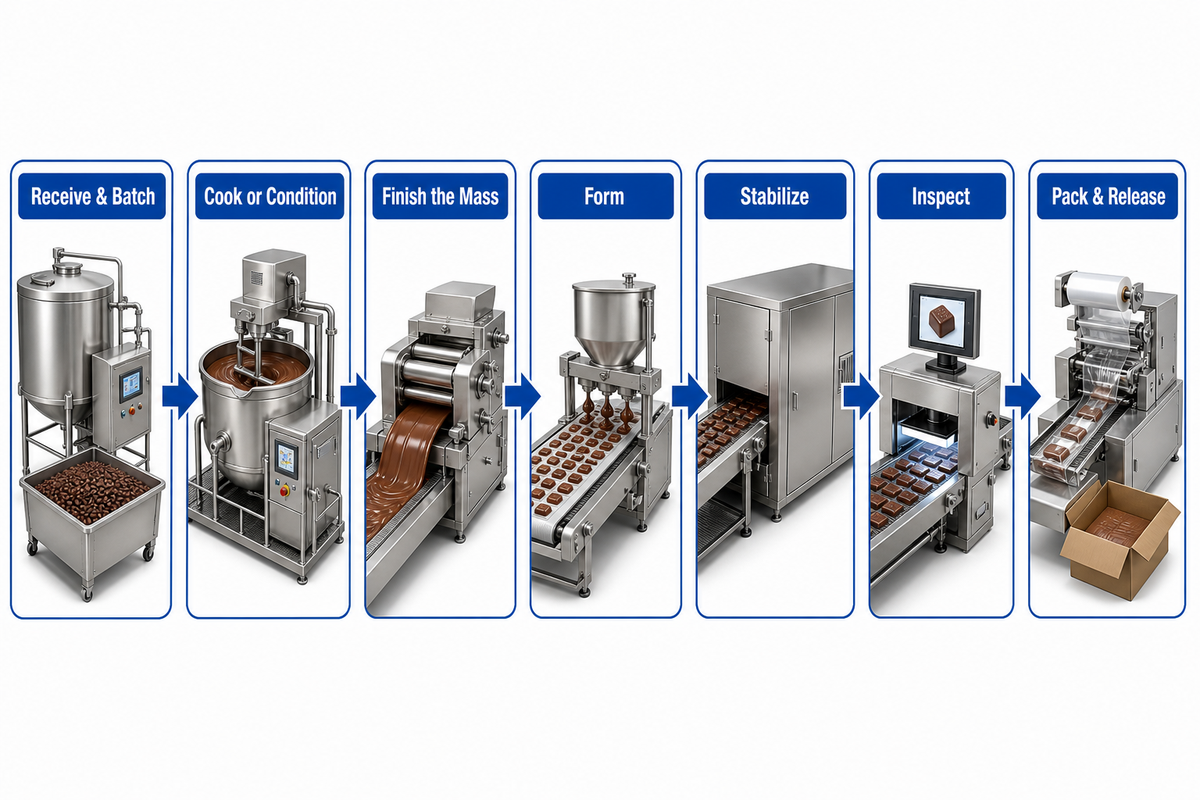
Confectionery converts controlled ingredients into repeatable sweets through sequential transformations of linked unit operations. Each operation must yield a mass, piece, or package that the next operation can accept. Only a production route that satisfies physical quality, food safety controls, packaging, records, and release controls is complete.
According to the University of Michigan chemical-engineering encyclopedia, one boiled-sweet route moves from ingredient preparation and weight-based mixing to cooking, cooling or tempering, forming, further cooling, and wrapping. This example illustrates a useful general approach, not a detailed process description. Gummy production lines must support gel formation and subsequent conditioning, while chocolate production lines must control tempering and crystallization.
Multi-textured treats may comprise inclusions, centers, multiple coatings, or multiple setting stages.
Nominal machine speed is not the same as accepted packed output. A depositor can cycle quickly while the product waits for setting, is damaged during demolding, deforms at a transfer, fails inspection, or reaches a wrapper in the wrong surface condition.
In an ideal deterministic line with perfect reliability and no additional constraints, the bottleneck module can define the theoretical maximum. Real buyer acceptance still needs evidence from the full route.
Key takeaway
Treat every stage as a supplier-customer interface: the upstream operation must prove that its output is fit for the next operation, and final release needs more than acceptable appearance.
Translate Candy-Making Language Into Process Requirements
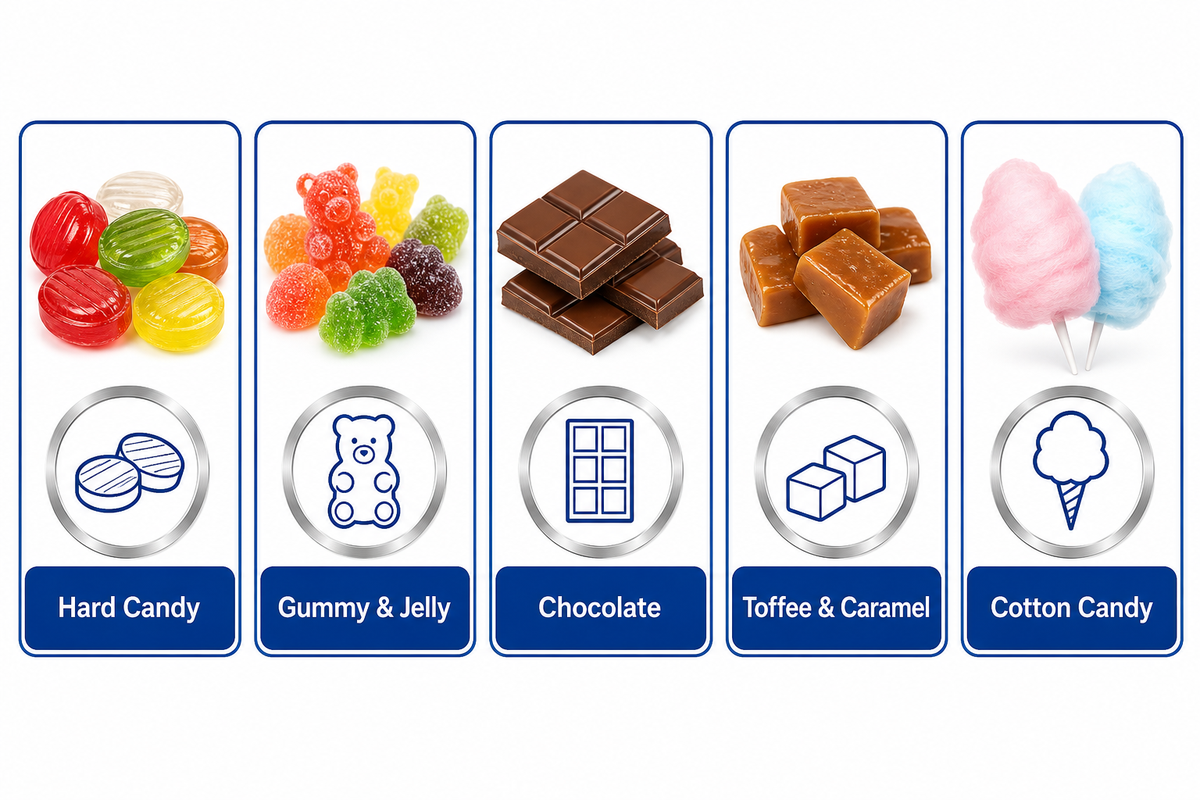
Many general accounts say candy is made by cooking sugar and water with sucrose, glucose syrup, or corn syrup. Factory specifications must be more specific. The factory specification must name raw materials, the sweetener system, the ingredients used in each controlled recipe, and whether corn syrup solids or another glucose source is present.
“Candy recipes” is only a starting point. Variability in ingredient identity, solids, temperature, pressure, and residence time provides different process duties, among other things.
For hard candy production lines, the route definition should distinguish clear, pulled, filled, layered, deposited, and die-formed products. The formulation and equipment determine cooking and inversion behavior, while post-cook acids, flavors, and colors need a recorded addition and mixing window. Control time and temperature against route-specific limits rather than a generic instruction.
Gummy and jelly confection production differs in structure. Because gelatin, pectin, starch, glucose syrup, sucrose, acid, and sometimes vegetable fat serve different functions, a mixture of glucose syrup cannot substitute for a complete formulation. Where acid is used, the addition sequence is important to setting, as well as to final aroma and taste.
Using the same depositor label doesn’t eliminate those variant recipe and setting differences.
This distinction between categories matters in other places as well. Chocolate is a fat-continuous system; cotton candy undergoes a very different type of transformation; and toffee is neither a generic gummy nor a hard glass. Even though each may be described as sugar confectionery or as a class of sugar confectionery, these confectionery products involve different production methods, interface formation, and cooling requirements. A hard outer shell around a soft center creates an interface, and doesn’t create a single continuous path.
In a candy factory, the industrial candy manufacturing process converts those distinctions from broad manufacturing controls into measurable production parameters. Each production run should identify the recipe, the setup of the machinery, replaceable parts, limits, sampling plans, and acceptance criteria. Modern technologies may help optimize data capture, minimize variability, and support continuous improvement, but customers must never rely on machinery to ensure food safety or final product acceptance. Strict quality control must remain rigorous: it combines well-defined controls, accountable decisions, and records.
The candy production process is part of the wider food processing system. Each route’s process involves cooking or conditioning, forming, a defined cooling process, inspection, packaging and storage, and release of the final candy. Temperature control affects the product directly, but one reading alone does not validate the process. Candy packaging may help extend the shelf life and support a longer shelf life, but product- and package-specific data from storage and distribution environments must substantiate it.
Within the confectionery industry, candy processing, candy production, confectionery production, and candy manufacturing often overlap in usage, although their scopes differ. The use of advanced controls improves visibility; a proven method may also be applied to a related recipe only after requalifying its assumptions. Equipment may produce candies with different shapes or centers, but each variant needs a defined material state, forming route, and acceptance plan.
Some search phrases are too vague for requests for equipment. Replace “used in making,” “used in the confectionery,” “work in manufacturing,” “available in the market” with the product, type of material, and state, units, testing time, and pass criteria. That’s the science of sugar and product structure. It converts broad language from the food industry into a line brief that operations, quality, and procurement can verify.
Choose the Product Route Before You Choose Equipment
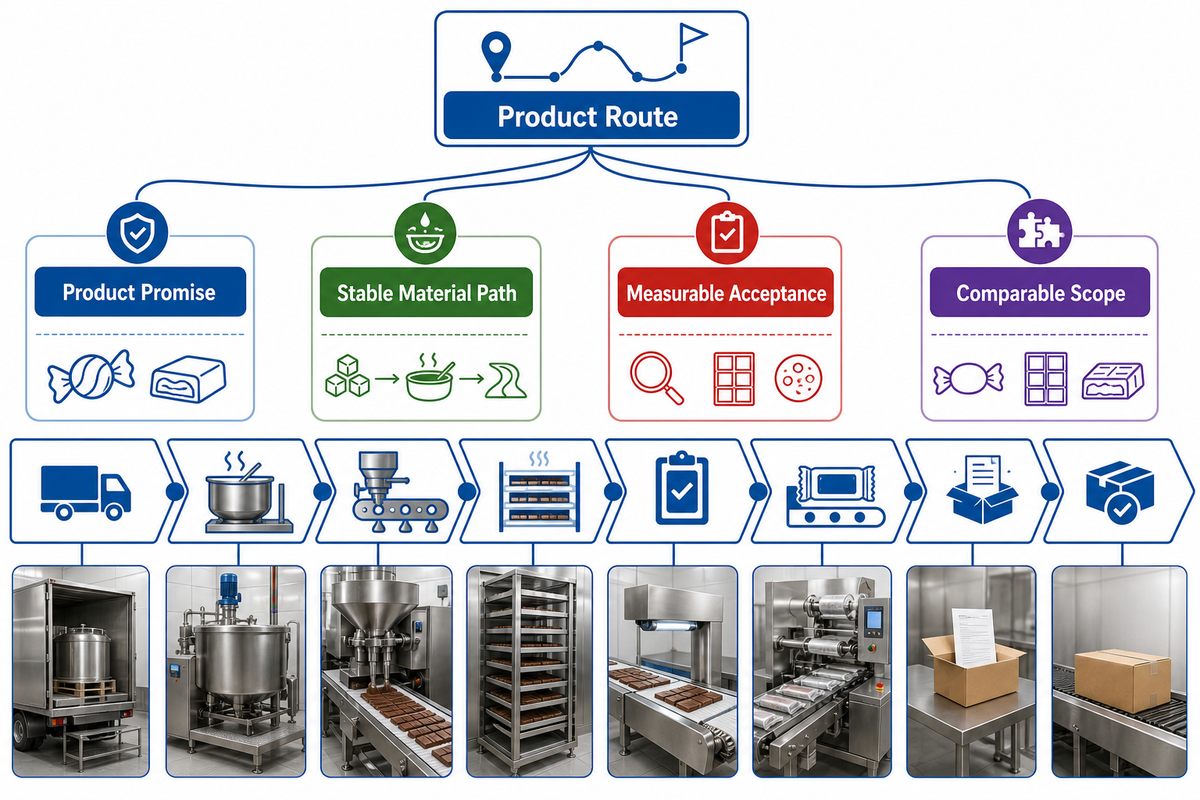
Select the product structure and forming route prior to evaluating machines. One word, “candy,” can mean a hot glassy mass, a pumpable gel, a plastic rope, a viscous caramel, or tempered chocolate. Each state means different duties for dosing, forming, cooling, release, cleaning, and packaging.
| Product route | Mass before forming | Forming route | Stabilization duty | First acceptance question | Equipment implication |
|---|---|---|---|---|---|
| Deposited hard candy | Concentrated, hot sugar mass | Meter into molds | Cool to a stable glassy piece | Can each cavity fill and release consistently? | Cooker, finishing, depositor, mold, cooler, ejector |
| Die-formed hard candy | Plastic, tempered sugar mass | Batch form, rope size, rotary die | Hold form through cooling | Does the rope enter the die without cracking or sticking? | Tempering, rope handling, die forming, cooling |
| Starchless gummy or jelly | Pumpable gel mass | Deposit into reusable molds | Set, demold, condition as qualified | Is the piece strong enough to release and transfer? | Gel preparation, depositor, mold handling, demolding |
| Starch-mogul gummy or jelly | Pumpable gel mass | Deposit into starch impressions | Set in controlled trays, then separate | Are deposit, set, separation, and starch handling compatible? | Mogul, tray logistics, conditioning, cleaning controls |
| Toffee or caramel | Cooked viscous mass | Deposit, slab, extrude, cut, or wrap | Cool without losing intended chew | Can it be formed and wrapped without pull, smear, or distortion? | Route-specific cooling and cutting or depositing |
| Chocolate molding or enrobing | Tempered fat-continuous mass | Mold, shell, fill, back-off, or coat | Crystallize under controlled cooling | Does the finish, contraction, and release meet the product standard? | Tempering, mold or enrober, vibration, cooling |
Current trade reporting on multi-textural confectionery makes this route-first discipline more important: a chewy center, crunchy coating, inclusion, or filled shell adds interfaces, not just a flavor. Owners need a product promise, plant managers need a stable material path, QA needs measurable acceptance, and procurement needs comparable scope.
Stage 1: Receive, Identify, Weigh, and Pre-Mix Ingredients
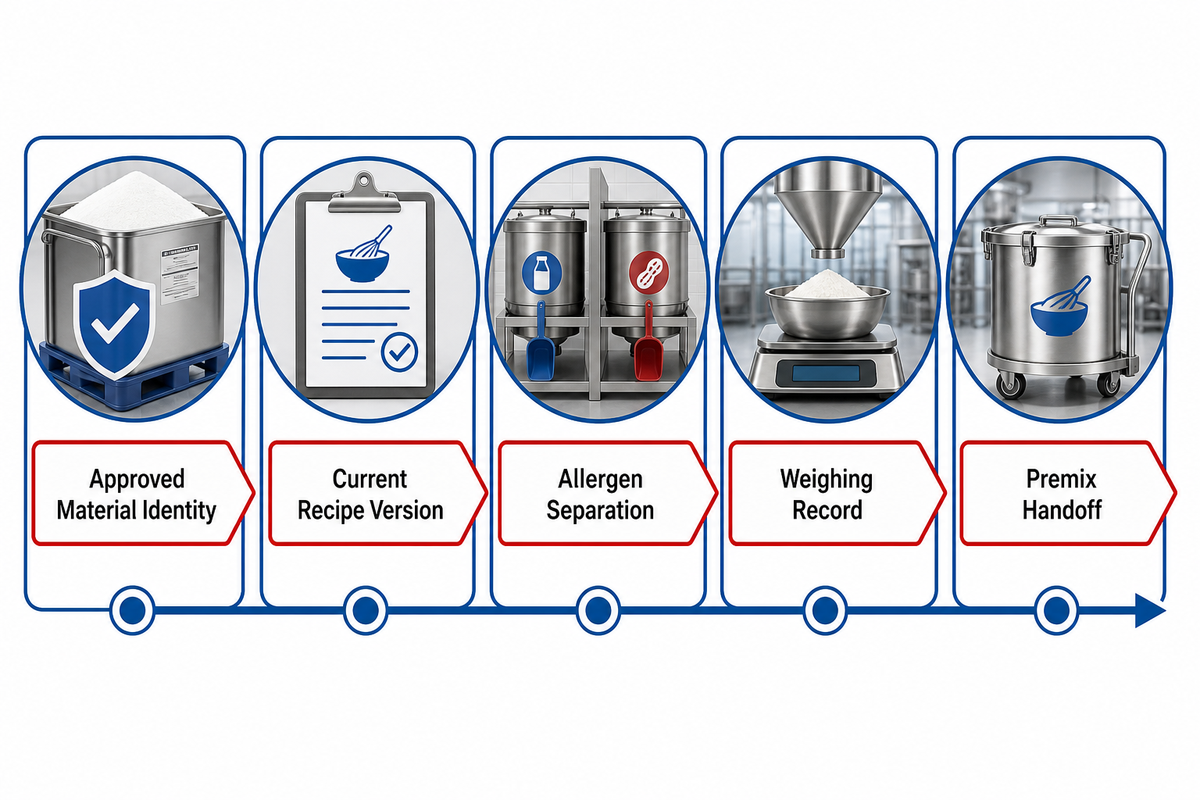
Stage 1 establishes material identity, lot traceability, approved status, recipe revision, batch mass, and hazard-control ownership. This stage also controls batch mass and hazards. It isn’t just a weighing step. Even the correct quantity of the wrong ingredient, an unapproved lot, or an obsolete recipe is still a failed batch.
A facility hazard analysis should identify which preventive controls are needed, including process, food-allergen, sanitation, supply-chain, recall-plan, or other controls as applicable. Where a hazard relies on a supplier-applied control, use approved suppliers and verification activities selected for the hazard and supplier performance. A certificate of analysis may be one input, but it is not universally sufficient.
“identify and evaluate known or reasonably foreseeable hazards”
Keep allergen materials identifiable through storage, movement, utensils, scheduling, and shared equipment; end-of-line cleaning cannot recover lost identity.
Weigh dry and liquid inputs against the current recipe version, and record the ingredient temperature when it changes pumping, dissolution, or heat demand. Segregate base ingredients from flavors, colors, acids, functional actives, and subsequent filling ingredients. Cooker handoff documentation should specify the recipe version, target batch mass, actual deviations, and the condition and release status of the ingredient.
Do
- Verify identity, lot, and approved status
- Bind the batch to one recipe revision
- Record deviations before the cook starts
Don’t
- Treat scale accuracy as material verification
- Move allergen control to the final wash
- Hide an unknown behind an average
Stages 2-3: Cook or Condition the Mass, Then Add Sensitive Ingredients
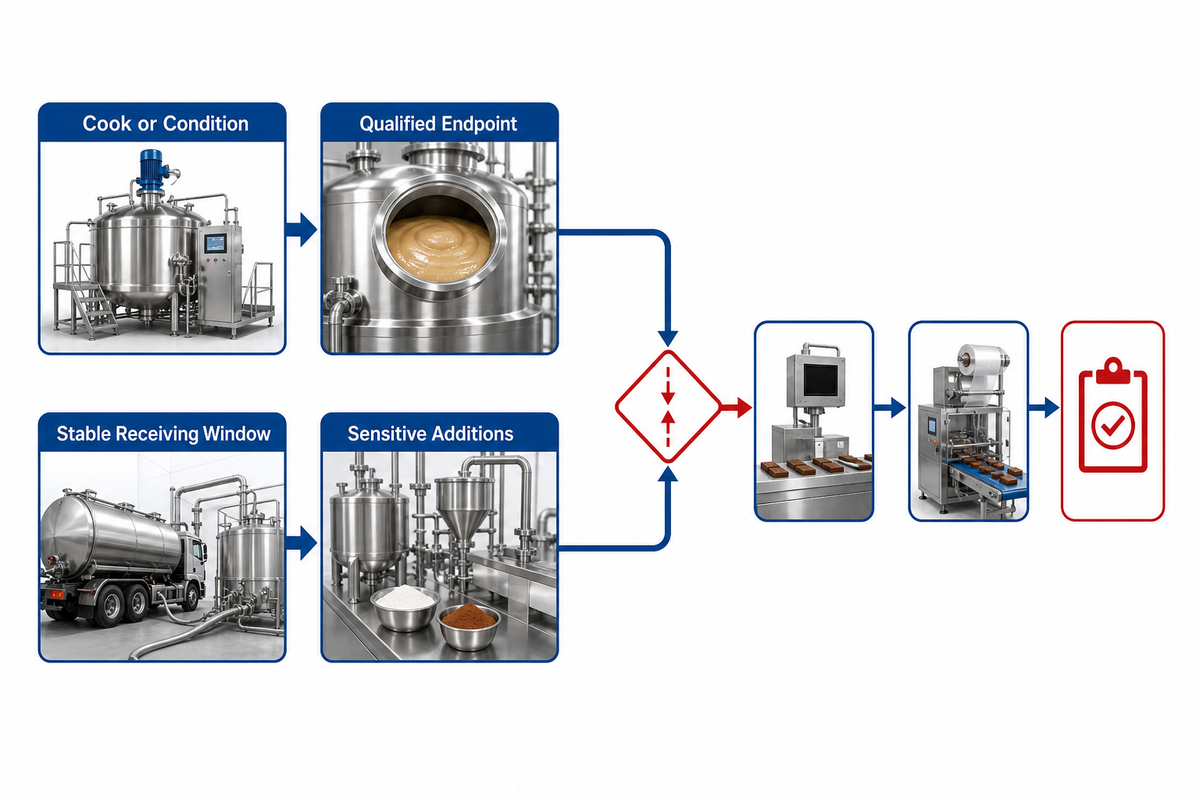
The required state for the forming route must be achieved by either cooking or conditioning. Post-cook finishing must incorporate sensitive ingredients without destroying flavor, color, structure, or control. Increase throughput only after both the endpoint and the downstream receiving window are stable.
A 2024 open review describes hard candy as a low-moisture glassy product and reports typical final moisture around 2-3%, while its formulation table shows markedly different cooking conditions across studies. The lesson isn’t an absolute temperature. Define the route-specific endpoint through the product state and the measurement method, and ensure the forming stage is able to receive the product.
This Guide’s Endpoint-Before-Throughput Rule
Do not raise the feed rate merely because the cooker or depositor can move faster. First show that dissolution, heat transfer, evaporation or conditioning, residence time, and the receiving window remain in control. Then confirm that flavors, colors, acids, fillings, or actives enter at the qualified point and disperse before the mass changes beyond the forming window.
| Control variable | Possible failure signal | Verify next |
|---|---|---|
| Dissolution and mixing | Undissolved material or uneven mass | Ingredient order, agitation, time, temperature |
| Cooking or conditioning endpoint | Texture, set, or forming drift | Calibrated endpoint measure and sampling location |
| Post-cook addition | Flavour, colour, pH, or dispersion variation | Addition point, mass condition, mixing time |
| Transfer to forming | Skinning, crystallization, viscosity, or temperature drift | Hold time, pipe or hopper condition, feed continuity |
Stage 4: Form by Depositing, Die Forming, Extrusion, or Molding
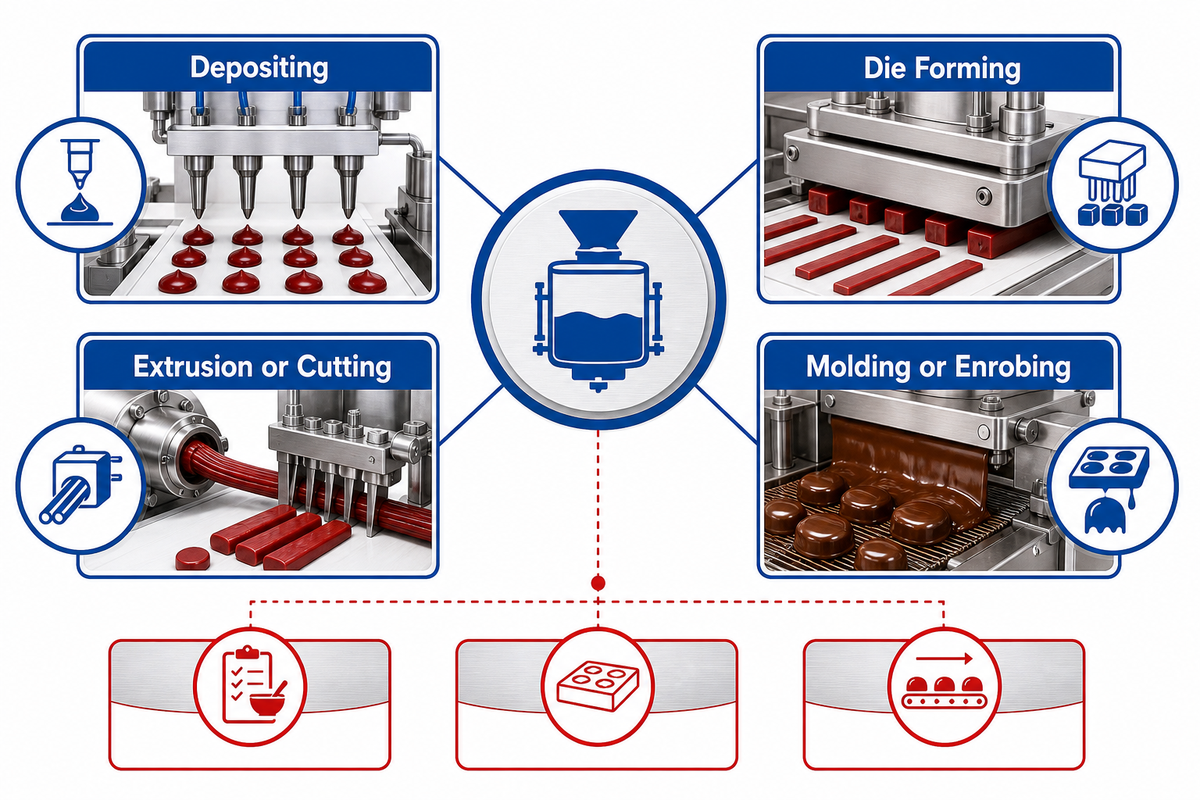
Forming converts a controlled mass into repeatable geometry. A candy depositing machine depends on metering, mass condition, nozzle and manifold behavior, and mold readiness. Die forming relies on mass plasticity, rope sizing, die geometry, and timing. Extrusion, cutting, starch molding, and chocolate molding introduce different interfaces.
The University of Michigan describes a direct depositing process into molds and distinguishes this from a batch forming process, rope sizing, and rotary die shaping. A patent on depositor plates describes the grouping of nozzles and the flow of material into the mold as engineered elements. Neither source proves a vendor’s capability or that equipment suits multiple products.
A forming trial must bind the recipe state, viscosity and temperature window, tooling, downstream setting duty, sanitation method, geometry, and equipment setup.
While placing a hard candy request, teams need to determine if the product is die-formed or deposited. After deciding on the recipe, piece geometry, center or color pattern, cooling duty and acceptance evidence, look at a viable configuration of a hard candy machine based on more than just headline speed.
Register the piece weight or geometry, mold or die identity, mass condition, reject symptoms, and the loading pattern downstream at the forming handoff. An even depositor weight doesn’t guarantee that the piece will successfully set, release, transfer, and pack.
Stage 5: Cool, Set, Demold, and Transfer Without Moving the Bottleneck
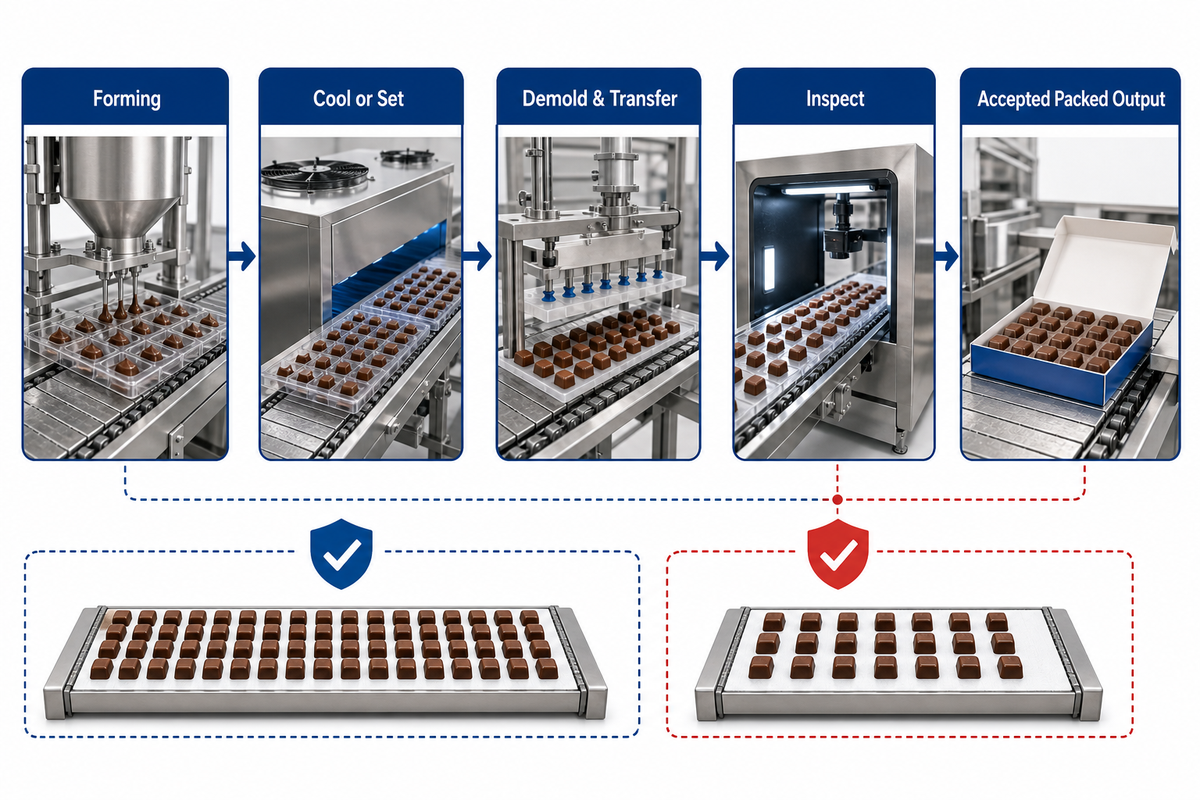
Cooling and setting are active steps in the process and shouldn’t be viewed as waiting steps. The objective is to allow the structure and surface to stabilize so transfer and inspection can occur without defects being passed on to the next process. In this guide, line design starts from the slowest stable interface and then verifies accepted output.
| Interface | Apparent fast module | Hidden limiting condition | Observable symptom | Evidence to collect | Owner/action |
|---|---|---|---|---|---|
| Ingredient feed | Mixer or cooker | Lot release or feed continuity | Starved batches or substitutions | Lot, recipe, feed-time record | Stores/QA: close material status |
| Cooker endpoint | Heating capacity | Endpoint repeatability | Mass-condition drift | Endpoint and residence-time trend | Process: stabilize before speeding |
| Post-cook dosing | Pump rate | Mixing and thermal window | Color, flavor, or pH variation | Addition time and mass condition | Process/QA: verify dispersion |
| Forming | Depositor or die rate | Mold/die and mass compatibility | Weight or geometry rejects | Cavity/die map and piece checks | Production: isolate the pattern |
| Cooling or setting | Conveyor speed | Heat or mass transfer | Soft, cracked, sticky, or unstable pieces | Time, environment, product condition | Plant: verify the qualified window |
| Demold and transfer | Ejector or robot | Piece cohesion and surface release | Tears, distortion, sticking | Defect location by mold and time | QA/production: hold and trace |
| Inspection | Camera or checkweigher | Decision rule and rejection handling | False accepts or excessive rejects | Challenge samples and reject log | QA: verify detection and response |
| Packaging | Wrapper rate | Product condition, infeed, seal, film | Jams, smears, open seals, damage | Infeed state and seal verification | Packaging/QA: qualify the handoff |
Every proposal should distinguish three rates: rated module speed, stable upstream feed, and accepted packed output. In an ideal deterministic line with fixed rates, continuous supply and discharge, sufficient buffers, 100% availability, and 100% pass yield, the slowest module can equal the theoretical line maximum. Measure accepted output for a defined product, room, package, and acceptance plan after accounting for active constraints such as starvation, blocking, uptime, yield, rejects, changeovers, sanitation, and release holds.
Stage 6: Use Quality Control to Find the Last Stable Point
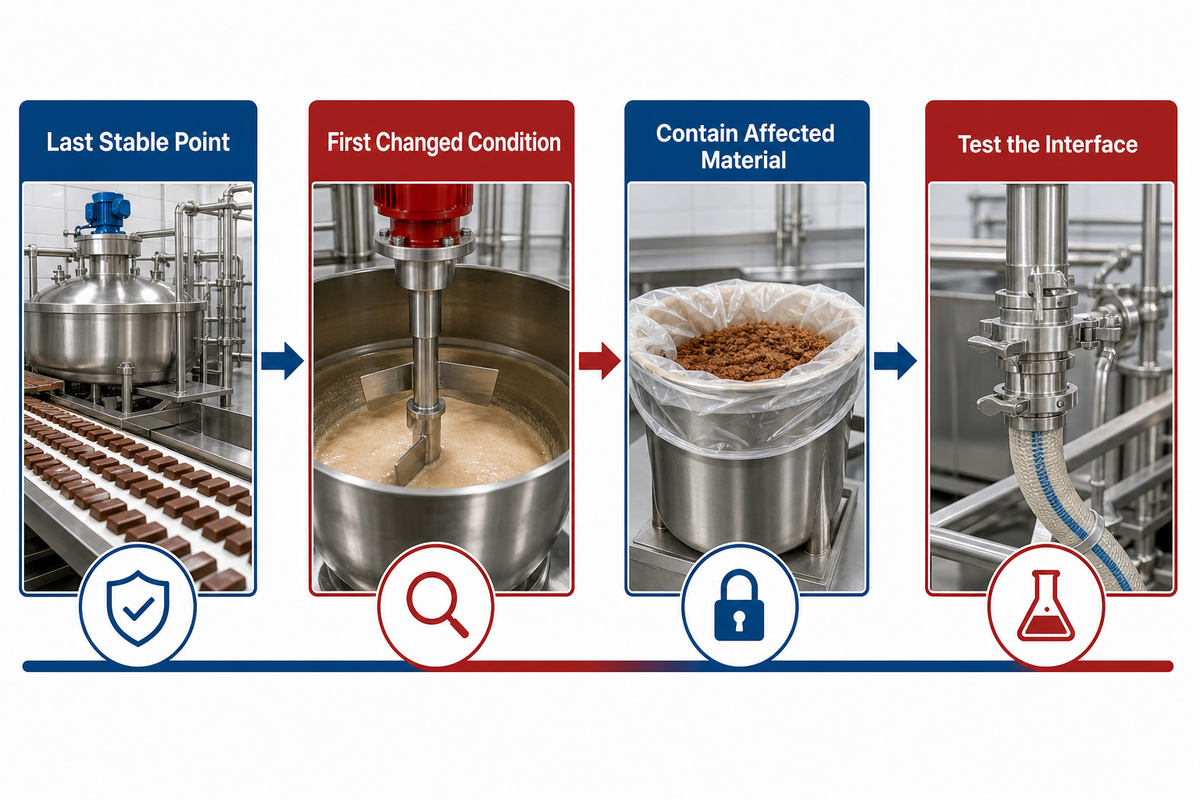
For a physical-quality defect, trace upstream until you find the last measured condition that was still acceptable. Compare what changed immediately after that point, contain the affected material, and test the suspected interface. In this guide, “Last Stable Point” is a diagnostic shorthand that narrows diagnosis; it does not establish food safety.
Safety boundary: Normal appearance, low water activity, a stable piece, or an in-spec weight is not a lethality validation or preventive-control verification. Food-safety release follows the facility’s hazard analysis, validated controls, monitoring, corrective actions, verification, and records.
| Observed defect | First evidence | Trace upstream to | Containment action |
|---|---|---|---|
| Piece-mass variation | Time/cavity/nozzle or rope position | Stable mass feed and forming condition | Hold affected interval; verify feed and forming |
| Misshapen form | Geometry pattern and mould/die identity | Last good forming and transfer check | Separate pattern; inspect tool and mass state |
| Graining or crystallization | Endpoint, hold, agitation, contamination record | Last controlled mass state | Hold batch; review process history |
| Sticky surface | Product and room condition over time | Last stable cooling/setting/conditioning check | Protect product; verify environment and package timing |
| Demould damage | Mould position, set time, release condition | Last good set and mould condition | Hold affected mould/time range |
| Colour or flavour variation | Addition lot, time, temperature, mixing | Last approved finishing record | Hold batch; verify dosing and dispersion |
| Package-seal issue | Seal challenge, product contamination, film and jaw record | Last verified infeed and seal condition | Stop release; segregate the affected interval |
Stage 7: Package, Change Over, Clean, and Release the Line
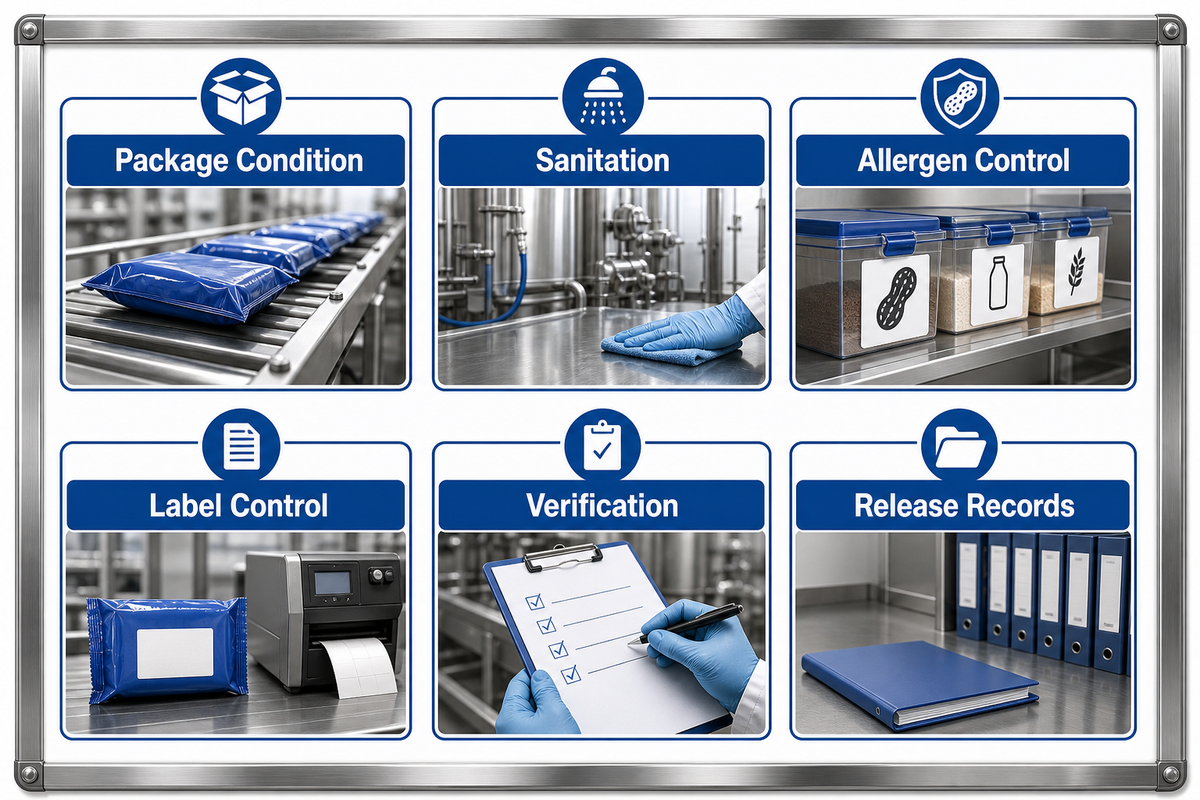
Packaging and release close the process only when the product condition, package barrier and seal, label, sanitation, allergen controls, monitoring records, and expected storage conditions are acceptable. A mechanically complete changeover is not released production.
Conditions that cause damaged or inadequate seals may occur well before the wrapper. Surface conditions, product temperature, dust, oil, geometry, and product stability at wrapper infeed can affect seal integrity. Shelf-life acceptance binds formulation, package, storage conditions, distribution exposure, seal checks, and a product-specific study; wrapper discharge is not the finish line.
Allergen controls must extend across relevant facility operations, as appropriate to the food and facility and wherever cross-contact or mislabeling hazards are identified. Relevant operations can include receiving, identification, storage, scheduling, utensils, shared equipment, retained mass, cleaning, label reconciliation, and finished-package accuracy. FDA currently identifies nine major food allergens, including sesame, and describes cross-contact as unintended allergen incorporation into another food.
For U.S. facilities and activities subject to the applicable provisions of 21 CFR Part 117, the regulation establishes requirements for current good manufacturing practice, hazard analysis, risk-based preventive controls, monitoring, corrective actions, verification, and records. Its supply-chain program provisions apply where a hazard requires a supply-chain-applied control. This guide helps buyers request evidence; it is not a facility compliance plan or legal advice.
| Activity | Question it answers | Typical evidence |
|---|---|---|
| Parameter or limit | What condition must be met? | Facility-specific limit and scientific basis |
| Monitoring | Was the control operated as specified? | Calibrated reading, observation, frequency, operator, time |
| Deviation response | What happened to affected product and the cause? | Hold, evaluation, disposition, correction, corrective action |
| Verification | Are monitoring and control records reliable and complete? | Record review, calibration, observation, testing as appropriate |
| Validation | Can the control effectively manage the identified hazard? | Scientific and technical basis tied to the process |
| Records | Can the facility reconstruct the decision? | Approved, attributable, reviewable evidence |
Validation applies where required; 21 CFR 117.160(c) identifies controls for which validation is not required.
Process Evidence Handoff Checklist
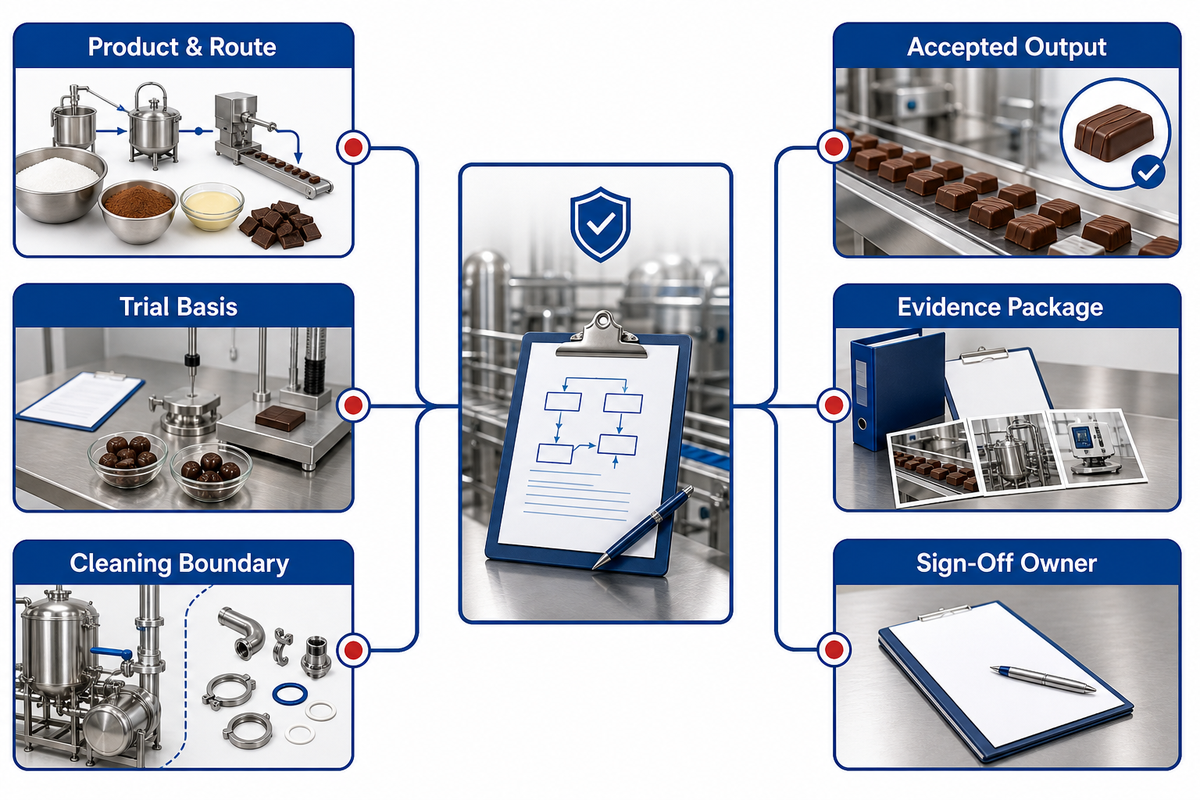
This guide treats comparable quotations as requiring one controlled line brief. Provide the same manufacturing route, state of the material, definition of a piece and a package, the basis for the accepted output, all interfaces, provided utilities, cleaning boundaries, responsibility for hazard control and acceptance evidence, and what is included, excluded, assumed, and unknown. Validation boundary: 21 CFR 117.160.
| Process input | Defined condition | Evidence requested |
|---|---|---|
| Product family | Hard candy, gummy/jelly, toffee/caramel, chocolate, multi-texture | Route diagram and boundaries |
| Recipe system and mass state | Controlled formulation family and forming condition | Trial input and endpoint method |
| Piece and geometry | Mass, shape, dimensions, colors, centers, inclusions | Sample plan and acceptance rule |
| Accepted output | Good packed pieces or mass per defined period | Test duration, rejects, stops, assumptions |
| Cooling/setting | Required condition before release and transfer | Time/environment/product record |
| Hazard-control ownership | Supplier, receipt, validated process, sanitation, allergen | Responsibilities, parameters, records, exclusions |
| Package and storage | Format, barrier, seal, climate, distribution, shelf-life plan | Seal and product-study protocol |
| Utilities and room | Power, water, air, steam, cooling, drainage, environment | Consumption and connection schedule |
| Cleaning/changeover | Product/contact boundaries, allergen and color sequence | Access, method, validation ownership |
| Acceptance | Sample run, FAT/SAT scope, documents, training, spares | Pass/fail rules and signed deliverables |
Please provide the measurement units and values: ingredient and batch mass in kg, piece mass in g, geometry in mm, time in min, product and room temperature in °C, relative humidity in %, material flow in kg/h, piece rate in pcs/min, connected load in kW, and pressure in bar or PSI, where applicable. These are measurement fields for a trial protocol and aren’t confirmed operational specifications.
| Measurement category | Target field format | Actual field format |
|---|---|---|
| Batch mass | 0.0 kg | 0.0 kg |
| Piece geometry | 0.0 mm | 0.0 mm |
| Product temperature | 0.0°C | 0.0°C |
| Room temperature | 0.0°C | 0.0°C |
| Relative humidity | 0.0% | 0.0% |
| Cook or condition time | 0.0 min | 0.0 min |
| Set or cool time | 0.0 min | 0.0 min |
| Stable run duration | 0.0 hr | 0.0 hr |
| Accepted mass flow | 0.0 kg/h | 0.0 kg/h |
| Connected load | 0.0 kW | 0.0 kW |
| Air pressure | 0.0 bar | 0.0 bar |
| Drive speed | 0 rpm | 0 rpm |
| Yield or reject rate | 0.0% | 0.0% |
Procurement should compare offers against the same brief rather than the same headline speed. Plant management can test interfaces, QA can identify evidence gaps, and finance can see which utility, labor, reject, changeover, or downstream constraint remains outside the quote.
According to SINOFUDE’s supplied company profile, the brand was established in Shanghai in 1998 and its stated product range covers confectionery, bakery, and chocolate production equipment. The same company-supplied brief says it emphasizes component processing, equipment accuracy, quality, delivery, pricing, and after-sales service. The next critical step is still to connect any proposal to the actual product and acceptance plan.
Build a Confectionery Line Brief
Bring the product family, recipe system, piece and pack definition, accepted-output basis, cooling or setting duty, utilities, cleaning boundaries, and acceptance evidence. Bring the brief to discuss a practical line scope with SINOFUDE.
Frequently Asked Questions
What is confectionery manufacturing?
Answer
Confectionery manufacturing is the controlled conversion of ingredients such as sugar, syrups, fats, dairy ingredients, cocoa ingredients, hydrocolloids, flavors, and colors into sweets. Industrial production normally includes receiving and batching, cooking or conditioning, finishing, forming, cooling or setting, inspection, and packaging. Material flow sits inside a facility-specific food-safety and quality system.
What are the main steps in candy manufacturing?
Answer
A practical seven-stage map is: receive and batch ingredients; cook or condition the mass; add sensitive ingredients; form the product; cool, set, dry, or demold it; inspect physical quality; then package, clean, verify, document, and release. The exact controls depend on the product route, so the map should organize questions rather than prescribe one recipe.
Why do boiled sweets and gummy products need different control plans?
Answer
Boiled-sweet production creates a concentrated sugar mass that becomes a glassy solid after forming and cooling. Gummy production creates a gel system whose set, demolding, conditioning, and storage behavior depend on the formulation and process. Both can use depositing, but their mass condition, endpoint, mold release, cooling or setting duty, and acceptance plan aren’t interchangeable.
What determines whether candy is deposited or die formed?
Answer
The decision depends on the product structure, mass condition, geometry, center or color pattern, forming window, surface finish, cooling duty, and desired handling route. Depositing meters a fluid or pumpable mass into molds. Die forming feeds a plastic rope through sizing and shaping equipment. A representative product trial should verify the chosen interface.
Which quality checks matter before packaging?
Answer
Check the characteristics tied to the approved product: piece mass and geometry, surface and internal condition, set or cooling stability, color and flavor consistency, release damage, foreign-material controls, and package-infeed condition. Food-safety release remains separate and follows validated controls, monitoring, verification, sanitation, allergen, label, and record requirements.
How should a buyer compare confectionery production-line quotations?
Answer
Give every supplier the same controlled line brief, then compare the same product family, formulation range, mass state, piece geometry, center or color pattern, package format, and accepted-output definition. State the test duration, room conditions, utility basis, upstream feed, downstream cooling or setting duty, buffers, inspection method, allowable rejects, cleaning boundary, allergen sequence, and changeover expectation. Ask suppliers to identify every inclusion, exclusion, assumption, change part, and third-party interface. Separate rated module speed from stable feed and accepted packed output, and require the quotation to show how stops, rejects, sanitation, and release holds affect the accepted-output result. Define the trial material and sample plan before FAT, then keep SAT conditions and responsibilities distinct. Compare food-contact materials, access for cleaning, controls and data records, manuals, training, spares, calibration evidence, and validation-support documents without treating equipment features as a regulatory guarantee. A quote becomes comparable only when its pass or fail rules, measurement units, witnesses, evidence package, and sign-off owner are written.
Research Transparency

This guide synthesizes public academic, government, university, patent, and trade sources plus the company context supplied by SINOFUDE. Route-specific figures remain bounded to their sources. No invented recipe, capacity, OEE, reject rate, MOQ, price, lead time, certification, customer result, or food-safety guarantee is used.
References & Sources
- Hard Candy Production and Quality Parameters: A Review
- University of Michigan Visual Encyclopedia: Hard Candy
- 21 CFR Part 117: Current Good Manufacturing Practice and Preventive Controls for Human Food
- US FDA: Food Allergies
- Physicochemical and Sensory Stability Evaluation of Gummy Candies
- ConfectioneryNews: Innovations Driving Success in 2026
- EP4021195A1: Depositing Method and Depositor Plate
- US4225627A: Demoulding Confections With Steam