
Get in Touch with SINOFUDE Company

Starch Mogul Line: The Complete Guide to How It Works, Common Problems, and What to Buy

What Is a Starch Mogul Line?
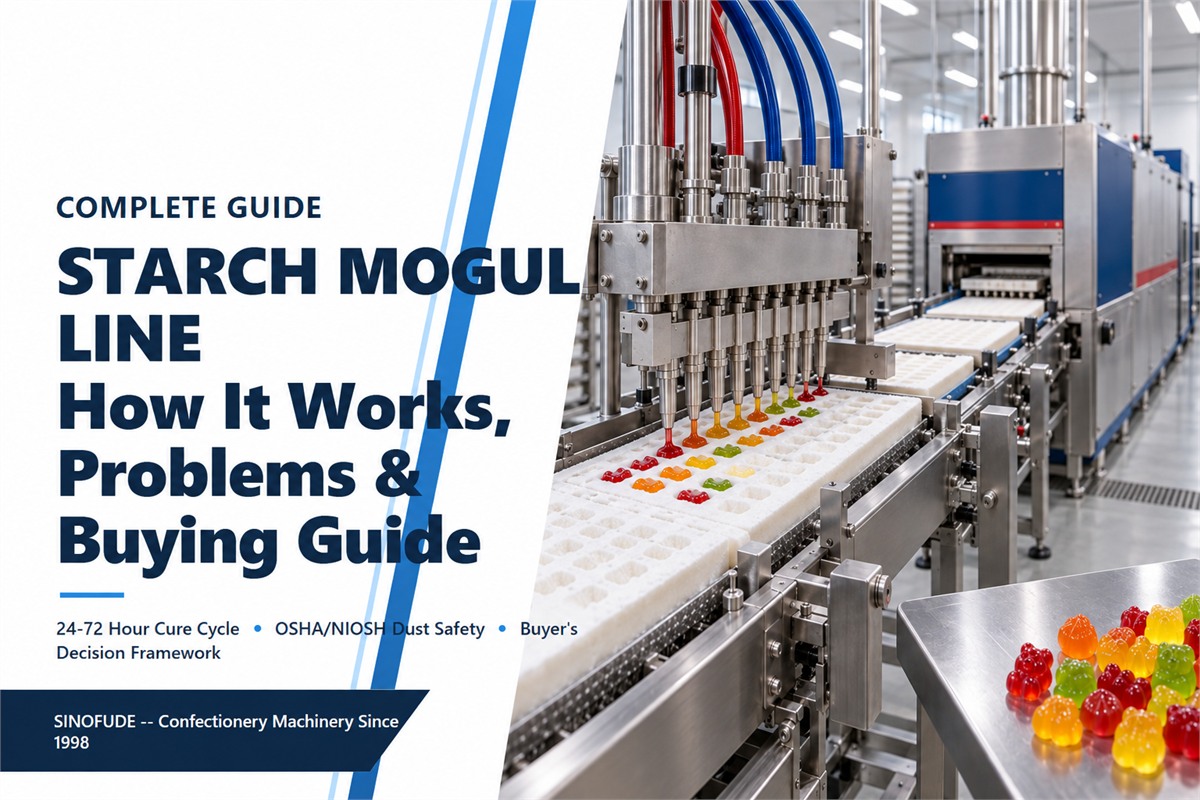
A starch mogul line is confectionery equipment that constructs and cures gummy or jelly pieces by depositing liquid slurry into cavities stamped into a bed of dry, conditioned starch. The starch bed absorbs moisture from the slurry as it cures, then a separate step recovers both the candy and the starch. It’s also called a starch mogul machine or a candy machine. The same basic principle applies to semi-automatic and fully automatic lines.
The name comes from the “mogul” printing board that stamps the cavities, a design that dates back to the early twentieth century. Wikipedia’s entry on the starch mogul notes that the machine reduced the number of jobs needed in candy factories and, in doing so, improved worker safety by taking manual moulding out of the process. That labor-reduction and safety story is part of why the mechanism has stayed in production plants for a century, largely unchanged in principle even as the equipment around it has been automated.
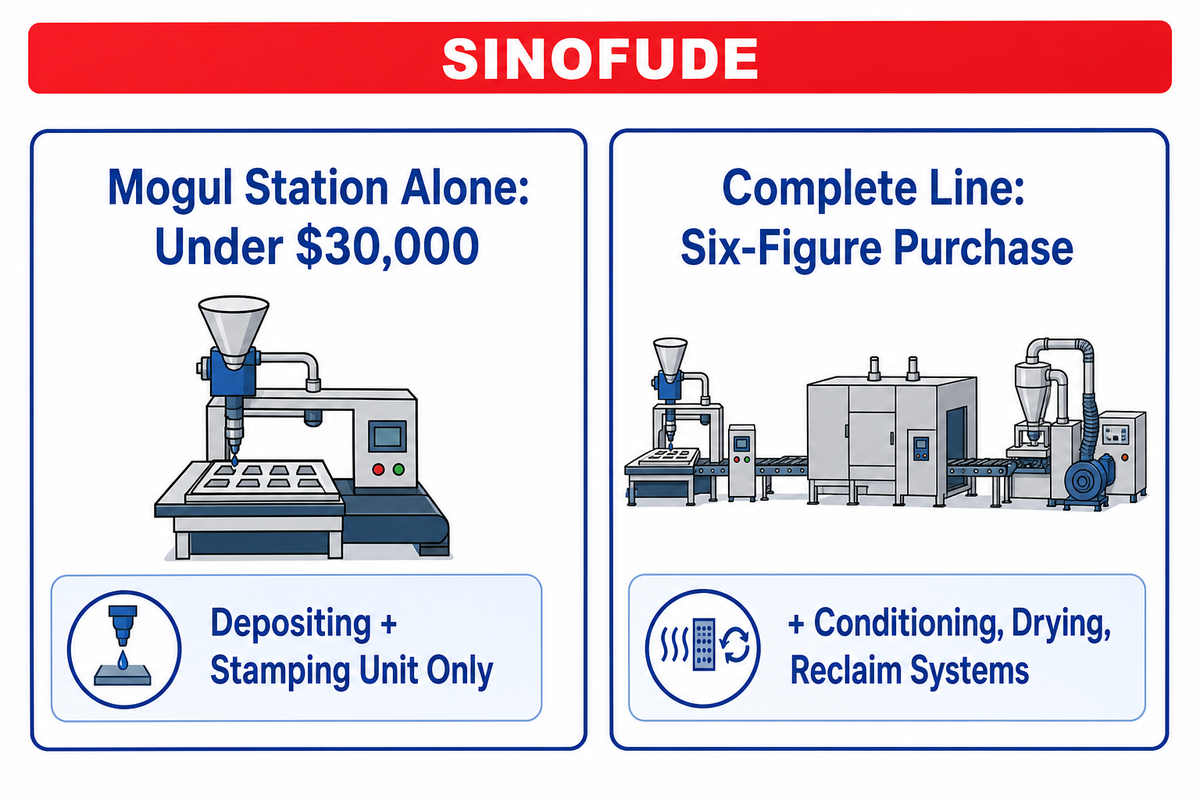
One common mistake buyers make is assuming “starch mogul” and “starch mogul line” mean the same purchase: the mogul itself is one station (the depositing and stamping unit), while the full line adds the starch conditioning, drying, and reclaim systems that a buyer actually has to budget floor space and utilities for. Confusing the two leads to an expensive gap between the quoted machine and the installed system, since a standalone mogul station can run under $30,000 while a complete line with reclaim and drying integration is a six-figure purchase in most industrial configurations.
How a Starch Mogul Line Works
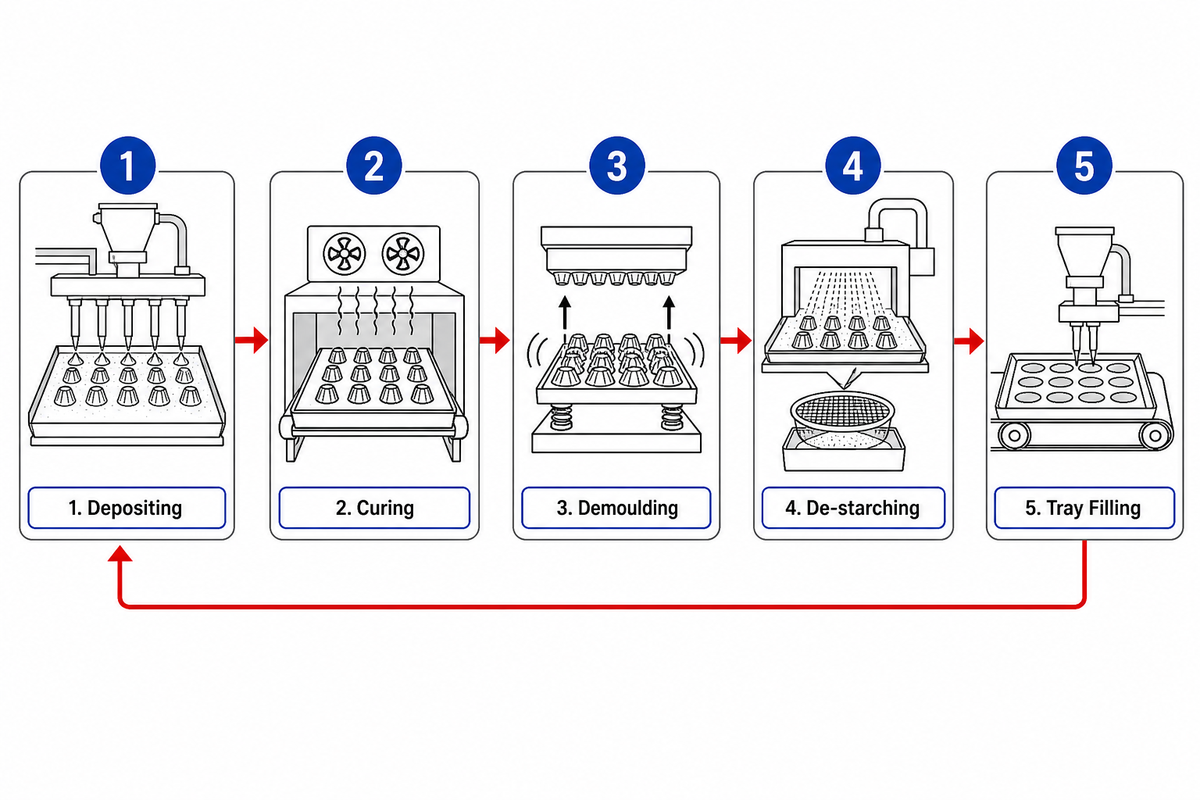
A starch mogul line works through five major steps that repeat continuously during production: depositing cooked slurry into starch-lined trays, curing while the starch cools and absorbs moisture, demoulding by shaking or blowing the set pieces free, de-starching to reclaim the starch, and returning that starch to tray filling for the next cycle.
The starch mould performs more than just holding a shape. A patent concerning the mechanism, US20230082291A1 states that the starch mould cools the deposited mass and absorbs water from it, and that both effects aid the candy’s solidification. Independent research on the peer-reviewed processing of starch-molded confectionery describes the same sequence and separately mentions that the shape can be easily modified by swapping the print board on the equipment, rather than retooling the entire line. That changeover mechanic is why the drying and print-board planning table later in this guide matters as much as the mechanism itself.
Multiple independently operated equipment manufacturers describe the same basic architecture. Serbia’s Nipinox lists starch feeding, tray tracking, product stamping, depositing, a final starch sprinkling step, and a rotating dusting mechanism as the working principle of its automatic mogul line, and D&R Machinery’s line adds a starch collecting and recycling system as a standard stage rather than an optional extra. The consistency across vendors is notable: the mechanism described is the industry-standard practice, not one company’s proprietary method. Most current lines are built on stainless steel frames with PLC-controlled sequencing across depositing, drying, and demoulding, and most lines include a dryer or drying tunnel as part of the line rather than as a separate machine. Given that the mechanical components that interact with starch and the product will wear over time, having spare parts available and servo drive support will become necessary, and will continue even after purchasing this type of processing technology.
Published specification sheets from several independent manufacturers give a sense of the range across this equipment category: capacities from roughly 80 kg/h on a small pilot unit up to 1,000-2,500 kg/h on a mid-size line and 3,200-4,500 kg/h on the largest industrial models, running at up to 35 trays per minute, with typical utility draws around 95-105 kW of power, compressed air at 0.7-0.8 MPa, and chilled water supplied at roughly 4°C. Gelatin itself typically melts around 32-35°C, which is why some recipes add starch or pectin to raise heat resistance to roughly 40-45°C for warm-climate distribution. None of these figures describe a specific SINOFUDE model; they’re general market ranges gathered from public competitor specification pages and are meant to calibrate expectations before requesting a quote.
Starch Mogul vs. Starchless Depositing: Which Fits Your Product?
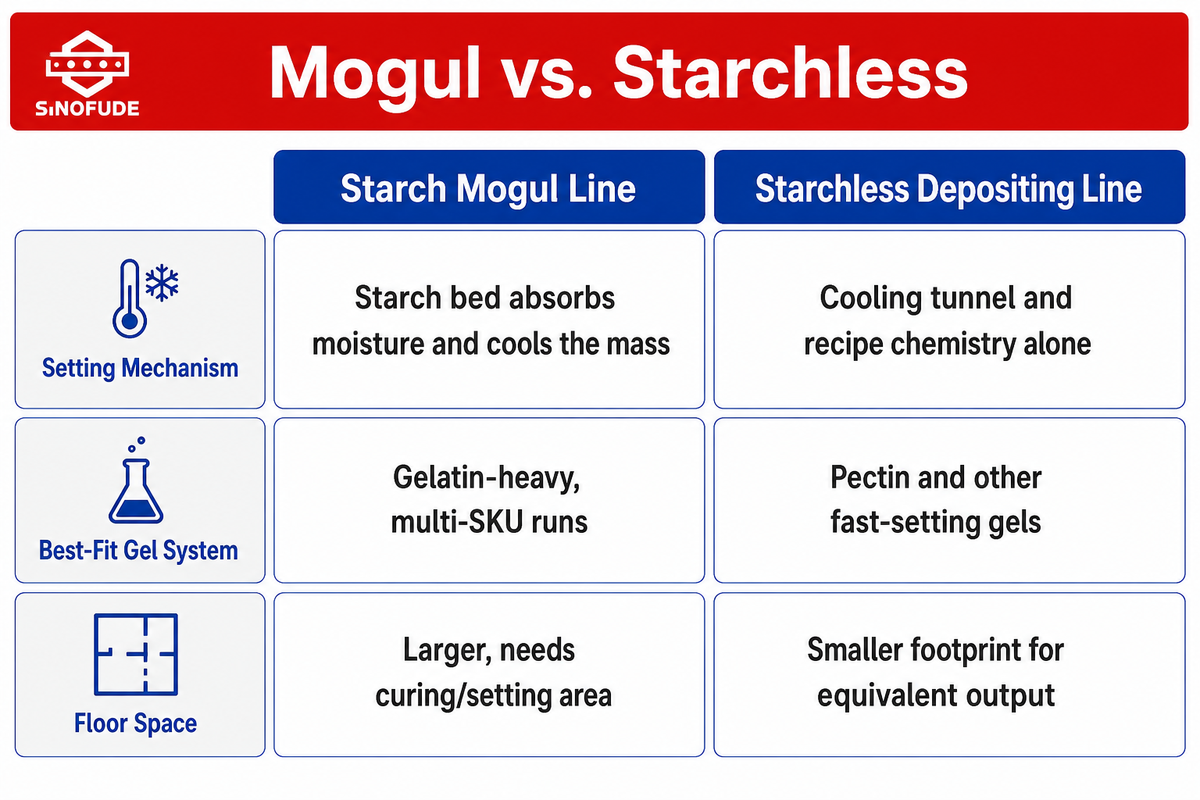
Starch mogul and starchless depositing lines both make shaped gummies, but they split the work differently: the starch bed on a mogul line combines shaping and curing, while a starchless depositing line shapes with a servo-driven mould and pushes curing onto a cooling tunnel and the recipe. When you remove the starch, you don’t remove the job the starch was doing.
This isn’t a minor wording difference, and picking the wrong side of it is a genuinely expensive mistake, because the root cause of most post-installation complaints traces back to this exact choice: a plant that installs a starchless line for a gelatin-heavy, high-SKU-count product often finds its cooling tunnel becomes the bottleneck instead of the depositor. One manufacturer reported in a launch report for a starch-free depositing system that setting times varied from a few minutes for some pectin recipes to a maximum of four hours for gelatin, figures that apply only to that particular system and recipe set. SINOFUDE’s own starchless gummy depositor line is built around that same shifted burden, with the servo depositing head and cooling tunnel sized to carry it.
| Comparison Category | Starch Mogul Line | Starchless Depositing Line |
|---|---|---|
| Setting mechanism | Starch bed absorbs moisture and cools the mass | Cooling tunnel and recipe chemistry alone |
| Typical setting time | Hours (general range, recipe-dependent) | Minutes to a few hours, recipe-dependent |
| Shape/tooling changeover | Swap the print board on the same line | Change the mould set on the depositor head |
| Best-fit gel system | Gelatin-heavy, multi-SKU runs | Pectin and other fast-setting gels |
| Starch handling & cleaning | Dedicated conditioning, reclaim, and dust control needed | No starch handling; cleaning is simpler |
| Floor space | Larger, needs curing/setting area plus starch systems | Smaller footprint for equivalent output |
| Capital cost driver | Starch conditioning and reclaim systems | Precision servo depositing heads |
| Product surface finish | Fine detail transfer from the starch mould | Depends on mould/nozzle precision |
| Recipe flexibility for centre-fill/layering | Possible with multiple depositor heads | Common on modern servo systems |
Neither column is a universal winner. A plant using mostly gelatin-based products with a high SKU count still has good reasons to use starch mogul line; a plant standardizing on fast-setting pectin recipes at high changeover rates has good reason to use a starchless system instead. The decision also depends on the gel systems and sweeteners being used: gelatin, pectin, agar, carrageenan all behave differently in starch, and the base recipe with the combination of sugar and glucose syrup changes the extent of the setting, and building processing lines around hard candy or marshmallow instead of gummy candy has different depositing and cooling requirements than the case of jelly candy being used throughout this guide. That recipe variation doesn’t change the underlying mogul-versus-starchless trade-off described above; it only shifts where on that trade-off a given product lands. Whichever technology a plant chooses, planning a gummy production line or a jelly candy production line both benefit from verifying the recipe on an actual candy machine before placing a full-size making-machine order.
The Moisture Window and Common Problems
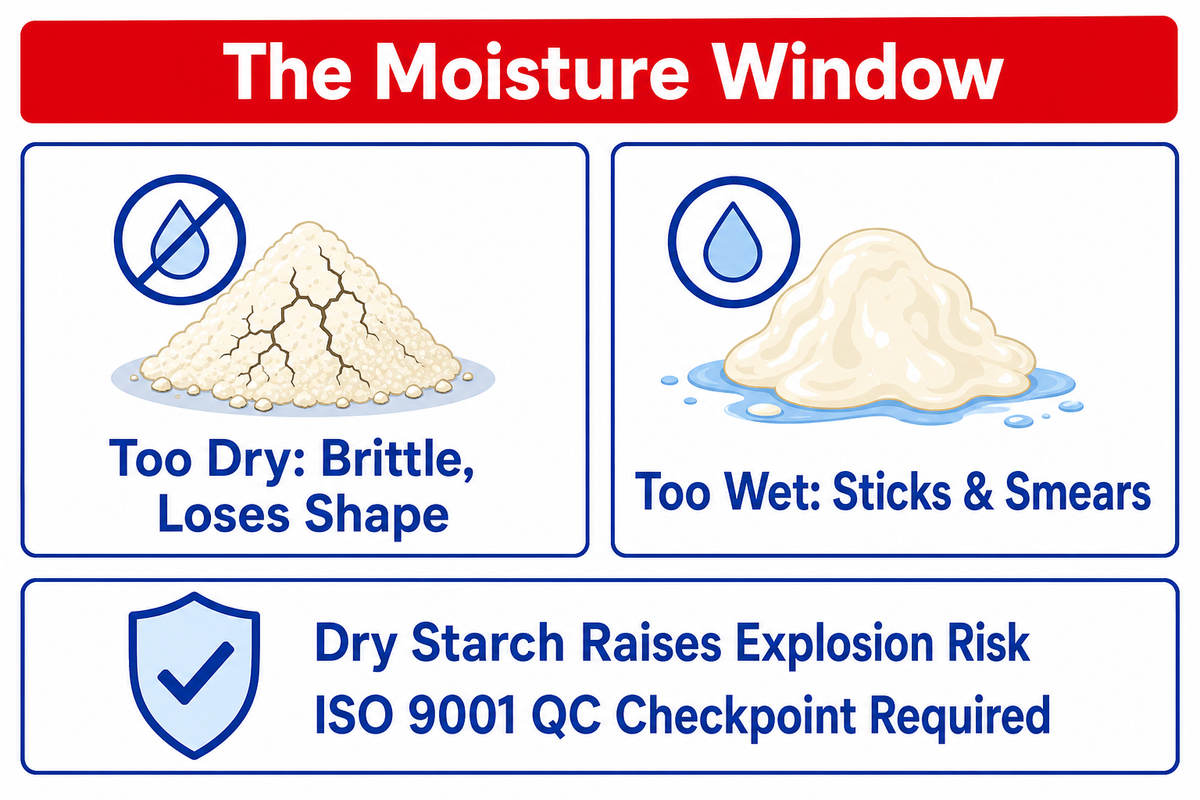
Most of the problems experienced with the starch mogul line can be traced to one thing: moisture content of the molding starch. If it’s too dry then the starch doesn’t retain the mould shape; if it’s too wet then it doesn’t fully cure and starts sticking to the product.
CAPOL’s Senior Technical Sales Manager, Martins Zerwes, shows us both failure modes. If moisture content is too low, the starch becomes brittle and loses strength to contain the shape of moulds. Dusty starch also increases the risk of explosion in the production process and ties in to the safety numbers that follow in the next segment. At the opposite extreme, too much moisture in starch makes it a worse curing aid. The excess moisture on both sides causes the starch to stick to the finished gummies and jellies, and appears later as smears in the package.
“Particular attention needs to be paid to the moisture content of the molding starch, which should not deviate from a certain range.”, Martins Zerwes, Senior Technical Sales Manager, CAPOL
Regarding starch, the same source suggests corn, wheat, or rice starch, rather than potato starch, which cakes or clumps. To completely remove starch residue, one must use a combination of brushing and the starch suction system over a cyclone with a filter. If you don’t do this, the starch dust will absorb the anti-sticking agent and result in the same smearing problem from the other side. For material with a drifting moisture window, the solution is using starch conditioning equipment with built-in starch control along with a pre-sifter to remove tailings, and a routine quality control check for conditioning instead of treating it as a one-time commissioning task; an ISO 9001-certified supplier should already have this checkpoint documented in its standard operating procedure. Since moisture also affects how the piece sets, a molding-starch problem rarely stays confined to aesthetics. It can also affect the texture and firmness of the finished part, which further supports the case of treating moisture control as a process-control step as opposed to a one-time setup step.
Drying Time and Print-Board Changeovers: The 9-Row Changeover Matrix
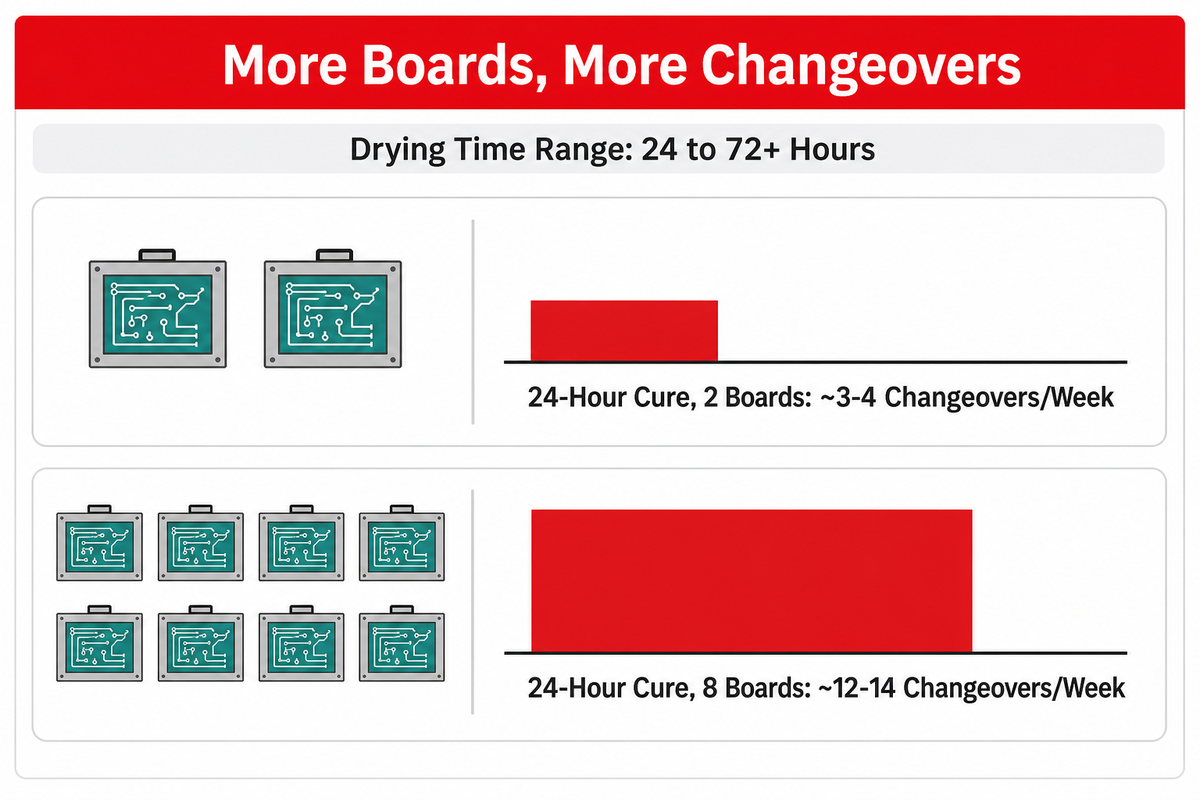
As for starch-molded confectionery, the published process investigations state the general drying time is 24 to 72 hours, or more. The drying time for each individual process would heavily depend on the recipe, thickness of the part, as well as the drying conditions, as opposed to a single, defining time.
When considering the effect of this range in combination with how many print boards a line has in stock, keep in mind that a board is tied up for the entire cure time before it can be used for the next SKU. The table below is an original planning reference for this guide and isn’t from any manufacturer’s documentation. The changeover numbers are an estimate to assist with the planning and don’t represent the final output for any machine.
| Cure/Dry Time Band | Print Boards Available | Realistic Changeovers per Week (modeled) |
|---|---|---|
| 24 hours | 2 boards | ~3-4 |
| 24 hours | 4 boards | ~6-7 |
| 24 hours | 8 boards | ~12-14 |
| 48 hours | 2 boards | ~1-2 |
| 48 hours | 4 boards | ~3-4 |
| 48 hours | 8 boards | ~6-7 |
| 72+ hours | 2 boards | ~1 |
| 72+ hours | 4 boards | ~1-2 |
| 72+ hours | 8 boards | ~3-4 |
Consider this a planning starting point, not a formal specification. A buyer running mostly 72-hour-plus gelatin recipes and expecting frequent SKU changes should ask a supplier directly how many print boards a quoted line includes, since that number affects real-world changeover frequency more than almost any other single line spec; under-ordering boards is a common and expensive mistake that only shows up months later as a production bottleneck. Mild steel and painted boards also have a shorter useful life during repeated cleaning cycles compared to stainless steel, which is worth factoring into total cost. Print tray dimensions on a typical mid-size line run around 820 mm by 400 mm, a useful reference point when checking whether a quoted line’s print-board count and tray size match your target output. Bring both numbers, the cure-time band and the tray size, into the same supplier conversation rather than negotiating them separately.
Starch Dust Safety and Hygienic Design
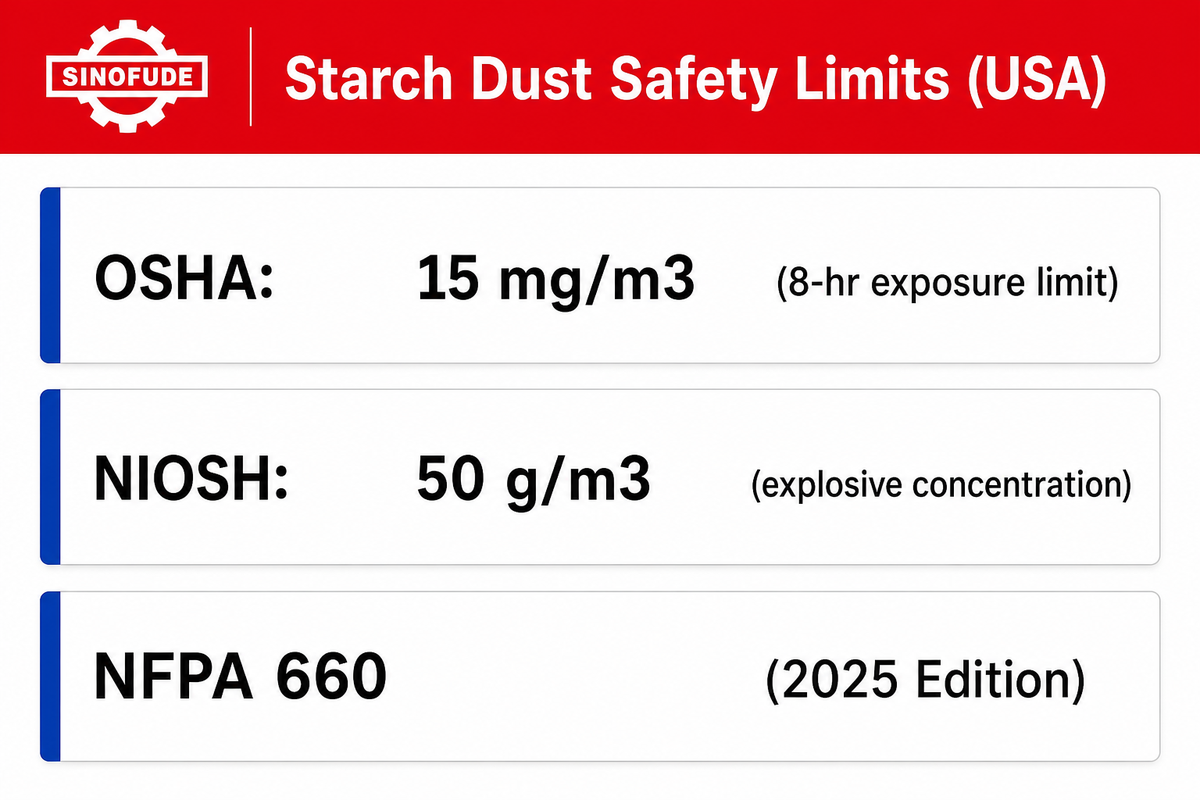
When considering the three different things relating to starch handling lines in the USA, the following is relevant: an OSHA Occupational Exposure Limit, NIOSH explosibility test data, and a 2024-2025 combustible-dust design consolidation now folded into NFPA 660.
OSHA lists an 8-hour permissible exposure limit of 15 mg/m3 for total starch dust and 5 mg/m3 for the respirable fraction. Separately, NIOSH’s Pocket Guide to Chemical Hazards records that dispersed starch dust can form an explosive mixture with air, with a minimum explosive concentration of 50 g/m3. These are buyer-facility hazard inputs, not proof that a particular installation is compliant or explosion-proof, and OSHA itself states plainly that NFPA consensus standards, including its combustible-dust standards, “aren’t OSHA regulations.” The engineering-design side of that hazard is now covered by NFPA 660, which as of its 2025 edition (effective December 2024) has absorbed NFPA 61, the older standard written specifically for fires and dust explosions in agricultural and food-processing facilities, making this a genuinely current 2024-2025 standard-consolidation event rather than a settled legacy rule; NFPA’s own page confirms that NFPA 61’s 2020 edition is its last published edition as a stand-alone standard. In each jurisdiction, regulations and compliance enforcement for that standard are still under the authority having jurisdiction and the insurance provider, so it is worth verifying a supplier’s claim of compliance rather than taking that claim as is. All references (above) indicate the same practical hygiene and safety measure, which is effective dust extraction, as a reduction in waste during starch reclamation and a reduction in airborne dust.
The moisture mechanism from the previous section connects directly here: starches that are too dry do more than just fail to keep their shape; they actually start to become dustier, which increases the risk for exposure and explosion. That link matters more now than it would have a few years ago: it sits inside a genuinely current 2024-2025 standard-consolidation event, with NFPA 660’s 2025 edition absorbing the older NFPA 61 dust-explosion standard effective December 2024. Two companies outside the US that base their equipment directly on this hazard are tna’s mogul line, which is described as an “ATEX Compliant Design”, and Winkler und Dunnebier’s starch conditioning system, built “in accordance with latest explosion prevention (ATEX)”, while also providing a bacteria-reduction function in the moulding starch, which is a hygiene feature that differentiates the dust safety problem. From a US regulatory perspective, 21 CFR 117.40 requires food equipment to be designed to be easily cleanable, requires automated and conveying systems to be maintained in a clean and sanitary condition, and requires compressed air that contacts food to be treated and not allowed to contaminate the product, framed as buyer validation inputs instead of an installation specific compliance commitment. Taken together, the dust-hazard numbers and the hygienic-design rule cover two different risks the same starch-handling system creates, and a buyer should ask a supplier about both, not just whichever one the sales material emphasizes.
Why Starch Mogul Technology Still Matters
Starch mogul lines continue to be in production for a simple reason: the starch bed absorbs process variability that a starchless line will have to push onto the recipe and the cooling tunnel, which makes the technology actually useful for gelatin-heavy, multi-SKU production, as compared to making it a holdover awaiting replacement.
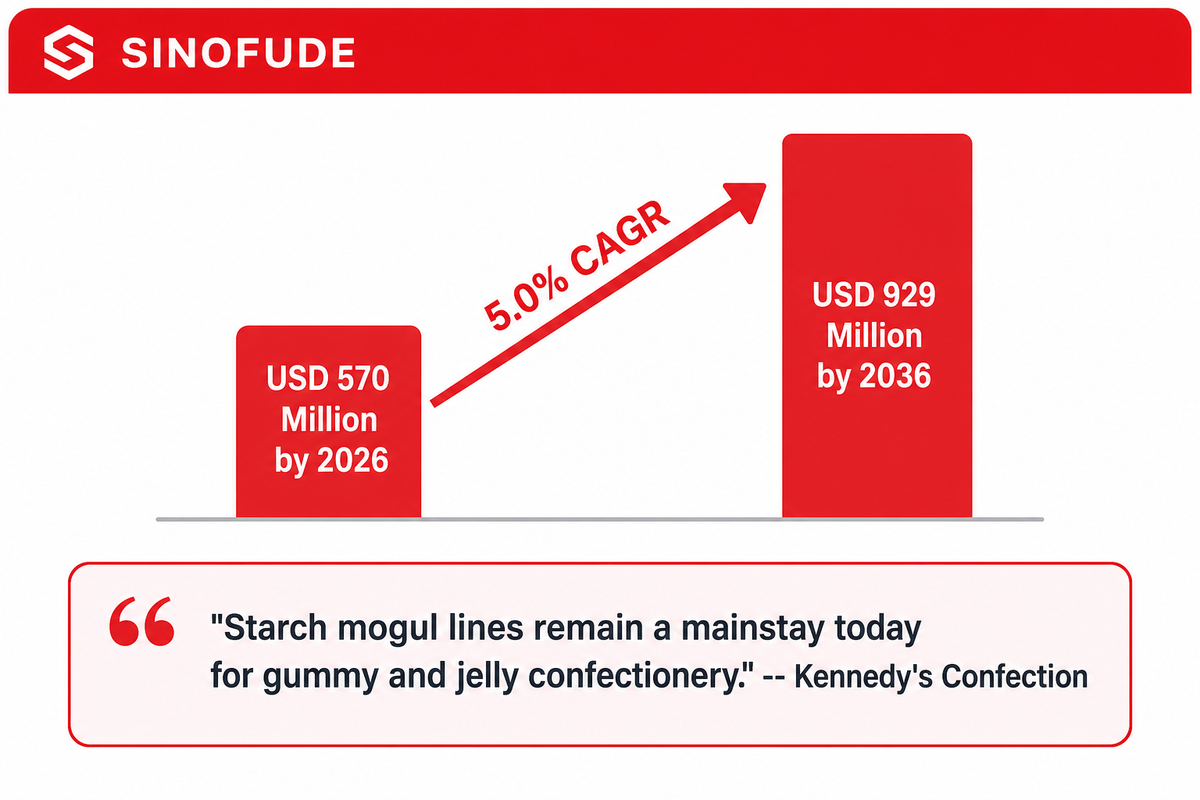
This is also why independent 2026 English-language trade press still treats it as current rather than legacy. UK confectionery publication Kennedy’s Confection states that “starch mogul lines remain a mainstay today for gummy and jelly confectionery.” This lines up with what a live search on this equipment reveals: multiple independently operated vendors across China, Serbia, Germany, and the tna/Baker Perkins family are actively marketing new lines for this exact category, not clearing out an outdated product line.
Market-size figures for the broader molding starch category add supporting context, though they should be read as directional rather than audited: one market-research vendor’s public summary projects the global molding starch market at roughly USD 570 million by the end of 2026, growing at a 5.0% compound annual rate to roughly USD 929 million by 2036. That figure describes the ingredient market, not installed equipment demand, so it’s worth treating as background color rather than as proof of any particular growth rate for starch mogul lines themselves. A closer look at how the existing search results for this exact keyword are already scored supports the same picture: across the 7 ranked competing pages benchmarked for this guide, content scores run as high as 86 against a 91-point target set for this article, and the single highest-scoring competitor, a step-by-step starch mogul guide from gummymaking.com, has 0 measured organic traffic and only 1 referring domain on that page. The opening here isn’t a stronger incumbent to out-rank; it’s the depth those existing guides never built.
Buyer’s Decision Framework: Choosing a Starch Mogul Line Supplier
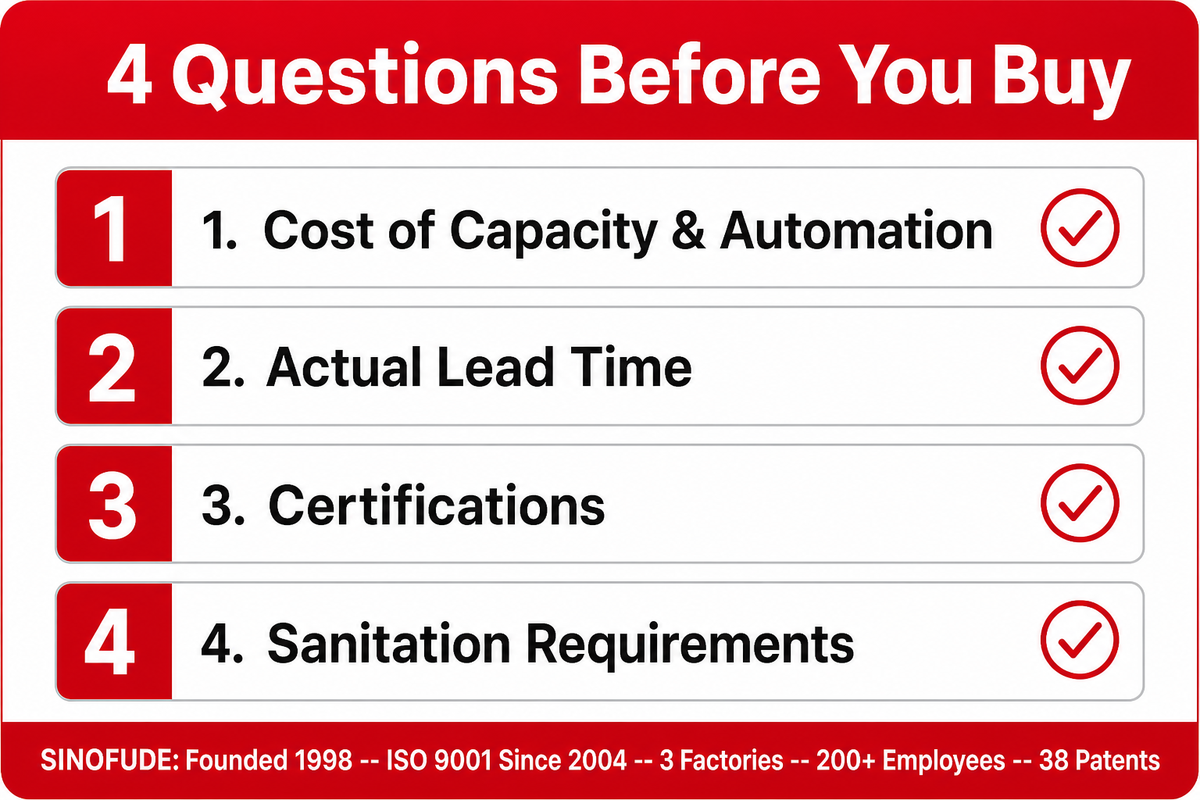
Skipping straight to price is a common and risky shortcut. Prior to purchasing a starch mogul line, buyers need to obtain answers on 4 topics: cost of the required capacity and automation level, what the lead time will actually be, what certifications the supplier can actually present, and what level of sanitation of the starch system is required on a day to day basis. Each of those four topics is covered in turn below.
- Cost: pricing spans a wide range, from roughly $20,000-30,000 for small pilot-scale units producing around 80-100 kg/h up to high six figures for full industrial lines with multiple depositor pumps running at 3,200 kg/h or more; ask for a quote scoped to your specific capacity, automation level, and product mix rather than comparing headline numbers across suppliers.
- Lead time: Schedule length will vary based on customization and type of depositor pumps, so agree on delivery timelines in writing.
- Certifications: verify what type of certifications the supplier can provide for the equipment and for the factory itself, such as ISO 9001 quality management and CE marking for the machinery; treat any affirmation of hygienic design or explosion safety as your starting point for verification rather than a complete answer.
- Sanitation is worth confirming too: ask what obligations, in terms of cleaning, the starch reclaim, de-starching, and dust control systems place on the user, since this is a real ongoing operating cost rather than a one-time installation cost.
- Downstream integration matters too: confirm whether the quoted food machine includes finishing machines and machines for packing or whether these are to be sourced separately, as this will change both the total cost and the duration of the installation.
Suppliers who have been in the business of building jelly candy starch mogul lines and candy making equipment will have more pertinent advanced answers to these questions than newer suppliers, so ask how long the specific gummy machine model you’re considering has been in commercial service. SINOFUDE, for instance, is a Shanghai-based manufacturer founded in 1998 that has been ISO 9001-certified since 2004, runs three factories with more than 200 employees across confectionery, baking, and chocolate equipment divisions, and holds 38 patents; a supplier’s manufacturing history and credentials are worth checking against those same production-scale claims.
If your evaluation gets to the point of evaluating a specific model’s specifications, SINOFUDE’s page on the industrial starch mogul production line outlines the specifications for the CLMS range, including where each tier falls in terms of utility requirements.
Frequently Asked Questions
What’s a starch mogul production line?
A starch mogul production line is confectionery equipment that deposits gummy or jelly slurry into cavities that are stamped into a bed of dry, conditioned starch. This equipment cures the product and a separate stage of demoulds it while reclaiming the starch for reuse. The starch mogul production line is one of two methods used to shape and cure soft candy, the other being starchless servo depositing.
How much does a starch mogul production line cost?
Cost will depend on both capacity and level of automation. Small pilot-scale units are priced between USD 20,000-30,000, but fully automated multiple pump depositor systems with integrated starch reclaim systems can be in the range of tens of thousands to hundreds of thousands of dollars. Get a quote that’s targeted towards your expected throughput and product variety. Don’t use published pricing as a benchmark.
What’s the typical lead time for a starch mogul production line?
Lead time is heavily based on the level of customization, depositor type, and tooling, and suppliers will quote differently. Confirm the delivery time as part of the quote rather than accepting the verbal estimate, as a heavily customized system can take significantly longer compared to a pre-made system.
Can the line handle pectin or vegan gelling agents?
In most cases, yes. Modern starch mogul systems are capable of handling pectin and agar gelling systems as well as other non-gelatin gelling systems, but keep in mind that drying and setting the profiles may require some experimentation and require validation for your recipe.
Do I need to buy a starch reclamation system?
In practice, yes. Reclaiming and reconditioning starch is central to running a mogul line economically, since food-grade starch is a recurring input cost and a complete reclaim loop eliminates waste and reduces the dust load as described in the safety section. Reclaim systems usually consist of sieving to remove candy residue, de-dusting and moisture reconditioning before the starch is placed back into tray filling. Skipping this increases starch consumption and removes a corrective action to keep the moisture window within the acceptable range as explained in this section. Make a supplier show you their reclaim-loop design and explain how their system addresses the pre-sifting rather than putting “starch recycling” on their specifications.
References & Sources
- U.S. Food and Drug Administration, 21 CFR 117.40, Code of Federal Regulations
- Occupational Safety and Health Administration, starch chemical exposure data
- Occupational Safety and Health Administration, Combustible Dust Consensus Standards
- National Institute for Occupational Safety and Health, NIOSH Pocket Guide to Chemical Hazards: starch
- National Fire Protection Association, NFPA 61 Standard Development
- ScienceDirect, peer-reviewed starch-molding process research
- U.S. Patent and Trademark Office via Google Patents, US20230082291A1
- CAPOL GmbH, How to prevent smearing in the packaging of gums and jellies
- Confectionery Production, ProSweets sees key launch for Baker Perkins starch-free gummy depositing system
- Kennedy’s Confection, Shaping up to meet fast-changing consumer demands
- Wikipedia, Starch mogul



