
Get in Touch with SINOFUDE Company

Line Capacity & Cost Planner for Industrial Gummy Production
A capacity case is what we create with your project boundary, sellable output target, piece weight, and production calendar. Assumptions remain visible because we cannot justify a single gummy production line cost without the recipe, losses, utilities, modules and packaging.
- Sellable-output basis
- Separate operating factors
- Hidden-bottleneck review
- Like-for-like quote scope


Define released demand and the operating calendar.
Separate availability, speed and quality factors.
Find the slowest qualified process checkpoint.
Normalize line scope before comparing price.
Required nominal kg/h = sellable kg/h ÷ combined operating factor
Capacity and Cost Planning Scope
This page is a template for a project: gummy manufacturing equipment, prior to detailed engineering. The output is a complete scenario with clearly articulated inputs and output in the form of an RFQ rather than a selected machine.
Our planning begins with released product required per day or year, not maximum depositor motion.
Our calculation divides by buyer-entered operating factors and keeps every factor visible.
Our review compares preparation, depositing, setting, demolding, optional residence and packaging.
Our comparison aligns included modules and buyer responsibilities before quoted totals are compared.
What the Planner Can and Cannot Do
It can help us
- Convert demand into a preliminary nominal capacity case
- Expose missing product, schedule and scope inputs
- Compare supplier boundaries on the same row set
- Prepare a more complete technical conversation
It cannot establish by itself
- Guaranteed installed output or first-pass yield
- A final candy making machine price
- Compliance for an unspecified destination and configuration
- ROI, payback, staffing or utility savings
Decision Boundary
Decision boundary. Our scenario becomes ready for engineering review only when the recipe route, piece definition, production calendar, loss basis, required modules, packaging hand-off and site responsibilities are stated.
- Teams may quote daily demand, but it can still be difficult to arrive at a defensible nominal line rate.
- A depositor speed can be confused with finished line released output.
- Supplier quotes may appear comparable, but can actually exclude different modules and responsibilities.
- A common assumption is that the highest individual-machine rate defines line capacity. Instead, the comparison covers our full qualified process.
- The largest module is not always the best fit. Released demand, recipe behavior and the slowest accepted stage set our sizing basis.
- The cheapest quoted total is not necessarily the lowest project cost. Quote comparison begins when we normalize exclusions, interfaces and site work.
Production Inputs That Set the Capacity Case
Our review needs the product geometry and demand. A target of pieces per hour means very little without piece weight, and a target of kg per hour doesn’t tell us if it’s possible to release a sufficient number of good pieces in the line.
- Gelatin, pectin or other defined system
- Piece weight and geometry
- Solids, temperature and viscosity behavior
- Layers, colors, filling or functional ingredients
- Sellable kg/day or units/day
- Hours per shift and shifts per day
- Operating days and seasonal peaks
- SKU mix and changeover pattern
- Quality acceptance basis
- Cooling and demolding condition
- Optional conditioning residence
- Finishing and packaging interface
| Input | Valid planning format | Why we ask |
|---|---|---|
| Sellable demand | Greater than 0 kg/day | Defines the released production target |
| Scheduled operating time | Greater than 0 h/day | Converts daily demand into an hourly need |
| Piece weight | Greater than 0 g/piece | Converts mass rate into pieces per hour |
| Availability | 0–100% buyer-entered | Represents scheduled-time availability |
| Performance/speed factor | 0–100% buyer-entered | Separates qualified running speed from availability |
| Quality/yield factor | 0–100% buyer-entered | Separates accepted output from produced output |
| Process-yield factor | 0–100% buyer-entered | Records a distinct recipe or mass-loss basis when used |
| Operating days | At least 1 day/year | Builds an annual scenario without a hidden calendar |
| RFQ term | How we use it in the decision |
|---|---|
| Gummy candy production line | Our definition covers the connected production process, not one depositor alone. |
| Production capacity | Our model separates required sellable output from nominal production equipment rate. |
| Initial investment | Our comparison starts only after the quoted scope and site boundary are aligned. |
| Operational costs and labor costs | Our worksheet uses buyer staffing, tariffs, maintenance and measured loss assumptions. |
| Level of automation | Our scope defines which controls, hand-offs, inspections and automated packaging tasks are included. |
| Cooling tunnel | Our review covers setting, mold circulation, demolding and qualified release rate. |
| Production efficiency | Our model keeps availability, performance and quality factors separate. |
| Production volume | Our scenario binds the volume to a day, year, SKU mix and saleable-product definition. |
| Temperature control | Our specification treats recipe condition as a production requirement, not a generic promise. |
| Customized solutions | Our page uses this phrase only after product and integration inputs define what changes. |
| Pectin gummy | Our input record treats it as a recipe route that may change process and residence needs. |
| Gummies per hour | Our calculation derives pieces from the buyer’s piece weight and sellable mass rate. |
| High-capacity line | Our planning requires a stated numeric case instead of using the label as a specification. |
| Conveyor interface | Our interface review identifies product condition, accumulation, controls and ownership at the hand-off. |
| Candy production manufacturer | Our selection still requires project-specific evidence before a configuration is chosen. |
| Automation | Our quotation maps what is automatic, operator-assisted or buyer-local. |
PROCEDURE NOTE
Avoid double counting. If planned downtime is already removed from scheduled hours, we do not reduce availability for the same downtime again. Rejected pieces stay visible in our quality factor instead of being buried inside speed.
Sellable Output and Nominal Capacity Calculation
Our calculation works backward from the good product the business requires. The result is a rate that tells us what sets of the process require further analysis; it is not a commitment that a yet unproven recipe will result in the rate achieved.
Calculation Steps
-
01
Daily target
Enter sellable kilograms and scheduled hours.
-
02
Hourly release
Divide daily sellable kilograms by scheduled hours.
-
03
Piece demand
Convert kilograms with the declared piece weight.
-
04
Loss factors
Apply availability, speed, quality and optional process yield.
-
05
Nominal review
Compare the required rate with every qualified stage.
Formula Set
-
Sellable kg/h = sellable kg/day ÷ scheduled h/dayThe schedule must be positive and must use the same production-day basis as demand.
-
Sellable pieces/h = sellable kg/h × 1,000 ÷ g/piecePiece weight must be positive and must represent the product used in this scenario.
-
Combined factor = availability × speed × quality × process yieldEach percentage is entered separately as a decimal and none may be zero for sizing.
-
Required nominal kg/h = sellable kg/h ÷ combined factorWe round for discussion only after retaining the underlying inputs and units.
Unit boundary. Piece-rate conversion uses piece weight in our model to convert the mass requirement into pieces per hour. It does not change required nominal kg/h when the sellable mass demand and operating factors stay fixed.
SINOFUDE PLANNING NOTE
Nominal, qualified and released rates are not interchangeable because hidden assumptions create a sizing risk. The wrong choice costs you diagnostic time after installation, while the real trade-off may be schedule, recipe stability, footprint or scope rather than nameplate speed. NIST operations-driven performance measurement serves as public context for keeping our operational measures tied to the manufacturing decision, not as proof of a SINOFUDE result.
Complete Line and Standalone Depositor Boundary
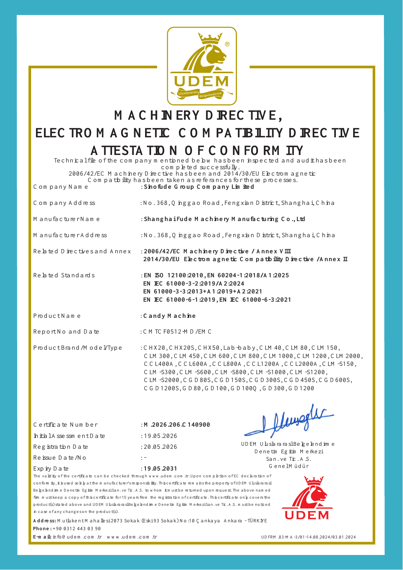
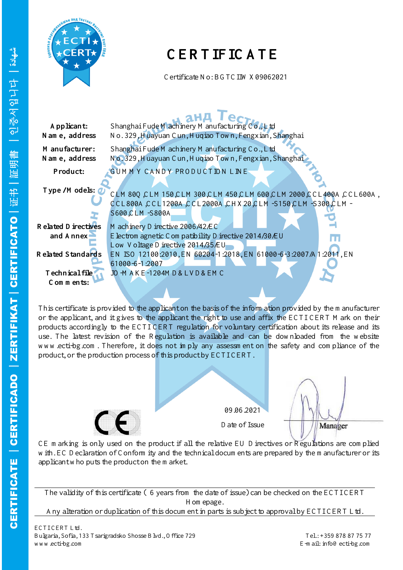
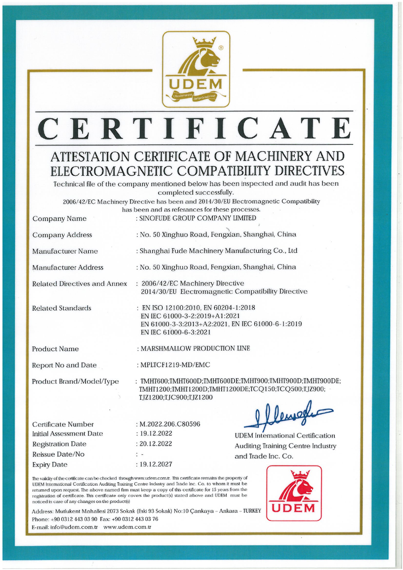
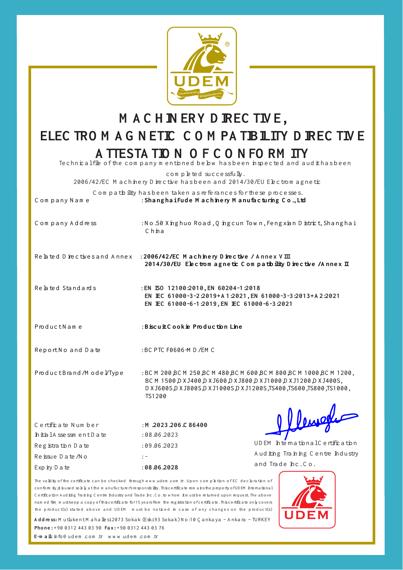
We distinguish a full production responsibility from a single machine supply without assigning a general legal label. A depositor can be a valid purchase when responsibility for the surrounding process, controls and acceptance is explicitly assigned to the buyer or integrator. For EU-bound projects, we use EURegulation (EU) 2023/1230 as one input when defining integration responsibilities; it is not a blanket compliance conclusion.
| Scope question | Complete-line review | Standalone-depositor review |
|---|---|---|
| Upstream mass preparation | Included or explicitly interfaced | Buyer/integrator defines feed condition |
| Molds and circulation | Coordinated with line rate | Compatibility and ownership confirmed |
| Cooling and demolding | Qualified as part of line release | External capacity and handshake confirmed |
| Finishing and packaging | Included or bounded by a hand-off | Normally outside unless quoted |
| Controls and guarding integration | Defined across the quoted system | Integrator responsibility must be explicit |
| Finished-line acceptance | Possible when full test scope is agreed | Machine test does not prove external line output |
Use a Standalone Unit When
- The feed condition and controls interface are already engineered.
- Molds, cooling, demolding and packaging capacity are independently proven.
- Guarding, utilities and line-risk ownership are assigned.
- The acceptance test is limited to what the supplied unit can demonstrate.
Use an integrated line review when
- The slowest stage or residence requirement is unknown.
- Recipe transfer and product-release criteria need joint trials.
- Multiple vendors would otherwise leave interface gaps.
- The buyer needs one normalized capacity and acceptance basis.
Quote Normalization and RFQ Inputs
We make sure each supplier answers the same questions before evaluating prices. A lower quoted price is not a lower project cost because the molds, utilities, controls, packaging interface, and validation or installation work may be outside the quoted boundary.

Technical RFQ package
- Product family, recipe route and piece definition
- Sellable output and production calendar
- Separate operating-factor assumptions
- SKU mix, molds and changeover sequence
- Cooling, optional residence and packaging hand-off
Commercial comparison package
- Included, optional, excluded and buyer-local rows
- Freight, duties, installation and commissioning
- Documentation, training and spare-parts boundary
- Factory and site acceptance stages
- Assumptions, validity and unresolved interfaces
Quote Normalization Matrix
| Scope row | Allowed status | Comparison rule |
|---|---|---|
| Preparation and cooking | Included / optional / excluded / buyer-local / unknown | State batch, transfer and controls boundary |
| Depositing and molds | Included / optional / excluded / buyer-local / unknown | State SKU count and qualification basis |
| Cooling and demolding | Included / optional / excluded / buyer-local / unknown | State the release and interface basis |
| Residence and finishing | Included / optional / not required / buyer-local / unknown | Do not assume the recipe requires this step |
| Packaging interface | Included / optional / excluded / buyer-local / unknown | State accumulated product and control hand-off |
| Installation and acceptance | Included / optional / excluded / buyer-local / unknown | Separate factory, integration and site stages |
SINOFUDE First-Party Company Context
This is our company profile, not an independent statement on the results of the gummy lines we quoted. The quote confirms the project configuration, the documentation we will provide and the scope of our acceptance.
We confirm product, market, output and scope language.
We convert demand into an assumption-visible capacity case.
We test bottlenecks, residence and responsibility gaps.
We align modules and interfaces to the reviewed case.
We state included scope, exclusions and acceptance steps.
Company development
We were founded in 1998 and are located in Fengxian District, Shanghai. We have developed from one factory to three factories with more than 30 acres in total and more than 200 employees.
Product focus
We organize our equipment work into confectionery, baking and chocolate divisions. We use that cross-category process experience when we map interfaces in a gummy project.
Management system
Our ISO 9001 management system was introduced in 2004. We treat that company-history statement separately from product- or project-specific certification.
Process investment
We use high-power laser cutting for complex parts, together with laser welding and CNC processing equipment. We also use friction and tube welding methods within our stated manufacturing capability.
Machining capability
We use CNC sawing and wire cutting to support part accuracy and processing efficiency. We also use machining centers, inclined-rail lathes, drilling and gantry-milling equipment.
Innovation context
We state that our company holds 38 product patents. We do not use that company-level count as proof of this planner’s output, cost or project performance.
PROCEDURE STATEMENT
Project-specific evidence wins. Our company history does not replace recipe data, stage-rate evidence, drawings, utility information or written acceptance criteria. Those project inputs guide what we can responsibly propose.
Production Line Planning Tools
Line Capacity and Cost Questions
We cannot give a defensible total until “machine” is defined as a depositor, a process island or a complete line. Pricing in our proposal follows the agreed capacity case, modules, molds, controls, utilities boundary, packaging interface, project services and acceptance scope.
Our review covers sellable output, piece and recipe requirements, operating calendar, equipment modules, residence time, SKU changes, controls, site interfaces and acceptance work. Freight, installation and buyer-local scope also need the same comparison boundary.
No. Our bottleneck comparison uses the qualified release rate of cooking, transfer, depositing, cooling, demolding, any required residence step and packaging before naming a line constraint.
Our formula divides sellable kg/day by scheduled hours/day, then divides the hourly result by separate buyer-entered availability, speed, quality and process-yield factors. A separate check prevents the same downtime or loss from being counted twice.
No. Our scope includes conditioning residence and WIP only when the defined recipe and process route require that stage.
No. It organizes the capacity and scope discussion, while recipe trials, interface data and engineering review determine the final equipment configuration.
Only when their capacity basis, included modules, molds, controls, utilities, installation, documentation and acceptance responsibilities are normalized. Our comparison marks unresolved rows as unknown instead of assuming equivalence.
No. Our process uses destination-market requirements as project inputs, then defines the supplier, integrator and buyer responsibilities for the actual configuration.



