
Get in Touch with SINOFUDE Company

CIP Cleaning System for Confectionery Production Lines
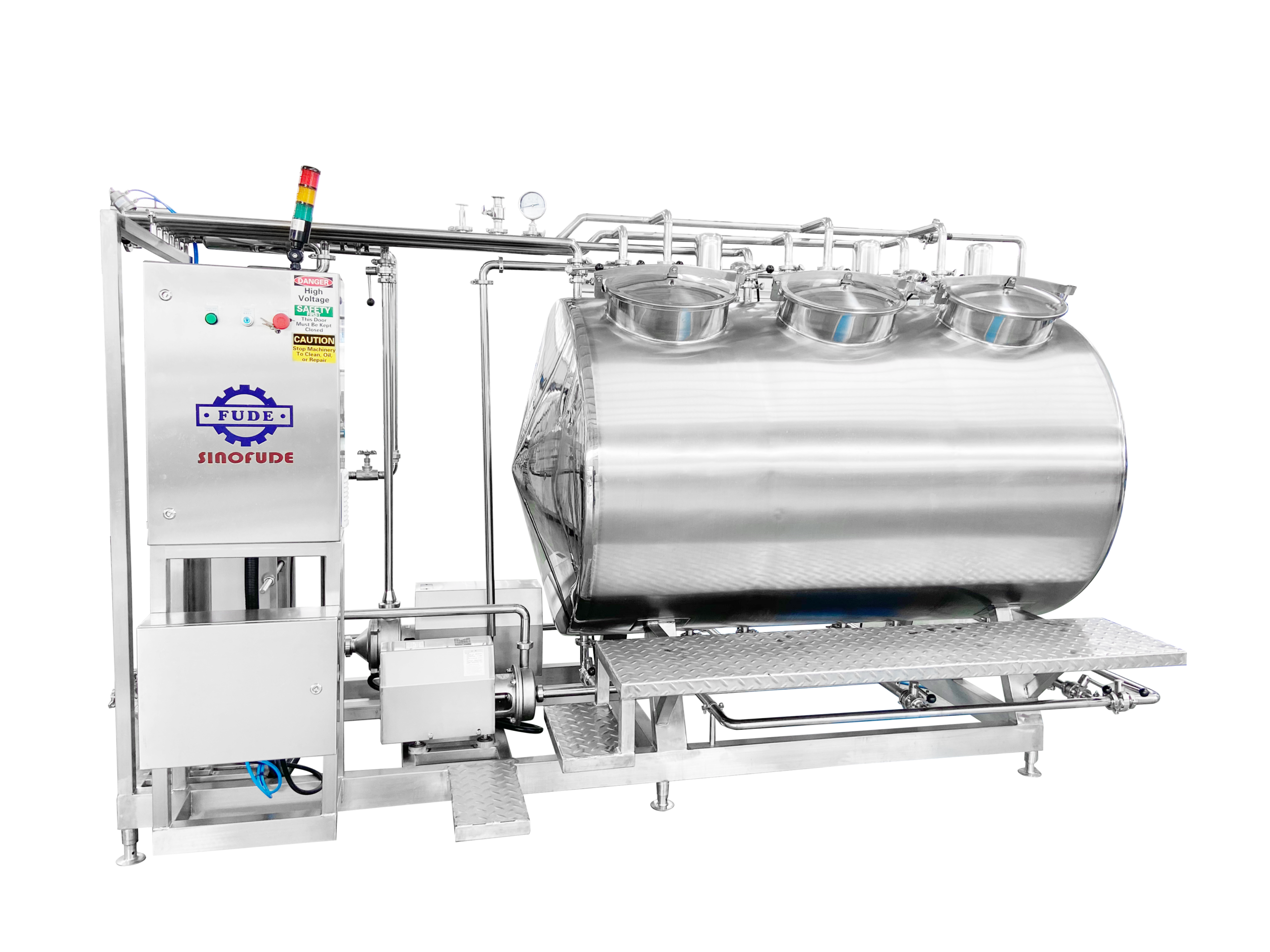
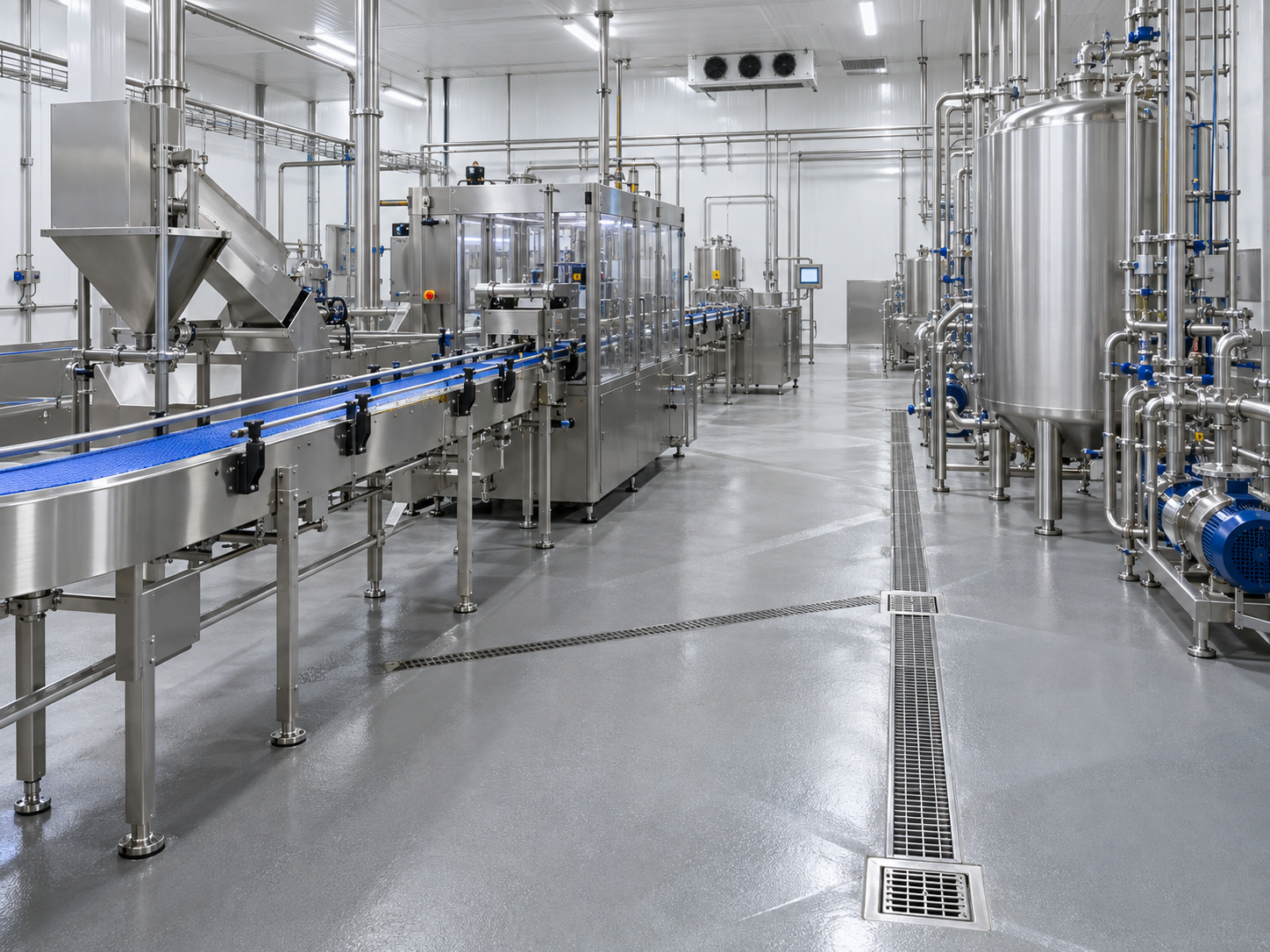
SINOFUDE CIP cleaning systems clean confectionery lines in place: cookers, pumps, depositing heads and pipework, without disassembly. The cleaning program is set for each production line and tailored to the constraints of the production equipment and layout, as opposed to a generic recipe being applied to all equipment.
- 2–3 cleaning circuits per reference line for gummy, popping boba, hard candy and marshmallow duties.
- Four water-cleaned reference programs with documented temperature, time, chemical concentration and water use.
- Retained run records for 2-3 years on the relevant configuration of the line.
- 12-month warranty for the whole machine, counted from completion of installation.
Specifications
These figures describe the confirmed line programs below. Tank capacity, pump duty, heating arrangement and control scope are engineered with the production line and fixed in the quotation.
Reference circuits
2–3 per line
Reference water
1.0–1.8 t per cycle
Run-record retention
2–3 years
Pure chocolate paths
non-water route
Warranty
12 months from installation completion
Clean-in-Place Equipment and CIP Skid Configuration by Circuit
When performing cleaning in place, the circuit boundary is set by what the cleaning solution must reach, and the pipe layout determines the cleaning-solution route.[4] Pipe diameter, route length, equipment hold-up, valve arrangement, elevation and the spray device decide the hydraulic duty. Soil on the equipment defines the cleaning cycle and the tests required before processing can resume.
How the CIP System Is Supplied
For gummy, popping boba, konjac, hard candy, lollipop, marshmallow, toffee and fondant projects, the CIP cleaning system is quoted as a separate line item within the SINOFUDE production-line quotation. A skid quote is hard to compare unless the return, heating, chemical dosing, recording method and document pack are explicit.
Gummy line
3 CIRCUITS covering the sugar-dissolving section; the cooking and metering-pump section; and the depositing head with its hopper and distributor.
Popping boba line
3 CIRCUITS covering the core-liquid pipeline; calcium-bath and circulation loop; finished-product pasteurisation line.
Hard candy / lollipop line
2 CIRCUITS covering the dissolving and cooking sections, including the path where sugar scale can restrict heat transfer.
Marshmallow / fondant line
2 CIRCUITS covering the cooking section; aeration and extrusion-head section where gelatin and sugar residues must be dissolved.
What the Skid Carries
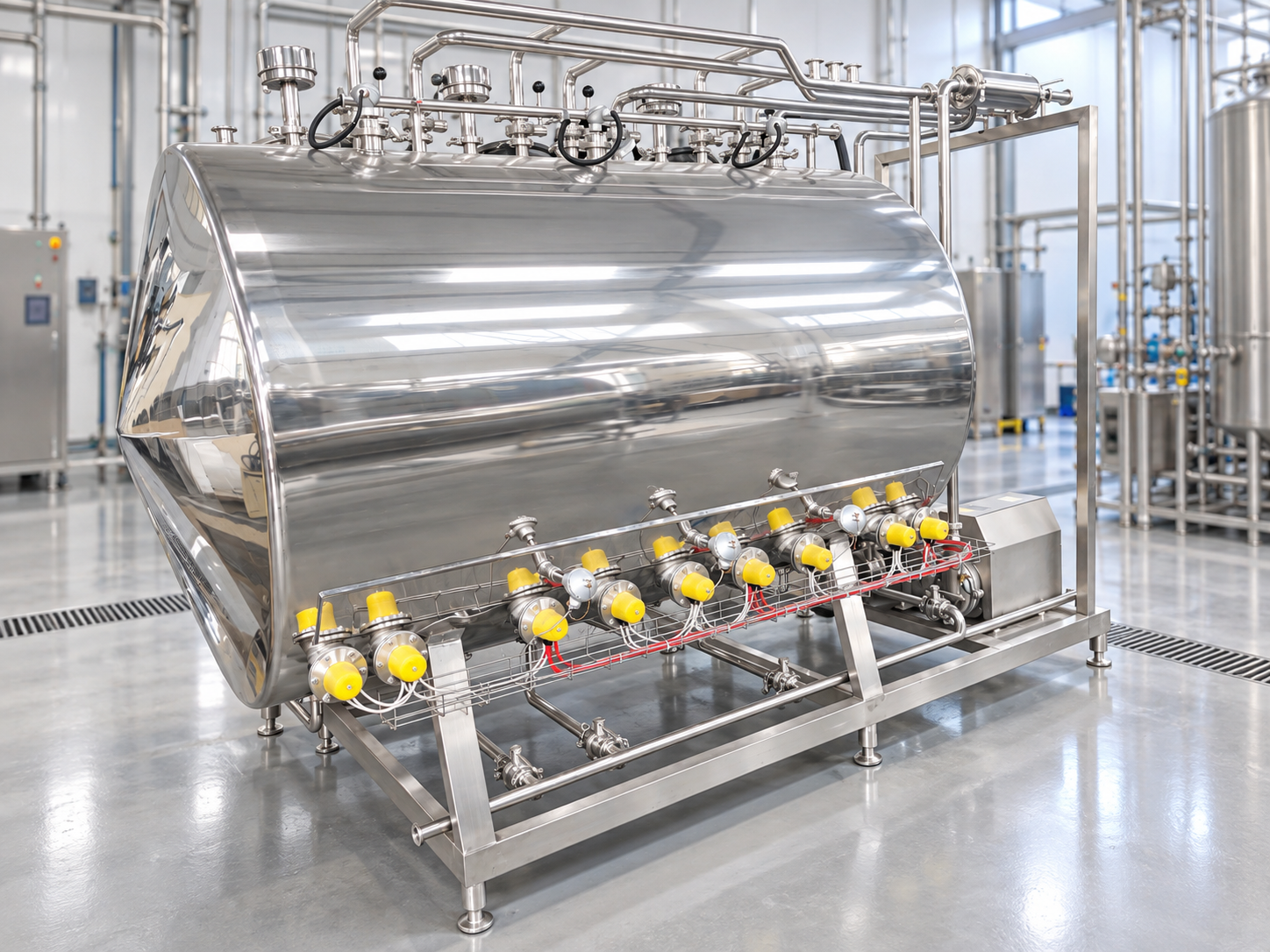
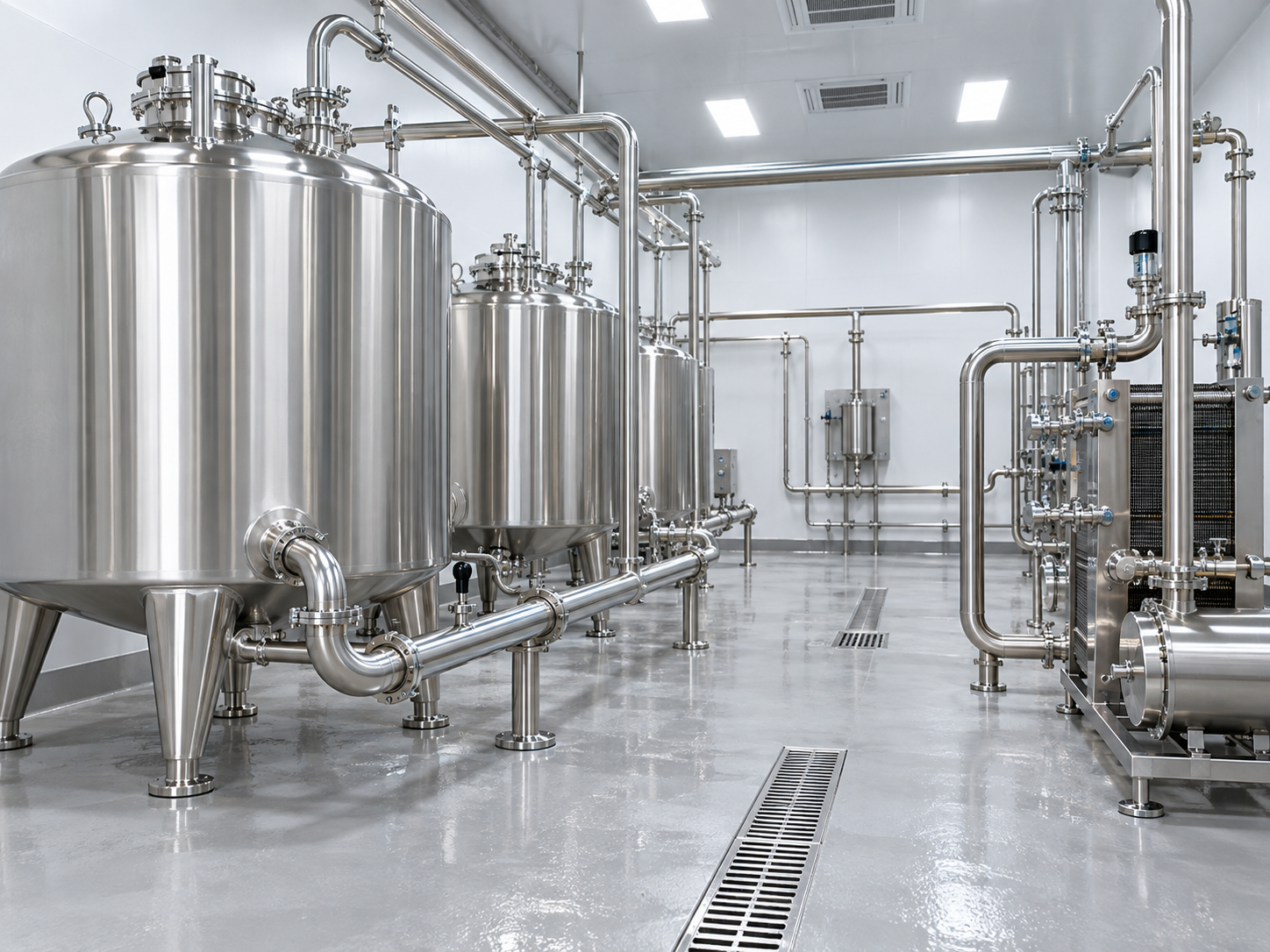
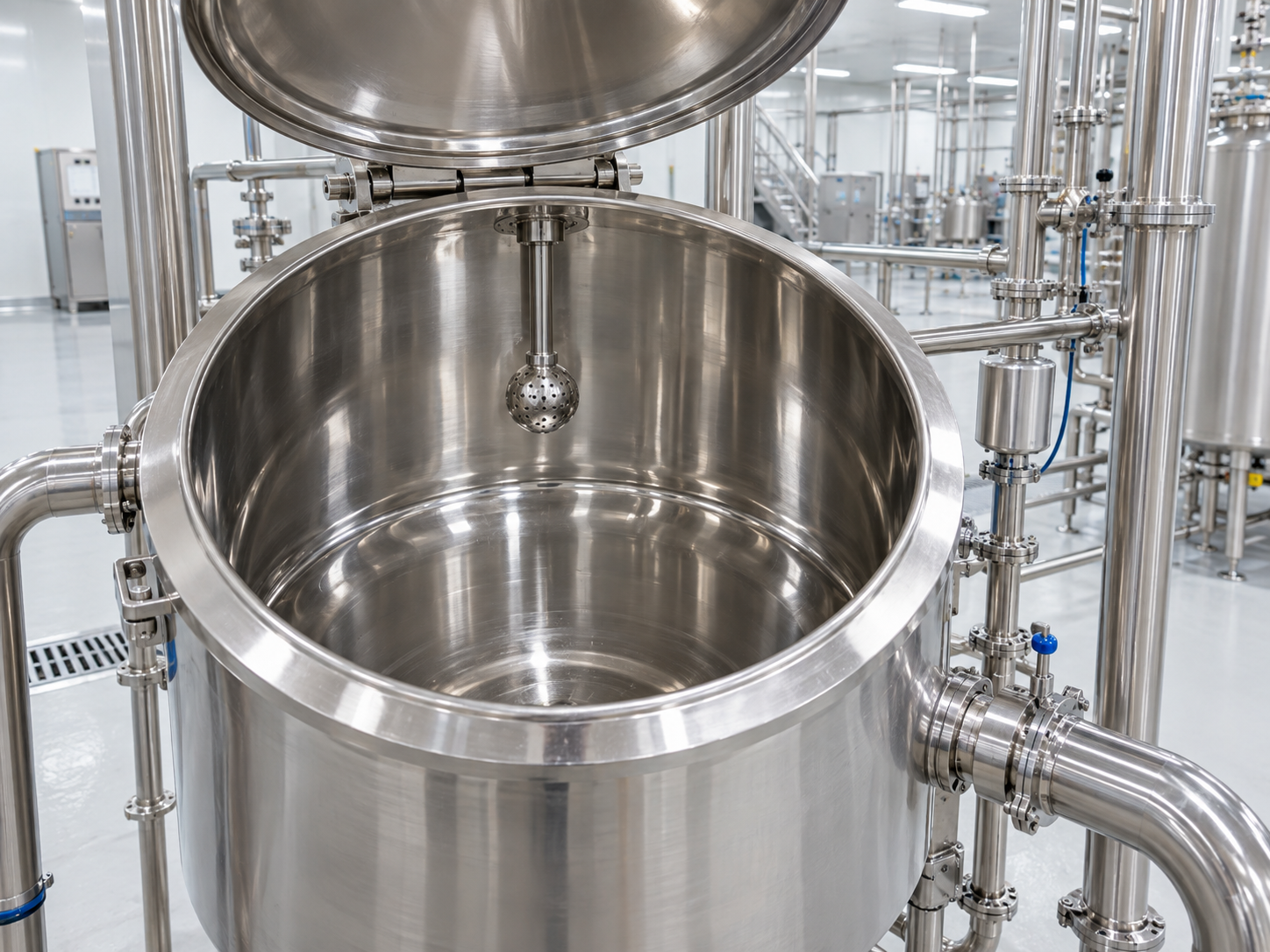
The final process equipment design incorporates solution storage/staging, a sanitary supply pump, return pipework, valves, a heating method, instrumentation, controls, and a recording facility. Where a vessel or depositor requires impingement, the design also includes impingement devices (such as a CIP spray ball). The design captures the responsibility and extent of coverage of these devices.
Hydraulic Review
Heat exchangers, cooking coils and long transfer runs need their own review because the easiest visible surface is rarely the limiting location. The quotation therefore fixes circuit boundaries first, then checks the required flow rate, return condition, temperature control and detergent contact step.
One Tank, Several Compartments or a Mobile Unit
A buyer can choose the wrong CIP unit when sizing starts with tank capacity instead of the number and geometry of the objects being cleaned. A portable CIP Skid is a type of portable CIP system, and a fixed multi-compartment system addresses a different routing and recovery issue. Tank size and the geometry of the CIP circuit should be considered when selecting a CIP system.
| Architecture | Best purchasing question | Trade-off to close in the quotation |
|---|---|---|
| Single tank or portable unit | Can one solution be prepared, used and fully cleared before the next step? | Lower footprint, but more changeover and recovery decisions. |
| Fixed multi-compartment skid | Which rinse, caustic or acid streams need separation, recovery or dedicated storage? | More piping and controls, with faster sequencing when the line justifies it. |
| Distributed return arrangement | Can every remote branch drain and return without a stagnant pocket? | Routing, elevation and valve logic become central to cleanability. |
Automation and Run Records
An automated CIP system should automate the approved sequence, not conceal an undefined one. The control system coordinates fill, heat, circulate, dose, drain and rinse conditions; the buyer and supplier still agree the permissives, alarms, sampling points and release authority.
Gummy-line cycles are archived in SCADA for 3 years.
Hard-candy temperature and time curves are stored by a paperless recorder for 2 years.
Marshmallow CIP run curves are retained for 2 years.
Popping-boba pasteurisation and CIP data are kept for 3 years automatically.
CIP Chemistry for Confectionery Soils: Hot Water, Caustic and Acid
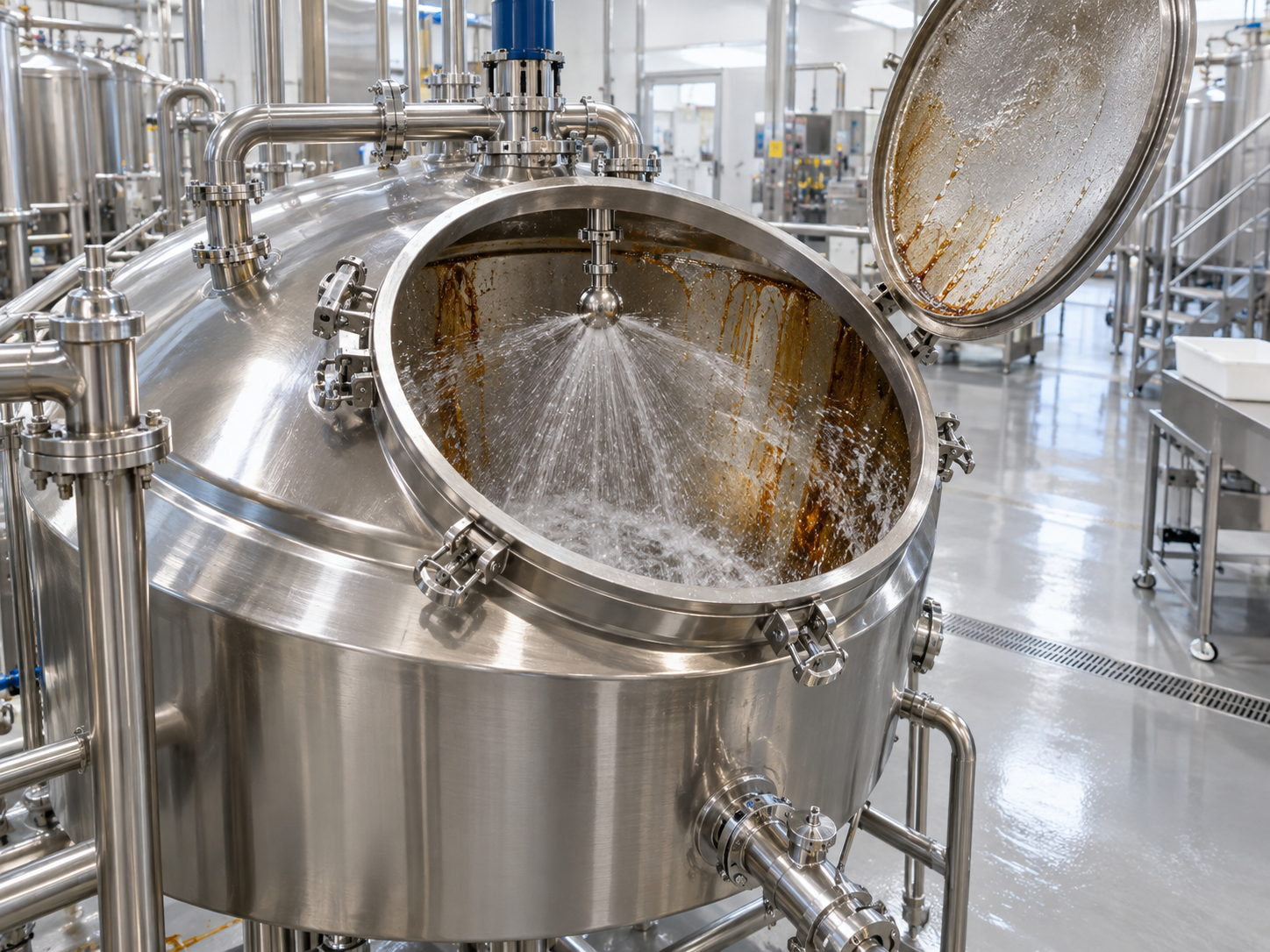
Water temperature, detergent type, contact time and mechanical action work as a set.[4] A hotter or stronger solution does not rescue poor coverage, low velocity or a branch that cannot drain; it is not a substitute for hydraulic verification. Food-soil research likewise shows that the composition and condition of the deposit change cleanability, so the residue must be identified before a CIP process is commissioned.[5]
| Residue and line | Reference cleaning route | Release check |
|---|---|---|
| Gelatin, pectin or carrageenan gummy residue | 2.0% NaOH at 80 °C / 176 °F for 20 min, plus 1.5% HNO3 at 65 °C / 149 °F for 15 min | Final-rinse conductivity below 5 µS/cm, with periodic ATP surface swabs |
| Alginate and calcium residue on popping-boba equipment | 85 °C / 185 °F hot water for 20 min, then 2.0% caustic at 75 °C / 167 °F for 20 min | Free calcium ion residue test and ATP check |
| Sugar scale on hard-candy cooking equipment | 85 °C / 185 °F hot water for 20 min, then 1.5% caustic at 80 °C / 176 °F for 15 min | Visual no-sugar-scale check and final-rinse conductivity check |
| Gelatin and sugar on marshmallow / fondant equipment | 75–85 °C / 167–185 °F hot water for 30 min, then 1.5% NaOH at 70 °C / 158 °F for 15 min | Final-rinse Brix below 0.1% plus ATP surface swab |
| Cocoa butter and chocolate on pure chocolate paths | Non-water warm fat or vegetable-oil flush circulation plus scraper removal | Allergen rapid-test cards and microbiological sampling |
| Water-soluble coatings on a chocolate line | Water wash followed by an engineered hot-air drying circuit at 80 °C / 176 °F for 4 hours | Dryness, allergen and microbiological checks in the buyer’s release plan |
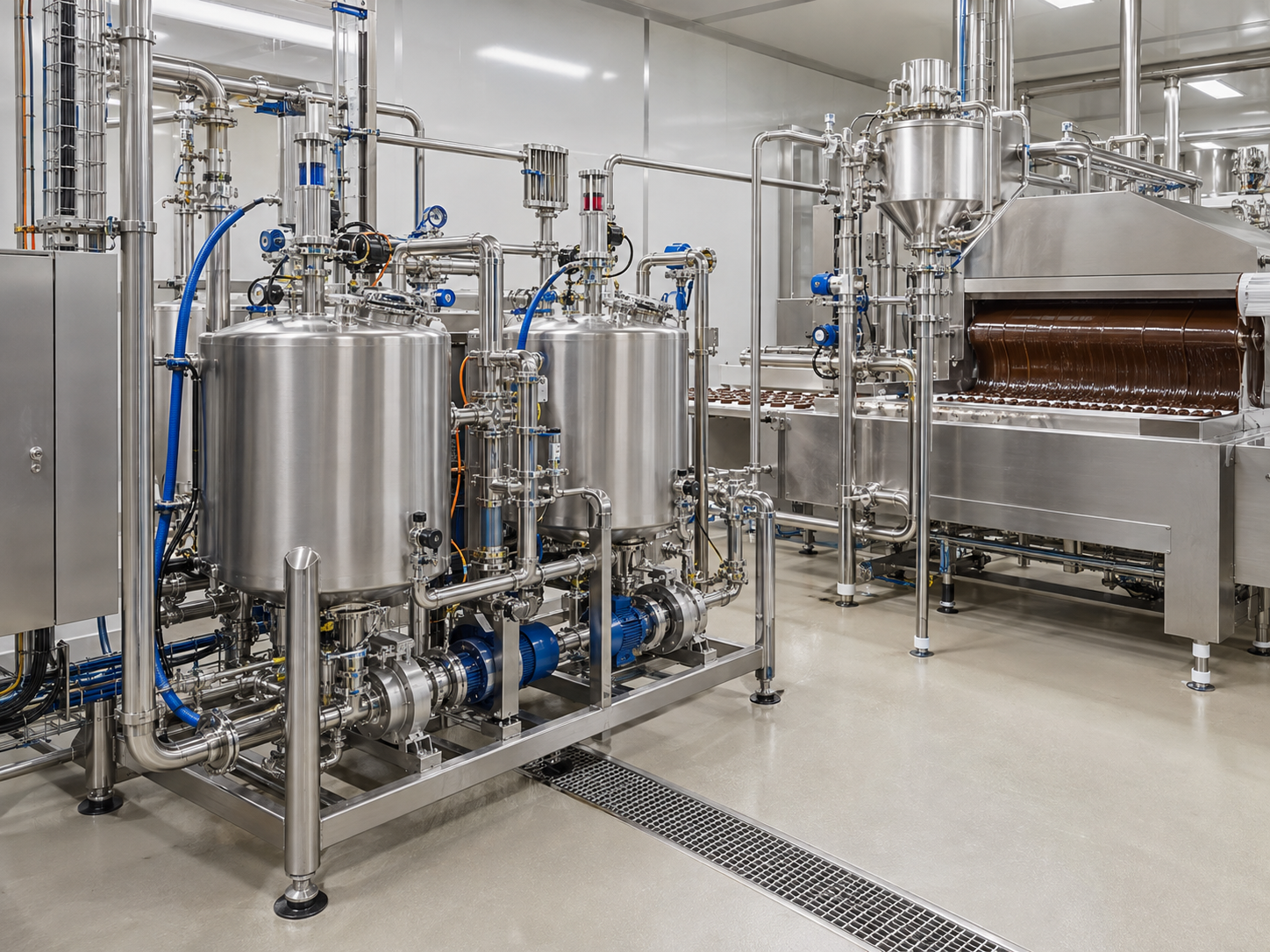
The reference programs show what SINOFUDE specifies for the named lines. This does not replace the detergent supplier’s compatibility and safety assessment. Source-water quality, discharge limits, elastomer compatibility, soil age and production recipe all belong in the site review before the program is approved to ensure cross-product contamination is controlled.
A visually clean interior surface is not the same as an allergen-release decision. Allergen release requires its own evidence.
On the confirmed chocolate route, milk and peanut rapid-test cards are paired with microbiological sampling. The records are kept for 3 years.
Hygienic System Design, Materials and Documentation
United States food-equipment rules place the cleanability obligation on the plant and its equipment selection. Because trapped soil creates a contamination risk, SINOFUDE engineers the circuit around cleanability, drainage and controlled records; 21 CFR 117.40 requires adequately cleanable food-contact equipment, smooth contact seams and accurate, maintained instruments.[1]
| Buyer obligation | SINOFUDE design response | Evidence to request |
|---|---|---|
| Equipment can be adequately cleaned and maintained | Circuit boundaries, drainability, access and spray coverage are reviewed with the line layout. | Approved layout, piping and instrument diagram, and commissioning checks. |
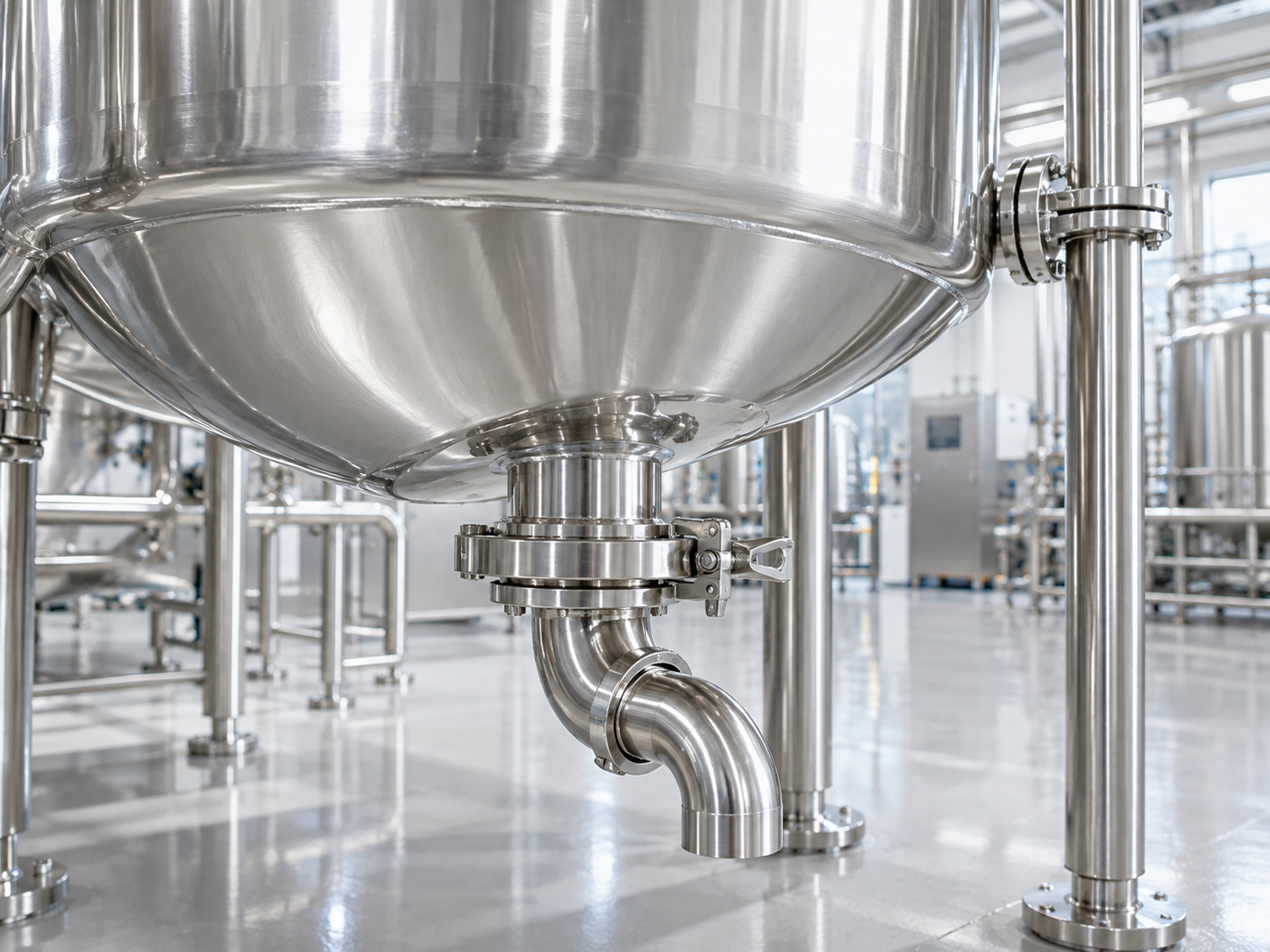
| Contact seams do not trap food particles | In-house laser cutting, laser welding, friction welding and tube welding support firm joints and the removal of dead corners that are hard to keep sanitary. | Drawing review, visual inspection and fabrication records in the agreed scope. |
| Control and recording instruments are suitable | Temperature, time, conductivity or the applicable line release record are defined before the acceptance plan is frozen. | Instrument list, calibration responsibility and acceptance protocol. |
CIP Cycles by Production Line
The Last-Rinse Receipt is the evidence bundle left by one completed run: the archived time-and-temperature curve plus the line-specific final check. The Last-Rinse Receipt is SINOFUDE’s name for this per-run record on the water-cleaned lines, not an industry certification.
This record, in combination with other documentation, can be used to demonstrate that the approved program ran and reached its release condition. On hard-candy and popping-boba lines the reference program names the check but not a pass value, so that limit is written into the acceptance plan. Spray coverage, dead legs and drainability need separate commissioning proof and cannot be determined from this record.[4]
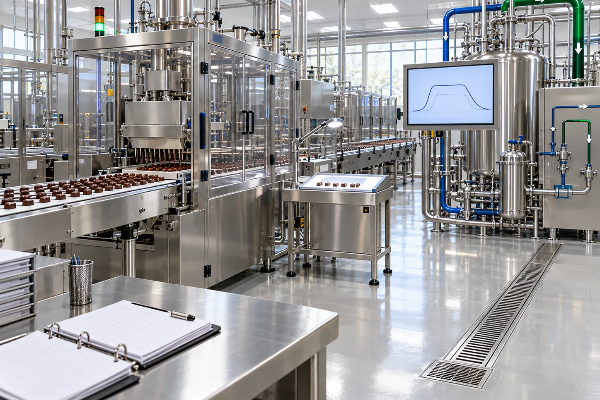
| Program item | Gummy | Popping boba | Hard candy / lollipop | Marshmallow / fondant |
|---|---|---|---|---|
| Cleaning circuits | 3 | 3 | 2 | 2 |
| Hot-water step | Not in reference program | 85 °C / 185 °F · 20 min | 85 °C / 185 °F · 20 min | 75–85 °C / 167–185 °F · 30 min |
| Caustic step | 2.0% NaOH · 80 °C / 176 °F · 20 min | 2.0% caustic · 75 °C / 167 °F · 20 min | 1.5% caustic · 80 °C / 176 °F · 15 min | 1.5% NaOH · 70 °C / 158 °F · 15 min |
| Acid step | 1.5% HNO3 · 65 °C / 149 °F · 15 min | Not in reference program | Not in reference program | Not in reference program |
| Water per cycle | About 1.5 t / 396 US gal | About 1.8 t / 476 US gal | About 1.0 t / 264 US gal | About 1.2 t / 317 US gal |
| Final-rinse check | Conductivity below 5 µS/cm | Free calcium residue test | Conductivity check; no numeric limit stated | Brix below 0.1% |
| Surface check | Periodic ATP swab | ATP bioluminescence check | Visual check for no sugar scale | ATP swab |
| Run record | Final-rinse pH and conductivity plus SCADA cycle record | Pasteurisation and CIP data | Temperature and time curves | CIP run curves |
| Record kept | 3 years | 3 years | 2 years | 2 years |
| Special recovery point | Program linked to three product paths | Calcium loop kept distinct in the circuit plan | Vacuum-pump water recirculated to reduce water demand | Hot water dissolves gelatin and sugar before caustic circulation |
Chocolate is a separate route. Pure chocolate product paths use warm-fat or vegetable-oil circulation plus scraper removal. A water-washed coating line adds 80 °C forced drying for 4 hours, followed by the agreed allergen and microbiological release checks.
CIP System Pricing, Lead Time and Payment Terms
A CIP skid price depends on the number of circuits, the arrangement of vessels, the cleaning chemicals, the heating method, automation and process monitoring, the grade of stainless steel, the extent of process documentation, site utilities and validation support, and the technical documentation package.
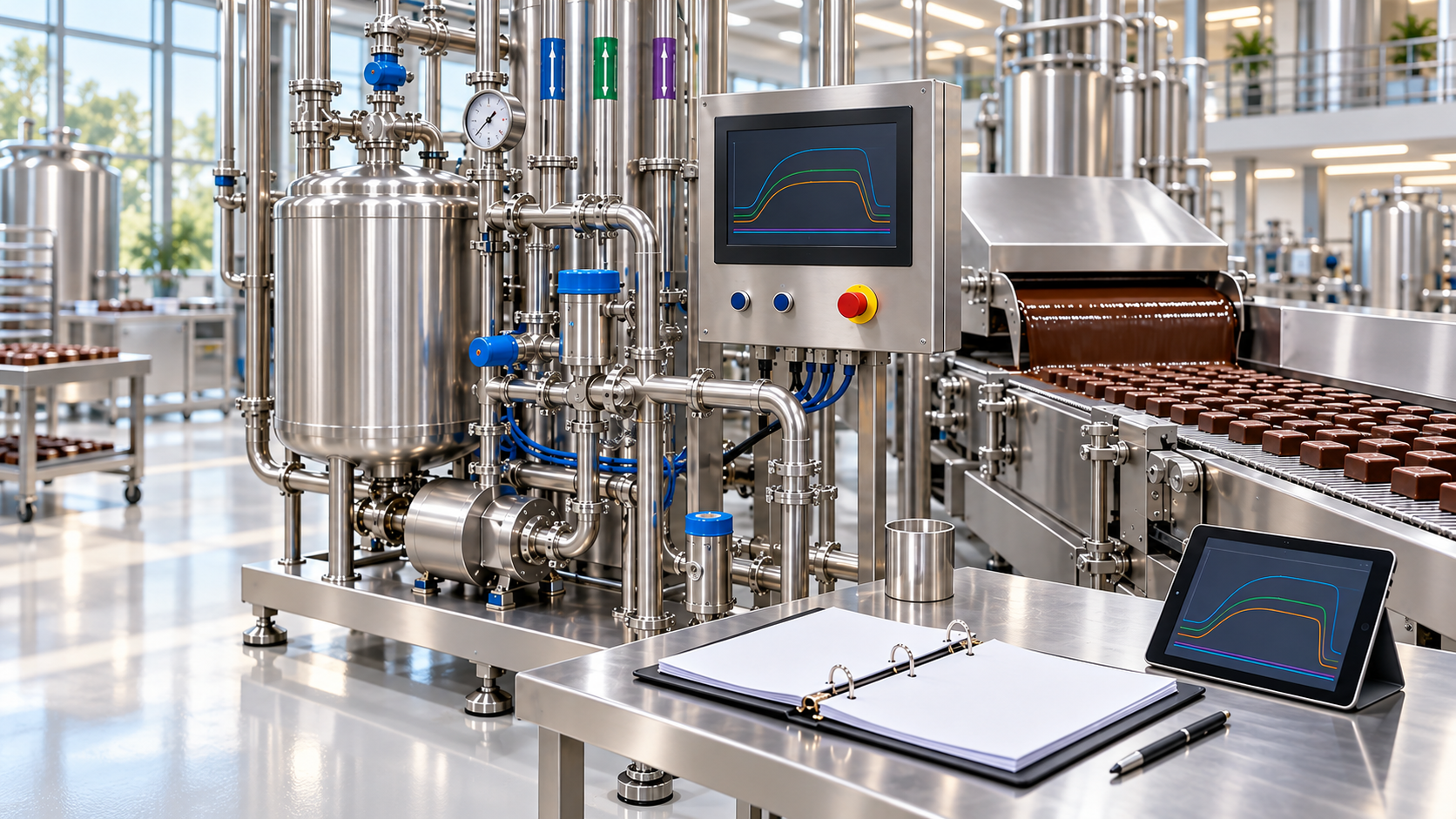
| Quotation variable | Decision that changes scope | What to send |
|---|---|---|
| Circuits and flow paths | Which product-contact equipment is cleaned together, separately or outside the loop? | Piping sketch, equipment list and estimated route length. |
| Residue and recipe | What must be removed, at what changeover frequency, and with which allergen boundary? | Product family, residue description and current manual cleaning method. |
| Utilities | How will water, heat, compressed air, drainage and electrical control be provided? | Source-water analysis, utility limits, voltage and frequency. |
| Automation | Which sequence steps, permissives, alarms and records must be automated? | Control philosophy and required data-retention period. |
| Materials and documents | Which grade, certificate, manual, drawing and verification document belongs in the contract? | Procurement specification and destination requirements. |
Confirmed Commercial Sequence
CIP Validation, Verification and Data Recording
When prospective clients compare CIP cleaning system manufacturers, a repeatable cleaning process needs two kinds of proof. First, commissioning should demonstrate that the design reaches, wets and drains the intended circuit. Second, each production release should confirm that the approved cycle ran and the specified final check passed.
Flow is central because turbulent action can be lost at the remote branch even when the supply pump is running. CIP literature uses about 1.5 m/s as a starting design rule, subject to the actual circuit and equipment. [2]
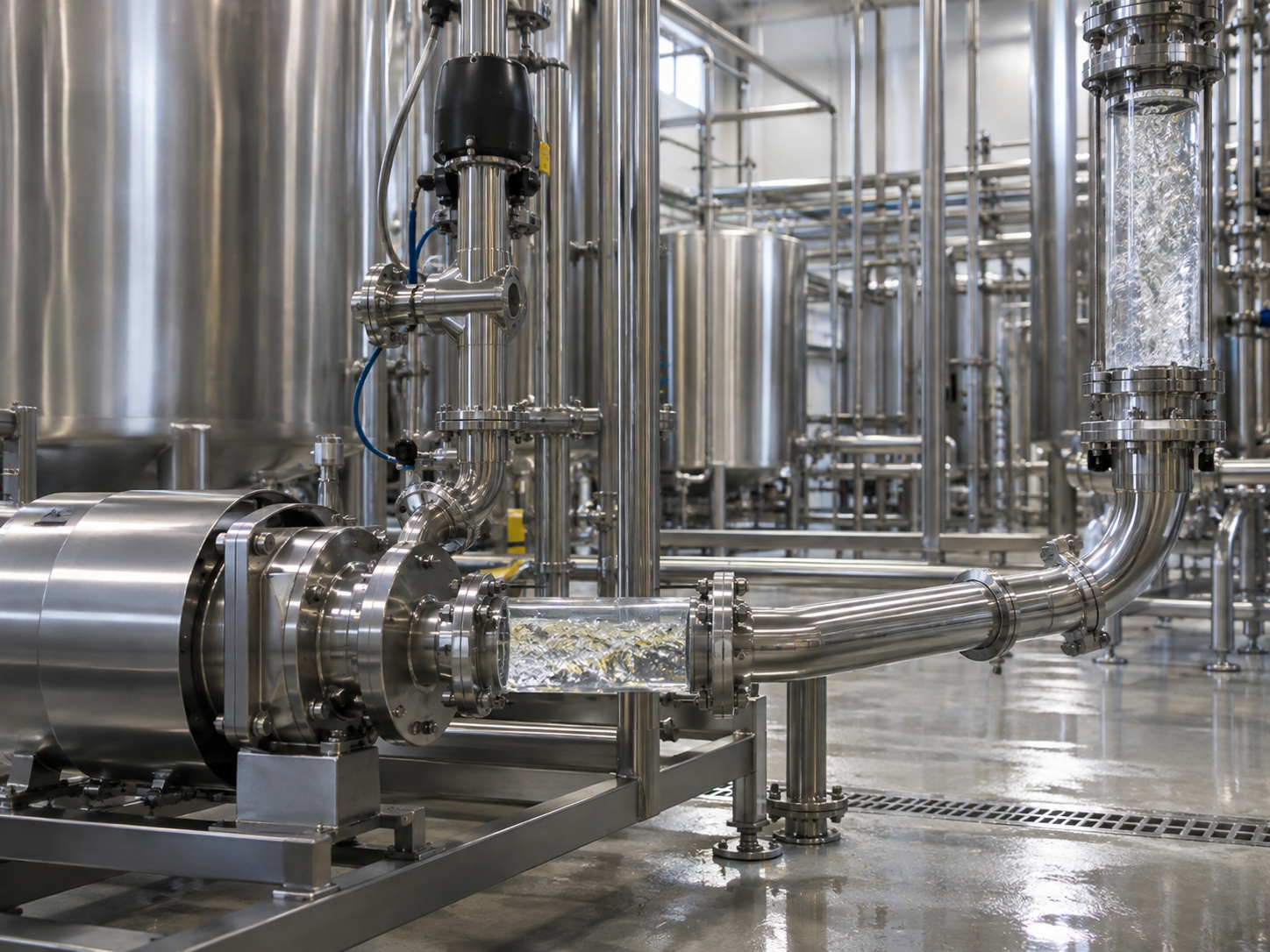
| Stage | What the evidence should establish | Inputs still owned by the site |
|---|---|---|
| Drawing review | Circuit boundary, valve logic, instrument list, sampling points, drain route and record fields. | Plant utilities, discharge route, product soils and release authority. |
| Factory acceptance | Build matches the approved scope; controls and sequence execute; alarms and records can be reviewed. | Final site pipework and production water are not yet represented. |
| Site acceptance | Installed flow paths, spray coverage, return, drainability, utilities and sampling work as approved. | Water quality, detergent supply, operating limits and sanitation sign-off. |
| Routine verification | The run curve and final check form the Last-Rinse Receipt for that cycle. | Trend review, periodic ATP or microbiological checks, deviation handling and release. |
On SINOFUDE gummy lines, factory acceptance includes a fully automatic CIP cycle test. This statement is limited to the confirmed gummy-line acceptance scope; the acceptance protocol for another line is written into that project’s contract.
| SINOFUDE | Buyer / food plant | Chemical supplier |
|---|---|---|
| Define the supplied circuit, controls, instruments and documentation. | Provide source-water quality, utilities, drain route and product-soil information. | Define safe concentration, temperature, compatibility and handling guidance. |
| Run agreed factory tests and support site commissioning. | Approve the validation plan, sampling method and production-release authority. | Support detergent titration and site-specific use instructions. |
| Train operators on the supplied equipment and records. | Maintain calibration, sanitation records, deviation control and ongoing verification. | Review formulation changes that affect cleaning performance or materials. |
For confectionery projects, the supplier-buyer responsibility matrix indicates that responsibility is defined for utilities, acceptance and operating ownership.
Line-Specific Release Evidence
Conductivity is useful for process control, but it remains limited unless the operator knows how the endpoint is defined. Flow and coverage are of primary importance, together with a defined end point for release.
Gummy
Final-rinse pH and conductivity monitored online, conductivity below 5 µS/cm, with periodic ATP surface swabs.
Marshmallow / Fondant
Final-rinse Brix below 0.1% plus ATP surface swab.
Hard-Candy
Means no sugar scale remains, as confirmed by visual inspection, and the final-rinse conductivity check has been performed. SINOFUDE’s reference program has not specified a numeric limit.
Popping-Boba
Free calcium ion residue test plus ATP bioluminescence.
“A timer going off does not mean the CIP cycle has passed its release check. We pair the recorded cycle with the final check selected for that confectionery line, so the plant can keep the record available for review.”
Quality-System and Project Documents
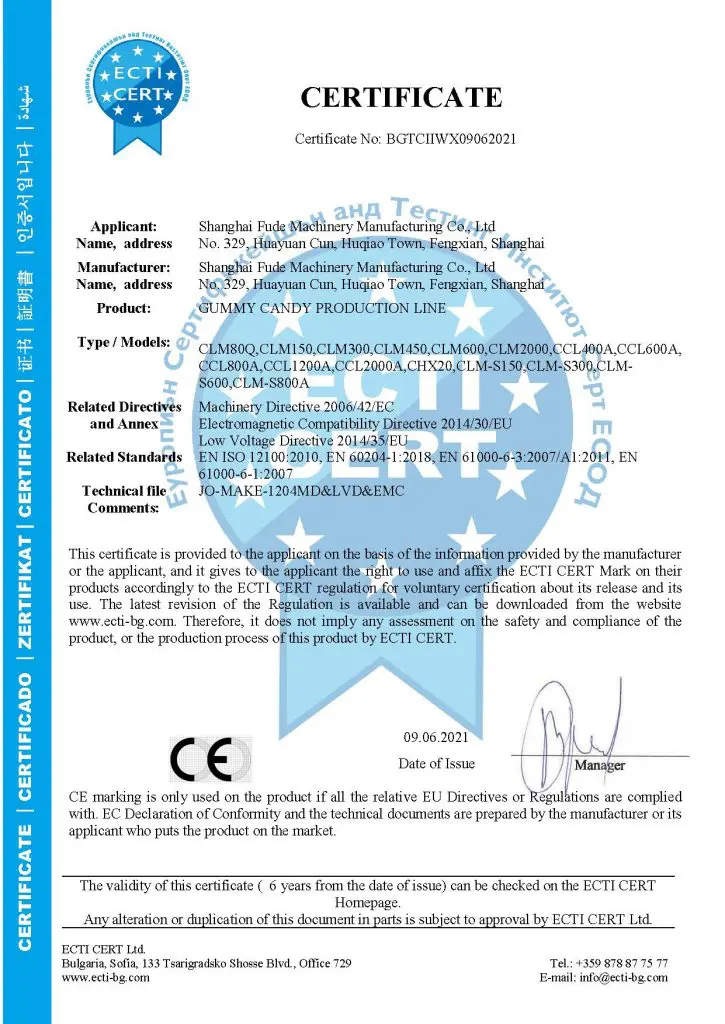
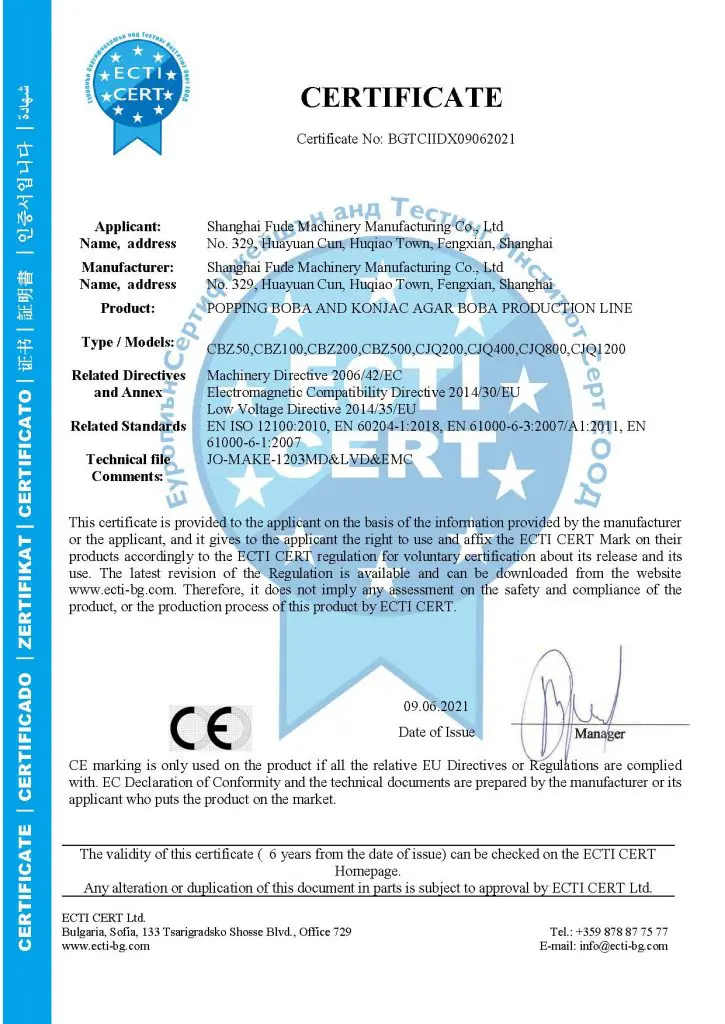
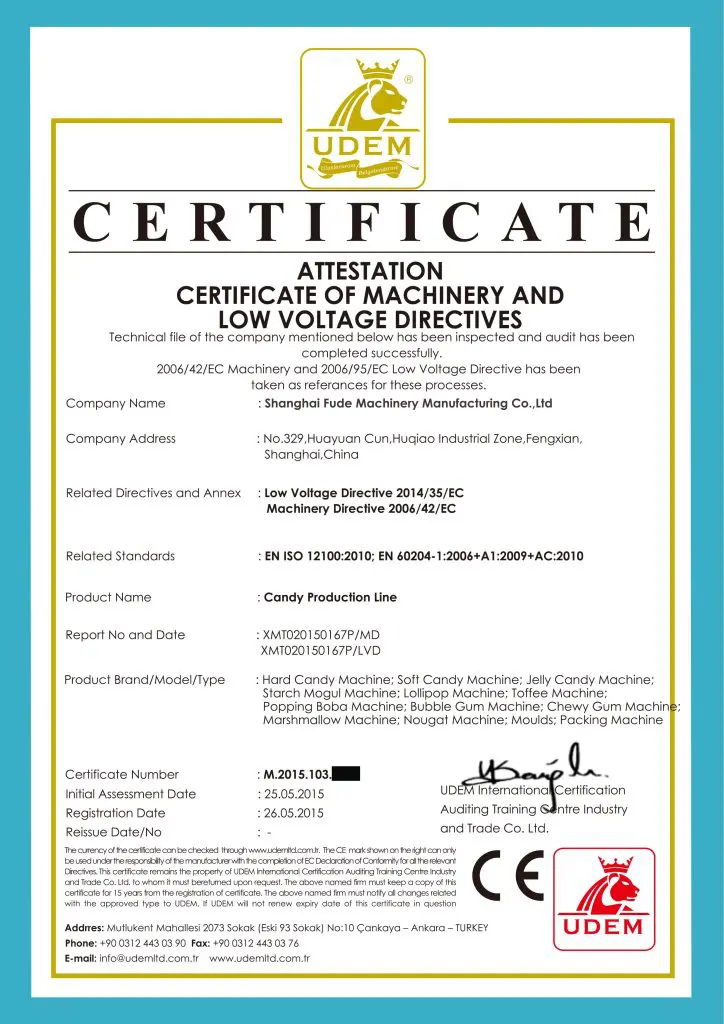
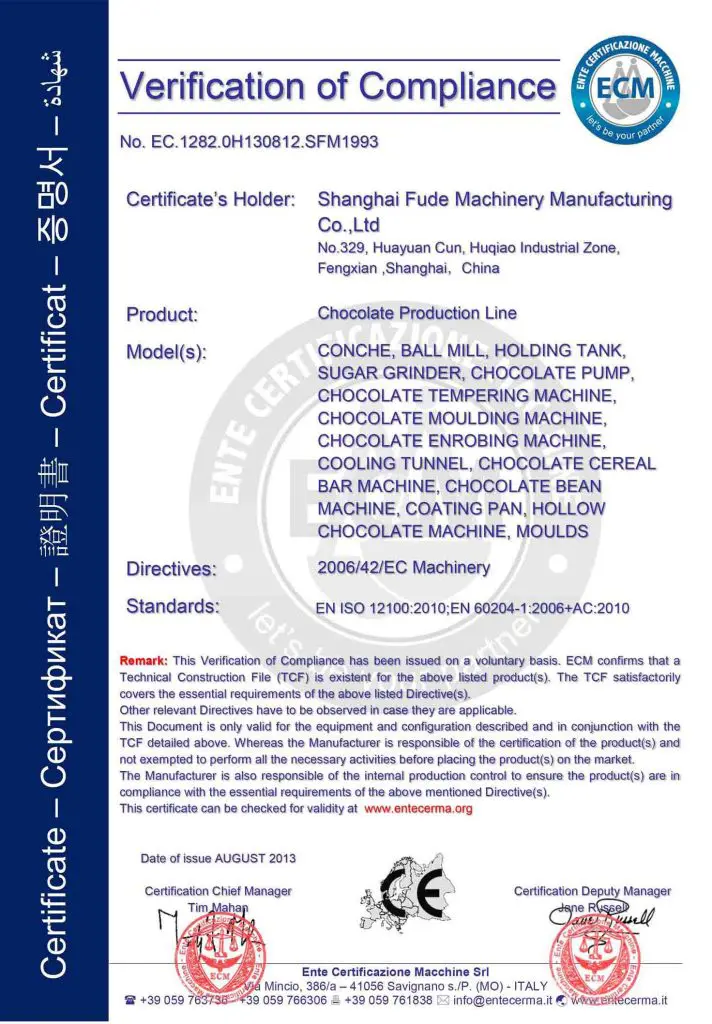
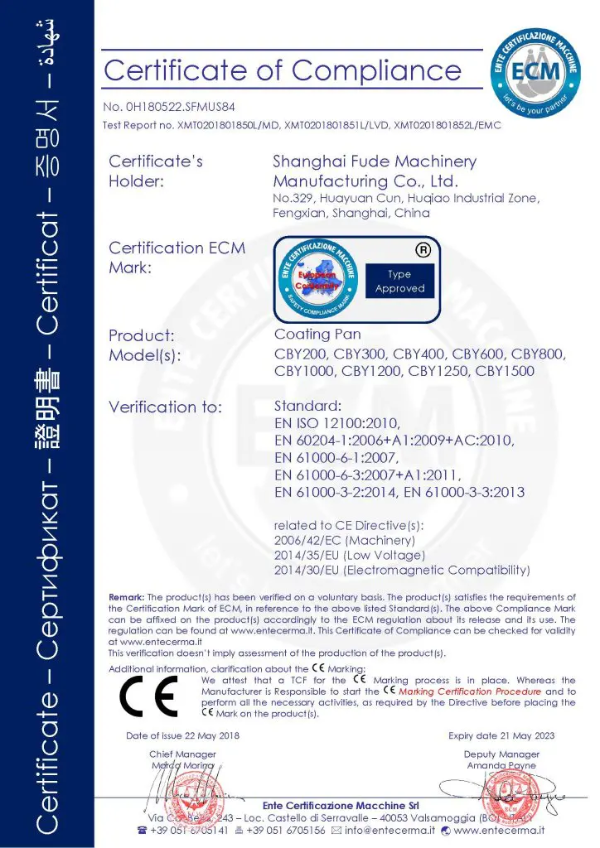
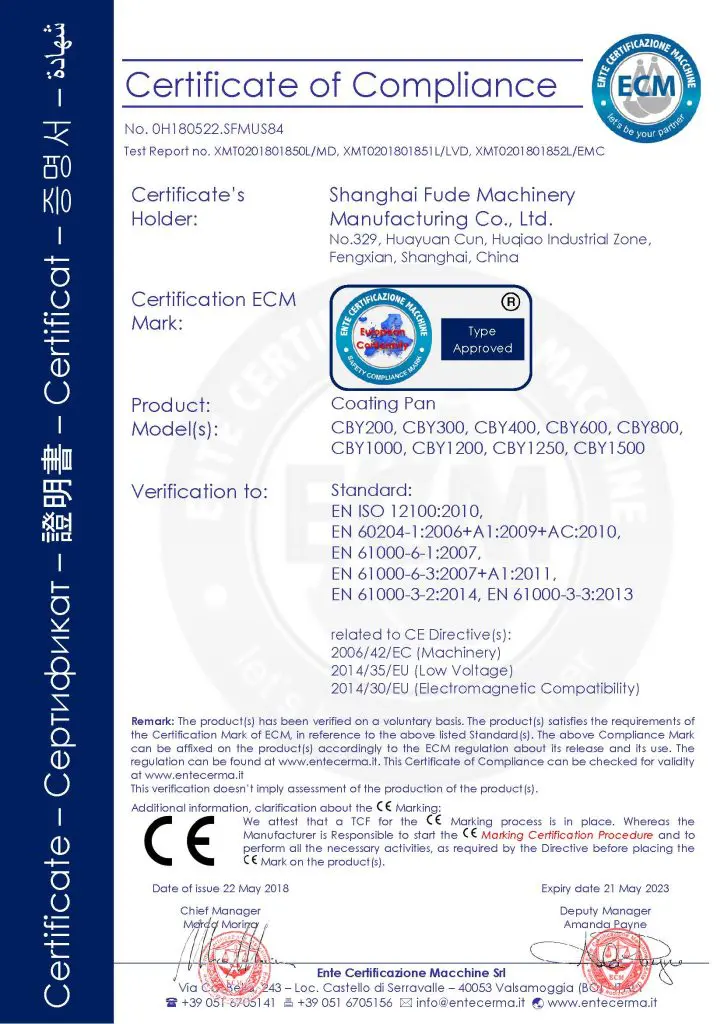
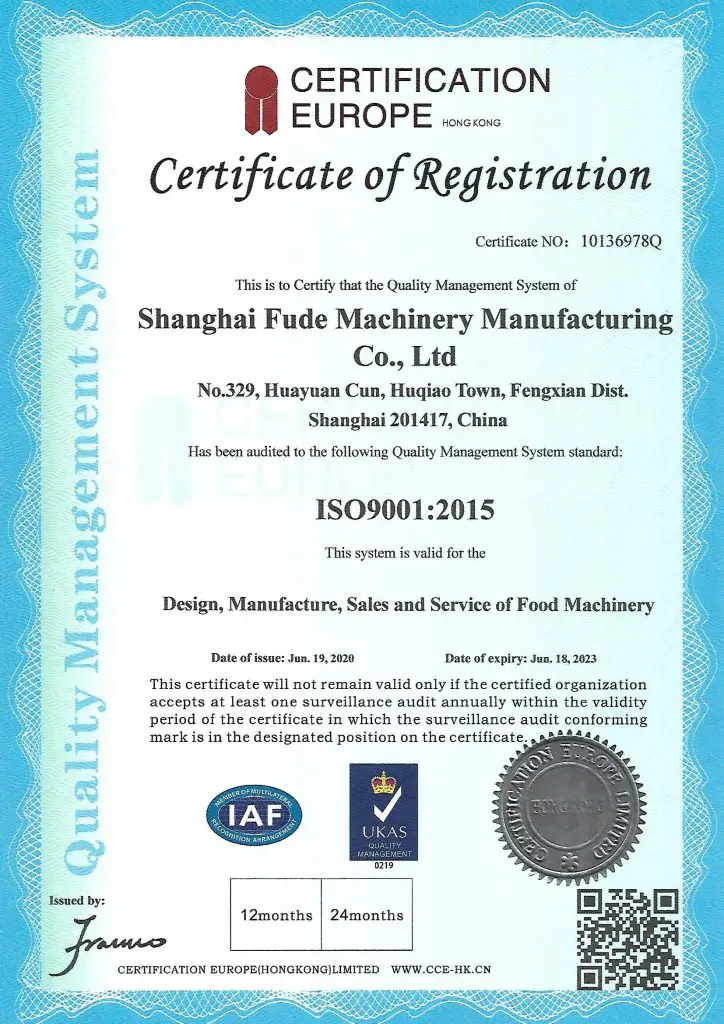
SINOFUDE’s quality-management certificate is ISO 9001 no. 16426Q00865R001, issued by Huazhong International Certification and Inspection Group on 7 May 2026 and valid to 6 May 2029. Its scope covers research, development and production of confectionery, bakery, chocolate and popping-boba production equipment, excluding products under a licensing scope; it is a company management-system certificate, not a standalone product approval.
Documents Shipped with the Agreed Line
On SINOFUDE gummy lines, the operation and maintenance manual with procedures, electrical schematics, piping and instrument diagram, material certificates and spare-parts list ship with the order. A CIP validation guide is included on the confirmed gummy-line scope. For other lines, the document pack is listed line by line in the contract.
Prepare the record and document requirements for your quotationFrom Line Survey to Commissioning
Send a description of the product, process boundary, equipment and process changes.
Close the technical brief. After contract, during the 7-day technical briefing, we define the circuits, utility assumptions, recording requirement, release evidence and document list. The first workshop layout drawing is free and is refined after contract.
Drawings showing the layout, process piping and instrumentation, drain routes and control sequence are to be reviewed and approved by the buyer prior to production.
Build and witness. After the technical briefing and drawing confirmation, production is scheduled for 60 days. Buyers can see the same model running on the production floor when the visit is booked 7 working days ahead.
Install, commission and train. Export on-site assembly, installation and commissioning are paid services. The buyer covers return flights, local transport and lodging plus USD 200 per technician per day; the normal team is 1–2 technicians, and on-site service and English training run 7–15 working days for the buyer’s operators and maintenance staff. Overseas on-site service is scheduled according to visa processing and technician availability, so commissioning dates should be booked early.
Support the installed line. The 12-month warranty covers hardware quality faults with free replacement parts and excludes misuse damage, wear parts and process-related technical assistance. Spare parts are picked, checked and dispatched within 2 working days of order confirmation, backed by 7×24 online technical support.
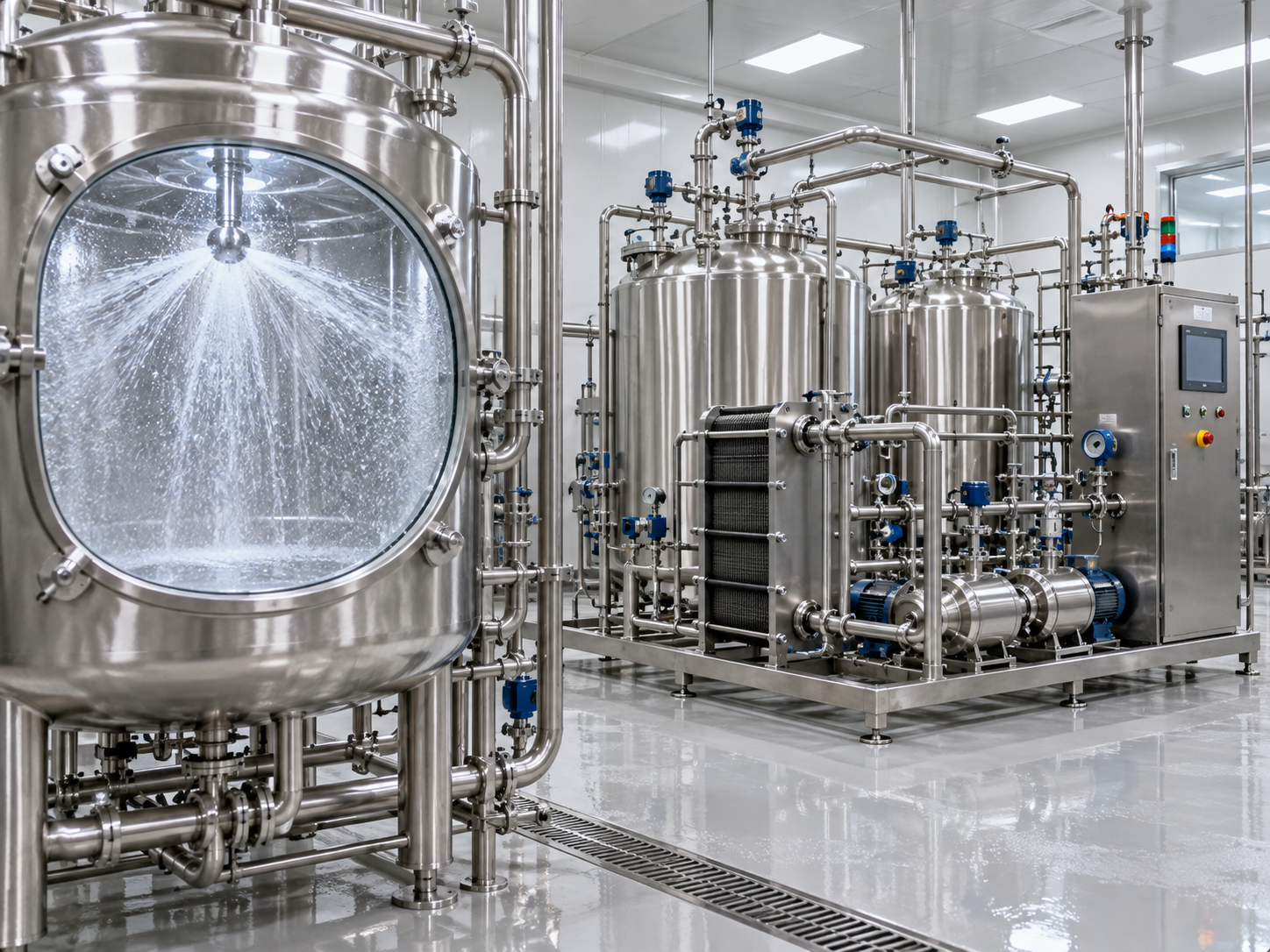
Design Points Your Line Needs Before CIP
| Design point | Why it changes the outcome | Evidence to close it |
|---|---|---|
| Remote branches and dead legs | A stagnant branch can retain product or weak solution even when the main loop looks active. | Marked piping drawing and branch-length review. |
| Drainability and low points | Trapped liquid dilutes the next solution and extends rinsing. | Slope review and observed drain test. |
| Spray coverage | A vessel can receive flow without wetting the shadowed area. | Coverage test during commissioning. |
| Velocity and return condition | Mechanical action falls when the remote flow path is starved. | Measured supply and return conditions at the agreed test point. |
| Source-water quality | A final-rinse conductivity limit is meaningful only when incoming water is cleaner than that limit. | Water analysis and agreed release baseline. |
| Acceptance language | An unquantified “clean” criterion causes disputes at first acceptance. | Written FAT, site-acceptance and release criteria before build. |
One confirmed hard-candy failure mode is irregular cleaning of the vacuum-cooking heating pipe. The sugar scale increases thermal resistance and reduces heat transfer until the cooking temperature can no longer be reached reliably.
The user may be tempted to extend the cooking time. However, one real cause is lack of cleaning control over the heat transfer path. Timer extensions will not solve the problem.
Applications
Match the Cleaning Scope to the Production Line
- Gummy production lines: three confirmed cleaning circuits and a conductivity-based final-rinse criterion.
- Popping boba production line: three confirmed circuits keep the core-liquid and calcium paths separate, as well as the pasteurisation path.
- Hard Candy Production Line: dissolving and cooking circuits with sugar-scale inspection.
- Marshmallow Production Line: cooking plus aeration / extrusion cleaning circuits.
- Chocolate production line: non-water product-path cleaning, with a separate drying route where water washing is used.
A line-specific sanitation brief is required for product and allergen changeover on a nutraceutical gummy production line.
Send photographs, a piping sketch and the intended circuit list by WhatsApp at +86-18201800253 or email kate@sinofude.com.
Where Clean-in-Place Is the Wrong Route
CIP is effective when a closed flow path can circulate cleaning fluid across every product-contact surface and return it predictably.[4] CIP and clean-out-of-place are not interchangeable; for open conveyors and removable parts, access-based sanitation is where to look instead.
| Equipment or soil | Better route | Reason |
|---|---|---|
| Pure chocolate product path | Warm-fat or vegetable-oil circulation plus scraper removal | Water creates a moisture risk in fat-based product handling. |
| Water-soluble coating line | Water cleaning followed by 80 °C forced drying for 4 hours | The wash is only complete when the water-removal step is controlled. |
| Removable moulds, templates and small change parts | Clean-out-of-place or manual cleaning | Removed parts are not a closed return circuit. |
| Starch trays and dry-powder zones | Dry-first cleaning and controlled escalation | Introducing water can spread paste and extend drying. |
| Open conveyors and packaging equipment | Access-based sanitation procedure | Open surfaces do not provide a contained cleaning and return path. |
For example, on a gummy line, the depositing head with its hopper and distributor is part of the confirmed third circuit. Removable change parts, in this case, may follow a separate cleaning route.
CIP Cleaning System Engineering Tools
Engineering Tool
CIP Circuit Volume & Required-Flow Planner
Calculate precise circuit volumes and establish the optimal flow rates required for effective pipeline sanitation.
Open Planner
Project Builder
CIP Quotation Brief Builder
Generate a comprehensive technical brief to streamline your CIP system procurement and ensure accurate supplier quotations.
Start Building
Data Comparator
Confectionery CIP Reference-Cycle Comparator
Benchmark standard cleaning cycles across gummy, marshmallow, and hard candy lines to validate your sanitation strategy.
Compare Cycles
CIP Cleaning System FAQs
What is a CIP skid?
A CIP skid is a collection of mechanical and process control equipment integrated to prepare, heat and control cleaning fluids, route them through the closed process circuit and manage their return or discharge. It may be integrated in different physical configurations. The appropriate configuration is based on the circuits and the solution recovery plan.
What are the main components of a CIP system?
A CIP system requires a combination of hardware, control and process automation elements integrated in a mechanical and/or a process circuit. The functional set includes a solution tank or staging arrangement, pump, supply and return pipework, valves, heat input, dosing route, instruments, control logic and process recording.
How long does a CIP cycle take?
The confirmed steps vary by line: gummy includes 20 min caustic and 15 min acid contacts; popping boba uses 20 min hot water and 20 min caustic; hard candy uses 20 min hot water and 15 min caustic; marshmallow uses 30 min hot water and 15 min caustic. Those contact steps are not the whole elapsed cycle because fill, heat-up, drain and rinse time depend on the installed circuit.
How many tanks does a CIP system need?
Tank count is determined by solution separation, recovery, footprint and sequence. A single tank can suit a sequence that is fully cleared between steps.
Several compartments support separation or faster reuse, but add pipework, controls and validation points. The quotation fixes the layout and design of the system after an analysis of the circuits, requirements and utilities.
What is the difference between CIP and COP?
CIP removes soil via a closed system.[4] Clean-out-of-place (COP) removes parts to a separate wash station, while manual cleaning provides direct access to open equipment.
CIP is especially useful in food processing where equipment is large and fixed in place. It is used to clean dairy and other related product residues from closed process systems. A food plant often needs all three methods in different locations, followed by the site’s required clean and sanitize steps.
What industries use CIP systems?
CIP is widely used across food and beverage, dairy, confectionery and related industries. Closed process systems in these industries often require repeatable cleaning sequences. This page is limited to CIP systems used in confectionery industries and does not claim pharmaceutical validation.
How is a CIP cycle verified before production restarts?
The Last-Rinse Receipt preserves the final check for a particular line, along with the time-and-temperature conditions for that run. The final check, along with the program documentation, confirms that a program has been completed.
A documented program, together with commissioning evidence and the agreed final check, is used to release the equipment for normal production. The documented program names the evidence for each line: conductivity, Brix, free calcium, a visual check or ATP. It is essential that operators identify and document the cause of an incomplete drain, high return conductivity, or other out-of-limit conditions, and state who investigated the condition and whether the cycle is repeated and who has authority to release production.
The record identifies the cycle, recipe, start and finish conditions, alarm or deviation, final sample and person authorising release.
Slow changes in rinse times may go unnoticed, but a trend of increasing rinse times may indicate a developing sanitation failure.
The food safety plan owns the final release decision and determines when periodic verification is required.
How do operators know all detergent is out of a long or branched line?
Measuring return conductivity to determine end conditions requires that source water conductivity be less than the limit. A timer alone cannot answer that question; the return path needs a defined endpoint such as conductivity or another approved check. Sampling location and branch-clearance evidence are agreed during commissioning.
How can a plant verify flow at the furthest branch instead of only at the pump?
The acceptance test verifies the required flow at the intended remote point and confirms that the flow condition meets the limits specified in the acceptance plan. That test catches a starved branch, wrong valve path or excessive pressure loss that a pump-running signal cannot reveal.
What should a CIP quotation include?
Include the production line, equipment and circuit list, residue, changeover pattern, source-water quality, utilities, voltage and frequency, required records, release checks, material grade, documents, site work and acceptance scope. Complete the quotation brief builder to capture open-ended statements.
What does installation and commissioning cost abroad?
Our export on-site service is paid. The buyer covers return flights, local transport and lodging plus USD 200 per technician per day for 1–2 technicians; the confirmed on-site service window is 7–15 working days. On-site dates depend on visa processing and technician availability.
What does the warranty cover?
Our whole-machine warranty lasts 12 months from completion of installation. It covers hardware quality faults with free replacement parts and excludes misuse damage, wear parts and process-related technical assistance.
Why are pure chocolate lines cleaned without water?
Water on a pure chocolate product path creates a moisture-removal problem in a fat-based process. The confirmed route uses warm fat or vegetable-oil flushing plus scraper removal; where a water-soluble coating requires water washing, an 80 °C forced-drying step for 4 hours is added before the agreed release tests.
What records does the CIP system keep for audits?
Each line’s recording system archives its run data automatically: gummy SCADA records, which also log the online final-rinse pH and conductivity, are kept 3 years, hard-candy paperless records 2 years, marshmallow run curves 2 years, and popping-boba pasteurisation and CIP data 3 years. The buyer’s food-safety system controls review, deviations and final record retention. Where the final check is a manual test, such as Brix, free calcium or a visual check, the plant files its result with that run’s record.



