
Get in Touch with SINOFUDE Company

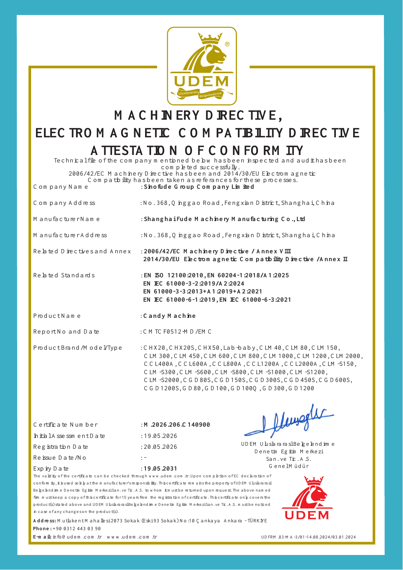
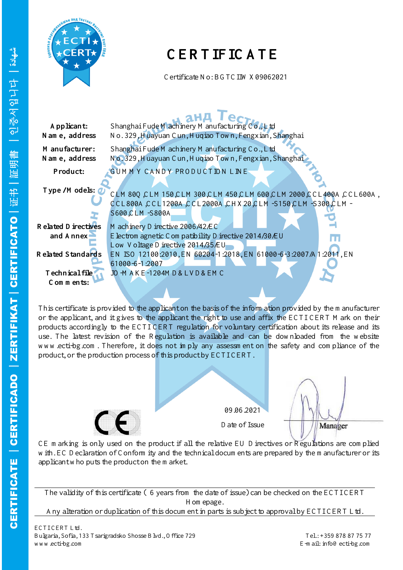
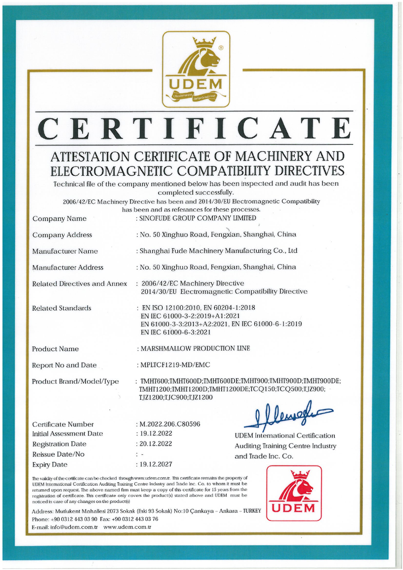
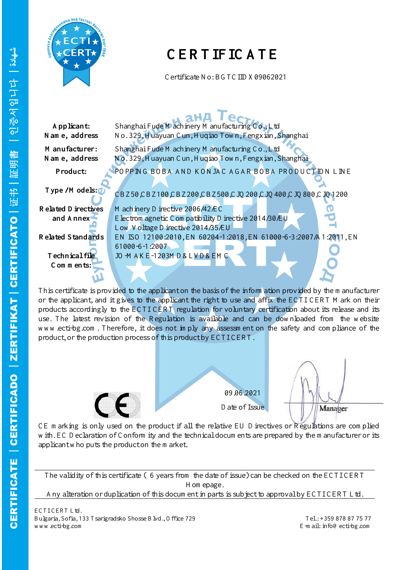
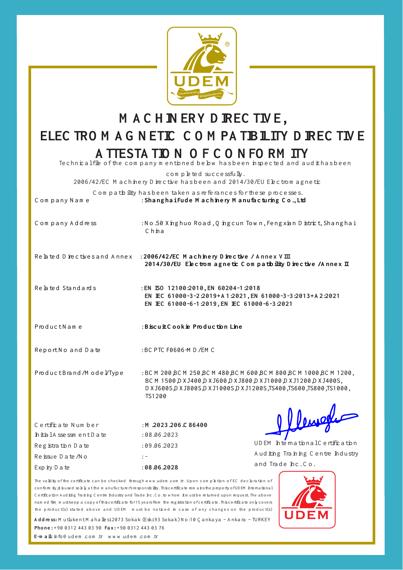
ISO Certified Quality
Candy Wrapping Machine
Candy Wrapping Machine Solutions for Industrial Confectionery
Prepare the pack before picking the machine. SINOFUDE looks into your candy, wrapper film, infeed state, target output, and line interfaces. SINOFUDE will then build an automatic candy wrapping machine based on your production brief.
- Pillow and flow-pack screening
- Candy-and-film trial plan
- FAT criteria fixed in writing
Get My Machine Recommendation
Start with one production sample, one target pack and one production roll of film. That small evidence pack settles more engineering questions than a catalogue speed alone.
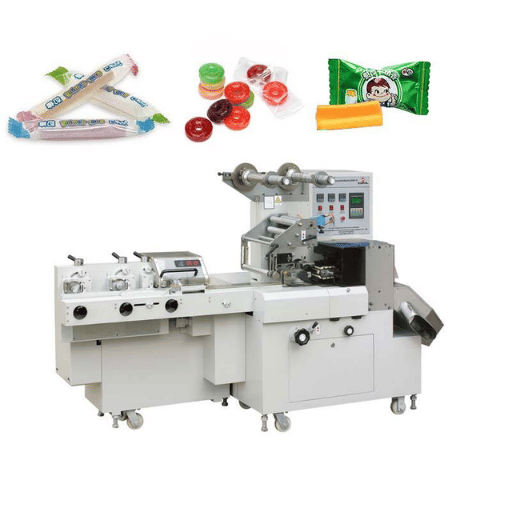
Candy Wrapping Projects at a Glance
Core Decision & Model
Core decision:Pack style and infeed state before model
Verified references:CP-Z400 pillow packer and CP-SNZ800/S800/D800 twist series
Verification
Project evidence:Candy and film trial plus written FAT sheet
Timeline & Terms
Production schedule:35-45 days to ex-factory after deposit
Payment:30% deposit and 70% before shipment by T/T
Logistics
Shipping:FOB Shanghai, with CIF available on request
Choose the Wrapping Process Before the Model
A candy packing machine can form a pillow pack, twist a wrapper around a piece, fold a film around a chocolate, or count loose candy into a bag. The shorter term wrap machine does not settle that process choice, even when suppliers place every route under the same candy packaging heading.
- 01 Pillow & flow wrapping
- 02 Twist & fold wrapping
- 03 Roll-feed or cut-and-wrap
- 04 Counting & bag filling
- 05 Process families we screen
- 06 Three Rates Selection
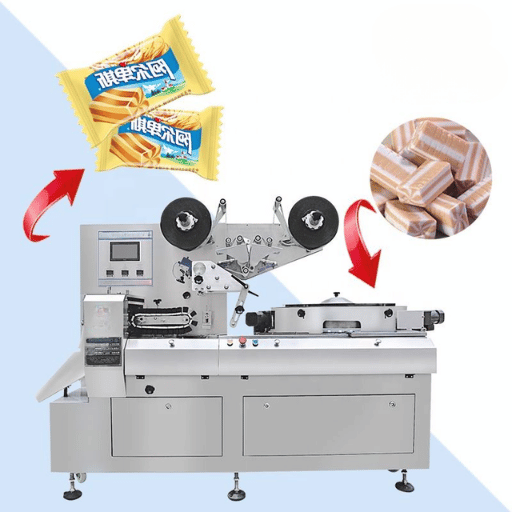
Pillow and horizontal flow wrapping
Use a flow wrapping machine for individually spaced regular pieces that enter a formed film tube, are sealed lengthwise and cut across the web. Product pitch, flow wrap seal method, cut position and film registration belong on the selection sheet.
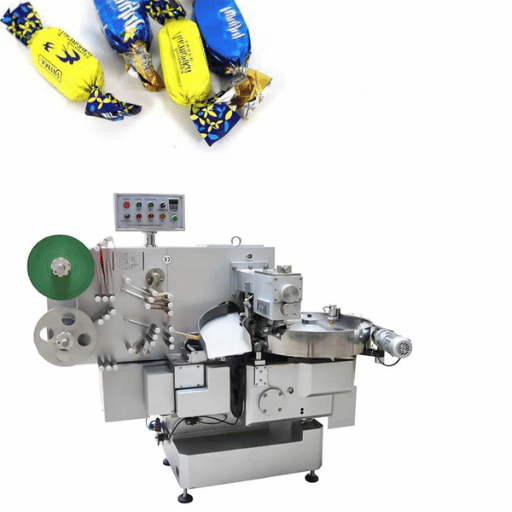
Twist and fold wrapping
A buyer searching for a double twist candy wrapping machine, double twist wrapping machine or twist wrapper is asking for a different wrap motion. SINOFUDE’s current CP-SNZ800/S800/D800 series is a first-party twist-packaging reference for solid foods including chocolate, crisp candy, nougat, hard candy and milk candy. Each twist wrap still needs a defined tail, fold, grip and finished-pack rule for the real product.
Roll-feed or cut-and-wrap
This brief can mean film supplied from a roll, candy supplied as a rope, or a finished roll-shaped pack. Our application review separates those meanings before equipment is recommended; a dedicated SINOFUDE candy roll wrapping machine is confirmed only after model review.
Counting and bag filling
Choose a bagging route when the sale unit is a pouch containing many loose pieces. Counting accuracy, dosing, bag size and seal integrity replace single-piece orientation as the main acceptance questions.
Process families we screen
- Hard candy and pressed sweets with regular geometry
- Toffee, caramel and taffy that may need temperature and stickiness controls
- Chocolate bar and snack products that can mark, melt or lose orientation under pressure
- Gummy and jelly products with oil, sugar or tack at the infeed
- Lollipops with stem position and wrap-tightness acceptance rules
- Single pieces, grouped packs and downstream cartoning handoffs
Three rates belong on the same selection sheet
| Rate | Meaning | Buyer decision |
|---|---|---|
| Mechanical cycle rate | The wrapper’s motion under a named setup | Useful for sizing only after the product and knife layout are fixed |
| Stable production rate | Output while product, film and operators run under planned conditions | Sets the working target for the FAT window |
| Accepted output | Packs that pass the agreed seal, cut, appearance, code and product-damage rules | Feeds staffing, cost and line-capacity calculations |
A high speed candy wrapping machine earns its place only when those three rates stay connected. Accepted output is the requested target because that is the number the next operation receives.
The Candy-to-Pack Qualification Grid
The same input grid guides our work on a new line, a replacement wrapper and a capacity project. It makes the quote reviewable because each buyer input is tied to a configuration decision and a test result.
| Buyer input | Configuration decision | Acceptance evidence |
|---|---|---|
| Candy family, centre and recipe | Contact pressure, feeding route and temperature window | Approved sample description and sample set |
| Shape, length, width, height and weight range | Machine family, pitch, guides and change parts | Signed product-window sheet |
| Warm, cool, sticky, oiled, sugar-dusted or fragile infeed | Cooling, separation, contact level and accumulation | Witnessed infeed trial at agreed condition |
| Random, oriented, spaced or grouped arrival | Disc feeder, lane, belt, chicane, robot or manual-load boundary | Recorded feed and recovery test |
| Pillow, flow, twist, fold, roll or bag result | Wrapping mechanism and sealing method | Approved finished-pack sample |
| Film structure, thickness, width, core and roll diameter | Unwind, sealing, registration and tension setup | Trial on a production roll |
| Printed eye mark, date code and label needs | Sensor, coder and artwork controls | Legible, positioned code on accepted packs |
| Good packs per minute and shift pattern | Required sustained rate and buffer capacity | Timed accepted-output FAT record |
| Upstream and downstream interfaces | Height, speed, signals, accumulation and ownership | Signed interface list and line test |
Film Fit Is a Trial Result
A film name is not a machine setting. Whether the brief names cellophane, wax paper or a plastic laminate, our review still covers the complete web. We review substrate and sealant layers, gauge, roll diameter, core, width, coefficient of friction, print repeat, eye mark, seal window and food-contact conditions.
| Film input | What it changes | What to verify |
|---|---|---|
| Heat-seal or cold-seal structure | Seal hardware, dwell, pressure and contamination sensitivity | Seal strength and appearance at the target rate |
| Thickness and stiffness | Web tracking, fold memory and cut behavior | Stable unwind without curling, tearing or double feeding |
| Surface slip and static | Product flow, web transport and dust attraction | Run stability under production humidity |
| Printed registration | Pack length, sensor contrast and cut position | Eye-mark recovery after stop and restart |
| Food-contact declaration | Intended food and conditions-of-use review | Film-supplier documentation for the destination market |
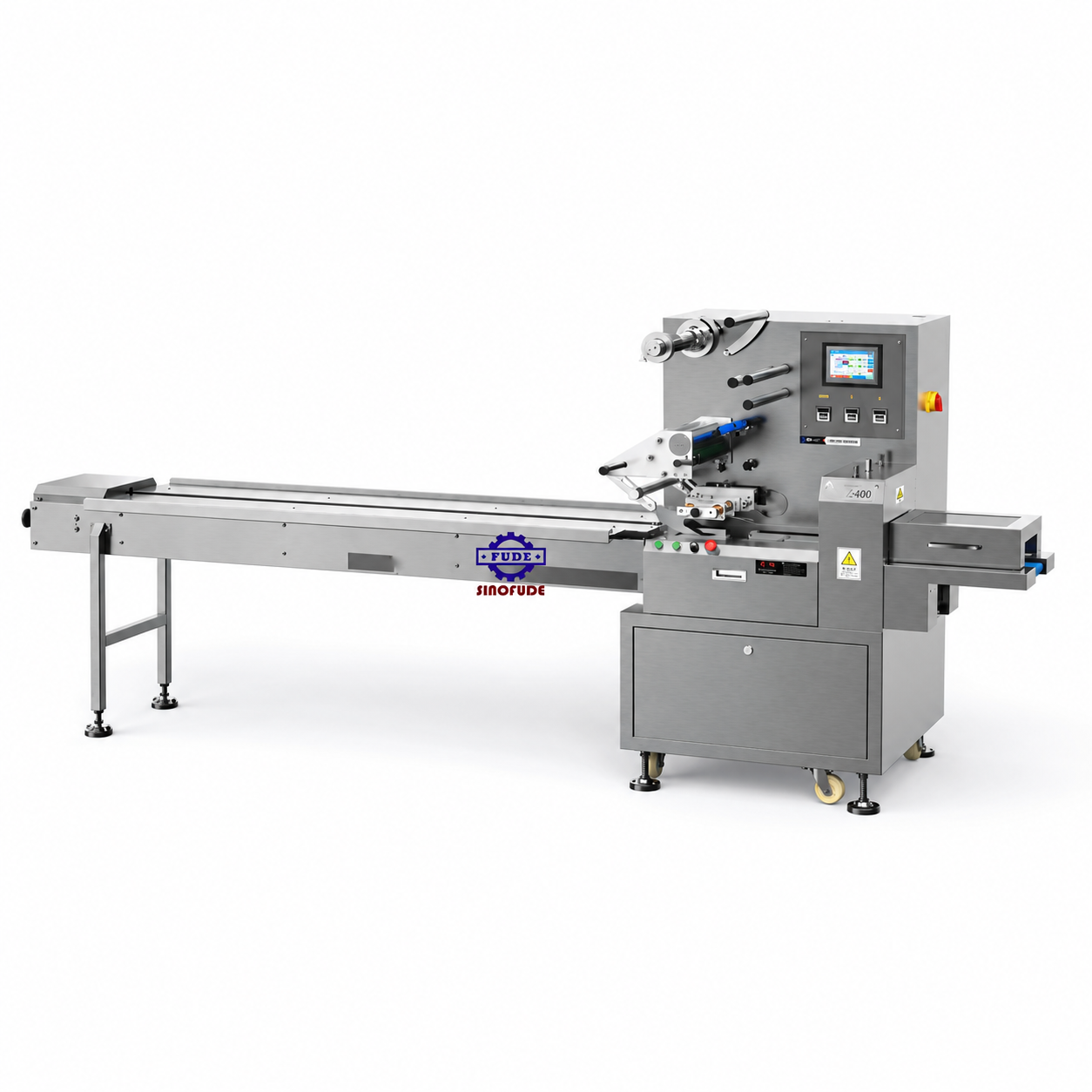
A Verified SINOFUDE Starting Configuration
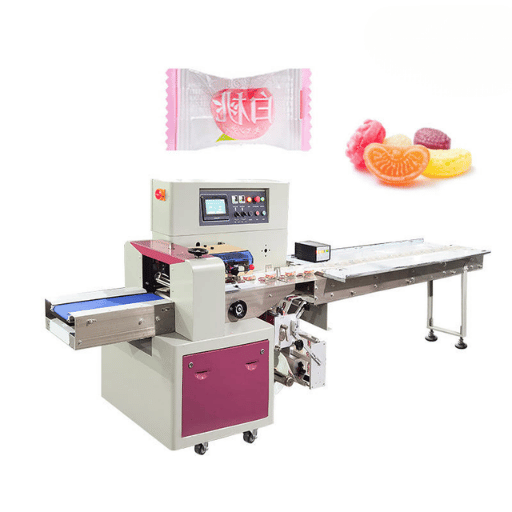
For this project, the CP-Z400 is currently the most relevant first party reference. SINOFUDE has it listed as a multi-function pillow packaging machine for regular solid products and has published the screening data below.
| CP-Z400 published item | Page value | RFQ use |
|---|---|---|
| Installed power | 3.0 kW | Preliminary electrical load |
| Machine envelope | 3675 × 900 × 1600 mm | Layout and access screening |
| Machine weight | 700 kg | Floor and handling plan |
| Power supply | 220 V, 50 Hz | Site-utility comparison |
| Maximum film roll diameter | 390 mm | Roll-format screening |
| Maximum film width | 250 mm | Pack and web-width screening |
The selected knife layout, product envelope, pack length and sustained output are verified during sample and film trials. The confirmed values are then fixed in the quotation and FAT sheet.
Current twist-series reference
The CP-SNZ800/S800/D800 page lists a 280 mm maximum film diameter, 110 mm maximum film width, 2.2 kW motor power, 1790 × 1474 × 915 mm machine dimensions and 1080 kg machine weight. These values support initial screening only; the selected variant, candy window, film and accepted output belong in the signed quotation and FAT record.
01
Cost Drivers That Deserve A Separate Line Item
Driver
Why It Moves Cost
How To Control It
Product Range
More shapes and sizes can require more guides, recipes and change parts
Group SKUs into launch and future ranges
Feeding State
Random, sticky or fragile products need more handling than spaced, stable pieces
Define the handoff and send production samples
Film And Coding
Seal method, print registration and code inspection add hardware and validation
Freeze the wrapper specification before order
Line Integration
Buffers, conveyors, signals and safety ownership extend the machine boundary
Use one signed interface sheet
Acceptance And Support
Longer tests, site commissioning, training and spares change project scope
Compare quotations against the same FAT and support list
02
Commercial Baseline
Production runs are scheduled at 35-45 days to ex-factory after deposit, confirmed with your quotation.
Payment is 30% deposit and 70% balance before shipment by T/T.
We ship FOB Shanghai, with CIF available on request.
FAT, Changeover, Cleaning and Safety Acceptance
The FAT should determine whether the pack released by the machine is acceptable. Checking shaft speed or performing empty runs is not sufficient. The sample film, accepted-pack rules, planned stops and evidence record are fixed before the test.
Seal failure risk rises because product crumbs, film behavior and recovery settings meet at the jaws. SINOFUDE therefore builds the acceptance sheet around the real candy and film, not an empty-machine demonstration.
Freeze the test article. Identify candy lot, condition, geometry range, wrapper roll, print repeat and code requirement.
Define a good pack. Set seal, cut, registration, appearance, damage, count and code rules in observable terms.
Run a timed window. Record total packs, accepted packs, rejects, stops, film changes, jams and operator interventions.
Test recovery and changeover.
Include stop/start registration, recipe recall, change parts, cleaning access and restart output.
Close deviations. Assign each open item, required evidence, owner and completion date before shipment release.
ANSI/PMMI B155.1-2023
is a relevant machinery-safety reference for packaging equipment, conveying and coordinated line functions. Our project risk review assigns guards, interlocks, emergency stops, interfaces and destination-market evidence; the standard reference is not a model certification claim.
Food-contact file
- Machine contact-surface and cleaning information for the selected build
- Film-supplier declaration tied to the food and conditions of use
- Cleaning method, access points and product-change sequence
- Foreign-material, lubricant and maintenance controls defined by the buyer’s food-safety plan
Changeover proof for a multi-SKU line
| Change Item | Evidence during FAT | Release Rule |
|---|---|---|
| Product guides and pitch | Named change parts, settings and tool list | First accepted pack produced after the agreed sequence |
| Film roll and registration | Threading path, recipe, eye-mark recovery and cut position | Registration remains inside the signed pack limit |
| Seal setup | Temperature or cold-seal setting, pressure and sample checks | Seal passes the buyer’s agreed inspection method |
| Cleaning and allergen change | Access demonstration, removed parts and cleaning sequence | Buyer signs the access and verification method |
| Recipe and operator handoff | Saved values, permissions and restart steps | Trained operator repeats the change without an undocumented adjustment |
×
![Enlarged Certificate]()
Project Handoff from Sample to Shipment
Send the product window.
Candy samples, dimensions, infeed condition, target pack, film file and output target enter one application record.
Review the process family.
Our engineer separates pillow or flow packing from twist, fold, roll-feed, cut-and-wrap and multi-piece bagging needs.
Build the machine boundary.
Feeding, wrapper, coding, inspection, conveyors, safety interfaces and downstream ownership are assigned.
Issue the written quotation.
Configuration, options, exclusions, commercial terms, documentation, FAT and support scope are listed.
Approve trial and FAT criteria.
The test uses the same good-pack rules later applied to shipment release.
Prepare delivery.
Closed deviations, the document pack and the agreed shipping term control release.
RFQ details that prevent a second engineering loop
Candy type and center
Dimension and weight range
Surface and infeed temperature
Arrival orientation and spacing
Target pack style
Film structure and roll data
Printed registration and coding
Accepted output target
Upstream and downstream layout
Site voltage and frequency
Destination country
FAT and training expectations
SINOFUDE
SINOFUDE Manufacturing
and Project Support
SINOFUDE, as an industrial candy wrapping machine manufacturer, incorporates the wrapper into the technical review of the upstream confectionery process; the current CP-Z400 page lists 220 V as a configuration reference, not as a universal site requirement. As stated on the company’s About page, the SINOFUDE brand was founded in 1998 in Fengxian District, Shanghai, and the business has grown to three factories spanning more than 30 acres and employing over 200 people. These are company-level facts, and not performance claims for the models.
When a Standard Candy Wrapper Is Not the Right Route
The fastest station is not always the fastest line. Pillow and twist mechanisms are not interchangeable, and a sample trial is not a substitute for a timed accepted-output test.
A common assumption is that the cheapest machine is the best buy. The wrong choice costs more when the quotation omits feeding, change parts, FAT evidence or the site handoff.
The right call is the process that produces an accepted pack from the real infeed, not the process with the strongest catalogue headline. When the wrapper is the wrong answer, the table below points to the next engineering step.
| Situation | Why it works against you | Better next step |
|---|---|---|
| Warm, soft or unset candy | The product can deform, stick or mark before sealing | Fix cooling and surface condition, then repeat the infeed trial |
| Random shaped pieces that require a fixed face | The wrapper sees orientation loss rather than a packaging-speed limit | Add orientation and buffer scope before choosing the wrapper |
| Loose assortments sold in one pouch | Single-piece wrapping adds a process the sale unit does not need | Review counting, weighing and bag filling |
| Konjac or crystal boba projects | The product-process boundary starts with forming and cooking, not an individual-candy wrapper | Review the planned konjac ball machine production route before specifying downstream packing |
| Small manual or home-use volumes | Industrial feeding, guarding and integration dominate the investment | Use a manual or small-batch packaging route |
| Unconfirmed candy roll or twist brief | The phrase alone does not identify the input state, wrap motion or finished pack | Send a target pack; CP-SNZ800/S800/D800 provides a current twist-series reference, while roll-wrap intent still needs process confirmation |
Candy Wrapping Machine Engineering Tools
01
Candy-to-Pack Qualification Builder
Choose the target pack and the condition arriving at the wrapper. The result is an RFQ route, not an automatic model promise.
Use Tool
02
Accepted-Output and Bottleneck Calculator
Enter sustained rates for each handoff and the observed good-pack yield. The lowest rate sets line capacity; all values are your trial assumptions.
Use Tool
03
Candy Wrapper Quote Scope Scorecard
Check each item that is explicit in a supplier's written quotation. The score measures scope completeness, not machine quality.
Use Tool
04
Cost per 1,000 Good Packs Calculator
Use annualized ownership and operating costs with your forecast of accepted packs. Currency is whatever unit you enter consistently.
Use Tool
SOLUTIONS
Candy Wrapping Machine FAQ
Start with geometry and product state, not the recipe name. Hard candy, toffee, caramel, chocolate, gummy and lollipop products can require different pressure, cooling, orientation, feeding and wrap motions; SINOFUDE confirms fit from samples and the target pack.
A wrapping machine often packages individual pieces, while a candy packing machine can also mean counting or weighing many pieces into a pouch. Define the sale unit and pack style before comparing models.
No. Product and film replenishment, changeover, cleaning, jam recovery, inspection and maintenance still need assigned tasks, even when feeding and wrapping run automatically.
Do not assume it. Pillow sealing and double-twist motions are different processes. CP-Z400 is the current pillow reference and CP-SNZ800/S800/D800 is the current twist-series reference; send both target packs and ask for the exact variant, change parts and FAT demonstration for each.
The current product page lists a 3675 × 900 × 1600 mm envelope, 700 kg machine weight, 3.0 kW installed power and 220 V/50 Hz supply. The final configuration and site utility sheet are fixed in the quotation.
Specify accepted packs per minute over a timed run, plus reject rules, planned stops, film changes and operator interventions. Nameplate speed alone does not state how many saleable packs reach the downstream process.
Send a production roll with structure, thickness, width, roll outside diameter, core, print repeat, eye mark, seal method and intended-use food-contact file. The CP-Z400 page lists a maximum film diameter of 390 mm and maximum width of 250 mm for initial screening.
Production runs are scheduled at 35-45 days to ex-factory after deposit, confirmed with your quotation. Sample approval, change in scope or unresolved interface data can move the approved schedule.
Payment is 30% deposit and 70% balance before shipment by T/T. Shipping is FOB Shanghai, with CIF available on request.
Send the input form, target finished pack and required wrap motion. An application engineer confirms the process family and model before quoting; the phrase “roll wrapping” is not treated as a capability or configuration by itself.



