
Get in Touch with SINOFUDE Company

Gummy Production Lines: Five Line Families, One Routing Decision
A gummy production line is a connected set of machines that turns syrup into finished pieces: cooking, dosing, forming, setting, demoulding and finishing. SINOFUDE builds five line families around that sequence.
EXW at the SINOFUDE factory
One year standard warranty under the final contract
±0.1 g depositing weight tolerance on the CLM depositing models
Five line families, one routing decision
Routing Decision
This page allows you to choose your family before you’re quoted for a machine.
Setting Work
The first selection is not an output; it establishes the line’s setting work.
Line Recommendation
Send us your product brief along with your target output and weight of the piece to receive a line recommendation, prior to receiving a quote.
Gummy Production Lines at a Glance
A gummy production line is an integrated set of confectionery machinery that cooks a gelatin, pectin or starch-based syrup, doses colour, flavour and actives, deposits or moulds the mass into shaped cavities, holds it until it sets, then demoulds, dries and finishes the pieces for packing.
Buyers say gummy production line, gummy candy production line and commercial gummy making machine for the same equipment, and none of those phrases tells you what forming route is inside it. Everything that follows is from our own commercial and engineering documents, and every line is quoted the same way to every buyer.
Our commitment How it lands on your purchase
Delivery basis
EXW at the SINOFUDE factory Chinese taxes inside the price; import duty, destination VAT and customs clearance outside it.
Warranty
one year under the final contract Deliberate damage and faults caused by operating error are excluded.
Installation and commissioning
USD 200 per engineer per day You cover air tickets, visas, accommodation, meals and local transport.
Depositing weight tolerance
±0.1 g on the CLM depositing models Liquid dosing on the CFA batch mixing system is held to ±0.1 per cent.
Control platform
Siemens PLC WEG or SEW motors, Yaskawa servos, Airtac cylinders. Exceptions are named in the final technical schedule.
Capacity planning basis
an eight-hour production day Half a day is the planning allowance for product changeover and cleaning; actual duration is verified by product code and sanitation requirement.
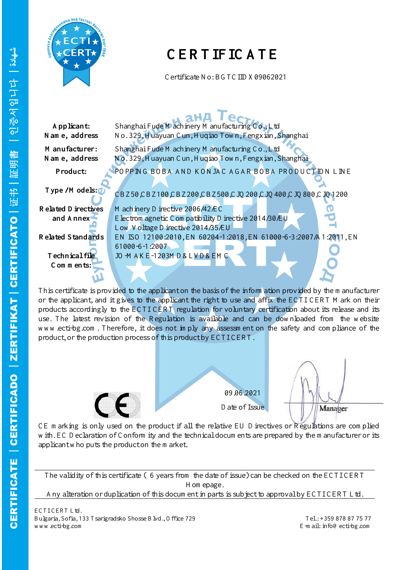
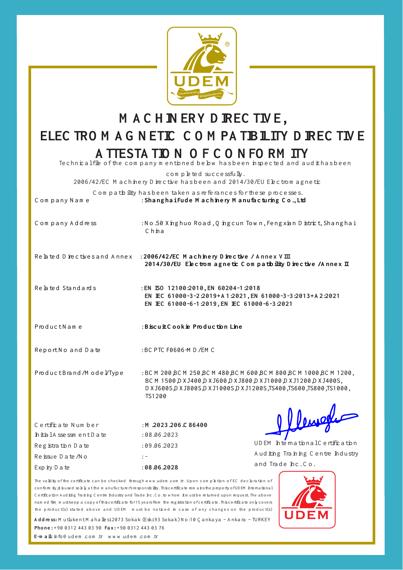
CE conformity certificate
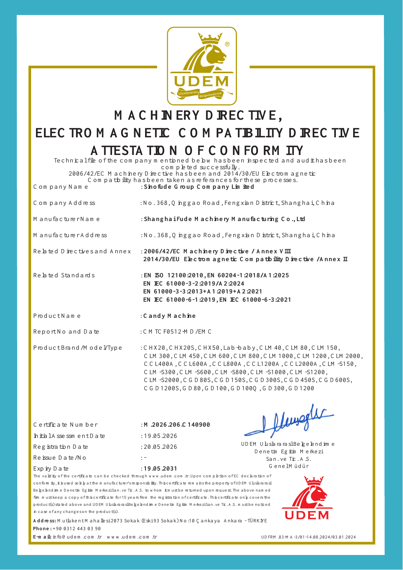
UDEM M.2026.206.C140900 Registered 20 May 2026, expiring 19 May 2031, covering the listed CLM, CCL, CLM-S, CGD, GD, CHX and Lab-baby models. It does not cover unlisted models or destination approvals.
Documents that ship with the order
Approved general arrangement, utility schedule, electrical drawings, manuals, component list, spare-parts list, factory acceptance record, and the relevant conformity or material evidence.
Five Gummy Production Line Families
Three of these five are forming routes and you pick one. The other two are layers that sit on top of whichever route you pick.
SYS_ID: CLM.01
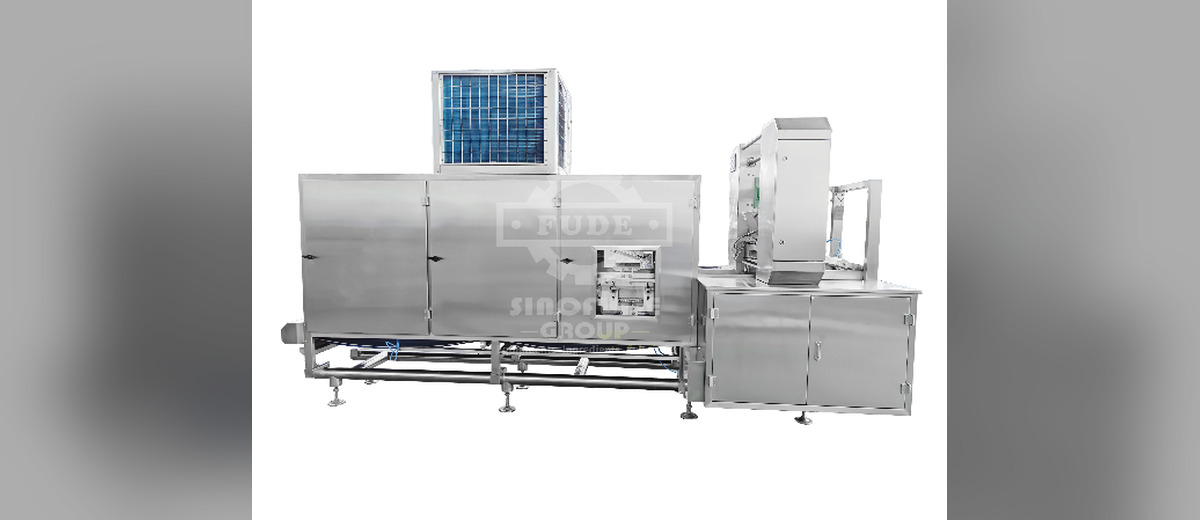
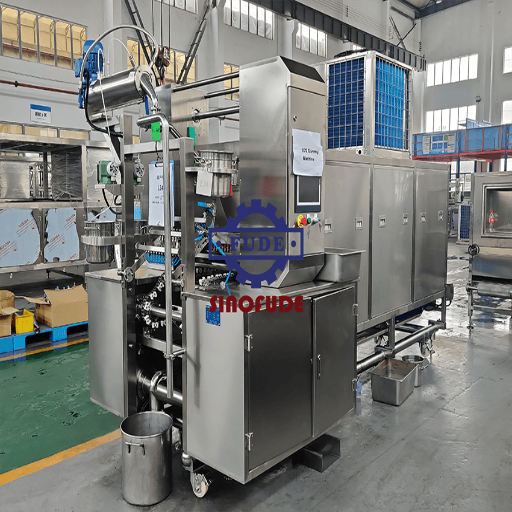
Starchless servo depositing, the CLM family
The depositor uses a servo to meter mass into a silicone or metal mould, which the mass sets in, as opposed to setting in powder. Depositing is done at final solids, so there is no stoving stage to schedule.
- Rated capacity: 40 to 600 kg/h across the family
- Forming medium: reusable silicone or metal moulds
- Operators: 2 to 4
- Asks of your building: connected load, chilled water for the cooling tunnel, a smaller recipe window
- Tolerance: ±0.1 g
Centre-filled, layered and high-clarity products end up here, because the mould is a defined cavity rather than an impression in powder.
SYS_ID: CLMS.02
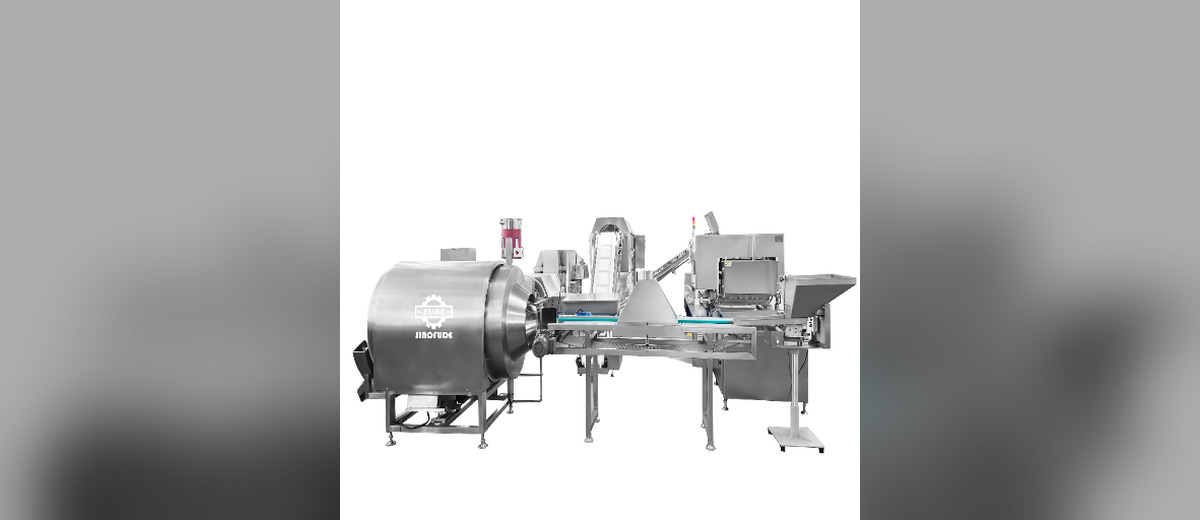
Starch mogul moulding, the CLM-S family
A mogul compacts cavities into conditioned moulding starch and deposits into those cavities. The trays are then stacked while the starch cools and dehumidifies the pieces. Since changing the shape requires a change of stamp, this system stays flexible across very different piece designs.
- Rated capacity: 150 to 600 kg/h (full-auto); CLM-S50 at 40-50 kg/h (semi-auto)
- Forming medium: food-grade corn starch in PVC trays
- Operators: from 1 to 2 at smaller size, 3 to 4 at largest size
- Asks of your building: starch circulation, recovery, dust management, curing space
- Supplied: cooking, tray circulation, recovery, extraction
Where the Setting Work Goes discusses the trade-offs of this route between flexibility and floor space.
SYS_ID: NTR.03
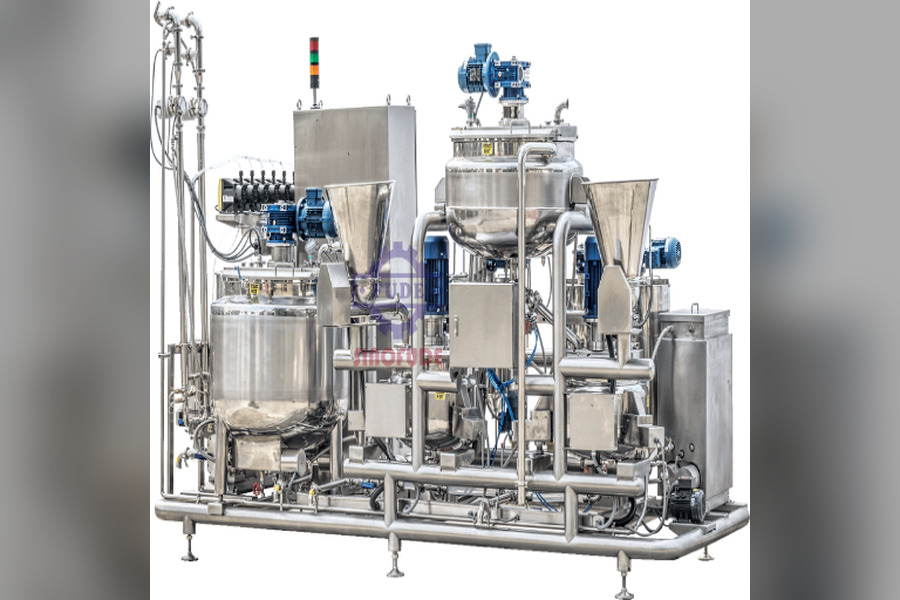
Nutraceutical and vitamin gummies
This is a requirement layer rather than a separate machine: dosing control, batch weighing, parameter recording and a clear responsibility boundary, added on top of a route you already chose.
- Runs on: the starchless route in almost every case
- Added control: liquid dosing to ±0.1 per cent
- Added docs: batch weight records
- Why it matters: reused moulding starch is a documented cross-contamination pathway
SYS_ID: JLY.04
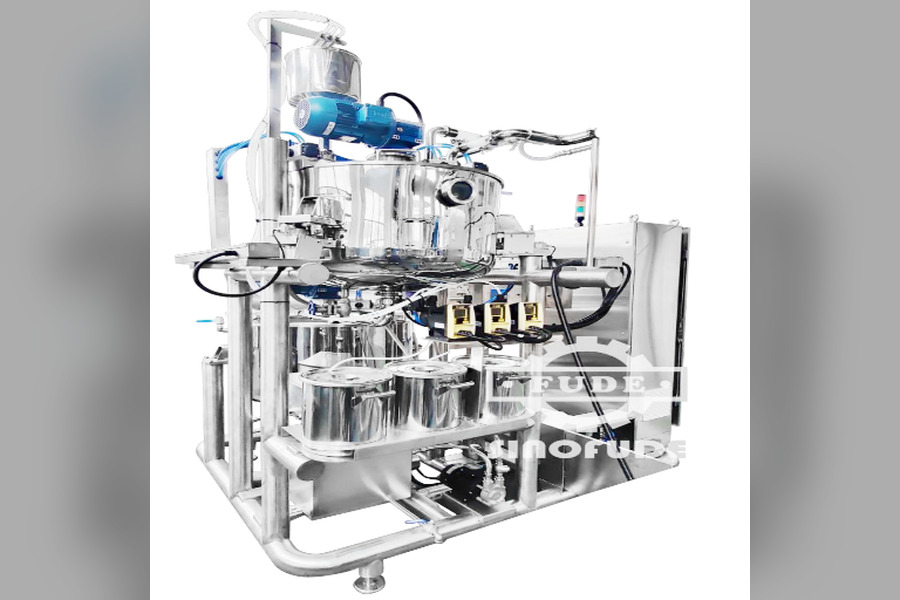
Jelly and pectin candy
Pectin is a gel chemistry, not a production line. It changes when the mass sets, how long the deposit window stays open and how tightly acid addition has to be timed, and it runs on either forming route.
- Runs on: either forming route
- What changes: pH control, tighter timing
- Formats: jellies, centre-filled, sugar-free
- Unchanged: cooking, dosing and finishing
SYS_ID: PLT.05
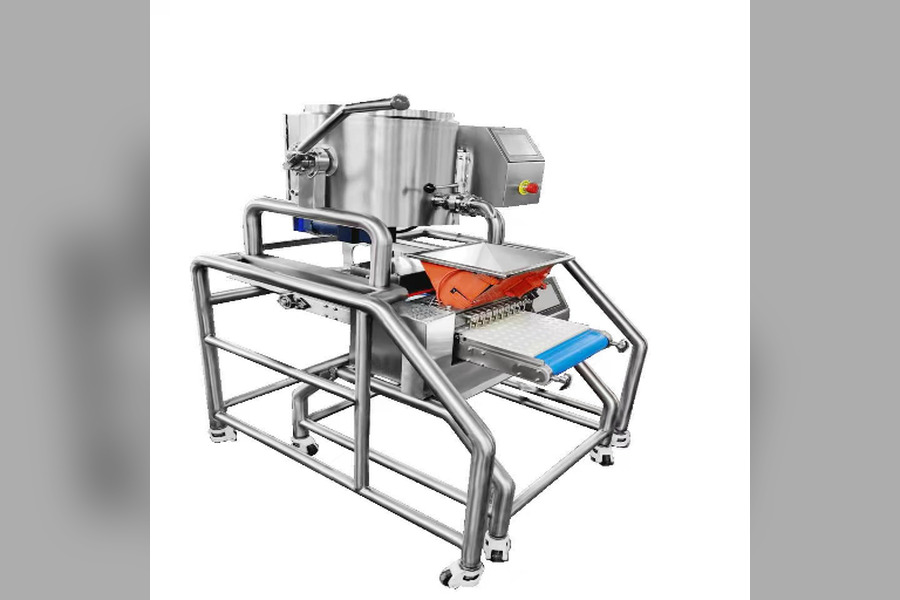
Pilot and small-scale lines
A pilot line puts the setting work onto the operator: moulds are loaded by hand, pieces cool without a tunnel. It is right for recipe development and small contract runs.
- Rated capacity: up to 20 kg/h
- Models: CLM Baby and CHX20
- Operators: 1 on CLM Baby, 3 on CHX20
- Changeover: 30 minutes
- Tolerance: ±0.1 g
Both pilot models have the same depositing accuracy as production units.
Where the Setting Work Goes
Every gummy needs three things done before it leaves a mould: the heat taken out, the water taken out, its shape held until it sets. No line skips any of them; the families differ only in where they put that work.
Starch mogul, CLM-S
Where the setting work goes
Into the starch bed and into time. The starch is mould, coolant and desiccant at once.
What it costs you
Starch circulation, curing space, work in progress, starch recovery, dust management
Starchless servo depositing, CLM
Where the setting work goes
Into the cooling tunnel and into the recipe
What it costs you
Connected load, chilled water, a narrower process window
Pilot lines, CLM Baby and CHX20
Where the setting work goes
Onto the operator
What it costs you
Labour, and a hard ceiling on output
Nutraceutical and vitamin
Where the setting work goes
A dosing-control and documentation layer above whichever route you chose
What it costs you
Batch weighing, parameter recording, a defined responsibility boundary
Jelly and pectin
Where the setting work goes
Into pH and a shorter setting window
What it costs you
Tighter timing between acid addition and depositing speed
What the starch is actually doing
The published patent application on starchless production spells out the process: the starch mold decreases the temperature of the gummy composition and absorbs water from it, and both help the composition to solidify, with complete solidification taking about 24 hours.3 A 2024 study published in Heliyon holds its mass in starch molds at 25 °C for 24 hours before demolding, and measures finished moisture between 13.00 and 17.95 per cent by weight.4 Patent application GB 2640026 A describes conventional gummy drying as a batch process below 45 °C and below 30 per cent humidity that takes over 48 hours, and it names the bottleneck precisely: drying positions have to be adjusted by hand to keep moisture distribution even across the product.
Running cost of the medium
Confectionery Production provides numbers: 5 to 6 kg of starch per mogul tray, around 30 trays a minute, 10.8 tonnes an hour, close to 260 tonnes in a day. The same article reports drying taking around 24 hours or even 48 and states that storage under controlled temperature and humidity is absolutely required.8
Starch is not inert, and US federal enforcement addresses candy and starch dust as a combustible dust hazard. The assessment considers particle size, moisture, dispersibility, ignition energy, confinement, housekeeping and explosion-protection design, not one specific value. Vacuum dust extraction is included with the CLM-S system; the site hazard assessment belongs to you and your local experts.
Moving the work does not delete it
Contrary to the way this choice is usually shopped, taking the starch away does not delete the setting variable. It relocates it, half onto the machine as mould material, surface finish and release, and half into the recipe. The same patent shows the recipe half moving on its own: adding pectin to a gelatin formulation cut the time before pieces could leave a starchless mould from 90 minutes to 20, machine unchanged.3
- Pectin added to a gelatin formulation: mould-removal time fell from 90 minutes to 20, machine unchanged
- Gelatin bloom index lowered: the minimum time before a piece can be taken out rises significantly, so higher bloom is preferred on the starchless route
- Neither figure is a SINOFUDE machine specification, and neither belongs in a capacity table
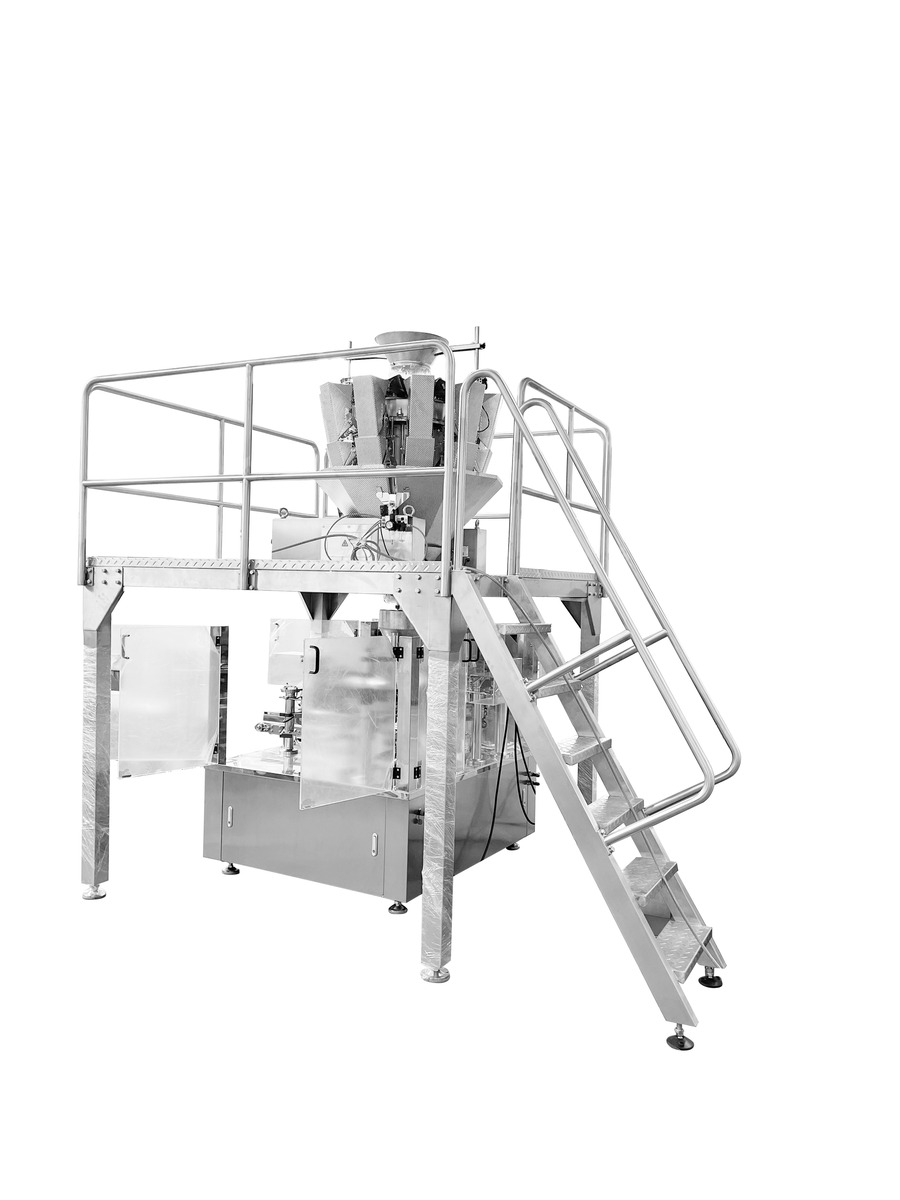
PRODUCTION PROCESS ANALYSIS
Where the Setting Work Goes picks a forming route. It does not stand in for process validation: gelatin, pectin and starch moulding differ in thermal history, water activity, drying, changeover and allergen control, all confirmed against your own finished-product specification at acceptance.
Line Family Comparison: Capacity, Forming Medium, Operators and Changeover
One row is a product family or a capacity step inside one. Where the Setting Work Goes decides which rows you read, and this table gives the cost of each in production capacity, people and downtime.
| Line family | Decision this row changes | Rated capacity | Forming medium | Operators | Changeover | Depositing weight tolerance |
|---|---|---|---|---|---|---|
| Starchless servo depositing, CLM family | Forming route | 40 to 600 kg/h | Reusable silicone or metal moulds | 2 to 4 | Mould change, 30 to 120 minutes | ±0.1 g |
| Starch mogul CLM-S50, semi-automatic laboratory unit | Forming route | 40 to 50 kg/h | Food-grade corn starch in PVC trays | 1 to 2 | Printing roller change | Not published in the model table |
| Starch mogul CLM-S150, commercial | Forming route | 150 kg/h | Food-grade corn starch in PVC trays | 1 to 2 | Printing roller change | Not published in the model table |
| Starch mogul CLM-S300, commercial | Forming route | 300 kg/h | Food-grade corn starch in PVC trays | 2 to 3 | Printing roller change | Not published in the model table |
| Starch mogul CLM-S600, volume | Forming route | 500 to 600 kg/h | Food-grade corn starch in PVC trays | 3 to 4 | Printing roller change | Not published in the model table |
| Pilot CLM Baby, integrated cooking | Forming route | Up to 20 kg/h | Reusable moulds, loaded by hand | 1 | 30 minutes | ±0.1 g |
| Pilot CHX20, twin servo | Forming route | Up to 20 kg/h | Reusable moulds, loaded by hand | 3 | 30 minutes | ±0.1 g |
| Nutraceutical and vitamin | Requirement layer | Runs on the starchless route | As row 1 | As row 1 | As row 1 | ±0.1 g, plus liquid dosing to ±0.1 per cent |
| Jelly and pectin | Gel chemistry | Either forming route | Follows the route chosen | Follows the route chosen | Follows the route chosen | Follows the route chosen |
Catalogue kilograms per hour are still a reference. The contract defines the product, recipe condition, piece weight, steady speed, sampling method, run length, and the limit on rejects, while acceptance defines that case. A new product code would also need a new mould, cooling, and packaging.
The tolerance column applies to the CLM depositing models only. The CLM-S table has no depositing tolerance row, so those cells say so rather than borrowing the figure above them.
The two routes overlap across the whole commercial range. Starchless runs 40 to 600 kg/h; the full-automatic mogul models run 150 to 600 kg/h, with the semi-automatic CLM-S50 below them as a laboratory unit rather than a production machine. The common assumption is that a bigger output number puts you on a different kind of line, and from 150 kg/h upwards that is not the case: choosing a forming route is not choosing an output class.
Operator counts are for the forming section and come from our model tables, not from a whole plant.
Changeover is a different unit of work on each route. A mould change and a printing roller change are not comparable jobs, so they are not converted to a single figure.
Why set time is not a column
Setting time varies more with the recipe than with the hardware, and the patent case in question moves mould-removal time by a factor of 4.5 with one change to the formula. A set-time column would therefore describe your gel system while appearing to describe our equipment.3 We specify the setting and curing time relative to your target texture, your piece size, and the formula.
Connected load, and why it is not a column either
We publish two connected-load figures in our two specification tables. These figures are not comparable with each other.
| Source table | Column heading | Reading | What that table says is included |
|---|---|---|---|
| CLM-S starch mogul | Installed total power | 35 kW at the CLM-S600, rated 500 to 600 kg/h | Cooking, tray circulation, closed-loop starch recovery and vacuum dust extraction. Curing rooms belong to your own layout and utilities. |
| CLM depositing models | Installed Power | 400 kW at the CLM600 | No scope statement is given on that table. |
Dividing one of those by the other produces a figure that means nothing. That is a measurement problem rather than an arithmetic one: a quantitative result only means something alongside what was measured and under what conditions, so a figure whose measurement basis is not stated cannot be set against one measured on a different basis. Supply boundaries are fixed in your quotation.
Gel Systems and Product Formats Across the Range
Gelatin, pectin, starch, and carrageenan are the chemistry options in whichever route you selected. Each of these affects the behaviour of the mass in the cooker, how wide the deposit window remains open, and what the formed piece requires after forming.
[ DATA MATRIX ] Gel system or format | What it changes in the process | What the line has to do about it
Hover to reveal system parameters
Rated output assumes the hopper stays full, and in the pectin gummy manufacturing process that means scheduling cook batches so the cooker never becomes the constraint the depositor is waiting on. This is a scheduling problem that gets resolved at the quotation stage with your batch sizes.
The targets these systems are steered towards are published. Peer-reviewed work reports finished moisture between 13.00 and 17.95 per cent by weight and pH between 3.5 and 6.5 across a sample set,4 and Current Innovations in the Development of Functional Gummy Candies, a review in Foods, describes gummy candies being cooled and dried by air convection after moulding, down to a water content between 15 and 30 per cent.
Targets the instruments hold
Those are the variables the instruments exist to hold. 21 CFR 117.40(f) states that instruments used for measuring, regulating or recording temperature, pH and water activity must be accurate, precise, adequately maintained and adequate in number, thus the instruments are a part of what you are purchasing.1
Where the Setting Work Goes chooses the route. The gel system decides what has to be validated on it, against your finished product specification rather than the family name.
Quotation Inputs, Delivery Terms and What Moves the Price
We quote against a scope, not a catalogue number. Send these six inputs and the quotation comes back with a defined battery limit, not a range.
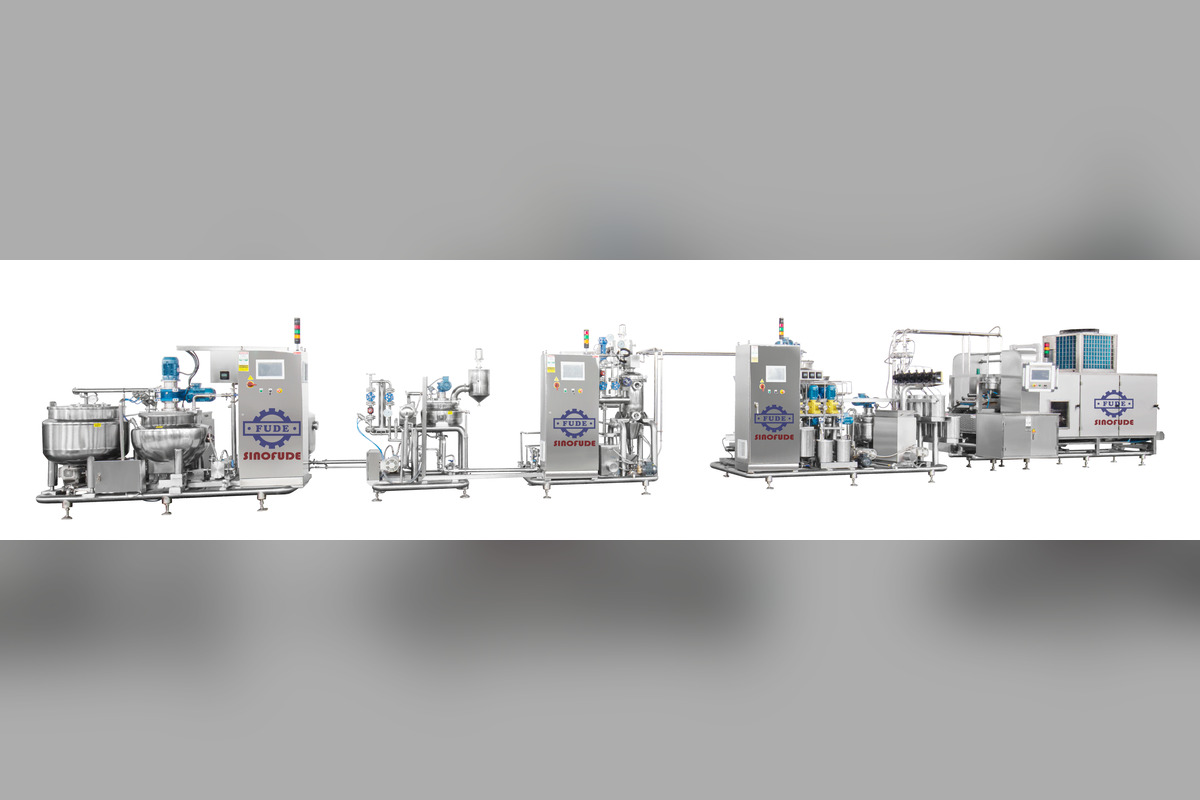
Quotation Inputs
- Target output in kg/h or pieces per hour, and your proposed shift schedule.
- Piece weight, shape, and if the piece is solid, centre-filled or layered
- Gel system: gelatin, pectin, carrageenan or a blend, with bloom or grade if known
- Whether the product carries actives and at what declared dose
- Floor area, ceiling height, and whether you can allow curing space for work in progress
- Site utilities: supply voltage and frequency, chilled water, steam or electric heating and compressed air
What moves the price
- Rated capacity and the number of depositing heads
- Forming route: a mogul and a starchless line differ in terms of machine count
- Automation level: from semi-automatic tray handling to fully automatic gummy line
- Optional modules: boiler, chiller, air compressor, clean-in-place, individually priced
- Temperature control scope: length of the tunnel and demand for chilled water
- Record-keeping depth, where recorded parameters and batch weighing are required
- Destination market route, which must be named before electrical design is frozen

Delivery terms
We ship EXW at the SINOFUDE factory. Chinese taxes are inside that price; import duty, destination VAT and customs clearance sit outside it.
Landed cost sits on your side of the line
The US Department of Commerce sets out the rest: a landed cost is the total price once goods arrive at your door, made up of product price, insurance, freight, tariffs and taxes, and other fees, and which side pays duties is normally set by the Incoterm in the contract. Ask us for a pro forma invoice, your customs broker for the duty and tax layer, and treat the total as an estimate.
Installation and commissioning
Installation and commissioning are charged at USD 200 per engineer per day. You cover air tickets, visas, accommodation, meals and local transport, and engineer count and days are fixed from the final line scope and your site readiness.
Your delivery schedule is fixed in your quotation against the agreed scope and battery limits. We plan capacity on a conventional eight-hour production day and allow half a day for product changeover and cleaning whenever a change occurs, and capacity is not reserved or guaranteed from a catalogue number alone.
Forming-section labour, at the published US average
The operator column becomes a cost once you multiply it by a wage and a shift. Both inputs below are published, so you can redo it with your own rate.
| Route and size | Operators at the forming section | Labour per eight-hour day at USD 24.70/hour |
|---|---|---|
| Starchless servo depositing, CLM family | 2 to 4 | USD 395 to 790 |
| Starch mogul CLM-S50 and CLM-S150 | 1 to 2 | USD 198 to 395 |
| Starch mogul CLM-S300 | 2 to 3 | USD 395 to 593 |
| Starch mogul CLM-S600 | 3 to 4 | USD 593 to 790 |
| Pilot CLM Baby | 1 | USD 198 |
| Pilot CHX20 | 3 | USD 593 |
Hygienic Design, Certification and Documentation
For a gummy plant, compliance requires three separate layers, and one certificate addresses only one of the three. Reading them as a single layer is the most common reason an equipment file is rejected in a US procurement review.
01
Layer one: equipment conformity
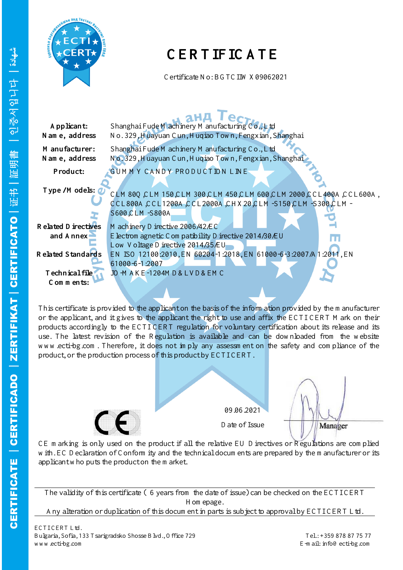
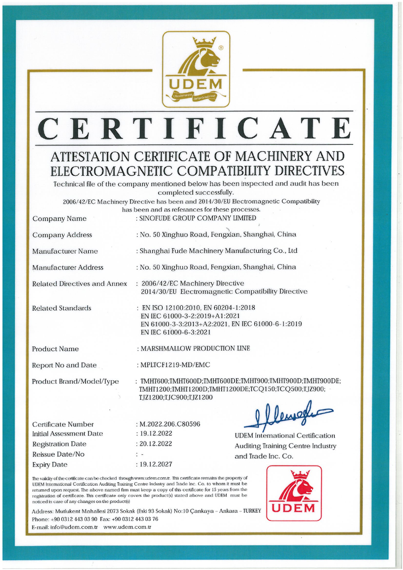
Our current candy-machine CE conformity certificate is UDEM M.2026.206.C140900, registered 20 May 2026 and expiring 19 May 2031, covering the listed CLM, CCL, CLM-S, CGD, GD, CHX and Lab-baby models. What it supports is those named models; what it does not prove on its own is an unlisted model or a destination approval, so every quotation is checked against the exact model list and the certificate conditions.
Scope of the mark
The European Commission states that the mark does not indicate approval by the EU or by any other authority for safe product use, and does not indicate the product’s origin.7 It records that the manufacturer performed the assessment and holds the technical file.
North American routes
UL and CSA are a separate system, and your destination market has to be named before electrical design is frozen
ISO 9001
Held at the organisation level since 2004. It certifies a quality management system, not the safety or food-contact suitability of any individual machine.
02
Layer two: food-contact materials
Material evidence is mapped to parts, not given as a blanket statement: 304 and 316L certificates, XRF identification records, test reports for the polyurethane conveyor belting. Read it part by part against the final bill of materials, not as a claim that every surface is 316L.
No single document settles this layer
The FDA’s own description of its food contact substance notification programme points the same way: an effective food contact substance notification is specific to the submitting company and the intended use described in it. A machine certificate does not establish food-contact authorisation for every material and condition of use, and no single document can.
03
Layer three: preventive controls in your plant
21 CFR 117.40 reads as a set of duties on equipment: it must be adequately cleanable and adequately maintained; food-contact surfaces must be corrosion-resistant, non-toxic and able to withstand the cleaning compounds and sanitising agents used on them; seams must be smoothly bonded; and holding, conveying and manufacturing systems, including pneumatic, closed and automated systems, must be capable of being kept clean and sanitary.1
Two paragraphs that catch people out
Two paragraphs catch people out. Compressed air mechanically introduced into food has to be treated so the food is not contaminated, and an enclosed servo transfer path is not exempt from the cleanability duty because it is enclosed.1 For dietary supplements the governing rule is 21 CFR 111.27, which writes the equipment duty onto you in the second person.2
Machine design answers the equipment layer. Hazard analysis, risk-based preventive controls and the rest of the plant-level programme sit inside your quality system; we support them with design features, material evidence and drawings rather than replacing them.
Why We Built This Page as a Router
This page aids in selecting a forming option and a line group: starch mogul versus starchless servo depositing, and where a CLM-S is positioned against a CLM. It is not a compliance determination. Food-contact authorisation, hazard analysis, and preventive controls reside in your quality system and with your local specialists; our role is design features, material evidence, and drawings and records to assist them.
×
![Zoomed Certification Image]()
When a SINOFUDE Gummy Line Is Not the Right Answer
Four situations we would rather address now than at commissioning.
You are shopping for a countertop appliance
A domestic candy making machine and a 600 kg/h production line share a page in search results, and the only common element is the word gummy. If you are looking for a counter-top appliance, a kitchen appliance retailer is the better place to search. Our smallest production unit still requires a potential customer to develop a recipe, provide an operator, and arrange three-phase power.
Your building cannot carry a starch route, and your product needs one
A mogul asks for starch circulation, curing space and work in progress standing in trays, and it brings a combustible dust duty with it. NFPA 654 and NFPA 664 use seventeen parameters to identify a dust explosion hazard, and minimum explosible concentration is only the first.6 OSHA notes that the minimum dust-layer thickness describes the quantity of fugitive dust, not its properties.
Housekeeping is not resourced
Annex D of NFPA 654 gives the yardstick for characterising a dust layer: immediate cleaning is warranted once 1/32 inch builds up over at least 5 per cent of a room’s floor area, capped at 1,000 square feet once floor area passes 20,000, counting overhead beams, joists, ducts and the tops of equipment. OSHA quoted that guidance in its 2007 Combustible Dust National Emphasis Program, a directive OSHA now publishes as an archive document rather than as current policy.5 If this task cannot be assigned on your shift schedule, the starch-free process removes it rather than leaving it to be managed.
The same record advises not to exclude dusts on a deflagration index threshold, mentioning that the least explosive class caused the most incidents and injuries by gross numbers.6
Work out your dust housekeeping trigger area
You need a texture only gelatin gives, and you cannot use gelatin
Starch-free production uses pectin and carrageenan, however trade coverage states clearly that they do not provide the texture and chewiness achieved with gelatin.8 If that texture is the product, the gel system is your constraint, not the line.
How We Work: From Enquiry to Commissioning
Six steps, in order, with the decision that belongs to each.
01
Product brief.
You send output, piece weight, gel system, actives and site constraints. We come back with a line recommendation and the forming route that fits, before any price.
02
Understand the scope and battery limits.
We define what is included, what is optional, what you provide, and which machines are supplied by external parties. The quotation and delivery scheduling are based on these limits rather than a catalogue number.
03
Technical schedule and drawings.
General arrangement, utility schedule and electrical drawings are approved by you. The destination market route is named here, because it changes the electrical design.
04
Manufacture.
Siemens PLC control, WEG or SEW motors, Yaskawa servos and Airtac cylinders are the default platform. Any exception is written into the technical schedule rather than discovered at the factory test.
05
Factory acceptance test.
Run on your recipe, against the agreed procedure, covering contract functions, safety interlocks, alarms, changeover tasks and the document set. Items untestable here become site acceptance items.
06
Installation, commissioning and site acceptance.
Charged at USD 200 per engineer per day. Plan your own people too: trade coverage puts core commissioning at three to five people per medium-sized plant area, at least half operationally experienced.
CORE ENGINEERING
SINOFUDE application engineering
Step one exists to move the expensive discovery forward. The risk everybody wants to avoid is finding out at commissioning that your gel system will not run at your piece weight, and the factory acceptance test on your own recipe settles it.
Curing duration varies with candy size, recipe composition and target final texture, and capacity is not reserved or guaranteed from a catalogue number alone. Send the recipe and the piece weight, and the schedule comes back against your product rather than against a family name.
Gummy Production Line Engineering Tools
Forming Route Router
Two answers fix the forming route: the output you need, and whether your building can give curing space to work in progress. Everything else is a layer that sits on top of the route you land on.
Forming-Section Labour Estimator
The operator column of a line comparison becomes a cost the moment you multiply it by a wage and a shift. Both inputs here are yours, so the answer is yours rather than a supplier’s.
Dust Housekeeping Trigger
A starch mogul brings a housekeeping duty with it. Annex D of NFPA 654 gives the yardstick for characterising a dust layer: immediate cleaning is warranted once a layer of 1/32 inch builds up over at least 5 per cent of the floor area of a facility or any given room,
FAQ: Gummy Production Line Questions Buyers Ask
What is a gummy production line?
It is an integrated set of confectionery machinery that cooks a gelatin, pectin or starch-based syrup, doses colour, flavour and actives, forms the mass in cavities, holds it until it sets, then demoulds, dries and finishes the pieces. The forming stage separates the families: starch mogul, starchless servo depositing, hand-loaded pilot moulds.
Which gummy production line family should we start from?
Two questions settle it: what output do you need in kg/h, and can your building carry curing space plus work in progress standing for a day or more. If the answer to the second is no, the starchless route is the one to price, because it moves the setting work into a cooling tunnel and a recipe instead of into floor area and time; if it is yes, the mogul stays open to you and brings stamp-change flexibility with it, along with a starch circulation area, a dust duty and the housekeeping that goes with both. Those two answers fix the forming route, which is the decision Where the Setting Work Goes is built around, and the dosing-and-records layer and your gel system are then added on top of whichever route you chose.
What output can each family reach?
Starchless covers 40 to 600 kg/h; full-automatic starch mogul covers 150 to 600, with the semi-automatic CLM-S50 at 40 to 50 as a laboratory unit; pilot lines reach 20. Across the commercial range the two routes overlap, so output alone will not pick your route.
What information do you need to quote a line?
Six factors will help establish a boundary to the project: the target output and shift pattern, the weight and format of each piece, the gel system, the actives and their dosage, available floor space and clear ceiling height, and site utilities. From these six factors, a scope and battery limits are established, and price and delivery follow from them.
Can one line run both gelatin and pectin?
Yes, with the process window set for the harder of the two. Gelatin tolerates a long deposit window provided temperature holds along the path; pectin sets during the run, so cook batches are staggered and nozzle temperature controlled to stop pre-gelation inside the assembly. Both are confirmed on your recipe at the factory acceptance test.
What depositing weight tolerance is achievable?
We hold ±0.1 g on the CLM depositing models and ±0.1 per cent on CFA liquid dosing. The CLM-S table publishes no depositing tolerance, so we quote none for that family.
What changes when the line has to make vitamin or supplement gummies?
A dosing-control and record-keeping layer is added over the route you already chose: batch weighing, recorded process parameters and a defined responsibility boundary. In the United States the governing equipment rule becomes 21 CFR Part 111 rather than Part 117, and that part writes the equipment duty onto you in the second person rather than onto your supplier. The forming route usually changes too, because reused moulding starch is a documented cross-contamination pathway where moisture drawn out of the pieces carries other substances into the powder with it, so active-loaded products move to the starchless route, where heat-sensitive actives then set a separate ceiling on residence temperature that is confirmed on your own recipe at the factory acceptance test.
Who installs the line, and what does the warranty cover?
Our engineers install and commission at USD 200 per engineer per day, and you cover travel, visas, accommodation, meals and local transport. The warranty is one year, excluding deliberate damage and operating error.
What is verified at factory acceptance, and what is left to site acceptance?
Against a written procedure, the factory test verifies contract functions, safety interlocks, the recipe, alarms, changeover tasks, the document set and a trial run on the agreed product. Performance on your utilities, integration with other suppliers’ machines and behaviour in your ambient are site acceptance items, and anything untestable in our workshop is listed as one before shipment.
Which certificate applies to the machine in our quotation?
CE conformity certificate UDEM M.2026.206.C140900, valid 20 May 2026 to 19 May 2031, covering the listed CLM, CCL, CLM-S, CGD, GD, CHX and Lab-baby models. It does not cover an unlisted model or a destination approval, so ask us to confirm it for the model you are buying.



