
Get in Touch with SINOFUDE Company

ISO Certified Quality
Wafer Production Line
Wafer Production Line for Flat Wafer Biscuits
Configure your line for baking, sheet cooling, cream spreading, stacking, conditioning, cutting, and the packaging handoff. SINOFUDE will work from the final form of the product and account for factory limitations so the quote is complete and defines the operating scope beyond the oven.
Quotation unit:
One configured production line
Schedule basis:
Up to 90 days after the agreed advance-payment milestone
Payment route:
T/T deposit and pre-shipment balance, or L/C
Shipping basis:
EXW, FOB or CIF in the written quotation
It is helpful to provide the first inputs: a photo of the product, dimensions of the sheet and cuts, number of layers, filling, the accepted output basis, the package, the utilities and a possible floor plan.
Send Your Wafer and Output Target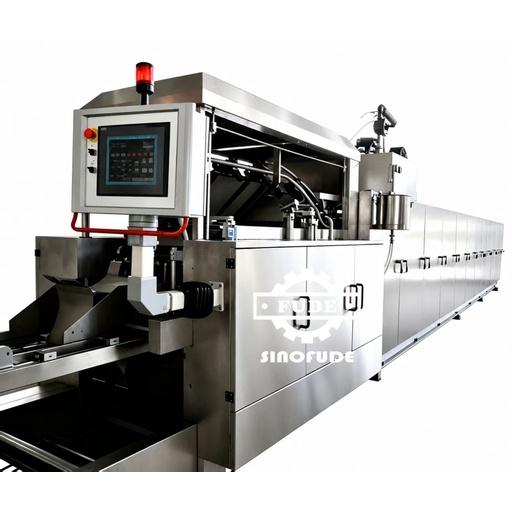
Product Family
Flat sheets and layered cream wafers
Core Process
Batter to cut wafer and packing handoff
Production Scheduled
Within 90 days
Terms
T/T or L/C
EXW, FOB or CIF
EXW, FOB or CIF
Configure the Wafer Biscuit Production Line Around Your Product
The starting point for the line design is a saleable wafer and not a generic machine capacity. The size, thickness and embossing of the sheets, the number of layers and the behavior of the cream, and the format of the cuts determine the design of the baking plates, the transfers, the cooling, and the setup for spreading and packing. A photo of the product starts the discussion, an agreed-upon sample and defined acceptance criteria complete it.
Boundary before model choice
The Wafer Line Scope Map separates what each module does, which inputs belong to the buyer and where a handoff can become a bottleneck. This matters because “complete line” is not always the same scope across quotations. One offer can stop after baking while another includes conditioning, cutting and transfer into a wrapper.
Wafer Line Scope Map
Product definition:
flat sheet or layered biscuit, dimensions, pattern and layer count.
Process definition:
batter, baking, release, cooling, cream, stacking, cutting and transfer.
Output definition:
accepted kg/h, sheets/h or packs/h under recorded run conditions.
Factory definition:
heat source, electrical supply, air, exhaust, access and floor space.
Acceptance definition:
recipe, run time, samples, rejects, stops, records and signoff.
Commercial definition:
included modules, installation boundary, Incoterm and payment milestone.
Three buyer warnings converted into test conditions
“The quote says complete line”
only after every module and packaging interface is listed.
“The headline rate cannot be compared”
until product mass, test time, stops and rejects use one basis.
“The wafer leaves the cutter crisp”
does not close the texture test; the planned package must be included.
Complete Wafer Production Line Process
A wafer production line is food manufacturing machinery built around a combination of heat, moisture and mechanical transfers and is a type of food processing equipment. Solving a stage in isolation can move the problem downstream: a sheet can leave the wafer baking oven intact, crack in cooling, slide during cream spreading or lose crispness in packing. The scope needs to be owned by one person at each transfer.
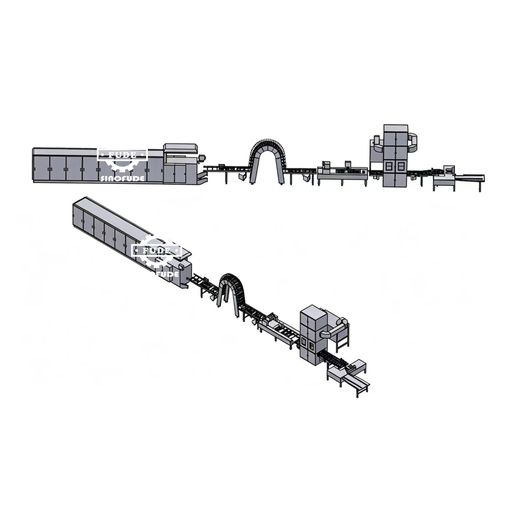
1
Batter preparation
InputMixing order, temperature, density, viscosity and holding time influence depositing and bake consistency.
Freeze: recipe boundary, allergen controls, batch size and feed method.
2
Dosing and baking
CoreBatter is deposited between baking plates and baked under controlled time and temperature conditions.
Freeze: sheet geometry, plate pattern, heat source and color target.
3
Release and cooling
CriticalWafer sheets need stable release and controlled handling before filling or stacking.
Freeze: breakage definition, cooling path, accumulation and transfer height.
4
Cream preparation
OptionalFilled wafers require cream condition and supply to match spreading and line speed.
Freeze: filling recipe, temperature window, allergens and cleaning method.
5
Spreading and stacking
OptionalCream is spread and sheets are layered to the approved construction.
Freeze: layers, filling distribution, edge condition and stack alignment.
6
Conditioning and cutting
CoreThe book is stabilized before precise cutting into the sale format.
Freeze: cut plan, trim handling, acceptable chips and reject handling.
7
Packaging handoff
InterfaceProduct spacing, orientation and environmental exposure affect the next machine and finished texture.
Freeze: wrapper infeed, pack count, barrier target and seal inspection.
Wafer Baking and Sheet Handling Equipment
The wafer baking machine sets the geometry of the sheets and the thermal cycle, but stable production also depends on the condition of the plates, depositing, releasing and downstream handling.
Uneven thickness or color is not always an oven control problem; batter condition, dosing, plate gap, surface condition and line stops can produce similar issues.
Batter and dosing equipment
Confirm the preparation boundary, hopper replenishment and the variables operators record. An automatic dosing label does nothing for consistency if batter holding time or temperature changes between the sample trial and production.
Wafer baking oven
Compare plate format, heat source, temperature-control architecture, exhaust needs, opening and release method. Ask how the line responds to a stop and how an operator isolates heat and motion for cleaning or service.
Sheet cooling conveyor
Cooling must protect the wafer sheet without creating collisions or long exposed residence. Check transfer points, guides, accumulation behavior and access for removing broken sheets.
Cream mixer and spreader
Record cream temperature, supply stability, spread distribution and cleaning boundary. The common assumption that line speed alone controls filling weight is not necessarily correct when cream rheology changes.
Layering and conditioning
Sheet alignment, layer count and conditioning determine whether a wafer book remains stable through precise cutting. Confirm how off-center sheets and interrupted cream supply are detected and handled.
Cutting and transfer
Freeze the cut map, blade arrangement, trim route, reject definition and packaging infeed. The cheapest cutter is not always the best choice if it creates chips, jams or manual reorientation.
Configuration Inputs and Acceptance Basis
This is a project input sheet, not a published SINOFUDE specification. Complete the values, then you can compare offers. The final technical proposal should contain the selected value, test method, and the responsibility and acceptance record for the exact line.
Accepted Output Normalization Worksheet
A capacity mismatch becomes expensive because suppliers can count different products, stops and rejects. SINOFUDE engineers the proposal around one accepted-output definition and the buyer’s recorded test conditions; IEC 62381:2024 reinforces the value of tying tests to an applicable specification and agreed responsibilities.
| Item | Value and unit to provide | Acceptance basis | Record required |
|---|---|---|---|
| 1. Saleable output | kg/h, sheets/h or packs/h | Accepted product over the agreed test period | Run log, rejects and stops |
| 2. Sheet format | Length × width × thickness in mm | Approved drawing and cooled samples | Measurement sheet |
| 3. Layer construction | Integer layer count and filling ratio | Cut sample matches approved construction | Sample set and mass record |
| 4. Finished cut | Rows × columns and piece size in mm | Cut plan, chip and breakage criteria | Inspection sheet |
| 5. Utilities | Voltage, Hz, phase, gas and air pressure | Approved utility schedule and measured connection | Utility drawing |
| 6. Factory envelope | Length × width × clear height in mm | Equipment, service and operator clearance | Approved layout |
| 7. Product condition | Temperature and moisture target | Buyer-approved sampling and test method | Quality record |
| 8. Test duration | Minutes or hours at agreed operating state | Start, stop, fault and restart rules defined | Signed FAT report |
Wafer Production Line Price, Lead Time and Commercial Scope
A comparable wafer production line price requires the same product, the module boundary, utility basis, and defined delivery scope. The quotation will vary based on the number of parallel baking plates and the heating method, process automation, cooling path, filling system, cutter, controls, guarding, and the electrical standard, the packaging interface and site services.
We quote one configured production line. Production runs are scheduled at up to 90 days after the agreed advance-payment milestone, confirmed with your quotation.
Payment and shipment basis
Payment is arranged by T/T deposit and pre-shipment balance, or L/C; exact percentages and milestones are confirmed in the written quotation. We ship on an EXW, FOB or CIF basis, with the final Incoterm stated in that quotation.
Included-line check
Batter system and supply boundary
Baking oven, plates and heat source
Cooling, spreading, stacking and conditioning
Cutting, trim handling and packing transfer
Controls, guards, electrical cabinet and manuals
Landed-scope check
Freight, insurance and Incoterm
Unloading, access and foundations
Utilities, exhaust and local code work
Installation, commissioning and trial materials
Training, spares and support boundaries
The Bronze TCO Framework provides no assurance of payback period. Compare the accepted output, rejects, staffing, energy costs, cleaning, maintenance, spare parts, transportation, and financing using your own values. The high capacity answer is not always the most economical answer when a cutter, cooling system, or wrapper becomes the constraint.
Food Safety, Product Acceptance And Machine Safety
Quality control begins before the machine build, when the buyer defines the recipe, allergens, product limits and local regulatory basis. FDA preventive-control principles call for hazard analysis and applicable process, allergen and sanitation controls with monitoring and validation. These responsibilities should be addressed in the factory’s food safety plan, and a photograph of a machine or a general certification is not a substitute.
Food-Contact And Sanitation Review
Map every batter, cream and wafer contact surface. Check material documentation, access, retention points, cleaning method, chemical compatibility, reassembly and verification before locking the design.
Allergen And Changeover Review
List milk, soy, nuts and other recipe allergens, then define separation, cleaning and validation responsibility. A visual clean alone does not establish that the buyer’s allergen control has been achieved.
Guarding And Interlocks
OSHA 29 CFR 1910.212 addresses point-of-operation and moving-part hazards. Bakery-equipment provisions in 29 CFR 1910.263 add relevant questions around interlocks, emergency stops and oven fuel safeguards.
Hot Surfaces And Energy Isolation
Identify the baking zone, heated plates, drives and stored energy. Access for cleaning or jam recovery must be reviewed together with guards, interlocks and the site’s isolation procedure.
Flour And Sugar Dust
Fine combustible food powders can create fire or explosion hazards when dispersed and ignited. The buyer should assess dust release, housekeeping, ventilation and ignition control for the actual recipe and room.
Acceptance Records
Retain the approved product, drawing, settings, utility readings, run log, samples, defects, deviations and signatures. These records carry more decision value than a polished demonstration clip.
Wafer Texture Protection Chain
Check crispness and structure after cooling, filling, cutting and the planned package, not only at oven discharge. Barrier selection and seal inspection belong in the same acceptance conversation because moisture migration can undo otherwise acceptable baking.
How We Work: From Product Requirement to Factory Acceptance
1
Describe the product.
Send pictures, samples, dimensions, pattern, layers, filling, package and basis of acceptance.
→
2
Describe the factory.
Send available layout, voltage, frequency, phase, heat source, air, exhaust and environmental constraints.
→
3
Review the configuration.
SINOFUDE maps each stage, control point, operator touchpoint, interface and exclusions. Document requirements also go into a technical proposal.
→
4
Freeze drawings and scope.
Approve the line layout, product drawings, utilities, modules, commercial boundary and responsibilities prior to production release.
→
5
Prepare the acceptance plan.
Record recipe, run duration, sampling, output basis, defects, stops, restarts, rules and documents before FAT.
→
6
Inspect and sign off.
Run the agreed product, record deviations, close open points and bind the results to the agreed configuration.
→
7
Plan shipment and site work.
Confirm EXW, FOB or CIF, packing, access, unloading, utilities, local compliance work and the commissioning boundary.
→
A factory demonstration shows that equipment can run under the supplier’s chosen conditions. A factory acceptance test shows whether the quoted line meets the buyer’s written product and test conditions.
Wafer Production Line Engineering & Optimization Tools
Wafer Line Configuration Builder
Choose the saleable product and process boundary. This produces an RFQ module list, not a final engineering specification.
Wafer Output Normalization Calculator
Convert observed pieces and average piece weight into accepted pieces per hour and kilograms per hour. Use measured buyer inputs; the result is not a capacity guarantee.
Wafer Line Quotation Scope Comparator
Mark the items stated clearly in a quotation. A completeness score helps expose open scope; it does not rank machine quality.
FAQ: Wafer Production Line
The quoted boundary can include batter preparation, wafer baking, sheet cooling, cream preparation and spreading, stacking, conditioning, cutting and transfer to packaging. Confirm every module and exclusion in writing because “complete” does not define the same boundary in every offer.
Batter is prepared and dosed between baking plates. Baked wafer sheets are released and cooled; filled products then pass through cream spreading, layering, conditioning and cutting before a controlled handoff to packaging.
Product format, plate and oven configuration, heating method, automation, cooling, filling, cutting, controls, electrical requirements, guarding, packaging interface and site-service scope all affect price. Compare quotations on the same accepted-output and delivery basis.
Use one defined saleable product and unit, then record test duration, uptime, rejects, stops, staffing and downstream constraints. Sheets per hour and kilograms per hour are not interchangeable without sheet mass and an agreed accepted-product definition.
No single capability should be assumed from the keyword. Rolled egg wafers require hot forming, while Swiss rolls use soft-cake processing. Send the target product so the route can be separated before quotation.
Not necessarily. “Wafer making machine” can refer to a baking oven or a smaller process unit, while a complete line can extend through cooling, filling, cutting and the packaging interface. Compare the stage boundary, not the label.
Test the buyer’s agreed recipe and format over a defined run. Record output, rejects, color, dimensions, layer construction, cream distribution, cutting, stops, restart behavior, utility readings, safety functions, cleaning access, samples and deviations.
We quote one configured production line. Production is scheduled within 90 days after the agreed advance-payment milestone. The written quotation confirms the final configuration, schedule, payment milestone and shipping basis.



