
Get in Touch with SINOFUDE Company

Chocolate Moulding Lines for Industrial Tablet and Bar Production
A chocolate moulding line is the forming part of a chocolate plant: tempered chocolate is deposited into polycarbonate moulds, which are then vibrated to expel trapped air, and continue through a cooling tunnel until the fat phase crystallizes and contracts, followed by demoulding. SINOFUDE builds five CJZ models carrying between 200 and 410 moulds in circuit. The number of moulds in circuit, and not the depositing speed, dictates the maximum cooling time per piece.
Application Context
In this context, chocolate bar means a moulded tablet: chocolate that is deposited and then released by contraction. It is not referring to a cereal or nougat bar that is cut and enrobed, which is a completely different line. Please review the section in this document on when a tabletop unit is the honest answer. That explains where the line is drawn, and why this is a different purchase rather than a smaller version of the same thing.
Request a configured quotation
Please send us your product drawing, target piece weight and daily output. Recipes, moulds and drawings provided remain with the engineering team handling your request.
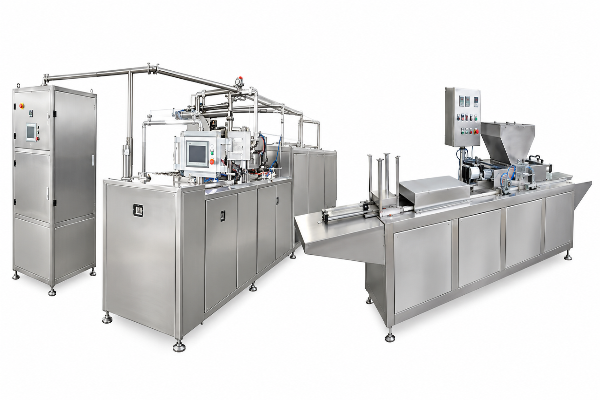
Five CJZ models, 200 to 410 moulds in circuit
One-shot depositing, 32-piston set as standard
Deposit weight adjustable 3–15 g
About 60 days to manufacture a standard line
Inside a Chocolate Moulding Line: Six Linked Stages
A moulding line is not a machine with attachments. It is six duties handed off in sequence around a closed mould circuit and a quotation that includes only some of them cannot be compared to a quotation that includes all of them.
SYSTEM OVERVIEW
INTEGRATED
PROCESS
CIRCUIT
01
PHASE // 01
Tempering and mould conditioning
Chocolate reaches the depositor already tempered, and the moulds reach it warmed. Both are conditions that the forming section relies on rather than produces. On our line tempering is handled by the separate CTW series, which is why it is itemised as its own line item.
02
PHASE // 02
Depositing
The chocolate depositor meters chocolate into each cavity. Our standard set is 32 pistons and the hole pattern can be combined or adjusted to accommodate the mould, thus allowing one head to serve single-colour, two-colour, three-colour, and centre-filled work.
03
PHASE // 03
Vibration
The mould cavity is vibrated to level the deposit and expel trapped air. If this is not done, the bar will contain voids and a dull base face, no amount of cooling will improve this.
04
PHASE // 04
Cooling
The cooling tunnel is where the fat phase crystallizes and the piece contracts. Work from ETH Zurich in the Journal of Food Engineering places the accepted throughput ceiling in this section, citing Beckett’s standard reference work for it, and it is treated in full below.
05
PHASE // 05
Demoulding
Automatic demoulding works by the principle of contraction. It does not rely on applying a force. One of the reasons this process is successful is due to crystallization. A piece which has crystallized sufficiently will have shrunk away from the wall. A piece which has not will leave the mould clean whatever the station does.
06
PHASE // 06
Conveying and mould return
Empty moulds are collected, cleaned as required, and preheated for the next depositor run. This portion of the circuit time is consumed and is the reason that circuit calculations provide an upper limit rather than a cooling specification.
07
PHASE // 07
Control and Line Integration
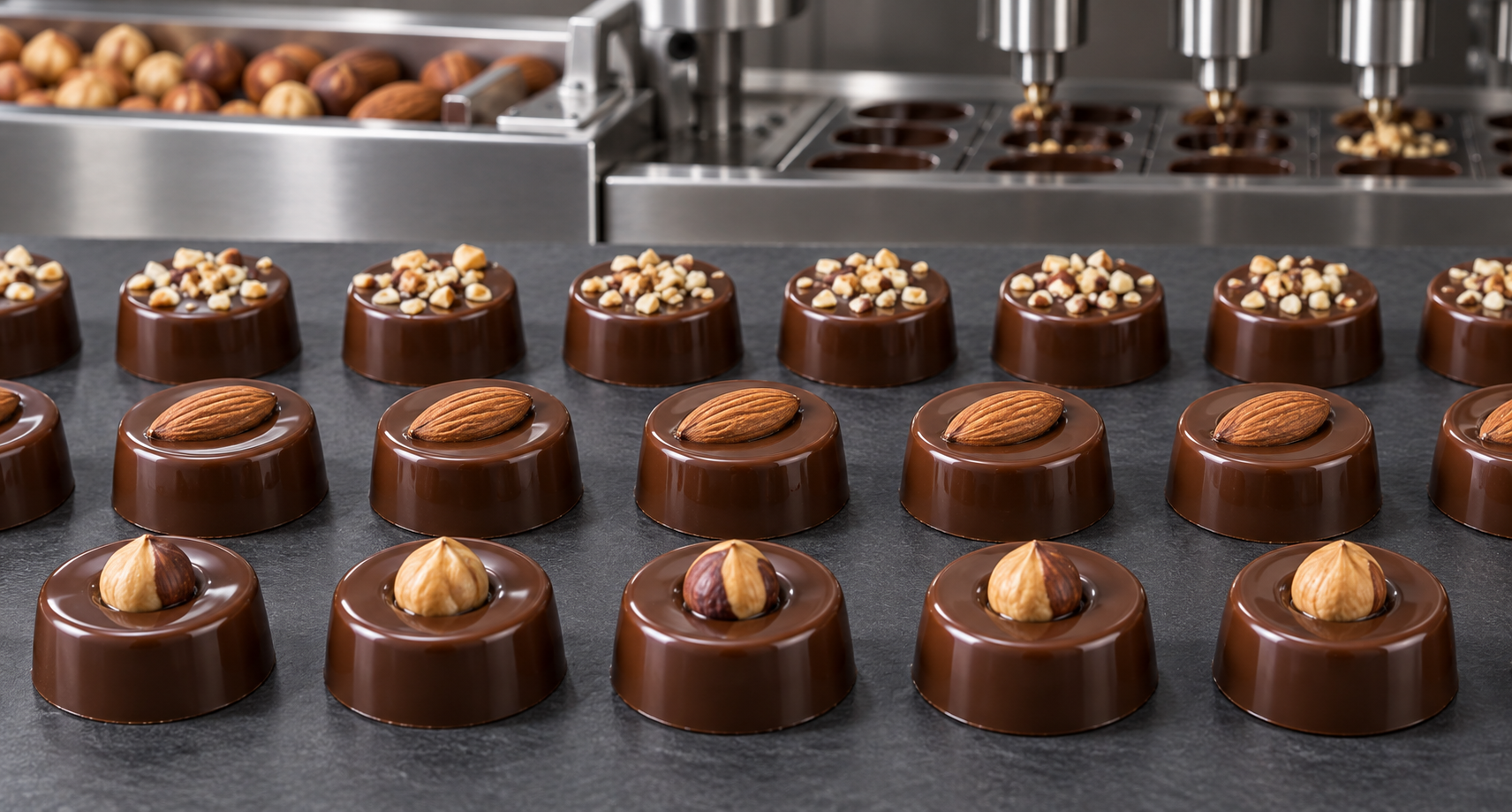
The CJZ line runs on servo drives under a Siemens PLC touch-screen control. A nut placement system can be fitted where the product carries whole or chopped inclusions.
Product Formats the CJZ Line Runs
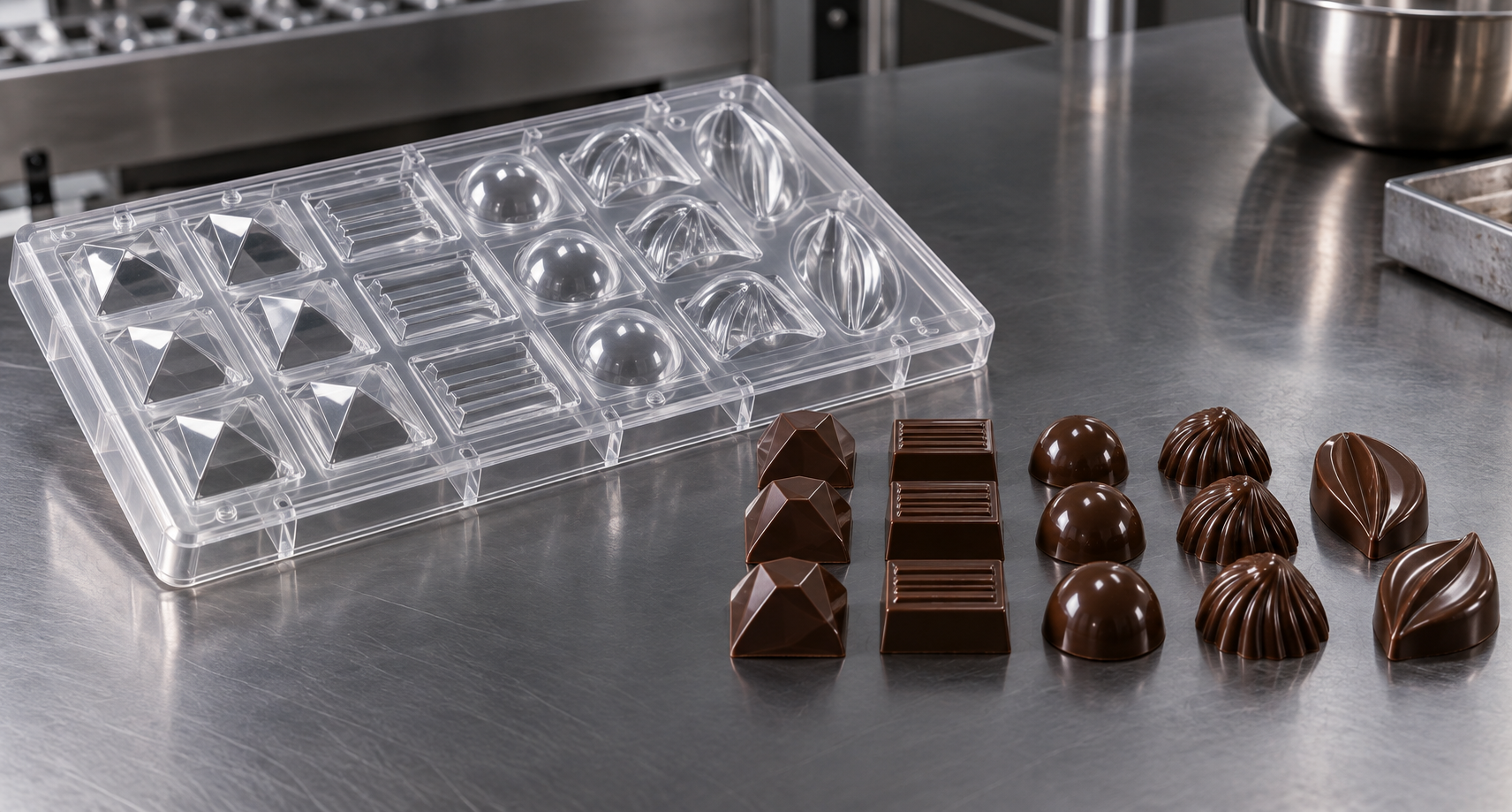
The format of the line has a greater impact on its configuration than capacity does. Formatting the line changes the depositing sequence, the mould, or both.
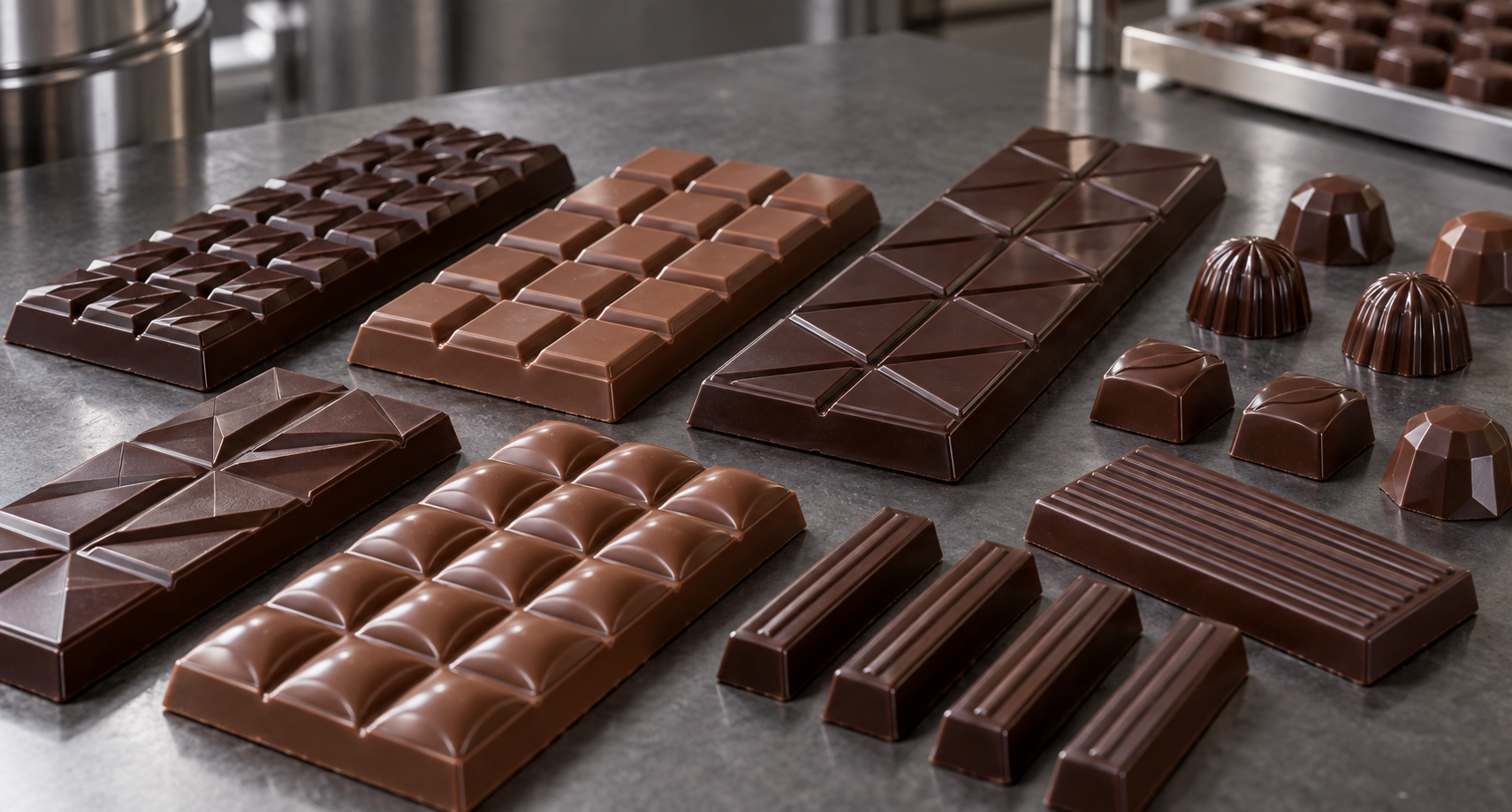
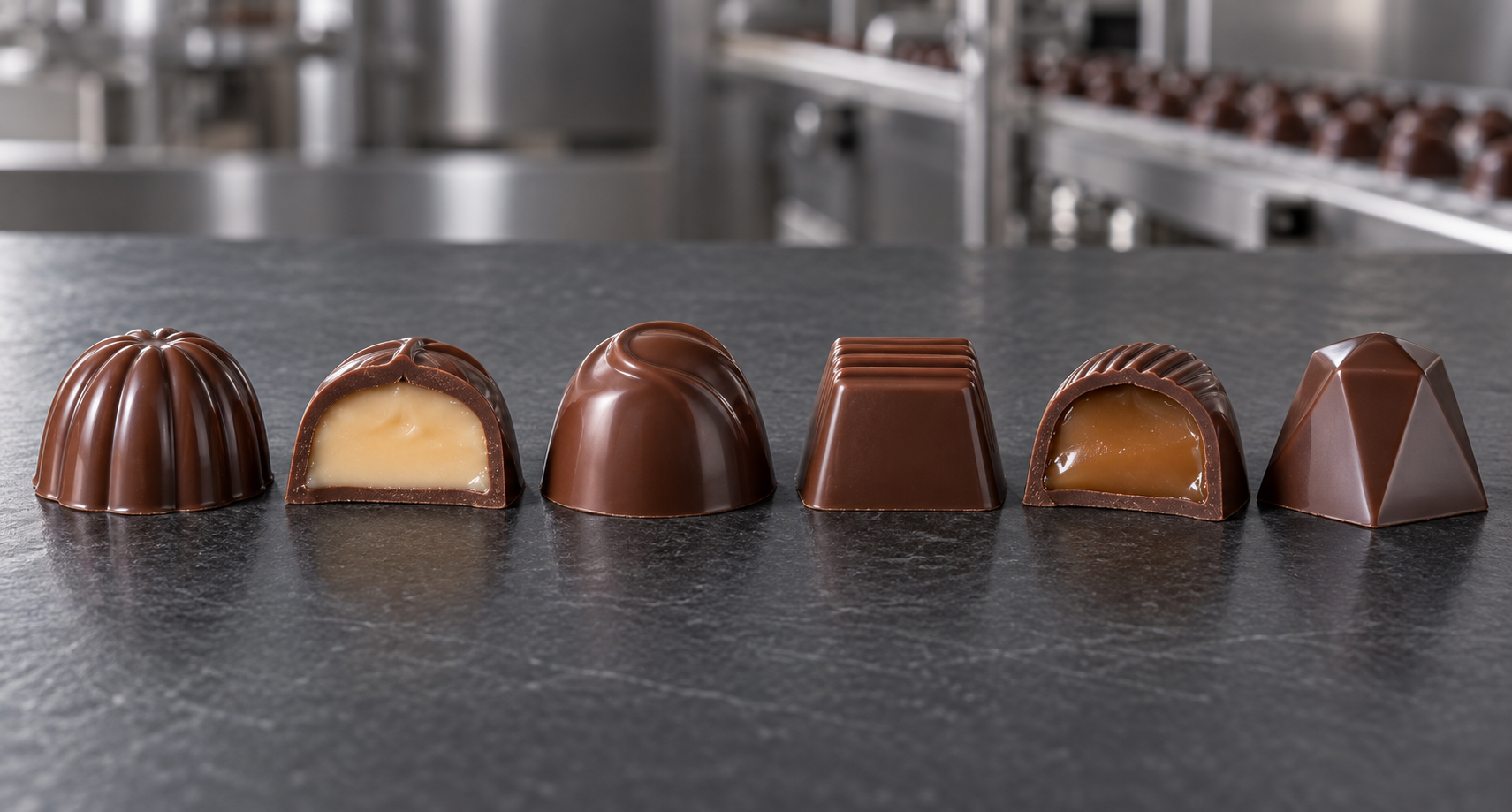
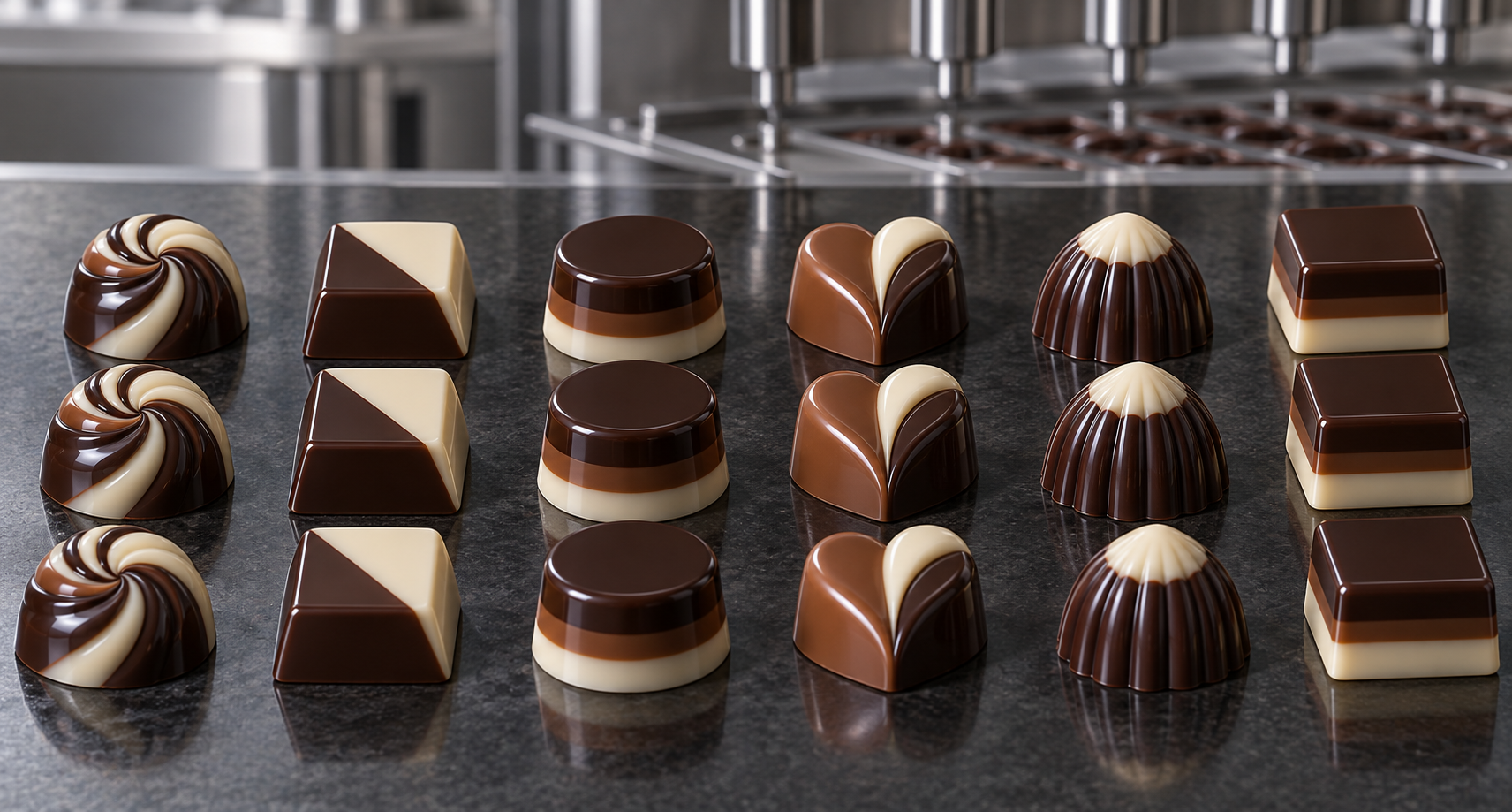

Request a configured quotation
There is one important point that is worth mentioning before it is included in a quote. Published work on filled-chocolate manufacture holds that one-shot depositing requires the shell mass and the filling mass to be closely matched in yield value, flow rate and density. A filling that is designed without this constraint in mind is a recipe problem that, while appearing to be a machine problem, is really a design problem.
Moulds, Colour and Inclusion Options
Tooling & Circuit Principles
The mould is the tooling side of the purchase, and when considering how many moulds to buy, it is not a matter of how many moulds you want, it is how many you can fit in the circuit.
Output Capacity Calculation
The number which transforms everything else to kg/hr is the number of cavities on the mould, and it belongs on your mould drawing, not on the machine. We check it against your piece weight and cavity layout at the time of quoting, and it is the first number you should request all suppliers to quote against.
Technical Specifications
Interactive Data
CJZ Moulding Line Models and the Dwell Budget
Five models. Four published numbers for each model. The number which matters is not the number on the top row.
| Model | Mould rate, moulds per min | Moulds in circuit | Machine weight | Circuit time at published rate range |
|---|---|---|---|---|
| CJZ275/320 | 10–30 | 200 | 500 kg (1,102 lb) | 6.7–20.0 min |
| CJZ275A | 10–30 | 280 | 3,500 kg (7,716 lb) | 9.3–28.0 min |
| CJZ275A-2 | 10–30 | 330 | 4,300 kg (9,480 lb) | 11.0–33.0 min |
| CJZ275A-3 | 10–30 | 410 | 5,200 kg (11,464 lb) | 13.7–41.0 min |
| CJZ275A-T | 6–14 | 410 | 6,500 kg (14,330 lb) | 29.3–68.3 min |
The Dwell Budget
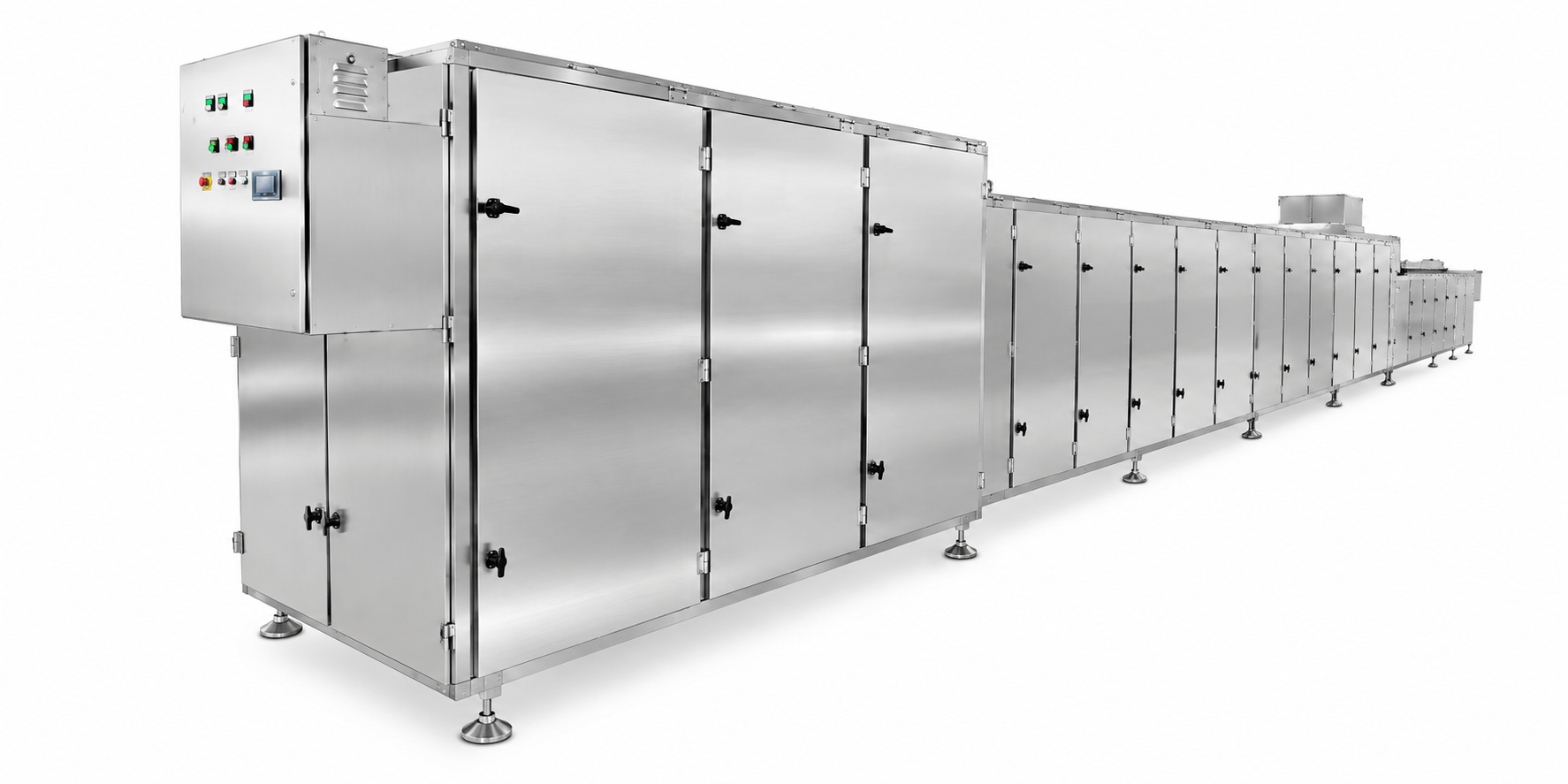
Looking at the first four rows, the mould rate remains constant. What changes is the number of moulds in the circuit: 200, then 280, then 330, then 410. Increasing this range does not purchase you a faster head. It purchases you time. We call that purchased time the Dwell Budget.
Dividing moulds in circuit by mould rate will give you the time taken for a single mould to complete the trajectory. For 200 moulds, this time will fall between 6.7 and 20.0 minutes. For 410 moulds this time will fall between 13.7 and 41.0 minutes. This time is the upper bound your cooling has to accommodate, and the correct way to implement it is subtraction: depositing, vibration, demoulding and the return leg consume their share of this time and whatever is left is what the tunnel actually has.
Understanding the Bound
We don't have any published information on what other legs of the process consume on your product, so this bound is stated without that subtraction. Think of it as a ceiling, never as a cooling time.
Physical Limitations of Cooling
The upper bound is a physical limitation rather than a commercial one. The Laboratory of Food Process Engineering at ETH Zurich, publishing in the Journal of Food Engineering, sets out the accepted position on where a moulding line is constrained, and cites Beckett's standard reference work for it.
"The filled molds are then conveyed into the cooling tunnel in order to further crystallize and solidify the mass. This cooling process is high in energy consumption and is the bottleneck for higher throughput (Beckett, 2008)."
That sentence describes established practice, not an experiment. What the ETH Zurich group measured was the crystallisation and detachment behaviour underneath it, and that is where the reason the time cannot simply be cut comes from. During cooling chocolate “undergoes a complex polymorphic phase transition and related volume reduction which enables detachment from mold wall surfaces”, and that shrinkage “generates tensile and shear stresses acting at the mold walls leading to detachment of the solidified chocolate mass from the mold wall surface”.
Contraction and Clearing
“Release” refers to the mechanism of contraction. A piece that has not crystallized fully has not contracted fully, and it will not clear the mould, however fast the head upstream is running.
For that reason, the selection question is not “how many moulds a minute,” but rather:
"Does my product's cooling fit inside the circuit time at the rate I want to run?"
Two Honest Constraints
Two honest constraints on this reading, both of which a supplier has an incentive not to mention.
First: We publish a figure called mold (PCS), and we do not state whether this figure includes moulds circulating in the loop, moulds shipped, or mould stations. As shown in the table, we assume this figure is for moulds in the loop, and to be safe, you should verify this in writing prior to taking any sizing action.
Second: The arithmetic says nothing about whether a given cooling time is sufficient. Cooling performance is dependent on air temperature, air velocity, and heat flux, and this must be validated for your product and format and cannot be estimated by this calculation.
Ready to configure your solution?
Send your target piece weight and daily outputBudget Structure, Quotation Scope and Lead Times
Price for a configured line is a function of the sections that you specify, the formats that you run, the mould tooling that your piece needs, and the utilities that your building has. There is no published price for a moulding line, and similarly no supplier in this category publishes a price. What can be published is the range of the expenditure and the limits of the comparison that you should contemplate.
What Moves Your Budget
| Driver | Effect on the budget | How to control it |
|---|---|---|
| Moulds in circuit | Rises across the model range and carries the mould tooling cost with it, because the circuit has to be filled | Size from the cooling your product needs, not from the headline rate |
| Mould tooling | A recurring capital line, not a consumable: mould count times cost per mould, plus a tool charge per new cavity design | Consolidate piece geometries early; every extra cavity design is another tool |
| Format complexity | Centre-filled, multi-colour and inclusion work add depositing sequence, mass handling and sometimes a placement system | Stage formats: commission the base format, add the rest against a proven line |
| Tempering capacity | Quoted separately as a CTW machine, and it must match the forming rate you intend to run | Check the tempering rating against the line rate before comparing two quotations |
| Building and utilities | Chilled water, compressed air at 1.5 m³/min and 0.2–0.4 MPa, electrical connection, floor run of 25,000 mm for the line as configured | Confirm what is on site before the layout is fixed, not after the crate lands |
The Quotation Parity Check
Two quotes that say "chocolate moulding line" may differ by an entire tempering machine and a cooling tunnel. Before comparing prices, make both suppliers answer the same twenty questions. That side-by-side test is the Quotation Parity Check. These are the questions that we believe a complete machinery quotation must answer.
Quotation Parity Variables
| Group | What the quotation must identify |
|---|---|
| Machine | Models, quantities, capacity basis, materials, component brands |
| Installation envelope | Power and utilities, dimensions, line layout |
| Tooling and consumables | Included moulds or change parts, packaging |
| Evidence | Documents, tests |
| Service | Installation, training, spare parts, warranty |
| Commercial | Delivery, Incoterms, payment, exclusions |
| Your side of the line | What you must supply at site |
The last row is the one that decides projects. A quote which does not specify what is to be provided has moved that cost rather than eliminated it.
The capacity basis row deserves its own check, because it is where two quotations stop being comparable without anyone saying so. Moulds per minute, kilograms per hour and pieces per minute are three different quantities, and converting between them needs the cavity count per mould and the piece weight. Ask for all three. Our own published figures work the same way: the CJZ275A sheet states 100–180 kg/h, and that figure only lines up with a mould rate once you fix the cavities and the piece weight for your product. Then check the result against the tempering machine feeding it, because a CTW250 is rated at 250 kg/h and a CTW500 at 500 kg/h, and a forming section cannot outrun the mass reaching it.
Ask us to run the twenty points above against the quotations you already hold
Line Envelope and Utilities
| Specification | Figure | What it constrains |
|---|---|---|
| Moulds in circuit | 200 to 410 depending on model | The ceiling on cooling dwell at a given mould rate |
| Mould rate | 10–30 moulds per minute (6–14 on CJZ275A-T) | Forming rate, before cavity count and piece weight are applied |
| Depositing | 32-piston set, one-shot | Colour count, centre-fill and inclusion sequences |
| Deposit weight | 3 to 15 g adjustable | Piece weight range before a custom mould is needed |
| Standard mould | 280 × 200 mm, virgin polycarbonate | Cavity layout and pieces per mould |
| Compressed air | 1.5 m³/min at 0.2–0.4 MPa (29–58 psi) on the CJZ275A sheet | Plant air sizing; purity class is yours to specify |
| Room conditions | 20 to 25 °C (68–77 °F), 55 per cent humidity on the CJZ275A sheet | What your building must hold for the cooling system |
| Line length | 25,000 mm (984 in) overall on the CJZ275A sheet, cooling tunnel included | Floor run you must clear before layout is fixed |
| Tempering feed | CTW250 at 250 kg/h, CTW500 at 500 kg/h | Mass reaching the depositor; the forming section cannot outrun it |
Every figure in that table is a SINOFUDE published specification; the utility and envelope rows are published on the CJZ275A sheet and must be reconfirmed for the model you buy. Imperial conversions are computed at 1 psi = 6.894757 kPa and 1 inch = 25.4 mm exactly.
Lead Times
| Stage | Lead time | What it covers |
|---|---|---|
| Manufacturing, standard line | About 60 days | Build of the line as configured in the approved quotation |
| On-site installation | 5–7 days | Installation work at your plant once the line is delivered |
| Customised configuration | Adds design time | Engineering before the build starts, against your format and layout |
The installation figure only includes time on site and not time in transit. Payment terms and Incoterms are project specific and are included in the formal quotation and sales contract and not in this document.
Product Formats the CJZ Line Runs
The format of the line has a greater impact on its configuration than capacity does. Formatting the line changes the depositing sequence, the mould, or both.

01
Solid tablets and bars
The baseline configuration. One chocolate mass, one deposit, one cavity geometry. This is the configuration the dwell arithmetic below is easiest to understand as there is only one mass to crystallize.
02
Centre-filled pieces, one-shot
Shell chocolate and filling flow through one common head, through inner and outer concentric nozzles, and are co-deposited into the cavity in a single depositing step. Traditional shell moulding reaches the same finished piece in three steps, as set out in US 2011/0189370 A1: the shell is formed by injecting chocolate into the mould and then inverting it to drain the excess, the filling is added, and a final deposit closes the base. What one-shot saves is process steps, not chocolate.
03
Two-colour and three-colour
Upper and lower or left and right two-colour work, and three-colour work, are run by configuring the piston set and the deposit sequence rather than by changing the machine.
04
Pieces with inclusions
Optional nut placement systems can be used to add whole or chopped nuts and other inclusions. Inclusions change a piece’s thermal mass, so the cooling setting for an unadorned tablet is not appropriate in this case.
05
Sandwich balls and decorated work
Sandwich balls and surface decorated pieces are part of the line and are primarily dependent on mould design and nozzle arrangement.
06
A format not listed here
Send the drawing of the piece, the target weight, and the mass you intend to run. The flexibility of a given format is answered against the mould and the deposit sequence, not against a catalogue.
Request a configured quotation
There is one important point that is worth mentioning before it is included in a quote. Published work on filled-chocolate manufacture holds that one-shot depositing requires the shell mass and the filling mass to be closely matched in yield value, flow rate and density. A filling that is designed without this constraint in mind is a recipe problem that, while appearing to be a machine problem, is really a design problem.
Moulds, Colour and Inclusion Options
The mould is the tooling side of the purchase, and when considering how many moulds to buy, it is not a matter of how many moulds you want, it is how many you can fit in the circuit.
| Option | What we supply | What it changes | Sourcing |
|---|---|---|---|
| Standard mould | 280 × 200 mm with a chain-carried holding part | Sets cavity layout and the pieces produced per mould | Supplied with the line |
| Mould material | Virgin polycarbonate, no recycled or second-hand raw material | Polycarbonate is the conventional material for moulded chocolate, as prior art such as US 6,217,927 B1 records; it releases well and takes a high-gloss cavity finish | Supplied with the line |
| Mould size | Other sizes to your design | Piece geometry, cavity count and therefore output at a given mould rate | Made to your drawing |
| Piston set | 32 pistons as standard, hole pattern combinable and adjustable | Single, two-colour, three-colour and centre-filled sequences | Supplied with the line |
| Nut placement | Optional inclusion placement system | Adds whole or chopped inclusions before cooling | Optional, quoted separately |
| Control | Siemens PLC with touch-screen interface, servo-driven motions | Recipe handling and repeatability across a shift | Supplied with the line |
Cavity Layout & Output Calculation
The number which transforms everything else to kg/hr is the number of cavities on the mould, and it belongs on your mould drawing, not on the machine. We check it against your piece weight and cavity layout at the time of quoting, and it is the first number you should request all suppliers to quote against.
Budget Structure, Quotation Scope and Lead Times
Price for a configured line is a function of the sections that you specify, the formats that you run, the mould tooling that your piece needs, and the utilities that your building has. There is no published price for a moulding line, and similarly no supplier in this category publishes a price. What can be published is the range of the expenditure and the limits of the comparison that you should contemplate.
What Moves Your Budget
Effect on the budget: Rises across the model range and carries the mould tooling cost with it, because the circuit has to be filled
How to control it: Size from the cooling your product needs, not from the headline rate
Effect on the budget: A recurring capital line, not a consumable: mould count times cost per mould, plus a tool charge per new cavity design
How to control it: Consolidate piece geometries early; every extra cavity design is another tool
Effect on the budget: Centre-filled, multi-colour and inclusion work add depositing sequence, mass handling and sometimes a placement system
How to control it: Stage formats: commission the base format, add the rest against a proven line
Effect on the budget: Quoted separately as a CTW machine, and it must match the forming rate you intend to run
How to control it: Check the tempering rating against the line rate before comparing two quotations
Effect on the budget: Chilled water, compressed air at 1.5 m³/min and 0.2–0.4 MPa, electrical connection, floor run of 25,000 mm for the line as configured
How to control it: Confirm what is on site before the layout is fixed, not after the crate lands
The Quotation Parity Check
Two quotes that say "chocolate moulding line" may differ by an entire tempering machine and a cooling tunnel. Before comparing prices, make both suppliers answer the same twenty questions.
The capacity basis row deserves its own check, because it is where two quotations stop being comparable without anyone saying so. Ask for moulds per minute, kilograms per hour and pieces per minute. Ask us to run the points below against the quotations you already hold.
| Group | What the quotation must identify |
|---|---|
| Machine | Models, quantities, capacity basis, materials, component brands |
| Installation envelope | Power and utilities, dimensions, line layout |
| Tooling and consumables | Included moulds or change parts, packaging |
| Evidence | Documents, tests |
| Service | Installation, training, spare parts, warranty |
| Commercial | Delivery, Incoterms, payment, exclusions |
| Your side of the line | What you must supply at site |
The last row is the one that decides projects. A quote which does not specify what is to be provided has moved that cost rather than eliminated it.
Line Envelope and Utilities
Review the constraints and published specifications for your line configuration. Every figure in the table below is a SINOFUDE published specification.
The utility and envelope rows are published on the CJZ275A sheet and must be reconfirmed for the model you buy. Imperial conversions are computed at 1 psi = 6.894757 kPa and 1 inch = 25.4 mm exactly.
| Specification | Figure | What it constrains |
|---|---|---|
| Moulds in circuit | 200 to 410 depending on model | The ceiling on cooling dwell at a given mould rate |
| Mould rate | 10–30 moulds per minute (6–14 on CJZ275A-T) | Forming rate, before cavity count and piece weight are applied |
| Depositing | 32-piston set, one-shot | Colour count, centre-fill and inclusion sequences |
| Deposit weight | 3 to 15 g adjustable | Piece weight range before a custom mould is needed |
| Standard mould | 280 × 200 mm, virgin polycarbonate | Cavity layout and pieces per mould |
| Compressed air | 1.5 m³/min at 0.2–0.4 MPa (29–58 psi) | Plant air sizing; purity class is yours to specify |
| Room conditions | 20 to 25 °C (68–77 °F), 55 per cent humidity | What your building must hold for the cooling system |
| Line length | 25,000 mm (984 in) overall, cooling tunnel included | Floor run you must clear before layout is fixed |
| Tempering feed | CTW250 at 250 kg/h, CTW500 at 500 kg/h | Mass reaching the depositor; forming section cannot outrun it |
Lead Times
The installation figure only includes time on site and not time in transit. Payment terms and Incoterms are project specific.
About 60 days
Manufacturing, standard line
Build of the line as configured in the approved quotation
5–7 days
On-site installation
Installation work at your plant once the line is delivered
Adds design time
Customised config
Engineering before the build starts, against your format and layout
What Your Auditor Will Ask For
A chocolate line is audited against the buyer’s food safety system rather than against the machine. The regulations provided herein describe what your plant equipment must be able to do, and these are useful for you as an evidence request checklist. None of them certifies a moulding line, and no supplier can hand you compliance.
| Reference | What it actually addresses | What to ask for |
|---|---|---|
| 21 CFR 117.40(a)(1) | Plant equipment must be designed and constructed so as to be adequately cleanable, and maintained to protect against allergen cross-contact and contamination | Cleaning access on the depositing head, the mould circuit and the tunnel, described as a procedure you can carry out |
| 21 CFR 117.40(b) | Seams on food-contact surfaces must be smoothly bonded to minimise accumulation of food particles, dirt and organic matter | Weld and joint treatment on food-contact surfaces, and the surface finish specified rather than just the alloy |
| 21 CFR 117.40(a)(2) | Equipment must be designed, constructed and used so as to avoid adulteration with lubricants, fuel, metal fragments and other contaminants | Lubricant grades used where a contact path exists, and where the boundaries sit |
| 21 CFR 117.40(f) | Instruments and controls used for measuring, regulating or recording temperature, pH, acidity or water activity must be accurate, precise, adequately maintained and adequate in number | Which instruments on the line serve control, and how they are calibrated. This paragraph is about instruments serving food safety control, so scope it to what it covers rather than to every readout on the line |
| EN 1672-2:2020 | Hygiene and cleanability requirements for food processing machinery in the European Union, adopted to clarify the Machinery Directive | Relevant where you are shipping into or operating in the European Union; confirm which edition your assessment is against |
| ISO 14159 | Hygienic design principles for machinery | A design-principles reference for your own assessment, not a machine certificate |
| ISO 8573-1 | Classifies compressed air purity for particles, water and oil, written as three class numbers in the fixed order particles : water : oil, with a hyphen where a class is not specified | State the purity class you require for air contacting product or product-contact surfaces. We publish the quantity and pressure of air the line needs; the class belongs in your specification |
| 21 CFR Part 163 | United States standards of identity for cacao products: composition and naming, not equipment | Relevant to your recipe and labelling. A machine cannot comply with a standard of identity, so treat any claim that it does as a red flag |
Cleaning Practice
Dry Cleaning Protocol
Moulded chocolate is a fat-continuous, low-water-activity product, and the general practice for equipment on chocolate lines is dry cleaning rather than wet clean-in-place. The reason is the product, not the regulation: water introduced into chocolate makes it seize, and standing water in a low-moisture process is the condition under which the organisms of concern in these foods become a problem. A review of food safety in low-moisture foods published in the Journal of Food Science sets out that second half, surveying dry-cleaning methods for exactly this class of product.
Regulatory Context
Read that as prevailing practice with a physical basis rather than as a legal requirement, because the regulation says something narrower. United States rules do permit wet cleaning of equipment, requiring that surfaces then be sanitised and thoroughly dried, and hygienic-design guidance describes dry methods as favoured rather than mandatory. Where your process includes dry particulate handling upstream, that part of the plant has its own established dry-cleaning guidance, and it is a separate question from cleaning the mould circuit.
Technical Specs & Delivery
Company Standards
SINOFUDE introduced the ISO 9001 management system in 2004, and most of our products have passed EU CE and UL certification. Those are company-level and product-range statements. For any specific line, ask for the certificate covering the configuration you are buying, with its number, issuing body and validity, because a certificate follows a configuration rather than a model name.
Documents That Ship
Every line ships with protective packing, machine identification, a packing list and delivery documents, together with machine and parts manuals and the pre-shipment test report. Food-contact construction is stainless steel, 304 as standard with 316 used in selected applications, and the exact grade, thickness, finish and gasket material are fixed in the model-specific technical agreement rather than on a web page.
From Enquiry to Commissioning
01
Send your detailed brief on target output, product weight and geometry, format, chocolate type, colours, inclusions, degree of automation, and details of your building’s utilities and layout.
02
Our engineers review it. Tempering, depositing, cooling and demoulding have to agree with each other against your product. This is the review that stops a line being under-specified.
03
You will receive a written quotation and configuration. The mould system, cooling section and options are all fixed here, based on the information provided in step one.
04
The next step is drawings for approval; the build time begins with approval of drawings and deposit, not with order placement.
05
We manufacture and test the line. A pre-shipment test report is issued prior to the line shipping, and if the report indicates the line does not meet the acceptance criteria written into your contract, then this is our responsibility to correct it before it leaves the factory.
06
We install, commission and train: 5 to 7 days on site, running your recipe on your material with your operators.
What to Fix in the Contract Before You Sign
Factory acceptance and site acceptance are only as strong and firm as the contract draws them. The acceptance clauses of equipment supply contracts made public show why labels are not as important as people think. Acceptance can be construed to have occurred once the buyer puts the equipment to use, or after a specific period of time has elapsed following the shipment, or after a shorter, site-specific period has elapsed due to buyer-controlled site conditions that prevent the completion of the tests. Two contracts may contain the same letters, ‘SAT,’ and mean completely different things.
Point to fix
What to write down
Why it matters later
Acceptance procedure
The test itself, its pass criteria, who witnesses it and what happens on failure
Determines whether a signature means the line performed or merely that time passed
Capacity basis for the test
The recipe, the piece weight, the cavity count and the format the rate is measured at
A rate proved on a different piece is not a rate proved on yours
Payment and warranty triggers
Which acceptance stage releases payment and which starts the warranty clock
Filed equipment contracts tie both to acceptance; if that is unstated, the dates drift
Warranty boundaries
The period for the equipment and the separate, shorter period that normally applies to spare or repaired parts
These are usually different numbers, and assuming one covers the other is a common and expensive mistake
Scope of supervision
Whether installation supervision, site acceptance assistance and operator training sit inside the supplier scope
Public procurement records for complex imported equipment put these inside supplier scope explicitly; a quotation that is silent has not included them
Spares and documentation
Spare-parts availability period, parts logistics, manual and electrical drawing language, and how remote troubleshooting is requested
These are the four things operators raise most often after a line is running, and they are cheapest to secure before the order
Bring that list to us and to anyone else you are considering. A supplier who will put answers in the contract is telling you something; so is one who will not.
Where Moulded Chocolate Lines Earn Their Place
These are the production situations a continuous moulding line is built for. Each describes the shape of the problem rather than a specific installation.
MOULDING
01 / 04
Strategic Production Planning & Acceptance Tools
01
Pilot Gummy Line Configuration Selector
Use four operating choices to form a first-pass brief. The result is a discussion route, not a guaranteed machine selection. Designed for precision B2B manufacturing planning.
02
Sustained Gummy Output Planning Calculator
Separate rated output from scheduled output and estimated saleable output. Enter your own utilization and yield assumptions; the result is a strategic planning scenario designed for industrial B2B precision, not a guaranteed SINOFUDE performance promise.
03
Gummy Line Factory Acceptance Input Sheet
Tick every input already defined. The tool builds the missing-field list needed to turn accuracy, output and changeover language into a testable acceptance method for industrial procurement.
Chocolate Moulding Line FAQs
What is a chocolate moulding line?
It is the forming section of a chocolate plant. Tempered chocolate is deposited into moulds, and is vibrated to release entrapped air. The moulded chocolate then is conveyed through a cooling tunnel until the fat phase crystallizes and the piece contracts. The piece is then demoulded and conveyed onward. Tempering upstream and wrapping downstream are separate machines.
What is the difference between one-shot depositing and shell moulding?
One-shot combines the shell chocolate and filling through the same head. They are co-deposited in a single step through both the inner and outer concentric nozzles into a cavity. Traditional shell moulding requires three steps. First, chocolate injects and the mould is inverted to let the excess drain. Next, filling is added. Lastly, the base is closed with a deposit. One-shot depositing is an alternative to traditional shell moulding, and what it saves is process steps rather than chocolate. It is also not co-extrusion: US 2011/0189370 A1 separates the two expressly, because co-extrusion forms a rope whose centre is exposed at the cut ends.
How long does chocolate take to cool in the mould?
The mechanism behind cooling is where the ceiling of what can be moulded sits, and the piece is released because the crystalline contraction away from the mould wall is what allows it to release. The cooling time is dependent on many factors including air temperature, air velocity, and the amount of heat flux reaching the piece; hence, the same cooling time in two different tunnels may not mean the same cooling.
Why are chocolate moulds made of polycarbonate?
Polycarbonate is the conventional material for moulded chocolate. It takes a high-gloss cavity finish that transfers to the product and it releases well when the piece has contracted. Our standard mould is 280 × 200 mm in virgin polycarbonate with no recycled or second-hand raw material, and other sizes are made to your design.
Does a moulding line temper the chocolate?
No. Tempering happens upstream and is a separate machine. We supply it as the CTW series: continuous CTW250 at 250 kg/h and CTW500 at 500 kg/h, and batch CTW10, CTW50 and CTW100 at 10, 50 and 100 kg/h. When you compare two moulding-line quotations, check whether tempering is inside the scope of each, because that single item can account for much of a price difference.
How many moulds does each CJZ model carry?
200 on CJZ275/320, 280 on CJZ275A, 330 on CJZ275A-2, and 410 on both CJZ275A-3 and CJZ275A-T. The first four run at 10 to 30 moulds per minute; CJZ275A-T runs at 6 to 14. We publish this figure as mold (PCS) and it is the figure the logic on this page is based on, so confirm the counting basis in writing before you size a line on it.
What deposit weight can the line hold?
Deposit weight is adjustable from 3 to 15 g, or to other weights specific to your mould design. This is the adjustable range rather than a weight tolerance. Please note that for an acceptance test, a tolerance figure would have to be accommodated in the contract based on your recipe, piece weight, and your line speed. A tolerance demonstrated on another product cannot be considered a tolerance on yours.
How do I convert moulds per minute into kilograms per hour?
To calculate production potential, multiply the number of moulds produced per hour by the cavities per mould and the piece weight. All three are required, and the cavity count is from your mould drawing and not from the machine. Our CJZ275A sheet states 100 to 180 kg/h, and that figure only reconciles with a mould rate once the cavities and the piece weight are fixed. Ask all suppliers for the three numbers prior to comparing capacities.
What utilities does the line need?
Compressed air at 1.5 m³/min and 0.2 to 0.4 MPa, a room at 20 to 25 °C and 55 per cent humidity for the cooling system, and a floor run of 25,000 mm for the line as configured, which is the overall length including the cooling tunnel. Connected load is fixed per configuration and comes with your quotation. Confirm the air purity class you require in your own specification.
What is the lead time for a chocolate moulding line?
About 60 days to manufacture a standard production line, plus 5 to 7 days installing on site. Customised configurations add design time before the build starts. The installation figure covers time at your plant and does not include transit.
Is the line CE certified?
SINOFUDE introduced the ISO 9001 management system in 2004 and most of our products have passed EU CE and UL certification. Because certification follows a configuration rather than a model name, ask for the certificate covering the line you are buying, with its number, issuing body and validity, and put that requirement in the contract.
What should be in a complete quotation?
This includes the models, quantities, capacity basis, materials, brands of components, power and utilities, dimensions, line layout, moulds (if any), change parts, packaging, documents, tests, installation, training, spare parts, warranty, delivery, Incoterms, payment and exclusions, and a statement of what you must supply at site. The last item is the one that most often turns into an unbudgeted cost.
Can the line run two-colour or centre-filled products?
Yes. Single-colour, two-colour in upper and lower or left and right arrangements, three-colour work, sandwich balls and centre-filled work are all run by configuring the 32-piston set and the deposit sequence. Filled formats carry one constraint worth designing around early: published work on filled-chocolate manufacture (Meyer, 2009) holds that one-shot depositing requires the shell and filling masses to be closely matched in yield value, flow rate and density.



