
Get in Touch with SINOFUDE Company

CHOCOLATE LINES FROM SINOFUDE
Get A Line Proposal With A Free Layout Drawing
Chocolate Production Lines For Moulded, Enrobed And Deposited Chocolate
SINOFUDE builds chocolate production lines that start from cocoa liquor and ingredients or from finished chocolate, and every line passes a factory acceptance test (FAT) on the agreed product before it ships. We route each project by product format and fat system, then size tempering, forming and cooling to the slowest station, and the FAT checks the contracted output.
Tempering control of ±0.2 °C and a continuous demoulding rate of at least 99.5%, measured at FAT.
Orders from one machine to a complete line, so you can start with the station that limits your output.
The first workshop layout drawing is free with your line proposal.
12 months warranty on the whole machine, counted from completion of installation.
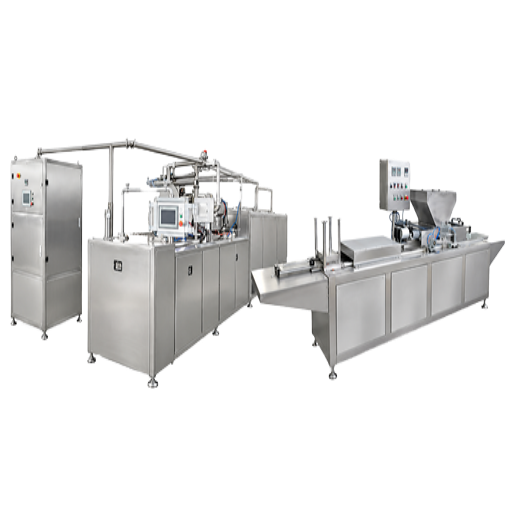
Commercial Terms & Specifications
Minimum order
one machineor a complete line
Payment
40% deposit60% balance against a copy of the bill of lading
Warranty
12 monthsfrom installation completion
Spare parts
2 working daysfrom order confirmation to dispatch
Install abroad
USD 200per engineer per day, plus travel and lodging
Recipe proof
paid machine trialwith your own recipe
Chocolate Production Line Routes and Equipment
A chocolate production line from SINOFUDE is built around the product you sell rather than a catalogue layout. Our chocolate machinery covers conches, ball mills, storage and melting tanks, pumps, batch or continuous tempering, moulding, drops, hollow-product spinning, enrobing and cooling systems, so one engineering team sizes the whole route and hands it over under one FAT.
The starting point changes the equipment, the utilities and the quality controls. From cocoa liquor and ingredients we supply refining, storage, tempering and forming; from finished chocolate the route begins at melting and tempering.
01
08
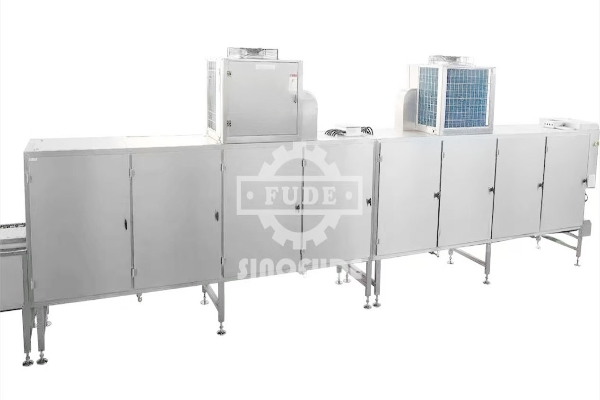
From Chocolatiers to Industrial Scale
The same chocolate manufacturing equipment families cover every scaling step, so a plant can be extended station by station as throughput limits appear.
Chocolatiers & R&D
Professional equipment
CTW10, CXJZ08, CXTCSmall Factories
Equipment for small shift
CTW50/100, CCD400Growing Plants
Continuous output on routes
CTW250, CJZ, CTCIndustrial Plants
Equipment feeding routes
CTW500, CCD1200+Made in Our Own Machine Shop
SINOFUDE, founded in 1998, builds confectionery, bakery and chocolate production equipment in three factories in Fengxian District, Shanghai. We make 75% of core moving parts in-house, counted by part number, using laser cutting, laser welding, friction welding and tube welding, CNC sawing and wire cutting, a CNC machining centre, an inclined-rail lathe, drilling and gantry milling in use since 2010.
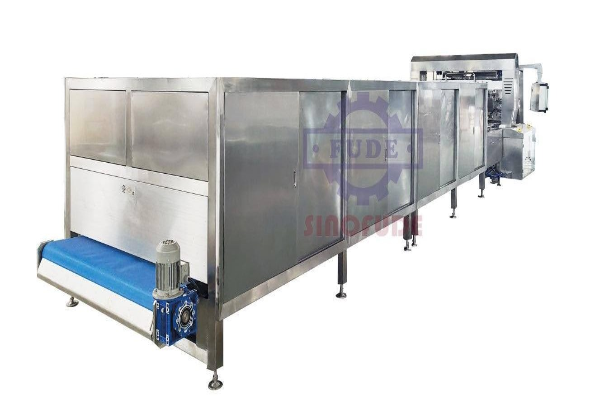
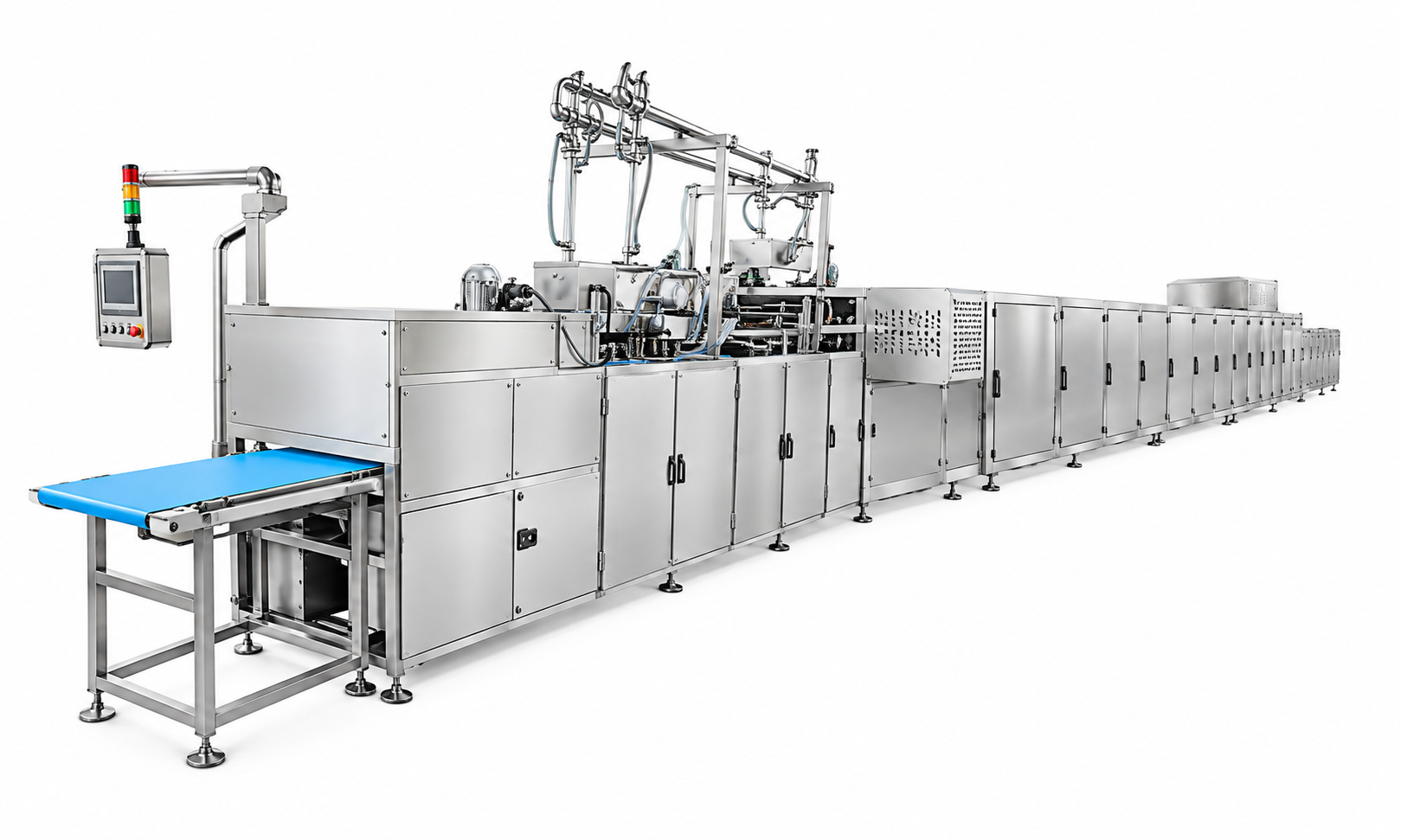
The Form-Fat GridMatching Format to Equipment
The Form-Fat Grid routes a chocolate project on two axes: the product format sets the forming route, and the fat system sets whether the line needs a temperer and how cooling is staged. Read your product across both before you compare machine lists.
The second axis is the one machine lists leave out, and it is where shared lines fail after a recipe change. A lauric coating and a cocoa-butter chocolate can use the same moulds, yet they do not share a temperer or a cooling profile, because a lauric fat is not interchangeable.
Consult SpecificationsRoute Finder Console
CTW Temperer
Standby
Cooling Array
Standby
Circuits Check
Fat System Protocol Matrix
| Fat System | Mixes with CB | CTW temperer | Cooling Stage |
|---|---|---|---|
| Cocoa butter | Reference fat | Needed: melt, cool, re-warm. | Staged above floor |
| CB with CBE | In any proportion | Needed, as cocoa butter | As cocoa butter |
| Non-lauric CBR | Small ratios only | Not needed; direct melt | Direct cooling |
| Lauric CBS | Full replacement | Not needed; direct melt | Direct cooling |
Core Processing Modules
Explore the foundational machinery for forming, cooling, and depositing within our integrated chocolate lines.
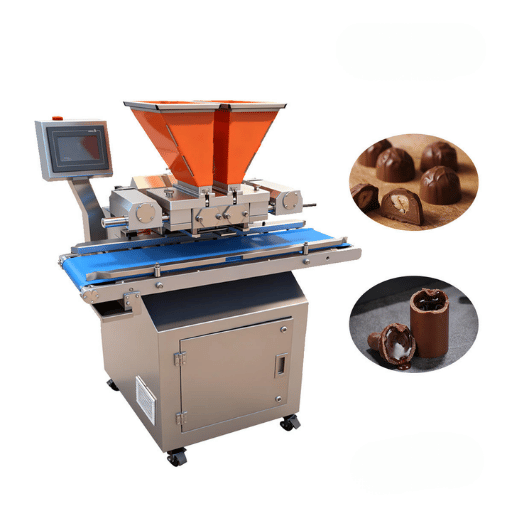
Chocolate Depositing Machine
Precision servo-driven deposit heads sized for accurate filling and exact mass control across various viscosities.
View Equipment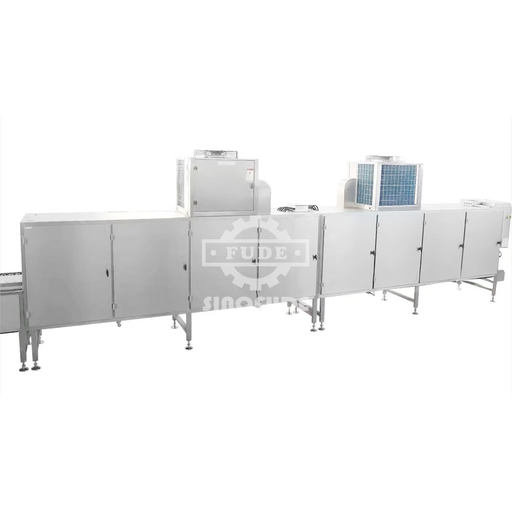
Chocolate Cooling Tunnel
Multi-zone dynamic cooling designed to prevent Type 1 bloom by safely staging temperature drops above the floor limit.
View Equipment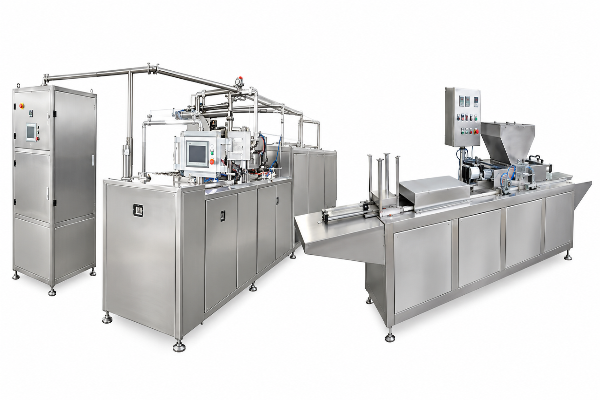
Chocolate Moulding Line
Complete integrated moulding circuits for solid, filled, and inclusion-based chocolate production routing.
View EquipmentWhat The Grid Changes On Your Line
We size the deposit head, the mould and the temperer from the same recipe sheet, because a head set up for one viscosity will not run a thicker filling on its own. The contracted output is verified at FAT.
01Temperer
02Cooling
03Circuits
04Deposit
05Confirm
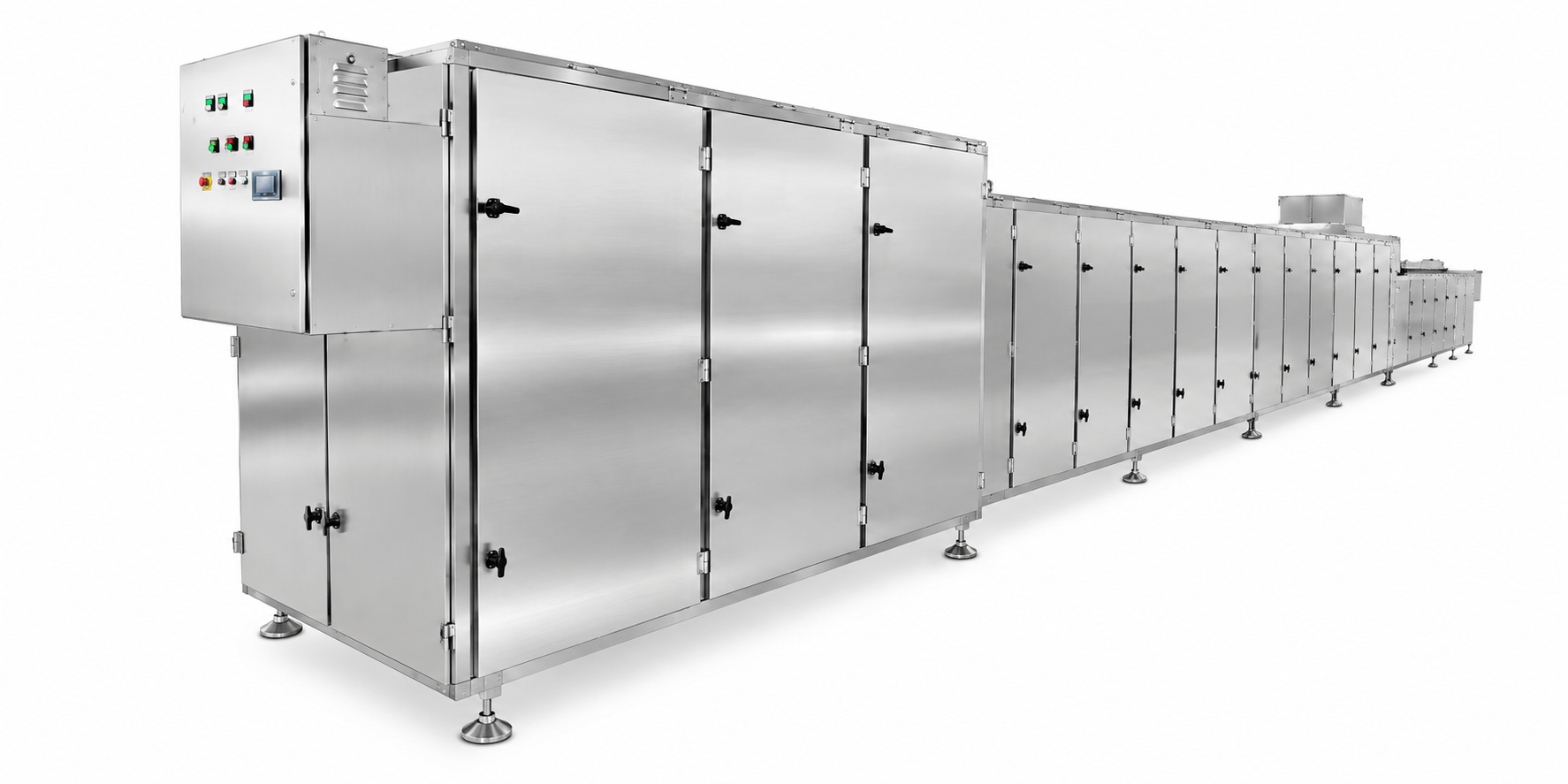
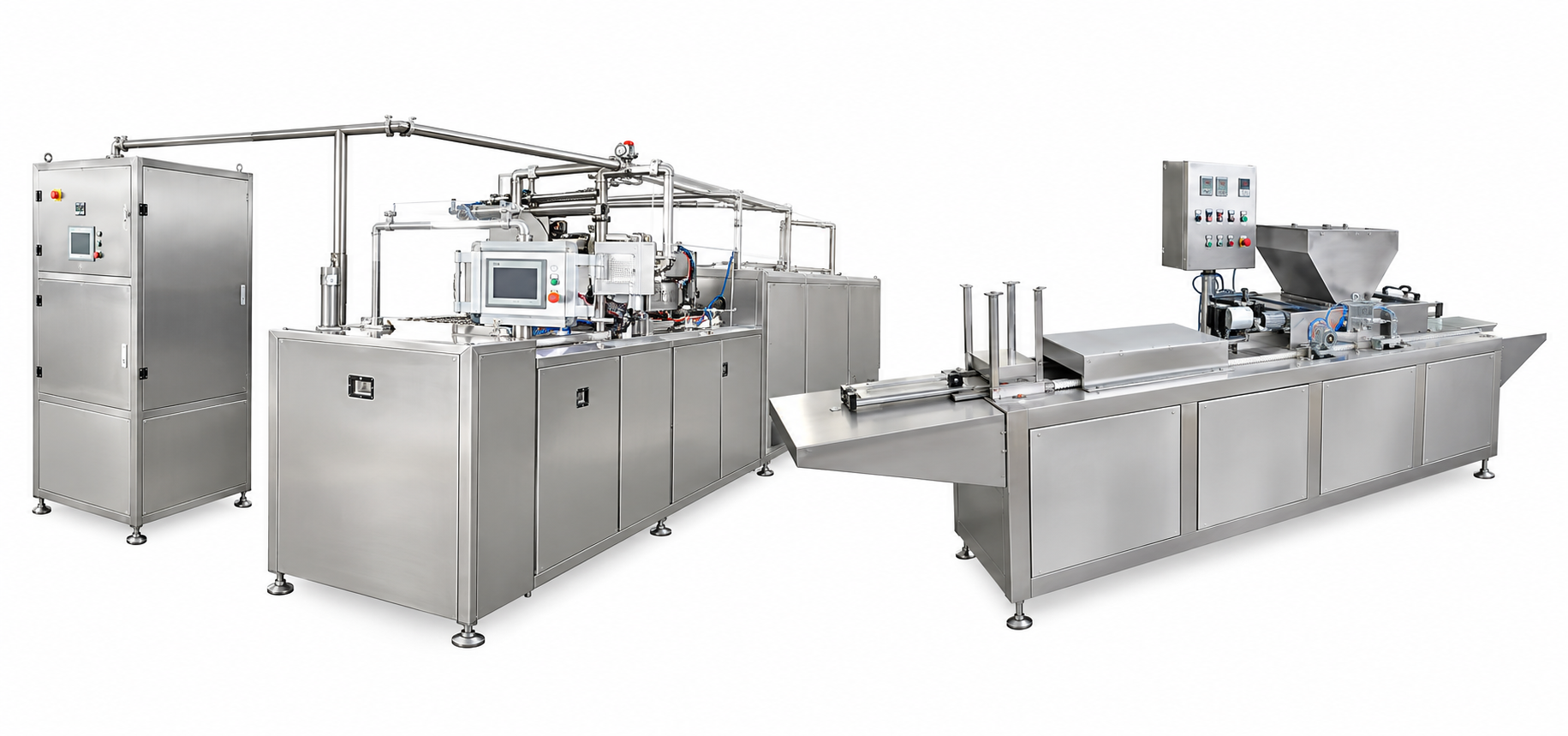
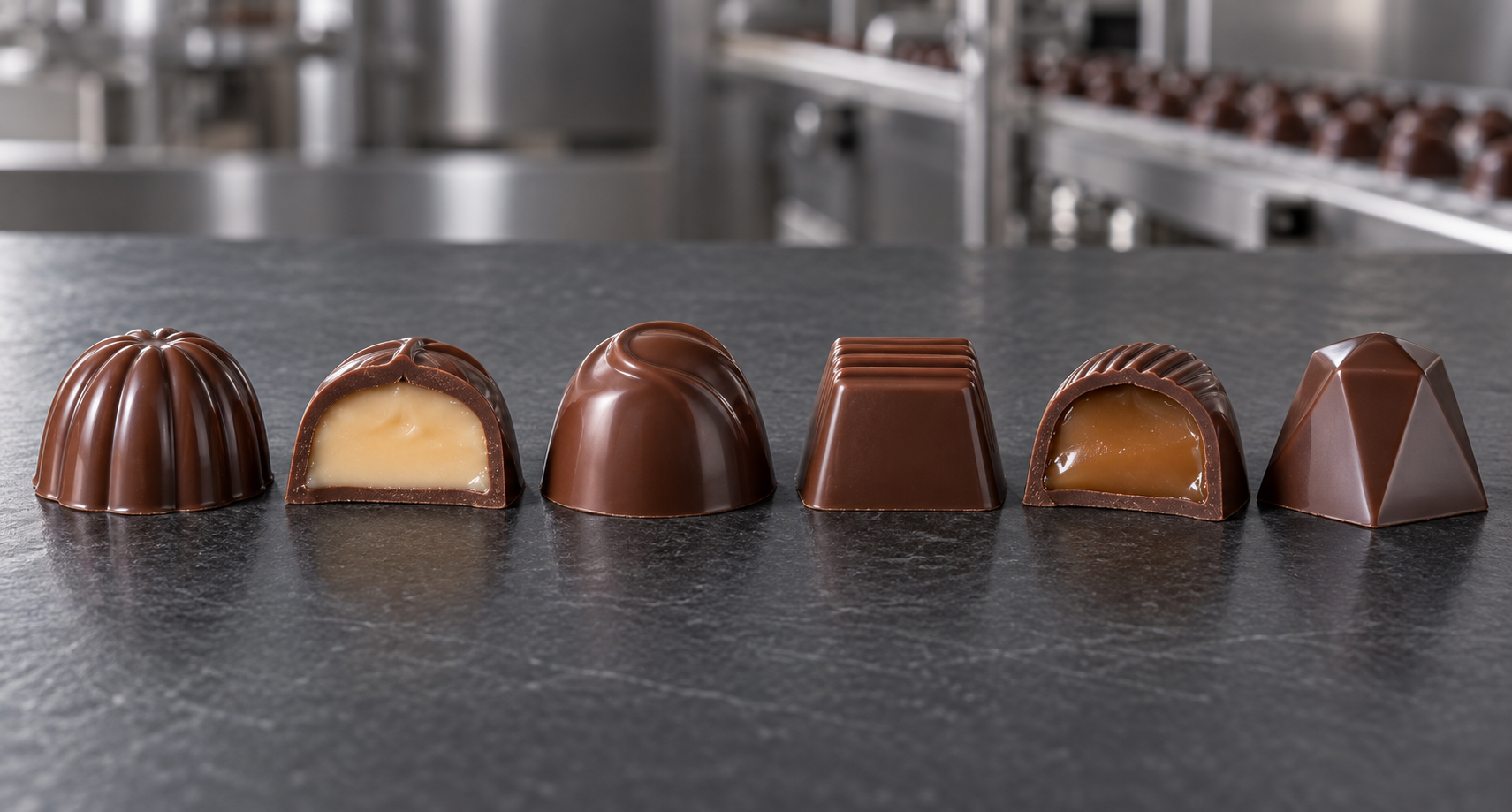
Temperer Requirements Configuration
A CTW tempering machine is sized to the chocolate the forming stations draw. Recipes with CBS and CBR, however, run without a CTW. A recipe with cocoa butter or CBE needs a CTW.
* Module Integration: Automatic bypass valves deploy when non-cocoa butter systems are selected, routing directly to deposit heads.
Cooling Dynamics & Bloom Prevention
Contrary to the common assumption, colder air is not always faster, because cooling too fast forms unstable crystals that bring Type 1 bloom.1 How much cooling length a moulded route needs is set out in the cooling section of our CJZ moulding line page.
Shared Circuits Management Protocol
A lauric coating and a cocoa-butter chocolate on one route need a flush and scrape between them, and the capacity plan allows half a day for product changeover and cleaning when a change occurs.
Deposit Heads Calibrations
A deposit head sized for one viscosity and inclusion size cannot automatically run another, so mould dimensions, product mass and tempering demand are calculated together ensuring line synchronicity.
Output Verification (FAT Trials)
Final settings are fixed in the equipment selection list and proven at a paid machine trial with your precise recipe constraints, locking in production guarantees before shipment.
Product Formats Each Route Produces
Each of the products below corresponds to a single forming route. The fat system on the Form-Fat Grid decides whether tempering is needed and how cooling is staged. The composition of the recipe governs the way the chocolate flows, and hence the deposit head, the mould and also the trial follow your recipe rather than the default settings offered in the catalogue.
Product Format |
Route |
SINOFUDE Equipment |
What Sets the Piece |
|---|---|---|---|
Solid tablets and a chocolate bar production line |
Moulding | CXJZ machines, CJZ lines | Mould drawing and piece weight |
Centre-filled shells |
One-shot moulding | CJZ one-shot | Filling ratio and the flow of shell and filling |
Two-colour pieces |
Moulding | CJZ two-colour | Mould design and colour sequence |
Enrobed bars, wafers and biscuits |
Enrobing | CTC, CXTC | Centre size, coating coverage and thickness; pairs with our wafer production line and enrobed biscuits and cookies lines |
Drops and chips |
Depositing onto a belt | CCD400 to CCD1200 | Drop size and belt width |
Hollow figures |
Spinning closed moulds | CKX | Mould shape and dosed shell weight |
Oat and cereal chocolate |
Forming | CSM400, CSM1000 | Recipe and piece size |
Panned centres |
Panning | CBY1000, CBY1250 | Centre size and number of layers, then polishing and sealing |
Compound coatings |
Enrobing, moulding or drops without a temperer | CTC, CJZ, CCD | CBR or CBS fat system from the grid; sold as a vegetable fat coating under 21 CFR 163 or as a compound coating |
Chocolate production line specifications
A nameplate kg/h hides a problem: line output falls to the slowest unit because tempering, depositing, cooling dwell and packing run in series. We plan every SINOFUDE line on an eight-hour production day with half a day allowed for product changeover and cleaning when a change occurs, and accepted capacity is proven at FAT on the agreed product.
Route
Equipment
Capacity or format
Standard lead time
Tempering, batch
CTW10 / CTW50 / CTW100
10 / 50 / 100 kg/h
Confirmed
Tempering, continuous
CTW250 / CTW500
250 / 500 kg/h
Confirmed
Refining
CJM 500 / 1000 / 2000 / 3000 L
20–25 µm in 16–22 h
Confirmed
Refining
Ball mill
18–25 µm in 4–8 h
Confirmed
Moulding
CXJZ08 / 15 / 30 / 60
Contracted output verified
45-60 days
Enrobing
CTC400–1200 mm
-
90 days
Compact enrobing
CXTC8–60 kg
-
Confirmed
Drops and chips
CCD400 to CCD1200
30–120 kg/h
90 days
Hollow figures
CKX8 or 16
moulds per cycle
45 days
Oat and cereal
CSM400 / CSM1000
Up to 1,000 kg/h
90 days
Panning
CBY1000 / CBY1250
50–150 kg per batch
Confirmed
Pricing, Lead Times and Commercial Terms
Prices are not published, because each line is priced as a process solution for one product mix. A quotation is driven by output, product form (moulded, enrobed, drops, hollow, oat and cereal), chocolate type (cocoa butter or a cocoa butter substitute), colours and centre filling, product size and weight, cooling requirement, coating coverage and thickness, packaging and working hours.
Quotation Driving Process
01 Line Architecture
Output
Number and size of stations
REDUCE:Order the station that limits your output first
Product form
Which forming route is quoted
REDUCE:Start on one route and add others later
Chocolate type
Whether a CTW temperer is included
REDUCE:Compound recipes run without a temperer
02 Physical Specs
Colours and filling
One-shot or two-colour depositing heads
REDUCE:Launch single-colour pieces first
Product size & weight
Mould and deposit head sizing
REDUCE:Keep one piece weight across related SKUs
Cooling requirement
Cooling length and refrigeration duty
REDUCE:Supply chilled water from your existing plant
03 Finishing Stage
Coverage & thickness
Enrobing curtain, bottoming and blower
REDUCE:Specify full or partial coverage in brief
Packaging
Packing equipment in scope
REDUCE:Quote the process island only
Working hours
Station size needed for the daily output
REDUCE:Run a second shift on smaller stations
Commercial & Scope Archives
Doc. 01 / Scope
Doc. 02 / Terms
What Every Line Quotation Lists
- The moulds and the commissioning spare-parts package included in the price.
- Boiler, chiller, air compressor and CIP can be included as optional process utilities, itemised on request.
- EXW at the SINOFUDE factory with China domestic taxes included; sea freight is quoted separately on request. Import clearance and duties in your country are paid by you; confirm the tariff classification with your customs broker.
- Installation and commissioning abroad at USD 200 per engineer per day for one or two engineers, with return flights, visas, local transport, lodging and meals paid by you.
- Warranty: 12 months for the whole machine from completion of installation, covering hardware quality faults with free replacement parts and excluding misuse damage, wear parts and process-related technical assistance.
- The handover documents: mechanical and electrical drawings, a tempering-curve parameter guide, a material list for the main components, maintenance SOPs, a spare-parts list and the FAT record.
SYS-IMG: PRODUCTION CORE
Lead Times and Payment
- Standard lead times run 45 to 90 days by machine family: 45 days for CJZ275A-T lines and CKX hollow machines, 60 days for CJZ275 lines and 90 days for CTC enrobing, CCD drop and CSM oat and cereal lines; other machines are confirmed in the quotation.
- Production starts after drawing confirmation, which follows the 7-day technical briefing.
- Payment is a 40% deposit, with the 60% balance against a copy of the bill of lading.
- Scope covers the complete route from ingredient handling through primary and secondary packaging, or only the agreed process island.
SYS-IMG: FAT ASSEMBLY
Quality Control & Factory Acceptance Testing
Every SINOFUDE chocolate line is tested on the agreed product before it leaves our factory, and the 60% balance falls due against the bill of lading after that test. The FAT record is enclosed with the handover documentation.
FAT Measurement Standards
Technical Acceptance Criteria
- Tempering temperature control accuracy of ±0.2 °C (±0.36 °F).
- Continuous demoulding rate of at least 99.5%.
- Pressure test of the water-jacketed pipework at 0.6 MPa (87 psi) with no leakage.
- Coating weight deviation, tested against the value written into the FAT protocol.
Output & Lifecycle Validation
- Output is evaluated on the agreed product against the capacity in the contract.
Bloom resistance needs storage observation beyond a short factory run, so the FAT protocol separates immediate acceptance from shelf-life validation. Teams that work to IEC 62381:2024 can reuse its FAT, SAT and SIT checklist structure for the control-system part of the protocol.
Sanitation & Overlap Rules
Standard Cleaning Methods
Pure chocolate circuits are never washed with water; we clean them with a warm fat or vegetable-oil flush plus scraping.
Lines that must be water-washed, for example for water-soluble coatings, are dried with an 80 °C (176 °F) hot-air circuit for 4 hours.
- Cleaning is verified with allergen rapid test cards for milk and peanut.
- Microbiological sampling records are strictly kept for 3 years.
Cross-Contact Risk Management
Milk carried over from a shared circuit is the cross-contact risk buyers audit for. Dry cleaning reduces that carry-over but does not remove it.
In a 2024 pilot-plant study, a 40 °C cocoa butter rinse cut the milk carried into the next dark chocolate batches by at least 89%, yet the first batch still carried about 2,000 µg/g of milk.
Audit & Pre-Delivery Requirements
Certifications & Factory Audit
- ISO 9001 Certificate: No. 16426Q00865R001 (Valid 2026-2029), covers R&D and production equipment.
- Core Manufacturing: Walk the machine shop where 75% of core moving parts are made.
- Global Reference: ENPRA S.A.S. in Ecuador takes reference calls about its SINOFUDE drop line on request.
Action Items & Witness Tests
- Watch the same model running in our factory (book 7 working days ahead).
- Witness the FAT and check the results against the acceptance values in the protocol before the balance is due.
Equipment Hologram Array
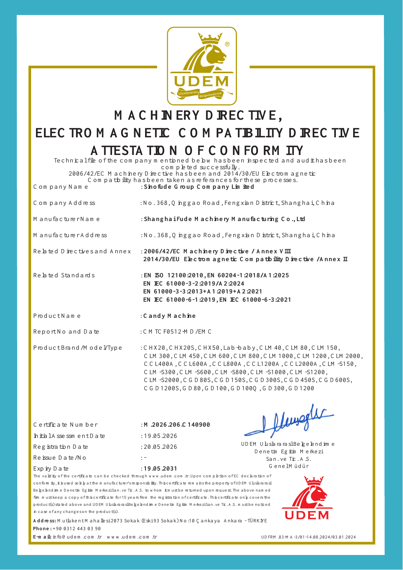
CANDY-UDEM-2026
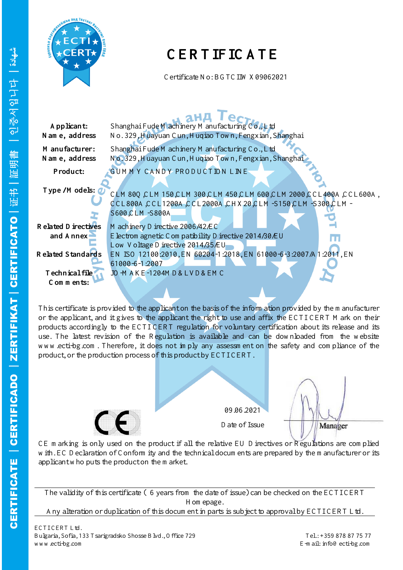
GUMMY-ECTI-2021

MALLOW-UDEM-2022
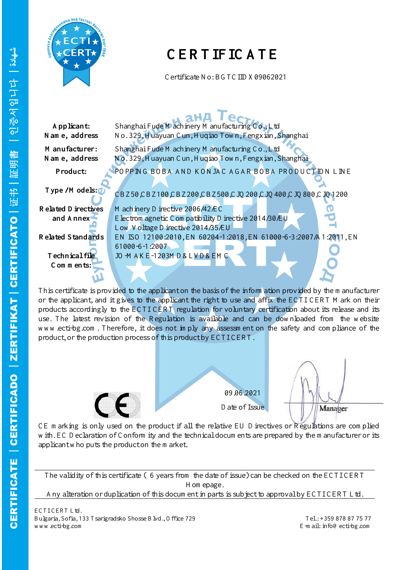
BOBA-ECTI-2021
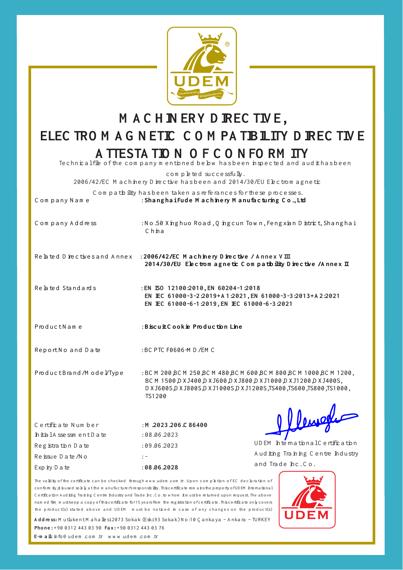
BISCUIT-UDEM-2023
Chocolate Line Project Sequence and Support
7-day technical briefing
After the order, our engineers take your team through the contracted line design.
Drawing confirmation
You sign off the layout and machine drawings, and production starts from that date.
Production
45, 60, or 90 days for standard machine families; others confirmed in quotation.
Factory acceptance test
The line runs on the agreed product; witness visits are booked 7 working days ahead.
Handover EXW
Sea freight is quoted separately on request.
Installation & commissioning
7 to 30 working days on site depending on line complexity, including English training.
What We Need to Size Your Line
SPEC 01
Product photo or dimensioned drawing, plus the target piece weight.
SPEC 02
Recipe family and fat system (cocoa butter, CBE, CBR or CBS), with raw materials and inclusions.
SPEC 03
Number of colours and the filling ratio, if any.
SPEC 04
Expected saleable output and package style.
SPEC 05
Site voltage, utility availability, ambient conditions and available footprint.
We build the equipment selection list from this brief, not from a standard line. Before contract, the line proposal covers the process flow chart, equipment selection list, workshop layout, utility requirement table, detailed technical specification and packing and logistics plan; the first workshop layout drawing is free and is refined after contract.
Chocolate Factory Equipment and Site Checklist
The chocolate factory equipment list is only part of a site plan. From cocoa liquor and ingredients, that list runs from CJM refiners or a ball mill, storage and melting tanks and pumps to a CTW temperer, one or more forming routes, cooling and packing; from finished chocolate it starts at melting and tempering. These site conditions are the ones buyers miss most often:
SITE 01
Building size, layout, ceiling height, floor loading and drains.
SITE 02
Local minimum and maximum temperature and humidity.
SITE 03
Door openings, lifting points and forklift access.
SITE 04
Chiller or refrigeration capacity & Compressed-air dryness.
Utility Requirements
Our utility requirement table then lists voltage, frequency, installed and operating electrical load, steam pressure and flow, compressed-air quality and demand, cooling or chilled-water duty, process water, drainage and ventilation for your line.
US Plants: Electrical Approval Route
OSHA 29 CFR 1910.303(a) requires workplace electrical equipment to be approved, and OSHA's interpretation for an imported machine control panel points to approval by a Nationally Recognized Testing Laboratory to US test standards.6 Agree the approval route with your electrical inspector before drawing confirmation and add it to the utility schedule.
Support After Commissioning
SUPPORT 01
7×24 online technical support, with overseas site visits scheduled by visa and availability.
SUPPORT 02
Spare parts picked, checked and dispatched within 2 working days of order confirmation.
SUPPORT 03
Common wear parts for the machine are listed with specifications in a list that ships with it, so they can also be sourced locally.
SUPPORT 04
Manuals and technical documents are also included for the equipment. These are provided to your personnel in English.
SUPPORT 05
Standard components: Siemens PLC, WEG or SEW motors, Yaskawa servo motors and Airtac cylinders.
Where a Different Route or Scope Fits Better
The Form-Fat Grid identifies situations when a complete line is the wrong choice. The Grid shows where to limit the scope, provides alternative routes, and identifies where to look instead.
Better Fit
Buy that single machine; we take orders from one machine
Why
A line runs only as fast as its slowest unit7
Better Fit
Buy cocoa liquor or couverture and start at refining or melting; if you start from beans, say so in your brief and the line proposal states whether roasting, cracking, winnowing and nib grinding can be quoted
Why
The routes on this page begin at cocoa liquor and ingredients or at finished chocolate
Better Fit
CXJZ moulding, CXTC compact enrobing or CTW10 to CTW100 batch tempering; size the temperer one step ahead and keep depositing and cooling at today's output
Why
Cost per kilogram rises when a machine runs below capacity7
Better Fit
Split them across two routes, or plan the half-day changeover allowance
Why
A deposit head set for one flow and inclusion size does not run another by itself
Better Fit
Leave the temperer out of scope
Why
These fats crystallise straight from the melt; CBE recipes still need tempering8
Better Fit
An integrator with a regional service base
Why
Our support runs on 7×24 remote help, spare parts dispatched within 2 working days and a wear-parts list for local sourcing
chocolate production planning & assessment tools
form-fat route finder
Chocolate lines are routed on two axes: the product format sets the forming route, and the fat system sets whether the line needs a temperer. Tick the products you make, choose the fat system of each recipe, and the finder returns the SINOFUDE route for each product and whether two recipes can share tempering and cooling.
Access Tool
line tempering match
A temperer has to supply every station that draws tempered chocolate at the same time. Enter each route, its fat system and the chocolate it uses per hour. The tool adds the routes that draw tempered chocolate, leaves compound (CBR or CBS) routes out, returns the smallest CTW that covers the total with the next model up for growth, and notes when an enrobing route would draw from a batch unit.
Access Tool
chocolate plant site checklist
Five site conditions are the ones buyers miss most often, and the utility schedule follows them. Tick every item you have already confirmed for your site; the checklist returns the open items as text you can paste into your enquiry.
Access Tool
Chocolate Production Line FAQs
What equipment does a chocolate factory need?
It depends on where production starts. From cocoa liquor and ingredients, a factory needs refining (CJM refiners or a ball mill), storage and melting tanks with pumps, a CTW temperer, one or more forming routes, cooling and packing. A bean to bar plant adds roasting, cracking, winnowing and nib grinding in front of that list.
Which production stages does a SINOFUDE line cover?
A SINOFUDE project covers the complete route from ingredient handling through refining, tempering, forming, cooling and primary and secondary packaging, or only the process island you choose. If you start from cocoa beans, list roasting, cracking, winnowing and nib grinding in your brief; the line proposal states whether that upstream scope can be quoted.
Can one line make several chocolate products?
Yes, within one fat system and one flow range on the Form-Fat Grid. A deposit head sized for one viscosity and inclusion size cannot automatically run another, so we plan half a day for product changeover and cleaning when a change occurs and split very different products across two routes.
Which raw materials and recipes can the line process?
Cocoa-butter chocolate, CBE blends and compound coatings on CBR or CBS, with or without inclusions such as nuts. Tell us the recipe family, fat system, inclusion size and filling ratio, and we confirm the route in the equipment selection list.
What is the difference between enrobing and moulding?
Moulding deposits chocolate into a mould cavity and releases the set piece; enrobing passes a centre such as a wafer or bar through a curtain of tempered chocolate. Moulding suits solid, filled and two-colour pieces, and enrobing suits bars, biscuits and centres made on another line.
Are you a factory or a trading company?
A factory. SINOFUDE was founded in 1998, runs three factories in Fengxian District, Shanghai, and makes 75% of core moving parts in-house, counted by part number.
How is a chocolate line cleaned between products?
Pure chocolate circuits are flushed with warm fat or vegetable oil and scraped, never washed with water. Lines that must be water-washed are dried with 80 °C hot air for 4 hours, and cleaning is checked with milk and peanut allergen test cards and microbiological sampling.
Can I test my recipe before ordering?
Validate processes through trial runs before you commit: we run a paid machine trial with your recipe, and the FAT before shipment is carried out on the agreed product. You can also watch the same model running in our factory, booked 7 working days ahead.
What are the machines made of?
Each line ships with a material list for its main components. CXTC compact enrobing units use SUS304 stainless steel of 1.5–3.0 mm, and the materials for other machines are named in the technical specification.
Should I buy a complete line or individual machines?
Buy the station that limits your output first if the rest of your line works. We take orders from one machine, and a later station is sized to the chocolate your existing temperer can supply.
How do I compare chocolate line suppliers?
Test the machine for several hours on your own product, ask for FAT acceptance values in writing, check the certificate number and scope of the quality system, and speak with references you choose yourself, not only the ones the supplier offers. Then compare spare-parts dispatch time, handover documents and who pays for installation travel.
Why does chocolate lose temper partway through a shift?
The whole charge of a wheel-type batch temperer is tempered at once, and that chocolate keeps changing minute by minute as it waits, so a bigger batch machine is not necessarily steadier. A continuous temperer keeps chocolate in temper at the outlet, which matters most on enrobing, where unevenly tempered chocolate builds up in the curtain; our continuous models are CTW250 and CTW500.
How is a chocolate line priced?
By configuration rather than a price list: output, product form, chocolate type, colours and filling, piece size, cooling, coating coverage, packaging and working hours set the scope. Each quotation lists the moulds and the commissioning spare-parts package, with optional utilities itemised on request; installation is charged at USD 200 per engineer per day, with the team and days confirmed from the final line scope.
Who services the line after installation outside China?
Our engineers install and commission on site for 7 to 30 working days, then support you 7×24 online. Spare parts leave within 2 working days of order confirmation, and a wear-parts list lets your team source common parts locally.
What does a US plant need before the electrical connection?
An electrical approval route your inspector accepts, agreed before drawing confirmation. OSHA 29 CFR 1910.303(a) requires workplace electrical equipment to be approved, and OSHA's interpretation for machine control panels points to listing by a Nationally Recognized Testing Laboratory to US test standards; your site voltage goes into the product brief and the supply frequency into the utility requirement table.



