
Get in Touch with SINOFUDE Company

Marshmallow & Fondant Lines
Marshmallow Production Line
- Engineer reply within 12 hours
- Built in 60 to 90 days
- Trial run on your own formula before shipment
- 30% deposit, 60% before shipment, 10% after commissioning
SINOFUDE builds continuous marshmallow production line equipment in four capacity steps from 20 to 500 kg/h, running extruded rope and deposited moulded product, plus a 400 kg/h industrial fondant line, separately. Below are the rated output, utility demand and floor length of each step, so you can estimate the size of the building before you ask anyone for a price.
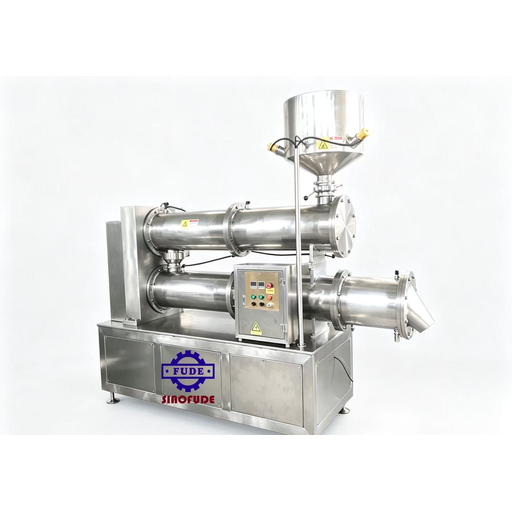
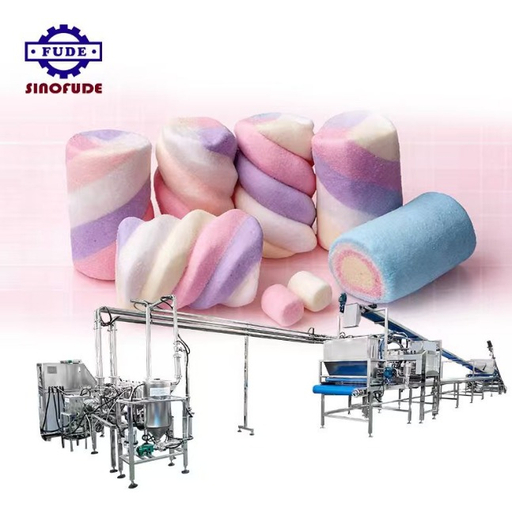
Use this page before you talk to sales
- Capacity ladders for steam, power, compressed air, weight, and floor length models (each described separately).
- The four conditions that need to be next to a kg/h figure before two quotations can be compared.
- Published process windows for every station, with the source named
- Eight commercial terms in writing: reply time, build time, payment, warranty, factory test, travel, spares, crating.
- Three calculators: a utility and floor-space sizer, a rated-output conditions worksheet, and an aeration density converter.
Where the quoted scope starts and stops
In scope, all the confectionery equipment, from the syrup melting and concentration machines to the cutting and anti-stick sieving machines, as well as the control system and layout drawing.
Out of scope, dry ingredient handling: intake, pulverising, dust extraction, bonding, ventilation and any classified area questions regarding powdered sugar or starch.
Out of scope, machinery: downstream wrapping and case packing.
Why it is named here: so you can place those packages with your own plant engineer at design stage rather than discover them at installation.
Output & Forming
20 to 500 kg/h
Rated output range across four marshmallow steps, plus 400 kg/h on the fondant line.
Forming routes: Extrude and cut, or deposit into moulds, including centre-filled and multi-colour.
Utility Demand
Required facility parameters depending on the selected step:
- Installed power 15 kW to 55 kW at 380 V
- Steam demand 50 to 350 kg/h at 0.2 to 0.6 MPa
- Compressed air 0.3 to 1.5 m³/min at 0.4 – 0.8 MPa
*Air must be treated to food-contact quality.
Project Timeline
60 to 90 days
Build time calculated from the deposit and the signed technical package.
- Warranty 12 months from commissioning sign-off
Facility Specs
Estimated physical footprint required to accommodate the line:
- Floor length (Semi-auto) 10 m
- Floor length (Automatic) 30 m to 40 m
The Two Product Lines on This Page
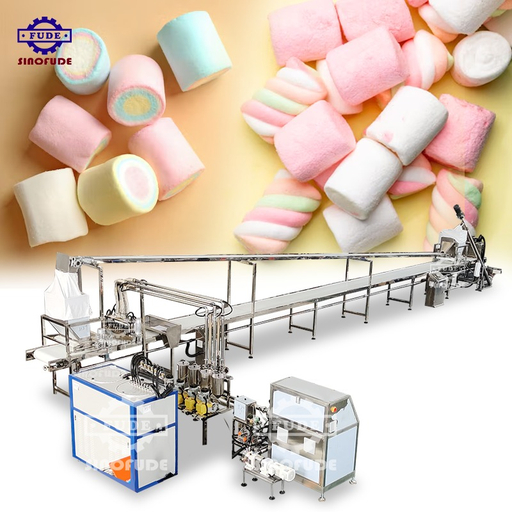
Marshmallow Extruder
Extrude and cut route, from the CHM-20 semi-automatic step at 20 kg/h to TMHT 1200 at 300 kg/h to 500 kg/h, with cut length adjustable 100 mm to 800 mm and coextruded centre fill available.
Explore Marshmallow Extruder
Fondant Line
BFJ400 cook and beat line rated 400 kg/h at 20 kW, with food-contact parts in SUS316 and a continuous vacuum cooking stage. Built for bulk industrial fondant, not for rolling sugar paste over a cake.
Explore Fondant LineThe Marshmallow Line, Station by Station
A marshmallow line is a foam-making machine with a sugar cooker on the front and a cutter on the back. Every station is responsible either for building the foam or for preventing the collapse of the foam before the cutting is completed.
Syrup preparation and cooling
A three-layer jacketed cooker melts and concentrates the syrup, then the mass moves to a cooling tank where gelatin is added during cooling, as opposed to during cooking. It stays in a storage tank at a stable temperature for continuous running. Jacketed pipes and rotor pumps move the mass between vessels to avoid lose temperature in transit.
Aeration
The aerator whips the syrup into foam. Protein in the mass forms bubble films around the entrained air, and continued agitation of films increases their strength while decreasing their surface tension. Your target density is set here, which makes this the station to interrogate in a quotation.
The station sequence in one line
Syrup melting and concentration→
Cooling with gelatin addition→
Buffer storage→
Jacketed transfer→
Aeration→
In-line colour and flavour dosing→
Extruding or depositing→
Cooling→
Servo cutting→
Anti-stick sieving
Published Setpoints by Station
The figures below come from granted patent art and published process guidance for aerated confectionery, not from a SINOFUDE test report. They act as your specification’s window as to where it can land.
1. Syrup cooking
120 °C to 130 °C, preferably 126 °C, per EP2175741B1 claim 12, for that patent’s own gelatin and pectin formulation. Read it as the window the cooker has to reach, because the setpoint itself comes from your formula.
2. First cooling
80 °C to 110 °C, preferably 100 °C, per EP2175741B1 claim 12 (brings the syrup down before it meets the colloid).
3. Cooling once syrup and gelatin are combined
50 °C to 70 °C, preferably 60 °C, per EP2175741B1 claim 13 (gelatin loses gelling power if the combined mass is held too hot).
4. Gelatin specification
Bloom 100 g to 300 g, especially 125 g to 275 g, preferably 180 g to 250 g, with viscosity 2.8 mPa·s to 5 mPa·s paired with the 180 g to 250 g bloom, per the product claims of EP2175741B1 (bloom, not grade name, is what the aerator responds to).
5. Aeration outlet
Foam at about 0.1 g/cc to 0.4 g/cc and 40 °C to 70 °C, per US6180158B1 (density and outlet temperature are co-specified, not independent).
6. Aerating gas
Inject immediately before the aerator at the pressure of 120 kPa to 2,400 kPa as nitrogen or de-watered and de-oiled clean air, as claimed in US6180158B1 (gas quality is a product specification as the gas remains in the product).
7. Extrusion
Pumpable at about 40 °C to 65 °C, preferably 50 °C to 60 °C, per US6180158B1 (too cold tears the rope, too warm loses the shape).
8. Conditioning after extrusion
Ribbon held at ambient 20 °C to 25 °C for 2 hours before cutting, per EP2175741B1 (the cut face has to firm up before a blade touches it).
9. Cut and set moisture
About 5% to 20%, preferably 5% to 15%, per US6180158B1; starch-mogul deposited product demoulds at 8% to 10% per published process guidance (the two routes leave the line at different moisture states).
10. Optional drying
1% to 5%, narrowed to about 2% to 4% for a dried aerated confection, per US6180158B1 (a line quoted without a drying station cannot reach this band).
Two further published figures: Average bubble size 20 µm to 25 µm, and for ungrained marshmallow a sugar blend kept above 50% corn syrup solids to prevent crystallising.
Where the Density Number Comes From
| Published source | Density stated | Why it matters to a buyer |
|---|---|---|
| EP2175741B1 | 0.10 to 0.6 g/cm³, especially 0.13 to 0.3, preferably 0.2 to 0.25 | The claimed band an aerator has to reach |
| US7329428B2 | About 200 to 500 grams per litre | The same band in the unit on a plant density check sheet |
| US6180158B1 | About 0.1 to 0.4 g/cc at 40 °C to 70 °C | Outlet density is specified together with outlet temperature |
| Confectionery Production | About 0.2 g/cm³ against 1.3 to 1.5 g/cm³ for unaerated gummy, jelly and high-boiled sweets | Aeration removes most of the mass per unit volume, so aeration control outranks cooker capacity |
Treated Air is a Food-Contact Input
The gas used in the formation of foam remains in the product and is therefore considered a part of the product by U.S. regulations.
Compressed air or other gases mechanically introduced into food or used to clean food-contact surfaces or equipment must be treated in such a way that food is not contaminated with unlawful indirect food additives. (21 CFR 117.40(g), Equipment and utensils)
Patent art specifies nitrogen or clean air, defined as de-watered and de-oiled, injected at 120 kPa to 2,400 kPa per US6180158B1.
Trade press reveals that simple systems use ambient air while developed systems process air or mixtures of gases including carbon dioxide and nitrogen and in all cases the gas must be clean and of food-grade quality.
For your reference, the air treatment train belongs in the line specification, not the building services budget, so you should ask what stages of filtration and removal of oil are included and where the interface is located.
Downstream Stations in Our Scope
Colour and flavour
Injected in line after aeration, so one mass feeds single-colour, multi-colour and twisted product without a recipe change upstream.
Forming
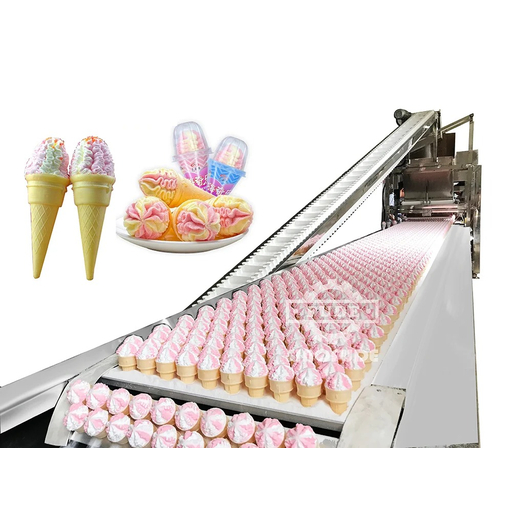
Runs through an extrusion die for rope, or a depositing head into moulds for shaped, cup and centre-filled product.
Cooling, servo cutting and anti-stick sieving
Then set the gelatin network, cut to length and remove surplus dusting powder.
Equipment and Construction We Publish
- Three-layer jacketed cooker, cooling tank and three-layer storage tank with scraper stirrer on the fondant line
- Lobe pumps for syrup transfer, two units on the fondant line
- Syrup coil type continuous vacuum cooker on the fondant line
- Warming system with water tank, heating elements, pump, temperature control and valves
- Electrical control cabinet and skid frame
- Food-contact parts in SUS316 and other parts in SUS304 on the fondant line
- Clean-in-place, abbreviated CIP, connection provided on the cooker and forming sections
Aerated Marshmallow and Grained Fondant Are Two Different Lines
Marshmallow and fondant are both sugar, and that is where the similarity stops. One is a foam that must never crystallise, and the other is a crystal mass whose quality depends on crystallising in a controlled way.
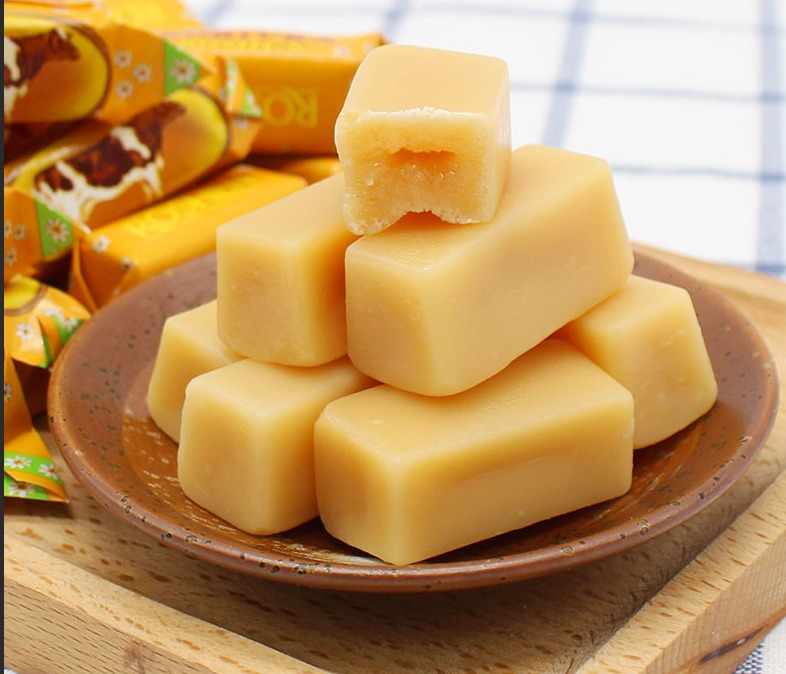
The grained and non-grained split
| What changes | Marshmallow, non-grained | Fondant, grained |
|---|---|---|
| Target structure | Amorphous sugar matrix holding an aerated gelatin network | Solid sucrose crystals dispersed in saturated syrup, water at 8% to 20% of total mass |
| Crystallisation | Suppressed. Published guidance keeps the sugar blend above 50% corn syrup solids to prevent it in ungrained marshmallow | Induced and controlled. A 2025 peer-reviewed paper on fondant structure reports a 30% to 70% crystal volume fraction for poured fondant, with crystals below 20 µm needed for smooth texture |
| Air phase | The structure itself. 0.10 to 0.6 g/cm³ per EP2175741B1, so air is most of the volume | Present but minor. The same paper describes fondant as an aerated dispersion carrying roughly a 6% to 10% air phase |
| Setting agent | Gelatin, acting as both whipping agent and gelling agent | None. The set comes from crystallisation and moisture, not from a colloid |
| Shelf-life failure mode | Moisture loss hardens it, and below 50% relative humidity that happens in storage | Crystal growth hardens it. One controlled study measured an untreated fondant control going from 203.19 g to 380.91 g hardness over four weeks |
| Equipment consequence | Cooker, aerator, dosing, former, cooling tunnel, cutter, sieve | Cooker set with a continuous vacuum stage, then a jacketed hopper beating and forming section |
Both products contain air, so the split is not about aeration. It is about whether crystallisation is suppressed or engineered, and that decision changes the cooker set, the forming section and the shelf-life failure mode.
Industrial fondant is not cake-decorating fondant
A bakery purchase, a sheeter that rolls ready-made sugar paste over a cake, bought by the piece.
A plant purchase, a cooking and beating line that manufactures fondant as a bulk centre, a cream filling or a coating base, measured in hundreds of kilograms an hour. A sheeter and a cooking line are not interchangeable purchases.
This page covers the second one, so a search for a cake-decorating fondant machine has landed on the wrong page.
The hygiene stake on the fondant side is documented and specific. Food Engineering, reporting University of Georgia research, records that Salmonella has been proven to survive eight months or more in fondant, halva and dried fruits, and that a salmonellosis outbreak was associated with a marshmallow confectionery.
Low water activity does not make a sugar mass safe. That is why closed, drainable, cleanable handling is a specification requirement on a fondant line rather than a preference
Forming Routes, Product Formats and What Each Route Commits You To
Extruding and depositing are the two process groups marshmallow manufacturing divides into, and published patent art denotes different densities of foam for each route. When you pick a route, you commit to part of your recipe.
| Forming route | Published density target | Product formats it gives you | What it commits you to |
|---|---|---|---|
| Extrude and cut | Preferably 0.10 to 0.3 per EP2175741B1 | Rope cut to length, twisted multi-colour, coextruded centre-filled | Final solids formulated for the method and quick-set stabilisers, because there is no mould dwell in which to finish. Cut length adjustable 100 mm to 800 mm on the automatic steps |
| Deposit into moulds | Preferably 0.5 to 0.6 per EP2175741B1 | Shaped pieces, cups, animals and flowers, jam or chocolate centres | Depositing speed 15 to 45 per minute, mould tooling per shape, and on starch-mogul practice hours of in-mould dwell before demoulding |
| Coextruded centre fill | Follows the extruded band | Centre-filled rope with jelly, chocolate paste or cream | A second dosing circuit and a filling viscosity window agreed before tooling |
| Multi-colour and twist | Follows the extruded band | Two, three and four colour twisted product from one aerated mass | In-line colour and flavour injection per stream rather than separate batches |
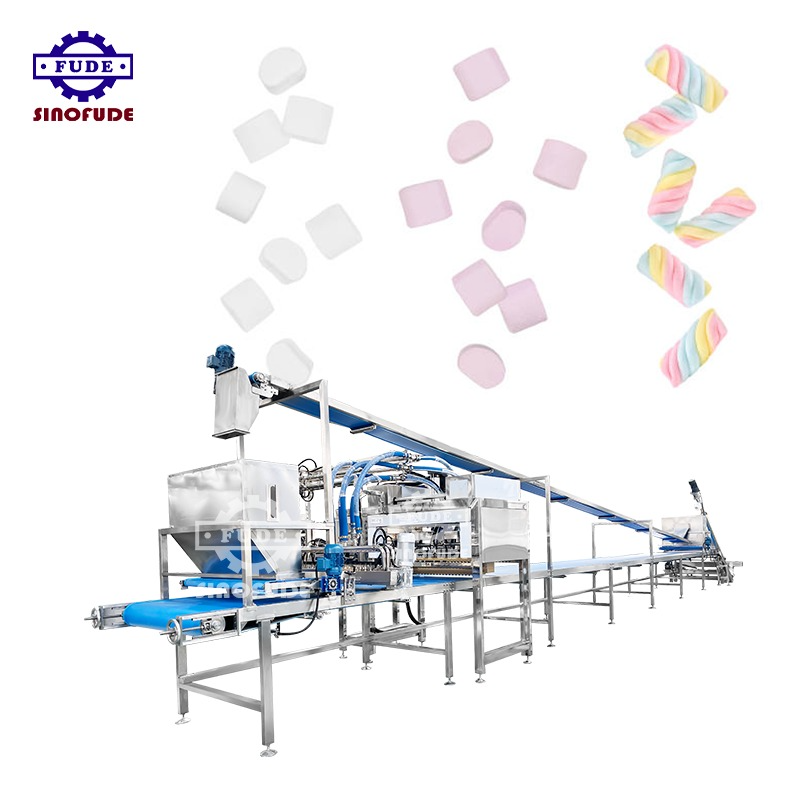
The in-mould dwell is part of your throughput, not a detail
Published process guidance for starch-mogul deposited marshmallow has the product sitting in the mould for several hours until it reaches final humidity.
It is cooled after setting the gelatin and shaken out once it reaches 8% to 10% moisture content.
There are different measures for forming rate and line rate for deposited routes. For conditioning areas, this means that space must fall within someone’s control.
Rated Output, Utilities and Floor Envelope by Model
The table below is the Sinofude first-party specification for each capacity step, read as the manufacturer’s rated nominal output for the stated model. Any empty cells are values we do not publish, and they are left empty rather than filled with a figure from elsewhere.
| Specification | CHM-20 | TMHT 600 | TMHT 900 |
|---|---|---|---|
| Rated output | 20 kg/h (44 lb/h) | 60 to 100 kg/h (132 to 220 lb/h) | 150 to 200 kg/h (331 to 441 lb/h) |
| Forming route | Deposited, semi-automatic | Extrude and cut, or deposited | Extrude and cut, or deposited |
| Cut length | 100 to 800 mm (3.9 to 31.5 in) | 100 to 800 mm (3.9 to 31.5 in) | |
| Depositing speed | 15 to 45 per min | 15 to 45 per min | 15 to 45 per min |
| Steam demand | 50 kg/h at 0.2 to 0.6 MPa | 150 kg/h at 0.2 to 0.6 MPa | 250 kg/h at 0.2 to 0.6 MPa |
| Installed power | 15 kW at 380 V | 35 kW at 380 V | 45 kW at 380 V |
| Compressed air | 0.3 m³/min at 0.4 to 0.8 MPa | 0.8 m³/min at 0.6 to 0.8 MPa | 1.0 m³/min at 0.6 to 0.8 MPa |
| Gross weight | 500 kg (1,102 lb) | 6,000 kg (13,228 lb) | 8,000 kg (17,637 lb) |
| Floor envelope | 10 m line length (33 ft) | 30 m line length (98 ft) | 35 m line length (115 ft) |
| Specification | TMHT 1200 | BFJ400 fondant |
|---|---|---|
| Rated output | 300 to 500 kg/h (661 to 1,102 lb/h) | 400 kg/h (882 lb/h) |
| Forming route | Extrude and cut, or deposited | Cook and beat, then form |
| Cut length | 100 to 800 mm (3.9 to 31.5 in) | |
| Depositing speed | 15 to 45 per min | |
| Steam demand | 350 kg/h at 0.2 to 0.6 MPa | |
| Installed power | 55 kW at 380 V | 20 kW |
| Compressed air | 1.5 m³/min at 0.6 to 0.8 MPa | |
| Gross weight | 10,000 kg (22,046 lb) | 3,000 kg (6,614 lb) |
| Floor envelope | 40 m line length (131 ft) | 6,400 × 1,300 × 2,300 mm (21.0 × 4.3 × 7.5 ft) |
Automation & Format
The three TMHT steps are fully automatic marshmallow production line configurations, with automatic transfer between stations, in-line dosing and servo cutting. The CHM-20 step is semi-automatic and deposits only.
Supplier Communication
Ask every supplier to put those four in writing, including us. The page does not claim saleable output after rejects, output after either coating or starch removal, or output after a full shift without breakdown.
Conditions Note
Rated output is the production capacity figure a supplier prints against a model, and it is not comparable until its measurement conditions are described. Two pieces of evidence make that point without any guesswork.
Our own figures change across our own properties. One marshmallow line page cites TMHT 600 as being between 60 to 100 kg/h, and TMHT 900 as being between 150 to 200 kg/h. An ice-cream-format page cites the same two models as 20 to 120 kg/h and 40 to 200 kg/h. Both pages were published by us, and a single number cannot describe both cases.
Industry Standards
The same caveat is also present on the other side of the market. A 2015 trade report on a European continuous pressure beater states a maximum throughput of 2,000 kg per hour depending on the density of the product.
The machine badge isn’t what sets density; it’s the product, and US6180158B1 specifies the aerator outlet density together with the outlet temperature rather than on its own. That is why these conditions go with the number.
The 4 conditions for kg/h:
- Product format and piece weight the figure was measured on
- Recipe density or specific gravity at the aerator outlet
- Whether the figure is at the former, or after conditioning, dusting, sieving, and rejects.
- The uptime basis: Instantaneous, sustained through an entire shift, or sustained after changeovers
Line Price Drivers, Build Time and Payment Terms
Price follows the capacity step, the forming routes, the number of product formats, the automation between stations, and the scope at each end of the line. There is no marshmallow machine price list for a configured line, because no two configurations are the same machine.
What Moves Your Number
Understanding the drivers, their effect on cost, and how to logically contain them.
Capacity Step
Effect on Cost
Installed power moves from 15 kW to 55 kW and line length from 10 m to 40 m across the four steps, and both carry through to equipment and building cost.
How to Contain It
Size for the demand plan rather than the ambition. A step run far below rated output pays full utility and labour cost for partial tonnage.
Forming Routes
Effect on Cost
Running both extruded and deposited product needs the tooling and the control recipes for both.
How to Contain It
Start with the route your launch formats need and leave the interface for the second route.
Formats & Tooling
Effect on Cost
Each shape, centre fill and colour combination adds moulds, nozzles or dosing circuits.
How to Contain It
Fix the launch format list before tooling is quoted. Adding a format later costs less than tooling for formats you do not sell.
Automation
Effect on Cost
Automatic transfer, in-line dosing and servo cutting displace labour and raise capital cost. Bureau of Labor Statistics puts median wage at 41,230 USD/year (19.82 USD/hour).
How to Contain It
Multiply by your shift pattern to see what a station is worth automating.
Energy at the Front of the Line
Effect on Cost
The Department of Energy's 2018 manufacturing energy footprint puts about two thirds of end-use energy in food and beverage plants into manufacturing processes such as process heating, so the cooker and drying end dominate running cost.
How to Contain It
Specify steam generation, heat recovery and insulation at design stage. Those are the pathways the Department of Energy names first.
How Your Quotation Is Produced
Enquiries reach an engineer and receive a reply within 12 hours; a priced quotation follows once the product brief and capacity target are agreed.
A complete line is built and ready for pre-shipment testing in 60 to 90 days, counted from the deposit and the signed technical package.
Payment runs 30% deposit by bank transfer, 60% before shipment, and the remaining 10% within 15 days of commissioning sign-off; letter of credit accepted.
That payment structure is event-defined rather than calendar-defined. Federal Acquisition Regulation Subpart 32.10 uses the same shape for United States government equipment contracts: a fully defined schedule of performance events, payment amounts commensurate with the value of each event, and no payment approved until the specified event is successfully completed.
The Cost Categories This Table Does Not Price
The drivers above move the equipment figure, and they are not the whole cost of owning a line. The National Institute of Standards and Technology sets out the categories a manufacturer should price across a machine's whole life.
The pros and cons of leasing, including the potential that leasing covers the risk of something becoming obsolete, but can ultimately result in higher costs.
Four categories that come after payment of the invoice. These are installation, use, maintenance, and disposal.
Location, safety, security and utility requirements: purchase variables in their own right, not afterthoughts.
Why they are listed: four of these sit outside anything we quote, so they are named here rather than left to surface at installation.
We publish no per-kilogram cost figure, because a peer-reviewed review of energy consumption in food manufacturing concludes that a standard method to report energy consumption during food processing is still needed.
Quality Control
Quality Control, Factory Testing and What Ships With the Line
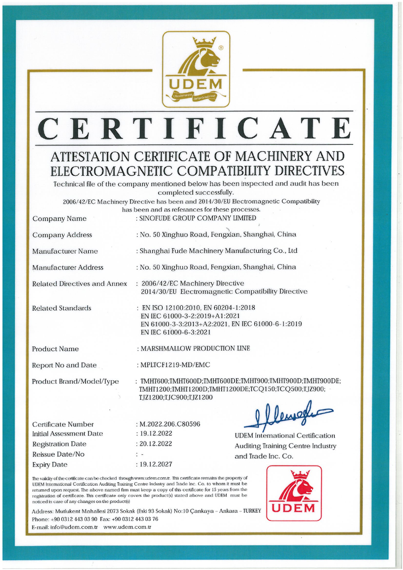
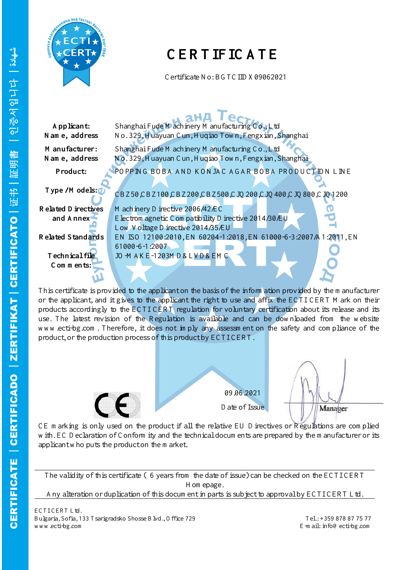
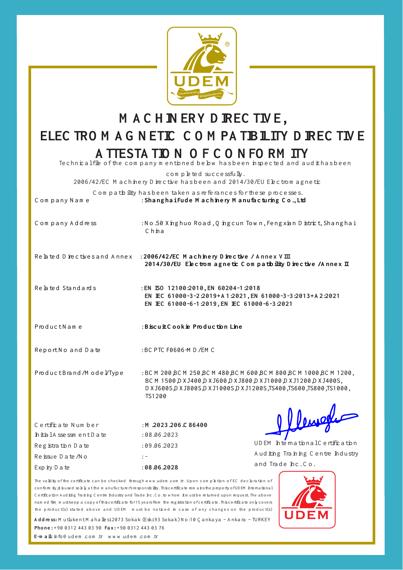
The Two Acceptance Scopes
A line is accepted twice, once on our floor and once in your plant, and the two tests prove different things.
| Scope | Why it is run | Reference framework |
|---|---|---|
| Automation and control acceptance | The control system behaves as the agreed written specification says it will | IEC 62381 gives a framework for factory acceptance, site acceptance and integration testing of an automation system, tied to an applicable specification and agreed responsibilities. It is a buyer-side reference and it certifies no confectionery line |
| Process and product acceptance | Throughput, density and piece consistency against conditions you have written down | Your own specification, using the four conditions above the rated-output table. A factory test does not prove rated output, because our floor cannot reproduce your product mix, shift pattern or ambient conditions |
What We Commit To At The Factory Test
The line is assembled complete on our floor and run before it is dismantled for shipment, and you sign off on the result before it is packed.
Before the line leaves our floor we run a trial production run on your own formula, with the raw material supplied by you, and record the result with you.
You can witness the factory acceptance test in person or by video call, or we send you the test video to verify.
Buyer-side guidance worth following: submit the test plan with your request for quotation, specify the dry-cycle duration with 24 hours as a recommended minimum, and send the operators who will own the line rather than only engineers.
Changeover And Cleaning: What To Verify, Not What To Assume
Clean-in-place connection is provided. It cleans internal product-contact surfaces and does not replace manual cleaning of equipment exteriors, floors, drains and changeover tools.
Neither a validated cycle nor a general organic-residue swab is designed to detect specific allergen proteins, so a satisfactory result does not by itself answer the allergen question on a line running several recipes.
We make no allergen-control claim for this equipment and we publish no validated cleaning parameters.
What To Verify
| What to verify | Why it matters | Named regulation |
|---|---|---|
| Inspection and access points on every wetted vessel and transfer leg | Equipment must be installed so as to facilitate cleaning and maintenance of the equipment and of adjacent spaces | 21 CFR 117.40(a)(3) |
| Material of every food-contact surface, and corrosion resistance in contact with food | Food-contact surfaces must be corrosion resistant, nontoxic, and able to withstand the food and the cleaning compounds used on them | 21 CFR 117.40(a)(4) and (a)(5) |
| Weld and seam finish inside the aerator head, syrup piping and dissolving vessel | Seams on food-contact surfaces must be smoothly bonded or maintained to minimise accumulation of food particles and allergen cross-contact | 21 CFR 117.40(b) |
| Drainability of the closed conveying and dosing system | Holding, conveying and manufacturing systems, including closed and automated systems, must be of a design and construction that enables them to be maintained in a clean and sanitary condition | 21 CFR 117.40(d) |
| Calibration and number of temperature and moisture instruments | Instruments controlling conditions that prevent microbial growth must be accurate, precise, adequately maintained and adequate in number | 21 CFR 117.40(f) |
| Air treatment stages upstream of the aerator | Gas mechanically introduced into food must be treated so the food is not contaminated with unlawful indirect food additives | 21 CFR 117.40(g) |
| Guarding at nip points on rollers, extruder and cutter, and interlocks on rotating vessels | Guarding is required against point of operation, ingoing nip points and rotating parts, and revolving drums must be interlocked so they cannot turn with the guard open | 29 CFR 1910.212(a)(1) and (a)(4) |
| Fan guarding on cooling and drying sections | Where the periphery of fan blades is less than seven feet above the working level the blades must be guarded, with guard openings no larger than one-half inch | 29 CFR 1910.212(a)(5) |
What Ships With The Line, And What Follows It
A matched consumable and wear-part set ships with the line; wear parts sit outside the warranty and are reordered against the part list.
The line is dismantled into standard export wooden crates and shipped with a container loading plan.
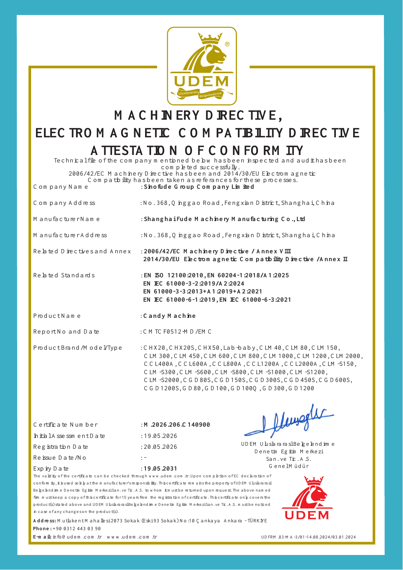
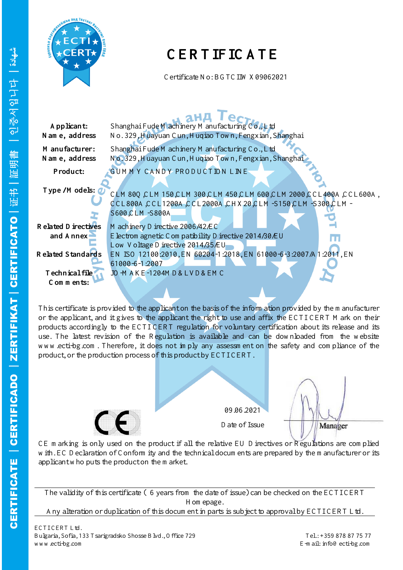
A machine manual and a parts manual ship with the line, and we prepare design, installation, operational and performance qualification documents when your plant requires them.
The line carries a 12-month warranty from commissioning sign-off, covering parts replacement and excluding wear parts and damage from misuse.
Where your own team installs the line, our after-sales engineers provide remote online technical support for the installation and for problems found after it.
01 / 05
×
The Line Project, From Brief to Commissioned Output
Product Brief
you describe the formats, piece weights and target density. This step fixes the forming route, so it comes before anything else.
Capacity And Takt Confirmation
we agree the rated output together with the four measurement conditions, so the number in the quotation and the number you audit are the same number.
Layout And Utilities
we issue the line layout against your building with the steam, power and compressed-air interfaces marked, and you confirm them with your plant engineer. Before our engineer travels we issue the utility requirement for your line and the recommended installation position from the layout, so water, compressed air, steam and power are ready on arrival.
Manufacture
the line is built to the signed technical package in 60 to 90 days.
Factory Test And Sign-off
we assemble the line complete, run it, run your formula on it with your raw material, and carry the cost of putting right anything the test finds before the line is packed.
Installation, Commissioning And Training.
Our engineers travel to your plant for assembly, commissioning and operator training. You cover return airfare, local transport, board and lodging, plus USD 85 to 120 per engineer per day on site; layout design, assembly, trial production and operator training are included in the line price.
What To Settle Before We Quote, And Why It Saves You Money
| Decide This | What To Tell Us | Why It Lowers Your Cost |
|---|---|---|
| Launch format list | The shapes, fills and colour combinations you will sell in year one | Tooling is quoted per format. A short honest list beats a long aspirational one |
| Target density | A g/cm³ or g/L figure, or the mouthfeel you are matching | Density drives aerator selection and the published band is 0.10 to 0.6 g/cm³. Guessing here is the most expensive guess on the list |
| Forming route | Extruded rope, deposited shapes, or both | Route and density are bound together, so settling route first removes a round of revisions |
| Conditioning space | Whether you have floor for in-mould or post-cut conditioning | Deposited product needs hours of dwell. Finding that out late turns a line purchase into a building project |
| Anti-stick strategy | Whether the product goes to an enrober, and what dusting medium you accept | Corn starch can prevent chocolate adhering and powdered sugar adds sweetness. Settling this changes the sieving and recovery scope |
| Dry-ingredient handling | Who supplies intake, pulverising and dust extraction | It sits outside our quoted scope, and naming the owner early avoids a gap at installation |
| Shift pattern | Hours per day and days per week you intend to run | It turns a rated figure into an annual tonnage, which is the only basis on which a capacity step can be judged |
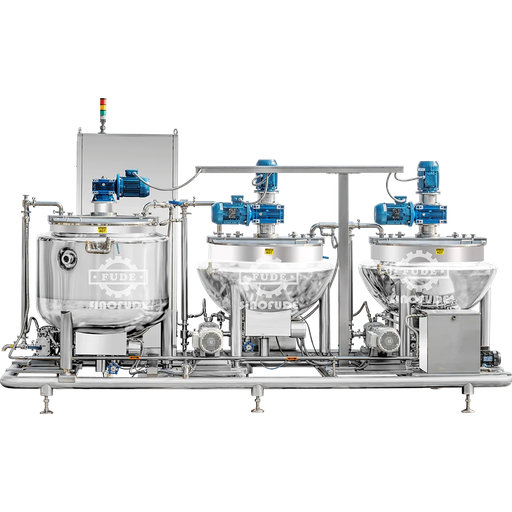
Where a Continuous Marshmallow Line Is Not the Right Answer
In candy production a continuous line earns its cost through consistency at volume. Five situations where it is the wrong purchase, each with what to do instead.
Situation
01
Demand below the entry step
Why it works against you
The 20 kg/h semi-automatic step is the floor of this range, and a line run far below rated output pays full utility and labour cost for partial tonnage
Where to look instead
Stay on a small marshmallow machine and batch equipment until demand is steady. Trade commentary is direct: batch gives flexibility but cannot reach continuous throughput, so batch suits the smaller operator and continuous the larger producer
Situation
02
Your recipe is tuned for batch whisking
Why it works against you
Extruded and band-deposited product must have its final solids formulated for the method and use quick-set stabilisers, because there is no mould dwell in which to finish
Where to look instead
Budget recipe development alongside the equipment, and use the pre-shipment trial run on your own formula to find the gap before the line ships
Situation
03
You need starch-mogul plate moulding, one of the two process groups marshmallow manufacturing divides into per US7329428B2
Why it works against you
Starch-mogul deposited product sits in the mould for hours until it reaches 8% to 10% moisture. That dwell is a building requirement, and the forming rate is not the line rate
Where to look instead
Plan a mogul and conditioning area as a separate project, or choose the extrude-and-cut route and accept a different product shape
Situation
04
Product goes straight to an enrober
Why it works against you
Corn starch dusting can prevent chocolate adhering to the piece, and powdered sugar adds sweetness to an already sweet product. The usual anti-stick answer becomes the problem
Where to look instead
Settle the dusting medium before tooling. Powdered sugar buys you release and costs you sweetness, so practitioner guidance points to dextrose or fondant sugar for product bound for coating, which changes the sieving and recovery scope
Situation
05
Dry-ingredient and dust handling is unresolved
Why it works against you
Intake, pulverising, dust extraction, bonding and ventilation around powdered sugar and starch sit outside our quoted scope, and an unowned gap here stops an installation
Where to look instead
Assign it to your plant engineer or a dry-handling specialist at design stage, and tell us where the interface sits so the layout leaves room for it
Marshmallow & Fondant Line Engineering Tools
Engineering Tool
Utility and Floor-Space Sizer
Enter the output you need and the forming route you intend to run. The sizer returns the SINOFUDE capacity step that carries that output, with the steam, power, compressed air, weight and floor length published for it.
Access Sizer →
Engineering Tool
Rated-Output Conditions Worksheet
A kg/h figure is not comparable between suppliers until the conditions it was measured under travel with it. Fill the four conditions below and the worksheet writes a paragraph you can paste into a request for quotation, so every supplier answers on the same basis.
Open Worksheet →
Engineering Tool
Aeration Density Converter
Marshmallow density is quoted in three different units depending on who is writing. This converter moves between them and places the result against the bands published in the patent art, so a density written on a check sheet and a density written in a specification can be compared.
Use Converter →Marshmallow and Fondant Line FAQs
Density follows the mixing action, the system pressure, the flow rate, the ratio between gas and liquid phase, and the temperature. Published examples show the sensitivity: on one continuous pressure aerator, dropping mixing head pressure from 5 bar to 3 bar moved finished density from 0.25 g/cm³ to 0.15 g/cm³ at the same pump and head speed.
The symptom operators report when density drifts is product that tastes right and eats wrong, heavy and solid instead of light.
In one practitioner thread the cook took about 20 minutes to reach 240 °F instead of 8, and the batch came out dense.
Operators in that thread blamed the weather and hard water. Experienced peers pointed at cook temperature and an uncalibrated thermometer, which is why instrument calibration sits in the verification table above.
Gelatin is the whipping agent and the gelling agent at once, and its bloom strength is what holds the air in. It is mixed in on our cooling lines while the mass drops in temperature; which is why the cooker, the cooling tank and the storage tank are three separate vessels with temperature control on the transfer legs.
They are the two process groups marshmallow manufacture divides into, and they call for different foam densities. The deposited product should be between 0.10 and 0.3 and the extruded product should be between 0.5 and 0.6. 0.6.
Extruded gives rope, cut pieces, twists and coextruded centres.
Deposited gives shapes, cups and moulded centre fills.
Marshmallow is non-grained, so crystallisation is suppressed and published guidance keeps corn syrup solids above 50% of the sugar blend. As it is grained, fondant produces fine crystals, and a 2025 A peer-reviewed paper reports a 30% to 70% crystal volume fraction for poured fondant. That difference is why fondant has its own cooker set and forming section.
Cooling sets the gelatin network so the piece can be handled without deforming, and sieving separates pieces and removes surplus dusting powder before packing.
Practitioners talk straightforwardly about how cutting and packing while still warm results in moisture build up in the pack, which results in condensation and even mould.
Overnight rest is a well known rule at the small scale and morphs into conditioning space at the line scale. An instantaneous shift in scale from small to large impacts certain rules. At line scale, rules which state that rest is a prerequisite prior to cutting change to rules that state that rest induces a given space or condition.
Yes on the fully automated steps, because colour and flavour are injected in line after aeration, so one aerated mass conveys single-colour, multi-colour, and four-colour twisted product. Centre fill requires a second dosing circuit and an agreed filling viscosity window. Each additional shape requires its own tooling, which explains the launch format list is the first thing we ask for.
Product format, piece weight, recipe density, the forming route, and whether the figure is taken at the former or after conditioning, dusting, sieving and rejects. Our own published figures differ between two of our own pages for the same models, and a 2015 trade report on a European aerator gives 2,000 kg per hour depending on the product density required.
Steam from 50 to 350 kg/h at 0.2 to 0.6 MPa, installed power from 15 kW to 55 kW at 380 V, and compressed air from 0.3 to 1.5 m³/min at 0.4 to 0.8 MPa, depending on the capacity step. The compressed air is treated air rather than shop air, because gas introduced into the product is regulated under 21 CFR 117.40(g).
Line length runs 10 m on the semi-automatic step and 30 m to 40 m on the three automatic steps, with gross weight from 500 kg to 10,000 kg, and the fondant line occupies 6,400 × 1,300 × 2,300 mm. Add conditioning area if you have running deposited product, and clearance for wash down access, which 21 CFR 117.40 (a)(3) makes an installation requirement.
Buyers on engineering forums answer this bluntly: anything that benefits the vendor usually buys you risk. Testing at the builder’s plant is beneficial because defects get fixed where the equipment was built, and the equipment travels once.
We create and run the line on our floor and you sign off on it before it gets packed.
The site test verifies if the line delivers your product according to your specification in your specific environment.
A complete line is built and ready for pre-shipment testing in 60 to 90 days, counted from the deposit and the signed technical package. Those two events start the clock together, because manufacturing cannot begin against an unsigned format list.
The line carries a 12-month warranty from commissioning sign-off, covering parts replacement and excluding wear parts and damage from misuse. A matched consumable and wear-part set ships with the line, and wear parts are reordered against the part list.
The line is assembled complete, run, and run again on your own formula with raw material you supply, and the result is recorded with you before packing.
Please submit your test plan with your request for quotation, as opposed to after the purchase order.
Set the dry cycle to a minimum of 24 hours.
Send along the operators who will assume ownership of the line, as well as engineers, and schedule the replacement of common wear parts while the line remains in our facility.



