Get in Touch with SINOFUDE Company


A Toffee & Caramel Line comprises a controlled product path to formulate, dose, cook, condition and cool a product before its forming, inspection and wrapping. The toffee manufacturing process and caramel manufacturing process may share equipment, but hard-candy recipes or machine settings can’t be duplicated to other products without product validation.
Updated September 2026 · By XCX
What this guide gives you
Use the Product Route Boundary Matrix to define the product, the Cook-to-Wrapper Evidence Chain to preserve each handoff, and the Defect Backtrack Matrix to investigate drift without guessing a cause from appearance.
Industrial-intent boundary: mixed search results include dessert recipes, chocolate-coated confection, caramel topping, and instructions to melt chocolate. Those uses of chocolate, topping, and dessert do not define a production route. If chocolate is part of the intended SKU, document it as a separate ingredient, addition, coating, cooling, and packaging requirement. Search labels such as making machine, toffee making machine, toffee candy making machine, and candy machine describe machinery and production equipment listings across the snack industry; they do not establish a validated route, factory design, or product specification.
Toffee & Caramel Line: The Short Manufacturing Answer
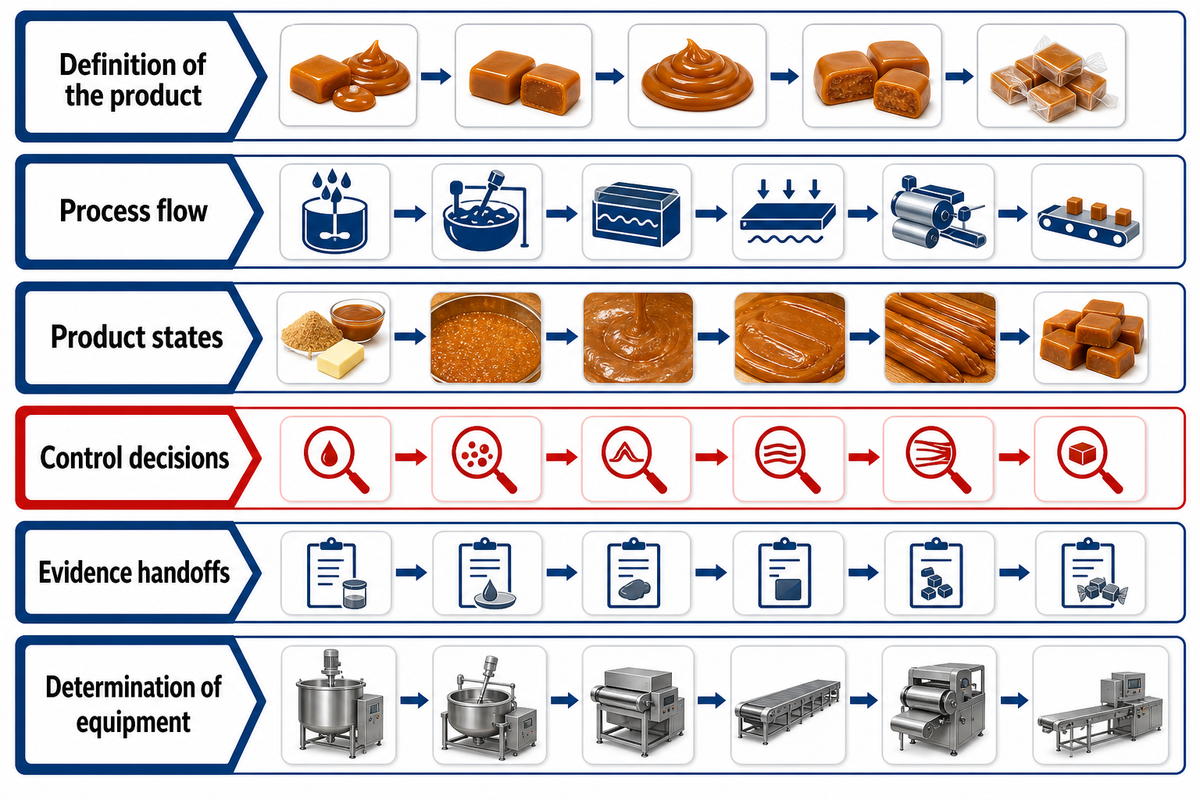
In the design and establishment of a product system, the process flow links product states, control decisions, and evidence handoffs before the identification of equipment. Definition of the product and process flow precedes the determination of equipment to be used.
1. Define
Formula family and target texture
Formula family and target texture
2. Dose
Identity, lot, condition, amount
Identity, lot, condition, amount
3. Cook
Endpoint method and thermal history
Endpoint method and thermal history
4. Condition
Additions, mixing, cooling state
Additions, mixing, cooling state
5. Form
Deposit, cut, shape, inspect
Deposit, cut, shape, inspect
6. Wrap
Piece state and infeed evidence
Piece state and infeed evidence
Product temperature alone does not differentiate between toffee and caramel; formulation, structure, residence time, cooling, and geometry also matter. A system of process improvement tends to focus on product requirements and defines the state of the product before it’s moved to the next process step. Such an approach helps to identify the nature of the process, continuous or discontinuous, and other features such as product cutting and wrapping.
What Changes Between Toffee and Caramel in Production?
Toffee and caramel routes can differ in sugar system, milk solids, fat phase, target moisture or solids logic, browning, cooling state, and finished geometry. A common assumption is that one temperature separates the products, but no absolute temperature differentiates the two products. Product boundaries are defined by approved product specifications and the SKU’s evidence method.
| Boundary | Soft caramel route question | Firm caramel or toffee route question | Verify on your product |
|---|---|---|---|
| Formula family | How should the mass flow and recover after deformation? | How should the piece fracture, chew, or hold a cut edge? | Approved recipe revision and ingredient identities |
| Endpoint logic | Which method indicates the intended soft finished state? | Which method indicates the intended firm finished state? | Method, sampling point, uncertainty, acceptance rule |
| Fat and protein | Does the emulsion remain uniform during flow? | Does conditioning preserve structure during cutting? | Mixing history, visual record, rheology or texture method |
| Browning | Which color and flavor range is approved? | How much further thermal history is acceptable? | Reference standard plus product-specific review |
| Cooling state | When is the mass stable enough to deposit or transfer? | When is it stable enough to size, cut, or shape? | Mass temperature history, time, room conditions, dimensions |
| Wrapper handoff | Will the piece deform or adhere at infeed? | Will edges chip, smear, or lose geometry? | Piece condition, weight, dimensions, rejects, accumulation |
Research on caramel describes it as an active emulsion-filled protein gel where fat is dispersed in a protein network. Consequently, protein structure, fat behavior, and the flow behavior of the system can affect oiling out, cutting, and wrapping performance, so one endpoint cannot describe the whole material state. This study provides a potential mechanism, not a universal factory limit or manufacturing design rule.
What is the difference between caramel and toffee?
Useful answer: the difference is the product specification and resulting process route, not one universal temperature. Define ingredients, finished texture, moisture or solids method, geometry, cooling behavior, and acceptance criteria for the named SKU before assigning a label.
Where Does the Route Diverge from Hard Candy?
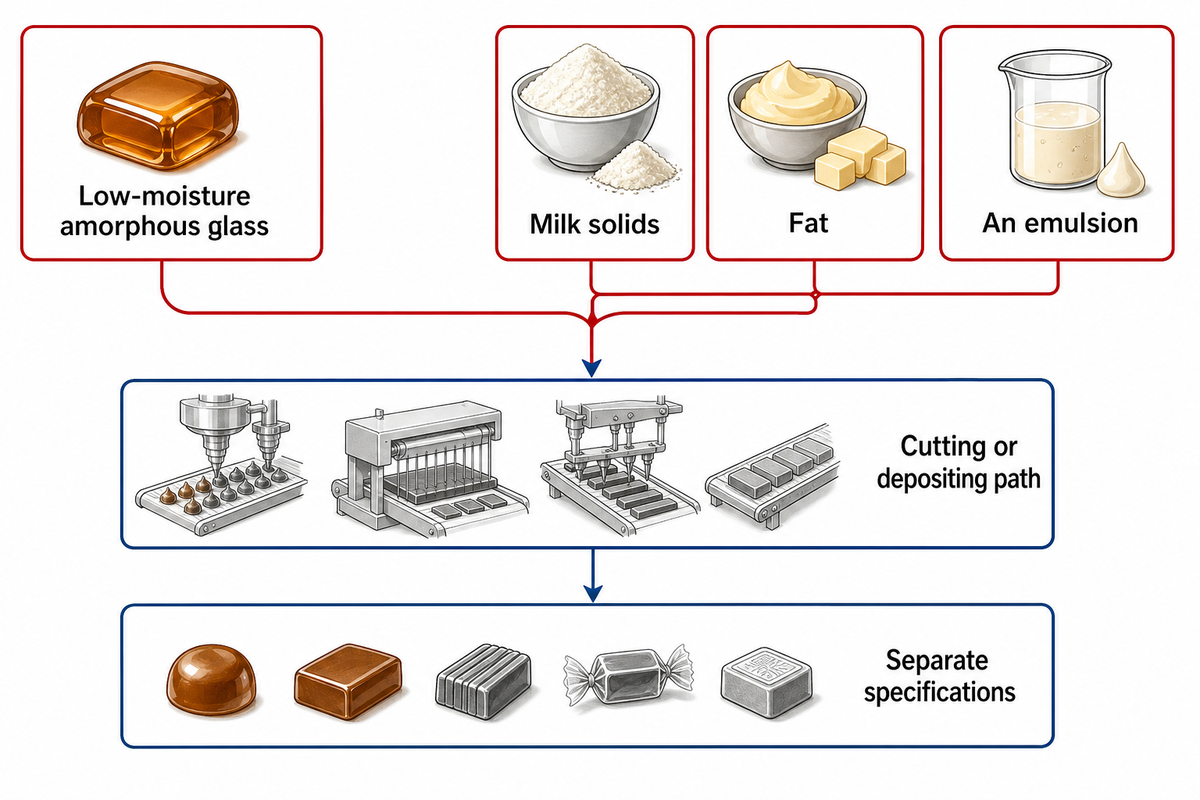
Hard candy is commonly managed as a low-moisture amorphous glass, while toffee and caramel may introduce milk solids, fat, an emulsion, a different moisture range, and a cutting or depositing path. A glassy hard-candy result is not always permanently stable; because of these differences, solidification, shaping, storage, and interaction with wrapping material can vary.
Neighboring product labels—candy bar, milk toffee, nougat, soft candy, lollipop, crunchy confection, or sweet snack—must be treated as separate specifications rather than proof that one line or formula is interchangeable.
Route-boundary checklist
- Is the intended structure glassy, chewy, short-bite, or another defined texture?
- How are milk solids, fat, and protein handled and verified?
- Which endpoint method belongs to this formula and sampling point?
- Does the product need depositing, sizing, cutting, or another forming concept?
- What cooling and room conditions protect the piece before wrapping?
- Which storage evidence applies to the validated SKU?
A 2024 peer-reviewed article summarizes published relationships among hard-candy formulation, water activity, humidity, temperature, glass transition, stickiness, and crystallization. Those relationships explain why settings can’t be copied casually; they don’t supply a toffee or caramel process window. Use the hard candy production line page for that route’s commercial context, not as proof of transferable conditions.
How Does the Process Move from Dosing to Wrapping?
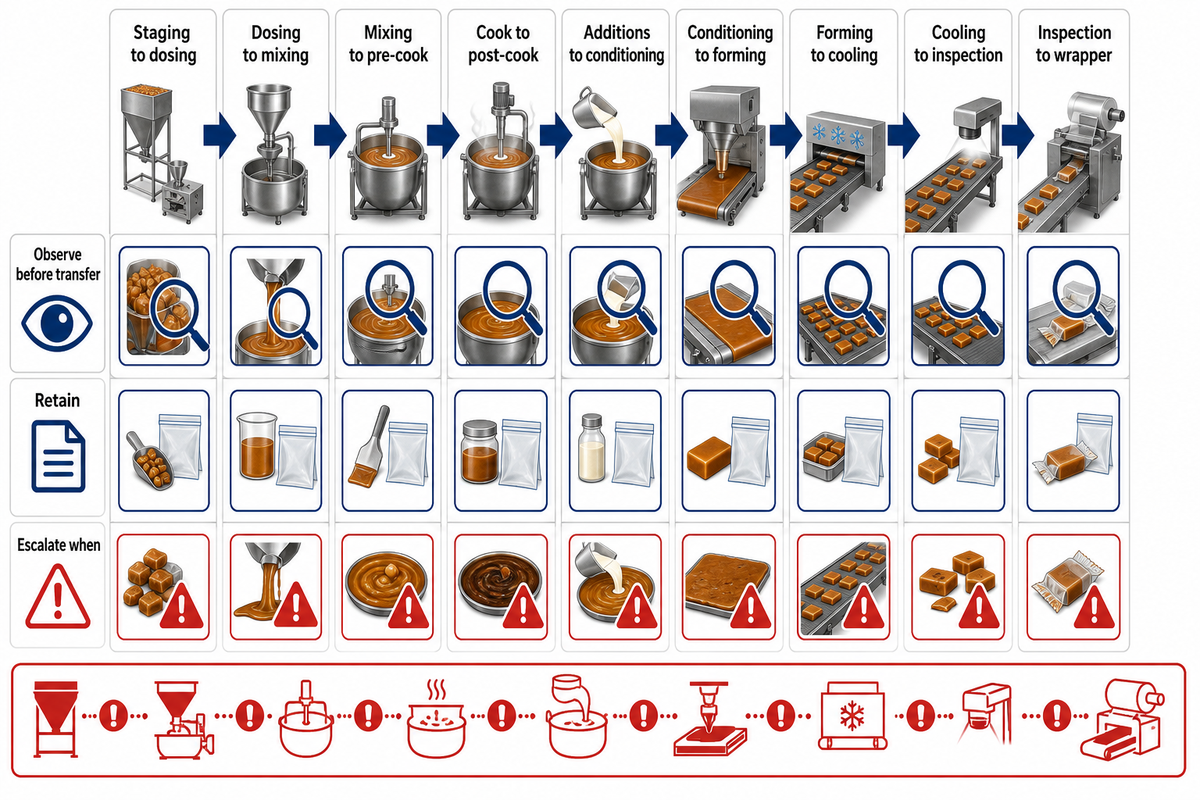
Every time a product passes through a processing step, the evidence should document what entered, what observable state left, what record was retained, and who owns an exception. The Cook to Wrapper Evidence Chain provides a means to document those answers for both batch and continuous processes in a manner that doesn’t treat either process as an automatic buying recommendation.
In practical toffee processing, process vocabulary may include a batch or continuous boil, a depositor, an extruder, a cooling drum, or automatic and high-speed automation, but each term still requires a defined product state and handoff.
4-Evidence Handoff Rule
| Handoff category | Observe before transfer | Retain | Escalate when |
|---|---|---|---|
| Staging → dosing | Identity, lot, condition, approved revision | Lot and weigh record | Identity or condition is unresolved |
| Dosing → mixing | Actual additions against the approved batch instruction | Amount, sequence, verification, deviation | An omission, substitution, or mismatch appears |
| Mixing → pre-cook | Addition order, dispersion, initial uniformity | Time, sequence, operator observations | An addition or sequence deviates |
| Cook → post-cook | Endpoint by approved method, thermal history | Method, sample, time and process record | Endpoint or method is uncertain |
| Additions → conditioning | Mixing and emulsion condition | Identity, amount, time, observation | Separation or nonuniformity appears |
| Conditioning → forming | Flow, temperature history, handling state | Time, room condition, setup state | Mass cannot hold the intended path |
| Forming → cooling | Weight, geometry, release, visible defects | Sample results and reject codes | Drift crosses the agreed rule |
| Cooling → inspection | Piece stability, surface, dimensions, and defects | Sample results and inspection disposition | Acceptance evidence is incomplete |
| Inspection → wrapper | Released piece state and accumulation behavior | Infeed state, stops, restarts, rejects | Pieces stick, deform, chip, or accumulate |
A continuous soft candy patent covers historical methods for concentration, rapid cooling, and mixing, as well as extrusion and final cooling. It is useful for process-order vocabulary, not evidence that an old configuration meets a modern SKU, hygiene plan, output target, or acceptance requirement. Factor in the conditions of the components, the final state of the batch, and the environments to which the batch was exposed, then confirm those conditions through product-specific trials and records before forming.
Which Variables Control Texture, Shape, and Release?
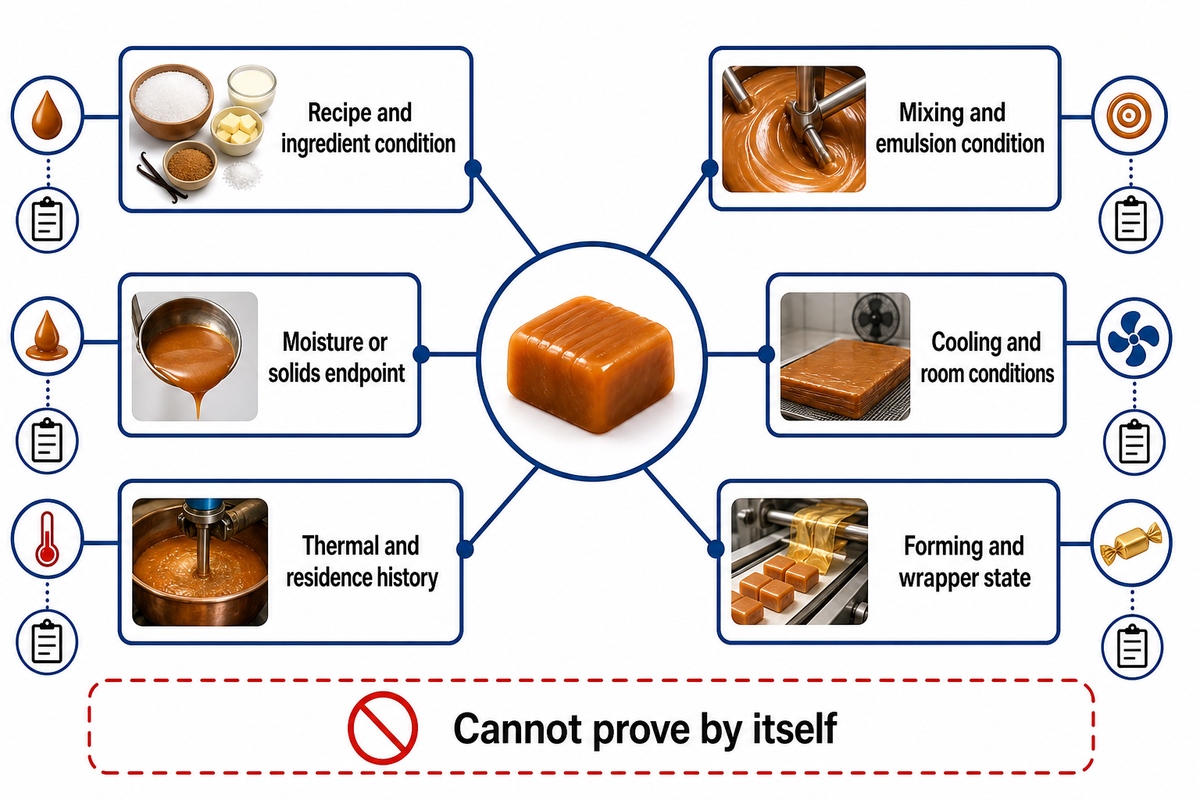
Relying on final product temperature is not sufficient because texture and handling emerge from interacting inputs. Consider the ingredient condition, final state of the batch, and environmental conditions to which the batch was exposed (e.g. time, temperature, pH), then compare them with the approved recipe, endpoint method, thermal and residence history, mixing, additions, cooling, room conditions, and forming state. State what the evidence does not prove, and give each variable an observable signal.
| Variable | Observable signal | Record | Cannot prove by itself |
|---|---|---|---|
| Recipe and ingredient condition | Identity, lot, physical condition | Revision, lot, staging check | Correct downstream processing |
| Moisture or solids endpoint | Approved method result at defined point | Method, sample, result, timing | Texture, safety, or shelf life alone |
| Thermal and residence history | Time and measured process history | Cook record and deviations | Which browning mechanism dominates |
| Mixing and emulsion condition | Uniformity, separation, flow response | Addition order, time, observation | Long-term stability without validation |
| Cooling and room conditions | Piece state, dimensions, release | Time, temperature, humidity as applicable | Earlier cook consistency |
| Forming and wrapper state | Weight, geometry, surface, infeed behavior | Samples, rejects, stops and restarts | A single upstream root cause |
Caramelization and Maillard browning aren’t interchangeable terms, and color doesn’t indicate which of the two pathways is prevalent. Various factors including product components, time, temperature, pH and others can impact the product and its quality. Chemical and nutritional concerns pertaining to the product should be assessed in the product-specific hazard and quality review, not as universal line settings.
Important boundary
A texture pass, water-activity result, or negative finished-product test is not automatically proof that a preventive control is validated. Product-quality acceptance and food-safety validation answer different questions.
How Do You Diagnose Crystallization, Sticking, Oiling Out, and Shape Loss?
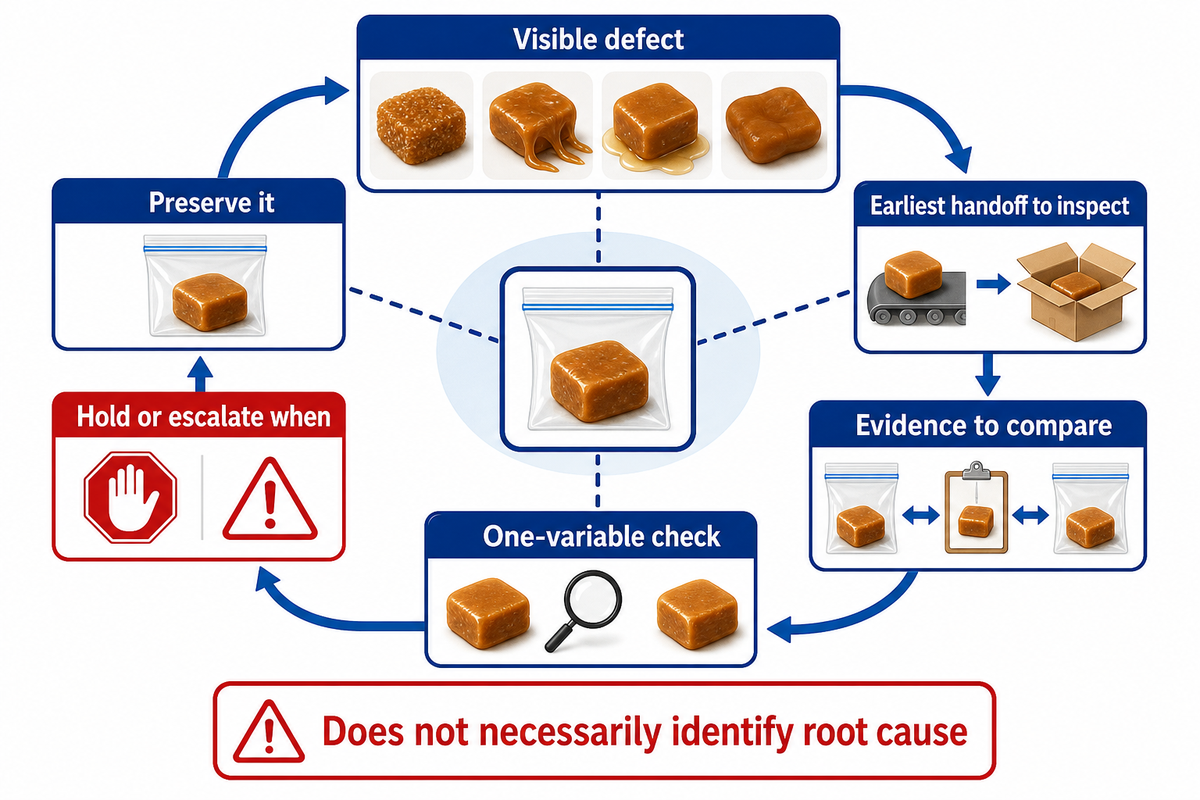
The observation of a visible defect does not necessarily identify root cause; it should limit the window during which the material is evaluated and narrow the earliest handoff to inspect. The failing material record shouldn’t be destroyed; preserve it, compare it with an accepted batch, and change one controlled variable at a time. If there’s uncertainty concerning the identity, safety, specification, or traceability of the material, the material should be held or escalated.
| Signature | Earliest handoff to inspect | Evidence to compare | One-variable check | Hold or escalate when |
|---|---|---|---|---|
| Grainy texture or crystallization | Staging, mixing, cook, or post-cook | Recipe, ingredient condition, sequence, endpoint, agitation | Repeat one approved condition while others stay fixed | Recipe, identity, or endpoint evidence is missing |
| Sticking or poor release | Cook, cooling, forming, or room exposure | Endpoint method, time, surface state, room conditions | Change one approved cooling or exposure condition | Product cannot be handled to specification |
| Oiling out or phase separation | Addition, mixing, or conditioning | Fat identity, order, time, mixing, thermal history | Verify one addition or mixing condition | Uniformity or ingredient control is uncertain |
| Too hard or too soft | Endpoint, cooling, or storage | Method result, thermal history, sample timing, room record | Recheck the approved endpoint method first | No valid acceptance criterion exists |
| Shape loss | Conditioning, forming, or cooling | Mass state, time, geometry, cooling record | Hold geometry and change one approved state variable | Pieces cannot meet dimensional acceptance |
| Inconsistent piece weight | Conditioning and forming | Flow state, feed, timing, sample sequence | Verify one feed or timing condition | Sampling shows uncontrolled drift |
| Wrapper release or accumulation | Cooling, inspection, and infeed | Surface, geometry, room exposure, stops | Change one approved infeed or exposure condition | Traceability is lost or product is damaged |
Why does caramel become grainy or oily?
Graininess can be associated with crystallization behavior, while visible oil can indicate loss of phase stability, but neither appearance proves one cause. Review formula revision, ingredient condition, addition order, mixing, endpoint evidence, thermal history, cooling, and sampling together before changing the recipe.
There’s supporting material state evidence that the interaction of formulation, water, and temperature influence the structure of a component. Plant investigation still has to bind the symptom to the actual batch record. A successful determination narrows the explanation but doesn’t validate every formula, production scale, or future run.
What Evidence Should QA Retain at Every Handoff?
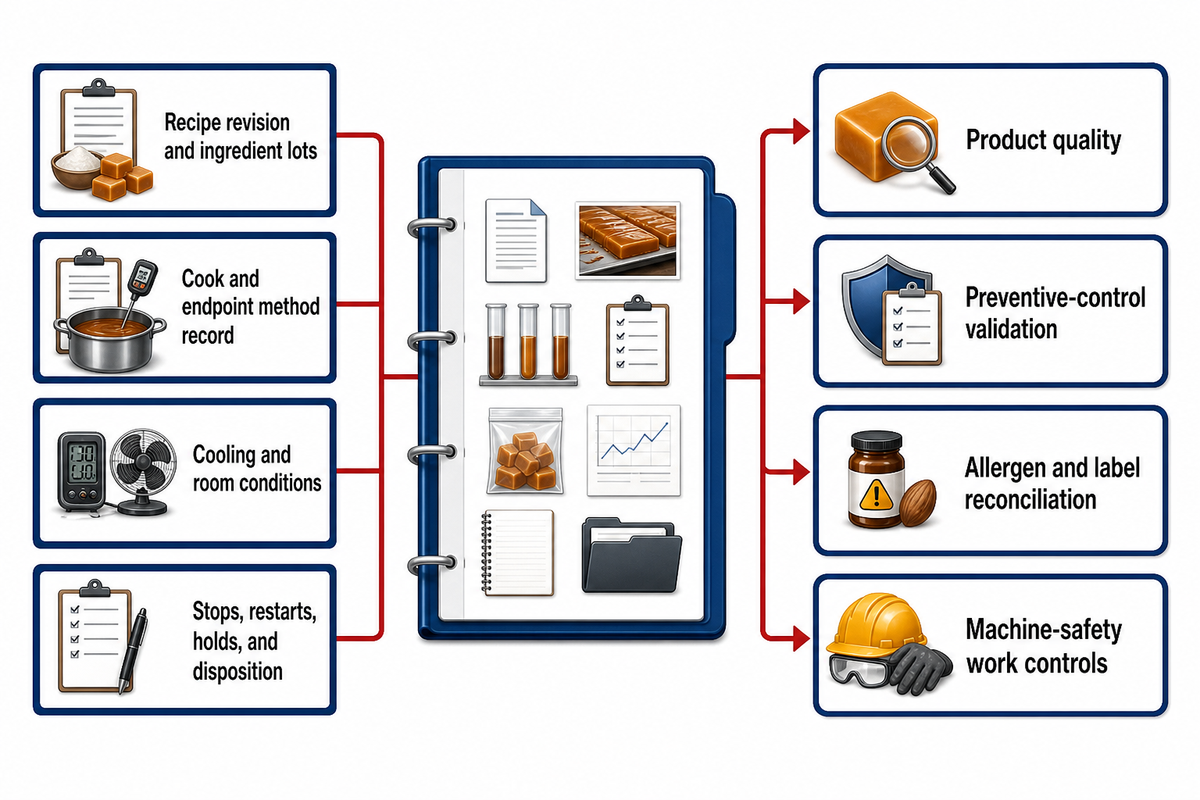
QA must have connected evidence to make batch comparisons without relying on memory or a finished-piece photograph. Evidence should rely on examination records and decision descriptions, while root-cause proof requires a supported investigation. The evidence package should distinguish records, acceptance criteria, and supported root-cause findings, even when a batch passes visual inspection.
Batch-to-Wrapper Evidence Pack
☐ Recipe revision and ingredient lots
☐ Raw-material identity and condition
☐ Addition order and dosing record
☐ Cook and endpoint method record
☐ Time and temperature history
☐ Post-cook additions and mixing
☐ Cooling and room conditions
☐ Piece weight and dimensions
☐ Reject codes and sampling plan
☐ Wrapper-infeed product state
☐ Stops, restarts, holds, and disposition
☐ Reviewer, time, and escalation owner
The evidence package should support four distinct decisions: product quality, preventive-control validation, allergen and label reconciliation, and machine-safety work controls. Evidence pertaining to one of these decisions may also pertain to the other decisions; however, the satisfaction of one of the decisions doesn’t imply the same for the others. Each SKU also needs agreed customer requirements and measurable product specifications.
How Should Food-Safety, Allergen, and Machine-Safety Responsibilities Be Assigned?
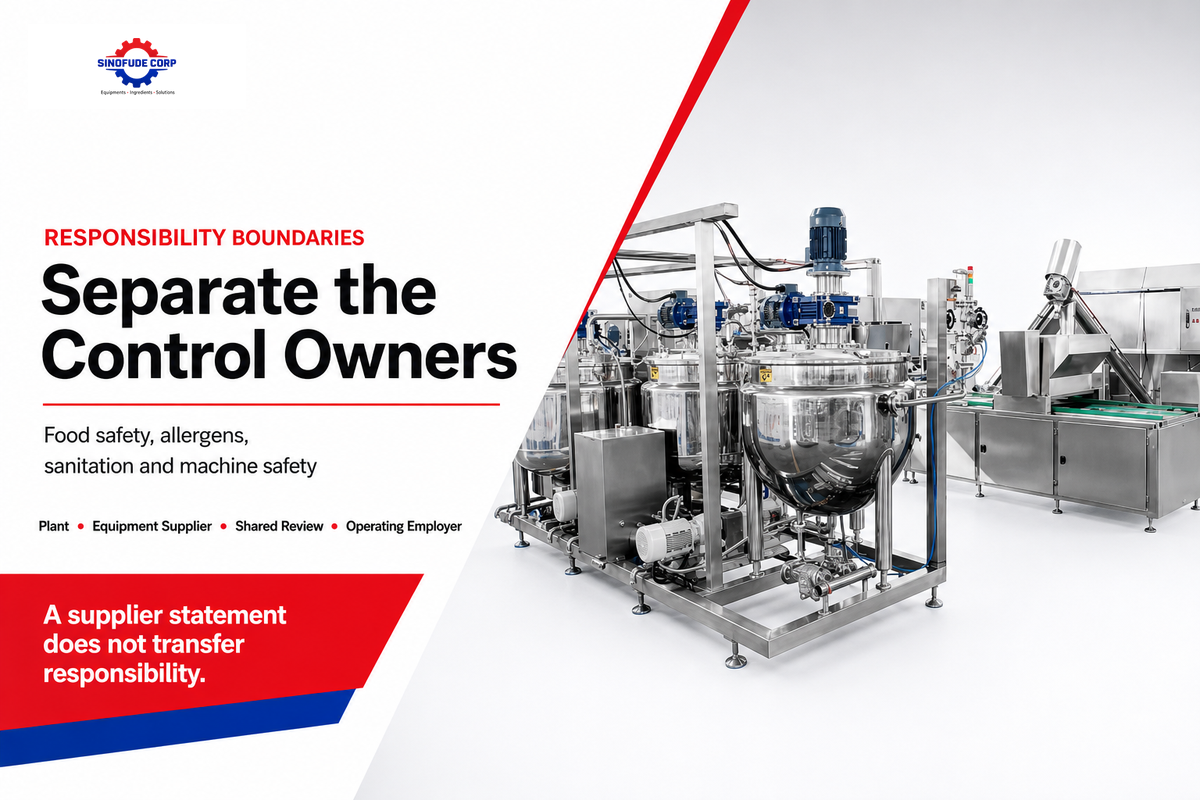
In a food manufacturing context, responsibilities should be separated by the control and operating context, not collapsed into a machine certificate or supplier statement. The design and modification of equipment may involve the equipment supplier and the food manufacturer, while the food manufacturer retains its food-safety system and the operating employer retains workplace procedures. Commercial labels such as supplier, manufacturer, distributor, factory audit, compliance, and logistics describe project roles or review activities; they do not transfer legal or operating responsibility.
| Control area | Plant / manufacturer | Equipment supplier input | Shared review |
|---|---|---|---|
| Hazard analysis and preventive controls | Define hazards, controls, validation, verification, records | Provide accurate equipment and process-boundary information | Confirm interfaces and required evidence |
| Allergen, rework, and labels | Ingredient identity, sequencing, cleaning, rework and reconciliation | Describe cleanability and product-contact boundaries | Review changeover access and records |
| Sanitation | Approve and verify procedures and frequencies | Provide cleaning instructions and design details | Test access, drainage, reassembly, and inspection |
| Guarding and access | Review installed use, tasks, people, and site interfaces | Provide designed safeguards and residual-risk information | Review forming, cutting, infeed, cleaning, and unjamming |
| Hazardous energy | Employer energy-control program, procedures, training, inspections | Energy-isolation information and equipment documentation | Verify maintenance and change-part tasks |
Under 21 CFR 117.136, reliance on a customer or later distribution-chain entity is conditional and documented; it is not a blanket transfer of responsibility. For low-moisture ready-to-eat foods within its stated scope, FDA’s draft, nonbinding sanitation guidance describes limits to relying solely on product testing within a wider sanitation and environmental-monitoring program. Those limitations must be evaluated for the actual product and facility on a case-by-case basis.
“The employer shall establish a program consisting of energy control procedures, employee training and periodic inspections.” OSHA 29 CFR 1910.147, shortened excerpt
OSHA 1910.212 and 1910.147 describe project-review requirements for safeguarding and hazardous-energy control, not certificates for a particular installation. They aren’t safeguarding certificates or energy-control certificates of compliance; hot mass, moving parts, cleaning, unjamming, and maintenance still need task-specific review. Hazardous-energy and safeguarding review should be documented for various use cases, and a product feature doesn’t exempt the employer from its documented program.
Use a Product Route Validation Card Before Discussing Equipment
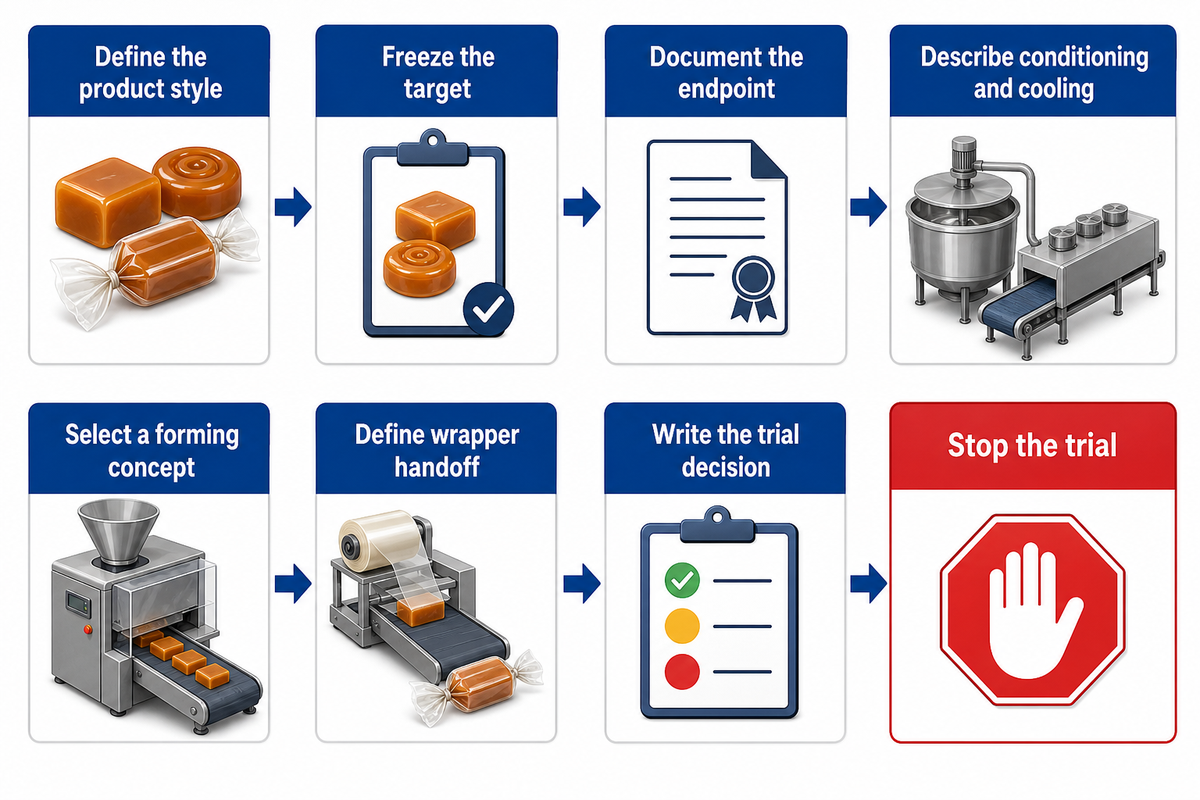
Products shouldn’t be discussed from the name alone; the equipment conversation needs a controlled product brief, route, evidence, and required output. Complete the Product Route Validation Card to define the route, evidence, and trial decisions first. Product Route Validation Cards shouldn’t be used as product selectors, quotation builders, or capacity calculators; they document the educational handoff.
- Define the product style: formula family, ingredient identities, allergens, and approved revision.
- Freeze the target: texture, piece geometry, weight, surface, and measurable acceptance language.
- Document the endpoint: method, sampling point, thermal history, and limits approved for the SKU.
- Describe conditioning and cooling: additions, mixing, flow state, time, and room conditions.
- Select a forming concept: depositing, sizing, cutting, or another route supported by the product state.
- Define wrapper handoff: piece condition, infeed behavior, accumulation, rejects, stops, and restarts.
- Write the trial decision: sample plan, acceptance criteria, owners, hold rules, and disposition.
Discussions should be discontinued if it can’t be documented that there’s control of the hazards of concern, allergen controls and label reconciliation. Undocumented controls may lead to unrestricted product or equipment changes, so stop the trial until an approved product specification, measurable endpoint, and reject definition are documented. Likewise, efficient, custom, cost-effective, premium, and high-quality are not measurable acceptance criteria, while manpower, productivity, output, scalability, market trends, and operational excellence need project-specific definitions before route improvements are evaluated.
Bring a Product Brief to SINOFUDE
SINOFUDE states that it has manufactured confectionery, chocolate, and bakery production equipment since its brand was founded in 1998. Send the approved product route, sample requirements, and trial acceptance questions for a project discussion; company history here is company-provided context, not independent performance proof.
Frequently Asked Questions
The following questions clarify the manufacturing boundaries associated with a product name. The answers to these questions contain the essential information required to brief a trial team on the validation and hazard analyses for the given product, with settings conditional on its formula and specification. They’re to be provided in a trial brief, but shouldn’t be constructed or substituted for validation, hazard analysis, installation review, or the commercial selection work owned by the existing solution Page.
What is the difference between caramel and toffee in manufacturing?
Answer
The manufacturing difference is defined by the approved formulation and required finished state rather than one universal cook temperature. Milk solids, fat, sugar system, endpoint method, browning, cooling, texture, geometry, and forming route can all alter the process. Name the SKU’s measurable acceptance criteria first, then validate the cooking, conditioning, cooling, and wrapper handoffs against those criteria.
Can the same line make both toffee and caramel?
Answer
A shared line may be technically possible for some validated product set, but the product name alone can’t establish compatibility. Compare formula and allergen handling, endpoint measurement, emulsion behavior, cooling state, forming geometry, cleanability, wrapper handoff, and changeover evidence. Representative trials must show that each intended SKU meets its own product, food-safety, and operating requirements before a shared route is accepted.
Why does caramel become grainy, sticky, or oily?
Answer
Those symptoms can emerge from different or interacting stages. Graininess may involve crystallization behavior; sticking can involve endpoint, cooling, surface, or room exposure; visible oil can point toward phase instability. Preserve the record, compare an accepted batch, inspect the earliest relevant handoff, and change one approved variable at a time. Appearance alone doesn’t prove the root cause.
Is toffee simply hard caramel?
Answer
Not as a reliable industrial specification. Product names vary, so formulation, texture, geometry, endpoint method, and acceptance criteria must define the route.
What information should be included in a product trial brief?
Answer
Include the approved formula revision, ingredient identities and allergens, raw-material condition, target texture, piece weight and geometry, endpoint method, sampling point, post-cook additions, intended cooling and forming concept, room conditions that matter, wrapper format and infeed state, and cleaning or changeover needs. Add a sample plan, measurable acceptance criteria, named reviewers, stop rules, deviation handling, and batch disposition. If capacity is later discussed, bind it to the validated SKU, geometry, route, and acceptance conditions rather than treating a nominal rate as a universal result.
Research Transparency
This guide synthesizes peer-reviewed food research, current U.S. regulations, FDA guidance clearly labeled as draft and nonbinding, OSHA standards, and a historical patent used only for process vocabulary. It contains no invented recipe, universal endpoint, production capacity, customer result, certification claim, price, MOQ, lead time, or performance guarantee.
References & Sources
These sources ground the material-state, process-record, food-safety, and machine-safety boundaries used in the guide. Source-specific findings remain attached to their scope, and older process documents aren’t treated as proof of present equipment performance. Product trials, customer specifications, and site reviews remain necessary for a production decision.
- Food caramels: a review
- Rheology and Microstructure of caramel Emulsion-filled Protein Gels
- Hard candy production and quality parameters review
- Hard-candy glass transition, stickiness, and crystallization study
- 21 CFR Part 117: Current Good Manufacturing Practice and Preventive Controls for Human Food
- 21 CFR 117.136 – Circumstances where a preventive control is not mandatory for an owner, operator, or agent
- FDA draft guidance on sanitation programs for low-moisture ready-to-eat foods
- OSHA 29 CFR 1910.212, General requirements for all machines
- OSHA 29 CFR 1910.147, Control of hazardous energy
- US3908032A, historical continuous process for producing soft candy