Get in Touch with SINOFUDE Company


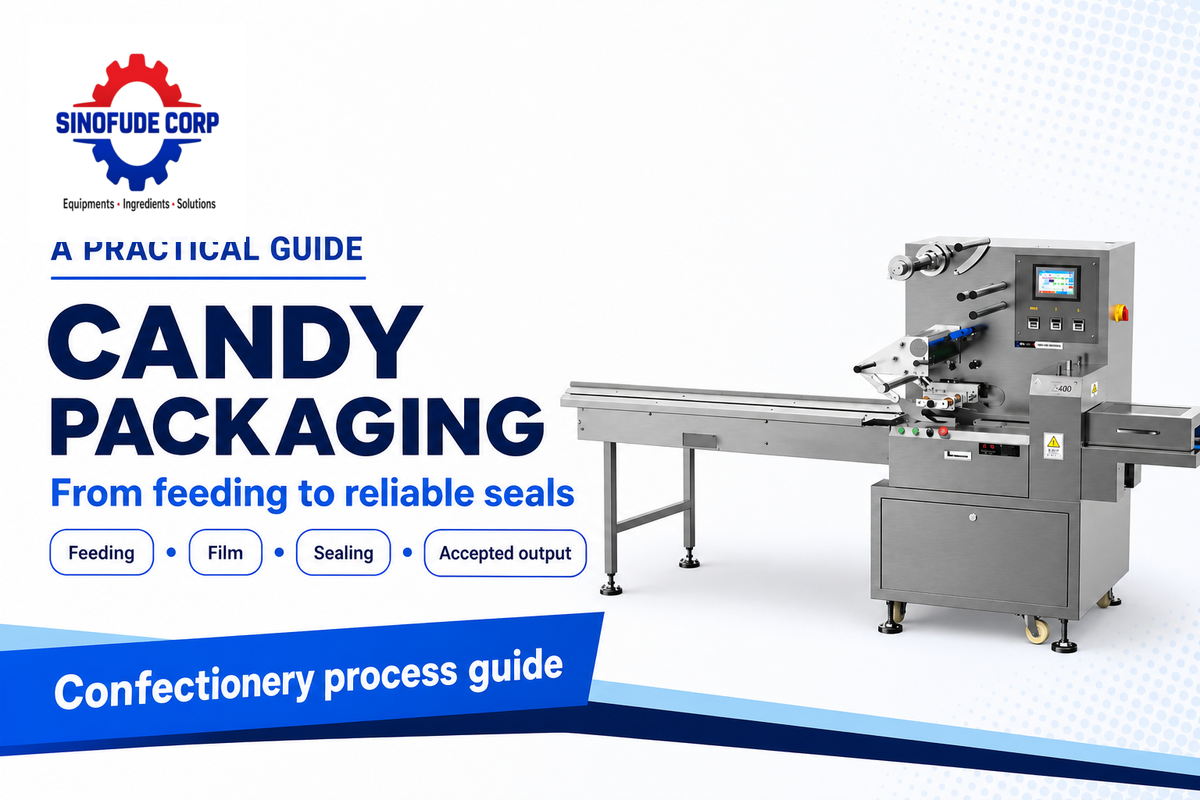
A candy packaging machine portions or presents sweets, brings packaging material around them, and closes the pack. How it forms the wrap depends on what arrives at the feeder: separate pieces, sticky clusters, a continuous rope or an already counted portion. A wrapper can run cleanly with one product and struggle with another that looks almost identical.
Understanding that sequence helps explain empty packs, trapped candy and seal failures. For equipment ranges and a project-specific proposal, see SINOFUDE’s candy packaging machine solutions. The operating principles below help you describe the problem prior to selecting a machine.
Updated October 2026
Process at a glance
Individual wraps: control each piece and its spacing. Multipiece bags: control the portion before closing the bag. Measure accepted packs per minute, with product condition and the inspection method recorded.
A candy packaging machine coordinates product feeding with wrapping or bag closing. Stable spacing and a suitable film matter as much as speed. Match the packaging method to the candy, then check the finished pack.
Key points
- A heavier bag doesn’t necessarily contain more pieces.
- A neat-looking seal can still fail during handling.
- Twist retention, seal strength and leak resistance describe different properties.
- Compare running cost using accepted packs, including stopped time and rejects.
How a Candy Packaging Machine Moves Product from Feed to Seal
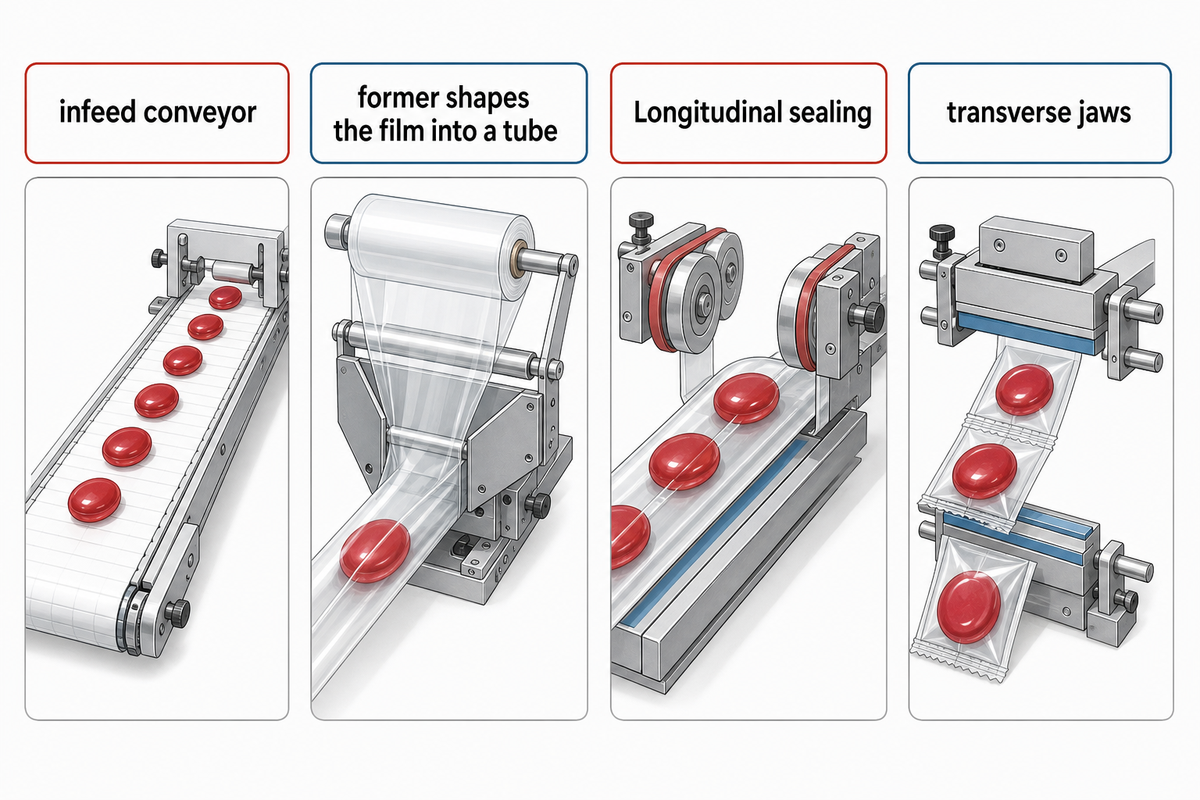
In an automatic candy wrapping line, the feed system presents products at a controlled pitch, film forms around them and the closing mechanism completes each package. All those movements must be synchronized. Poorly separated candy can reach a correctly timed sealing jaw in the wrong position, so a seal defect can begin well upstream.
How does a Candy Packer Machine Work?
A flow wrapper transports candy along an infeed conveyor while a former shapes the film into a tube. Longitudinal sealing closes the film overlap; transverse jaws separate successive packs and close the ends between products. Wrapping candies in a bag follows a different route: the machine forms or opens a bag, receives a measured portion, and then closes it. In a vertical form-fill-seal arrangement the vertical back seal closes the film tube prior to the transverse seals completing the bag.
Automatic feeding may use a hopper and a distribution system, belts or a dedicated feeder. Soft pieces should separate without stretching; a fragile shell needs support. PLC control coordinates movement and sensor signals. Print registration links the film’s printed mark to the cut position but can’t correct a wrong product spacing pattern by itself.
Common mistake: treating an empty pocket and a misplaced product as the same fault. The machine descriptions in Harpak-ULMA’s catalog distinguish a function that suppresses empty bags from protection for an incorrectly placed product. Neither of these functions should be deduced from the phrase “fully automatic”. Find out what the proposed control detects and what the machine does after detection.
At an illustrative 120 packs/min, one pack cycle takes 0.5 seconds. At 240 packs/min, one cycle takes 0.25 seconds. With the shorter pack cycle time, there’s even less opportunity for correcting a product arriving irregularly. Hence, for the same finished pack dimensions, a high-speed wrapper may require a different feeding arrangement from what’s typical.
Flow Wrapping, Twist Wrapping and Bagging: What Changes?
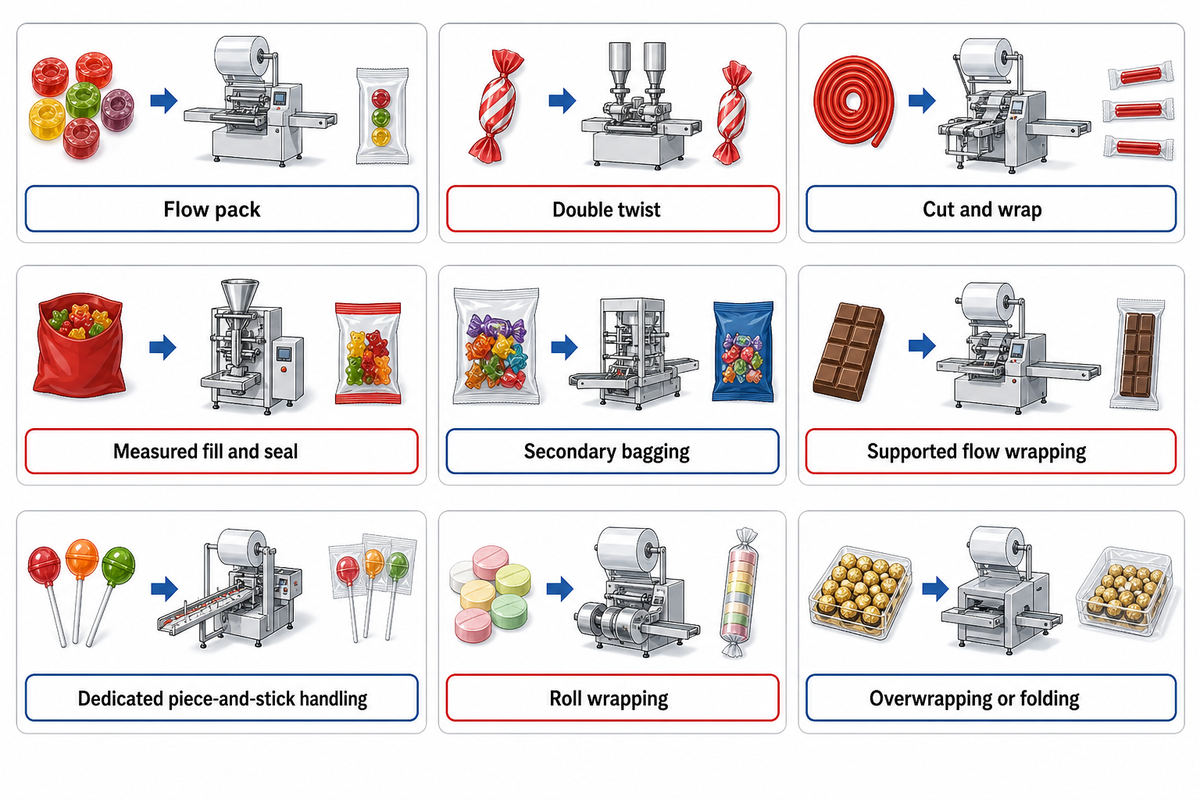
Flow wrapping closes a film tube around a product, twist wrapping holds the wrapper by twisting its ends, and bagging places a portion inside a larger container. The closure determines what has to be tested. Similar looking packs can be different in opening behavior and moisture and handling protection.
A horizontal packaging machine transports products along a horizontal path, for example, a flow pack machine. A pillow pack machine produces the familiar end-sealed pillow shape. Double twist wrapping, however, uses a different mechanism; therefore, changing film and guides doesn’t convert one machine to the other.
| Product or grouping | Packaging approach | What the mechanism controls | Limitations / Not suitable for |
|---|---|---|---|
| Separate hard candies | Flow pack | Piece spacing and sealed film enclosure | Loose pieces entering the end-seal zone |
| Candy with a twisted wrapper | Double twist | Wrapper length and retained end twists | Assuming a twist is a hermetic seal |
| Continuous soft candy rope | Cut and wrap | Piece cutting followed by wrapping | Product too soft to retain the intended shape |
| Loose gummies in a pouch | Measured fill and seal | Portion discharge and bag-mouth clearance | Clusters that prevent repeatable portioning |
| Wrapped sweets in an outer bag | Secondary bagging | Grouping or weighing already wrapped pieces | Counting outer bags as individual candy output |
| Chocolate bars | Supported flow wrapping | Surface protection and transfer alignment | Soft coating that marks on guides |
| Lollipops | Dedicated piece-and-stick handling | Stick orientation and wrapper position | Unsupported claims that every feeder handles sticks |
| Grouped tablet-shaped sweets | Roll wrapping | Group formation and wrapping around the stack | Irregular pieces that cannot form the intended group |
| An already formed pack or tray | Overwrapping or folding | Outer presentation and closure | Replacing a required primary barrier without testing |
Process categories are an editorial synthesis, not a model compatibility chart. The Central Food Technological Research Institute’s confectionery-packaging abstract lists twist retention and seal effectiveness as separate properties.
For twist candy, the film has to hold the intended twist after release. For heat-sealed packs, the sealing surfaces have to bond under the available conditions. Candy overwrapping may add presentation or grouping outside an existing wrap. None of those descriptions establish shelf life. Confectionery manufacturers need the completed pack evaluated against the product’s storage and distribution requirements.
Weighing and Counting Solve Different Problems
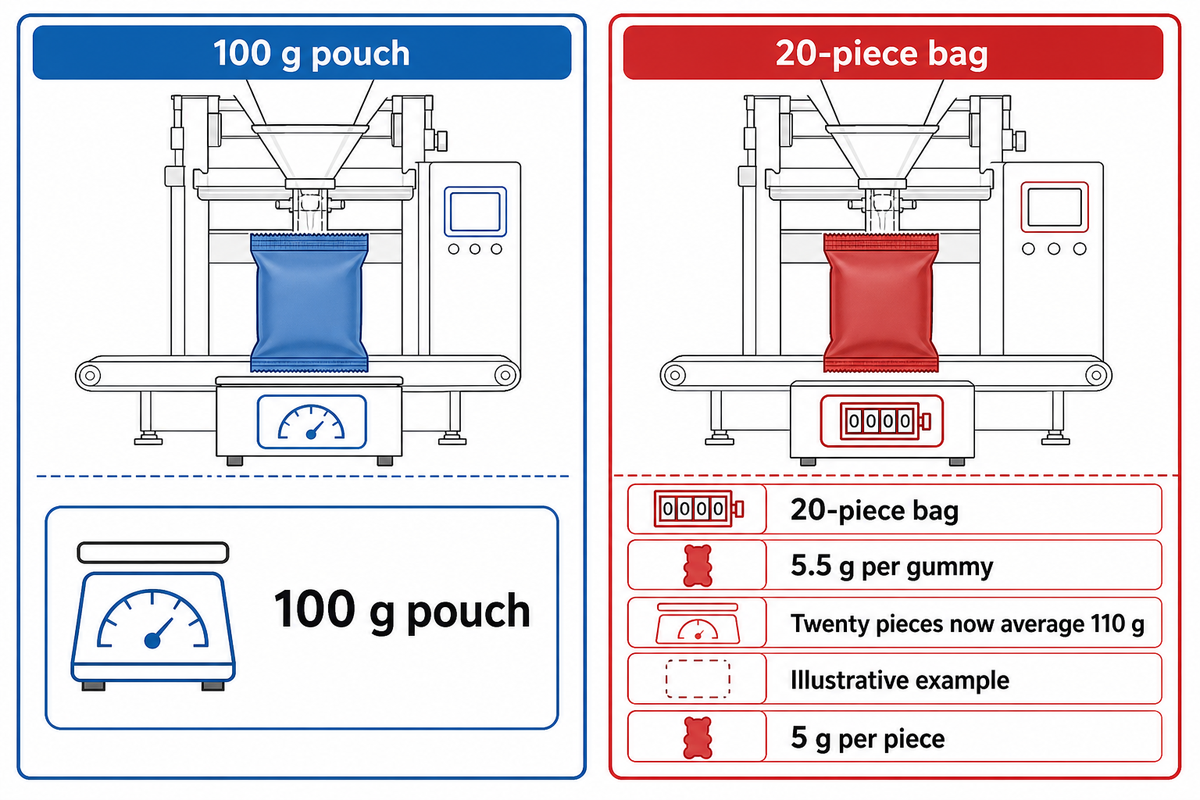
Mass can be measured and delivered to a pack, or pieces counted and delivered to a pack. Either can feed a bag or other container. A candy packing machine should therefore be described by both its measuring and packaging method. The container shape doesn’t reveal what quantity is controlled.
The 2026 NIST Handbook 133 index separates the procedures for packages labeled by weight from packages labeled by count. A combination weigher selects a mass toward a target. A counting system detects units. Some lines combine measurements, but a weight reading alone can’t prove an exact count when pieces vary in mass.
Let’s say a gummy producer makes a 100 g pouch and a 20-piece bag. Assuming each gummy is about 5 g, they both seem to contain the same amount. But what if the average changes to 5.5 g per gummy? Twenty pieces now average 110 g, while a 100 g weight target no longer corresponds neatly to 20 pieces. The plant manager wants to control steady filling, the finance staff sees an extra giveaway, and the quality staff must judge the label printed on the pack. In this case, the right approach would be to separate the two targets, verify how the line measures each target, and evaluate results for the product batch being reviewed. Avoid adjusting only the single nominal setting.
NIST’s net-content guidance makes a similar distinction between average and individual requirements in the U.S. framework. Meeting a batch average doesn’t excuse unreasonable individual shortages. Use the market rules and product-specific sampling; this guide doesn’t provide legal limits.
A 100 g mass target and a 20-piece count target address different requirements. Record both when both matter, with the candy batch identified. The word “automatic” describes how the work is performed. It doesn’t set the quantity claim that the finished pack must fulfill.
Match Candy Condition to the Packaging Film
Packaging film must be compatible with the candy surface, barrier, and closing method. There are different limits for handling the product. A film that releases cleanly from the sweet may still form a poor seal, and a strong seal may not afford adequate moisture barrier protection.
Soft candy may deform and cling to the wrapper, and hard candies may be sensitive to moisture uptake. Loose sugar can enter the sealing area. A chocolate ball may roll during transfer; a lollipop adds a projecting stick. These may affect the feed stream prior to becoming a film selection issue. Consider upstream root causes along with the hard candy defects and their causes.
Polypropylene, cellophane and aluminum foil pertain to different material families and shouldn’t be substituted for sealing specifications. Coatings and layer construction determine what surfaces can bond. Ask for the film structure, sealing side and the supplier’s trial conditions. A biscuit and a candy bar may use similar flow wrap machines, but that doesn’t mean they have identical jaw settings or limits.
What if a small caramel team trials an automatic packaging machine with pieces held overnight in a cool sample room? During production, freshly cut candy reaches the feeder sooner and sticks to the guides. The operator sees distorted packs and requests a different film. Film release may contribute to the problem, but the production conditions have changed together with the sample conditions. A more useful comparison is the condition of the candy at transfer, the time since it was cut, the film batch and the extent of deformation, if any. Retaining matched samples helps the team distinguish a wrapping-material problem from one created before the wrapper. Buying a faster machine may still result in distorted pieces.
The Institute of Food Technologists’ review of sweet packaging describes how a paper-based bar package required changes to forming and downstream handling. The lesson is practical: test the complete product and film combination. You can’t accept “runs paper” or “handles chocolate” in lieu of testing your product under representative conditions.
Trace Seal Failures Before Changing the Temperature
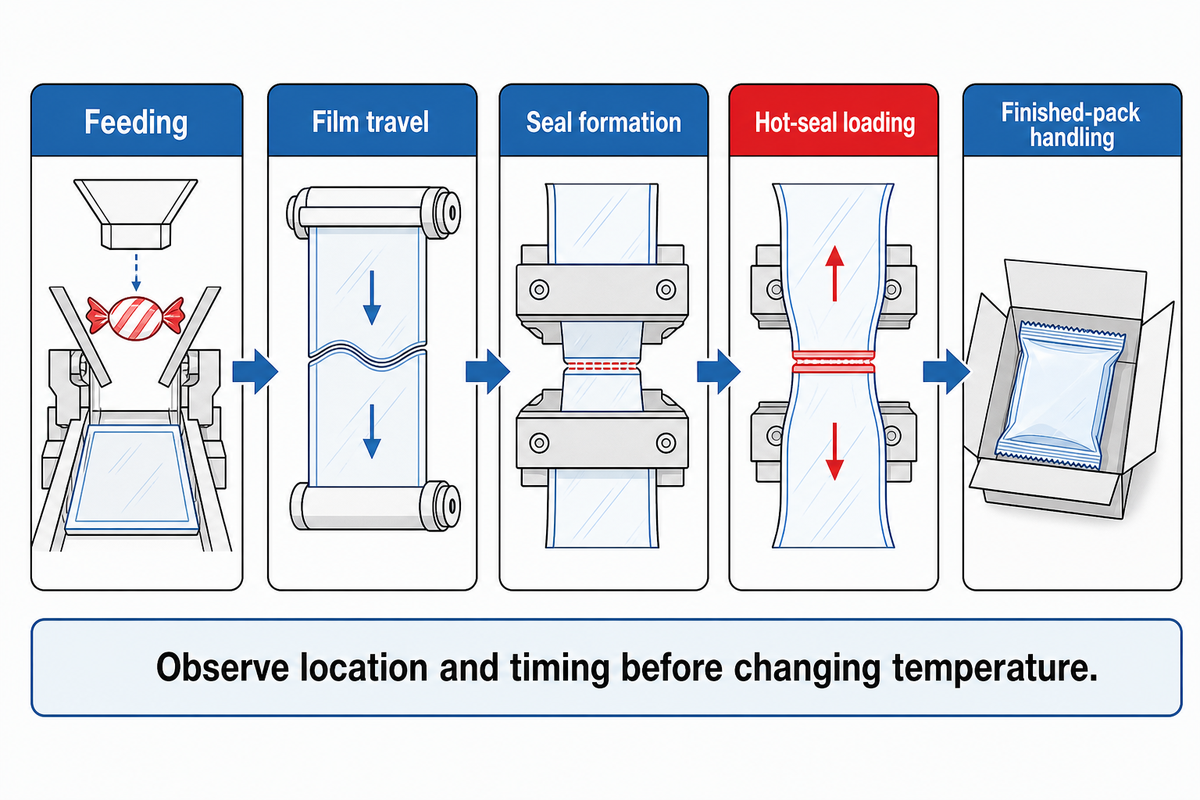
Seal failures should be traced by location and timing before changing the temperature. A product caught between the jaws, a wrinkle, inadequate heat transfer, and loading a hot seal can create different failure paths. Keep defective packs, and record when the defect first became evident.
5-Point Seal Fault Trace
The 5-Point Seal Fault Trace separates feeding, film travel, seal formation, hot seal loading and finished-pack handling before making a controlled adjustment.
| Observation | Stage to inspect | Evidence to compare | Limitations / Not suitable for |
|---|---|---|---|
| Candy trapped in an end seal | Feeding | Piece spacing and position before the jaw | Temperature changes cannot move the trapped candy |
| An empty finished pack | Feeding | Empty-pocket events and enabled controls | Does not prove a film or sealing fault |
| Print-to-cut position wanders | Film travel | Registration marks and film tracking | Printed appearance alone does not establish seal integrity |
| A wrinkle crosses the seal | Film travel | Film path and fold position | More heat may leave the wrinkle channel unresolved |
| A localized weak patch | Seal formation | Residue, contact pattern and jaw condition | Visible residue alone is not a proven root cause |
| Weakness along most of the seal | Seal formation | Material identity, contact time and settings | No universal temperature can be specified here |
| Split or distorted film near a jaw | Seal formation | Thermal and pressure conditions against the approved setup | Increasing pressure can worsen damage |
| Seal opens soon after release | Hot-seal loading | Delay to loading and support during discharge | A cooled-strip test does not reproduce the hot interval |
| Pack fails later in a case | Finished-pack handling | Failure location, handling and relevant package tests | A visually neat seal is insufficient evidence |
Use this as an observation map, not a diagnosis certificate. Greener’s technical guidance details heat, pressure and dwell time. A 2023 University of Twente study abstract states that folds and layer transitions changed the sealing conditions of the tested multilayer films. Its laboratory settings shouldn’t be transferred to an unrelated candy film.
“This test method measures the force required to separate a test strip of material containing the seal.”
Common failure modes that a hotter jaw will not fix
Candy in the path of the jaws prevents good film-to-film contact and can’t be relieved by increasing temperature. Wrinkles in film can also create localized paths through otherwise bonded areas. Therefore, it’s better to assess where a fault begins in horizontal seals rather than evaluating their appearance from afar.
Another failure begins after the jaws open. ASTM F1921’s public guidance on hot tack explains a seal can break under disruptive forces while still hot. A later pull test on a cooled strip covers a different condition. Neither test, by itself, shows that a complete package is leak-free.
For a proposed speed increase from 120 to 150 packs/min, retain samples from both settings and observe the first point of failure. Record film lot number, product condition and any changes made to the system. If the failure mode follows feeding position, investigate that path prior to replacing the film. If the failure mode follows discharge loading, examine support and timing. Adjustments and inspection inside machinery must be performed in accordance with the manufacturer’s procedures for isolation and maintenance.
Find the Hidden Bottleneck Between Cooling and Packing
The speed of a packaging line is determined by the slowest usable handoff (i.e. cooling, separation or downstream product handling). Analyze each step over the same period and express their output in the same unit of packs. A machine’s maximum speed can’t compensate for product that arrives too slowly, or in an unsuitable condition.
Can you Integrate a Candy Packer with a Candy Making Machine?
A candy packer can connect to a candy making machine when product discharge, transfer and packaging cycles are compatible. Candy depositing creates pieces, but release, cooling and separation may be needed before those pieces can be wrapped. Integration also requires coordinated stops and a defined response to accumulating product.
SINOFUDE’s public chocolate cooling tunnel guidance treats recipe, coating thickness, room conditions and discharge condition as connected inputs. That’s a chocolate specific example and not a universal cooling temperature for gum or gummies. The hard candy manufacturing process has its own upstream conditions.
3-Station Candy Handoff Map
The 3-Station Candy Handoff Map compares usable product release, correct presentation and accepted pack discharge to locate a hidden bottleneck.
| Station | Illustrative observation | What to investigate |
|---|---|---|
| Cooling release | 120 usable pieces/min | Product condition at transfer; unsuitable pieces excluded |
| Separation and presentation | 100 correctly presented pieces/min | Where pieces accumulate or lose orientation |
| Pack discharge | Wrapper setting: 150 packs/min | Accepted output, empty cycles and downstream stops |
Measure all three stations during a shared 10-minute window, then repeat under representative running conditions. For the example above, 120 pieces/min can’t become 150 single-piece packs/min without another product source. If the feeder presents only 100 pieces/min, increasing the wrapper setting leaves the first two constraints intact.
Other constraints may apply. Small batches add another limit: time spent loading, changing product and clearing the line. An automatic horizontal wrapper with manual feeding may be sufficient for a moderate level of demand, but its sustained rate depends on the task. Assessing enclosure and transfers as part of the machinery layout, one shouldn’t presume that automation removes all operator activities.
Turn Rejects into a Measurable Running Cost
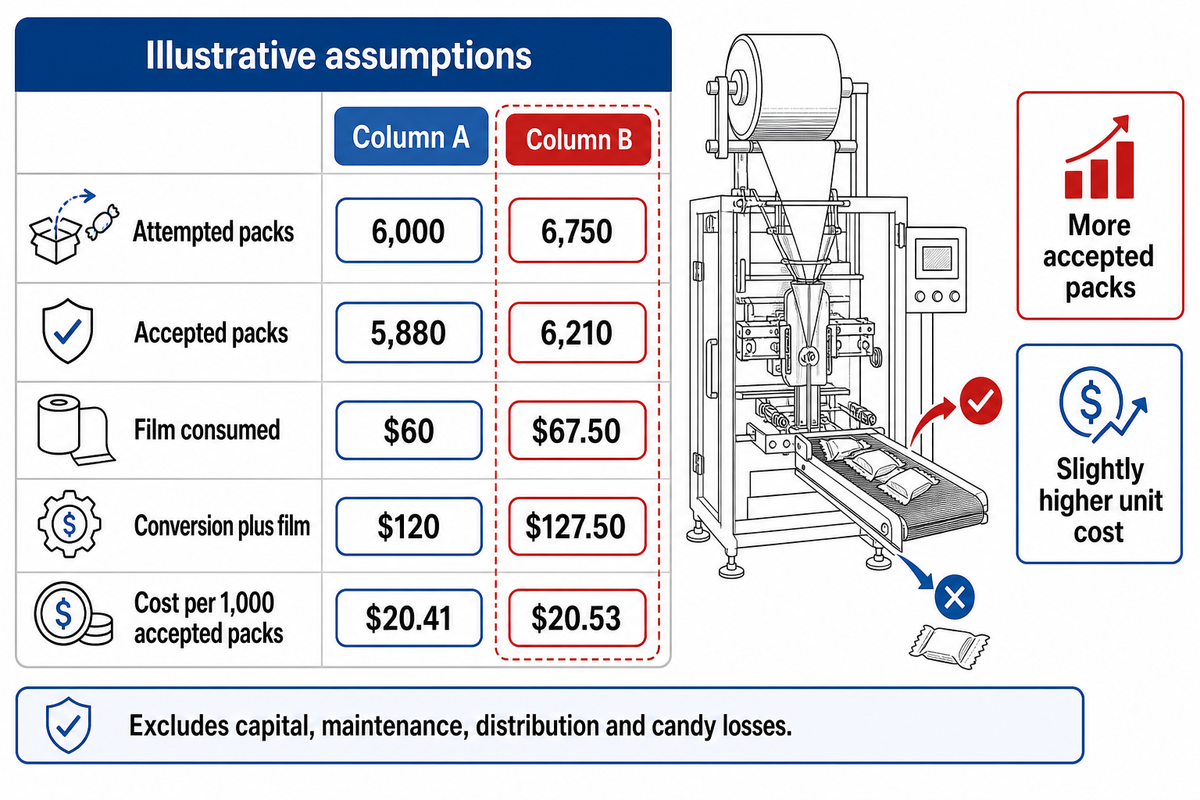
Cost should be based on accepted packs rather than machine cycles. Include stopped time and the film consumed by rejected packs. A speed increase would be useful only if the increase in accepted output exceeds the increase in waste and operating cost for comparable product and inspection conditions.
Reject-to-Cost Speed Check
The Reject-to-Cost Speed Check compares conversion and film cost per 1,000 accepted packs before and after a change in speed.
Assume a packaging supervisor compares two settings during a 60-minute period. Setting A runs at 120 packs/min for 50 minutes and rejects 2% of packs. Setting B runs at 150 packs/min for 45 minutes and rejects 8%. Finance assigns the same $60 conversion cost to each period, excluding film, and assumes $0.01 of film per attempted pack. The faster setting makes more accepted packs, but it also consumes more film and loses more production time. Quality staff first define acceptance to include the relevant quantity and package checks. Without that shared definition, the supervisor and finance team could compare different outputs while using the same word “good.”
| Measure | Setting A | Setting B |
|---|---|---|
| Attempted packs | 120 × 50 = 6,000 | 150 × 45 = 6,750 |
| Accepted packs | 6,000 × 0.98 = 5,880 | 6,750 × 0.92 = 6,210 |
| Film consumed | 6,000 × $0.01 = $60 | 6,750 × $0.01 = $67.50 |
| Conversion plus film | $60 + $60 = $120 | $60 + $67.50 = $127.50 |
| Cost per 1,000 accepted packs | $120 ÷ 5,880 × 1,000 = $20.41 | $127.50 ÷ 6,210 × 1,000 = $20.53 |
Even though accepted output increased by 330 packs, unit cost increased slightly. The value of candy rejects would also add an increased cost if it can’t be recovered. This example doesn’t consider capital and maintenance costs and distribution costs; this example isn’t a quotation or a complete investment-return model.
Use your own period costs and product losses in the cost per 1,000 good packs calculator. Keep the observation period and product constant when comparing settings. A 30 packs/min increase on the display is insufficient evidence for buying capacity if rejects and stopped time haven’t been measured.
Prepare Product and Film Samples for a Useful Supplier Conversation
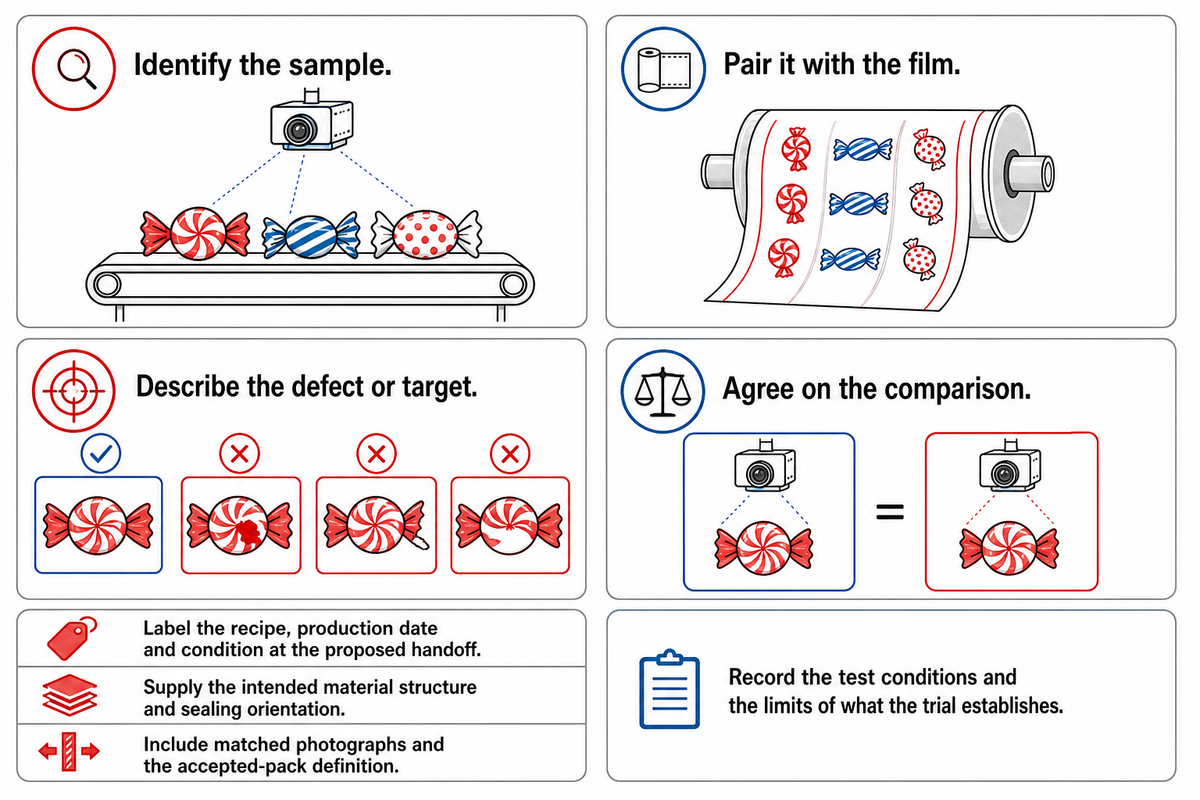
Replicate the product condition and the packaging material that the machine may encounter. Send more than the best-looking pieces. Variation in size should be included as well. Explain coating, stickiness and handling history. A supplier can discuss the feeder, wrapping process and cleaning method against a defined product instead of a category.
Provide dimensions in mm, individual mass in g and required accepted output in packs/min. State the desired pack length and film used. If a production line deposits candy at a stated kg/h, explain mass and pieces/pack and translate that to a wrapping requirement.
- Identify the sample. Label the recipe, production date and condition at the proposed handoff.
- Pair it with the film. Supply the intended material structure and sealing orientation.
- Describe the defect or target. Include matched photographs and the accepted-pack definition.
- Agree on the comparison. Record the test conditions and the limits of what the trial establishes.
Cleaning access belongs in that conversation. For US operations subject to 21 CFR 117.40, equipment must permit appropriate cleaning and sanitary maintenance, including protection against allergen cross-contact. A change between milk-containing chocolate and another sweet raises different cleaning questions compared to changing only the wrapper print.
Photographs don’t prove cleanability within a feeder or behind a guard. Request the intended cleaning procedure and identify removable contact parts. For a 100 g pouch and a 20-piece pack send both specifications even if the average mass is similar; one sample doesn’t prove both measuring tasks.
New Packaging Materials Change the Trial, Not the Basics
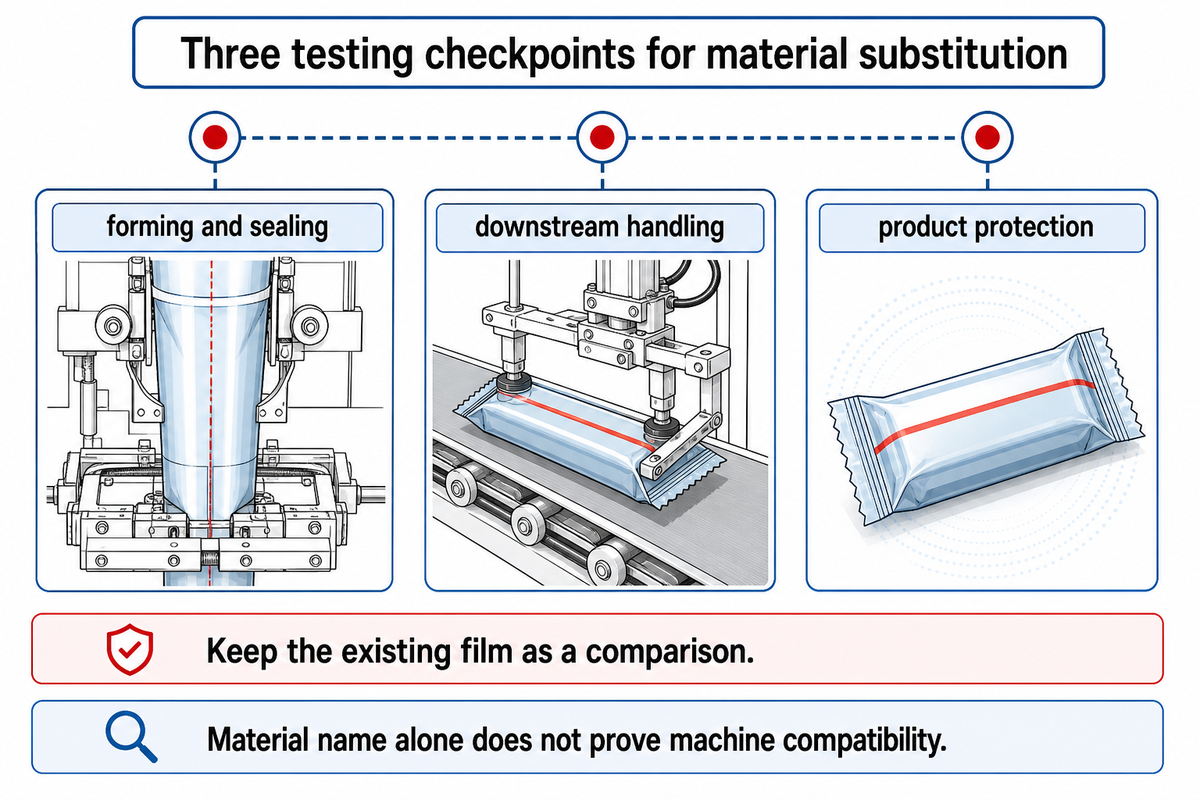
New types of packaging material require new tests because a material substitution can affect forming and sealing, and downstream handling together. Paper-based or mono-material construction alone does not establish compatibility with an existing wrapper. Keep the product protection requirement fixed while testing changes to the process.
In its July 2026 release on sustainability and equipment requirements, the PMMI cites package-material choices as an equipment issue for both packaging and processing. For the confectionery industry, that broad finding supports renewed trials; it does not supply a candy-specific growth rate or prove that a particular replacement film will run on a particular machine.
Research is also shifting beyond conventional films. North Carolina State University’s September 2026 report describes research into the use of plasma treatment of plant-based packaging and identifies barriers to commercial use. Different treatments resulted in varied moisture responses. Work should be treated as a research initiative as opposed to a commercially validated substitute for every confectionery wrapper.
The packaging material must be tested through the whole flow pack packaging machine. A film that successfully forms a tube may behave differently at the jaw overlap. A paper structure that’s able to withstand wrapping may tear during subsequent handling. Twist wrappers introduce another test: retention after the twisted ends are released. Changing the name of the material on a specification can’t answer those questions.
For a planned 2026 material change, retain the existing film as a comparison and agree on the required barrier and package tests before the trial. Record accepted packs over the same 60-minute period, including stops and waste, rather than choosing the best short burst from each run. Use representative candy batches. Observe finished packages after they’ve been subjected to the conditions of use relevant to the product.
Potential purchasers should ask which adjustments relate to the film, which to feeding and which relate to mechanical changes. If the material is unable to satisfy the product’s storage requirement, successful wrapping speed isn’t enough. SINOFUDE can discuss process requirements and the intended candy and pack; the trial should define the limits to the resulting recommendations.
Frequently Asked Questions
Are there Multifunctional Candy Packer Machines?
Multifunctional candy packers handle a defined range of products and formats after specified changes.
A machine may handle several piece sizes or pack lengths after changing guides, tooling and settings. That does not mean a flow wrapper can become a double-twist wrapper or bottle counter. Compare the proposed formats, feeding method, film specification and change parts with the products. Ask what must change between them, and assess the changeover work before treating versatility as a production benefit.
How does a Candy Packer compare to a Chocolate Wrapping Machine?
Candy packers and a chocolate packaging machine can share wrapping principles, but chocolate imposes its own handling limits.
A chocolate bar, coated candy and chocolate ball do not present the same shape or surface as hard drops or gummies. Temperature, surface marking and product support can change what the feeder and wrapping section must do. Start with the product condition and required pack, then compare equipment intended for that combination rather than relying on the machine’s category name alone.
What Candy Packer Specification should I look for when investing in a new Machine?
Read the candy packer specification against product variation, packaging material, quantity target and required accepted output.
Then examine the feeding arrangement, change parts, utilities, access for cleaning and interfaces with existing equipment. A maximum speed alone does not establish the output you will obtain with your candy. Use representative samples and a defined test scope to resolve the gaps. Record which product and film were tested, the conditions used and the inspection method before comparing the results with another proposal.
Is a Roll Wrapping Machine Similar to an Overwrapping Machine?
Roll wrapping and overwrapping describe different packaging operations.
Roll wrapping may assemble pieces into a roll-shaped pack; overwrapping usually covers an already formed product or group. Compare the finished package and machine cycle because supplier terminology varies.
What are the Benefits of a CIP Online Cleaning System in a Candy Packer Machine?
A candy packer should not be assumed to include a clean-in-place system or permit washdown.
Product-contact surfaces, the feeder, electrical protection and the intended cleaning method differ between machines. Some equipment permits removal of parts for cleaning; other designs support specified washing procedures. Water or cleaning chemicals used outside the manufacturer’s procedure can damage equipment or leave an unsuitable condition for the next batch. Ask for the documented cleaning method, the parts that must be removed, the isolation steps and the checks before restart. If a supplier offers automatic cleaning, clarify which surfaces it reaches and how residues and drying are checked. Treat cleaning-in-place as a defined feature, not a universal capability of candy packaging machinery.
Key takeaway
Compare candy packaging performance in accepted packs over the same measured period. Feeding condition, closure quality and stopped time determine how much of the displayed speed becomes usable output.
Discuss your candy and packaging requirement
Prepare representative candy, the intended film and your accepted-output target. SINOFUDE’s packaging solutions team can use those inputs to discuss the relevant equipment and process interfaces.
Technical scope: The information in this guide integrates publicly available technical information with SINOFUDE’s published process information. Illustrative calculations of timing, throughput and cost shouldn’t be construed as plant test results. Behavior of materials, legal requirements and particular features of equipment used should be examined for the intended use.
References & Sources
- Confectionery packaging research abstract, Central Food Technological Research Institute, K. R. Kumar, 1992.
- NIST Handbook 133, Current Edition, National Institute of Standards and Technology, 2026 chapter index.
- Net Contents of Packaged Goods FAQs, National Institute of Standards and Technology, updated August 2026.
- Packaging for Sweet Treats, Institute of Food Technologists, 2020.
- Research abstract on pressure, temperature and seal integrity, University of Twente, Ilhan, ten Klooster and Gibson, 2023.
- ASTM F88/F88M-23, public scope, ASTM International.
- ASTM F1921/F1921M-12(2023), public scope and significance, ASTM International.
- 21 CFR 117.40, Equipment and utensils, US Food and Drug Administration regulation, eCFR.
- Sustainability and packaging-equipment requirements, PMMI, July 2026.
- Plasma technology and plant-based packaging research, North Carolina State University, September 2026.