Get in Touch with SINOFUDE Company


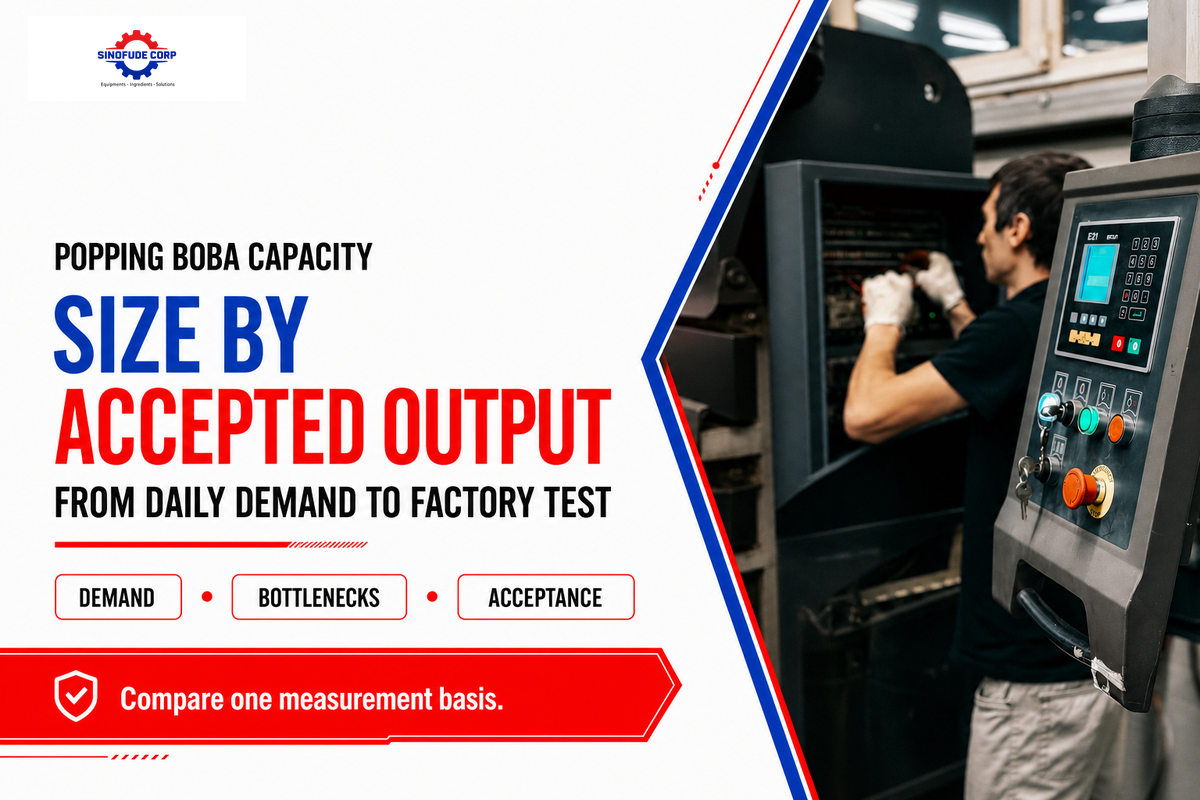
Updated October 2026 · Capacity planning and factory-test guide
Popping boba machines are comparable by capacity only when every supplier measures the same product, at the same point, over the same period, whether a quotation calls the setup a popping juice ball making machine or uses another supplier label. A headline rate can describe a depositor running briefly, while your purchase decision depends on accepted beads that have completed separation, inspection, filling, and any agreed hold test.
This handbook turns daily customer demand into a defensible rated-output requirement. It also shows where line bottlenecks hide, how changeovers alter useful capacity, when parallel modules help, and what evidence belongs in the quotation and factory acceptance record.
Six sizing checks: daily demand, measurement basis, supplier normalization, linked-stage bottlenecks, changeover losses, and factory-test evidence.
Industrial buyers may supply bubble tea, milk tea, and fruit tea programs where popping boba is sold as a topping, while a label such as standard popping boba still leaves the capacity basis undefined. Recipes may start with fruit juice or a tea base, but this guide measures machine capacity rather than consumer formulation.
Popping boba machine capacity should be stated as accepted product per net production hour. Compare kg/h after matching the product condition, line boundary, run window, stop treatment and quality rule. Size from daily accepted demand, then verify the full line in a witnessed run.
Quick capacity brief
- Start with accepted kilograms per production day and not a supplier model number.
- Keep availability, running-rate performance, accepted yield, and growth headroom separate.
- Normalize bead size, recipe, active heads, included liquid, downstream boundary and elapsed time.
- Witness stable output, stops, rejected mass, post-formation hold, and final acceptance.
The short answer
- A 100 kg/h claim doesn’t say whether the number covers drained beads, product in covering liquid or packed product.
- The slowest demonstrated linked stage sets the line ceiling.
- Two smaller modules add resilience only when shared tanks, utilities and controls, labor and packing don’t create one failure point.
- Purchase order and acceptance test need one output basis and one pass rule.
What Capacity Actually Means for a Popping Boba Machine
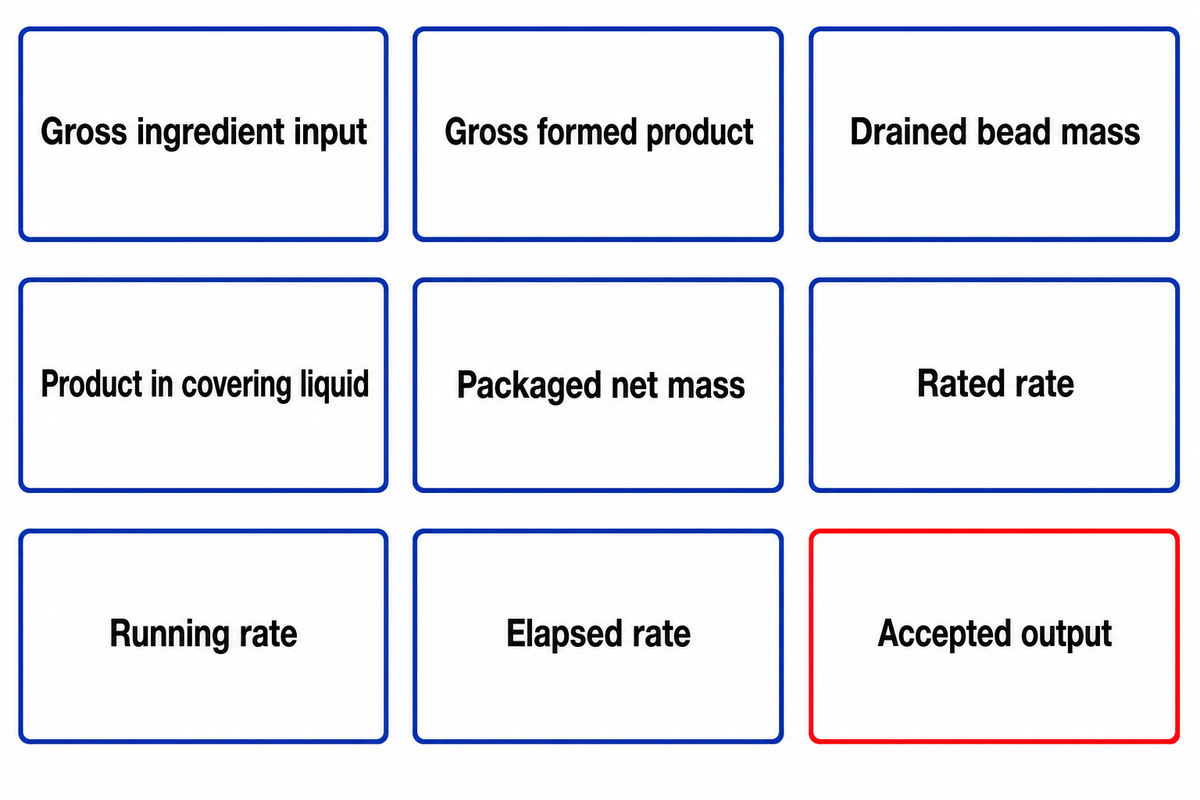
Whether a supplier calls the unit a popping boba maker or automatic popping boba equipment, popping boba machine capacity is a rate with five boundaries: product condition, supplied equipment scope, measurement point, time basis and acceptance rule. Without those boundaries, two values labeled kg/h can measure different things. One can count fresh beads at the depositor; another can count saleable packed product after quality checks.
Procurement teams assessing a commercial popping boba making machine should read its test boundary before its headline rate.
Automated spherification can link mixing, metered additions, nozzle dispensing, and a gelling bath. The cited patent explains that process path, but it does not publish a commercial accepted-output benchmark. A process description states what happens; a capacity contract states what mass is counted and when it becomes acceptable.
Bursting boba is another name used for the gel-membrane product. Popping boba pearls still need a written mass basis because bead count, drained mass, and packaged net mass answer different capacity questions.
| Capacity basis | What gets counted | Measurement point | Limitation / not suitable for |
|---|---|---|---|
| Gross ingredient input | Prepared liquid entering the supplied scope | Feed vessel or metering point | Does not deduct bath loss, rejects, or residue |
| Gross formed product | All beads leaving formation | Before separation or inspection | Includes nonconforming beads |
| Drained bead mass | Beads after a defined drain method | Post-separation scale | Changes with drain time and retained liquid |
| Product in covering liquid | Beads plus the specified medium | Blend or filling stage | Cannot be compared with drained mass |
| Packaged net mass | Declared product weight in accepted packs | After filling and closure | Needs fill-weight and pack-reject rules |
| Rated rate | Supplier-defined output at stated conditions | Named equipment boundary | Not proof of sustained saleable output |
| Running rate | Output while the line is moving | During run time only | Excludes stops and planned downtime |
| Elapsed rate | Output divided by the full witnessed window | Start-to-finish test clock | Needs an agreed start and stop event |
| Accepted output | Product passing the agreed quality rule | Final agreed acceptance point | Invalid if hold time or sampling is undefined |
Buyer objection: “Both quotes say 100 kg/h.” Ask about the drain method, liquid inclusion, the run clock, rejection rule, and the final acceptance point for each. If the methods differ, the numbers are not yet comparable.
Evidence capsule: the reviewed patent describes metered automated formation but gives no accepted kg/h figure. This is the reason a buyer-defined measurement boundary must be placed on all commercial figures.
Start With Daily Accepted Demand, Not a Supplier Model
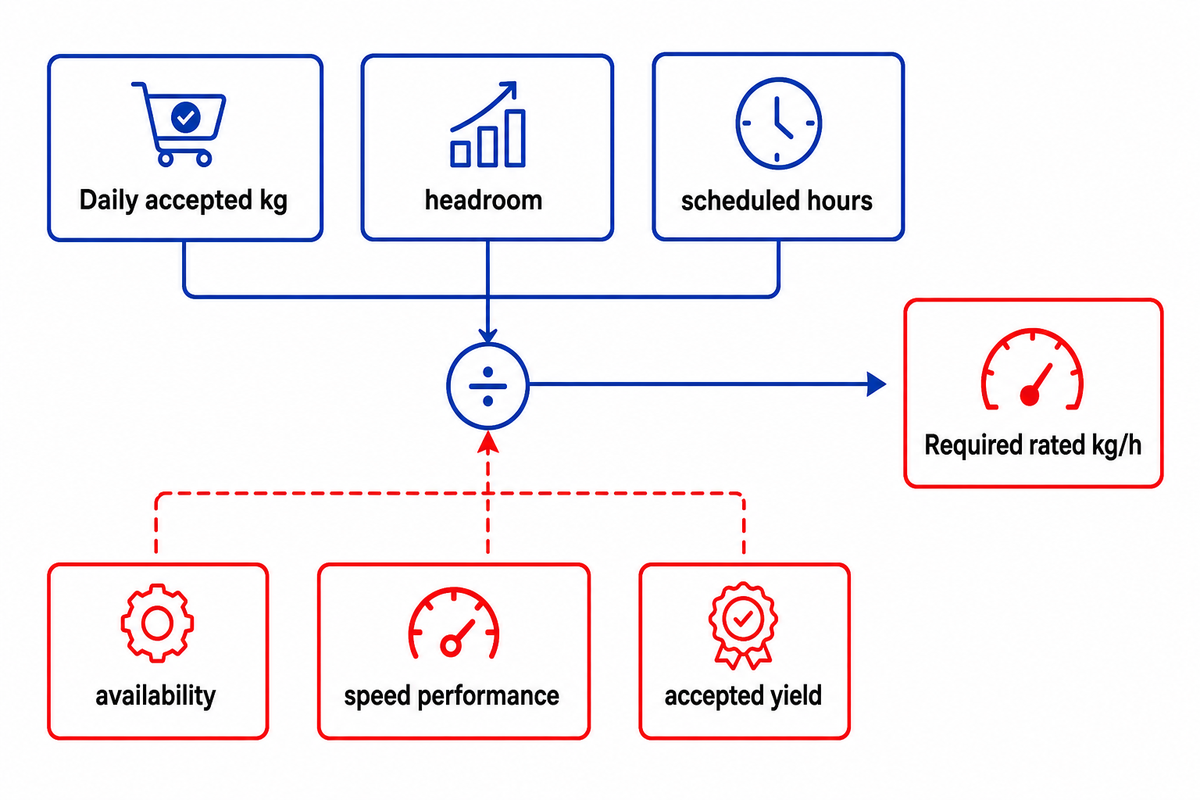
Required machine output comes from growth-adjusted accepted demand divided by net production time and demonstrated loss factors. Keep availability, running-rate performance, accepted yield, and headroom visible. A single “efficiency” percentage hides capacity loss and makes disagreements about acceptance more difficult.
Accepted-Output Equation
Required rated kg/h = Daily accepted kg × (1 + headroom) ÷ [scheduled hours × availability × speed performance × accepted yield]
What popping boba machine capacity is right for my business?
The right capacity covers the heaviest defensible production day without depending on untested uptime or yield. Build the figure from your demand forecast, campaign calendar, shift pattern and witnessed process results. Keep all the factors editable because a different bead size, flavor schedule, pack format or hold rule can change the answer.
Worked example: 1,200 accepted kg/day
A buyer plans 1,200 kg of accepted product per day and wants 20% demand headroom. The schedule provides 15.0 hours. Trial assumptions are 85% availability, 90% speed performance, and 95% accepted yield. These are example inputs, not default values.
1,200 × 1.20 ÷ (15.0 × 0.85 × 0.90 × 0.95) = 132.1 kg/h
The preliminary rated requirement is about 133 kg/h on the same product and test boundary. If accepted yield falls from 95% to 88%, the result rises to 142.6 kg/h. That 10.5 kg/h difference should trigger a yield investigation before procurement adds a larger depositor.
Operations can key these inputs into an accepted-output capacity worksheet, but the results are only as good as the witnessed factors entered.
Buyer objection: “We need 30% headroom for growth.” Separate demand headroom from hidden losses. Headroom protects a forecast. Poor availability, slow running, and rejects require their own corrective actions.
Evidence Capsule: The Tennessee Manufacturing Extension Partnership separates availability, performance and quality. In the example, 15.0 scheduled hours become 10.90 equivalent accepted hours after the three factors are applied.
A Practical Capacity Tier Map for Popping Boba Machines
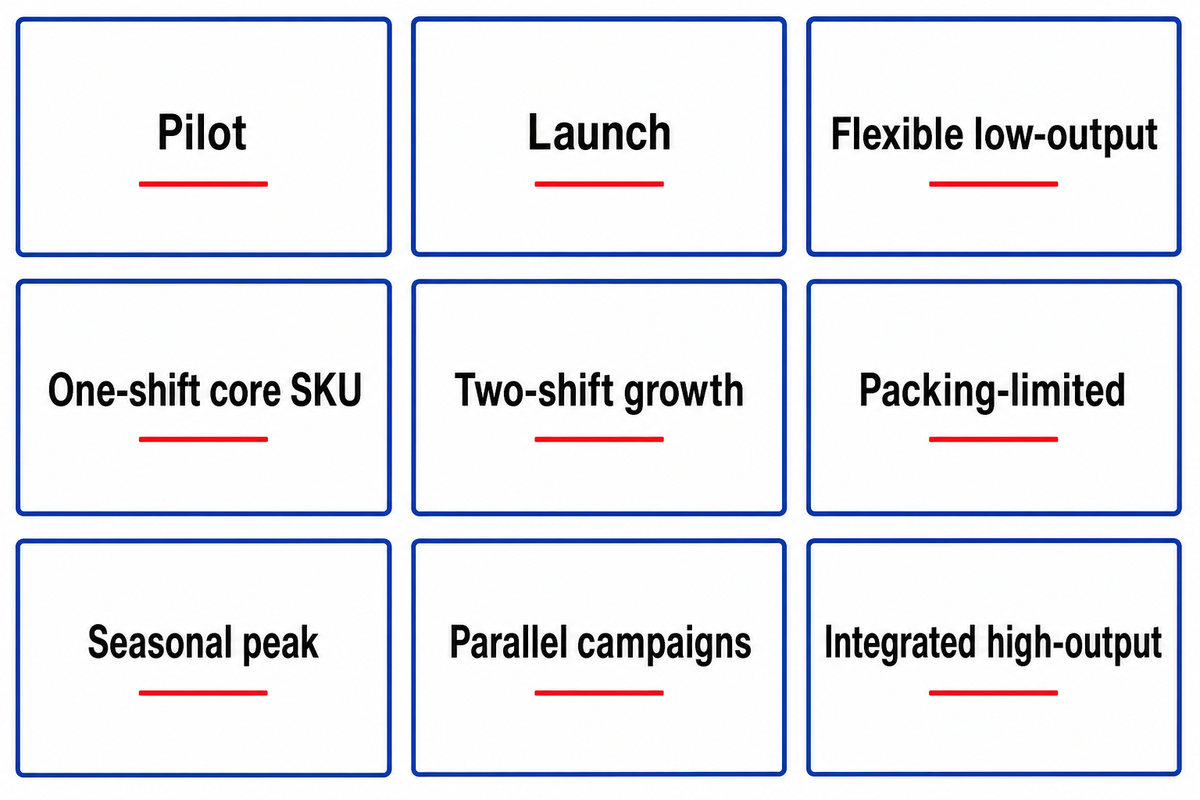
Capacity tiers work best as operating scenarios rather than as universal small, medium or large thresholds. Current supplier pages publish values such as 50-500 kg/h, 100 kg/h and 680,000 pearls/h. Those values, using different products and units, need to be standardized prior to being included in a shortlist.
The production of popping boba can favor a flexible low output route or an integrated high output line. Product mix and campaign length determine which option fits best, and the name of the option alone doesn’t determine the best fit.
What production capacities are available for popping boba machines?
Published capacity spans wide mass and count ranges, but “available” doesn’t mean “equivalent.” The TG Machine supplier page advertises 50–500 kg/h at about 50 kW. A SINOFUDE CBZ100/CBZ100S supplier page lists 100 kg/h with 35 kW steam heating or 60 kW electric heating. The SaintyCo X400 supplier page uses 680,000 pearls/h for 4–20 mm products. Treat these as dated supplier examples.
| Operating-fit tier | Typical production pattern | Capacity question | Configuration clue | Limitations / not suitable for |
|---|---|---|---|---|
| Pilot | Development batches and sample validation | Minimum stable batch and cleanup loss | Fast recipe access and documented settings | Not a scale-up proof without matched geometry |
| Launch | Short local campaigns | Accepted kg per campaign | Simple staffing and short product path | Frequent cleanup can dominate elapsed output |
| Flexible low-output | Several flavors or bead sizes | First-good-product time after change | Accessible product contact path | Not suited to a schedule built only on peak speed |
| One-shift core SKU | Longer repeated campaigns | Accepted kg across one full shift | Balanced preparation, forming, and packing | Cannot absorb an undersized downstream packer |
| Two-shift growth | Stable base demand with forecast headroom | Daily accepted kg plus sanitation window | Measured buffers and service access | Not proved by a brief no-stop demonstration |
| Packing-limited | Many container sizes or fill weights | Accepted packs/min and net mass | Buffer or matched filler lanes | A faster depositor may add blocking, not output |
| Seasonal peak | High demand for limited months | Peak-week demand and recovery plan | Overtime, parallel module, or inventory buffer | Permanent oversizing can raise fixed cost |
| Parallel campaigns | Two recipes at the same time | Independent accepted rate per module | Separated product paths and controls | Shared tanks or packing can erase independence |
| Integrated high-output | Long campaigns with automated packing | Full-line accepted kg/h | Matched utilities, inspection, filling, and storage | Needs site-level integration and release evidence |
After an operating tier has been determined, review the current SINOFUDE machine configurations on Popping Boba Machines by Capacity. The product page lists current model specifications and quotation options; this guide explains the sizing method.
Buyer Objection: “Just give us the medium range.” No reviewed industry source defines a universal middle tier. Use the scenario row that aligns with the campaign length, product mix, packing rate and acceptance boundary.
How to Compare Supplier Capacity Claims on One Basis
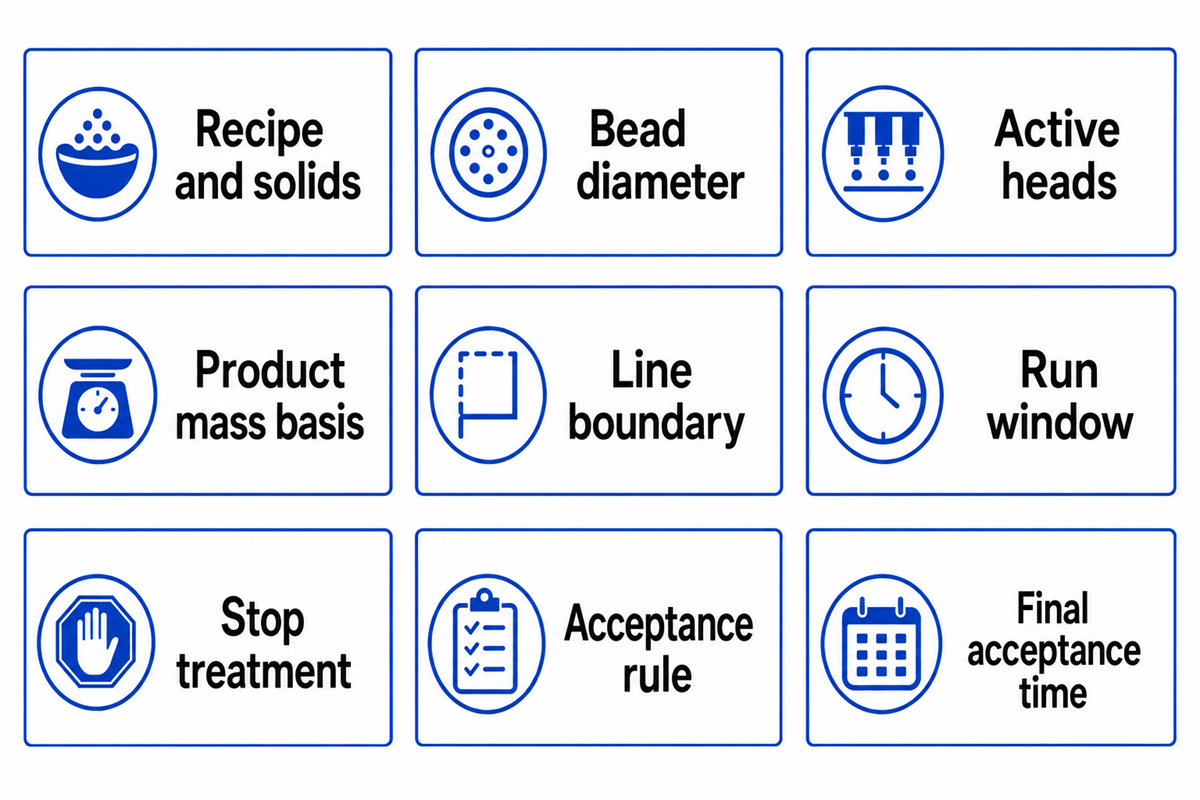
Normalize each capacity claim by locking the recipe, bead diameter, active forming heads, product condition, measurement point, run window, stop rules and final acceptance time. Record gross and accepted mass separately. A comparison becomes valid only after every supplier agrees to the same test definition.
| Normalization field | Supplier A | Supplier B | Comparable rule | Limitation / not suitable for |
|---|---|---|---|---|
| Recipe and solids | Declared | Declared | Same test batch or agreed equivalent | Different viscosity can change forming behavior |
| Bead diameter | mm | mm | Same target and tolerance | Count/h changes with diameter |
| Active heads | Count | Count | Record fitted and active heads | Installed count may exceed usable count |
| Product mass basis | Drained / wet / packed | Drained / wet / packed | Use one written definition | Covering liquid can inflate mass |
| Line boundary | Start and finish | Start and finish | Match included stages | Depositor-only rate is not packed-line rate |
| Run window | Elapsed minutes | Elapsed minutes | Same witnessed duration | A short burst can hide thermal or flow drift |
| Stop treatment | Included / excluded | Included / excluded | Use the same elapsed clock | Resetting the clock hides instability |
| Acceptance rule | Defects and sample plan | Defects and sample plan | Same limits and sampling | Visual approval alone is hard to reproduce |
| Final acceptance time | After agreed hold | After agreed hold | Match medium, temperature, and interval | Immediate checks may miss leakage or instability |
“Be adequately cleanable, and shall be properly maintained.”
The quoted equipment rule pertains to cleanability and maintenance. It doesn’t validate a popping boba recipe, preservation route, package, destination market and process classification. These require a review on a case-by-case basis.
Buyer Objection: “The rate was witnessed at the nozzle.” A nozzle count can help a diagnosis, but it can’t substitute for accepted mass measured downstream and held per the agreement.
Find the Bottleneck Before You Upsize the Depositor
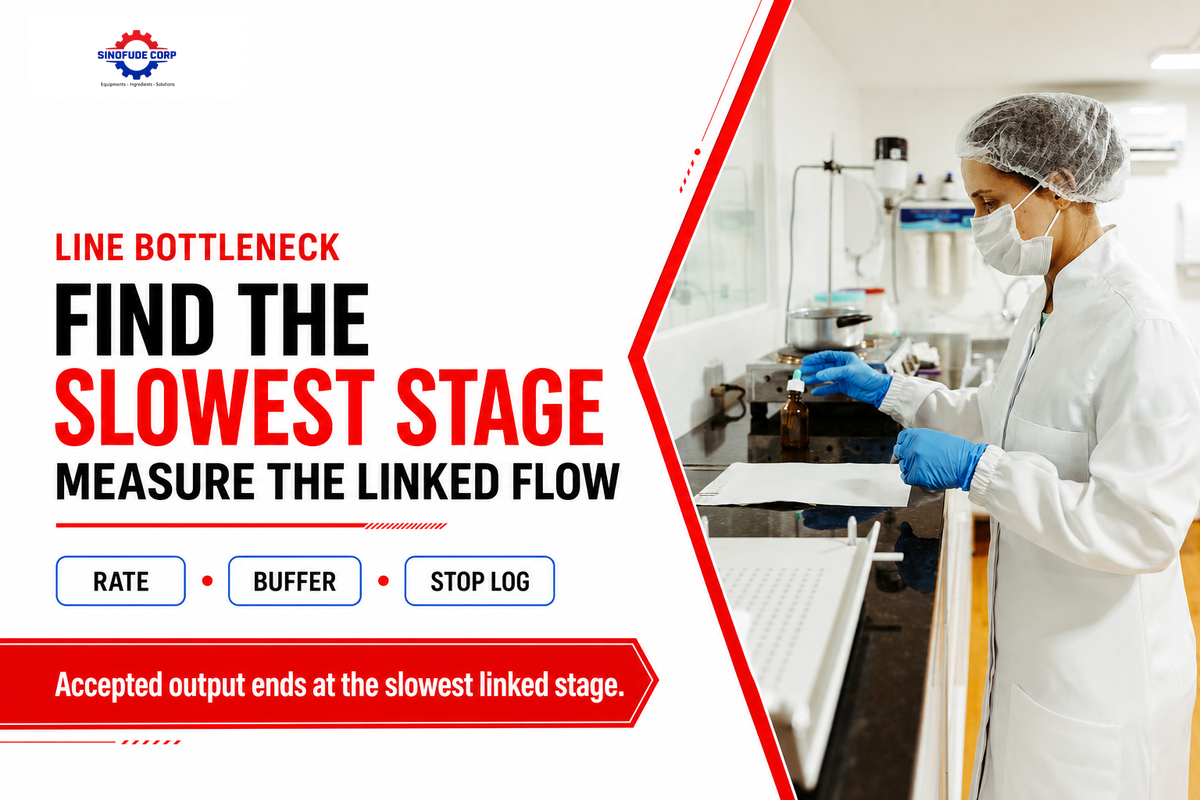
A popping boba line cannot sustain more accepted output than its slowest demonstrated linked stage. Preparation, formation, separation, inspection, filling, closure, labeling, or storage can set that ceiling. Starvation, blocking, micro-stops, and rejected product reduce the realized rate below the slowest stage’s nominal value.
This section uses line balance only to establish the capacity ceiling for machine sizing. For recipe transfer, shell-quality control, full-line interfaces, and complete factory/site acceptance planning, use the separate popping boba production-line process-control guide.
How does machine capacity affect popping boba production?
Higher forming capacity helps only up to the point where the rest of the route can receive and release the product. A reviewed packaging-line page lists filling at 8–25 bottles/min for 1–3 kg fills and downstream steps at 10–30 bottles/min. Those ranges illustrate why mass flow, package rate, and buffer time need one line-balance sheet.
- Choose one product basis and convert every stage to accepted kg/h or accepted packs/min.
- Measure the stable rate over a reasonable period, not the fastest minute.
- Record the buffer in kg or minutes before starvation or blocking.
- Code every stop as upstream starvation, equipment stop, downstream blocking, or quality hold.
- Take the lowest demonstrated linked-stage rate as the provisional ceiling.
- Apply elapsed losses and report accepted output over the full test window.
Line ceiling = min(preparation, forming, separation, inspection, filling, packing, storage-release rate)
A useful field record has one row per stage, with accepted rate, buffer ownership, starvation minutes, blocking minutes, faults, and rejection mass. The site’s popping boba line-balance checklist can organize that evidence before a larger machine is shortlisted.
Buyer objection: “The packer averages the right rate.” Average rate can conceal a 10-second recurring stop that propagates upstream. Pair the average with a timestamped stop log and buffer level.
Evidence capsule: an industrial food-line analysis shows that repeated 10-second pauses can accumulate into material lost time. A 150 kg/h depositor still produces 0 accepted kg/h while a full downstream buffer blocks it.
Account for Product Mix, Changeovers, and Cleaning
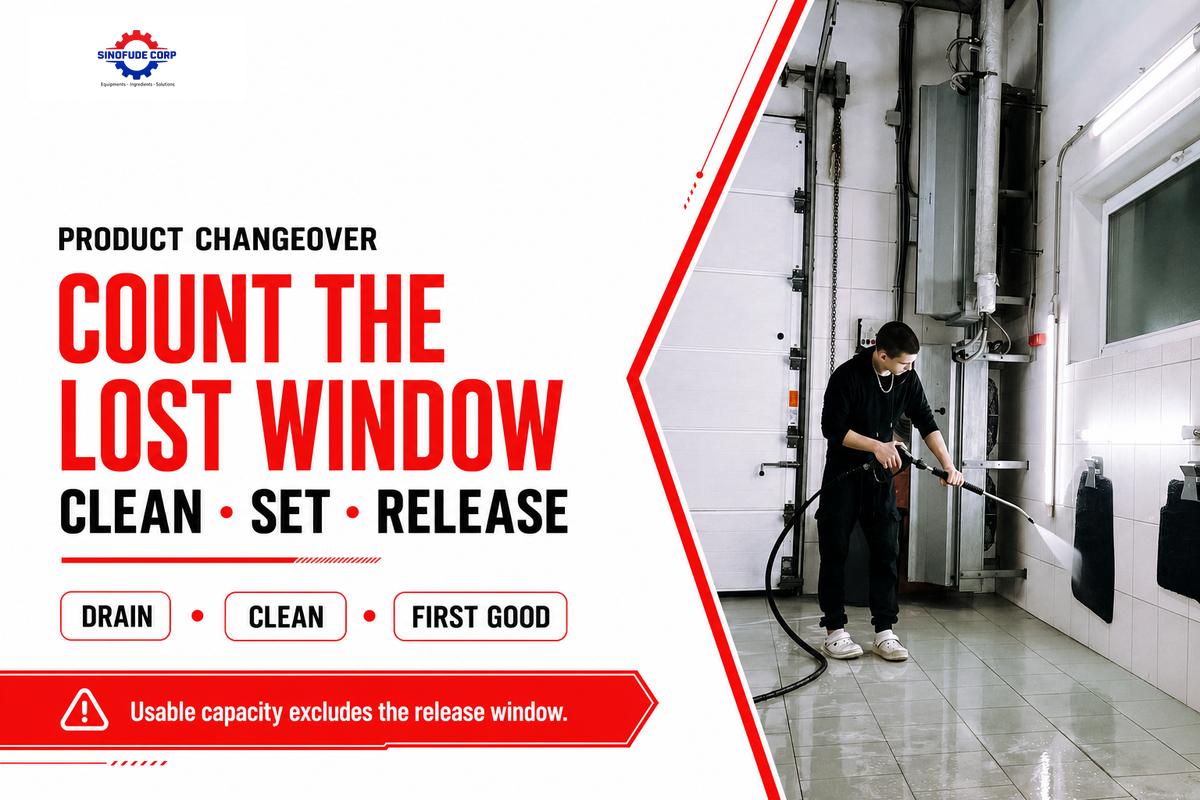
Product mix changes usable capacity because every flavor, color, bead size, and pack format can add shutdown, draining, cleaning, setup, startup scrap, and first-good-product time. A campaign calendar should subtract these minutes directly. One generic efficiency factor can’t show whether the lost time is due to sanitation, setup or unstable restart.
The claim that a piece of equipment is easy to clean requires a measured start and release interval. Creating popping boba across several flavors can turn access, draining, and first-good-product approval into the largest daily capacity loss.
What are the best practices for operating a popping boba machine?
Group compatible products into campaigns on the selected popping boba pearl maker, record the exact change boundary, and release the next run only after the agreed first-good-product checks. Keep separate documented steps for cleaning and sanitizing. The production record should identify who released the equipment and how much startup material was rejected. Accepted counting should be noted upon approval of the first good product.
| Campaign event | Minutes | Mass affected | Release evidence |
|---|---|---|---|
| Last accepted unit | Timestamp | Accepted | End-of-campaign record |
| Drain and product recovery | Measured | Recovered / discarded kg | Disposition record |
| Cleaning and sanitizing | Measured | Not production | Procedure and sign-off |
| Setup and parameter load | Measured | Trial material kg | Recipe/version record |
| First accepted unit | Timestamp | Accepted count restarts | Quality release |
University of Vermont guidance posits that hygienic design focuses on visible, reachable, and cleanable surfaces. Difficult access lengthens the non-producing window; it should be evaluated during equipment review, not discovered after the first multi-flavor schedule is released.
A quality popping boba batch requires a release rule as well. Diameter, leakage, membrane behavior, and stability should determine when accepted counting resumes after cleaning or a recipe change.
Buyer objection: “Our longest run proves the line can meet the monthly plan.” Long runs don’t prove net hours for a schedule with flavor, size, and pack variations. Recalculate net hours from the actual flavor, size, and pack sequence.
One Large Machine or Two Smaller Modules?
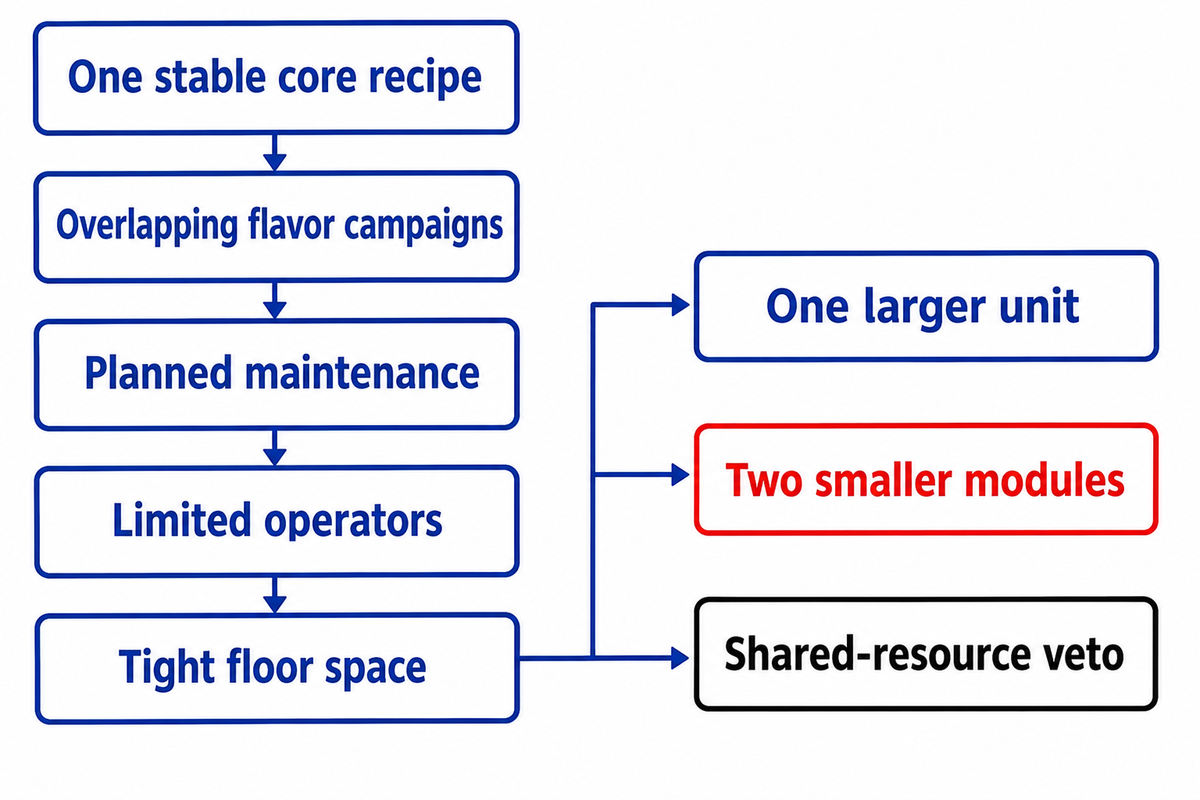
Parallel modules can recover accepted output during changeovers or faults, but only when the modules retain enough independent upstream, utility, control, labor, and downstream capacity. Two forming units that share one preparation tank and one saturated packer may add complexity without adding saleable kg/day or true redundancy.
The shared-resource test is a buyer-side engineering inference based on the analysis of coupled modules. Research on tightly coupled modules supports the limited-buffer mechanism; it doesn’t prove that all the listed resources constrain every popping boba project.
Worked crossover: shared packing changes the answer
Layout A has one unit that demonstrates 160 accepted kg/h for 13.0 productive hours, or 2,080 kg/day. Layout B contains two units, each at 90 accepted kg/h for 14.25 productive hours, for a total of 2,565 kg/day. A shared packer at 150 accepted kg/h for 15.0 hours constrains Layout B to 2,250 kg/day.
Layout B = min(2 × 90 × 14.25, 150 × 15.0) = 2,250 accepted kg/day
Layout B leads by 170 kg/day under those assumptions. If the shared packer reaches only 135 kg/h, its 2,025 kg/day ceiling makes Layout A larger. The decision changed without changing either forming module.
| Condition | One larger unit | Two smaller modules | Shared-resource veto |
|---|---|---|---|
| One stable core recipe | Fewer interfaces | Extra coordination | None if packing is balanced |
| Overlapping flavor campaigns | Sequential production | Can run in parallel | Shared preparation or packing |
| Planned maintenance | Full forming stop | Partial route may remain | Common controls or utility header |
| Limited operators | Simpler coverage | May split attention | One operator cannot service both safely |
| Tight floor space | One service envelope | Two access envelopes | Blocked cleaning or maintenance access |
Buyer objection: “Two machines mean 100% backup.” You must audit shared tanks, pumps, utilities, control nodes, operators, separators, fillers, and storage steps. Any shared constraint can invalidate the claim of redundancy.
Evidence Capsule: A peer-reviewed modular scheduling paper notes that tightly coupled modules may have limited or no buffering. Therefore, two 90 kg/h modules may not be summed until shared flow constraints are tested.
Build the Capacity Evidence Chain Before Release
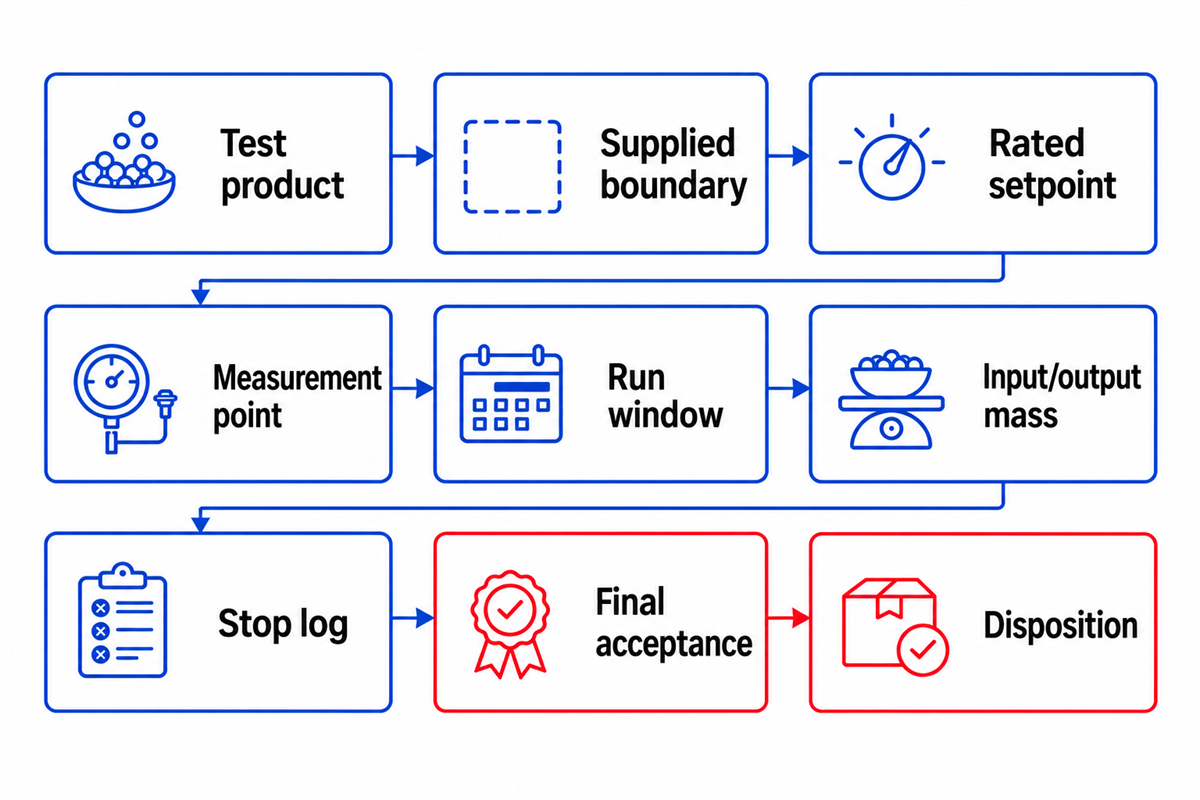
The Capacity Evidence Chain is a record that links a supplier’s quotation with witnessed factory-test evidence. It fixes the product, supplied boundary, rate setpoint, measurement point, run window, mass balance, stop log, acceptance rule, and remedy prior to the start of the testing.
Its scope here is limited to evidence needed to compare and accept a capacity claim. The linked process-control guide owns the broader recipe, quality, interface, and factory/site acceptance method.
The chain is a buyer-created documentation method. The cited acceptance-test sources support prior agreement on requirements, including the test sequence, acceptance rules, and proof required before the event. They don’t mandate this particular name or this specific sequence.
Factory acceptance guidance calls for requirements, test sequence, acceptance criteria, and proof to be agreed before the event. Packworld’s OpX account adds a practical warning. A machine that reaches 100 units/min but stops every 15-30 seconds hasn’t shown a stable longer run. The chain prevents that brief peak from becoming the contractual result.
| Chain field | Quotation entry | Witnessed evidence | Pass / retest rule | Limitation / not suitable for |
|---|---|---|---|---|
| Test product | Recipe, batch, temperature, bead size | Batch IDs and measured inputs | Match or approved equivalent | Water-only trials cannot prove product output |
| Supplied boundary | Included equipment and interfaces | Tagged start and finish points | No unlisted bypass | Depositor-only proof cannot release a full line |
| Rated setpoint | kg/h or pearls/h with basis | Controller and manual records | Within agreed operating window | Setpoint is not measured output |
| Measurement point | Drained, wet, or packed product | Scale ID, method, and timestamps | One agreed mass basis | Mixed bases invalidate the comparison |
| Run window | Start event, duration, stop event | Continuous timestamp record | Full agreed window completed | Clock resets hide interruptions |
| Input/output mass | Expected balance | Input, good, reject, residue kg | Balance within agreed tolerance | Unweighed residue can inflate yield |
| Stop log | Included and excluded stops | Cause, duration, recovery | Apply agreed stop treatment | Uncoded stops cannot support a remedy |
| Final acceptance | Defects, sample plan, hold interval | Diameter, leakage, membrane, stability | Meet every agreed limit | Immediate-only checks may miss hold failures |
| Disposition | Pass, remedy, or retest path | Signed result and open items | Named owner and due date | A verbal promise is not document control |
Use the popping boba acceptance-test specifier to position the chain fields in the request for quotation and purchase documents before the witness date.
Buyer objection: “We can finalize the acceptance method at the factory.” Late agreement allows each side to protect a different boundary. Freeze the chain before test product, labor and travel are committed.
Evidence capsule: industry acceptance guidance states 100 units/min with stops every 15-30 seconds is unstable evidence. Record rate, feeds, throughput, quality and uninterrupted test clock together.
Capacity Questions to Put in an RFQ
A comparable request for quotation outlines the product range, accepted-output target, line interfaces, utility limits, cleaning boundary, controls, evidence package, exclusions, and destination requirements. The supplier is to address each of these items for a named configuration. A generic brochure rate cannot resolve plant-specific power, water, drain, space, labor, or packing constraints.
Tea equipment projects can fail at the interfaces rather than during the forming stage. State who provides preparation, separation, filling, data connections, and storage before the rated output becomes a purchase order value.
How do I choose the right boba making machine for my business?
Select the machine after the production brief defines the accepted kg/day, product variants, campaign length, downstream packs, utility limits, and factory-test boundary. Have the supplier demonstrate which configuration satisfies the production brief. If a material input or site interface remains unknown, mark it as an open action rather than inserting a guessed allowance.
Electrical and thermal loads must be assessed from the machine as configured, and not a generic family value. The reviewed SINOFUDE CBZ100/CBZ100S supplier page lists 35 kW for steam heating and 60 kW for electric heating. These figures show why heating mode belongs in the connected-load discussion and don’t validate the need for an additional machine.
Record plant values in the connected-load and utility planning sheet before layouts and quotations are treated as comparable.
Buyer objection: “The machine has CE or UL paperwork, so the line is approved.” Certification scope, product process, package, preservation route, and destination obligations are separate questions. Request the actual documents and confirm their applicability.
Turn your demand plan into a testable capacity brief
Bring the daily accepted demand, product range, pack formats, utility limits, and proposed acceptance boundary. SINOFUDE can then discuss a current line configuration against the same written basis.
Frequently Asked Questions
How much do boba machines cost?
Cost depends on the quoted production boundary
Price changes with capacity basis, forming configuration, preparation scope, heating mode, controls, inspection, packing, utilities, and acceptance services. Ask every supplier to price the same written scope and exclusions. A low machine price isn’t comparable with a full-line quotation that includes downstream equipment and testing. Require the same test product and acceptance service in each bid.
How do you make popping boba?
Industrial production uses controlled liquid preparation and spherification
To make the popping boba, a production route prepares the liquids, meters droplets into a gelling bath, controls membrane formation, separates and treats the beads, inspects them, then fills the agreed product format. The slowest linked stage and the final acceptance rule determine useful capacity. The test record should state where accepted mass is finally weighed.
What ingredients are needed for popping boba production?
The formula and process route must be specified together
Common routes use a flavored liquid, a hydrocolloid system such as sodium alginate, and a calcium chloride bath, but the exact formulation, acidity, solids, viscosity, preservation, and covering medium are product-specific. Run the acceptance test with the agreed commercial formula or a documented equivalent. A recipe change requires a new capacity basis when flow behavior changes.
What is the difference between popping boba and traditional tapioca pearls?
They use different products and process routes
Popping boba contains liquid within a gel membrane and releases that liquid when bitten. Regular tapioca boba is a starch-based chewy solid, so an automatic tapioca pearl making machine isn’t interchangeable with a spherification line. Search pages may shorten the starch product to tapioca boba, but its preparation, cooking, handling, and capacity constraints remain different.
Can popping boba machines be customized for small-scale production?
Ask for a small-scale configuration against your batch and cleaning limits
A supplier can discuss configuration options, but suitability depends on minimum stable batch, bead range, recipe access, changeover loss, downstream handling, utilities, and required evidence. Use the sizing method first, then check current SINOFUDE machine availability. Don’t infer a guaranteed small-scale option from a family name.
What is a popping boba machine and how does it work?
It meters liquid to form gel-membrane beads
The forming equipment meters liquid through nozzles into a controlled bath, where a membrane develops around the center. Commercial production also needs preparation, separation, handling, inspection, filling, and cleaning. The machine’s nameplate rate doesn’t establish the accepted rate of that full route.
Company context
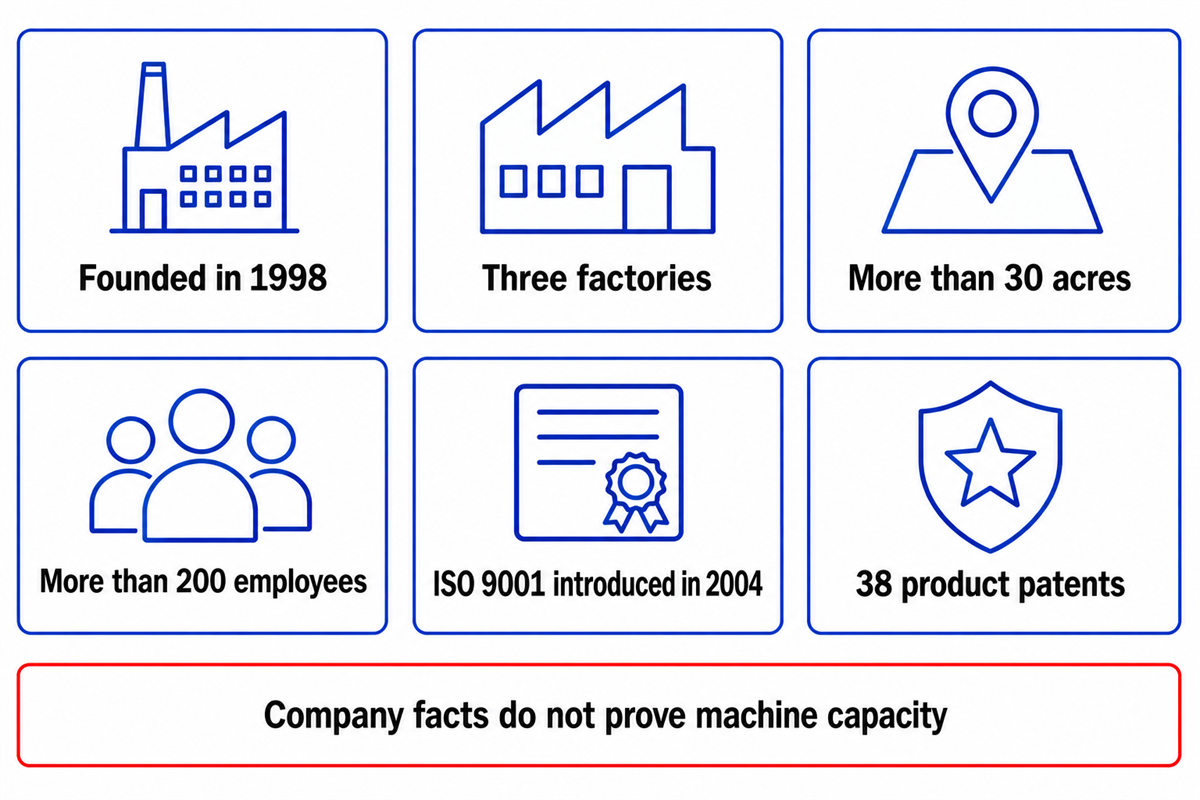
According to company information supplied for this article, the SINOFUDE brand was founded in 1998 in Fengxian District, Shanghai. The company reports three factories covering more than 30 acres, more than 200 employees, an ISO 9001 management system introduced in 2004, and 38 product patents.
The same company profile states that its range covers confectionery, baking, and chocolate equipment and that many products have CE and UL certification. These organization-level facts don’t prove the capacity, certification scope, or suitability of a specific machine. Current model evidence belongs in the quotation. Read the SINOFUDE company profile.
References & Sources
- US9320297B2, Encapsulated food product and method — Google Patents
- OEE Implementation Guide — Tennessee Manufacturing Extension Partnership
- 21 CFR 117.40, Equipment and utensils — Electronic Code of Federal Regulations
- Tips for Building Food Packaging Lines — Food Engineering
- Hygienic and Sanitary Design — University of Vermont Extension
- Successful FATs Improve Equipment Startups — Packaging World
- Modular scheduling in tightly coupled production systems — Journal of Intelligent Manufacturing