Get in Touch with SINOFUDE Company


![Small-Scale & Pilot Gummy Line [Scale-Up Guide]](https://sinofudecorp.com/wp-content/uploads/2026/10/small-scale-pilot-gummy-line-guide-featured.png)
Gummy process-development guide
Research reviewed October 2026 | For product developers, process engineers, quality teams, plant managers, and technical buyers
A small-scale & pilot gummy line refers to a production-like test system used to determine whether a gummy formulation and process can be repeated. Reduced output wouldn’t answer all the questions regarding whether a formulation is ready to be produced. It gives the team a controlled place to connect ingredient identity, process history, deposit behavior, setting, demoulding, conditioning, cleaning, and finished-product evidence.
That makes a pilot line different from both a benchtop depositor and a small commercial line. A depositor line may provide answers to a dosing question. A smaller commercial line should be able to make a saleable product. A pilot line should differentiate from these two and provide answers to what the team has proven to be true and what’s still scale dependent and what evidence should accompany the next engineering decision.
Scope boundary: this is an informational scale-up guide. It does not select a machine model, promise throughput, set a universal recipe, approve a shelf life, or determine regulatory status. Product classification, facility obligations, analytical methods, and acceptance criteria must be established by the operator and qualified specialists for the actual market.
Key takeaway
Do not ask whether one pilot batch “worked.” Ask whether the trial created a traceable relationship between controlled inputs, observed process behavior, measured product outcomes, and a bounded scale-up decision.
1. What Is a Small-Scale & Pilot Gummy Line?
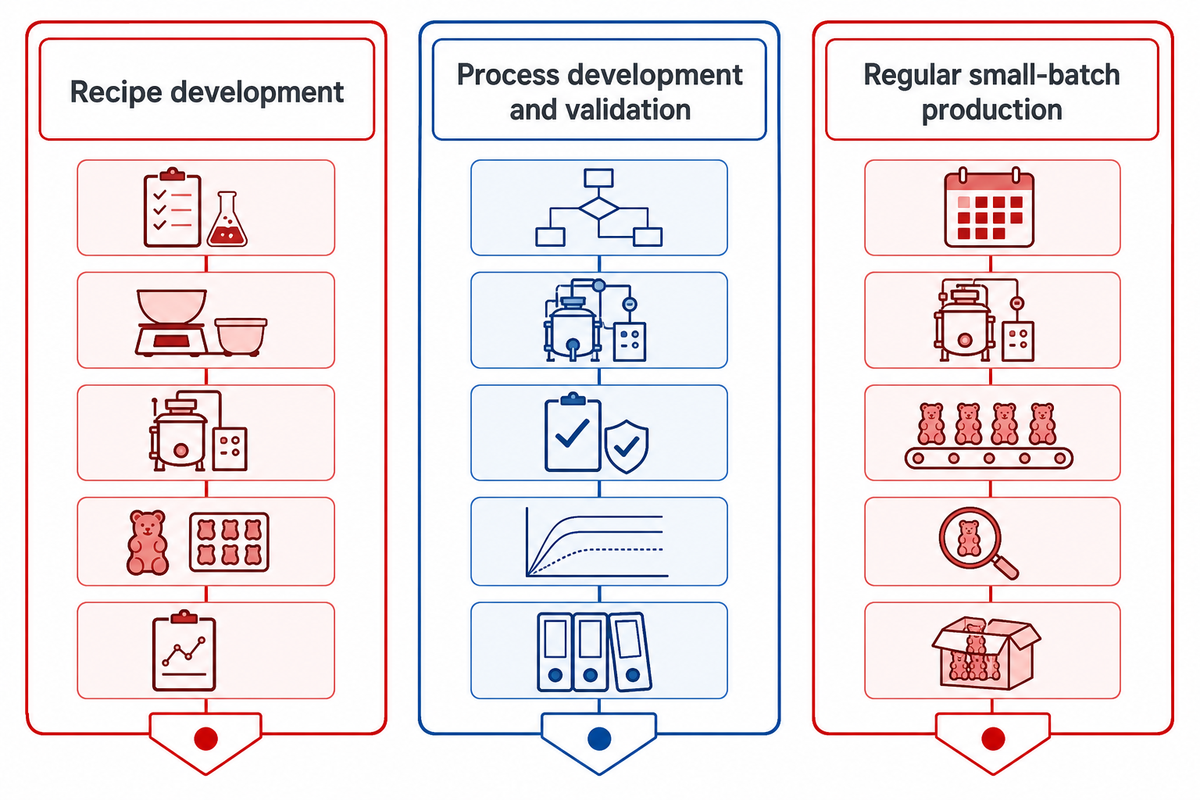
Short answer: it’s a connected, production-like environment for evaluating gummy ingredients, formulations, operating conditions, product handling, and repeatability at a manageable scale. A pilot line can reduce uncertainty, but its output is evidence for a decision, not automatic proof of commercial readiness. [1]
PSU defines a pilot plant as a facility for evaluating new ingredients, formulations and processes on a smaller scale. That definition is more useful than treating “pilot” as a capacity label. For example, a gummy pilot boundary could start with a premixed ingredient, cooking, or transfer. It could include heated hopper, dosing, servo-driven depositing, mould handling, coating, cleaning, cooling and demolding, etc. The correct boundary is the smallest connected process that can help answer the question being piloted without obscuring a later constraint.
A depositor is not the whole pilot process
A benchtop gummy depositor can test whether a mass can be dosed into a mould. It may not capture the delays, losses of temperature and recirculation that shape the final outcome. The experimental system needs to capture the aspects of the process that affect the outcome if the question being piloted is related to those aspects.
Keep three purposes separate
- Recipe development helps understand the behavior of formulations and defines a working range.
- Process development and validation tests whether defined inputs and processes produce consistent outputs.
- Regular small-batch production is production of a released product under a defined operating and quality system.
One machine may serve multiple purposes, but sampling, documentation, procedure and release aren’t interchangeable. Label runs before material enters the system.
Search terminology is not validation evidence
Supplier catalogs use overlapping labels such as “gummy making machine”, “small gummy-making machine”, “candy production line”, “gummy candy production line”, “gummy production line”, “manufacturing line”, “full line”, “full production line”, and “industrial lines” to define market segments. These phrases don’t define a stable process boundary. A machine described for gummy production still requires definition of the system and process around the actual product.
The same caution is valid for automation. Semi-automatic depositors, semi-automatic gummy systems, automatic gummy systems, fully automated lines, and continuous production systems, among others, create different staffing and control questions, but none of these guarantee precise dosing, temperature control, easy operation, easy cleaning, or high-quality gummy production.
R&D teams may use small batches to create small batch gummies and gummy bears or pectin-based gummies, or a product containing an active. Whether the manufacturer is one of the gummy manufacturers, candy manufacturers or contract manufacturers, the record should define glucose or other sweetener system, gummy slurry, syrup transfer, mold filling, gummy molds, and the finished gummy quality. Other GMP duties, if applicable, are to be separated from the equipment definition.
2. What a Pilot Run Must Prove Before Scale-Up
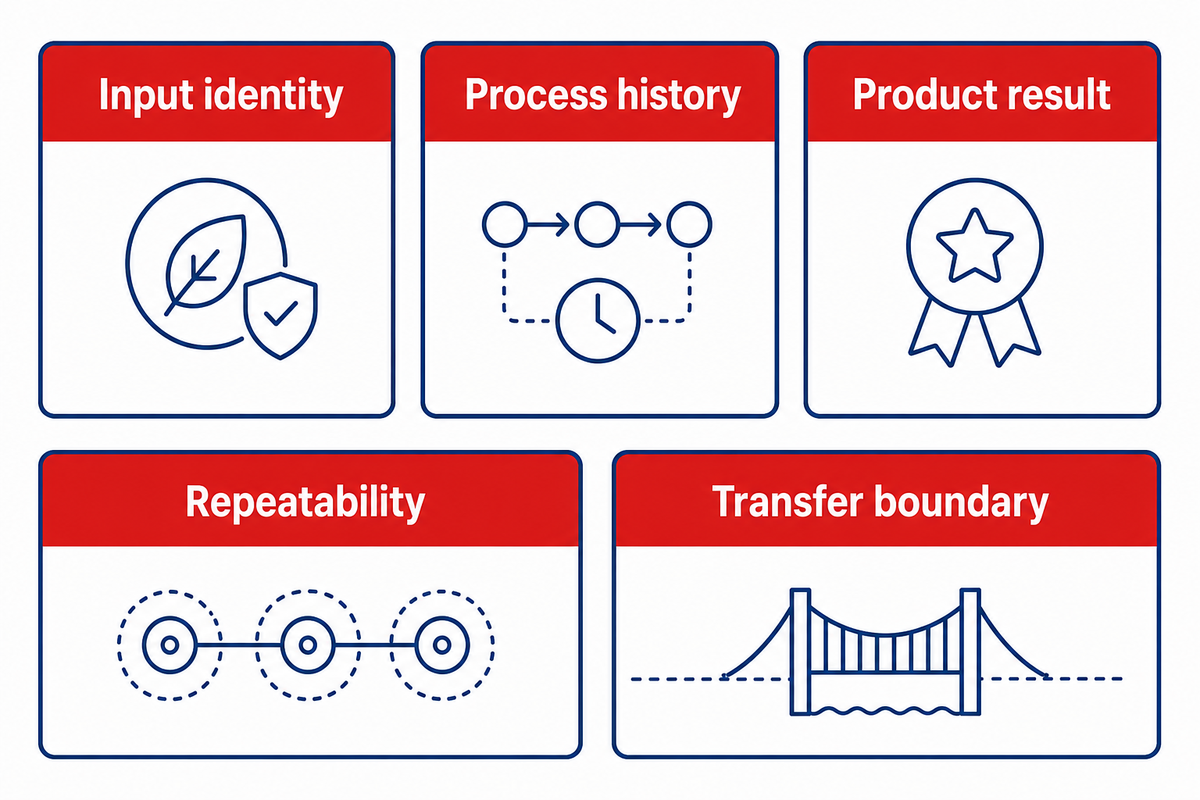
A useful pilot run shows a repeatable, documented relationship between critical inputs and acceptable outcomes across defined trial batches. It also records deviations, cleaning state, post-deposit results, and the questions that the pilot scale cannot resolve.
Begin with a decision statement rather than a batch size. Testing “make good gummies” tells team members nothing they can verify. A challenge statement such as “determine whether deposit-weight distribution remains within the project acceptance band throughout the run, with the defined formulation, transfer method, hopper condition, and sampling plan kept constant” gives team members something to observe and challenge.
A pilot objective can focus on a formulation window, dosing repeatability, mould release, setting route, conditioning time, cleaning carryover, or interface with upstream and downstream equipment. Don’t expect one run to answer everything. When more than one variable has to change, use a planned matrix and ensure a common batch identity so results can be assessed against each other.
| Evidence lane | What the record should answer | What it cannot prove alone |
|---|---|---|
| Input identity | Which formulation version, ingredient lots, premix, active, colours, flavours, and release states entered the batch? | That a different lot or supplier will behave identically. |
| Process history | What happened during cooking, transfer, hold, dosing, depositing, setting, demoulding, and conditioning? | That commercial geometry will reproduce the same times or setpoints. |
| Product result | What did samples show at defined locations and times, using named methods? | Shelf life or every applicable finished-batch requirement. |
| Repeatability | Did defined batches remain inside the project window, and can deviations be explained? | A universal minimum number of runs; that number is risk- and product-specific. |
| Transfer boundary | Which relationships are supported, which values require commercial revalidation, and which risks remain open? | Supplier performance guarantees or regulatory approval. |
Separate observation from acceptance
“The pieces looked good” isn’t acceptance evidence. Acceptance evidence is defined by a method, attribute, sample location, timing, and decision rule. Even a simple piece-weight check is more useful as a distribution across start, middle, and end samples than as one favorable measurement.
Active-containing gummies need an analytical lane
For products containing active ingredients, appearance, texture and deposit weight don’t replace applicable finished-batch evidence. Depending on product classification and market, the operator may have product specific questions regarding identity, strength or potency, within-batch distribution, purity, composition, contamination limits, sampling and scientifically valid test methods. In the United States, 21 CFR Part 111 contains finished-batch verification duties for dietary supplements where that rule applies. [2]
Keep the analytical lane conditional. Conventional confectionery products, dietary supplements, dietary ingredients, research-only products, and products making drug claims don’t have one undifferentiated compliance pathway. The equipment supplier can support a defined process and documentation package; it cannot determine the operator’s legal status or release the finished batch.
3. Map the Gummy Manufacturing Process Before You Set Variables
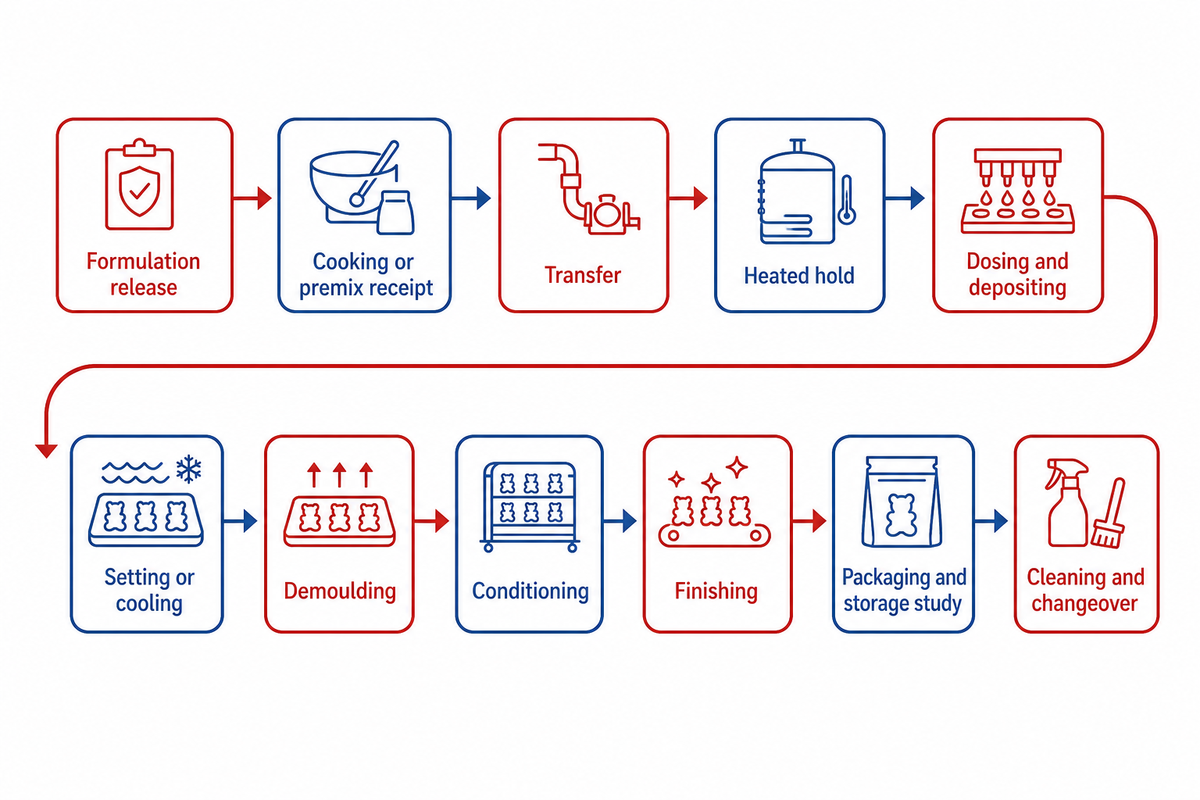
Short answer: map cooking or premix receipt, transfer, dosing, depositing, setting, demoulding, conditioning, finishing, and cleaning as one experimental system. For each step of the map, assign an input, an observable output, a sample point, an owner, and an unresolved dependency.
The process map shows the flow of materials and prevents a stable depositor from hiding an unstable gummy candy manufacturing process. For example, mass can leave a kettle inside a target condition and still reach a nozzle differently after a long hose, pump shear, transfer delay, hopper hold, and intermittent recirculation. The variable of interest is often the product’s history at the measurement point as opposed to the number shown earlier in the line.
Process-map sequence
Formulation release → Cooking or premix receipt → Transfer → Heated hold → Dosing and depositing → Setting or cooling → Demoulding → Conditioning → Finishing → Packaging and storage study → Cleaning and changeover
Mark every hold and transfer. Document clock time or shared batch at key steps to align upstream and downstream observations. If delay isn’t measured, the team may attribute a viscosity or deposit change to the wrong cause. If a sample has no position or time, it can’t explain start-up, steady-state, or end-of-run drift.
Follow the product beyond the discharge of a line. A formed product doesn’t mean it’s a finished gummy product. Release from gummy molds, support during setting, and the movement of moisture and coating behavior, as well as cooling and conditioning for package readiness, may all control the real cycle. The process boundary must include these stages or state plainly that the trial did not test them.
4. Build a Trial Matrix Around Formulation and Process Variables
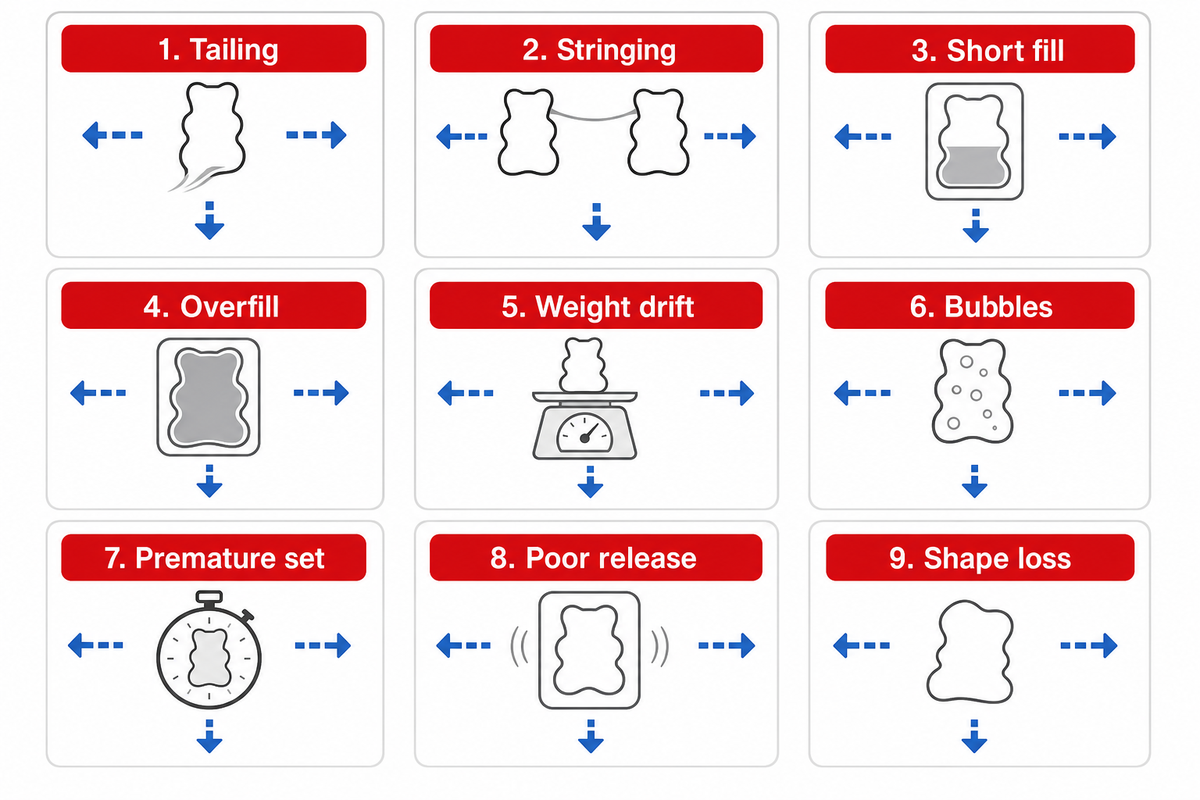
Short answer: Change a bounded factor set while keeping enough context constant to interpret the outcome. The matrix should capture formulation, process history, deposit behavior, and post-deposit outcome under one batch identity.
A 2024 gelatin-gummy study provides a useful example of an evidence package: it reports formulation-specific thermal and acid steps and measures properties including soluble solids, pH, water activity, dry matter, texture, and storage behavior. It’s an example of documentation depth, not a recipe, universal specification, or pectin operating window. [3]
The study used 8.5% gelatin in its final products and reported roughly 25% to 30% water content for that formulation family. The extract below shows why a pilot record needs sample identity, method, timing, and dispersion, not just one rounded value. These are published observations from one laboratory study, not SINOFUDE settings, release limits, or targets for another formulation. [3]
| Published sample code | Baseline dry matter | Dry matter after storage | Permitted interpretation |
|---|---|---|---|
| HSb | 71.35% ± 0.47% | 71.97% ± 0.03% | One sample result within the cited study. |
| LSb | 69.74% ± 0.73% | 69.73% ± 0.16% | Not a general dry-matter target. |
| NSb | 75.72% ± 0.14% | 75.96% ± 1.97% | Method and formulation remain attached. |
| HSinulin | 71.41% ± 0.40% | 70.85% ± 0.02% | A source observation, not scale-up proof. |
| LSinulin | 69.85% ± 0.64% | 69.91% ± 0.03% | Useful for evidence-package structure only. |
| NSinulin | 75.29% ± 0.24% | 75.71% ± 0.34% | Does not set a commercial acceptance band. |
| HSFOS | 72.89% ± 0.94% | 72.73% ± 0.20% | Must not be transferred to pectin systems. |
| LSFOS | 72.07% ± 0.56% | 72.40% ± 0.13% | Shows why dispersion belongs beside the mean. |
Pectin, gelatin, reduced-sugar, plant-based, and active-containing gummy formulations can behave differently. Peer-reviewed reviews of functional gummies discuss alternative gelling agents and sweeteners, while a later review notes that harmonized measurable quality parameters and specification limits remain limited. Build a separate development window for each system rather than borrowing a successful setpoint from another one. [4][5]
| Factor | Hold or document | Observe or measure | Required record | Scale-up risk |
|---|---|---|---|---|
| 1. Formula identity | Version, gel system, sweetener system, active load | Cook behavior, set, texture, defects | Approved formula and change history | A similar name can hide a different process window. |
| 2. Raw-material lot | Supplier, lot, release status, storage | Hydration, flow, set, colour, taste | Lot genealogy linked to batch | Lot variation may be confused with equipment drift. |
| 3. Solids basis | Named method, point, temperature correction | Flow, piece mass, conditioning trend | Time-stamped reading and method | Different evaporation and hold-up change the path. |
| 4. Acid or pH step | Ingredient, order, timing, sample point | Premature set, final pH, release | Addition event and verified measure | Transfer delay can shorten the usable depositing window. |
| 5. Temperature history | Sensor location and calibration state | Flow, tailing, set, colour or flavour change | Time-temperature trace at relevant points | Geometry changes heat transfer and thermal loss. |
| 6. Transfer and hold | Route, delay, hopper level, recirculation | Start/middle/end flow and deposit condition | Clocked transfer and hold events | Commercial hold-up and residence time will differ. |
| 7. Dosing condition | Recipe, nozzle, stroke or control setting | Weight distribution, short fills, overfills | Configuration plus sample sequence | Averages can hide drift and cavity effects. |
| 8. Mould condition | Route, cavity, preparation, reuse state | Fill shape, sticking, release, damage | Mould identity and inspection result | Starch and starchless routes are not interchangeable. |
| 9. Setting and conditioning | Environment, loading, time, sample position | Demoulding, moisture, texture, coating response | Time-stamped condition and product result | The downstream stage may set saleable output. |
| 10. Cleaning state | Previous product, method, disassembly, verification | Residue, carryover, drainability, restart behavior | Cleaning record and deviation | Different access and surface area change the burden. |
Use the 9-Symptom Observation-to-Investigation Matrix
Pectin suppliers and equipment makers describe several formulation and timing conditions that can contribute to set or depositing problems. Those sources help build an investigation list, but no symptom proves one root cause. Confirm with another signal before changing the process. [6][7]
| Observation | First bounded checks | Confirming evidence | Do not assume |
|---|---|---|---|
| 1. Tailing | Mass condition at nozzle, temperature history, nozzle state, cut-off timing | Time-linked sample images, condition reading, start/middle/end comparison | That temperature alone is the cause. |
| 2. Stringing | Flow behavior, gel development, transfer delay, nozzle cleanliness | Batch timeline and controlled repeat | That one mechanical adjustment will fix the formula. |
| 3. Short fill | Feed continuity, air, dosing command, cavity alignment | Cavity map and deposit-weight distribution | That every low piece has the same cause. |
| 4. Overfill | Dosing repeatability, mould position, product condition | Sequential weights and cavity-position record | That average piece weight describes the run. |
| 5. Weight drift | Hopper level, hold time, product history, dosing condition | Trend plot tied to time and batch events | That a stable mean excludes drift. |
| 6. Bubbles | Mixing and transfer entrainment, deaeration, leaks, recirculation | Upstream sample comparison and line inspection | That the depositor created all trapped air. |
| 7. Premature set | Gel system, acid event, temperature loss, transfer and hold duration | Event timeline and formulation-specific repeat | That a universal pectin setting exists. |
| 8. Poor release | Mould route, preparation, set condition, formulation, demould timing | Mould identity, sample position, surface and product observations | That depositing success proves demould success. |
| 9. Shape loss | Set strength, handling time, cooling, conditioning load, package pressure | Time-stamped shape and texture checks through storage | That a good line-exit shape will remain stable. |
5. Follow the Product Through Setting, Demoulding, and Conditioning
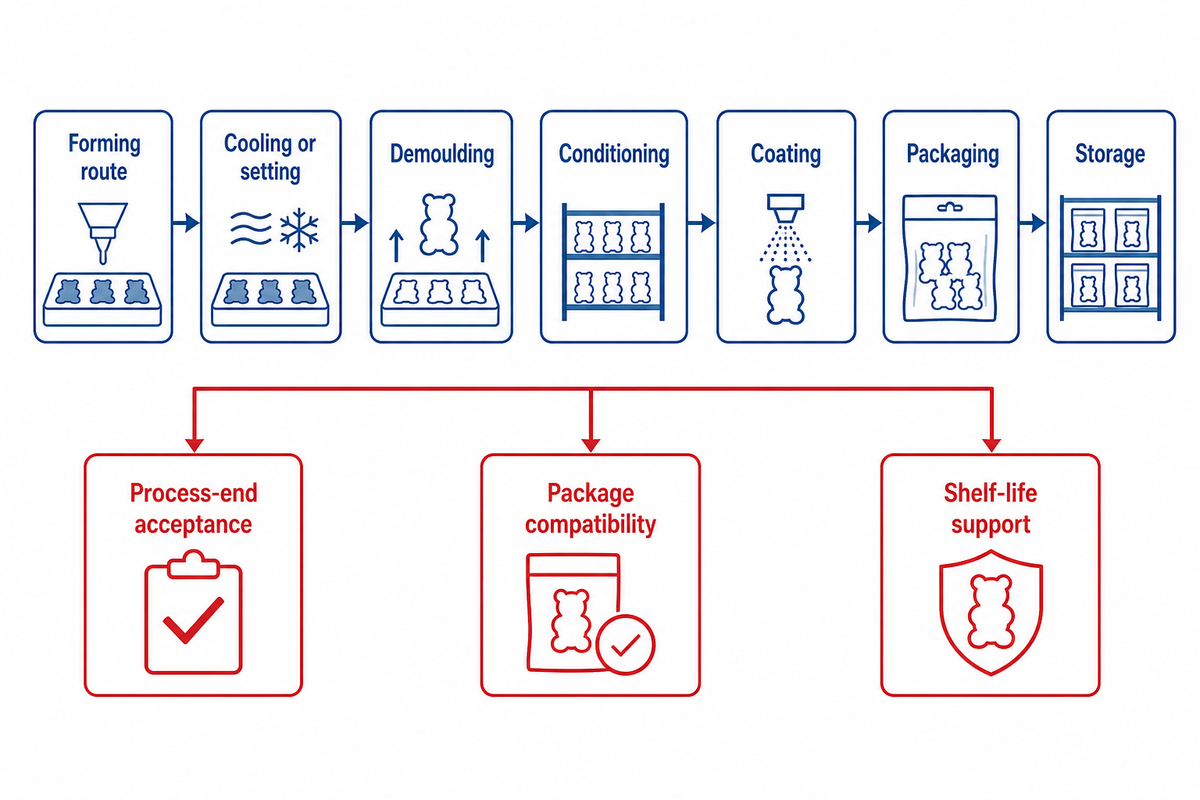
Short answer: the pilot is incomplete if it stops at the depositor. Follow the product through the forming route, any cooling tunnel or other setting stage, demoulding, conditioning, coating, packaging, and storage.
Starch moulds hold a shape during the stoving process and also affect moisture movement. Research on starch-moulded confectionery treats humidity, starch-bed moisture, chamber temperature, and time as factors that influence the movement of moisture during stoving. The starchless silicone-mould route also has its own set of conditions for holding and demoulding. These routes can both be useful, but their results are not directly interchangeable. [8][9]
Define what “ready” means at each stage. A gummy can be visually intact yet lack a controlled method for demould release, texture, moisture, water activity, coating, and package readiness. Record the method and measurement temperature, since a bare number without context may not be comparable.
The pilot endpoint is a handoff into stability work, not a shelf-life certificate. A single water-activity, moisture, texture, or appearance result cannot prove how the product will behave in its final package and storage environment.
Create a packaging-and-storage evidence lane
The storage plan should include the proposed package system, barrier assumptions, fill state, headspace (where applicable), storage conditions, sampling, methods and responsibility for verification. Results may vary due to formulation, package barrier, ambient humidity and temperature, and sensitive active ingredients. Keep process-end acceptance, package compatibility and shelf-life support as related but separate decisions.
Don’t misconstrue the two-month comparison of the gelatin study to mean general storage. Its value is structural: storage behavior was evaluated separately from the process endpoint. The same discipline should apply to every new gummy formulation, using its own methods and market requirements. [3]
6. Create the Pilot Run Transfer Dossier
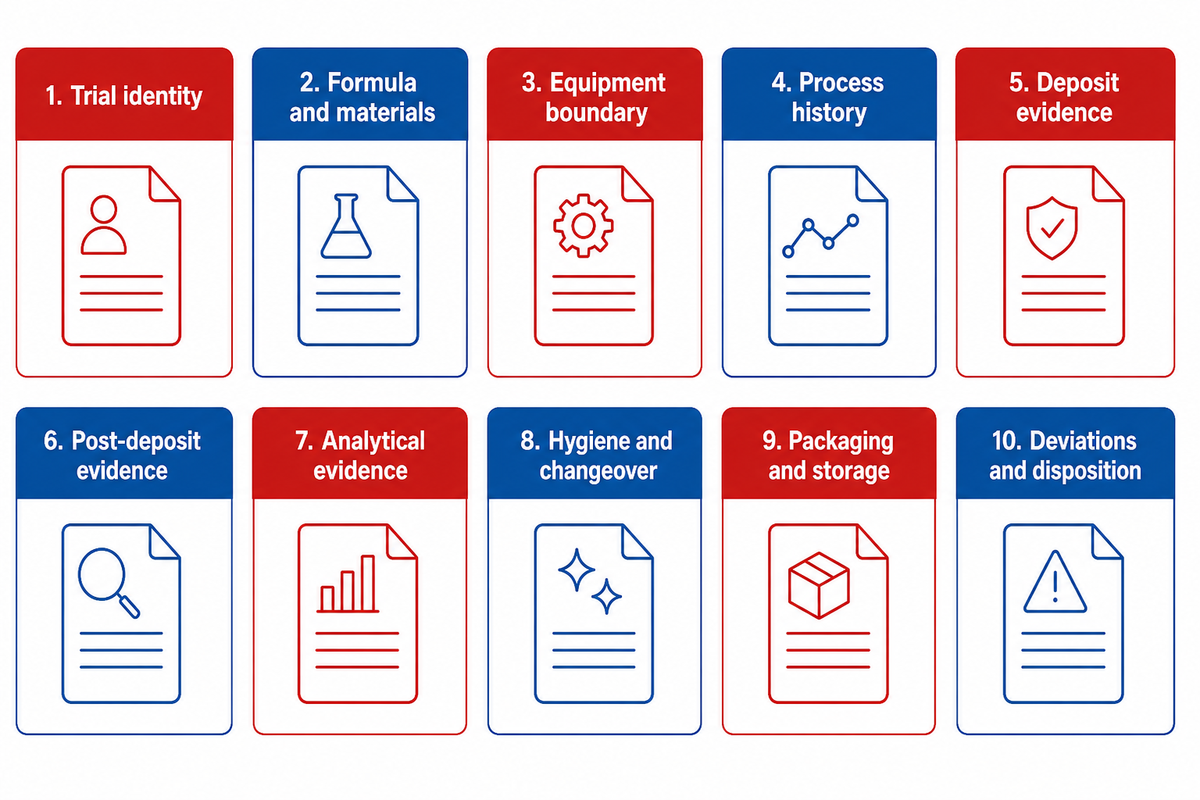
Short answer: the Pilot Run Transfer Dossier is a ten-part evidence architecture to tell engineering, quality, management and a commercial line supplier what was tested, what was repeated, what’s still scale dependent, and who owns each remaining decision.
This dossier isn’t a fillable Request for Quotation and won’t replace a quality record. It is an explanatory structure for preventing a recipe name and target output from becoming the entire scale-up brief. Every record group receives one disposition: transferable relationship, re-establish at scale, or unresolved.
| Record group | Minimum content | Transfer question | Typical owner |
|---|---|---|---|
| 1. Trial identity | Run ID, objective, date, team, release status | Can every sample and decision be traced to this run? | Project lead |
| 2. Formula and materials | Version, lots, supplier, storage, premix or active identity | Which inputs must remain controlled or be requalified? | Formulation / quality |
| 3. Equipment boundary | Included steps, relevant geometry, instruments, mould route | Which functions and interfaces must the larger system reproduce? | Process engineering |
| 4. Process history | Order, time-temperature events, transfer, hold, dosing condition | Which relationships matter, and which values are geometry-dependent? | Operations |
| 5. Deposit evidence | Sample plan, weight distribution, cavity effects, visible defects | Did control persist across the run rather than in one sample? | Process / quality |
| 6. Post-deposit evidence | Set, demoulding, conditioning, coating, package-ready result | Is the downstream path part of the proven process? | Quality / operations |
| 7. Analytical evidence | Named methods and, where applicable, identity, potency or strength, uniformity, purity, composition, contamination | What is process evidence, and what requires finished-batch verification? | Quality / laboratory |
| 8. Hygiene and changeover | Previous product, method, access, residue or carryover check, restart | Will the larger line preserve cleanability and segregation? | Sanitation / quality |
| 9. Packaging and storage | Proposed pack, conditions, sample schedule, stability owner | Which conclusions remain outside the pilot endpoint? | Quality / packaging |
| 10. Deviations and disposition | Event, impact, investigation, owner, due date, transfer state | Is the program ready, conditionally ready, or still unresolved? | Cross-functional team |
The dossier should retain uncertainty. If a trial didn’t test long commercial hold-up, state that. If a method is still under development, don’t say the outcome is approved. If there’s a setting in the pilot that appears to be useful but depends on the geometry of the pilot, mark it for re-establishment rather than including it in a purchase specification.
7. Utilities, Hygiene, and Changeover Constraints
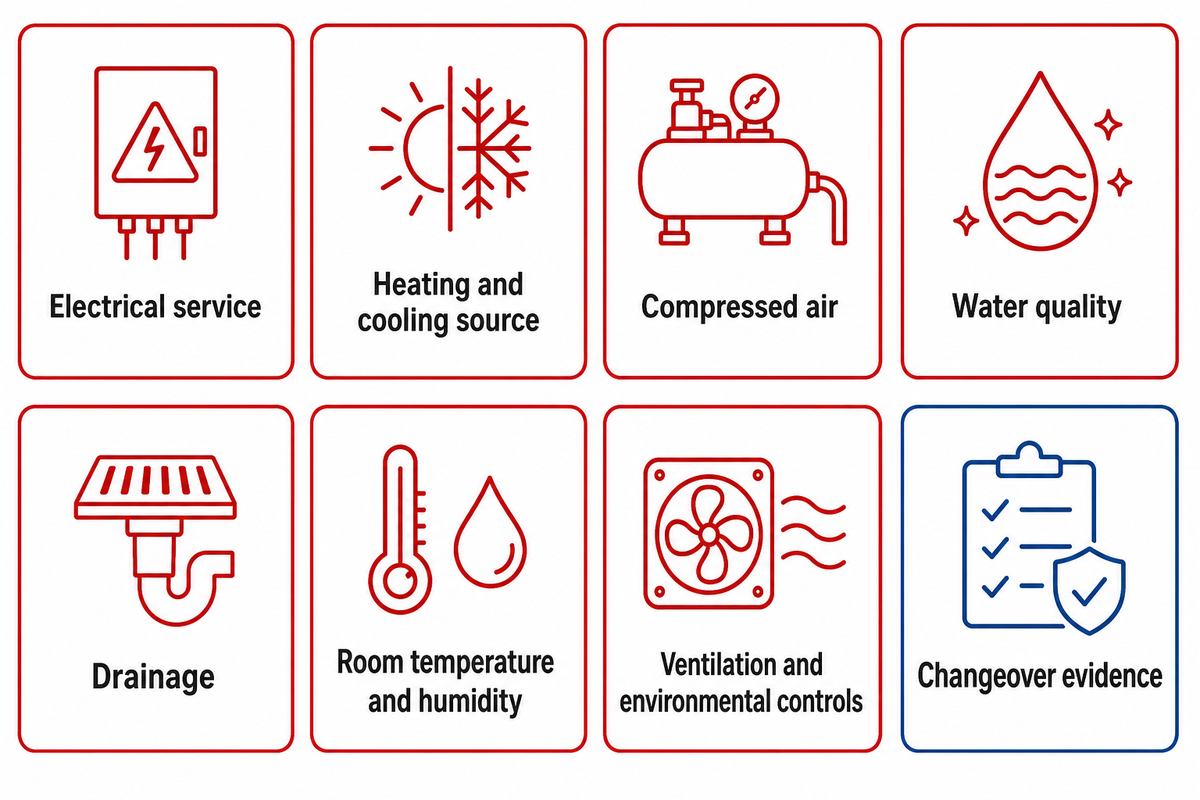
Short answer: conditions such as utility quality, environmental condition, materials of construction, cleanability, instrument state, drainage, access, segregation and changeover must be documented. The process isn’t transferable when conditions are changed invisibly.
Pilot protocols should identify the actual electrical service, the heating and cooling source, the compressed air, if any, the water quality, the drainage, the room temperature and humidity, and any ventilation or environmental controls that affect the product. Don’t estimate or define generic values of power, flow, pressure, or floor space. Obtain the utility schedule for the equipment from the supplier and compare it to the measured capability of the site.
Cleanability, maintained equipment, and accurate instruments are specified in 21 CFR 117.40, for food equipment in the US. They’re design and operating inputs and don’t represent government approval of the equipment. [10]
Regulatory duties are not machine approvals
Conventional food, finished dietary supplements, dietary ingredients, drug-claim products, and research or development pilot facilities may fall under different rules or exemptions. FDA guidance shows that facility registration and exemptions matter, while dietary supplements receive only specified exemptions rather than one blanket exclusion from food rules. The operator must determine the product representation, intended use, facility activity, registration status, and applicable regime. [11]
Where 21 CFR Part 111 applies, equipment, written procedures, specifications, tests, and quality control remain the responsibility of the manufacturer. A polished machine, automated system, or certification mark does not make a formula, method, facility, or finished batch compliant. [12]
Changeover evidence belongs in the trial
Capture what happened prior to batch, which parts were opened, how residue was removed, where liquid can pool, how contact surfaces were inspected or tested, and what happened at restart. Include questions on allergens and active carryover if relevant. The objective isn’t to prove universal clean-in-place. It’s to define the real boundaries of cleaning and the evidence needed for the products being used.
8. Why Pilot Programs Are Handling More Formulation Variability
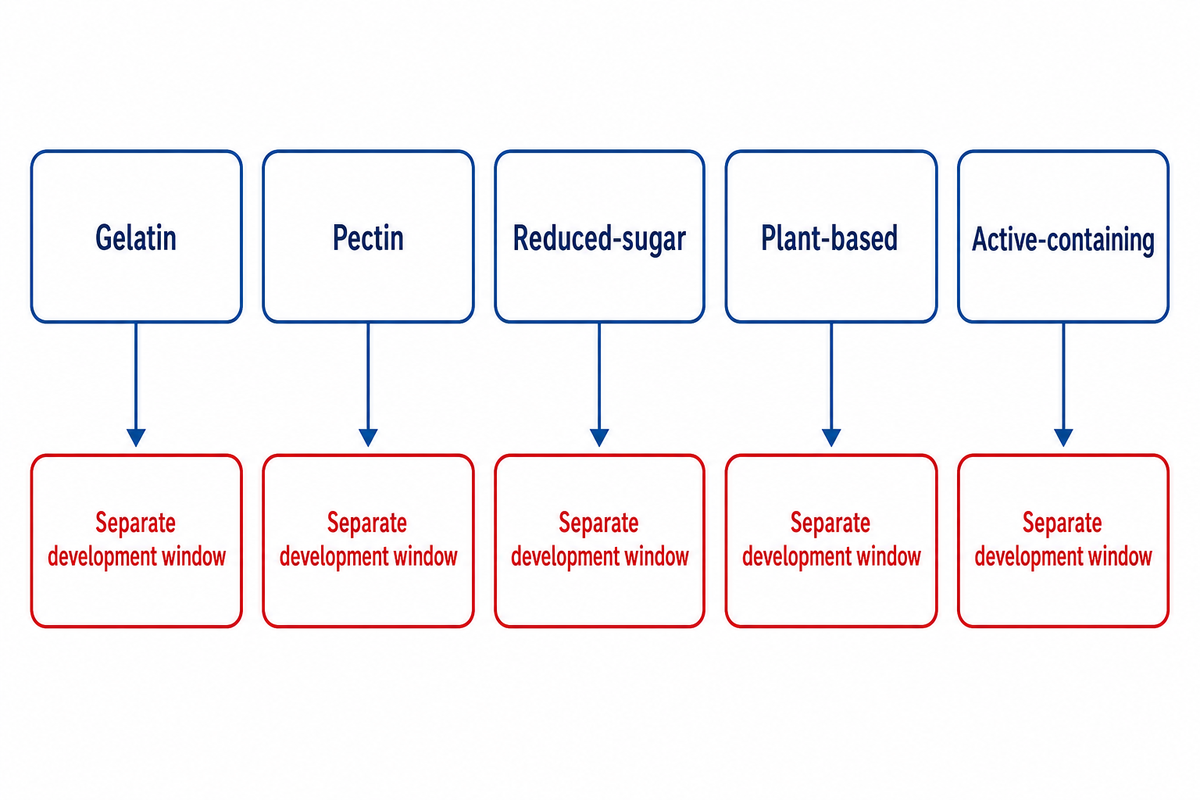
Short answer: Broader portfolios create greater validation and changeover burden. Gelatin, pectin, reduced-sugar, plant-based, and active-containing gummies should be treated as separate development systems, not flavour changes inside one universal operating window.
Functional-gummy research discusses alternative gelling agents, sweeteners, nutrients, and active ingredients. Trade coverage also shows continuing interest in starchless production for healthcare and functional products. The useful buyer implication isn’t a market-size forecast; it’s a larger evidence burden for formulation transfer, segregation, cleaning, analytical methods, and storage. [4][13]
Labels in the gummy market sometimes use phrasing like automatic gummy production, starchless gummy production, or production solutions to compress several engineering decisions into a catalogue label. The acceptance question is not whether a label promises high-quality gummies; it is whether the selected process produces the defined quality attributes repeatedly under the documented formulation, handling, hygiene, and conditioning conditions.
Flexibility of a process or system needs to be defined to be tested. Can the process or system, as planned, handle and control the gel system? Can the mold route, in the intended state, support the desired product? Can contact parts be accessed and changed over? Can identity and sampling be maintained if an active pharmaceutical ingredient is added? Can the planned packaging and storage protect the intended quality? During pilot work, how should the team make each broad statement into a more narrowly defined statement?
Keep research examples source-scoped. The reviewed gelatin study can’t prove pectin behavior. The starchless patent or vendor announcement can show that an approach exists, but it can’t prove general performance. Low-sugar formulations may bring together solids, flow, set, conditioning, flavor, and stability. Create a separate protocol when the mechanism or evidence package changes.
9. Pilot vs Full-Scale Production: What Transfers and What Changes
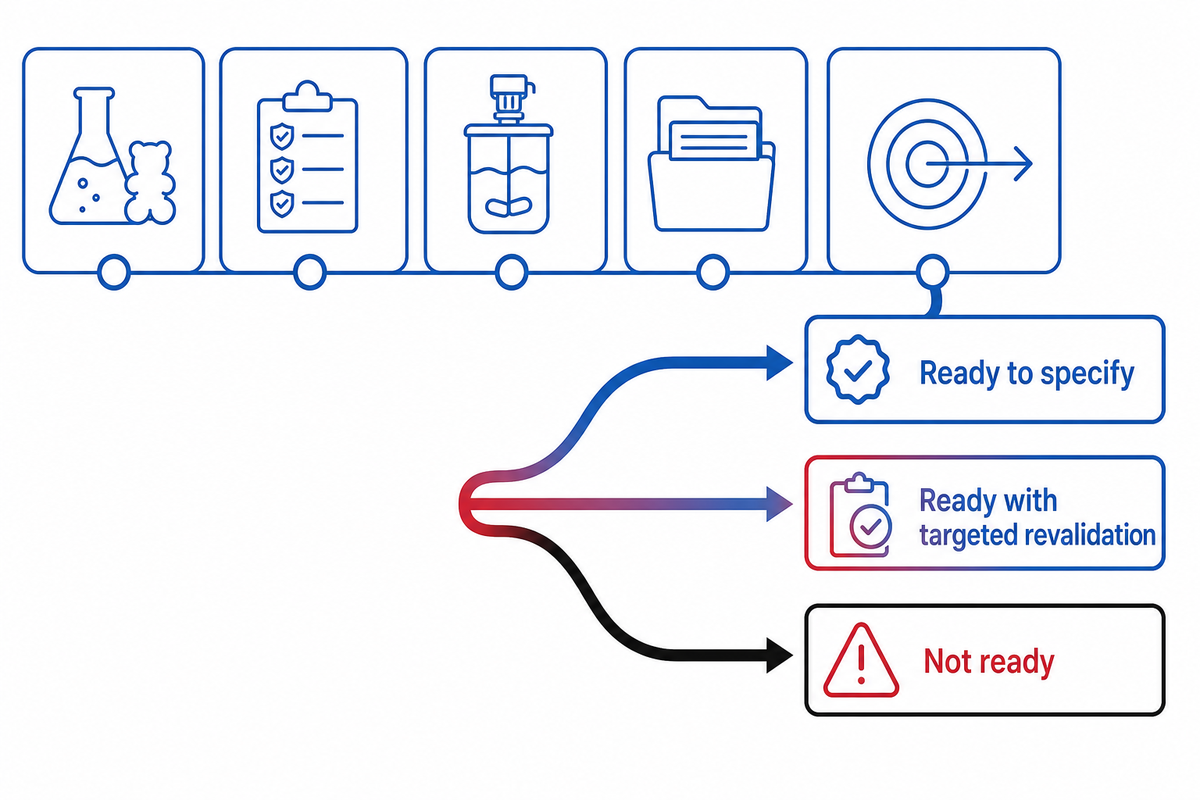
Short answer: transfer the supported relationship between inputs, process states, and outcomes. Re-establish exact setpoints when geometry, heat transfer, flow, residence time, hold-up, transfer delay, start-up loss, cleaning cycles, or bottlenecks change.
The process-scale literature documents cases where the same nominal setting didn’t produce the same conditions inside the equipment at larger scale. There are cases where mass and heat transfer, fluid flow, geometry, and other process conditions shift. This behavior is observed across industries, and it isn’t necessarily a conversion law for gummy-like processes. Therefore, it should be approached with caution. [14][15]
| Decision state | Evidence condition | Next action |
|---|---|---|
| Ready to specify | The product and process boundary are defined, repeatable relationships are supported, utilities and methods are known, and open risks are assigned. | Begin a commercial configuration discussion using the dossier and explicit acceptance methods. |
| Ready with targeted revalidation | The evidence model is sound, but named values depend on commercial geometry, longer hold-up, integration, or downstream capacity. | Define a focused factory or site test for each scale-dependent variable. |
| Not ready | Important deviations are unexplained, methods are undefined, downstream product evidence is absent, or regulatory and analytical ownership is unresolved. | Close the evidence gaps before treating a successful run as a capital basis. |
Commercial planning should also separate deposited pieces from saleable output. Conditioning capacity, packaging, sanitation, product changeover, planned downtime, and quality holds can move the bottleneck away from the depositor. Pilot output is helpful to identify events and losses; it isn’t necessarily the sustained commercial rate.
Once the team has a defined product, process boundary, utility basis, evidence dossier, and unresolved-risk list, use SINOFUDE’s small and pilot gummy line solution for the separate commercial discussion. That page owns equipment scope and configuration; this guide owns trial logic and transfer evidence.
Turn your pilot evidence into a bounded engineering brief
Provide the product goal, process map, Pilot Run Transfer Dossier, utility basis, and unresolved-risk list. SINOFUDE can use that boundary to discuss the next equipment step, without treating one pilot setpoint as a commercial guarantee.
10. FAQs About Small-Scale & Pilot Gummy Lines
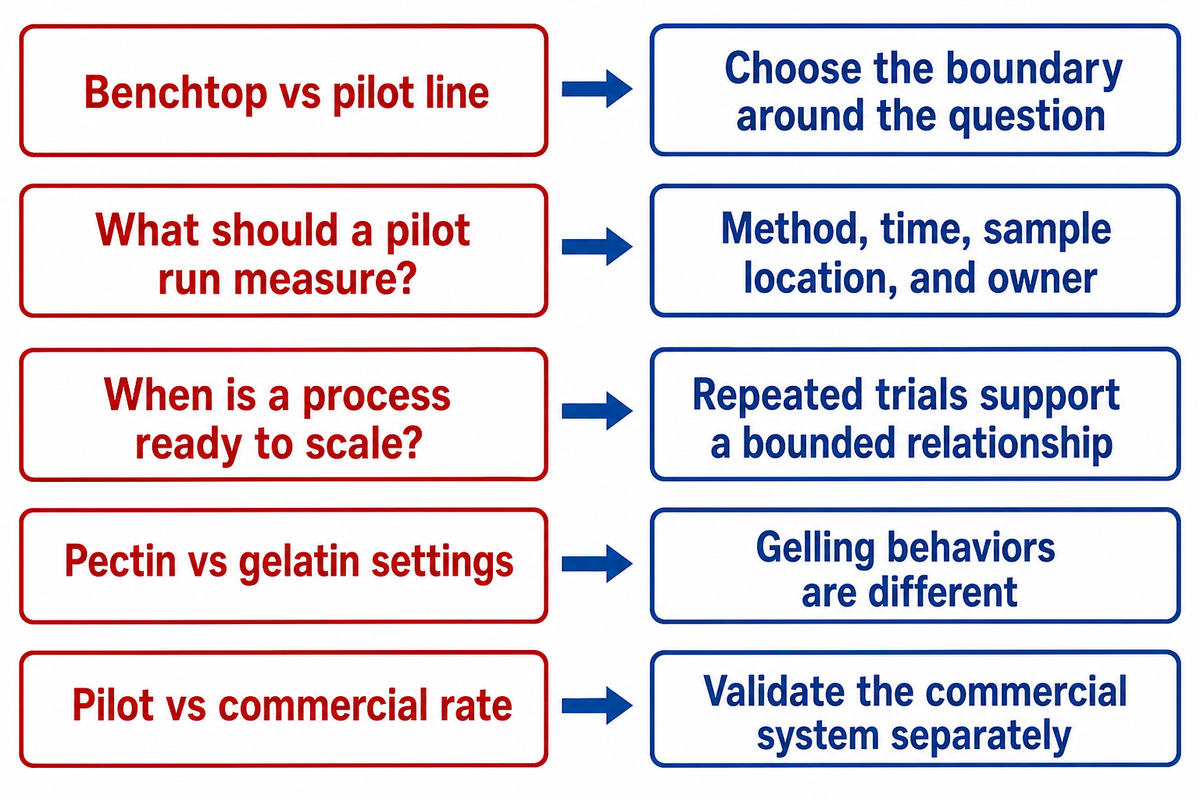
What is the difference between a benchtop gummy depositor and a pilot gummy line?
Benchtop depositors meter gummy mass into molds and may answer a narrow dosing question. Pilot gummy lines include transfer, temperature hold, depositing, setting, demolding, conditioning, and cleaning so teams can test process interactions. Choose the boundary around the question, not the desired batch size.
What should a gummy pilot run measure?
Record formulation and raw-material identity, batch and equipment boundary, time-temperature history, pH or solids, flow behavior, deposit-weight distribution, defects, setting and demoulding behavior, conditioning conditions, cleaning state, storage plan, and every deviation. For active-containing products, add the applicable identity, strength or potency, uniformity, purity, composition, contamination, sampling, and test-method questions. All measures require a method, time, sample location, and owner. Separate processed deposit from product. That separation keeps a stable deposit from being mistaken for shelf-life or regulatory proof.
How do I know when a gummy process is ready to scale up?
The gummy process is ready for commercial specification when repeated trials support a bounded relationship between critical inputs and acceptable outcomes; important defects and deviations are explainable; post-deposit, cleaning, utility, analytical, and storage boundaries are documented; and scale-dependent variables are listed for revalidation. That decision does not approve shelf life or replace any applicable finished-batch verification.
Do pectin and gelatin gummies need the same pilot settings?
No. Gelling behaviors are different, so evaluate acid timing, temperature history, hold time, depositing behavior, cooling, setting, and the completed product evidence package for each formulation system under review. A gelatin study, recipe, or set point isn’t absolute pectin proof.
Can pilot-line output be used as the commercial production rate?
Not automatically. Material losses, start-up behavior and bottlenecks may be evident in the pilot run, but for the commercial setting, geometry, residence time, line balancing, conditioning, quality holds, packaging, sanitation, changeovers, and scheduled downtime may shift the constraint. Use a pilot to determine relationships and acceptance criteria, and size and validate the commercial system separately.
About SINOFUDE
SINOFUDE is a Shanghai food-machinery brand founded in 1998. Its official company profile states that it operates three factories covering more than 30 acres and employs more than 200 people. [16]
The same first-party profile states that SINOFUDE introduced ISO 9001 management in 2004 and that most of its products have obtained European Union CE and UL certification. Treat this as company-reported information: certification scope and current validity must be confirmed for the specific equipment and destination. [16]
References & Sources
- Pilot Plants of the Penn State Department of Food Science.
- 21 CFR 111.75, Finished Batch Verification.
- Peer-reviewed 2024 gelatin-gummy formulation and storage study.
- Peer-reviewed review of functional-gummy formulations.
- 2024 review of gummy formulation quality parameters.
- Pacific pectin, Problems During gummy Making (supplier information; source-limited).
- Stabilizing Ingredients in pectin gummies (Equipment Manufacturer Information; Source-limited).
- Penn State research record: Moisture Diffusion During Stoving of Starch-Moulded Confectionery.
- Open-access starchless silicone-mould gummy study.
- eCFR, 21 CFR 117.40, Equipment and Utensils.
- U.S. FDA, Frequently Asked Questions on FSMA.
- Dietary Supplement Manufacturing (21 CFR Part 111, eCFR).
- Starch-free depositing in Healthcare Markets (Trade Source).
- Scale-up methodology (Industrial & Engineering Chemistry Research), cross-industry.
- Peer-reviewed food-processing scale-up review.
- SINOFUDE official company profile (first-party company information; certification scope requires product-level confirmation).
Editorial note: The regulatory and technical sources have been reviewed for this guide in October 2026. Confirm the current rule text, product classification, methods, and destination-market requirements before making a compliance or release decision.