Get in Touch with SINOFUDE Company


The hard candy manufacturing process is the factory sequence that turns a uniform sweetener solution into formed, cooled, inspected, and moisture-protected pieces. In factory practice, it succeeds by controlling every handoff: uniform syrup, a qualified cook endpoint, timed additions, forming, cooling, inspection, and packaging. While the machinery is important, repeatable candy comes from the condition passed from one process step to the next.
In one sentence: industrial hard candy production turns a controlled sugar or sugar-free formulation into a low-moisture amorphous solid, then preserves that state through forming, cooling, handling, and packaging.
Updated September 2026 · By XCX
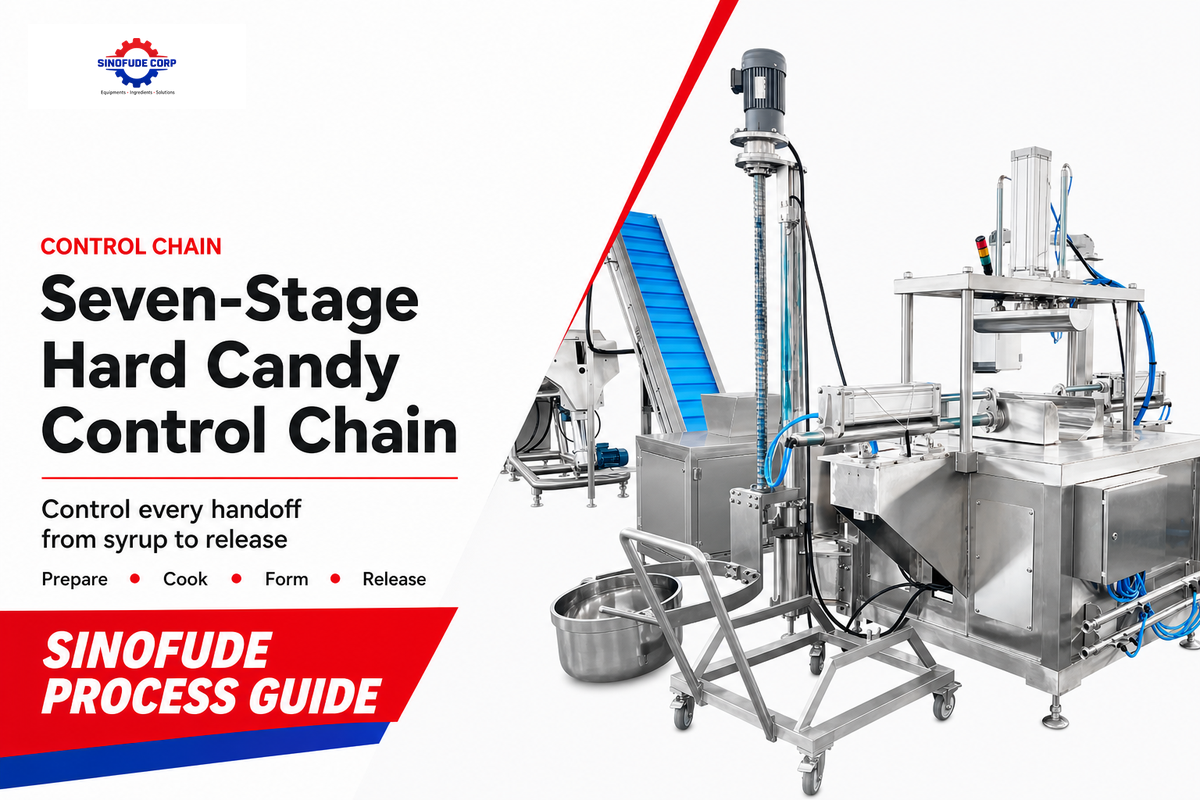
Seven-Stage Hard Candy Control Chain
1. Prepare
Weigh, dissolve, filter where qualified, and verify a uniform syrup.
Weigh, dissolve, filter where qualified, and verify a uniform syrup.
2. Concentrate
Remove water under controlled heat, pressure, residence time, and endpoint measurement.
Remove water under controlled heat, pressure, residence time, and endpoint measurement.
3. Finish
Add acids, flavors, colors, or actives inside a qualified mixing window.
Add acids, flavors, colors, or actives inside a qualified mixing window.
4. Form
Deposit a hot fluid mass or shape a tempered plastic mass.
Deposit a hot fluid mass or shape a tempered plastic mass.
5. Cool
Remove heat without condensation, deformation, sticking, or harmful stress.
Remove heat without condensation, deformation, sticking, or harmful stress.
6. Inspect
Check agreed product attributes and trace defects to the last stable point.
Check agreed product attributes and trace defects to the last stable point.
7. Pack & release
Protect the glassy product and close quality and food-safety evidence separately.
Protect the glassy product and close quality and food-safety evidence separately.
If you came here for a hard candy manufacturing process flow diagram or a practical hard candy making process, this seven-stage control chain shows how candy is made in a factory and what evidence must pass between stages.
| Stage | Input condition | Control question | Reference record |
|---|---|---|---|
| 1. Materials | Approved ingredients and current recipe | Are identity, lot and weights correct? | Material and weighing record |
| 2. Syrup | Uniform dissolved feed | Is the cooker receiving a homogeneous syrup? | Dissolution and transfer record |
| 3. Cooking | Known formulation and pressure basis | Did the batch reach its qualified endpoint? | Temperature, composition and time trend |
| 4. Late addition | Fluid mass inside the qualified window | Were sensitive ingredients dispersed without excess exposure? | Addition and mixing record |
| 5. Forming | Mass suitable for depositing or plastic forming | Are weight and geometry distributions acceptable? | Position and defect map |
| 6. Cooling | Formed pieces with known heat load | Did the product stabilize without condensation or deformation? | Product and room-condition trend |
| 7. Inspection | Cooled, separated pieces | Do agreed product attributes meet the lot standard? | Sampling and disposition record |
| 8. Wrapping | Stable product and qualified package | Are barrier, seal and code intact? | Seal and package checks |
| 9. Release | Closed quality and food-safety evidence | Can the responsible owners support lot disposition? | Signed release and retained evidence |
For the commercial boundary between shared modules and route-specific equipment, review SINOFUDE’s hard candy and lollipop production-line scope.
What makes hard candy manufacturing different?
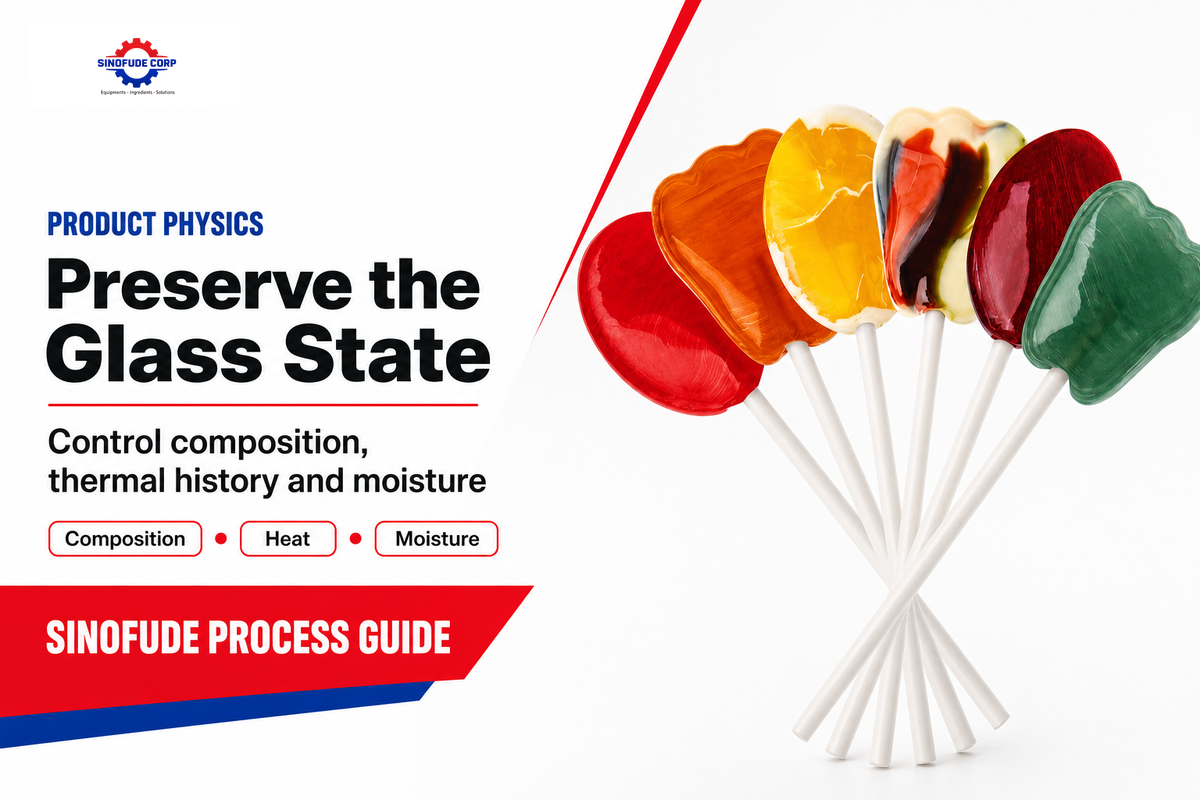
Unlike most other candies, hard candies are designed to be made as a glassy, non-crystalline solid, as opposed to being made with the presence of visible sugar crystals. Therefore, there are two aspects to production control in making hard candies. The first is the control of the composition and thermal history of the candy prior to forming. The second is control of moisture and temperature to prevent finished pieces from exiting the stable glassy state.
Three irreversible transitions
- Concentration: water removal fixes the mass that enters finishing and forming.
- Late-stage addition: acid, flavor, and color choices can change inversion, heat exposure, and sensory quality.
- Glass-state set: cooling establishes the solid structure that packaging must preserve.
| Document vocabulary | How to interpret it in a factory brief |
|---|---|
| Plant and process: production process; process of hard candy; production of hard candies; stages of candy making; making candy; mass production; candy factory; candy makers; batches of hard candy; advanced machinery | Convert the broad phrase into a defined product, route, batch boundary, accepted-output basis, and evidence owner. |
| Materials and chemistry: main ingredients; candy recipes; sugar solution; mixture; candy mixture; sugar mass; sucrose molecules; glucose and fructose; fructose; starch; citric acid; malic acid; crystallize | Record formulation identity, function, dose basis, addition point, dissolution state, and the mechanism each material can change. |
| Product families: hard candy products; sugar confectionery; sugar confections; boiled sweets; rock candy; cotton candy; toffee; softer candies | Treat these as different product families unless the specification proves that formulation, forming, cooling, and packaging requirements are shared. |
| Sensory targets: flavoring; colorants and flavors; hard candy flavors; fruit flavors; mint flavor; sour taste; glossy appearance; visual appeal; desired characteristics | Translate each description into an approved ingredient system, measurable sample, defect boundary, and retained comparison standard. |
| Thermal and cooling language: high temperature; higher temperatures; temperature control; monitor the temperature; heating and cooling; cooling process; candy cooling; cooling tunnel; cooling table; temperature to prevent cracking; reduce moisture content; temperature and water content | Tie every term to formulation, pressure basis, sampling point, calibrated method, residence time, room condition, and downstream result. |
| Quality language: quality control; strict quality control; quality inspection; quality of hard candy; homogeneous mixing; packaging and storage | Replace adjectives with sampling, test methods, limits, records, disposition authority, package performance, and storage-study conditions. |
A peer reviewed article reported on what is known as the ‘classic’ method of producing hard candy. It describes mixing sucrose with glucose or corn syrup, cooking to reduce water, adding sensitive ingredients at a suitable late stage, forming, and cooling the mass into an amorphous product. Reported recipes and operating conditions vary widely, which is why a published number should be treated as context rather than a factory setpoint.
Published context, not universal limits: the review summarizes roughly 135–160 °C cooking conditions across cited hard-candy studies, approximately 2–3% finished moisture in conventional examples, about 70–85 °C initial cooling for some shaping routes, and roughly 20–30 °C final cooling in reported processes. Recipe, pressure, equipment, geometry, sampling, and method determine whether any of these ranges is relevant to a factory trial.
Control principleThe output of every stage is the input specification for the next. A cooker, depositor, die, cooler, or wrapper cannot compensate indefinitely for an uncontrolled upstream handoff.
Ingredients are process variables, not just a recipe list
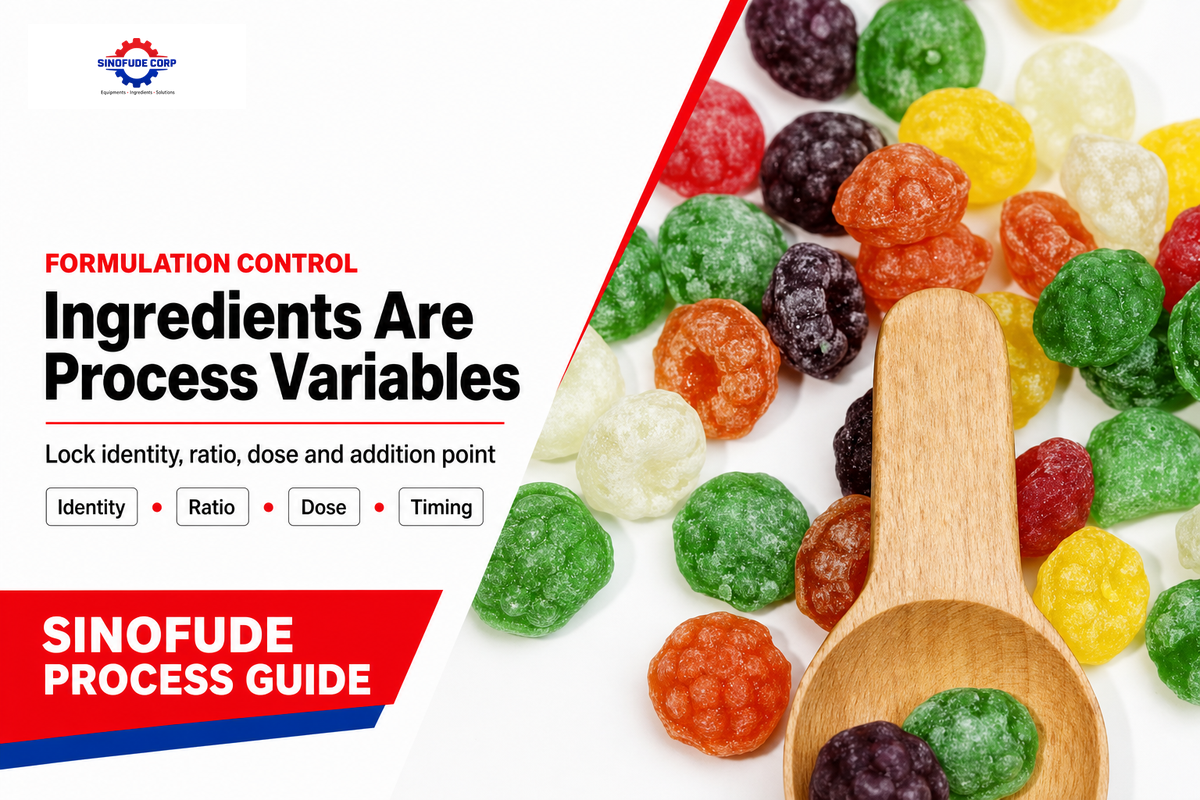
Sucrose builds the main glass-forming structure, while glucose syrup, corn syrup, or another doctoring system helps manage crystallization and changes viscosity, sweetness, hygroscopicity, and glass-transition behavior. Water helps carry and dissolve the ingredients during preparation. However, most of the water needs to be removed before glass formation can take place.
| Input group | Process role | What can move downstream | Evidence to retain |
|---|---|---|---|
| Sucrose + doctoring syrup | Structure, crystallization control, viscosity | Graining, stickiness, forming-window shift | Lot, ratio, solids basis, recipe revision |
| Water | Dissolution and process carrier | Endpoint and shelf-stability burden | Addition mass and endpoint method |
| Acid system | Flavor balance and product chemistry | Inversion, browning, hygroscopicity | Type, dose, addition point, exposure time |
| Flavor and color | Sensory identity | Volatilization, degradation, poor dispersion | Lot, dose, temperature, mixing time |
| Functional or sugar-free system | Product-specific structure and claims | Different cooking, cooling, texture, hygroscopicity, labeling | Separate formulation and validation package |
Sugar-free and polyol hard candies are not one-for-one sucrose substitutions. A polyol system can require distinct dissolution, cooking, depositing, cooling, demolding, humidity control, texture testing, and regulatory review. Therefore, it’s a separate product/process qualification.
Do not copy: a dosage, cook temperature, or moisture target from a supplier sheet or another recipe unless the material basis, equipment, pressure, sampling method, and finished-product acceptance have been aligned.
Stage 1: weighing, dissolving, and preparing a uniform syrup
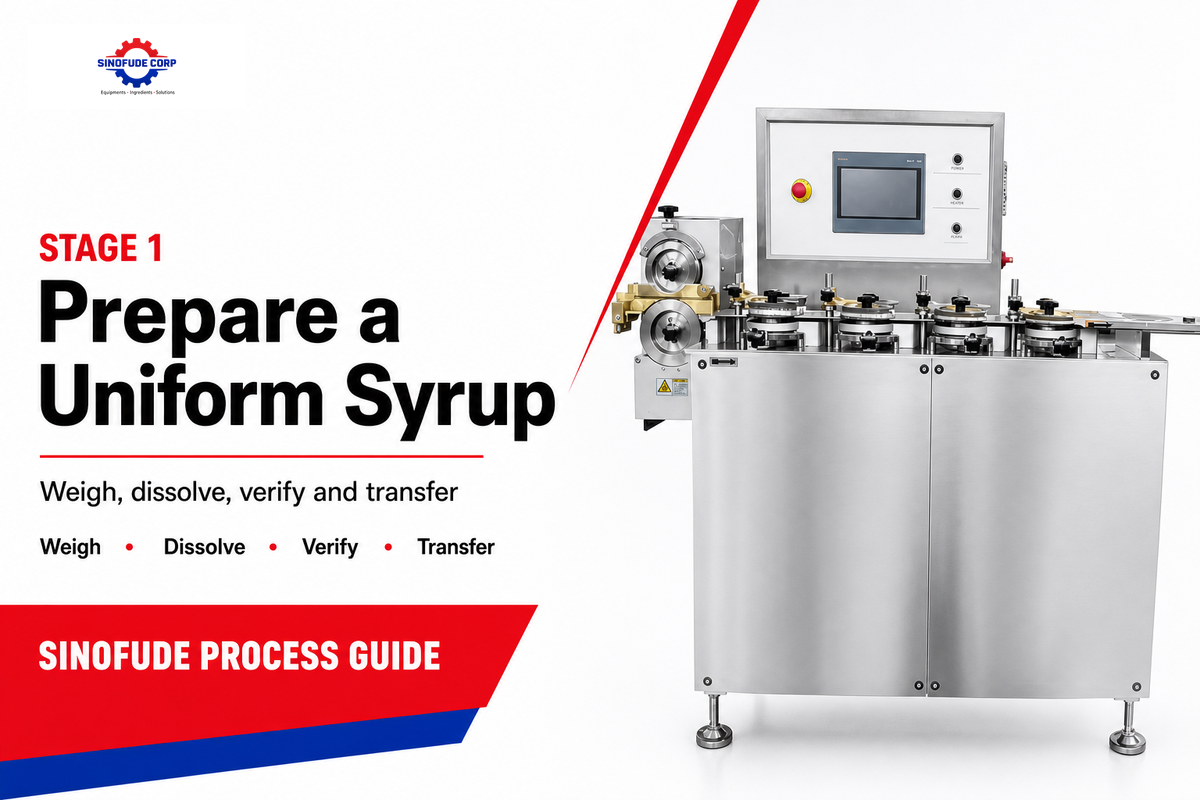
Stage 1 begins with material identity, approved status, lot traceability, recipe revision, and calibrated weighing. The batch should arrive at the cooker as a uniform syrup rather than a nominally correct list of ingredients with undissolved solids, wall deposits, or local compositional differences.
Check before transfer
- Ingredients match the current recipe
- Dry solids are dissolved as required
- Agitation and temperature are recorded
- Filter or strainer status is known where used
Signals to investigate
- Crystals on the vessel wall
- Unusual turbidity or sediment
- Unexplained mass-balance deviation
- Delayed transfer or temperature drift
Seed crystals or errors in the syrup ratio can survive the cooking process and lead to graining or opacities and poor handling. The question for practical release is simple: what measurement or observation proves the batch is homogeneous prior to starting the concentration?
Stage 1 handoff: recipe and lot identity + actual weights + dissolution evidence + syrup condition + transfer time.
Stage 2: cooking and concentration, when temperature is enough, and when it is not
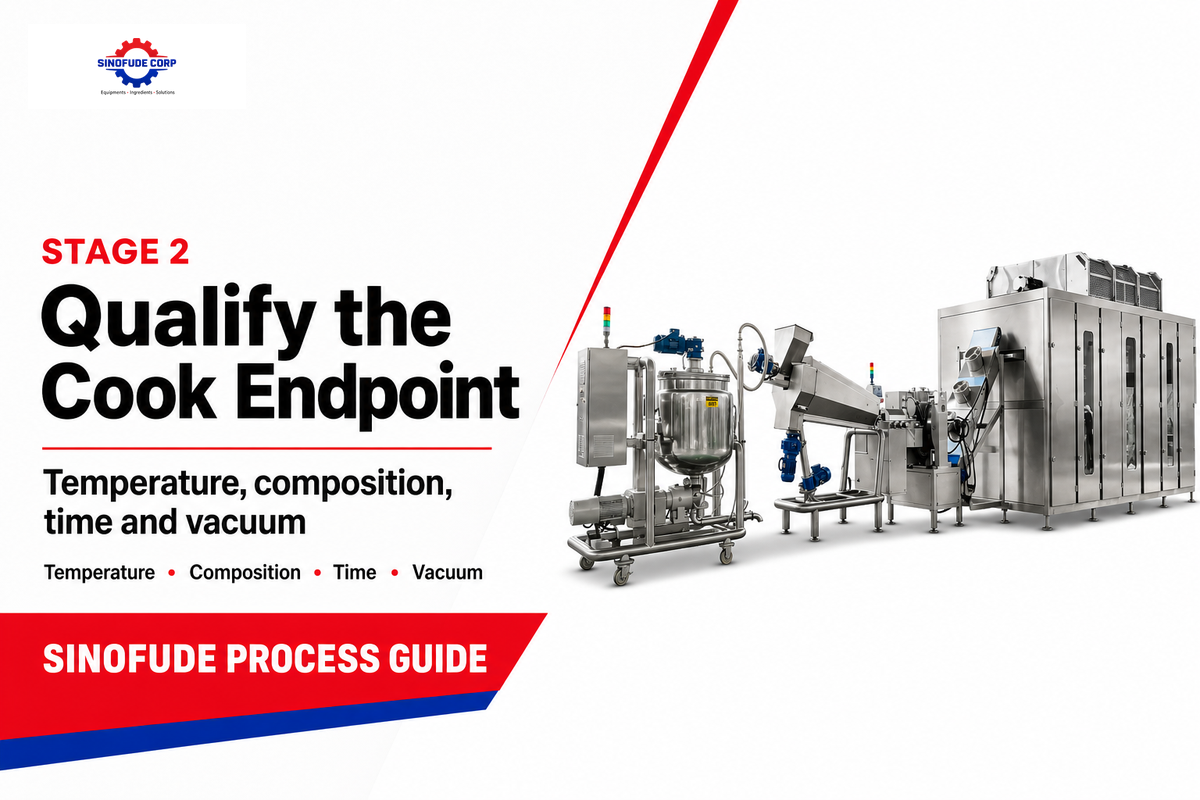
Cooking removes water and builds the concentrated mass required for glass formation. Both atmospheric and vacuum cooking are valid, but the temperatures, pressure basis, and residence times, as well as the points of sampling, aren’t the same in both types of cooking.
Endpoint Triangle
Temperature
Product temperature, pressure or elevation context, sampling location, and instrument calibration.
Product temperature, pressure or elevation context, sampling location, and instrument calibration.
Composition
Validated soluble-solids, residual-moisture, or related method appropriate to the formulation.
Validated soluble-solids, residual-moisture, or related method appropriate to the formulation.
Time, vacuum history
Residence time, pressure convention, vacuum stability, and exposure after the nominal endpoint.
Residence time, pressure convention, vacuum stability, and exposure after the nominal endpoint.
Use rule: finish temperature may be a valid endpoint inside a fixed formulation, pressure/elevation, sampling, and calibrated-instrument context. It becomes weak evidence when copied across recipes, plants, or cooker systems without normalization.
CSU Extension pretty convincingly explains why varying elevations lead to changes in boiling behavior and why an adjusted finish temperature can fit a fixed recipe. In a factory, the same logic requires pressure, formulation, instrument, and sampling context; a “hard-crack temperature” alone is not a transferable industrial acceptance specification.
| Endpoint record | Question it answers | Common blind spot |
|---|---|---|
| Calibrated product temperature | Did this controlled process reach its qualified thermal endpoint? | Pressure, elevation, lag, or sampling-point change |
| Solids or residual-moisture method | Was enough water removed on the stated basis? | Method bias or nonrepresentative sample |
| Time and vacuum trend | Was heat and pressure exposure repeatable? | Same endpoint number after a different history |
Excessive heat or hold time can increase inversion and browning, while an incomplete endpoint can leave too much water for stable handling. The correct window is formulation-specific and must be tied to downstream forming, cooling, and storage results.
Safety boundary: a high cooking temperature is not automatically a validated lethality step. Product composition and low-water-activity conditions can change microbial heat resistance, so food-safety validation must be product- and process-specific.
Stage 3: the heat-sensitive addition window for acids, flavors, and colors
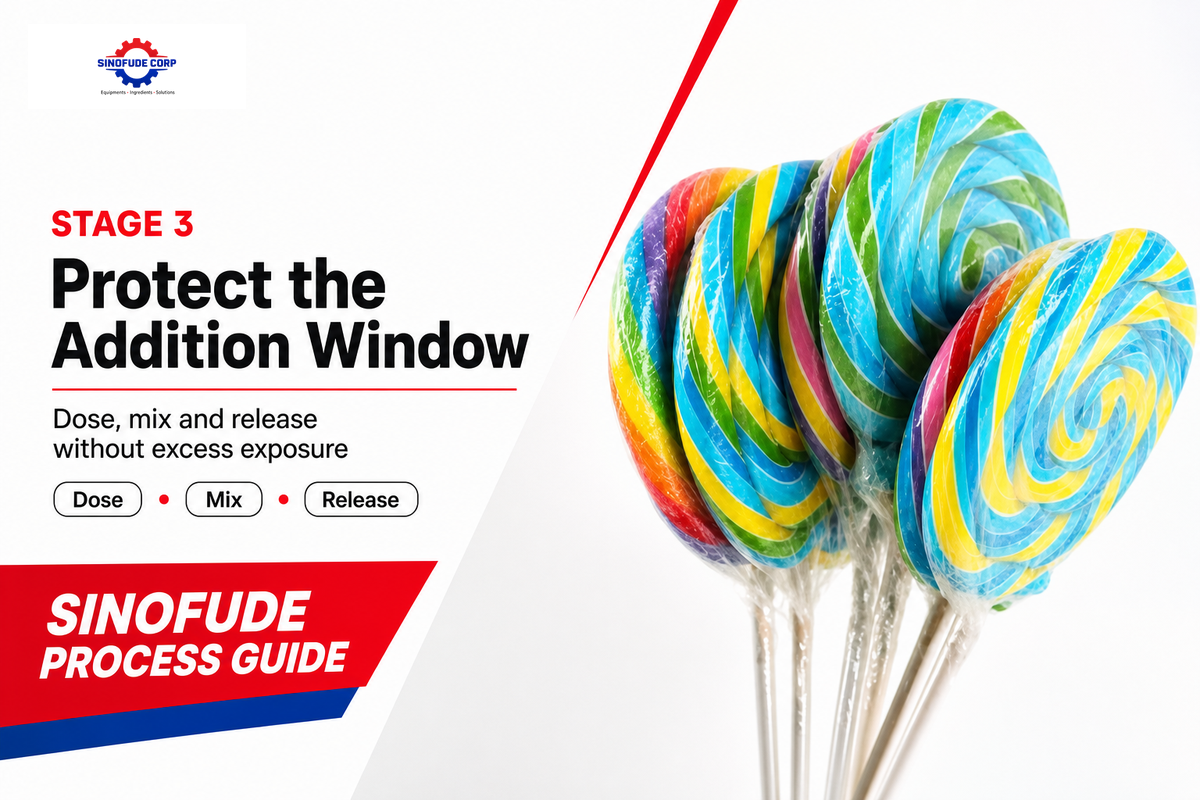
The additions must be made at a temperature that keeps the mass fluid for thorough mixing, yet cool enough to avoid excessive volatilization, degradation, inversion and local over-acidification. There is no single safe addition temperature for every acid, flavor, colorant, formulation, or mixer.
Heat-Sensitive Addition Window
- Define the mass condition at the addition point.
- Record ingredient lot, dose, sequence, and actual addition time.
- Verify mixing completeness without unnecessary hot hold.
- Connect acid exposure back to the cooking history and forward to storage behavior.
- Release the mass to forming before viscosity leaves the qualified window.
The mechanisms of acid-catalyzed inversion of sucrose are cross-stage variables, and interactions with water, temperature, timing of exposure, and the type and amount of acid complicate the mechanisms. If inversion or hygroscopicity is suspected in a sticky product, reviewing only the acid station misses part of the mechanism.
Stage 3 handoff: addition identity + sequence + mass condition + mixing time + hot-hold time + traceable batch record.
Stage 4: depositing, rope forming, dies, and drop rollers
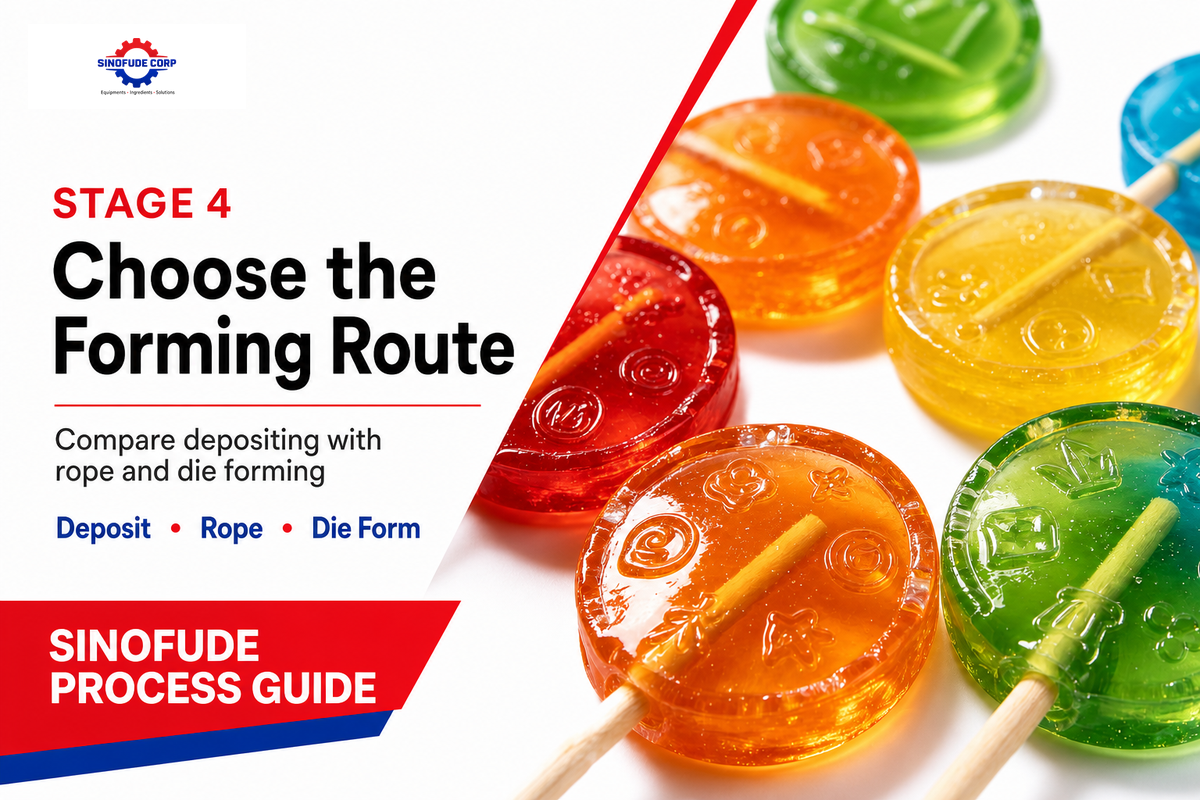
Hard-candy forming falls into two broad families. The first group is hot-fluid casting into a mold (mould). The second group includes batch rolling, rope forming, sizing, ball forming, chain or rotary die, stamping, equipment such as drop rollers, and documented configurations; this second group isn’t a universal listing of all the configurations.
| Route | Mass at entry | Best evaluated for | Evidence to request | Watch point |
|---|---|---|---|---|
| Depositing | Hot, fluid mass | Metering, cavity fill, shapes, colors, centers where configured | Piece-weight map, nozzle/cavity pattern, release and cooling results | Viscosity drift, tails, air, mould condition |
| Rope + die | Tempered, plastic mass | Rope stability, die geometry, change parts, center-fill compatibility | Rope condition, piece geometry, seam/center evidence, scrap handling | Cracking, sticking, sizing drift |
| Drop roller / related shaping | Conditioned sheet or mass | Product geometry, separation, tooling, changeover | Piece separation, geometry distribution, rework and cleaning plan | Web handling, fines, tool temperature |
No universal route is usually the best choice. Product geometry, recipe behavior, centers or color pattern, tooling burden, changeover, scrap handling, downstream cooling, and the acceptance plan decide the fit.
For route-specific planning, compare the candy depositing machine scope with the product brief, then use the hard candy route fit checker to structure the initial screening.
Commercial handoff: once the product and evidence requirements are fixed, review a suitable hard candy machine configuration against the same controlled brief. Compare accepted packed output and test conditions, not headline speed alone.
Stage 5: cooling and conditioning without trapping a sticky surface
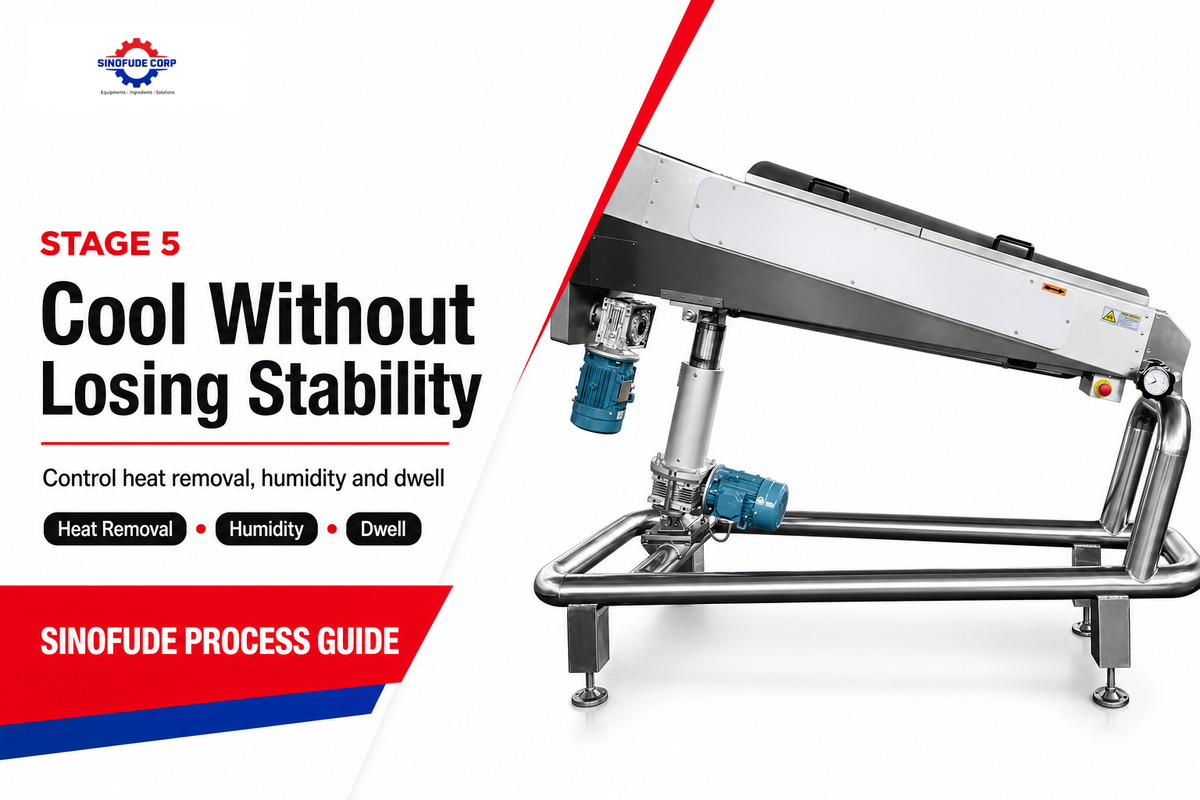
Cooling must be done at a rate that prevents loss of geometry and ensures the product is stable for separation, inspection, and wrapping. Product size, belt loading, contact surfaces, air temperature, humidity, residence time, and room dew point can all affect the handoff.
Glass-State Preservation Checklist
Product condition
Temperature, surface, separation, deformation
Temperature, surface, separation, deformation
Room condition
Temperature, humidity, dew-point margin
Temperature, humidity, dew-point margin
Exposure time
Delay before wrapping and unprotected dwell
Delay before wrapping and unprotected dwell
Wrapper barrier
Material structure and moisture protection
Material structure and moisture protection
Seal integrity
Setup, contamination, challenge method
Setup, contamination, challenge method
Storage/distribution
Climate, cycling, handling, intended duration
Climate, cycling, handling, intended duration
Water activity and glass-transition margin shouldn’t be used interchangeably. Water can be absorbed and plasticize the amorphous regions, thus lowering the glass transition temperature. The physical mobility is described by the temperature margin to glass transition. Measure and interpret each of these for the respective purposes.
Important: “fully hard” does not mean “safe to leave unprotected in a humid room.” Condensation or slow moisture pickup can create a surface problem after the piece has already passed a hardness check.
Stages 6 and 7: inspection, wrapping, storage, and release evidence
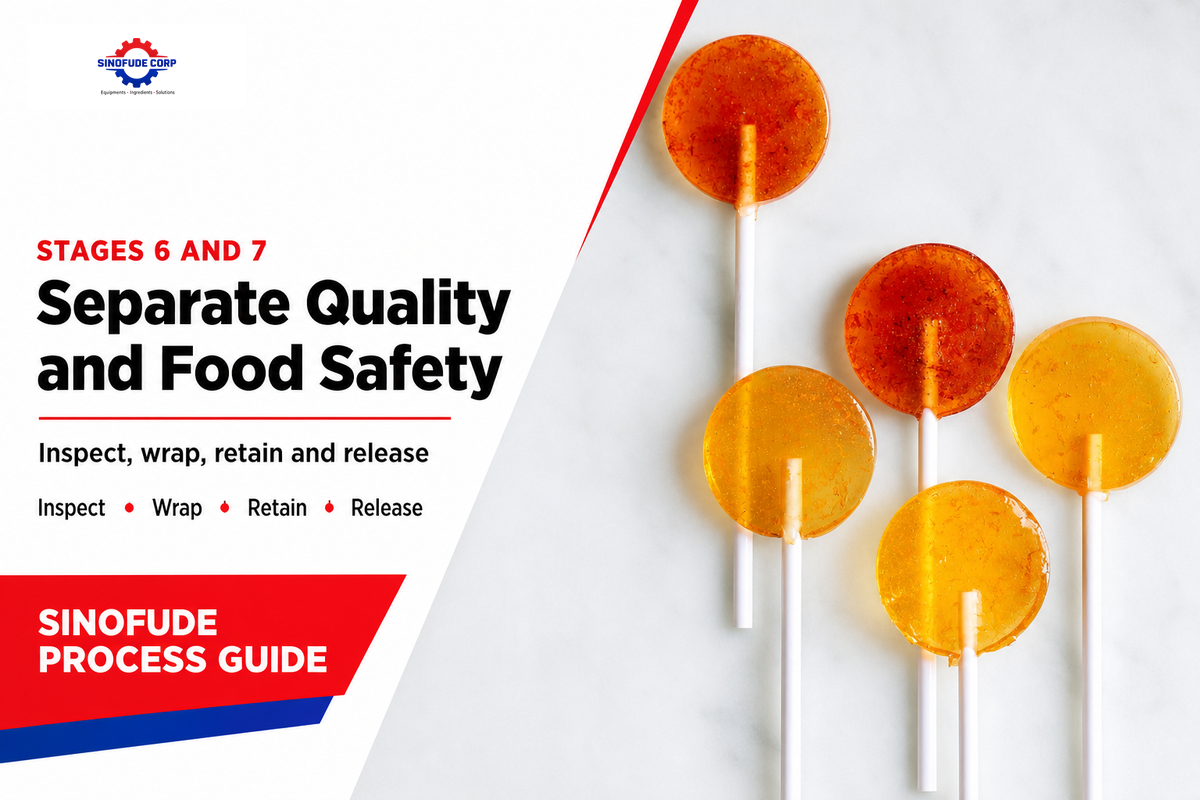
A product release requires two separate lanes that come together at the “lot” decision, but each performs a distinct function. Quality evidence in this context will address whether the candy and packaging comply with the agreed product standard. Food-safety evidence asks whether applicable hazards and preventive controls were handled under the facility’s hazard analysis.
| Lane | Typical evidence | What it does not prove | Decision owner |
|---|---|---|---|
| Product quality | Appearance, piece weight and dimensions, agreed texture/hardness method, composition or moisture method where applicable, seal integrity, code, retain samples | Validated lethality, allergen control, sanitation, label compliance, or complete hazard control | QA under the approved product specification |
| Food safety | Hazard analysis, applicable preventive controls, allergen/label checks, sanitation, monitoring, corrective action, verification, supply-chain records | Marketable appearance, desired texture, pack aesthetics, or promised shelf life | Qualified food-safety team under the facility plan |
For US facilities to which this Rule applies, 21 CFR 117.130 requires a hazard analysis for each food and includes factors such as formulation, ingredients, processing, equipment, packaging, labeling, storage, and distribution, sanitation, and intended use. The applicability and specific controls are facility-specific. This article shouldn’t be construed as legal advice.
Low moisture is not a waiver: a low-water-activity product and a high cook temperature do not by themselves establish a validated pathogen reduction. Product matrix, process conditions, equipment, and post-process exposure still matter.
Packaging controls process stability due to the movement of moisture through materials, and poor seals, pinholes, or damage resulting in moisture contamination. The study must capture the actual formula, barrier, and seal, along with the intended duration, headspace, and climate cycling, and handling.
Product
Formula, endpoint, geometry, surface condition
Formula, endpoint, geometry, surface condition
Package
Barrier, seal, fit, code, integrity
Barrier, seal, fit, code, integrity
Distribution
Temperature, humidity, cycling, duration, handling
Temperature, humidity, cycling, duration, handling
Defect-to-Control Backtrack Matrix
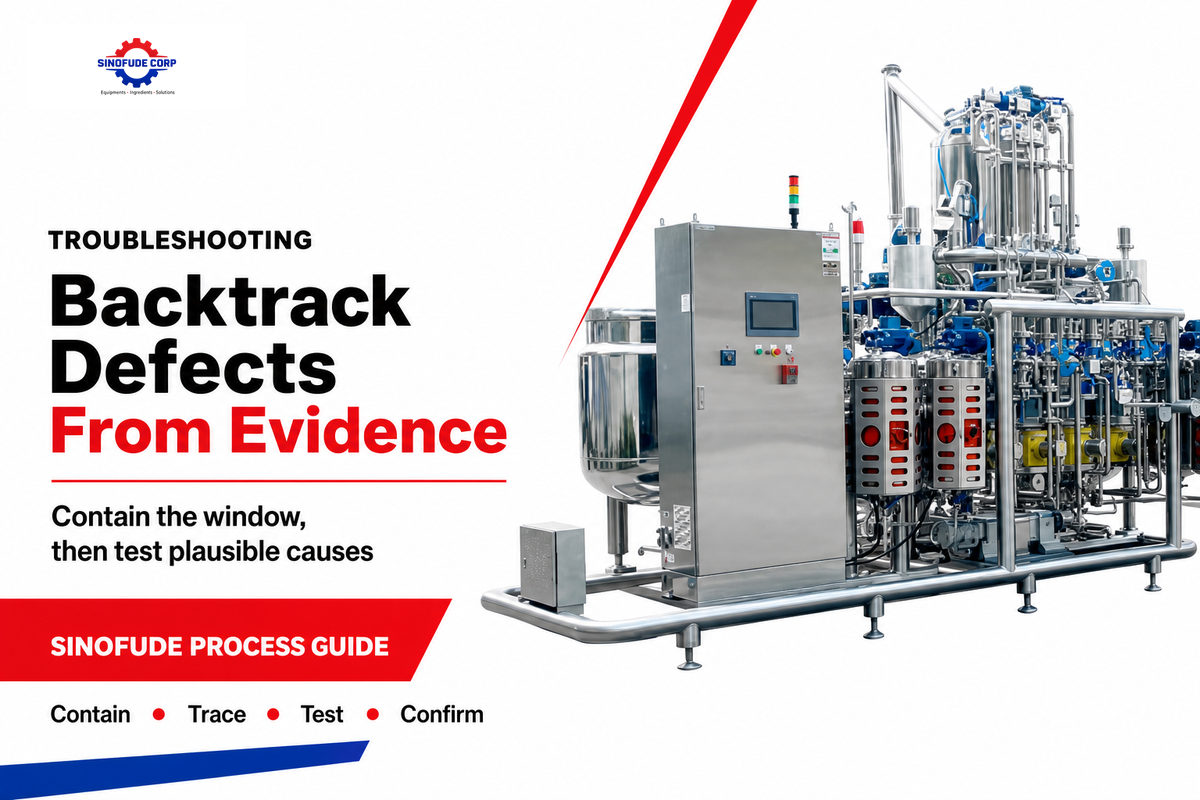
A finished defect rarely reports its cause. Start with the failure you observed and determine the last measured condition that was still acceptable. Then contain the affected time or batch window. Finally, test the few upstream mechanisms that can explain the evidence.
| Defect | Plausible upstream sources | Check first | Then verify | Avoid this shortcut |
|---|---|---|---|---|
| Sticky surface | Endpoint, hygroscopic inputs, inversion, humid air, condensation, delayed wrap, barrier or seal | Batch endpoint + room/dew-point trend + exposure time | Wrapper and seal + retained-sample history | Blaming the cooler alone |
| Graining / opacity | Seed crystals, ratio error, agitation, wall deposits, hold, moisture pickup | Dissolution and recipe record | Cook/hold and storage exposure | Changing one temperature blindly |
| Bubbles / tails | Air inclusion, mass viscosity, hopper/nozzle condition, deposit cutoff | Pattern by nozzle/cavity and time | Mass temperature and feed continuity | Averaging away a positional pattern |
| Weight variation | Feed pressure, viscosity, piston/valve, rope sizing, tool wear | Distribution by position and sequence | Feed and forming condition | Using only an overall mean |
| Cracks / deformation | Thermal gradient, residence time, transfer stress, geometry, demolding condition | Cooling position and piece condition | Air/contact/loading history | Treating all defects as one population |
| Open or contaminated seal | Product condition, infeed, film, jaw condition, settings, debris | Affected interval and seal challenge | Infeed state, material lot, setup and cleaning | Releasing on visual appearance only |
This matrix is a troubleshooting sequence, not a promise that one observed defect has one cause. Its purpose is to preserve evidence long enough to distinguish a batch mechanism, room condition, machine pattern, or package failure.
Retention rule: keep enough endpoint, environment, position, time, reject, package, and retained-sample data to connect a later complaint back to the responsible process window.
Decision framework: turn process requirements into a line specification
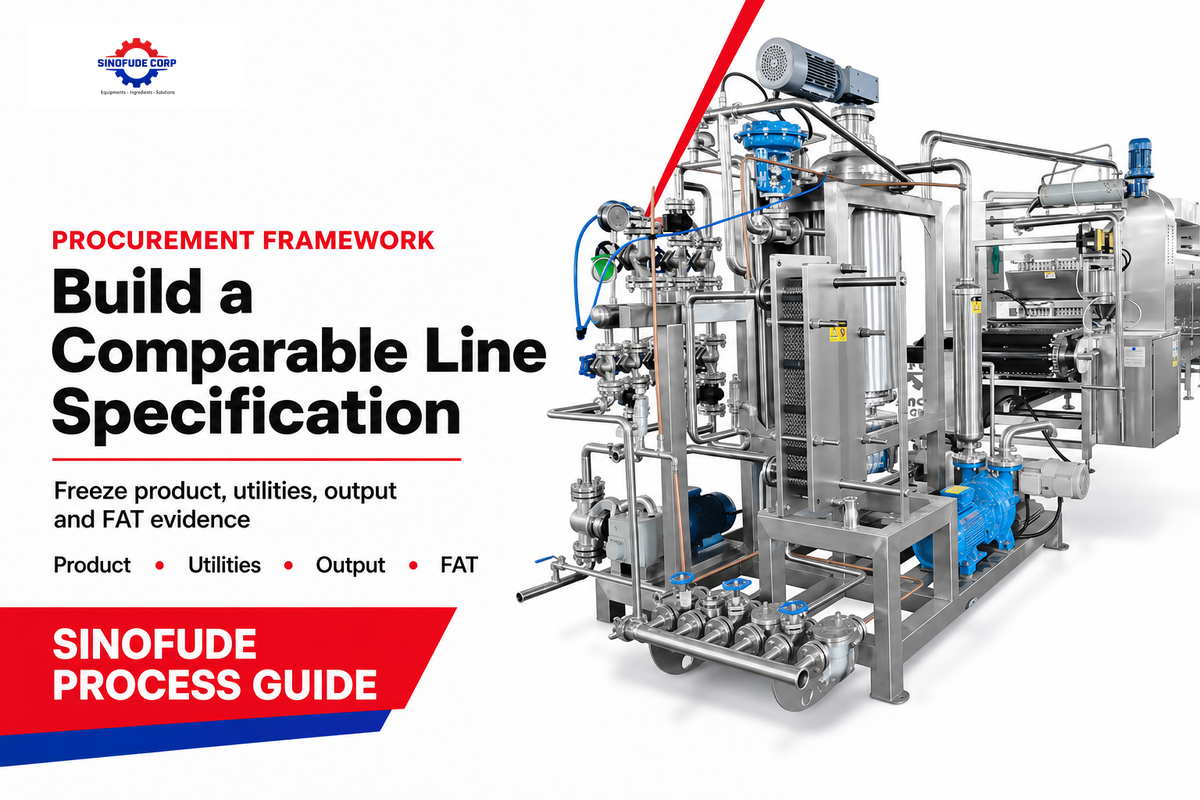
A similar request for quotation begins with product and process boundaries rather than machines. Give each supplier the same formulation family, piece and package definition, forming route, accepted-output basis, utilities, cleaning expectations, changeover plan, room conditions, and acceptance evidence.
| Scope category | Freeze before quote | FAT evidence | Site evidence | Owner |
|---|---|---|---|---|
| Product/formulation | Recipe family, ingredient constraints, sugar/sugar-free boundary | Representative material and recorded conditions | Approved production recipe and change control | Process + QA |
| Forming and piece | Route, mass, geometry, center/color, tooling | Weight/geometry distribution and defect map | Production sampling and tool/change-part control | Production + QA |
| Accepted output | Good packed output, test duration, exclusions | Raw counts, rejects, stops, changeover and intervention log | Repeat under agreed utilities and room conditions | Plant + procurement |
| Utilities and room | Power, air, water, vacuum, cooling and ambient basis | Connection and consumption record under the test condition | Installed utility and room-condition confirmation | Engineering + plant |
| Changeover | Recipe, color, flavor, allergen, tool and package transition | Timed steps, interventions, retained material and first-good-piece evidence | Approved procedure, training and line-clearance record | Production + QA |
| Package interface | Product condition, wrapper format, film, coding and handoff | Infeed stability, damage, seal and code checks | Qualified material, seal setup and shelf-study ownership | Packaging + QA |
| Hygienic design | Intended use, materials, cleanability, access, drainability | Visual/access review and documentation | Installed access, cleaning method, validation ownership | Food safety + engineering |
| Controls and records | Critical variables, alarms, recipes, audit trail, data export | Boundary and worst-case challenge tests | Calibration, user access, backup, recovery | Automation + QA |
| Release evidence | Quality and food-safety lanes, package study, documents | Methods, samples, results, deviations and signed disposition | Facility plan, monitoring, verification and lot release | QA + food-safety team |
Ask for raw results and test conditions rather than only “pass.” A capacity statement is meaningful only when it names the product, recipe condition, piece size, forming route, qualified runtime, reject disposition, package, utilities, room conditions, and output basis.
Teams that need a consistent supplier input pack can organize those fields in SINOFUDE’s hard candy line RFQ builder.
Procurement veto: if two quotations assume different products, cooling duties, changeovers, accepted-output definitions, or evidence packages, they are not yet comparable.
How SINOFUDE fits into the specification process
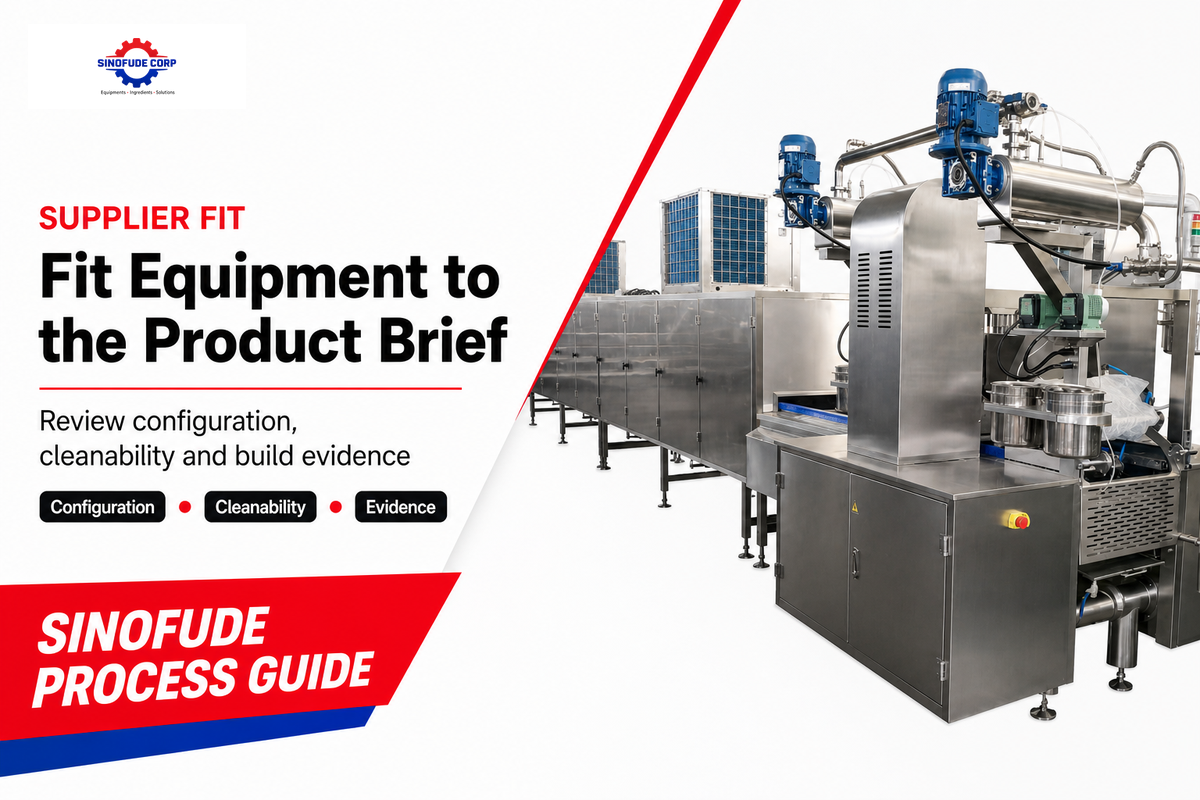
SINOFUDE states that its brand was founded in Shanghai in 1998. The user-supplied first-party brief states more than 30 years of development in confectionery, chocolate, and bakery industrial process design and production equipment technology. For company context, visit SINOFUDE.
The same first-party brief states that the company has three factories, more than 200 employees, and 38 product patents. SINOFUDE also reports ISO 9001 management adoption in 2004 and CE and UL coverage for many products. Those figures, certification scopes, and patent scopes must still be verified against the exact equipment offered; they do not prove a particular candy result or line capacity.
First-party scope: SINOFUDE describes laser cutting and welding, friction and tube welding, CNC sawing and wire cutting, machining centers, lathes, drilling, and gantry milling in its component manufacture capability. These statements help frame questions about build quality, accuracy, and cleanability; they do not by themselves promise performance outcomes or prove a specific line capacity, candy result, or sanitary acceptance.
The most useful supplier conversation therefore starts with the controlled product brief and the scoring template provided above. This gives SINOFUDE a controlled framework for configuration and gives the buyer an evidentiary framework for rating the response.
Bring a Reviewable Hard Candy Brief
Share the formulation family, target piece, forming route, accepted-output basis, room and utility conditions, package, changeover plan, and FAT evidence. SINOFUDE can review the line boundary against those requirements.
Frequently asked questions
What are the main stages of the hard candy manufacturing process?
Answer
A practical factory sequence is syrup preparation, cooking and concentration, late addition of acids/flavors/colors, forming, cooling, inspection, and packaging/release. Each stage needs a defined input condition, controlled variables, and a measurable output for the next stage. The sequence is useful for line design, but it doesn’t replace the facility’s hazard analysis, preventive controls, sanitation, allergen management, or finished-product specification.
What temperature is hard candy cooked to?
Answer
There is no single factory temperature that guarantees every hard-candy endpoint. Finish temperature can work as process evidence when formulation, pressure or elevation, sampling point, instrument calibration, and operating method are fixed. Vacuum cooking changes the relationship among product temperature, pressure, time, and water removal. A transferable industrial process should document the endpoint method and confirm it against composition or residual-moisture evidence and finished-product performance.
How does vacuum cooking help hard candy production?
Answer
Vacuum reduces the boiling temperature at a given composition and can reduce the thermal exposure required to remove water, depending on the cooker design and operating sequence. It doesn’t create a universal recipe or guarantee lighter color, flavor retention, or target moisture by itself. Pressure convention, residence time, product temperature, feed condition, vacuum stability, sampling, and downstream forming results must be recorded together.
Why does hard candy become sticky after cooling?
Answer
Stickiness can begin with an incomplete cooking endpoint, a hygroscopic formulation, excessive acid-driven inversion, condensation, humid cooling or packing air, a delay before wrapping, an inadequate moisture barrier, or a seal defect. Review batch endpoint evidence, room temperature and dew point, unprotected exposure time, wrapper specification, seal integrity, and retained-sample history before assigning the problem to one machine.
Is water activity the same as moisture content or glass transition?
Answer
No. Moisture content describes how much water is present on the stated measurement basis, while water activity relates to the availability or thermodynamic state of water under defined conditions. Glass transition describes a physical-state change in the amorphous matrix. Moisture uptake can lower glass transition and increase mobility, so these measurements interact, but they shouldn’t be substituted for one another without a validated method and decision rule.
Should hard candy be deposited or die formed?
Answer
The choice depends on the recipe’s forming behavior, piece geometry, colors or centers, tooling, weight-control method, changeover, scrap handling, cooling duty, and required acceptance evidence. Depositing meters a hot fluid mass into moulds; die routes generally temper the mass into a workable plastic state and form a rope or related feed. A representative trial should prove the selected route under the intended product and room conditions.
What should a hard candy line FAT prove?
Answer
A useful factory acceptance test should bind the product and test conditions, then show endpoint control, forming distribution, cooling handoff, reject handling, alarms, changeover, cleaning access, controls, records, and accepted-output calculation. It should document raw results, deviations, stops, excluded material, sampling, measurement capability, and responsible sign-off. Food-safety validation and site-specific release responsibilities remain distinct unless explicitly included and supported.
Research transparency
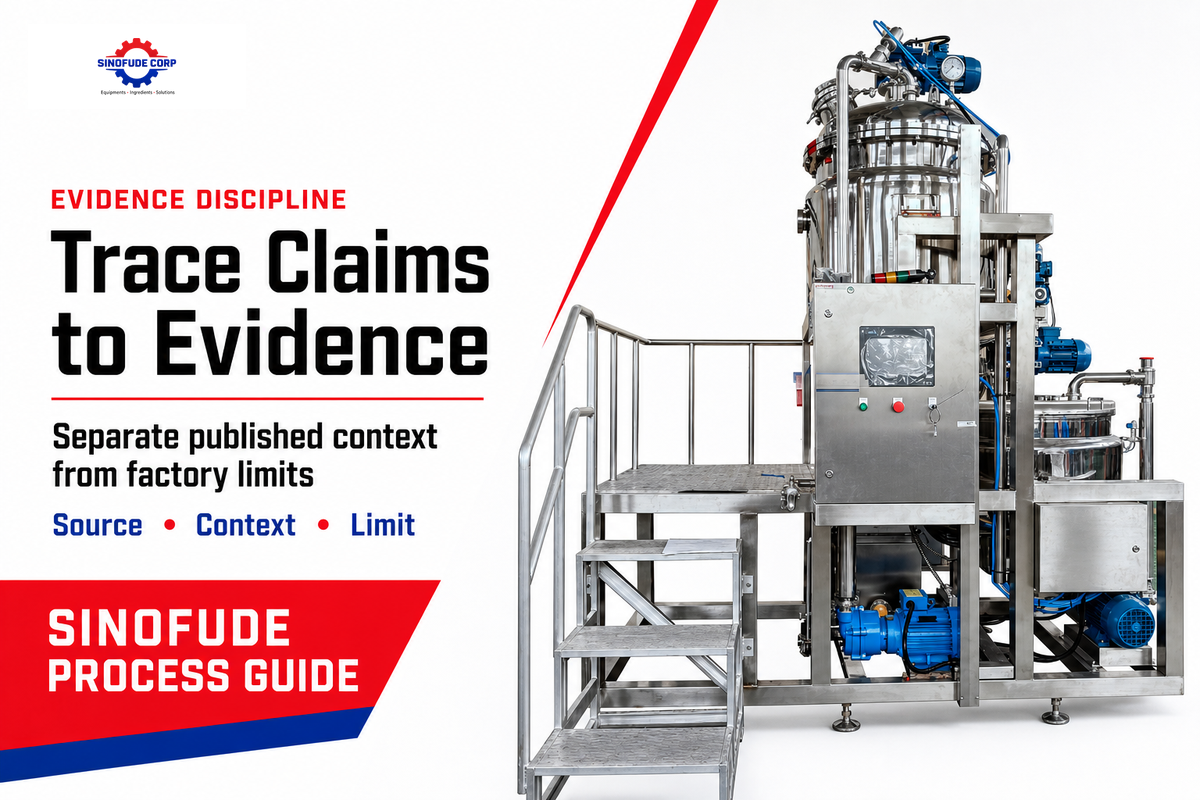
This guide uses reviewed academic, university, regulatory, professional, standards-scope, and equipment-process sources plus first-party context supplied by SINOFUDE. It doesn’t invent a universal cook temperature, moisture or water-activity limit, cooling condition, capacity, OEE, MOQ, price, lead time, shelf life, certification scope, customer result, or food-safety guarantee.
References & sources
- Hard Candy Production and Quality Parameters: A Review
- Hard-candy composition, glass transition, crystallinity, TSS and water-activity study
- Colorado State University Extension: Candy Making at High Elevation
- 21 CFR 117.130: Hazard Analysis
- IFT: Controlling Moisture in Foods Using Packaging
- ISO 14159: Safety of Machinery, Hygiene Requirements
- EHEDG: Hygienic Design Principles