
Get in Touch with SINOFUDE Company

Certification & Compliance for Food Processing Equipment: A Buyer’s Guide

Certification & Compliance is not a single badge, certificate, or supplier promise. For a food processing or confectionery line, it is a body of evidence matched to the destination, machine configuration, responsible parties, intended food contact, and the date the equipment is placed on the market or put into service.
This guide answers questions that procurement, engineering, and quality assurance teams routinely ask. It provides buyer information, not legal advice. The four-gate dossier below is an editorial due diligence framework, not a statutory procedure.
This article addresses industrial food equipment. Search results about compliance training, compliance courses, a certificate in compliance, or a compliance certificate belong to career education, not this buyer guide. CCEP, compliance officers, and a compliance professional also describe a different search intent.
Corporate compliance, compliance and risk management, and “best compliance” credential comparisons are outside this scope. The same applies to compliance programs for a compliance manager, internal audit, anti-money laundering or AML compliance, the General Data Protection Regulation, and course content for compliance teams.
Here, compliance certification and regulatory compliance mean matching machinery evidence to regulatory frameworks and legal obligations. The compliance framework connects compliance risk, legal compliance, project management, compliance responsibilities, risk control, and a practical risk management framework. This international compliance path helps procurement teams assess whether certifications help the supplied configuration, rather than treating a certified compliance label as proof.
What Certification & Compliance Means for a Food Machinery Buyer
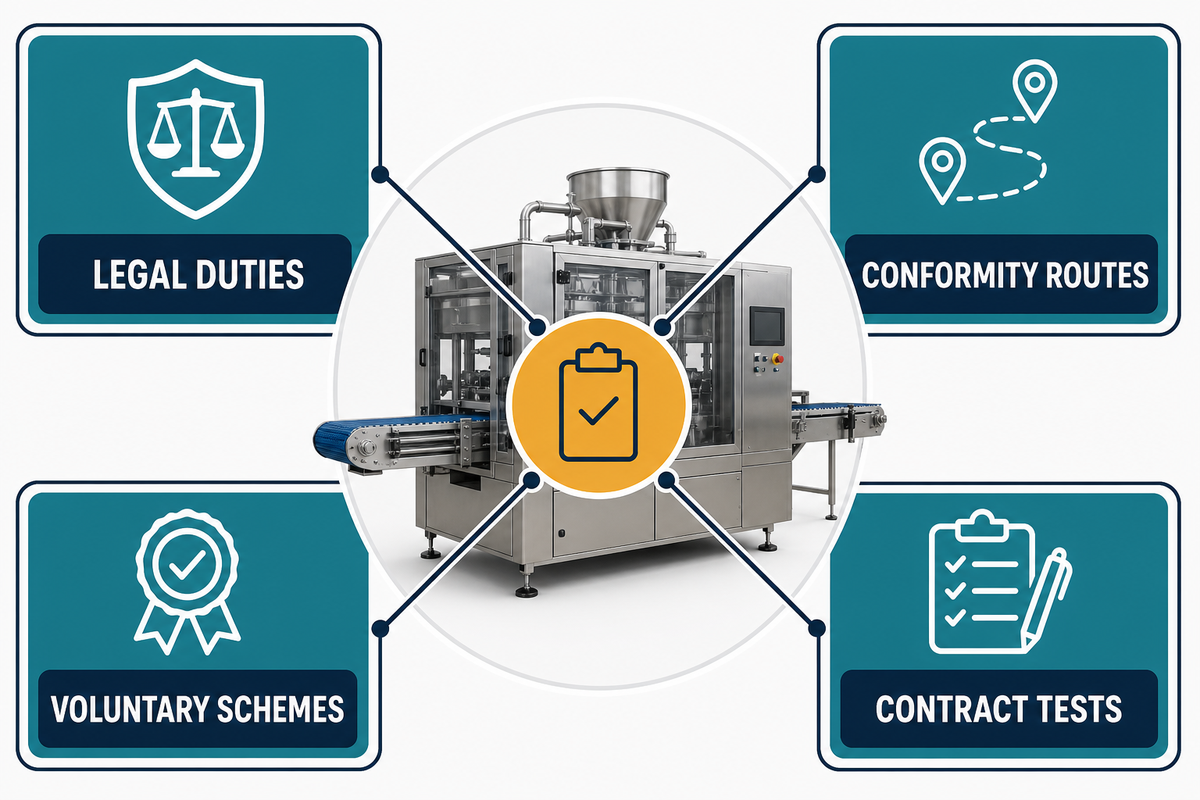
Four things are usually condensed into the term “compliance.” These can include legal requirements, conformity routes, voluntary schemes, and contractual requirements. Legal requirements can place duties on manufacturers, importers, integrators, employers, and/or food businesses. Conformity routes can require declarations, technical documentation, tests, and/or third-party involvement. Voluntary schemes can help demonstrate hygienic design or electrical safety. Buyers can also require contractual tests that go beyond legal requirements; the EU Machinery Directive illustrates why duties, declarations, and technical documentation must be distinguished.
| Question | What it establishes | What it does not establish |
|---|---|---|
| Applicable law | Which duties and responsible parties apply | That a supplied machine actually meets them |
| Declaration or certificate | A claim within a stated scope | Universal approval for every configuration |
| Test report or listing | Results or certification for identified products and standards | Coverage of unlisted options, field changes, or other jurisdictions |
| Factory acceptance test | Performance against an agreed test plan before shipment | Installed-line compliance or safe integration at site |
| Technical documentation | Design and conformity evidence retained under the applicable route | An automatic customer right to every confidential record |
| Food-contact statement | Material suitability within named conditions of use | Whole-machine approval or coverage of another supplier |
| Management-system certificate | A management system within the certified scope | Product conformity for every machine or option |
| Installation inspection | Condition and interfaces at the installed site | That future changes remain covered |
| Change record | What changed and which reviews were reopened | Acceptance of the change without authorized disposition |
The buying task is evidence matching, and the best practices begin with a scope check. A document is only useful when its issuer, legal manufacturer, product identity, revision, standard edition, options, intended use, and destination align with the equipment to be supplied.
Effective compliance management joins internal controls with documented risk assessment. The project framework should connect regulatory requirements to practical controls, assigned responsibilities, and release decisions.
Start With the Destination and the Placing-on-the-Market Date
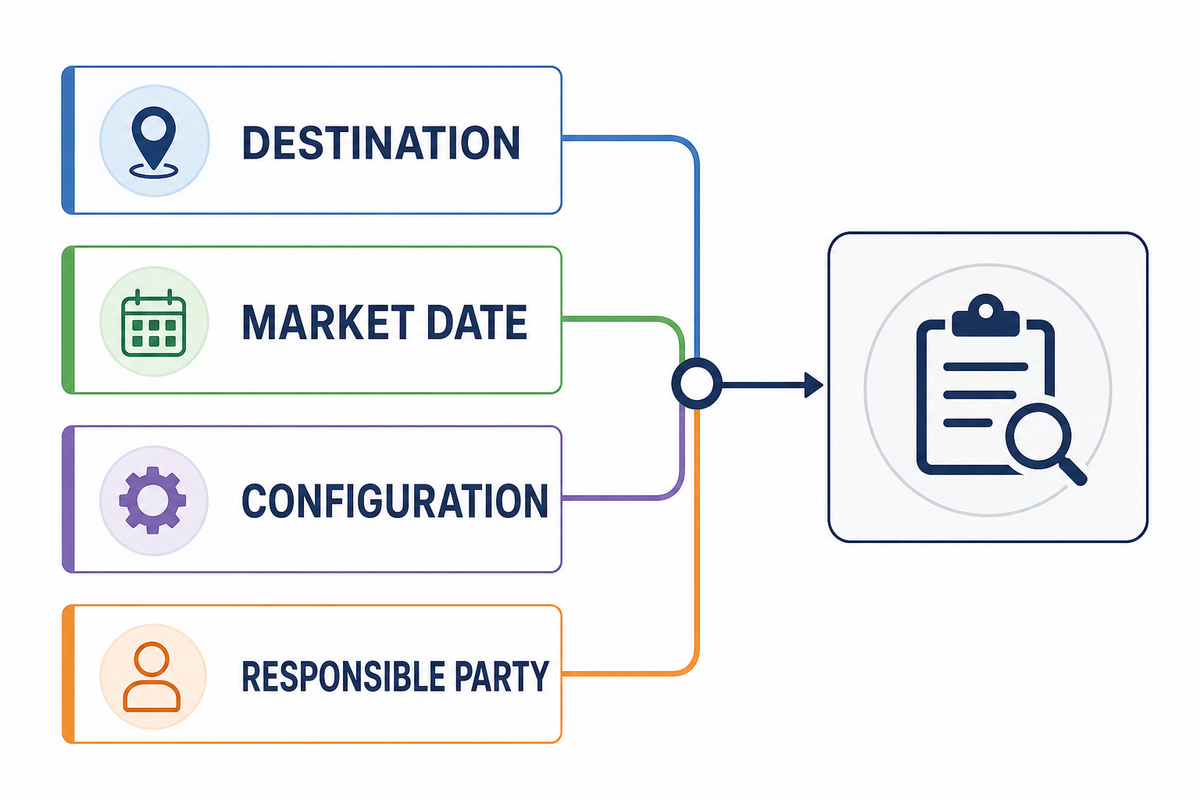
Start with the country of destination and the legally relevant market situation. In the European Union, the machinery framework is still covered by the 2006/42/EC Directive, prior to the general application of Regulation (EU) 2023/1230 on 20 January 2027. The correct route depends on the applicable transition provisions and the facts of placing the product on the market or putting it into service, not merely the purchase-order, factory acceptance, or shipment date, as shown in Regulation (EU) 2023/1230.
- State the country of destination. Don’t use a generic EU, UK or US checklist without jurisdiction review.
- Describe the supply. Is it complete machinery, partly completed machinery, a component, or an assembly of machines?
- There is no single universal “FDA-certified food machine” route. Identify the manufacturer, importer, distributor, integrator, employer, and food business, as applicable.
- Fix the intended configuration. Address guards, controls, software, upstream and downstream interfaces, utilities, and optional modules.
- Confirm the applicable date. Obtain project-specific advice to determine if a transition period applies.
This distinction matters when a buyer sources a depositor, cooling tunnel, conveyor, packaging unit, and control system from different parties. A factory acceptance test can verify the agreed factory configuration. The assembled line still requires a responsibility map and interface review.
Internal policies should state who can enforce compliance, who can address legal questions, and who owns operational risk. Effective management requires knowledge of relevant regulations, including the laws in the European Union that apply to the classified supply.
Keep Machinery Conformity and Food-Contact Compliance in Separate Evidence Lanes
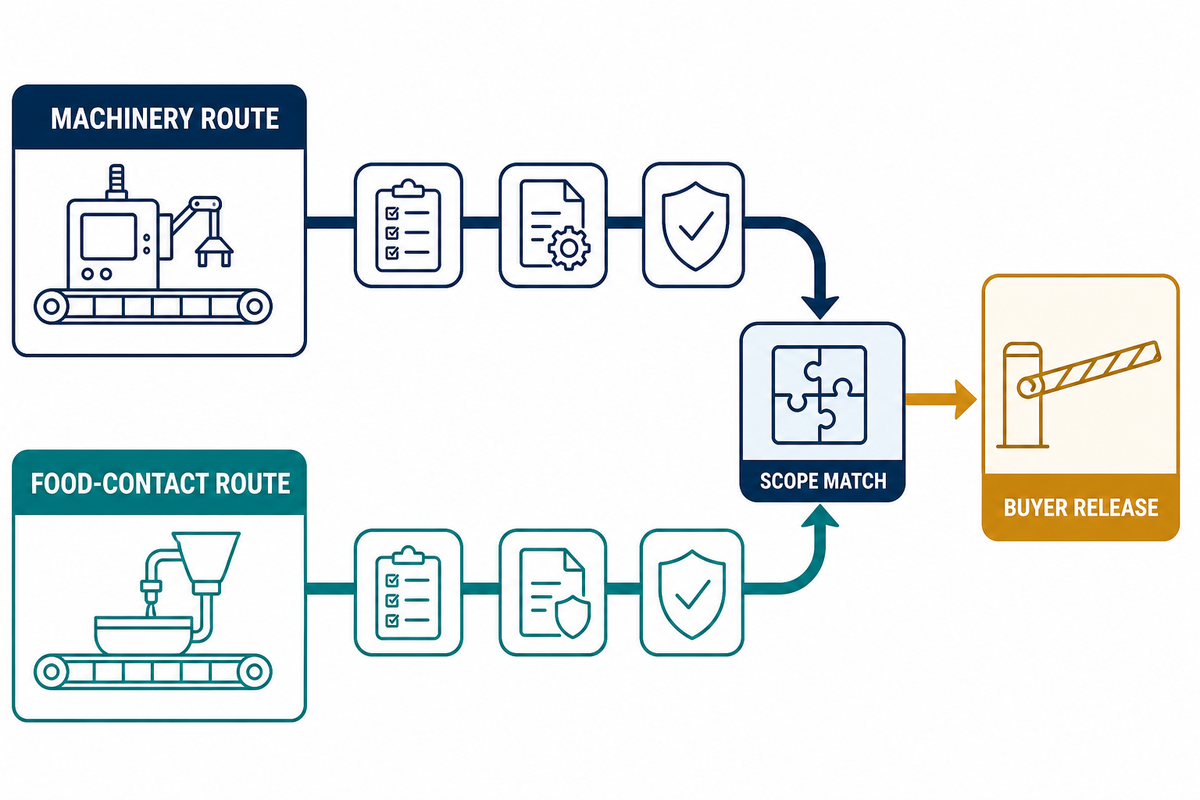
Machinery safety and food-contact compliance are separate evidence lanes. They may concern the same physical component, but they answer different questions. The machinery lane assesses hazards such as moving parts, control-system behavior, access to dangerous parts, guarding, and product conformity. The food-contact lane assesses material suitability for the intended food, contact time and temperature, cleaning, and repeated-use conditions.
| Lane | Typical evidence to request | Buyer check |
|---|---|---|
| Machinery | Declaration, incorporation documents where applicable, instructions, risk-related specifications, standards list | Match the legal entity, model, configuration, and destination route |
| Food contact | Contact-part register, material identity, supplier declarations, migration or test basis where applicable, intended-use limits | Match every contact part to food type, time, temperature, cleaning, and supplier source |
| Hygienic design | Drawings, surface and weld specifications, drainability and cleanability evidence, scheme certificate if specified | Verify scope and inspect inaccessible or product-retaining zones |
The European Commission’s food-contact legislation overview outlines a layered framework of general rules, good manufacturing practice, and material-specific measures. Therefore, “food grade” stainless steel is not a complete dossier. Other components such as gaskets, hoses, belts, coatings, lubricants, plastics, seals, adhesives, and printed parts may require separate assessment.
Notifications for food-contact substances in the US can be limited to a manufacturer, substance, and conditions of use. A familiar substance name or notification number therefore does not automatically cover material made by a different supplier. Procurement should link the regulatory basis to the actual material source and proposed use.
For the United States, Separate FDA, OSHA, Electrical, and Sanitary-Design Routes
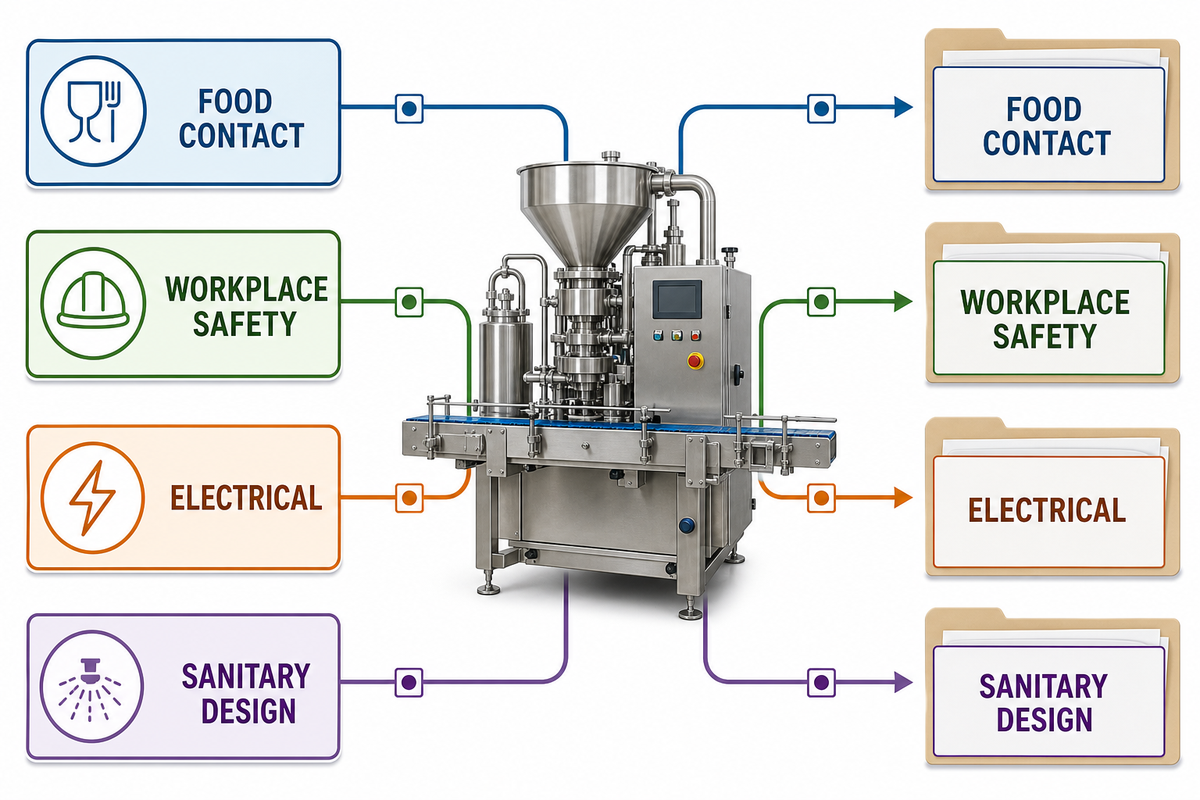
There is no single universal FDA-approved food-machine route. The FDA’s own guidance shows that approval language is category-specific. Buyers should assess food-contact requirements, food-facility and employer-safety duties, electrical approval, local installation review, and any specified sanitary-design scheme as separate routes.
Food and food-contact requirements
Check the intended food, contact materials, processing conditions, cleaning chemicals, and the actual facility obligations. Don’t convert a material statement into a whole-machine approval claim.
Workplace safety
OSHA obligations apply to employers and workplaces, including machine guarding and safe use. A supplier document doesn’t remove the operator’s duties after installation or modification.
Electrical approval
OSHA recognizes Nationally Recognized Testing Laboratories for defined scopes. Verify the exact product, standard, label or listing, options, and whether the local authority or project specification has additional requirements.
Sanitary-design schemes
NSF or other scheme requirements may be valuable or contractually required, but their scope must be checked. Sanitary certification doesn’t automatically establish electrical acceptance, guarding compliance, or suitability for every recipe.
Use those routes to structure the Request for Quotation (RFQ). Suppliers can then provide evidence relevant to each question instead of a folder of unrelated logos and certificates.
For practical scoping, review the relevant food and confectionery machines, the gummy production line or the chocolate production line boundaries before assigning evidence owners.
Verify the Scope Behind Every Mark, Declaration, and Certificate
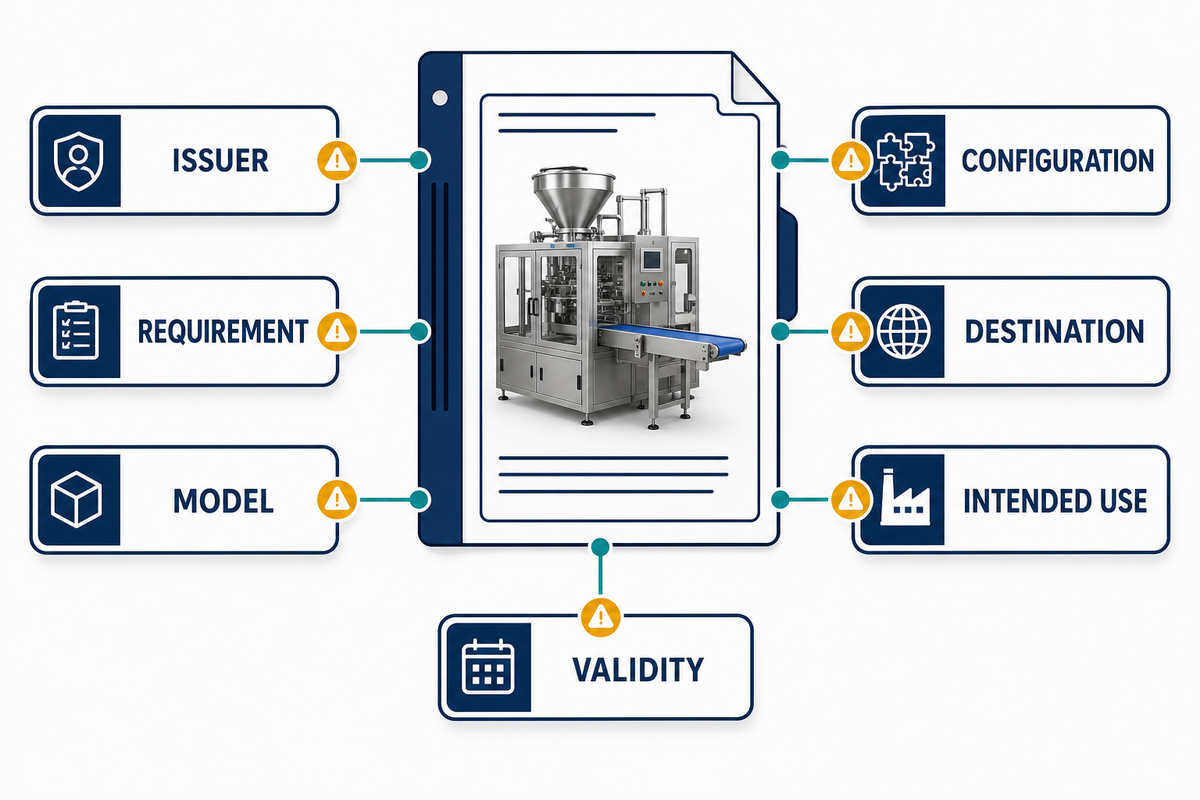
The title of the document is less important than its scope. A CE mark isn’t automatically proof that a notified body certified the machine; the applicable legislation and conformity route determine whether third-party involvement is required. Likewise, a management-system certificate describes a managed system, not the conformity of each item produced by that system; OSHA’s NRTL FAQ shows why product, standard, and laboratory scope must be verified separately.
Use the seven-field scope check
- Legal entity: Is the manufacturer of the named model the legal entity supplying the product?
- Product identity: Does the model, serial range, drawing, or family cover the machine in question?
- Configuration: Are options, software, controls, guards and line interfaces covered?
- Requirement: Which standard, scheme, regulation, or contract is named?
- Edition and date: Is the edition appropriate to the relevant market event?
- Issuer and status: Can the issuing body be identified, is its recognition relevant to the claimed scope, and what status or surveillance limits apply?
- Conditions and exclusions: What limits such as recipe, end use, cleaning, and temperature remain?
Build a Four-Gate Compliance Dossier Before FAT and Shipment
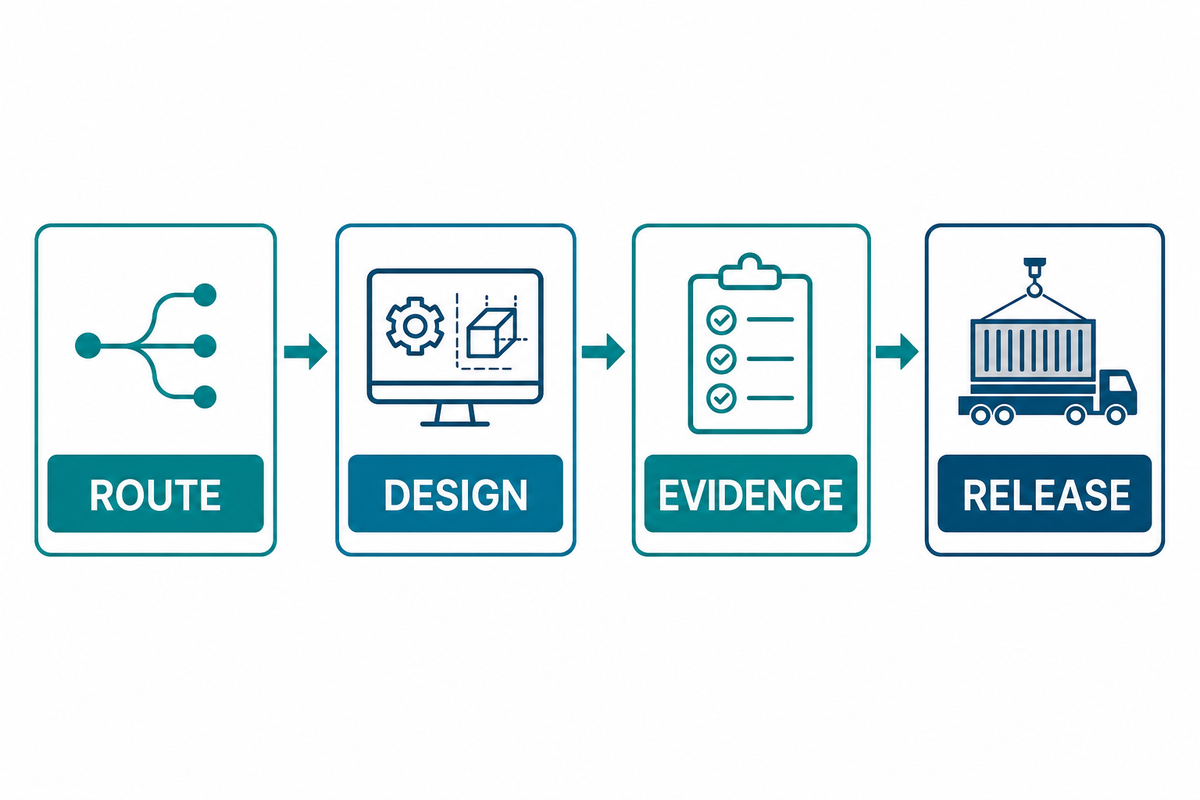
The following “four-gate dossier” for procurement control is a framework. It establishes a link between each requirement and an owner, piece of evidence, and release decision to help prevent surprises.
| Gate | Decision | Minimum buyer output |
|---|---|---|
| 1. Route | What requirements apply? | Destination, classification, intended use, date, responsible-party matrix |
| 2. Design | Has the agreed design addressed them? | Requirement-to-design matrix, contact-part register, interface and change log |
| 3. Evidence | Do documents match the supplied configuration? | Verified register of declarations, certificates, reports, instructions, and material evidence |
| 4. Release | Can the machine proceed to FAT, shipment, installation, or use? | Open-item list, approved deviations, release authority, site actions, retained records |
Do not presume you have the right to access the manufacturer’s full confidential technical file. Instead, tell the supplier what information you need for the purchasing decision and what evidence may be required under the applicable route. If the supplier cannot disclose certain information because it is confidential, agree on a defensible alternative such as a controlled review or witnessed testing.
Use your best judgment and commercial planning with the dossier. Our line capacity and cost planner helps define assumptions that should be described in acceptance criteria. The compliance dossier then indicates who verifies safety and hygiene of the materials, functions and interfaces of the chosen configuration.
Use a Supplier Evidence Interview Before You Accept Compliance Claims
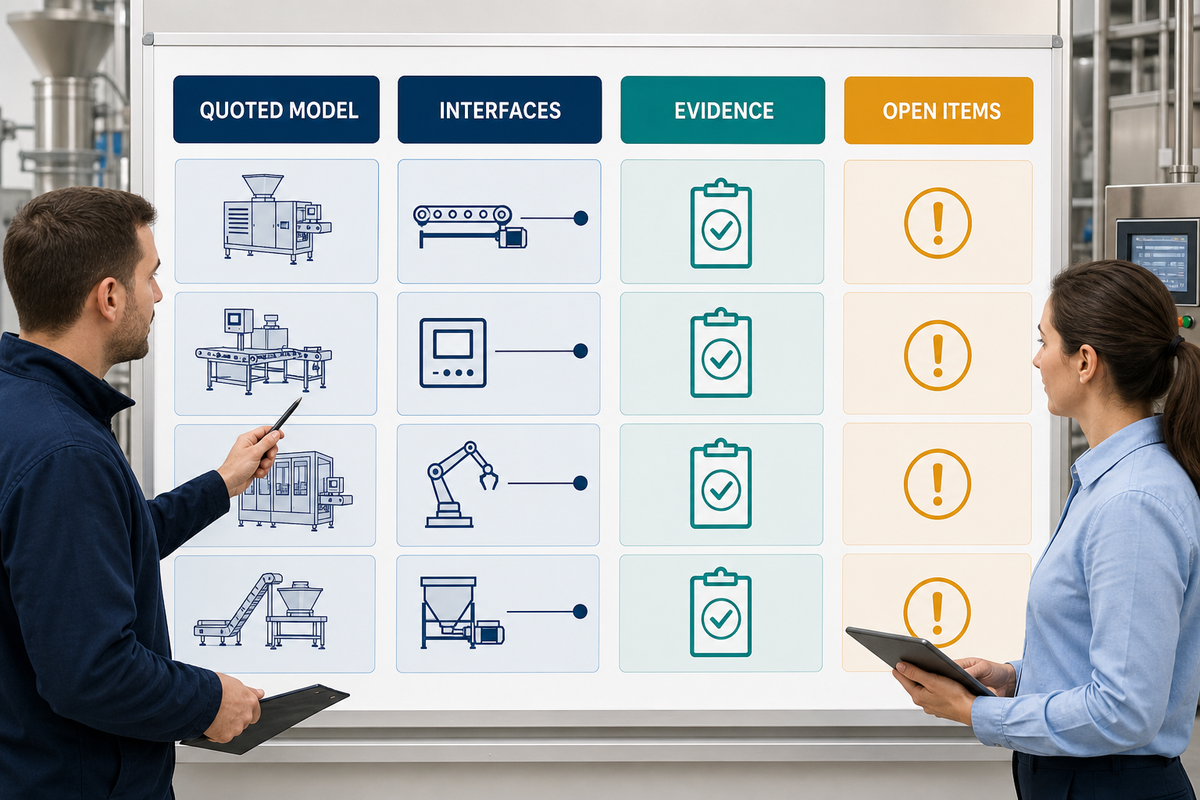
A productive supplier interview tests claims against the specific equipment and clarifies what remains with the buyer, integrator, installer, or operator; the HSE assembly guidance shows why line-level responsibility cannot be assumed from individual-machine paperwork.
Eight questions worth asking
- What legal entity manufactured the delivered machines? Who completed the equipment line?
- Is the supply machinery, partly completed machinery, or a component for integration?
- What laws, standards and scheme rules were applied to the quoted configuration?
- What options or site interfaces are outside existing declarations, test reports, or listings?
- Can the food-contact register trace each component to the actual material supplier and intended use limits?
- What design changes trigger document, testing, or certification review?
- What acceptance tests demonstrate agreed safety functions, cleanability, control behavior and performance?
- What must the buyer finish after shipment? Installation checks? Local approvals? Line level assessment? Training? Validation? Operating controls?
Answers should be documented against named evidence and owners. A confident verbal answer without a scope-matched record is an open item, not a pass. A missing certificate may be irrelevant if the applicable route doesn’t require that certificate; the correct remedy is proper classification, not collecting more paper.
What Is Changing in 2026, and What Buyers Should Do Now
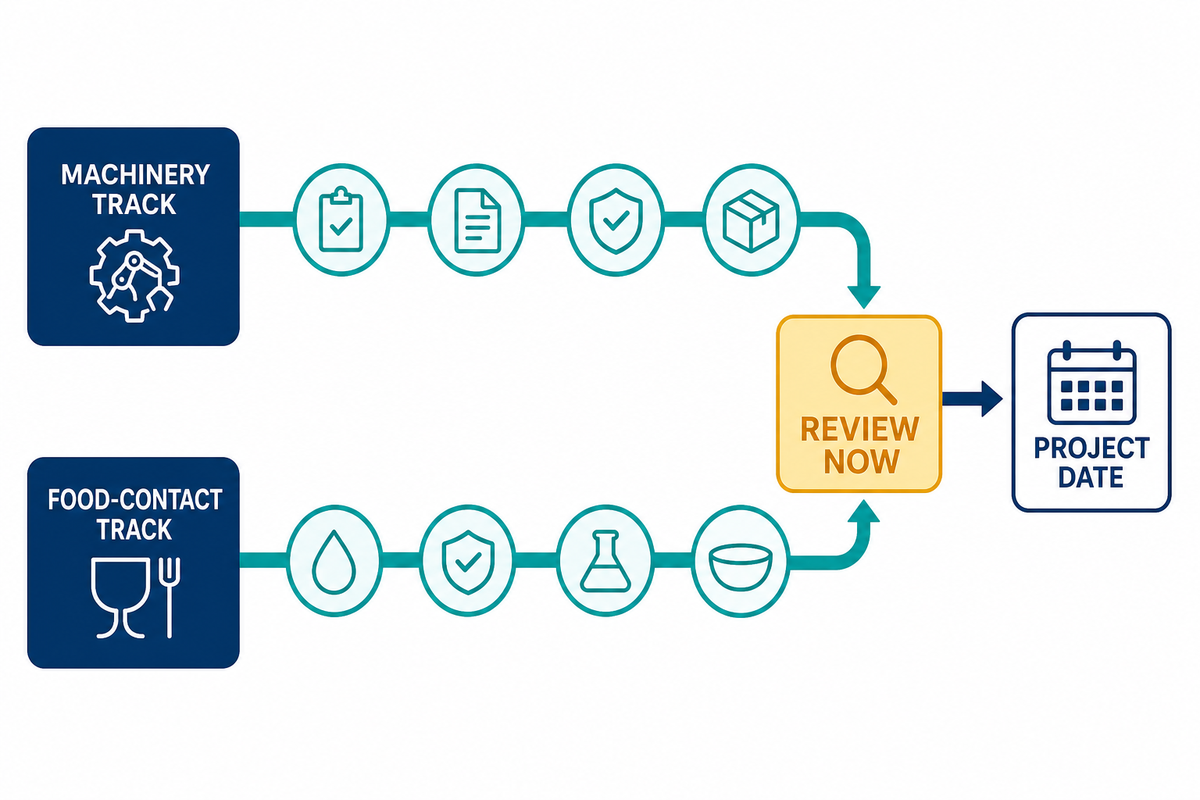
The clearest scheduled transition is the general application of the EU Machinery Regulation from 20 January 2027. Projects expected to cross that boundary should review specifications now, especially product classification, digital documentation, safety-related control or software issues, economic-operator roles, and line-integration responsibilities. An industry request to extend the deadline does not change the law unless the deadline itself is amended.
The new framework also raises cybersecurity risks for safety-related software and control systems. In this regard, consider cybersecurity as a design safety issue for machinery and not an information security certification issue.
Food-contact rules have their own timetables. Regulation (EU) 2024/3190, which concerns bisphenol A and certain other bisphenols, provides a separate transition for repeat-use final food-contact articles used as professional food production equipment. Under the conditions stated in that regulation, first placing on the market may continue until 20 January 2028. This product- and use-specific provision does not change the Machinery Regulation’s application date and should be reviewed for the particular project.
Automated testing and time-stamped records are emerging procurement considerations. They do not prove a universal legal duty or availability on any specific SINOFUDE machine. Buyers can nevertheless specify useful outcomes such as tamper-evident test records, change records, calibrated instruments, alarm logs, and exportable acceptance evidence.
Decision Framework: Route the Requirement Before You Accept the Claim
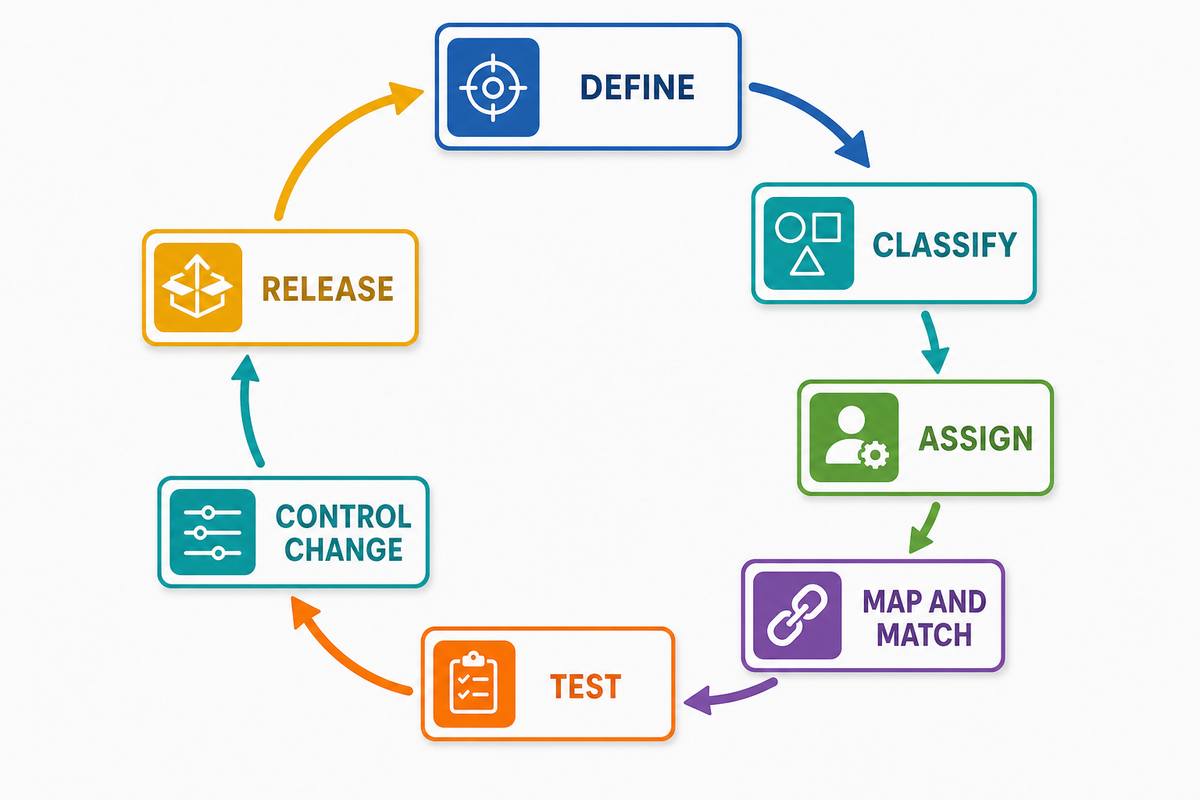
- Define: destination, use, food, process conditions, line boundaries, configuration, and relevant dates.
- Classify: legal product category and each separate food-contact, workplace, electrical and scheme route.
- Assign: manufacturer, importer, integrator, installer, employer, food business, reviewer and release authority.
- Map: each requirement to design evidence, a verification method, a document and an owner.
- Match: apply the seven-field scope check to every material claim, declaration, certificate, report and listing.
- Test: Witness agreed functions at the factory and site without treating FAT as the end of installed-line compliance work.
- Control change: re-open affected checks when the model, supplier, material, software, guard, control, or interface changes.
- Release: Record open items, accepted deviations, site actions, and the person authorized to proceed.
This certification process makes evidence useful by linking documents to decisions. It also gives suppliers a better brief, while the HSE’s food machinery safety guidance shows why machinery, installation, maintenance, and workplace responsibilities must be routed explicitly. Instead of promising universal compliance, suppliers can explain their scope and identify what the project team must complete.
Frequently Asked Questions
Is CE marking the same as a third-party certification?
No. CE marking indicates a manufacturer’s claim that the product meets applicable EU requirements, but the required conformity procedure depends on the product and legislation. Some routes involve a notified body; others rely on manufacturer assessment. Verify the declaration, product identity, legislation, standards, configuration, and any notified-body role rather than asking only for a “CE certificate.”
Can a food-processing machine be FDA approved?
“FDA approved” is not a safe universal description for a complete food-processing machine. FDA authority and approval pathways are category-specific. Buyers should separately assess food-contact materials, facility and process obligations, sanitary design, and any claims about particular substances. A material or notification reference must match its manufacturer and conditions of use.
Does a factory acceptance test prove the installed line is compliant?
No. A factory acceptance test only demonstrates what was agreed and tested on the factory configuration. Shipping, installation, utilities, software changes, upstream and downstream interfaces, shared controls, guarding, and local approvals may also affect risk. Keep FAT as one release checkpoint, and assign site and integration activities explicitly.
What should be in a machinery compliance dossier?
The contents depend on destination and classification, but a buyer register often includes declarations, incorporation documents where applicable, instructions, agreed standards, certificate or listing details, safety-function tests, contact-material evidence, drawings or specifications needed for acceptance, change records, open deviations, and responsibilities for installation and use. It isn’t necessarily the manufacturer’s complete confidential technical file.
How should buyers evaluate a supplier’s certification claim?
The seven-field check (legal entity, product identity, configuration, requirement, edition and date, issuer and status, conditions or exclusions) should be performed on the records. The records should be verified with the issuer or the official database, if available. If any of the fields don’t agree with the quoted machine, keep the claim open until the supplier provides a scope-matched justification or evidence.
Turn Compliance Questions Into a Buildable Specification
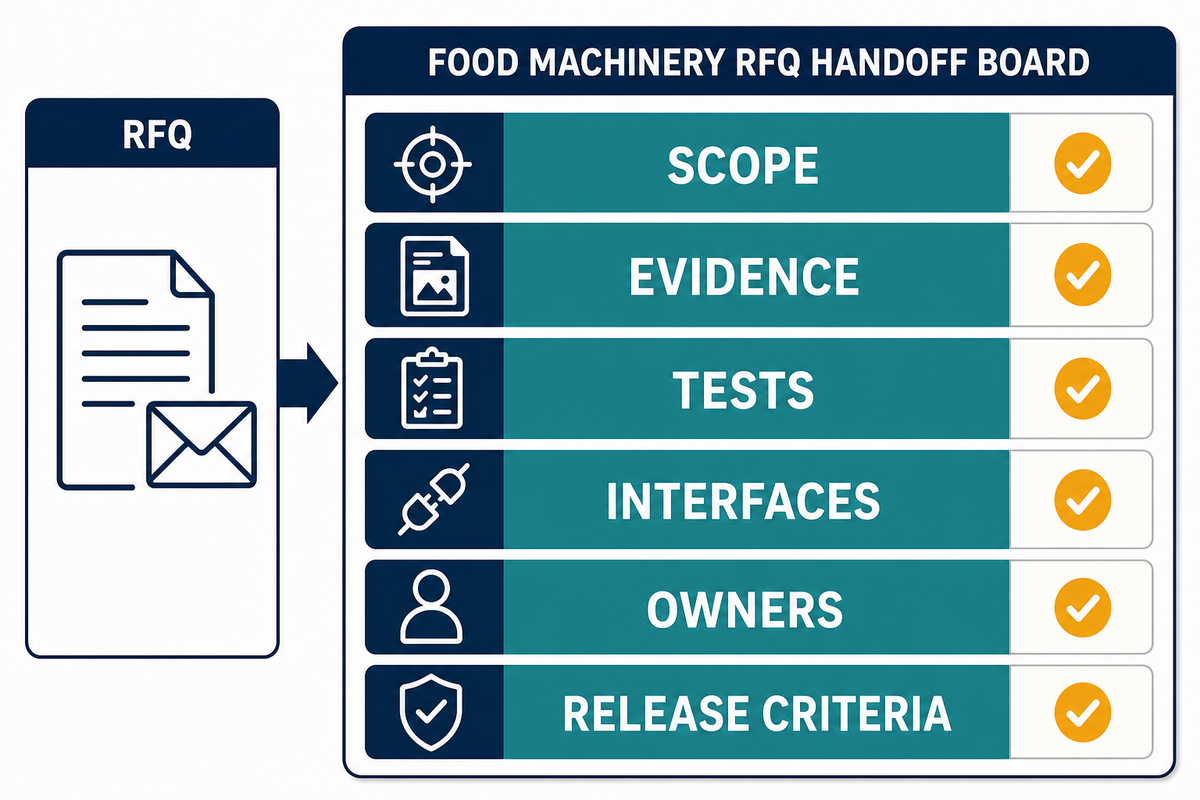
A good project begins with the product, process, destination, configuration, and evidence requirements. Use those inputs to structure a configuration-specific technical discussion with SINOFUDE. Legal determinations for a particular destination remain with qualified persons.
Visit SINOFUDE to define the application and request a configuration-specific technical discussion. Bring your destination, recipes, cleaning method, utilities, integration boundary, target date, and required evidence list so the conversation begins at the right level of detail.
References & Sources
- Directive 2006/42/EC on machinery
- Regulation (EU) 2023/1230 on machinery
- European Commission: Food-contact materials legislation
- Regulation (EU) 2024/3190 on bisphenol A and other bisphenols
- UK HSE: Machinery manufactured for own use or assembled in situ
- OSHA: Nationally Recognized Testing Laboratory FAQ
- FDA: Is It Really FDA Approved?
- FDA: Determining the regulatory status of food-contact material components
- 21 CFR 117.40: Equipment and utensils
- UK HSE: Machinery safety in food and drink industries



