Get in Touch with SINOFUDE Company


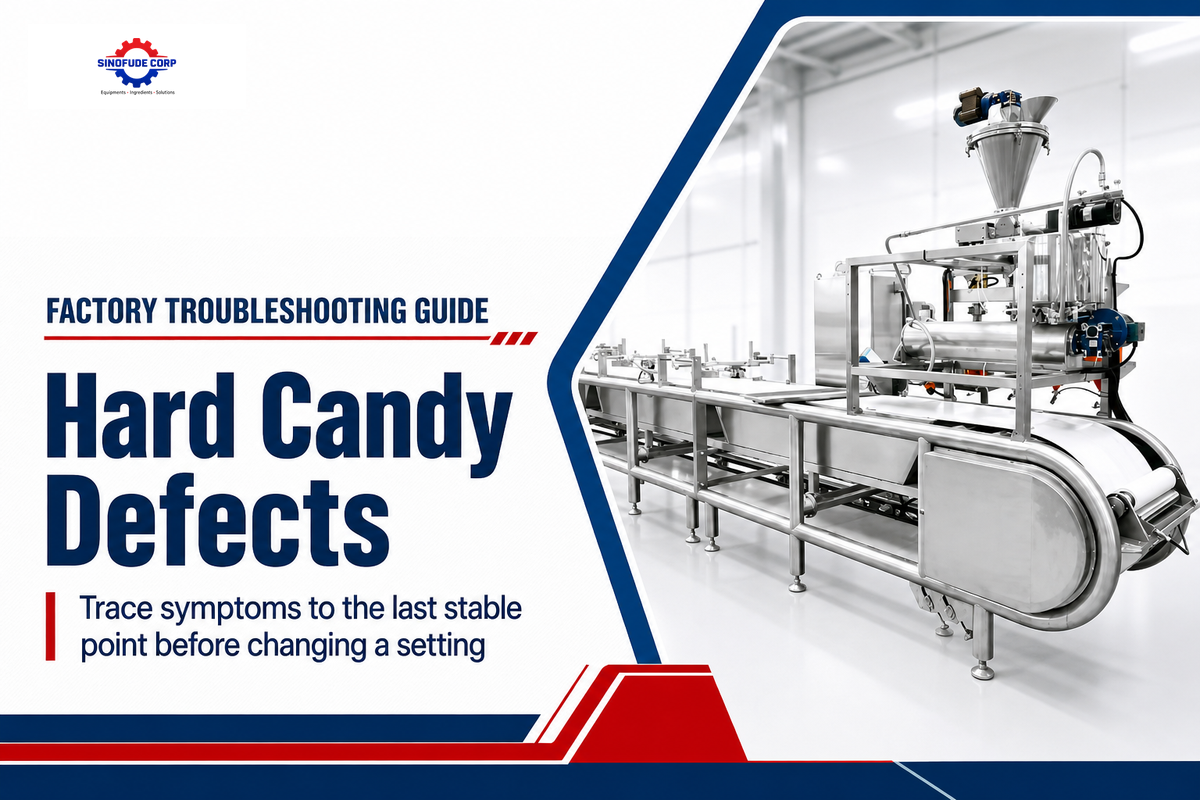
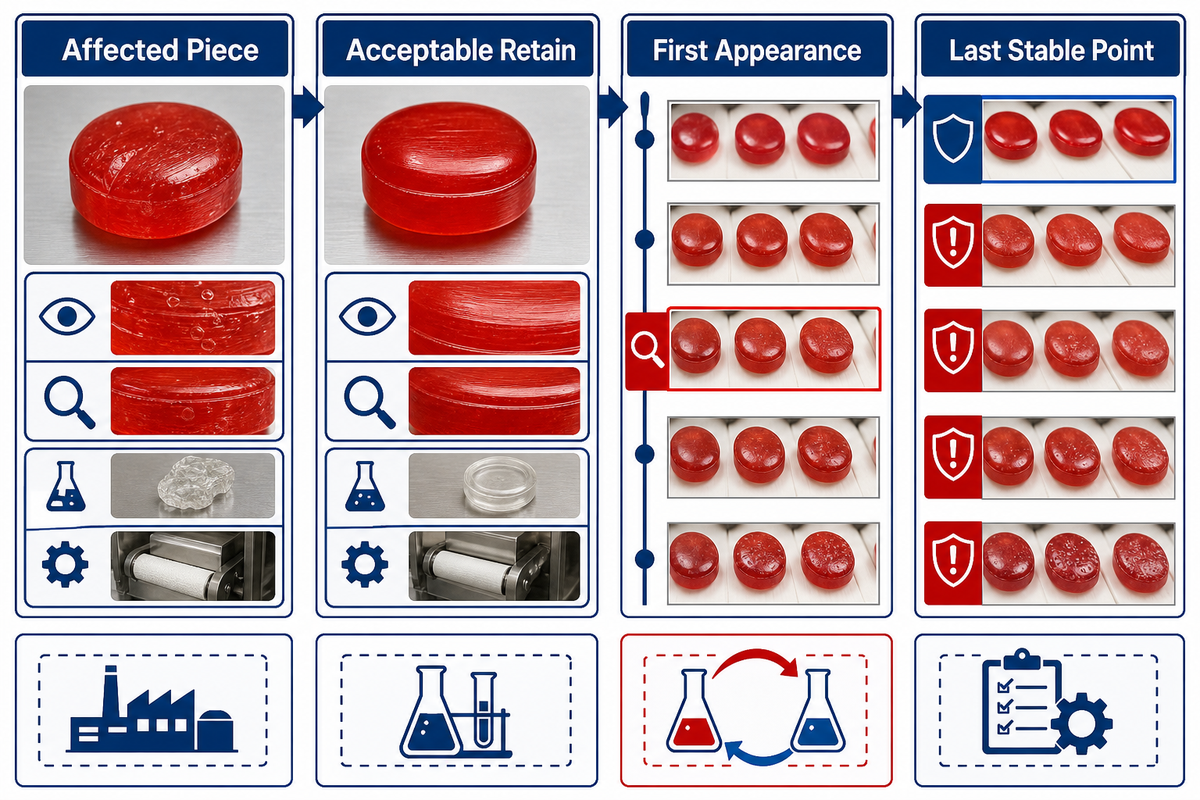
Hard candy defects are observed when hard candies fail; the last stable point should be the guidepost for tracing defects rather than an immediate match to a machine setting. When hard candies fail in a factory, record when the defect first appears, compare retained samples and positions, preserve process and packaging evidence, then test a bounded correction without confusing improvement with proof of root cause.
Direct answer: classify the symptom, place it in a failure-time window, compare the affected output with a known acceptable condition, and change only what the evidence supports. Hold or escalate any lot when safety, legality, traceability, allergen control, or a critical specification may be affected.
Updated September 2026 · By XCX
TL;DR
-
Sticky defects can begin in cooking, formulation, cooling, exposure, wrapping, sealing, or storage; apply the last-stable-point rule by comparing an affected piece with a retained acceptable sample and recording where it first appeared before changing a setting.
- Cloudiness doesn’t prove crystallization, and one visual symptom rarely proves one cause.
- A one-variable trial is a screening tool, not causal confirmation when factors interact or the process drifts.
- Visual inspection doesn’t replace the facility’s approved quality and food-safety disposition process.
Start with the defect signature, not a machine setting
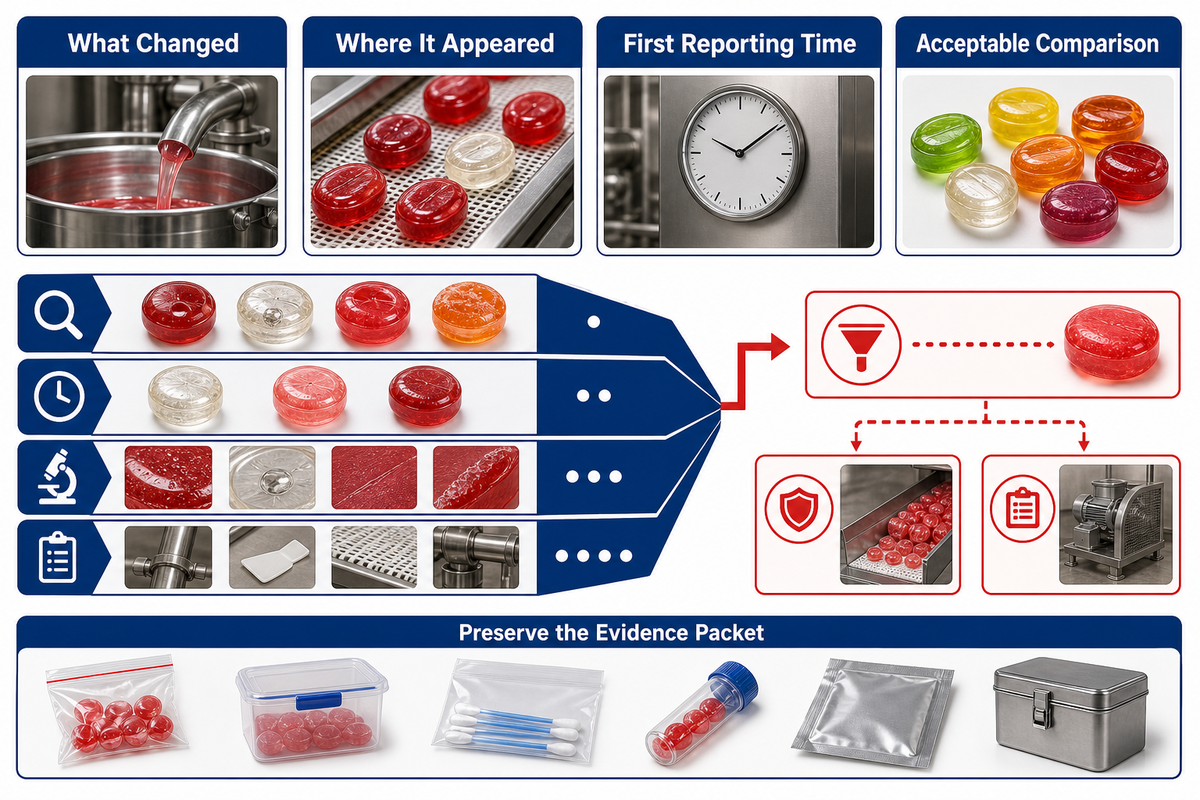
A defect signature that’s useful to the investigator should include changes that occurred, their locations, the first reporting time, and how the affected pieces differ from what’s acceptable. That description narrows the investigation without claiming a cause before the batch, room, position, package, and time evidence has been compared.
| Defect type | Describe before adjusting | Compare first | Do not assume |
|---|---|---|---|
| Sticky or sweating | Surface, wrapper contact, onset time, room and storage history | Unwrapped and wrapped retained samples | The cooking endpoint was low |
| Soft or deformed | Whole batch or local positions, warm or cooled condition | Endpoint, cooling position, exposure and package | The cooler alone caused it |
| Grainy | Visible crystals, rough mouthfeel, surface or bulk pattern | Dissolution, recipe, hold and wall-contact records | Every opaque area is crystal growth |
| Cloudy | Intended opacity, uniformity, depth and change over time | Approved standard and matched retained sample | Appearance identifies the mechanism |
| Bubbles or holes | Count, size, depth, nozzle or cavity position and sequence | Mass condition and positional map | All voids share one origin |
| Cracked or broken | Crack direction, edge, impact mark, cooling and handling stage | Position, thermal history and transfer points | Breakage began where it was found |
| Color or flavor shift | Lot, zone, time, shade, intensity and sensory reference | Material, heat, hold, addition and labeling records | It is only cosmetic |
| Size or weight variation | Distribution by position and sequence, not only the average | Feed, forming, tooling and synchronization evidence | One mean represents the population |
The ledger is a starting point, an intake editorial frame, not a validated standard for defects. It prevents erasing the pattern that could delineate formulation, environment, motion, handling, and packaging.
Minimum defect packet
Save an affected sample and a matched acceptable sample, then bind both to the product code, formula revision, material lots, date and time, line position, operator or shift, relevant settings, room conditions, package lot, and photographs. Add the first and last known affected times, the last stable measurement, stops or restarts, maintenance activity, and the qualified disposition owner. This packet preserves the starting condition after the line has moved on.
The 3-Window Failure-Time Map
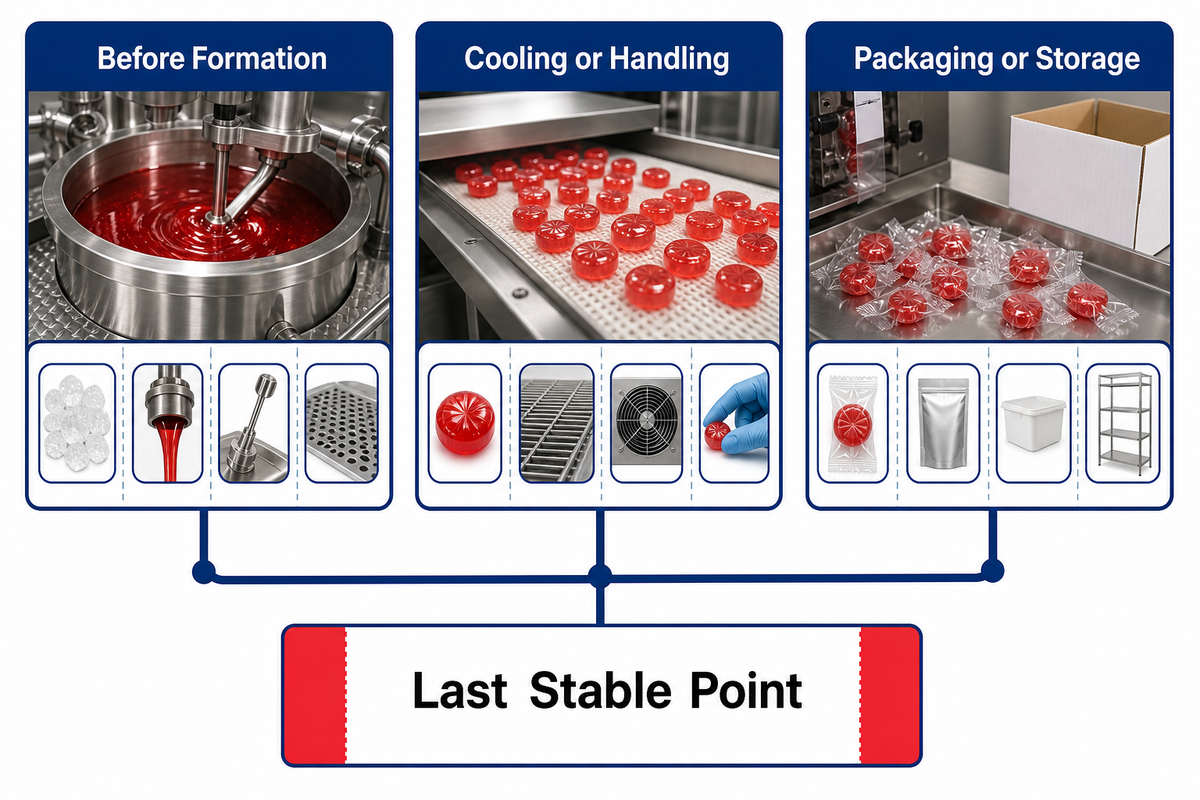
Place the first observed occurrence of the defect in one of three time windows: before formation, during cooling or any of the handling processes, or after packaging and storage. Evidence prioritization is time dependent, but this doesn’t prove a cause because an earlier condition can be hidden and revealed by a later stress.
Window 1: Before forming
Check recipe and lot identity, dissolution, concentration evidence, heat and hold history, late additions, mass condition, and feed stability.
Window 2: Cooling and handling
Map defects by belt, cavity, lane, time, transfer point, air condition, contact surface, residence time, and handling event.
Window 3: Packaging and storage
Compare unwrapped and wrapped retains, exposure time, film lot, seal checks, packing-room conditions, transport, and storage history.
The last stable point should be the boundary of the investigation. If the pieces were acceptable at the cooling discharge, but failed only in a specific wrapper, retain both the unwrapped acceptable piece and the wrapper before adjusting the cooker or cooler.
Sticky, sweating, or soft candy: separate six evidence lanes
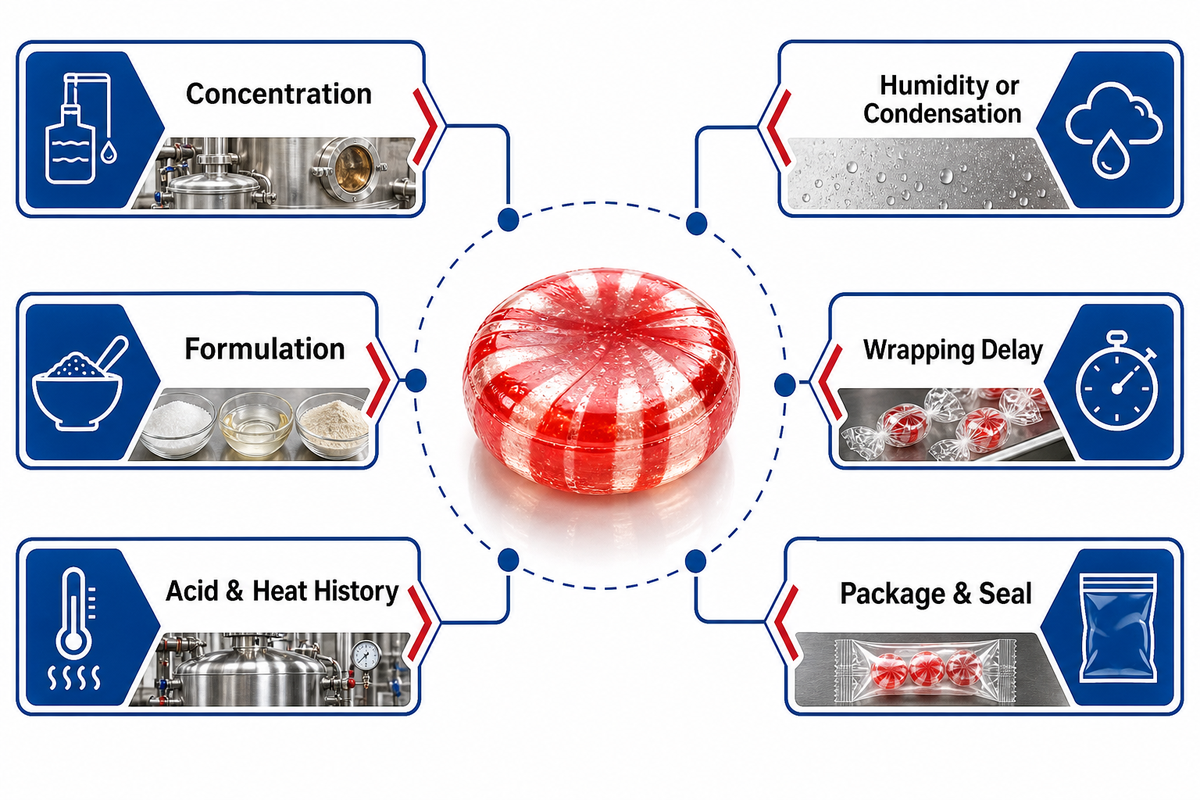
Sticky hard candy can reveal insufficient concentration, formulation-specific hygroscopicity, or history of exposure to acid and heat, as well as condensation or exposure to high humidity. It can also result from a delay in wrapping or from packaging and sealing performance. In sugar-based hard candies, bulk moisture by itself can’t identify a lane, as various factors, such as surface condition, water activity, glass transition, and exposure history, need to be considered.
| Lane | Evidence to retrieve | Useful comparison | Bounded next action |
|---|---|---|---|
| Concentration | Qualified endpoint method, instrument status, sample point, pressure and residence history | Last accepted batch on the same basis | Verify measurement before moving a setting |
| Formulation | Recipe revision, syrup system, acid, functional ingredients and lots | Matched formula and geometry | Review composition with product specialists |
| Heat and hold | Actual addition time, hot hold, rework and delay records | Normal time-temperature sequence | Test the specific history, not only peak temperature |
| Cooling and exposure | Room temperature, relative humidity, dew-point risk, residence and open exposure | Positions and time bands | Protect and compare a controlled sample |
| Wrapping delay | Cooling discharge to sealed-pack time | Short and long delay groups | Confirm the timing effect under stable conditions |
| Package and storage | Film specification, lot, seal integrity, climate and distribution history | Wrapped vs unwrapped retains | Route to packaging validation when evidence points there |
A peer-reviewed hard-candy review describes water as a plasticizer that can lower glass-transition behavior. A 2024 formulation report describes different moisture and state measurements on the specific hard candy formulations used. These sources don’t give a generally applicable moisture, water activity, temperature, or relative humidity limits for every hard candy as they describe a mechanism and diagnostic boundary.
Grainy, crystallized, or cloudy candy: confirm what the eye is seeing
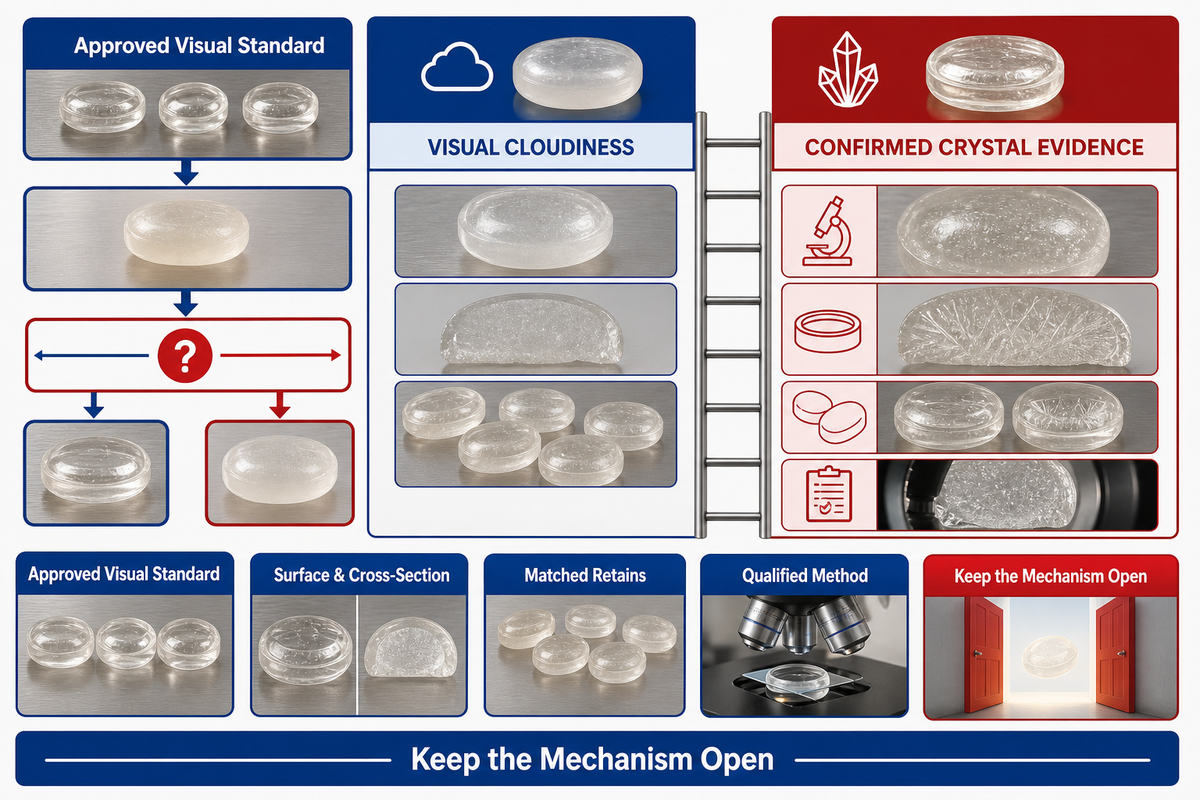
Graininess requires evidence of crystal formation or a matching texture change; cloudiness alone is only an appearance. Compare the approved product standard, matched retains, surface and cross-section, dissolution and recipe records, hold history, and storage exposure before labeling the observation as crystallization.
Do
- Compare against the approved visual standard
- Inspect surface and interior separately
- Preserve an affected and acceptable sample
- Review dissolution, ratio, hold, and wall contact
Don’t
- Call every opaque piece crystallized
- Infer a mechanism from one photograph
- Change agitation and temperature together
- Ignore intentional opacity or inclusions
Evidence becomes stronger when the same structural change appears under magnification or a qualified analytical method and follows a repeatable process or storage condition. Record as Cloudiness or opacity if the observation is visual only.
Bubbles, holes, cracks, and broken pieces: read the pattern
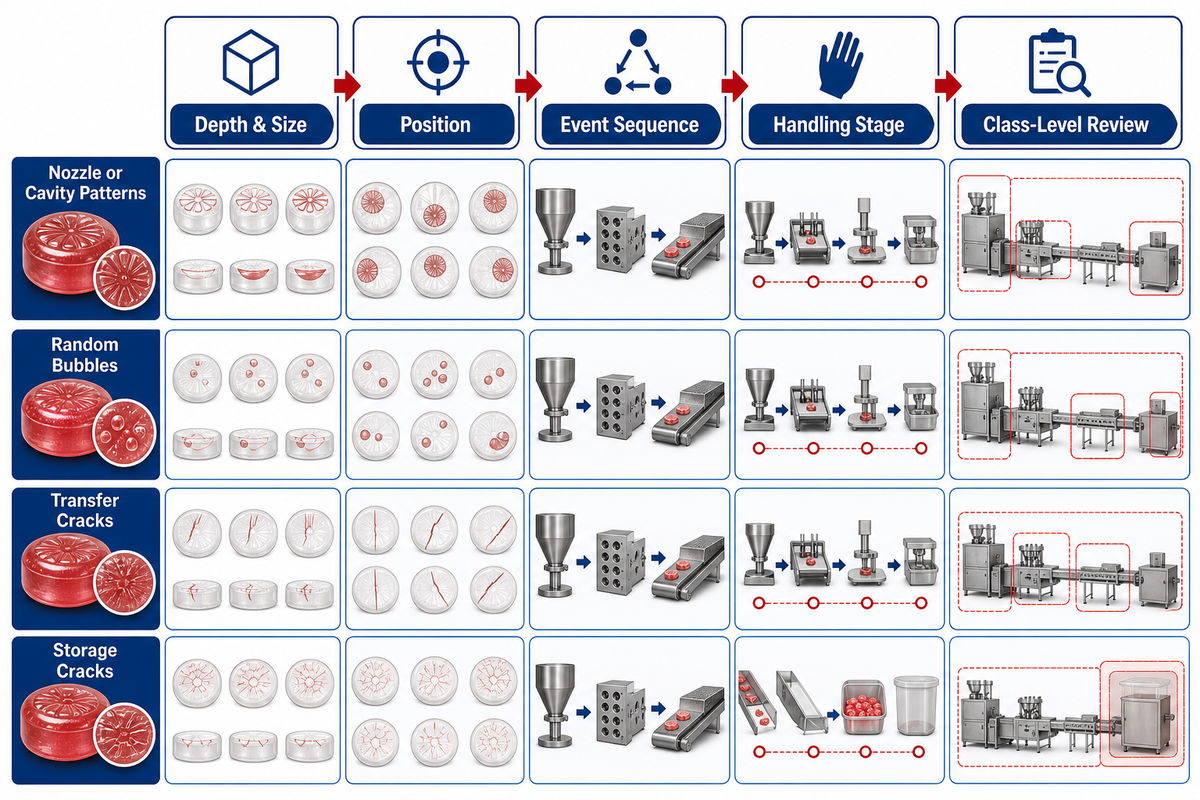
Mapped voids and breakage become a diagnostic tool when depth, size, position, event sequence, and handling stage are recorded. A nozzle or cavity pattern points to different evidence than random distributed bubbles, while a crack at a transfer point deserves a different check from cracks that appear during cooling or storage.
Position pattern
Map by nozzle, cavity, die, lane, belt edge, transfer, and package station.
Time pattern
Mark startup, steady run, stop, restart, refill, changeover, and shift boundary.
Geometry pattern
Record void depth, crack direction, edge damage, impact mark, and piece orientation.
One peer-reviewed study classified its images as good, holey, broken, and small and reported finding 2,552 samples with a 70% / 15% / 15% split. Its best reported aggregate result belongs to that study setup. Another study started with 76 photos of 682 complete and 206 defective candies and used augmentation to mitigate the imbalance, so neither result is a universal plant inspection claim or a substitute for class-level false negative review.
Inspection design check
Ask for recall and false-negative performance by defect class, not aggregate accuracy alone. A rare class can disappear inside a favorable overall result, and a model trained on one lighting, background, product geometry, or camera position may fail after a changeover. Local challenge samples should include marginal pieces, normal variation, multiple positions, and the defects whose escape would matter most.
Color, flavor, size, and weight variation: separate three evidence lanes
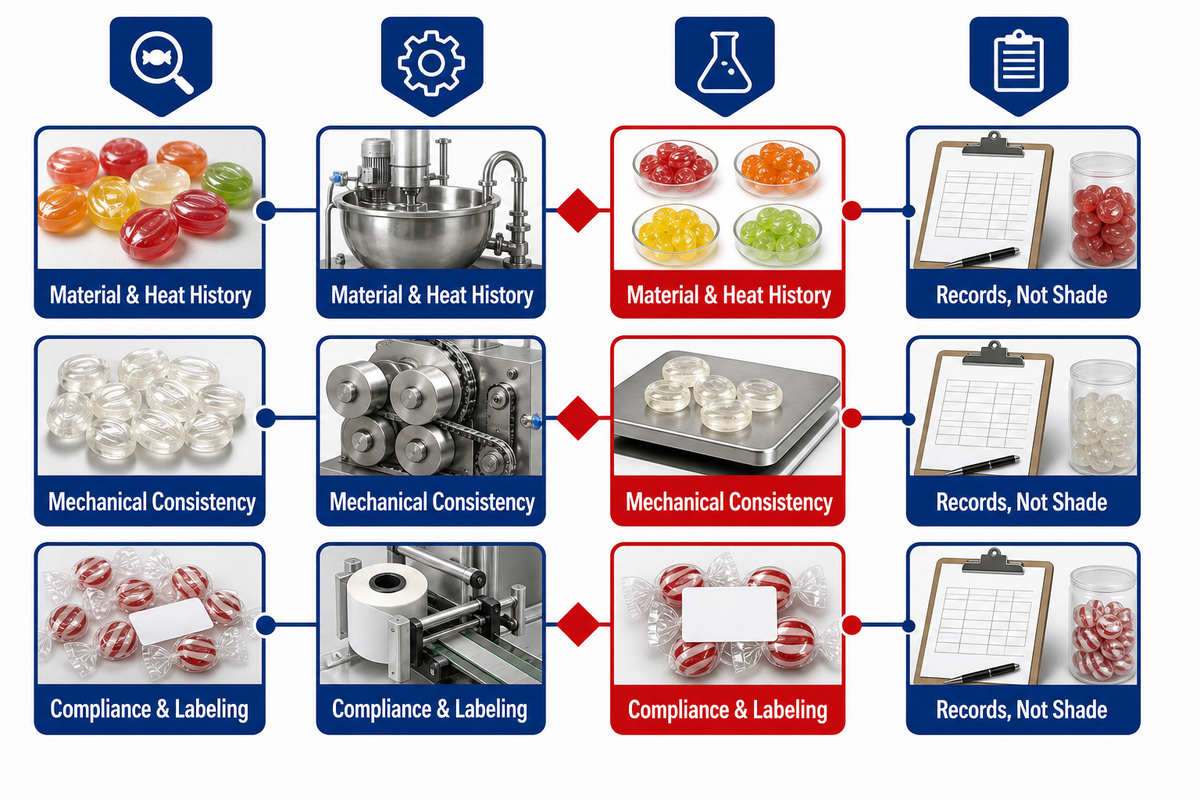
Separate variation into material or heat history, mechanical consistency, and regulatory or labeling review. Color and flavor can follow ingredient lot, addition, mixing, temperature, and hold time; size and weight can follow feed, viscosity, forming, tooling, or synchronization; additive-use and label questions require the approved compliance program.
| Evidence lane | Typical records | Analysis boundary |
|---|---|---|
| Material and heat | Ingredient lot, dose, sequence, mixing, mass condition, heat and hold history | Connect the shift to a documented material or thermal change |
| Motion and tooling | Feed pressure, viscosity, piston or valve behavior, rope size, die condition, position and timing | Use distributions by position and sequence, not only the mean |
| Regulatory and labeling | Approved additive, intended use, applicable amount, formula revision and label declaration | Appearance cannot decide authorization or labeling compliance |
The United States Food and Drug Administration explains that color-additive rules specify the food types in which a color may be used, any applicable maximum amount, and how it must be declared on the label. A shade shift can trigger a review of the records, but it can’t be used to verify compliance, determine the status of a hazard, or confirm a release.
Packaging and storage belong in the defect investigation
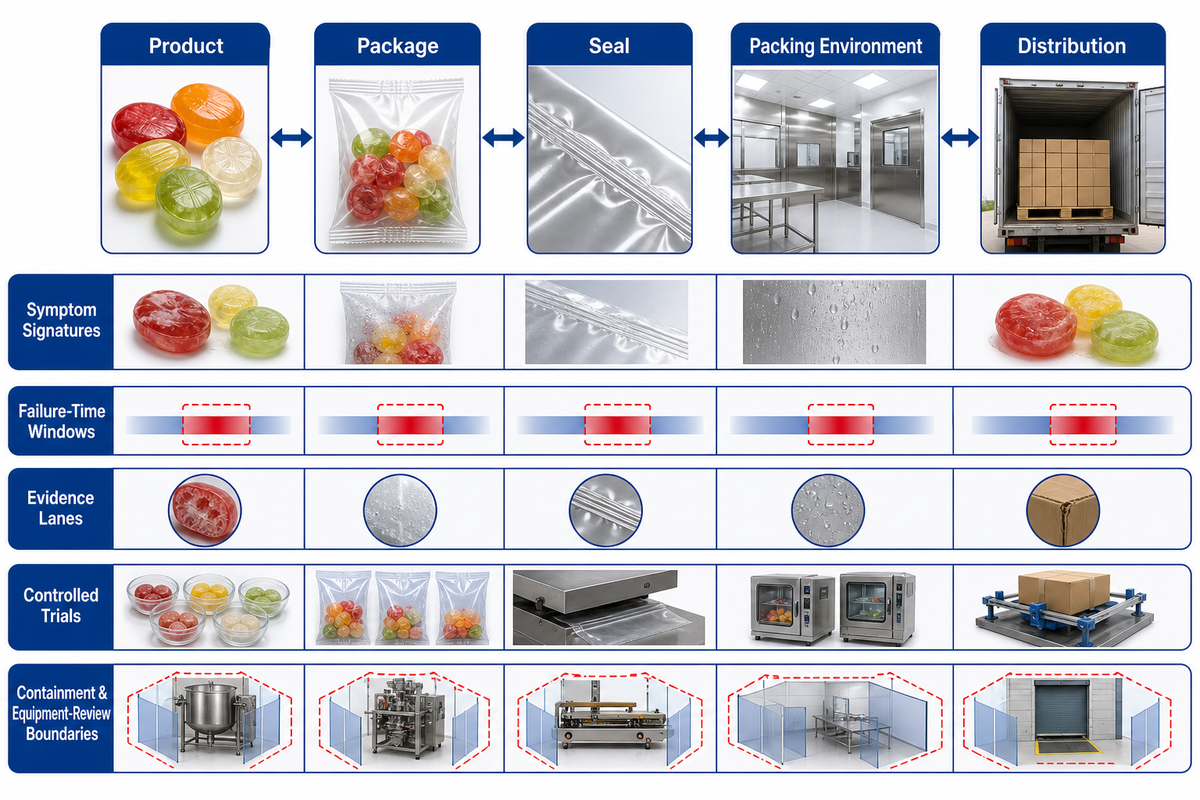
If acceptable candy changes after wrapping or storage, examine the product, package, seal, packing environment, and distribution in concert. Packaging and storage are distinct factors of the investigation, but they can reveal a deficient formulation or cooling, so neither the line nor the wrapper should be blamed by default.
| Sample | What it can reveal | Record with it |
|---|---|---|
| Protected unwrapped retain | Whether the product changes without the production package | Protection method, time, temperature and relative humidity |
| Normal wrapped retain | Combined product, film and seal behavior | Film lot, setup, seal check and coding |
| Complaint or stressed sample | The observed failure after known or uncertain exposure | Chain of custody, transport, storage and opening condition |
A peer-reviewed seal-integrity review distinguishes poor seals from leakages and explains that even small leakage can change a package’s gas and moisture environment. For hazard evaluation, 21 CFR 117.130 lists manufacturing or processing, packaging and labeling, and storage and distribution as separate factors, which supports keeping the records linked without collapsing their classifications.
Screen a proposed correction with the One-Variable Screening Rule
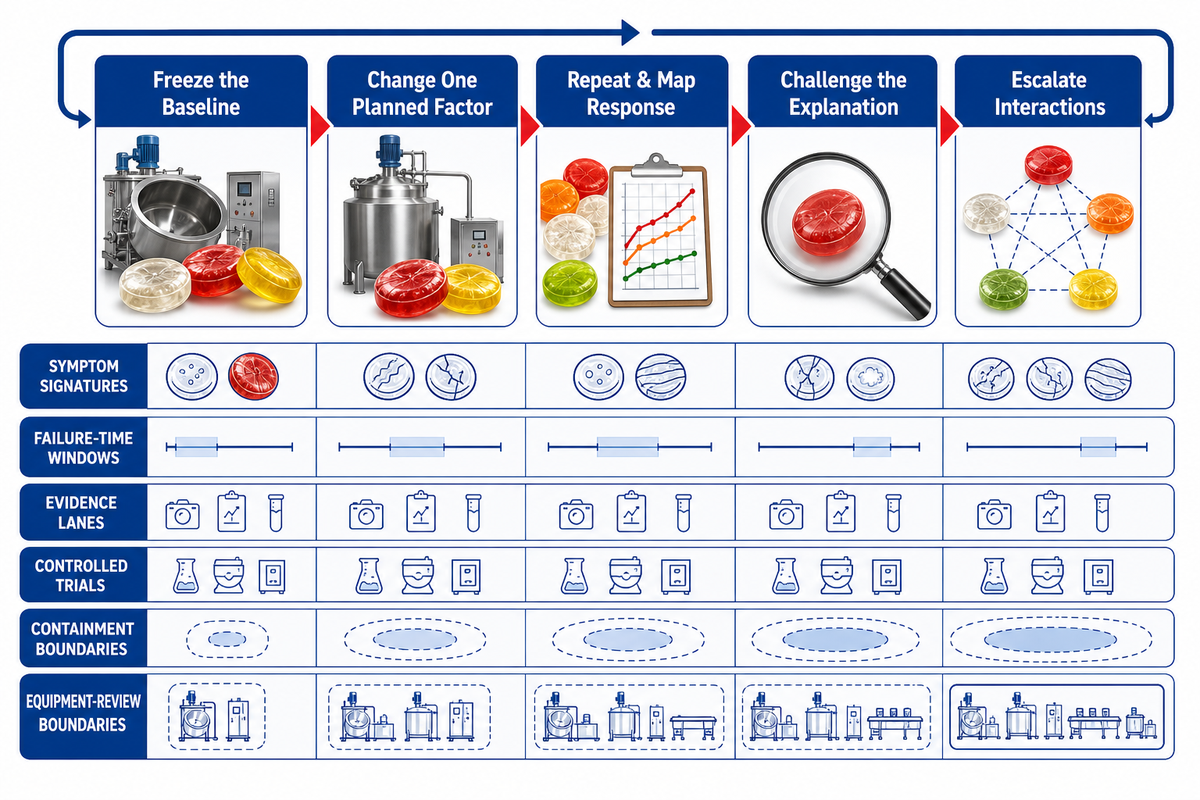
One planned change may be sufficient for determining whether a suspected factor warrants additional experimentation while holding the baseline as stable as possible and recording the prevailing and time-order conditions. An improvement in the process corroborates a hypothesis. However, improvement doesn’t verify root cause in the presence of interacting factors, process drift, or the effect of uncontrolled conditions.
- Freeze the baseline: define the product, process state, room condition, sample position, and response measure.
- Change one planned factor: state the exact change and keep unrelated settings under change control.
- Repeat and map the response: use a site-justified repeat count and record variability, order, ambient conditions, and new defects.
- Challenge the explanation: restore or vary the factor only under an approved trial, then check whether the response follows.
- Escalate interactions: use qualified experimental-design support when two or more factors may combine or drift cannot be excluded.
The National Institute of Standards and Technology shows why this limitation matters: full factorial designs can estimate main and interaction effects, replication provides information on variability, and randomization helps protect results from extraneous factors. Therefore, the One-Variable Screening Rule is a shop-floor evidence-based discipline and isn’t a substitute for designed experiments or process validation.
Inspection, containment, and escalation
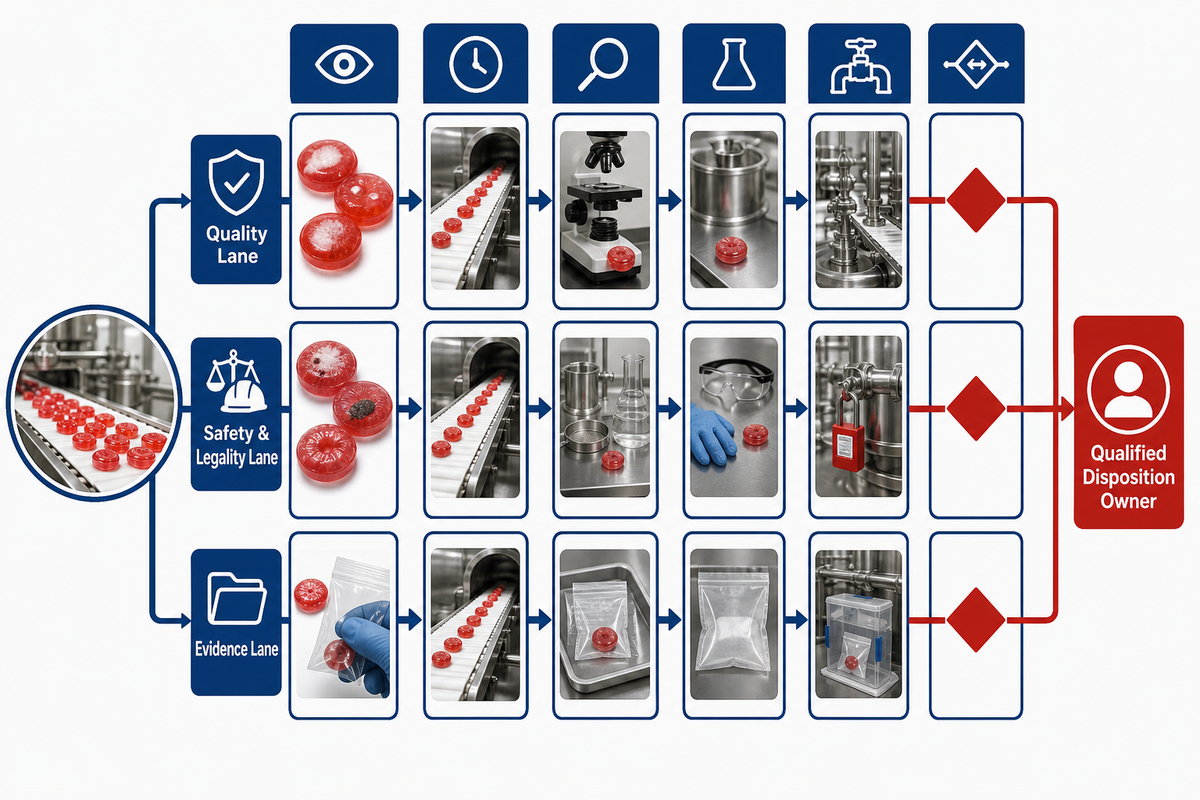
Classify the observation before disposition: cosmetic variation, approved-specification failure, or possible safety, legality, allergen, foreign-material, traceability, or labeling concern. Retain the lot and evidence, then conduct the sampling and deviation actions according to the facility’s approved plan for hazard analysis, containment, corrective action, and release authority.
Quality lane
Use the approved appearance, dimension, mass, texture, flavor, package, and sampling specifications.
Safety and legality lane
Escalate possible allergen, additive, contaminant, foreign-material, labeling, sanitation, or preventive-control implications.
Evidence lane
Preserve traceability, samples, photos, settings, alarms, maintenance, packaging, environmental, and disposition records.
Part 117 requires appropriate quality-control operations and a written hazard analysis for covered facilities, but it does not turn a generic defect chart into a release decision. The FDA Food Defect Levels Handbook addresses natural or unavoidable defects within its policy scope and is not a hard-candy cosmetic acceptance table; poor manufacturing practice can still require action.
Key takeaway
A defect table organizes evidence; it never authorizes product release. The facility’s approved specification, hazard analysis, sampling plan, and qualified disposition owner control that decision.
When equipment review is the next step
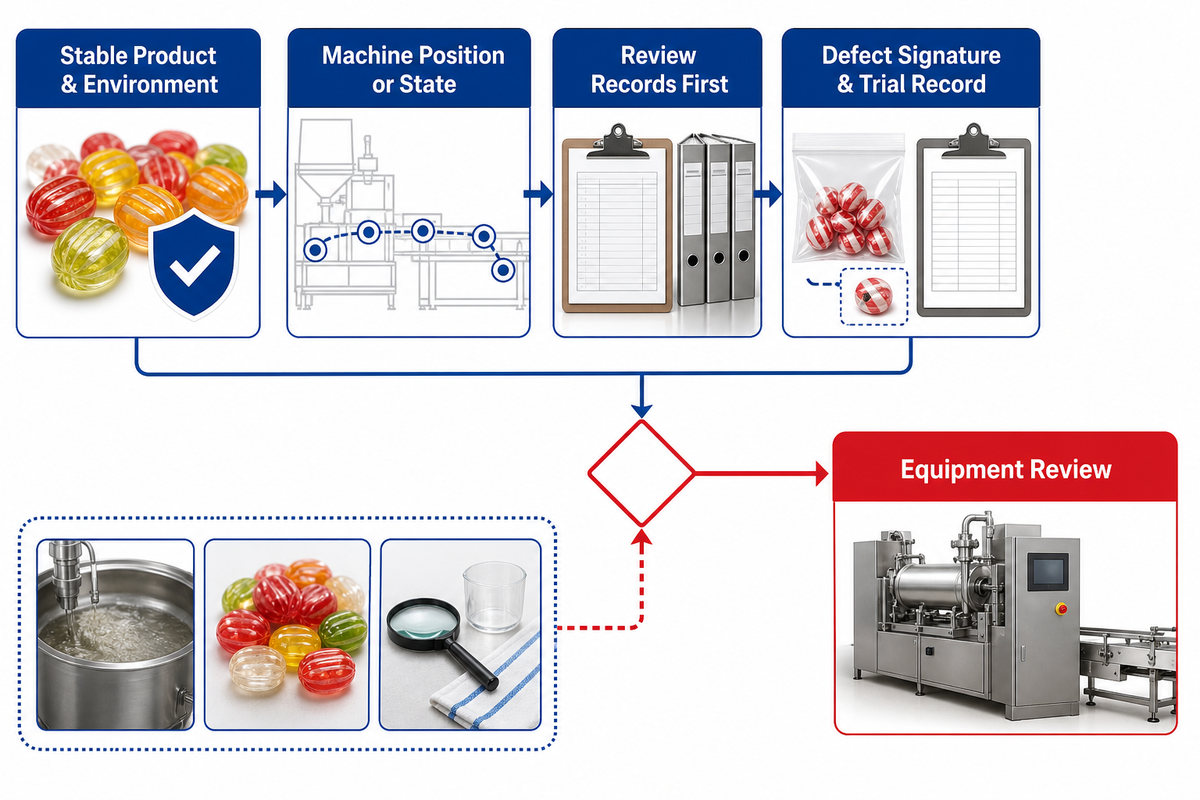
Review equipment when the defect repeats under a stable product and environment, follows a machine position or operating state, exceeds the current control or maintenance capability, or cannot be contained with the installed configuration; first review records and plausible non-equipment causes because recurring failures may still have multiple roots.
Equipment-review boundary
FDA HACCP guidance asks whether equipment provides necessary time-temperature control, is sized for the volume, stays within required tolerances, is reliable, and can be cleaned, with documented maintenance and calibration. FDA root-cause guidance also calls for production records and analysis of all plausible causes, so this checklist does not prove that machinery caused a cosmetic defect.
The HACCP source addresses food-safety system design, not a cosmetic hard-candy defect standard. It’s used here only to structure supplier-review questions, not to set process limits or prove causation.
Use the same symptom map and trial record when discussing the hard candy machine and production-line options. That focuses the product page on equipment selection while this article owns diagnosis and evidence routing.
RFQ checklist, copy these project-specific fields into your quote request:
| Parameter | Recommended range | Why it matters | How to verify |
|---|---|---|---|
| Product and piece | Approved formula family and project-defined g per piece | Binds feed, forming, cooling, and sampling | Representative-material trial and weight distribution |
| Accepted output | Project-defined kg/h conforming packed output over an agreed h | Separates good output from headline speed | Count raw input, rejects, stops, and good packs |
| Operating environment | Buyer-validated range in °C and % RH | Conditions can shift handling and surface stability | Logged trial with calibrated room instruments |
| Piece tolerance | Approved nominal g with a project-defined g or % limit | Defines metering or forming acceptance | Position and time-sequenced sample plan |
| Utilities | Site limits in kW, kPa, m³/h, and °C | Prevents a trial condition that the plant cannot reproduce | Metered factory test and site utility check |
| Changeover | Named SKU A to B within a project-defined min | Connects flexibility to a defined product change | Timed witnessed trial with first-good-piece criteria |
How SINOFUDE fits into the review
SINOFUDE states that its brand was founded in Shanghai in 1998 and now operates three factories covering more than 30 acres with more than 200 employees across confectionery, baking, and chocolate equipment. The company also reports ISO 9001 management-system adoption in 2004, CE and UL coverage for many products, and 38 product patents; each certification, patent, and capability must be verified against the exact offered equipment and current documentation.
First-party capability context: SINOFUDE describes laser cutting and welding, friction and tube welding, CNC sawing and wire cutting, machining centers, lathes, drilling, and gantry milling. These statements can frame questions about component accuracy, finish, access, and durability, but they do not independently prove a specific defect correction, capacity, sanitary acceptance, or customer result.
Bring the Defect Evidence, Not Just the Symptom
Share the formulation family, defect signature, failure-time window, position map, operating conditions, package, retained-sample comparison, and trial record. SINOFUDE can review the equipment boundary against a documented requirement.
Frequently asked questions
How do you fix sticky hard candy?
First identify whether the surface changed before cooling, during exposure, after wrapping, or in storage; then test the evidence-supported lane against a matched acceptable retain before changing a cooker, cooler, or wrapper setting.
Check the concentration record, formulation, acid history, room conditions, exposure time, wrapping delay, film, seal, and retained samples. Don’t raise cook temperature automatically; validate any changed limit on the actual product and equipment. Use a controlled comparison to screen the correction. Record the baseline, sample position, time order, ambient conditions, and every changed variable.
Can hard candies go bad?
Hard candy can lose quality through moisture uptake, crystallization, flavor change, package failure, contamination, or physical damage; treat contamination, labeling, or traceability concerns under the facility’s hold procedure.
Quality loss and food-safety disposition are different decisions. Shelf life depends on the formulation, process, package, storage, distribution, test methods, acceptance criteria, and applicable program, not a universal calendar number. Compare protected and normally wrapped retains through the intended study. If the package is damaged, labeling or traceability is uncertain, or contamination is possible, follow the facility’s hold and escalation procedure rather than relying on appearance, smell, or taste. Document opening condition and any temperature or humidity excursion before review.
Why does hard candy become cloudy?
Cloudiness is an appearance, not a confirmed mechanism, and may be intentional or require further structural evidence; compare the visual standard, cross-section, and matched retain before naming crystallization.
Compare the approved standard and matched retains, then inspect the surface and interior. Review dissolution, recipe, hold, wall contact, cooling, and storage evidence. Call it crystallization only when the site can distinguish crystals from other opacity with a qualified observation or method. If uncertainty remains, keep the mechanism open and document the observation.
What causes bubbles or holes in hard candy?
The pattern may involve air inclusion, mass condition, feed continuity, depositing behavior, tooling, or handling, but appearance alone cannot choose among them; map size, depth, position, and sequence before choosing a cause.
Map voids by nozzle, cavity, lane, time, size, and depth, then compare the pattern with mass temperature or viscosity evidence, refill and restart events, feed continuity, cutoff behavior, and the last acceptable interval. Inspect whether the void is open to the surface or enclosed and whether it follows one position. Avoid averaging away a local pattern or changing several settings before preserving the original condition and a matched acceptable sample. Keep class-level counts so a rare defect isn’t hidden.
When should a hard candy line be stopped for a defect?
Use the facility’s approved stop, hold, containment, and escalation criteria, especially for possible safety, legality, or critical-specification concerns; keep release authority with the site’s qualified quality or food-safety owner.
Escalate promptly when the observation may involve allergens, unapproved additives, foreign material, contamination, sanitation, labeling, traceability, package integrity, or a preventive control. For ordinary quality variation, follow the approved sampling and deviation process. This article can’t replace the site’s release authority.
Research transparency
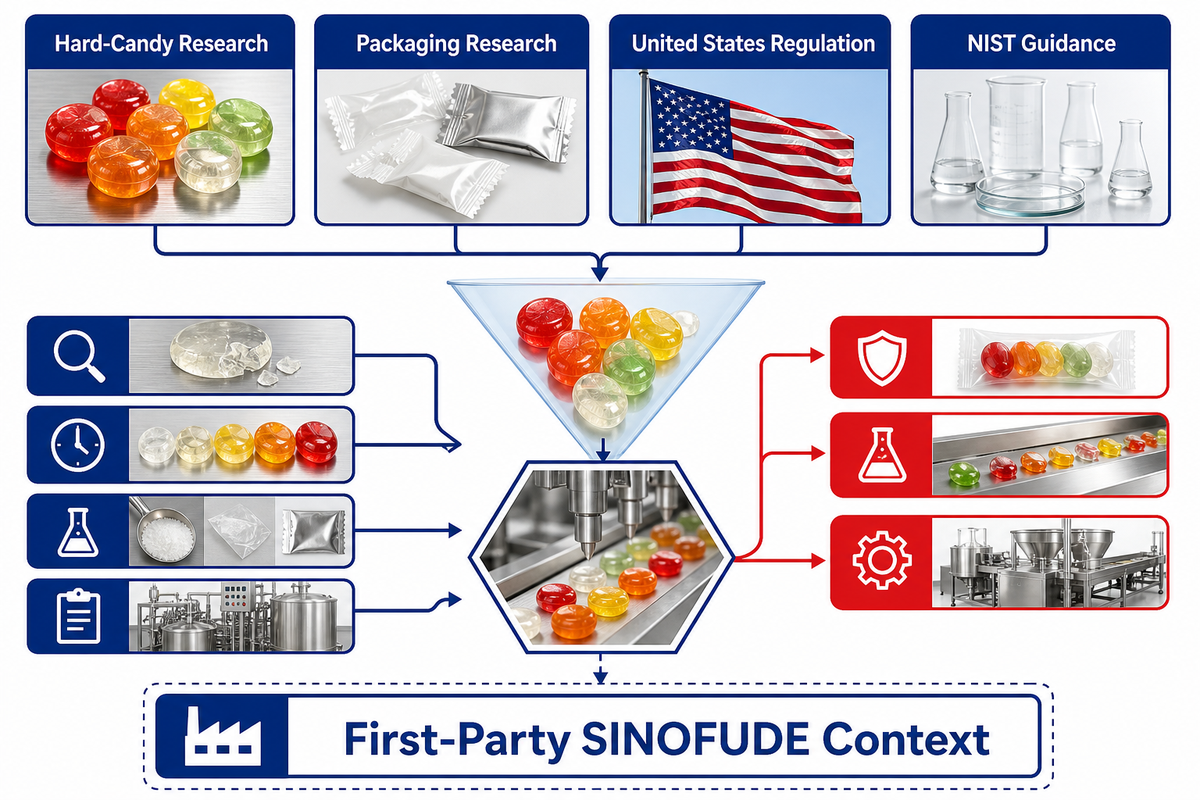
This guide combines peer-reviewed hard-candy and packaging research, current United States regulatory material, NIST experimental-design guidance, and first-party SINOFUDE context. Broader search vocabulary is recorded for scope, not treated as universal causes or recommendations. Vision-related terms include detection and classification of defective hard candies, hard candies based on image processing, image processing and convolutional neural networks, CNNs, spectroscopy, NMR, nuclear magnetic resonance, nondestructive quality inspection, trained inspectors, and hard candy samples. Product and formulation terms include corn syrup, sucrose, xylitol, sugar-free, polyol, hydrocolloid, spirulina, citric acid, sticky candies, lollipop, jawbreakers, assorted fruit, fruit flavors, artificial flavors, variety of flavors, bulk candy, chewy candy, oral health, emulsification, and release properties. Process and quality terms include candy production process, process of hard candy, make hard candy, make candy, cooling process, cool at room temperature, temper, hard-crack, air and moisture, candy quality, candy texture, textural, hard texture, small candy, quality defects, quality problems, industrial production, food industry, thermodynamic, sugar crystals, crystal size, differences in temperature, texture profile, hygroscopic, caramelization, desired texture, leading to stickiness, candies dissolve, dissolve slowly, and refine. It doesn’t invent a universal cook temperature, moisture or water-activity limit, cooling condition, defect threshold, capacity, price, lead time, shelf life, certification scope, customer result, or product-release rule.
References & sources
- Hard Candy Production and Quality Parameters: A Review
- Hard-candy formulation, glass transition, crystallinity, moisture, and water-activity study
- Hard-candy appearance defect classification study
- Hard-candy defect detection with dataset augmentation
- Review of food-package seal integrity
- NIST full factorial design example
- 21 CFR Part 117
- FDA Food Defect Levels Handbook
- FDA: Color Additives in Foods
- FDA HACCP Principles and Application Guidelines
- FDA: Strengthening Food Safety Through Root Cause Analysis