Get in Touch with SINOFUDE Company


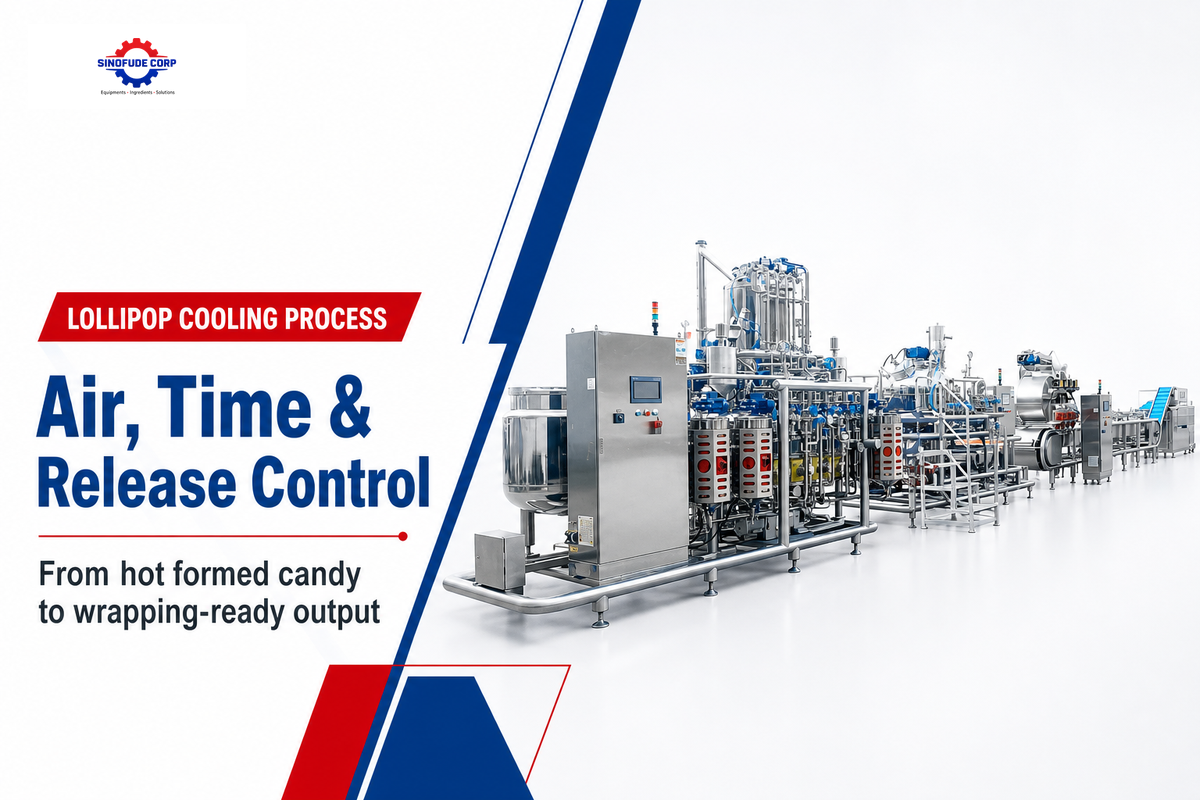
The lollipop cooling process is the controlled transition that transforms pliable candy into a state where the completed product can be transported and further processed without developing objectionable shape, surface, or sticking conditions. The design temperature for the product depends on several factors, including the ingredients and the family of products being manufactured, the dimensions of the product, the prevailing conditions of the air and the raw product, and the nature of the tests performed on the product to accept it for further processing.
Updated September 2026 · By Karry
Control air temperature, air moisture, airflow distribution, and residence time together, while keeping formulation, geometry, loading, and measurement method in view. Trend how representative lollipops respond; do not change one cooler setpoint from touch or appearance alone.
Cooling Outcome Stack
- Reduce product temperature without creating an unacceptable surface-to-core gradient.
- Retain intended shape, detail, orientation, and stick position through transfer.
- Prevent avoidable moisture pickup or condensation at the cooler exit.
- Release cleanly from the conveyor, bed, mold, carrier, or transfer point.
- Enter the wrapper without smearing, blocking, cracking, or stick movement.
- Generate a repeatable record that production and quality can review.
What the Lollipop Cooling Process Must Accomplish
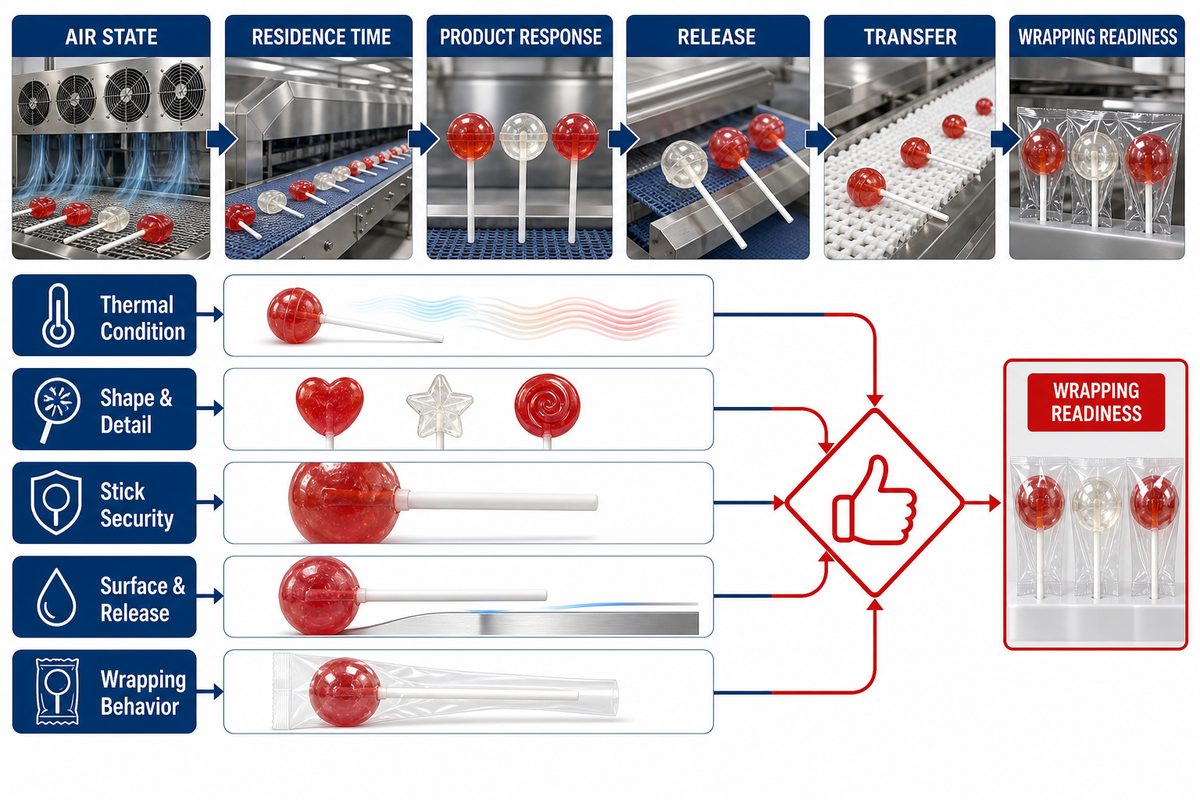
The objective of cooling is to ensure candy has achieved a stable state both from a thermal and a mechanical standpoint while also retaining its shape and stick. In addition, the surface of the candy must be acceptable and it must be removed cleanly from the cooling device. Candy is evaluated to determine if it’s suitable for further processing (i.e. wrapping) and if it has met the requirements for cooling.
| Outcome | What to observe | Evidence to retain | If it fails |
|---|---|---|---|
| Thermal condition | Representative surface and internal response | Method, location, time, sample basis | Review gradient and exposure |
| Shape and detail | Flatness, roundness, embossing, recovery after contact | Photos and defined checks | Trace forming, transfer, and loading |
| Stick security | Position, pull or handling response | Approved plant method | Review insertion and product support |
| Surface and release | Tack, marks, sticking, moisture, dullness | Zone and transfer observations | Review air state and contact surfaces |
| Wrapping behavior | Feed, seal area, film contact, jams | Short wrapper trial | Hold and investigate before release |
Peer-reviewed literature describes hard candies as an amorphous sugar product whose behavior depends on formulation, processing, temperature, humidity, and water; a polyol is not a universal component. The sensitivity of this product class to humidity and processing temperature supports a product-response approach to cooling; it does not establish a risk-based release, microbial lethality step, or shelf-life validation.
Boundary: a wrapping-ready quality decision can support manufacturing control. It does not replace the plant’s validated food-safety plan, packaging validation, or shelf-life programme.
Where Cooling Begins in the Lollipop Line
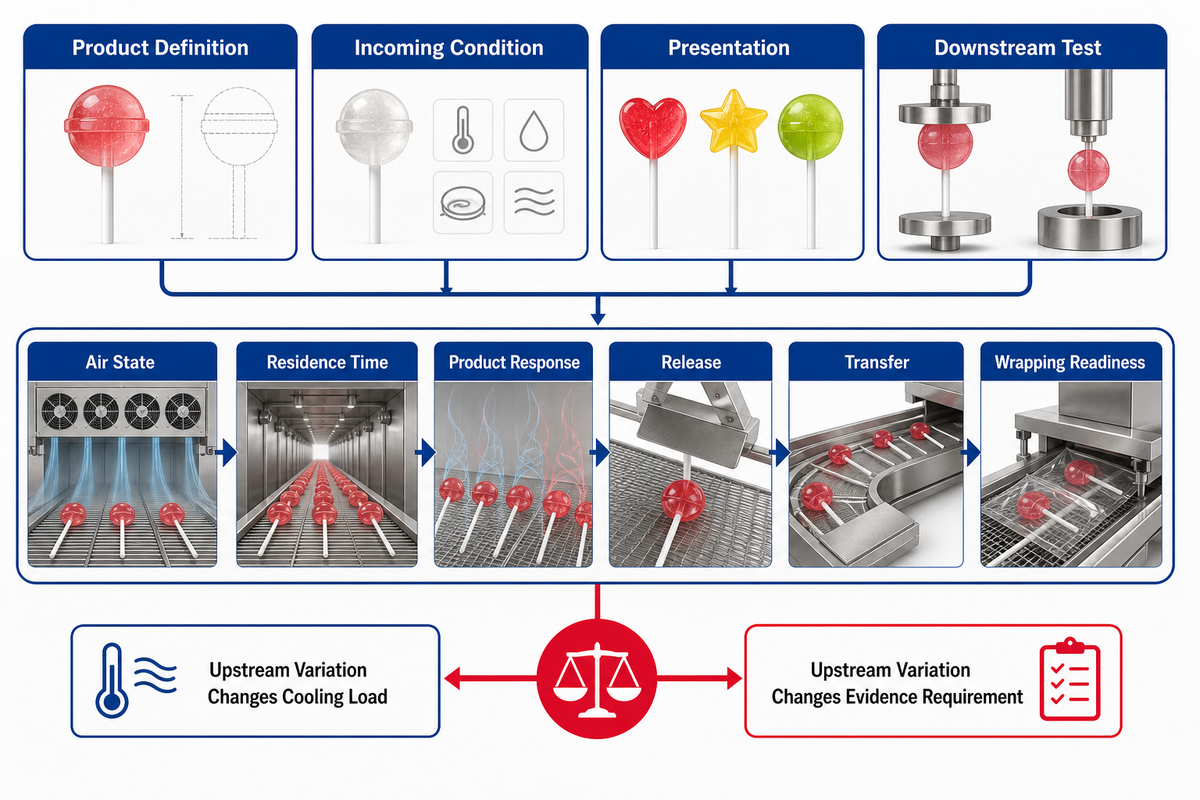
Cooling of sugars and other products begins with the condition delivered by forming, not with raw materials delivered to the manufacturing facility. In the lollipop manufacturing process, sugar and corn syrup are processed in a cooker, then delivered to a depositor or batch roller before the cooling system. This guide considers the condition of the product at the forming step.
Product definition
Recipe family, inclusion or filling, coating status, mass, thickness, diameter, shape.
Recipe family, inclusion or filling, coating status, mass, thickness, diameter, shape.
Incoming condition
Forming route, time since forming, temperature method, deformation or tack.
Forming route, time since forming, temperature method, deformation or tack.
Presentation
Spacing, orientation, contact points, stick support, lanes, bed depth.
Spacing, orientation, contact points, stick support, lanes, bed depth.
Downstream test
Transfer, release, wrapper feed, film contact, and defined acceptance.
Transfer, release, wrapper feed, film contact, and defined acceptance.
A flat lollipop, a ball lollipop, and a center-filled product can carry different contact and gradient risks even when their surfaces look similar. Once those inputs are defined, teams working with ball, flat, or deposited formats can review industrial lollipop machine options for configuration and project-scoping questions.
Do not ask the cooler to hide upstream variation. If piece mass, spacing, stick depth, or incoming condition moves, the cooling load and release evidence move with it.
Four Air-Side Variables to Control Within a Wider Cooling Envelope
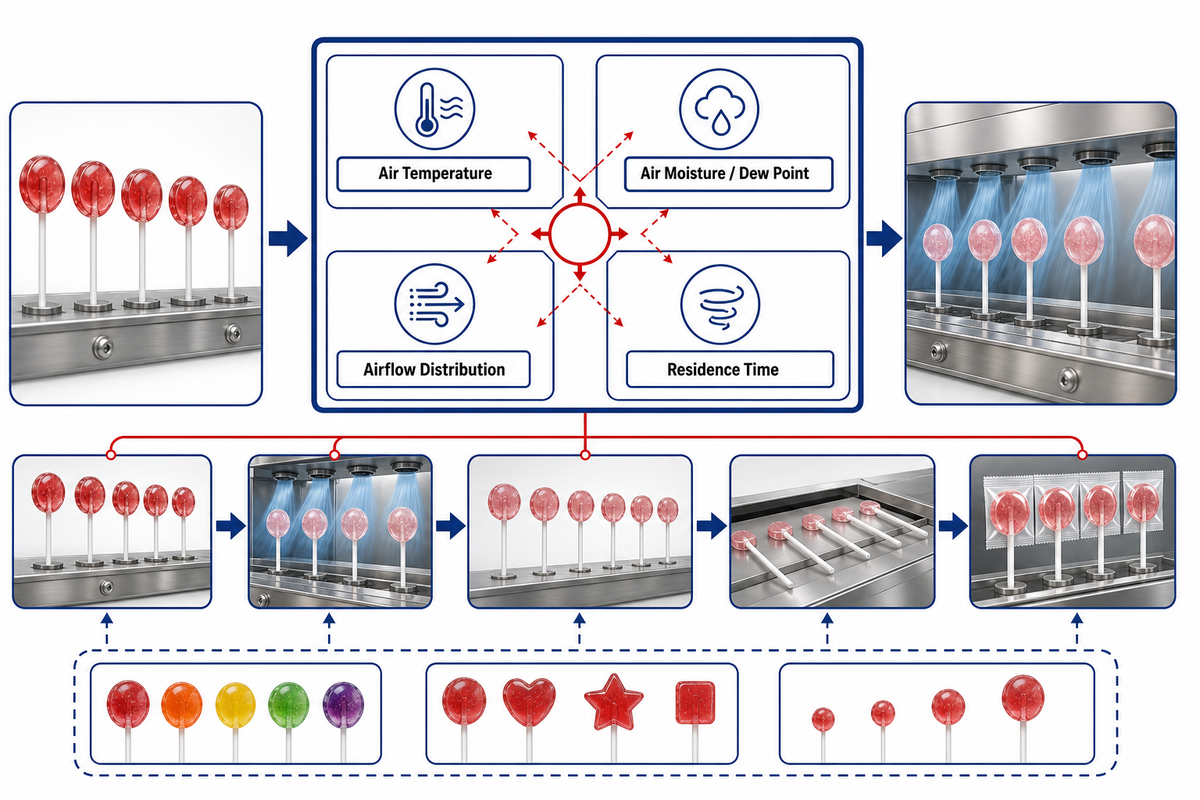
Operators of a given air stream have several variables that affect product solidification, namely temperature, relative humidity, velocity, and time. These are by no means the only constraints that affect product solidification. Other constraints may include the type and amount of additives in the product, initial product condition, geometric shape of the product, interfacial contacts between product pieces, and product loading, to name a few.
| Air-side variable | What a change can affect | What to trend with it | Common mistake |
|---|---|---|---|
| Air temperature | Heat-transfer driving force and surface response | Product profile, condensation risk, defects | Assuming lower is always better |
| Air moisture / dew point | Moisture pickup and condensation at transitions | Product surface temperature and transfer air | Using relative humidity alone |
| Airflow distribution | Local heat transfer and lane uniformity | Velocity or pressure map, loading, lane results | Treating fan speed as uniform exposure |
| Residence time | Total exposure before transfer | Actual path, stops, belt speed, accepted output | Using nominal time without the load pattern |
A hard-candy tunnel study modeled product size, production rate, tunnel dimensions, air temperature, velocity, and residence time together. Faster airflow isn’t automatically more effective, since it can increase the difference between center and surface temperatures. The use of high air velocity may increase center-to-surface non-uniformity under the modeled conditions, so it is not a universal route to rapid solidification.
Controlled-trial rule: change one intended variable, record all four air-side variables, hold product and loading definitions as stable as practicable, and judge the result with the same sample and wrapper method.
Surface Cooling Is Not the Same as Core Stabilization
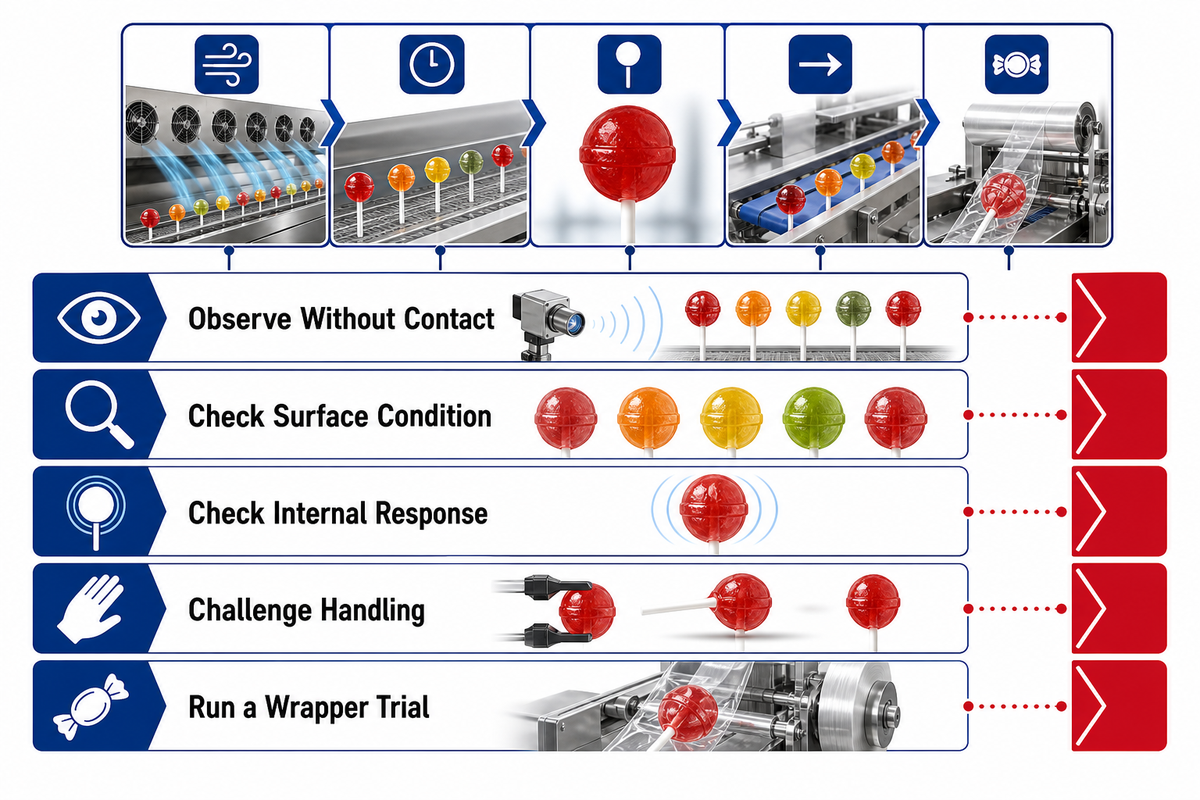
A hard or glassy candy product may feel cool to the touch even while its internal temperature, formulation, and moisture influence molecular mobility and stable glassy behavior.
Surface-to-Core Release Ladder
- Observe without contact: shape, gloss, lane pattern, visible moisture, or marks.
- Check surface condition: use a defined, repeatable method rather than an unrecorded touch.
- Check representative internal response: state the instrument, location, timing, and sample preparation.
- Challenge handling: confirm release, transfer, stick stability, and shape recovery.
- Run a wrapper trial: test the downstream condition that cooling is supposed to enable.
Research on some candy formulations demonstrated that changes in the components and the level of moisture in the formulation affect the formulation’s glass-transition state and mobility. A homogeneous spherical model can explain the direction of a temperature gradient. Modeling with a homogeneous sphere is limited for predicting stick-mounted, non-spherical, coated, embossed, or center-filled lollipops, so its numerical results cannot transfer directly.
Measurement note: “core temperature” is not self-defining. Record which product was sampled, where the reading was taken, when it was taken, how the sample was handled, and what uncertainty the method introduces.
Match Cooling Method to Product Format and Transfer Behavior
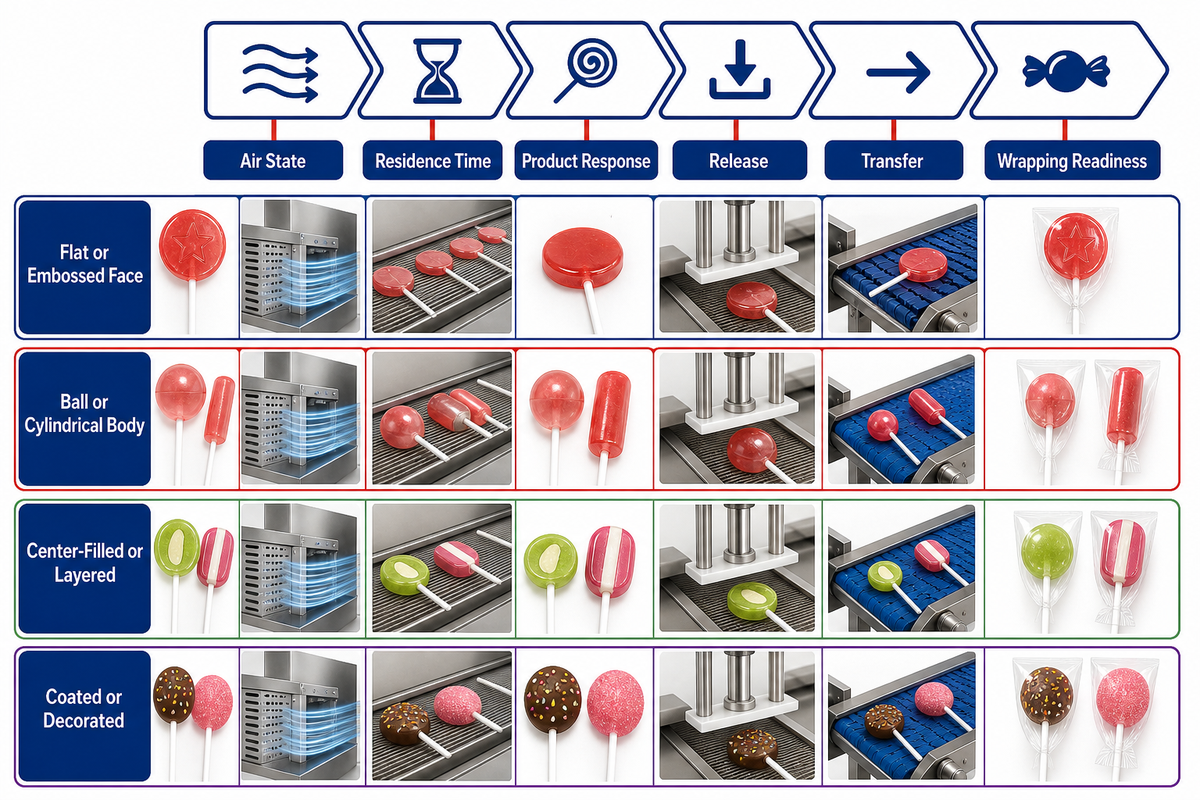
Products formulated as hard or glassy candy require cooling arrangements that support and move them without damaging the candy body or stick. Changes in formulation may significantly change the glass transition of the product. While research has primarily focused on hard-candy formulation and processing limitations, first-party equipment pages show different product routes for flat and ball lollipops rather than transferring lessons to center-filled products.
The arrangement of cooler features depends on how the product is supported, moved, and exposed. There are several design considerations, including contact patterns, collision risk, orientation, surface area, filling, coating, embossing, and wrapping transfer.
| Format question | Handling risk | Evidence to request |
|---|---|---|
| Flat or embossed face | Face marks, overlap, edge deformation, uneven contact | Orientation, contact map, lane-specific samples |
| Ball or cylindrical body | Rolling, collision, stick entanglement, shadowing | Motion path, bed depth, collision observations |
| Center-filled or layered | Different thermal response and structural support | Cross-section, fill condition, product-specific trial |
| Coated or decorated | Surface transfer, cracking, moisture sensitivity | Coating state, contact surfaces, wrapper compatibility |
GEA company pages illustrate that a single supplier employs different cooling paths for flat and ball lollipops, with particular motion and model-specific residence time considerations. These pages illustrate path and speed variation. They don’t ensure time, capacity, or performance for a different product, machine, recipe, or plant.
Procurement boundary: name the product format and handling risks before discussing cooler arrangement. Model selection, capacity, FAT, quotation, and supplier comparison remain separate commercial decisions.
Balance Line Speed, Loading, and Residence Time
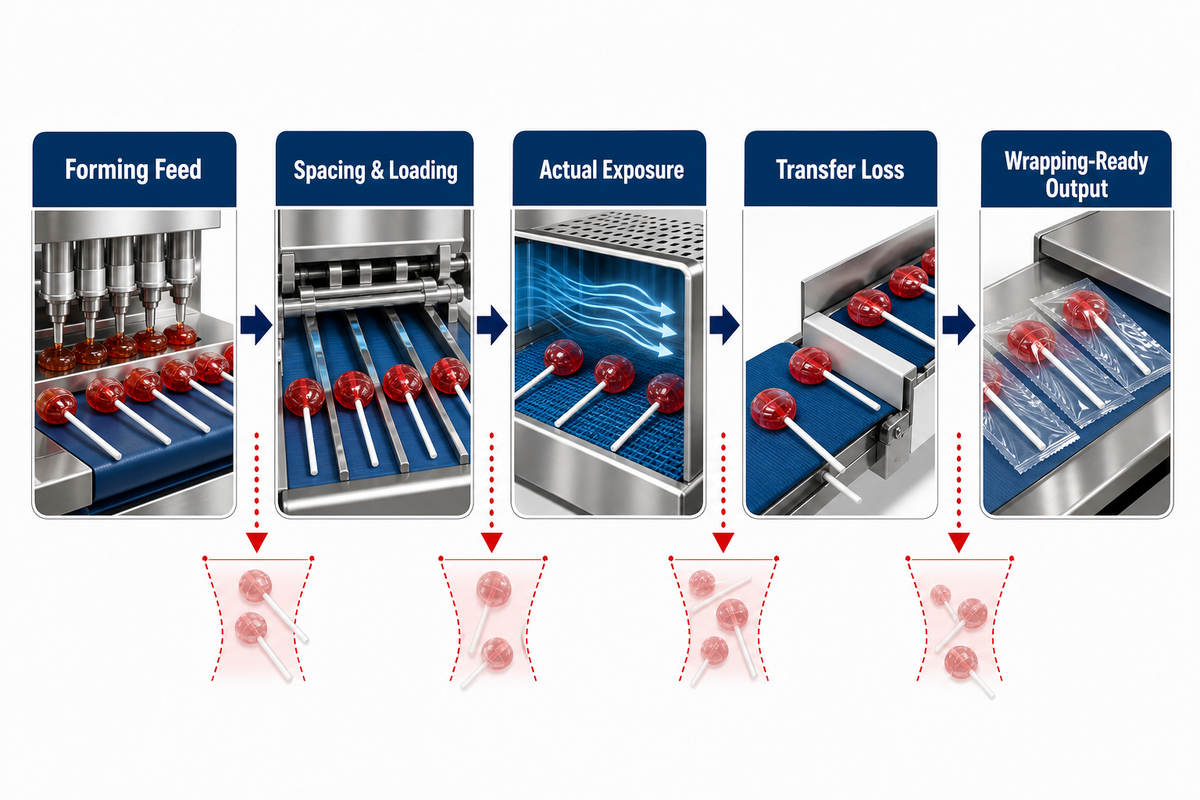
Increased process speed doesn’t necessarily improve the number of lollipops accepted by the wrapper. Variability in feed and spacing, difference in process path and air distribution, process loss and wrapping behavior can result in significantly reduced output as compared to the desired or specified rate.
Accepted-output constraint chain
Forming feed→Spacing and loading→Actual exposure→Transfer loss→Wrapping-ready output
Residence time, speed and path variation should be considered. Determining product acceptance and residence time requires consideration of several factors, including product variations and loading. A general cooling time calculator may lead to a number of erroneous conclusions.
Trial comparison: report good wrapped units over a defined period, not only the former or belt speed. Record rejects and holds by lane, time, and symptom so a speed increase is not mistaken for a throughput gain.
Control Humidity, Dew Point, and Condensation Risk
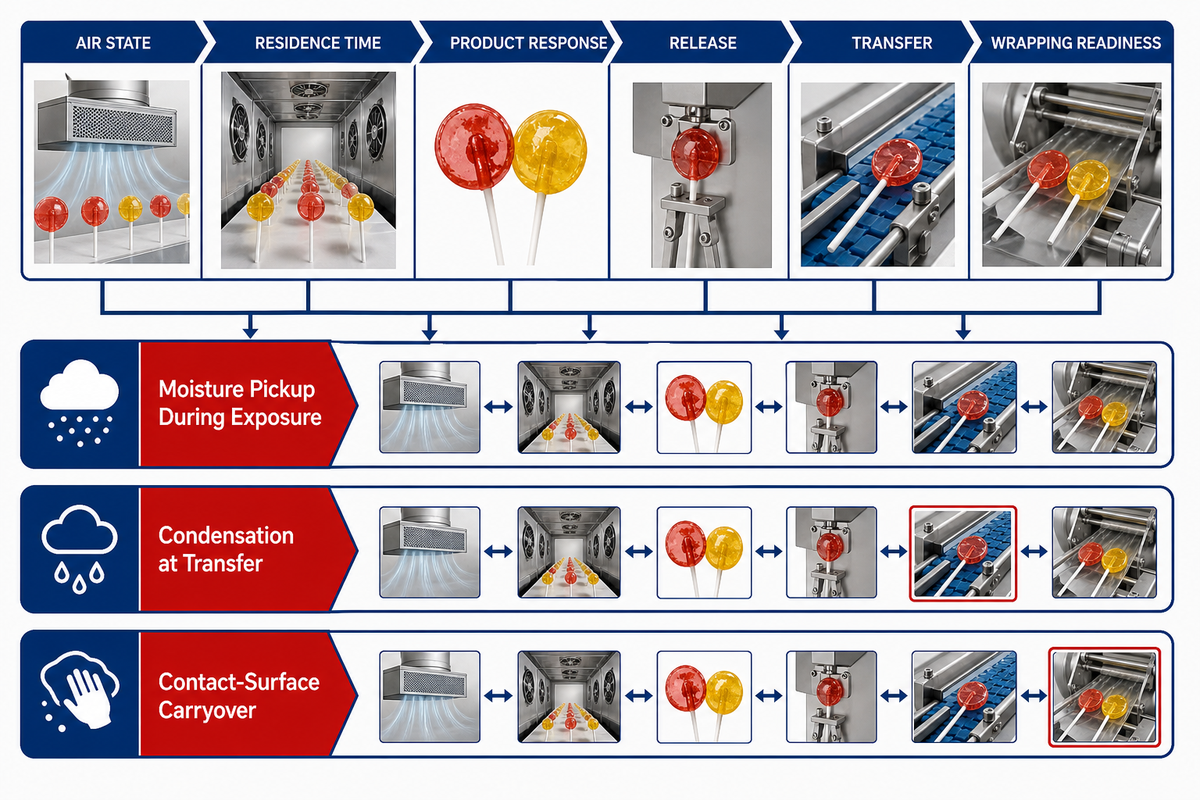
There are two ways by which a lollipop can gain moisture: (1) by amorphous candy directly absorbing moisture from the surrounding, or (2) by condensation on a candy surface. Relative humidity alone wouldn’t identify which of the two moisture cases is true, nor would it predict the condition of candy at the cooler exit.
| Situation | Evidence pattern | Check next |
|---|---|---|
| Moisture pickup during exposure | Tack or softening tracks time in humid air | Product equilibrium behavior, air state, exposure duration |
| Condensation at transfer | Surface wetness appears after entry into a warmer or wetter zone | Surface temperature versus receiving-air dew point |
| Contact-surface carryover | Marks follow a belt, carrier, guide, or lane | Sanitation, release, cleaning, and contact conditions |
Texas A&M University explains that understanding the role of water activity (a.k.a. aw) in a system helps explain the movement of moisture toward equilibrium relative humidity. Water activity, along with glass transition temperature, adds information that moisture content alone cannot provide. Water activity and glass transition temperature should be considered when making process and product specifications.
Minimum air-state record: temperature and humidity or dew point in relevant zones, product surface condition, product temperature method, exposure time, cooler-exit condition, transfer-room condition, and the time at which stickiness appears.
Diagnose Cooling Defects From Evidence, Not Guesswork
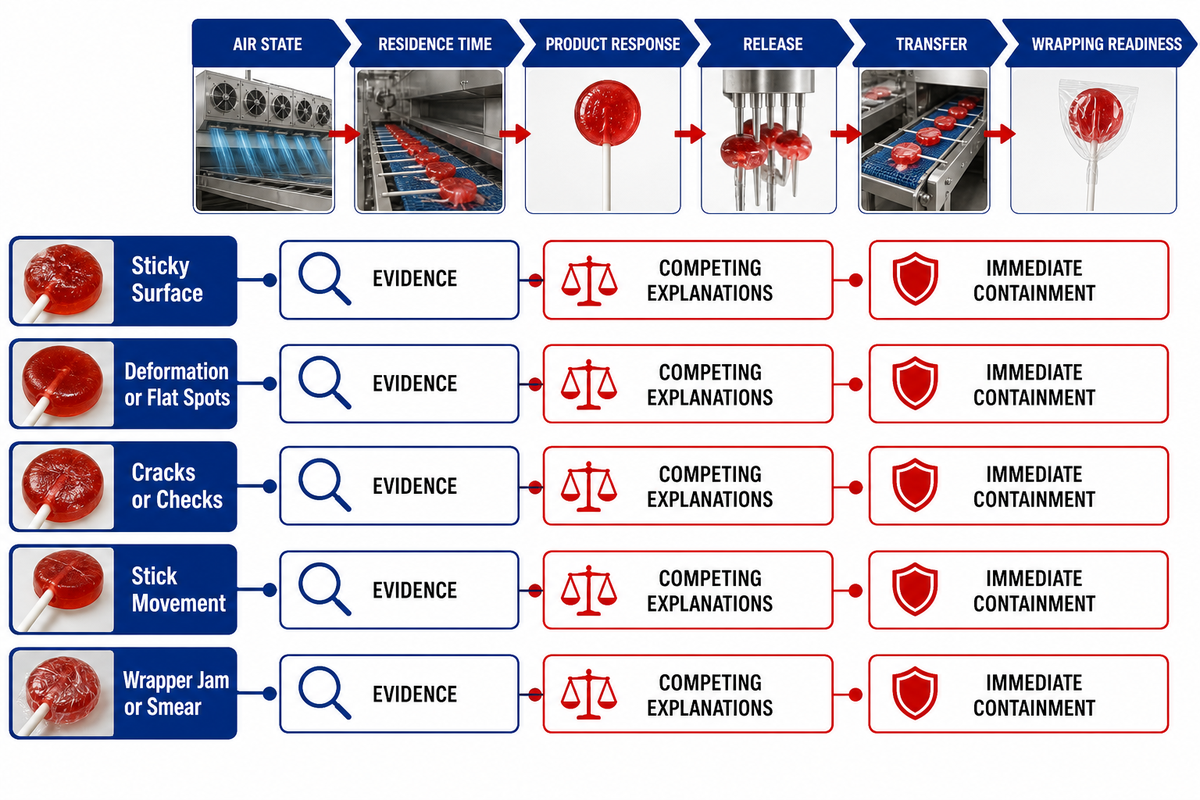
There can be multiple causes for a given defect and one deviation in a process can be expressed in several ways. Workers should distinguish common-cause variation from changes in the environment, process, product, method, line, equipment, loading, and transfers.
| Symptom | Evidence to inspect | Competing explanations | Immediate containment |
|---|---|---|---|
| Sticky surface | Air state, dew point, time of onset, batch endpoint | Moisture pickup, condensation, formulation, contact contamination | Segregate affected interval and protect from further exposure |
| Deformation or flat spots | Incoming condition, support points, loading, residence | Under-stabilization, collision, pressure, forming variation | Hold product and reduce the damaging contact condition |
| Cracks or checks | Gradient, impact point, timing, product geometry | Thermal stress, mechanical impact, formulation, inclusions | Isolate the event and preserve samples |
| Stick movement | Insertion record, support, handling, product condition | Insertion variation, soft interior, collision, pull at transfer | Stop release and trace to forming and transfer |
| Wrapper jam or smear | Product condition, pitch, film contact, feed timing | Cooling, spacing, wrapper setup, transfer alignment | Hold the affected interval and run a defined trial |
The last stable state should be considered the baseline. Workers should be guided to reflect on factors such as change in the recipe, adjustment of process conditions, lane loading, air state, fan/damper position, line speed, transfers, equipment (process) state, sanitation, and wrap state.
Escalation rule: production contains the affected product, quality defines disposition and release evidence, engineering tests the process mechanism, and maintenance addresses equipment condition. A setting change without ownership and a comparison record is not a diagnosis.
Define the Wrapping-Ready Release Decision
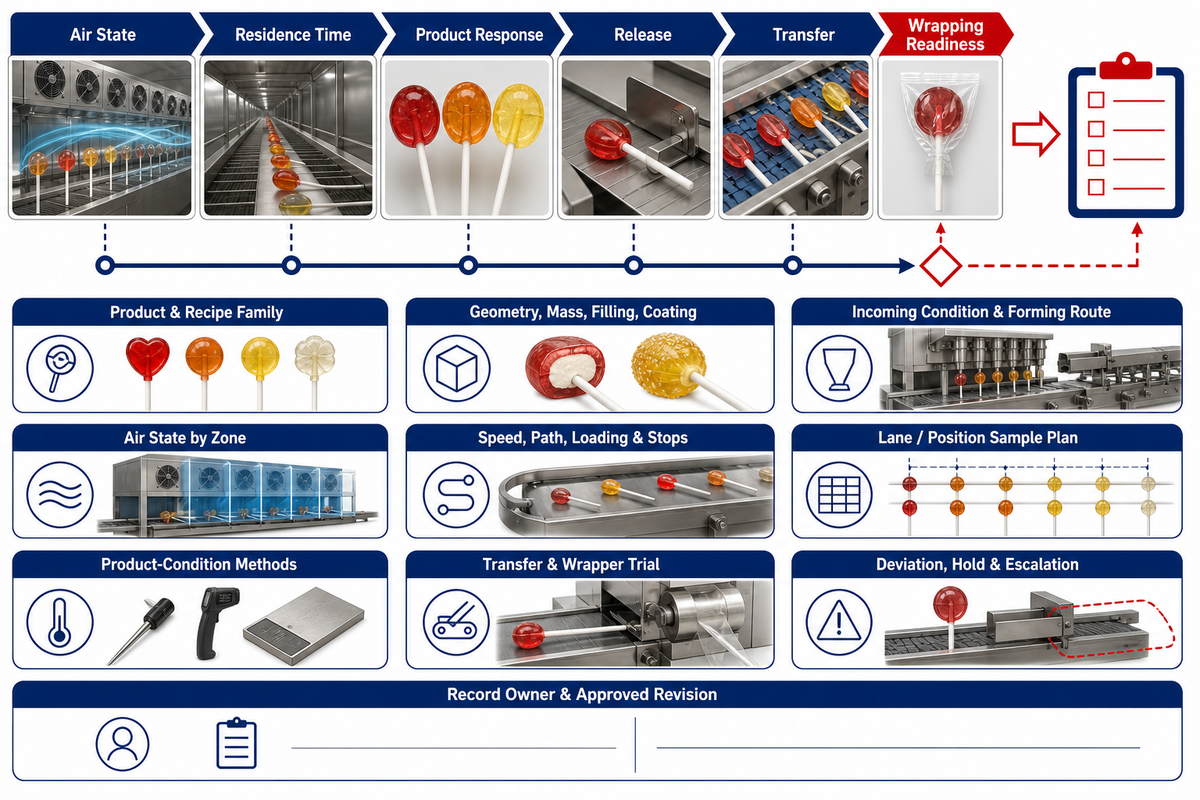
A good release decision accounts for representative product evaluation, transfer behavior, wrapper tests, deviation rules, and record ownership. Stability and moisture behavior can’t always be assessed by normal appearance and/or cleanliness of the product. Product compatibility with the required wrapping condition can’t always be assured by normal appearance and/or cleanliness of the product.
| Release criterion | Method and sample basis | Owner | Failure response |
|---|---|---|---|
| Product condition | Defined surface and representative internal method by lane or position | Production / quality | Hold and compare with approved envelope |
| Shape and stick | Approved checks on a representative sample | Quality | Trace forming, support, and handling |
| Release and transfer | Observe defined points under normal load | Production | Contain interval and inspect contact path |
| Wrapper compatibility | Short trial at intended condition with reject review | Production / packaging | Hold and separate product from machine causes |
In a study of commercial candies, glass-transition temperatures between 28 and 49°C were reported. The authors noted that the formula of the candy influenced the result. The reported commercial-candy glass transition temperatures provide evidence against a universal wrapping temperature and do not provide a specification to copy. The approved temperature is dependent on the product, packaging, and the method and reason for validating the process.
Regulatory boundary: 21 CFR Part 117 distinguishes monitoring, verification, and records, but it does not publish a lollipop cooling setpoint. An FDA confectionery inspection guide likewise provides no wrapping-ready temperature; use official sources to define compliance boundaries, not to manufacture a release number.
The average end-of-tunnel product may represent multiple product qualities, including product from edge lanes and product from changeover transients. To account for edge lanes, the sample plan should include position checks. The first stable period of a product, including the period after a changeover, should be verified before further processing.
Lollipop Cooling Handoff Card
- Product and recipe family
- Geometry, mass, filling, coating
- Incoming condition and forming route
- Air state by relevant zone
- Actual speed, path, loading, and stops
- Lane / position sample plan
- Product-condition methods
- Transfer and wrapper trial result
- Deviation, hold, and escalation rule
- Record owner and approved revision
Decision Framework: What to Record Before You Change the Cooler
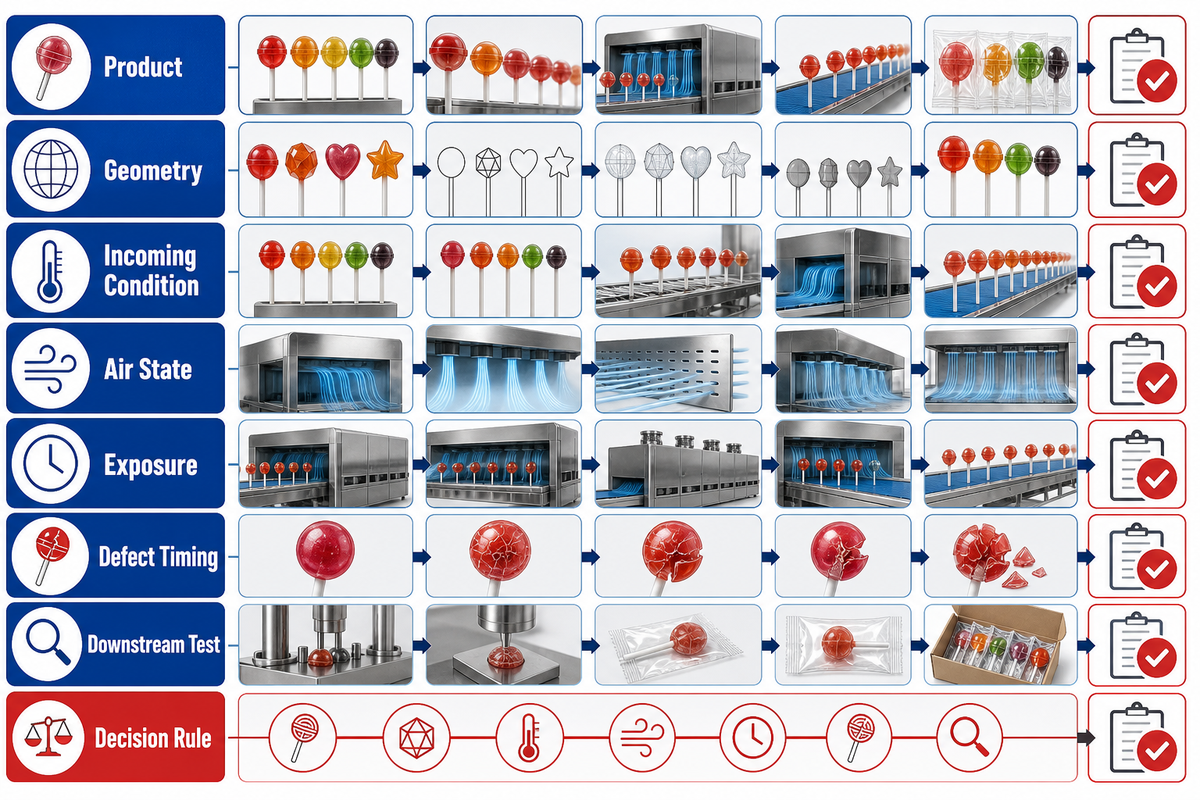
A target line speed and a defect photo aren’t sufficient to identify a cooling problem, or to determine the extent of a change. An effective cooling brief records eight input categories, allowing operators, quality team members, and suppliers to assess the same item, conditions, and acceptance standard.
8-Input Cooling Brief
| Input category | What to record | Why it changes the decision |
|---|---|---|
| 1. Product | Format, recipe family, filling or coating, and commercial use | Defines the material and handling boundary |
| 2. Geometry | Mass, thickness, diameter, shape, stick, and tolerance range | Changes heat path, support, and sampling |
| 3. Incoming condition | Forming route, temperature method, spacing, and observed variation | Defines the load delivered to the cooler |
| 4. Air state | Temperature, humidity or dew point, and airflow evidence by zone | Separates intended condition from distribution |
| 5. Exposure | Verified path, speed, residence, loading, stops, and recirculation | Defines actual rather than nominal treatment |
| 6. Defect timing | First appearance, lane, zone, interval, frequency, and last stable run | Locates the likely change or failure event |
| 7. Downstream test | Release, transfer, wrapper condition, reject basis, and packaging state | Defines the outcome cooling must enable |
| 8. Decision rule | Sample plan, owner, pass/hold logic, change approval, and record revision | Makes comparisons repeatable and reviewable |
This brief allows a controlled change to be compared to the status quo. If the change under consideration is route selection, production-line configuration, factory acceptance testing, a request for quotation, or equipment sizing, hand the input to the commercial project team while retaining the quality limits that define the equipment specification.
Decision principle: ask which missing evidence prevents a safe comparison. Collect that evidence before making the change more precise, more expensive, or harder to reverse.
Frequently Asked Questions
Why aren’t my lollipops hardening?
Check the complete product-and-air history.
Lollipops may remain soft because the incoming candy mass contains more water than expected, the forming-to-cooling handoff is too warm or uneven, exposure is insufficient for the piece geometry, or the product picks up moisture during or after cooling. Don’t change one setpoint from appearance alone. Compare the batch endpoint record, piece mass and geometry, air condition by zone, actual residence time, loading pattern, and wrapper response on a representative sample.
Should lollipops be refrigerated after production?
Use the validated product and package specification.
Finished hard lollipops are generally designed for dry protective packaging and controlled storage rather than routine refrigeration, but the correct condition depends on the validated product and package system. Moving cold product into warmer humid air can create condensation and packaging problems. Don’t treat a cooler setpoint as a finished-goods storage instruction.
How does humidity affect lollipop cooling and stickiness?
Separate moisture pickup from condensation.
Hard-candy surfaces can absorb moisture from humid air, while a cold surface can collect condensation when it enters air whose dew point is above the surface temperature. Trend temperature and humidity or dew point together with product condition, exposure time, transfer events, and packaging behavior. A single room-humidity reading can’t show where moisture was introduced.
How do you know when a lollipop is ready for wrapping?
Use a defined release check.
Combine representative product condition, shape and stick stability, clean release or transfer, and a wrapper trial under the intended line condition. Record the method, sample basis, lane or position, owner, and response when any criterion fails.
Is faster cooling always better for lollipops?
No, judge consistent accepted output.
More aggressive cooling can change gradients, condensation risk, handling behavior, and the balance between surface and internal stabilization. The useful target is repeatable wrapping-ready output inside a verified operating envelope, not the lowest possible air temperature.
Turn Cooling Evidence Into a Clear Line Brief
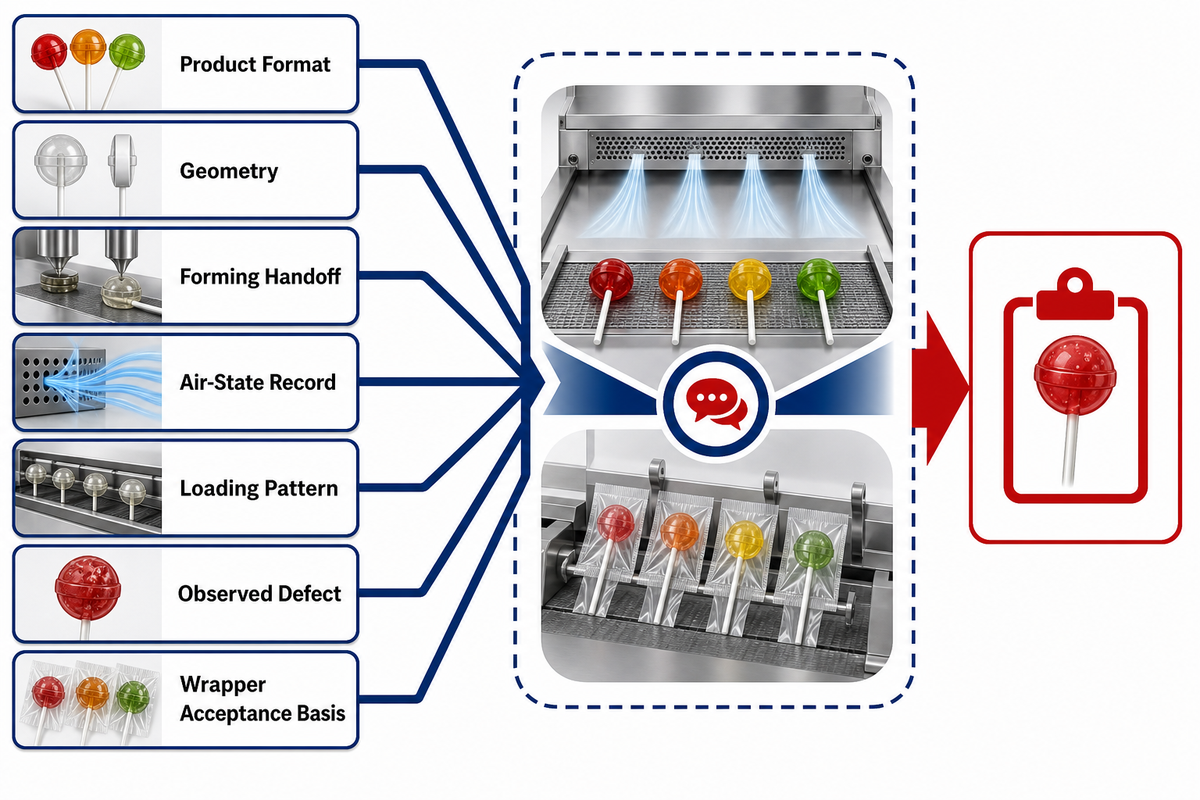
Share your product format, geometry, forming handoff, air-state record, loading pattern, observed defect, and wrapper acceptance basis. SINOFUDE can use those inputs to discuss the appropriate project scope without substituting a generic setpoint for a product-specific trial.
About SINOFUDE
Founded in 1998 and based in Shanghai’s Fengxian District, SINOFUDE focuses on production-line technology for confectionery, chocolate, and bakery applications. According to the company-supplied profile, the business has developed to three factories covering more than 30 acres, employs more than 200 people, and holds 38 product patents.
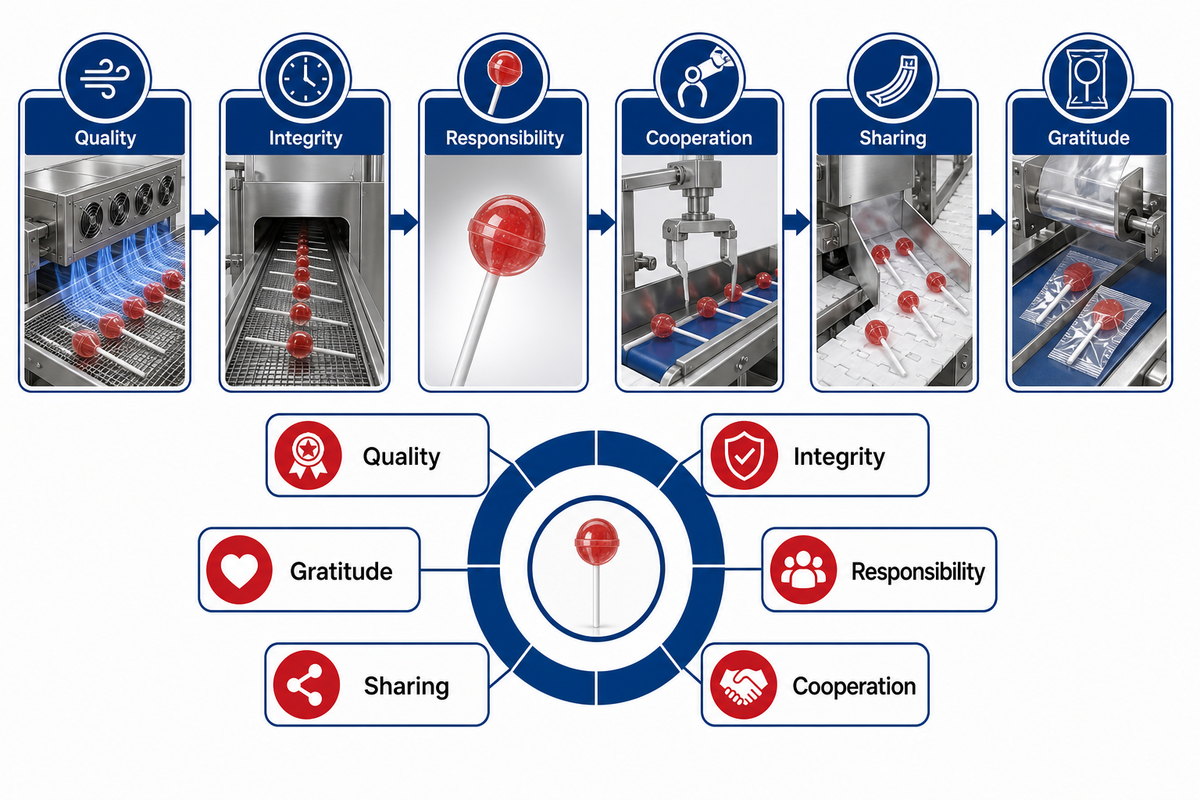
SINOFUDE describes quality, integrity, responsibility, cooperation, sharing, and gratitude as its core values. Certification or performance claims must be verified for the specific project.
About This Article
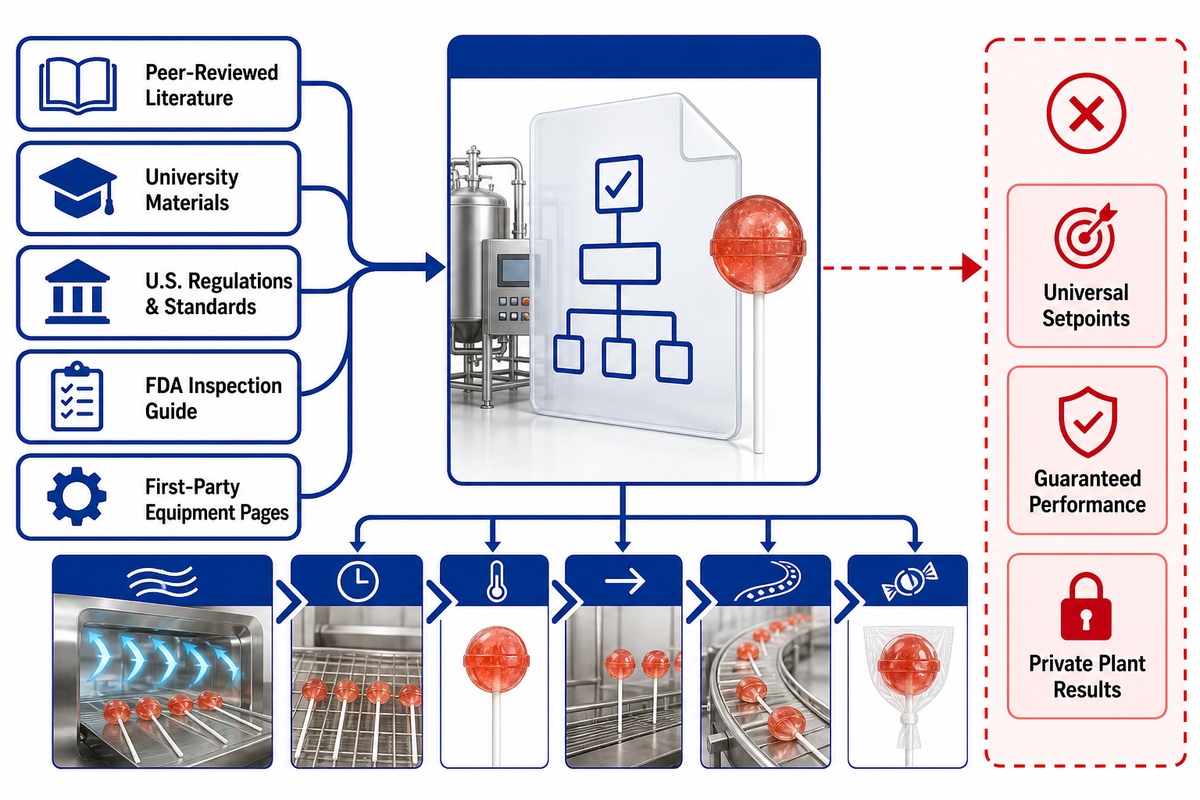
This document includes peer-reviewed literature, university-hosted teaching materials, current U.S. regulations and standards, the U.S. regulatory text, an FDA inspection guide, and first-party equipment pages with their scopes labeled. The article does not supply a private plant dataset, universal cooling setpoint, guaranteed capacity, defect rate, energy figure, shelf-life result, price, lead time, or machine certification.
Method note: the Cooling Outcome Stack, Four Air-Side Variables Matrix, Surface-to-Core Release Ladder, Defect-to-Cooling-Evidence Matrix, and Lollipop Cooling Handoff Card are decision aids created for this article. They are not standards, validated plant specifications, or substitutes for product trials.
References & Sources
- Hard candy quality: influence of formulation, processing, and storage · Peer-reviewed review indexed by Europe PMC
- Hard-candy quality review record · Europe PMC
- Moisture and sugar in shelf life · Texas A&M University-hosted technical review
- Water activity, glass transition, and molecular mobility in hard candy formulations · Frontiers in Food Science and Technology
- Modeling and optimization of hard-candy cooling · Journal article abstract and preview, ScienceDirect
- Glass-transition temperatures of sampled commercial candies · Europe PMC
- 21 CFR Part 117, Current Good Manufacturing Practice and Preventive Controls for Human Food · Electronic Code of Federal Regulations
- Miscellaneous Food Products inspection guide: candy and confectionery products · U.S. Food and Drug Administration
- Aquarius PopCooler F flat-lollipop route · GEA first-party equipment information
- Aquarius PopCooler B ball-lollipop route · GEA first-party equipment information