Get in Touch with SINOFUDE Company


Updated September 2026 · By XCX
The lollipop manufacturing process is a controlled sequence that dissolves and cooks syrup, adds ingredients, forms the candy, and places the stick. There are also variations in the processes for the deposit and rope-shaped methods of production. The eight major processes described below outline the requirements for each step of the process.
8-Handoff Lollipop Control Map
- Release recipe, ingredients, and batch identity
- Dissolve and prepare a uniform syrup feed
- Cook and verify the candy-mass endpoint
- Add flavor, color, and acid in the qualified window
- Form by the selected route
- Place the stick and confirm retained alignment
- Cool to a measured release condition
- Inspect and release wrapper-ready product
“Monitoring must be documented.” FDA, Preventive Controls for Human Food
The Lollipop Manufacturing Process Is a Series of Controlled Handoffs
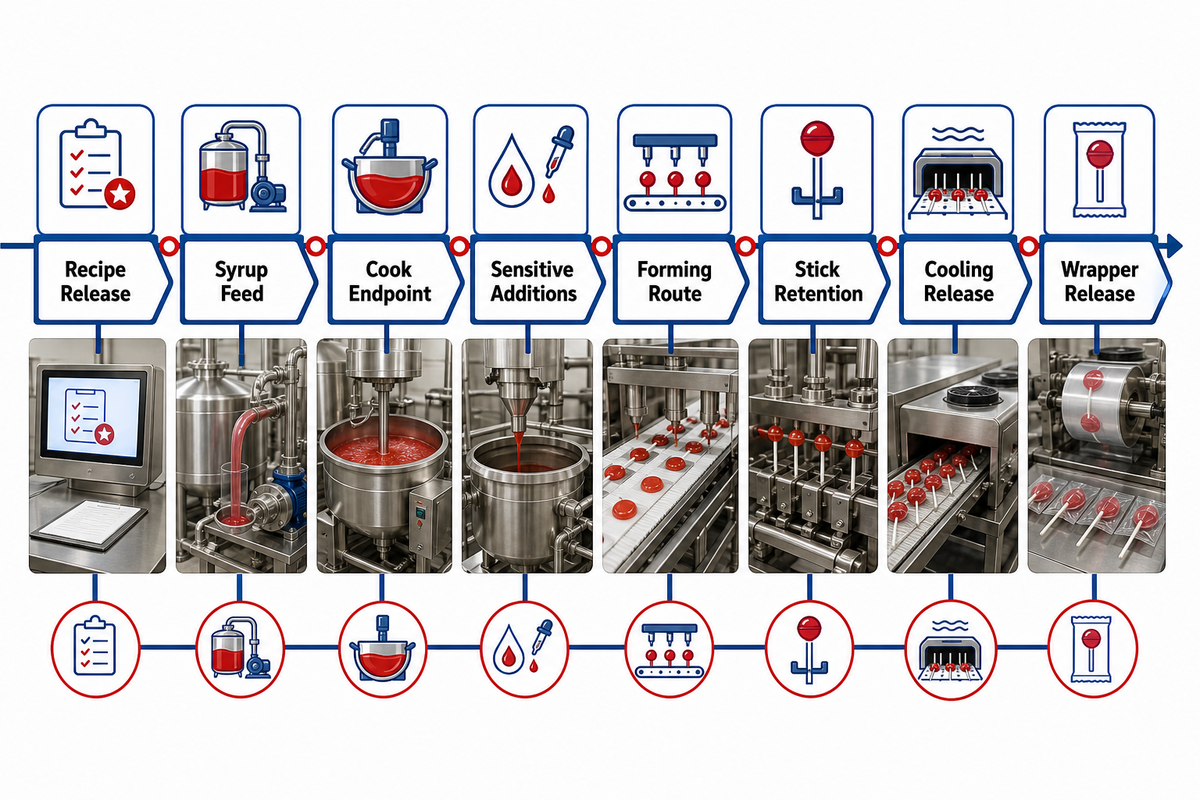
Handoff specifications describe the requirements for product traveling through a system (21 CFR Part 117: https://www.ecfr.gov/current/title-21/chapter-I/subchapter-B/part-117). These requirements can be a product test, measurement, status, or condition. There are eight stages in the production of lollipops, each with specified handoff requirements.
| Handoff | Outgoing state | Minimum evidence | Receiving question |
|---|---|---|---|
| Batch to syrup | Released materials | Recipe, lot, status, mass | May the cooker be charged? |
| Cook to additions | Qualified candy mass | Instrument, sample, response | Is the mass inside the addition window? |
| Form to cool | Shaped pieces with sticks | Geometry, placement, handling | Can cooling preserve the intended piece? |
| Cool to wrap | Wrapper-ready pieces | Surface, shape, stick, temperature | Can the wrapper receive and handle them? |
Handoff ruleA completed machine cycle is not automatically an accepted product transfer. The product state, record, and receiving condition must agree.
Step 1: Release the Recipe, Ingredients, and Batch Identity
Before charging the cooker, the approved recipe revision, ingredient and lot identity, allergen status, changeover condition, target quantity, and intended label version must be released. A correct total weight can’t correct a wrong ingredient, an unreleased lot, or a status record attached to the wrong batch.
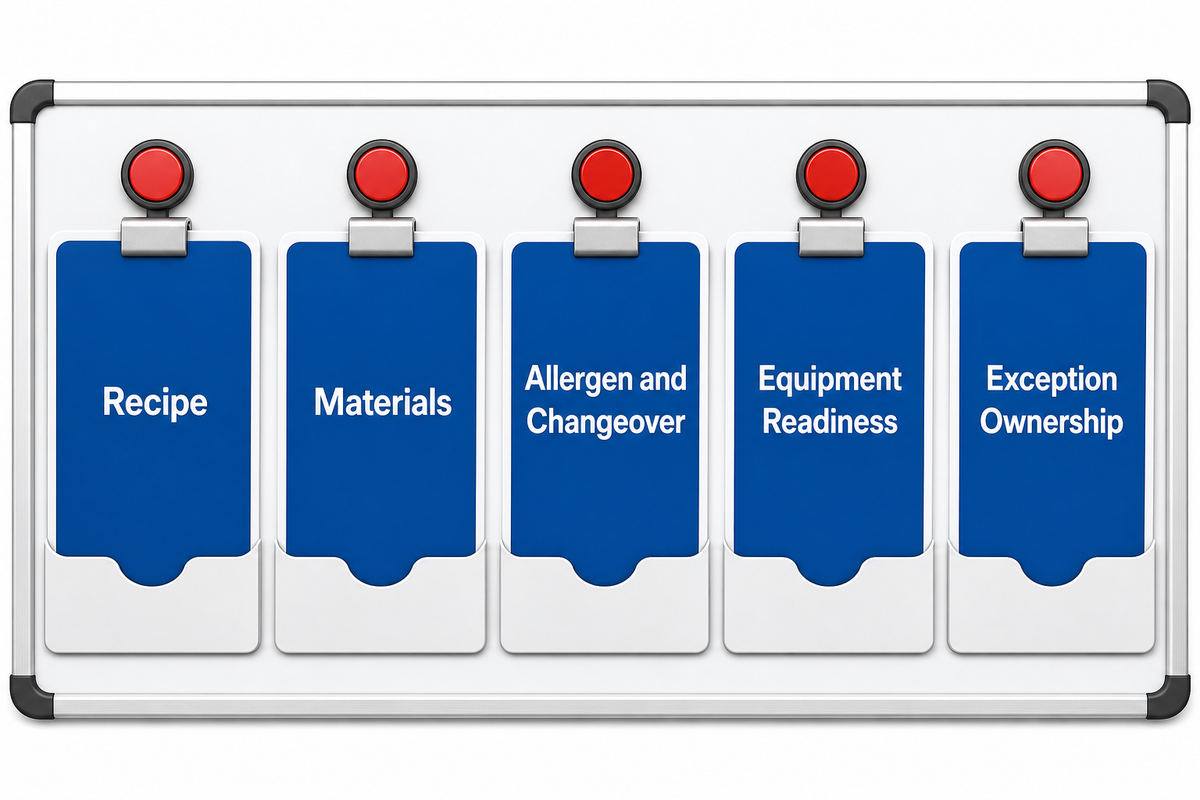
Batch Release Card
- Recipe: product code, revision, approved batch size, special instructions
- Materials: sugar, glucose syrup, or corn syrup identity, supplier lot, internal lot, status, measured quantity
- Allergen and changeover: formula status, line clearance, label match
- Equipment: assigned vessel, cleanliness status, instrument readiness
- Exception: hold scope, investigation owner, restart authority
Current regulations in 21 CFR Part 117 separate monitoring, corrective action, verification, and records where those requirements apply. These regulations don’t provide a sample checklist. Therefore, each facility must integrate its quality and process risks with the finished product.
Release when
identity, status, quantity, allergen condition, and label route agree.
identity, status, quantity, allergen condition, and label route agree.
Re-verify when
a supplier, ingredient specification, lot behavior, or approved formulation basis changes.
a supplier, ingredient specification, lot behavior, or approved formulation basis changes.
An older FDA water-activity technical guide notes that a supplier change can alter finished-product water activity even when the nominal formulation remains the same. That supports a change-triggered review; it does not set a sampling interval or lollipop water-activity limit.
Steps 2–3: Dissolve, Cook, and Verify the Candy-Mass Endpoint
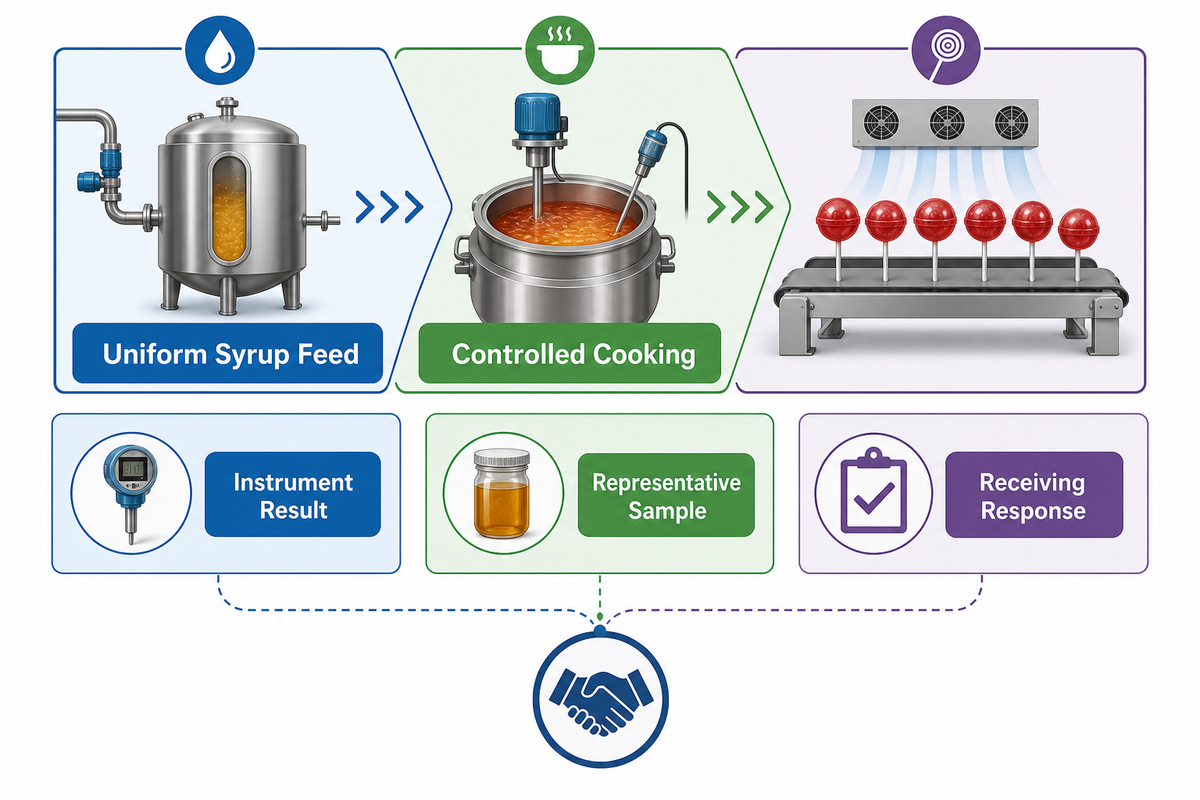
The dissolving hard-candy mass should form a uniform syrup before cooking reaches the endpoint. Further water removal moves the mass toward its route-specific forming state. Water activity is a separate measurement, not a universal endpoint for hard-candy cooks. However, atmospheric pressure and sampling are only two factors that can affect the interpretation of an endpoint reading.
| Evidence side | Record | Question answered | Limit |
|---|---|---|---|
| Instrument | Temperature, pressure, time, route signal | Did the controlled variable reach its approved window? | Needs check or calibration status |
| Sample | Location, method, conditioning, result | Does the sample represent the candy mass? | Precise measurement can still sample badly |
| Receiving response | Flow, deposit, rope, or forming behavior | Can the next operation receive the mass? | Observation does not replace required testing |
A 2024 peer-reviewed hard-candy review describes a general 135–160°C range, yet its compiled examples span roughly 110–170°C. In the Frontiers study, most samples reached 130°C in a 140°C oil bath, while 100% sucrose stopped at 121°C after crystallization intervened.
Terms that are not interchangeable: dry substance, moisture, water activity, product temperature, and glass-transition evidence answer different questions. FDA’s older measurement example notes that a 0.1°C sample-air difference at 25°C can affect the reading, so a specification must name its method and sample basis.
The review reports 2–3% moisture context, while its formulation table includes 118–130°C, 150°C, 170°C, 120°C, 145°C, 110°C, 160°C, and 135°C examples. One study also used a 5 min vacuum step. These are route-specific examples, not universal lollipop limits or proof of lethality or shelf life.
Endpoint decision
Use a formulation-qualified instrument result, a representative sample, and the next operation’s receiving response. Do not copy a published temperature into a factory specification without trials and method evidence.
Use a formulation-qualified instrument result, a representative sample, and the next operation’s receiving response. Do not copy a published temperature into a factory specification without trials and method evidence.
Step 4: Add Flavor, Color, and Acid Inside a Defined Window
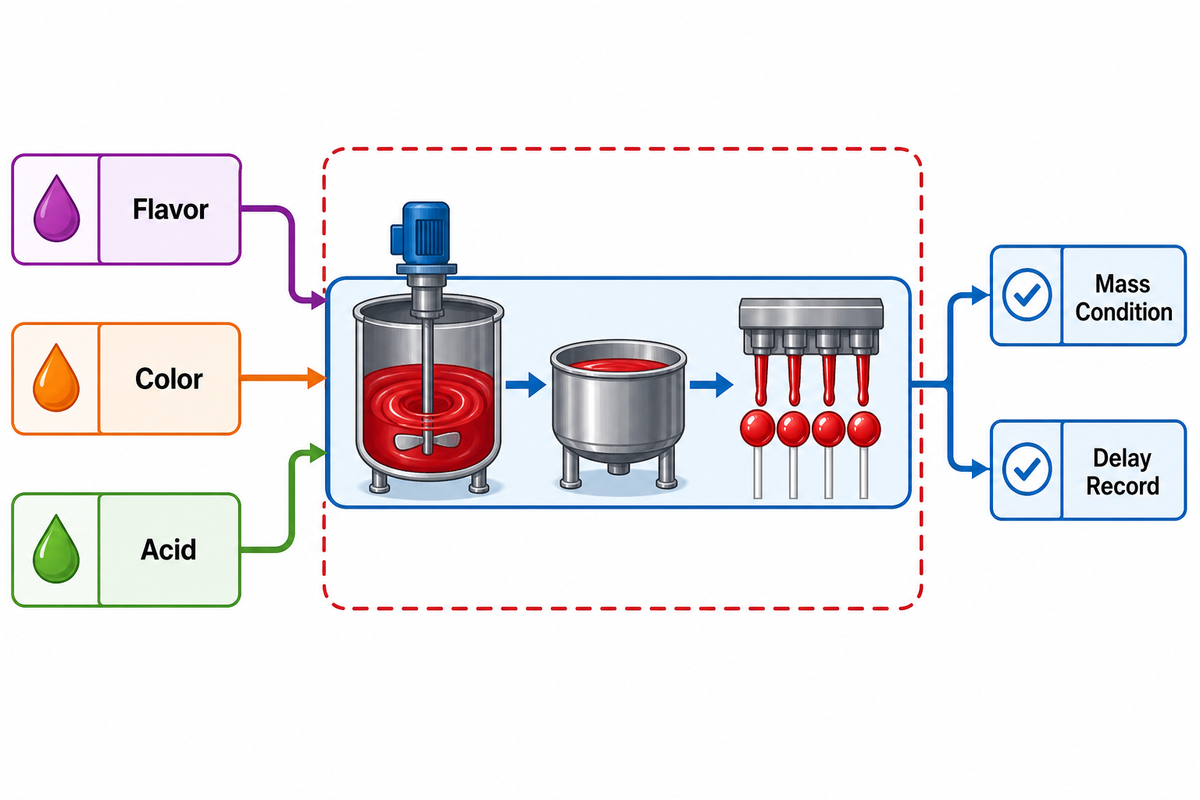
Hard candies can be cooked to the correct end point in a number of different ways. It’s important to record the order of addition, the condition of the candy mass after addition, and any actions or time delays after the cook endpoint.
| Window state | Risk to examine | Evidence to keep |
|---|---|---|
| Too early | Excess heat exposure or loss | Mass condition, time, sequence |
| Controlled window | Uniform addition and mixing | Identity, quantity, actual time, mixing record |
| Too late | Poor dispersion or forming response | Delay, hold decision, restart authority |
Citric acid is often added prior to the final cooling (peer-reviewed review: https://pmc.ncbi.nlm.nih.gov/articles/PMC11214042/). Flavor and color are commonly added after heating, depending on the formulation and qualified process. Supplier declarations may state that a given ingredient is ‘flavoring’ or ‘flavouring’; however, the batch record must state the actual ingredient.
Step 5: Choose the Forming Route Without Confusing It With Machine Selection
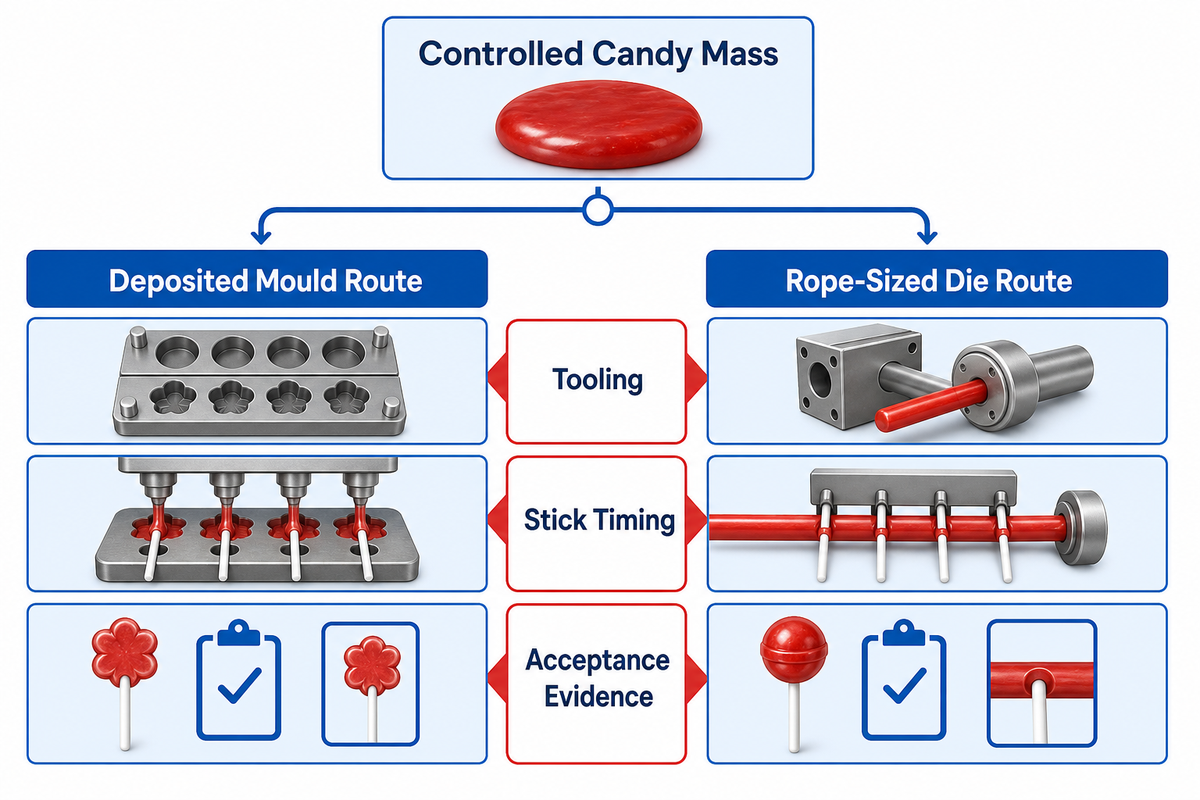
Some routes through the hard-candy production line use die forms, while others use molds to create a candy shape. Lollipop routes differ in the conditions under which the stick is added, the tools required, and the evidence required to demonstrate an in-process sample is acceptable.
| Decision field | Rope sizing and die forming | Depositing |
|---|---|---|
| Receiving condition | Plastic mass that can be sized and formed | Meterable mass inside a qualified flow window |
| Geometry path | Rope, sizing, die or forming set | Metering head, mold, release path |
| Stick question | Feed and capture during forming | Placement before, during, or after deposit by the qualified route |
| Proof to request | Rope condition, die sample, placement, cooling transfer | Deposit repeatability, mold release, placement, cooling transfer |
US4717573A describes one rotating forming and stick-capture arrangement. Because it’s restrictive in scope and withdrawn, it can’t be used to make a supplier performance claim.
Define first
Formula family, inlet condition, piece drawing, weight basis, stick specification, variants, cleaning boundary, and accepted sample.
Formula family, inlet condition, piece drawing, weight basis, stick specification, variants, cleaning boundary, and accepted sample.
Do not assume
A shape photo and kilograms-per-hour target select a compatible route.
A shape photo and kilograms-per-hour target select a compatible route.
Once those product inputs are fixed, customers can review the configuration and proposal stage of an industrial lollipop machine. Logic for this process is included in this article, while equipment selection, project scope, and quotation intent belong to the referenced page.
Step 6: Insert the Stick and Prove Retention Across the Next Handoff
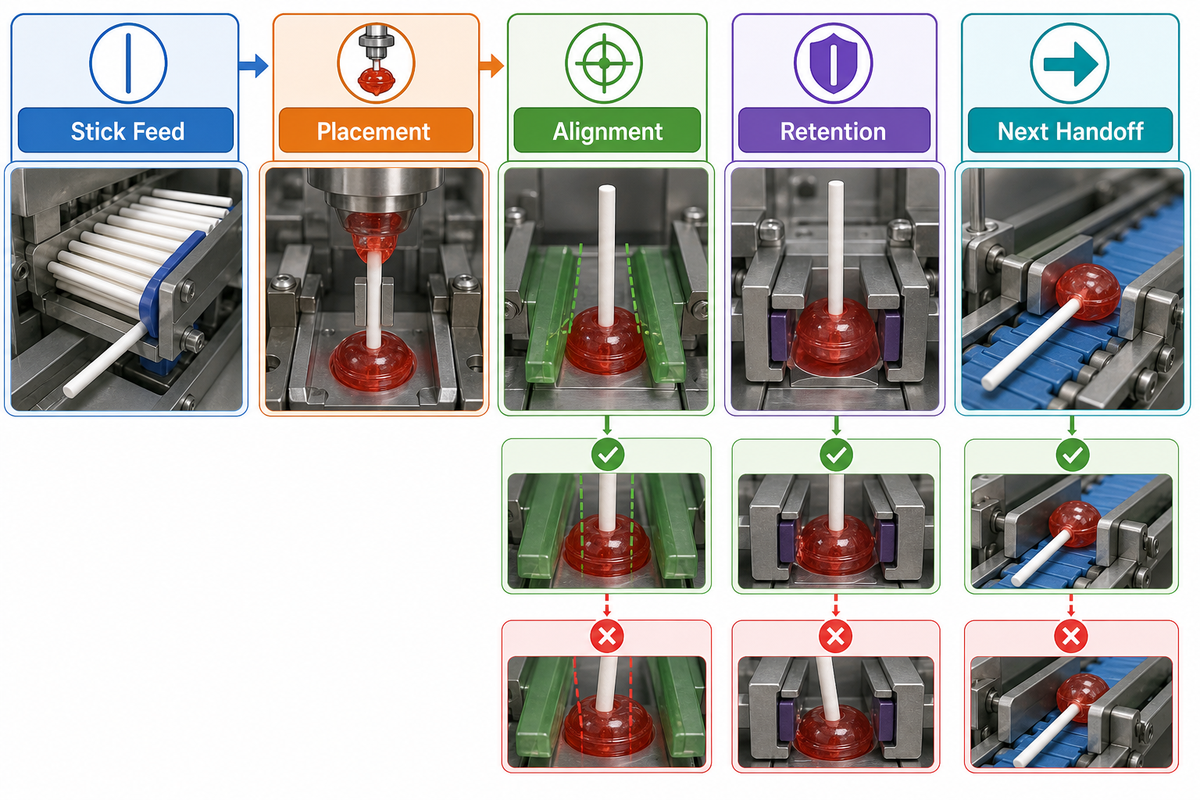
Mechanically placing a stick in the required position is one control for maintaining its position and orientation through transfer to the next processing stage. The stick may become loose through improper formation, an unsuitable stick specification, cooling, or downstream handling, so each handoff needs verification.
| Rung | Observation | Evidence | Escalation trigger |
|---|---|---|---|
| 1. Feed and placement | Correct stick reaches the intended position | Stick lot, feed event, placement sample | Wrong identity, missed feed, position drift |
| 2. Post-form retention | Fresh piece carries the stick without visible displacement | Defined sample and handling method | Loose, tilted, cracked, or disturbed interface |
| 3. Post-cooling transfer | Piece reaches inspection and wrapping in acceptable alignment | Transfer sample, reject reason, downstream response | Loss appears after cooling or handling |
A published patent on the handling of sticks discloses the mechanics of orienting and ejecting sticks. While this disclosure aids failure analysis, it doesn’t establish a universal pull-force limit or any capability of a current SINOFUDE model.
Use the ladder as a review method, not an industry standard.
Define plant-specific checks through trials and risk review. A loose stick can involve material state, stick specification, placement, cooling, or handling, not only the inserter.
Define plant-specific checks through trials and risk review. A loose stick can involve material state, stick specification, placement, cooling, or handling, not only the inserter.
Step 7: Cool to a Measured Release Condition
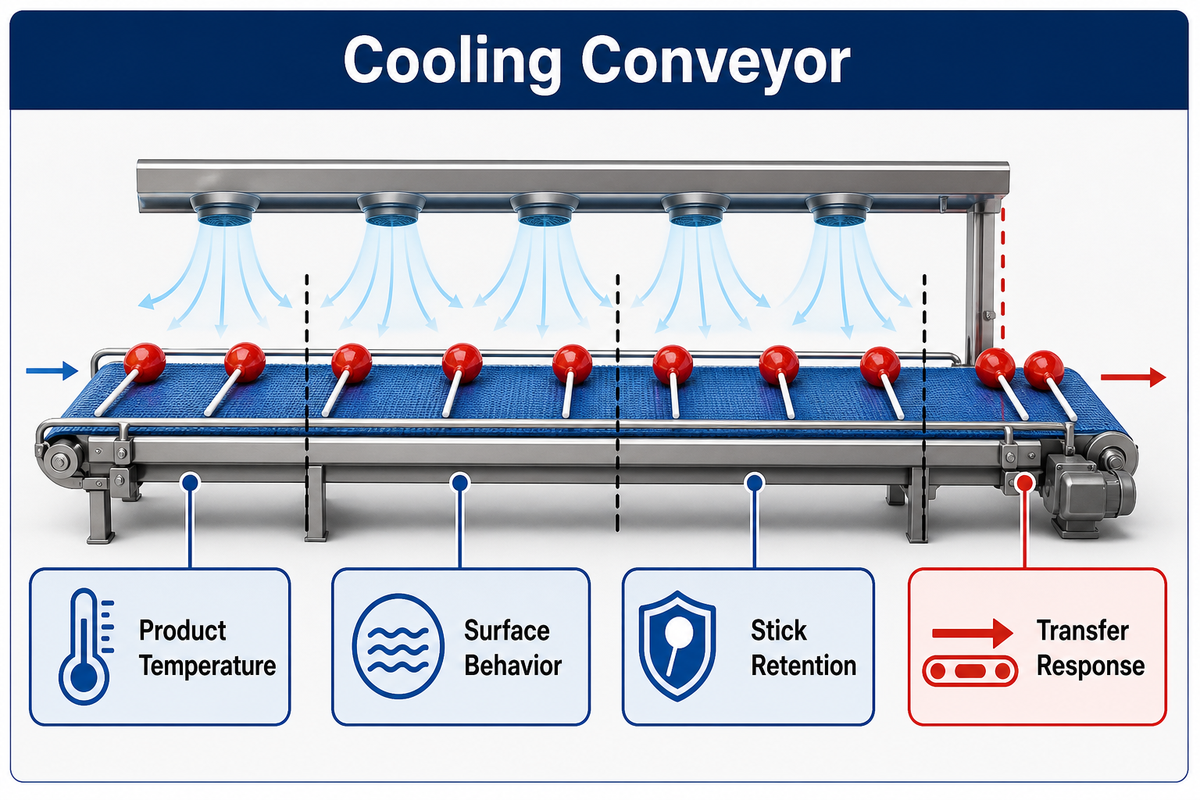
Cooling residence time alone doesn’t prove that a lollipop is ready to be transferred and packaged. The release of product for processing should be made based on the product’s temperature and the behavior of the product’s surface as it’s transported to and by the conveyor. Other factors can include product formulation, stick retention, product geometry, behavior after transfer to the target machine, and environmental conditions.
| Question | Clock-only answer | Measured release answer |
|---|---|---|
| What was controlled? | Minutes in tunnel | Time plus air, loading, piece, and inlet conditions |
| What reached the exit? | A piece after the timer | A sampled piece meeting defined handling checks |
| What happens next? | Assumed transfer | Observed transfer and wrapper receiving behavior |
In the study, sugar glass is described as kinetically stable but thermodynamically unstable, so the glassy state may still undergo later phase transitions. Other factors such as the atmosphere and formulation affect the behavior of the product.
Bounded case: Packaging Digest reported one plant configuration that moved from 20–25 minutes to 10 minutes with a new conveyor, 32 fans, and variable speed. Those numbers describe that case, not a transferable lollipop setting.
Release question
Can the sampled piece reach the wrapper with acceptable surface, geometry, stick alignment, temperature, and handling response under the defined operating conditions?
Can the sampled piece reach the wrapper with acceptable surface, geometry, stick alignment, temperature, and handling response under the defined operating conditions?
Step 8: Inspect and Release Product to Wrapping
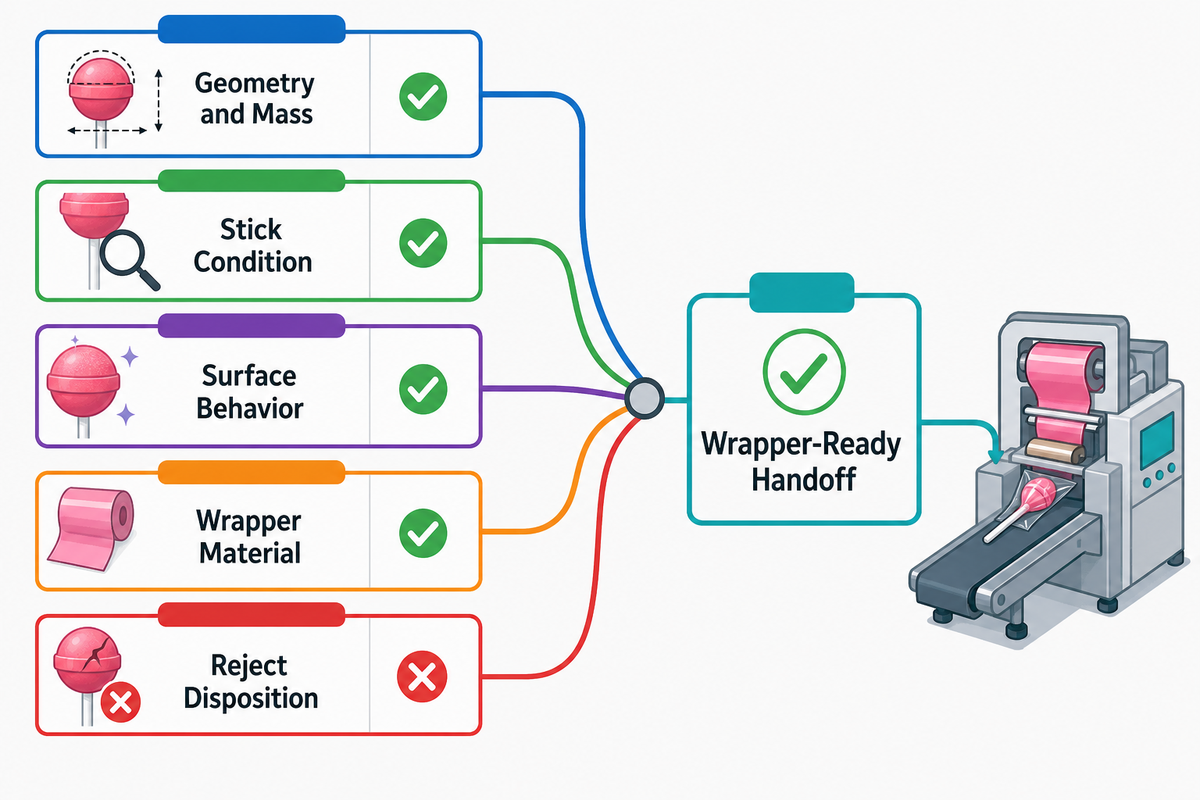
Products should be transferred to packaging only after they’ve satisfied defined criteria for product temperature, surface behavior, geometry, mass, and stick condition.
| Check | Release evidence | Hold condition | Downstream owner |
|---|---|---|---|
| Surface | Defined touch, visual, or instrument method | Sticking, sweating, contamination, unknown state | Quality and production |
| Geometry and mass | Representative sample against approved basis | Crack, chip, distortion, sample failure | Quality |
| Stick | Alignment and route-specific retention check | Loose, tilted, damaged, unverified | Production and quality |
| Wrapper response | Feed, registration, seal, code, reject record | Repeated handling or package defect | Packaging and quality |
As described above, product is accepted only when it satisfies defined conditions and characteristics. The quoted conditions should be interpreted in light of rejects, connected-line transfers, and accepted output rather than a single module’s nameplate rate.
Post-wrap boundary: the package material, food-contact surface, print system, barrier, storage humidity, and distribution condition need their own evidence. A sealed wrapper can still be unsuitable.
An FDA candy-wrapper letter documents a case in which a thin plastic coating failed as a barrier to migration from printed paper into candy. The example concerns lead-based printing ink and older guidance, so it is used only to show that wrapper appearance does not prove food-contact suitability.
What Automation Changes, and What It Cannot Prove
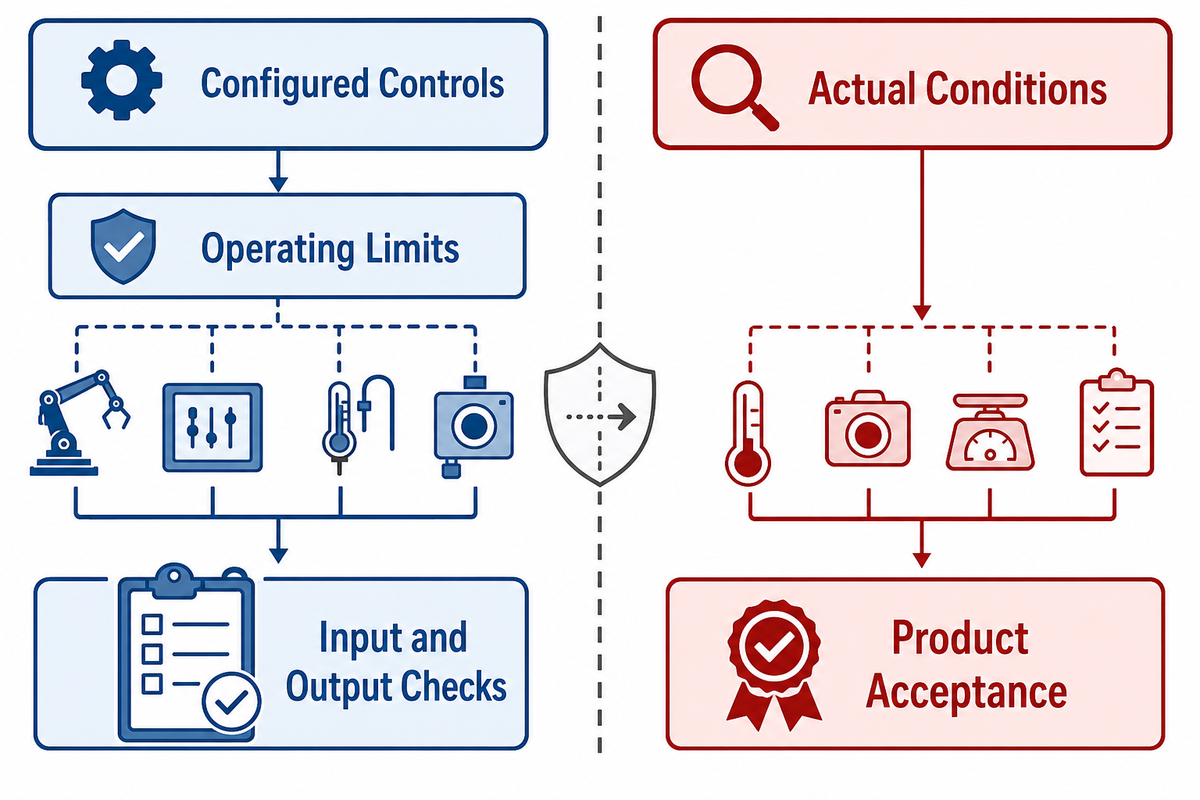
When the limits and ownership of a control system are defined, automation can apply configured controls consistently, but that alone doesn’t prove product acceptance. Like any mis-controlled process, automation can reliably control an undesirable process; therefore, reliance on automation shouldn’t replace process verification.
| Automation signal | What it can show | Evidence still required |
|---|---|---|
| Recipe and dosing event | Selected version, command, actual, timestamp | Approved master data and material identity |
| Cook alarm | Defined signal crossed a limit | Signal validity, sample, product disposition |
| Interface stop | Downstream condition blocked transfer | Hold scope, cause review, restart authority |
| Batch record | Linked events and exceptions | Completeness review and qualified approval |
An older FDA computerized-systems inspection guide treats the configured system, operating limits, input/output checks, records, and validation under actual conditions as connected responsibilities. It is used here as a historical inspection perspective, not a current lollipop standard or substitute for the user’s configured-system evidence.
Interface language: the 2025 ISA-95 update addresses enterprise and manufacturing-control boundaries plus shared information. It supports clear interfaces, not a lollipop throughput or labor-saving promise.
Decision Framework: Build a Comparable Lollipop-Line Supplier Brief
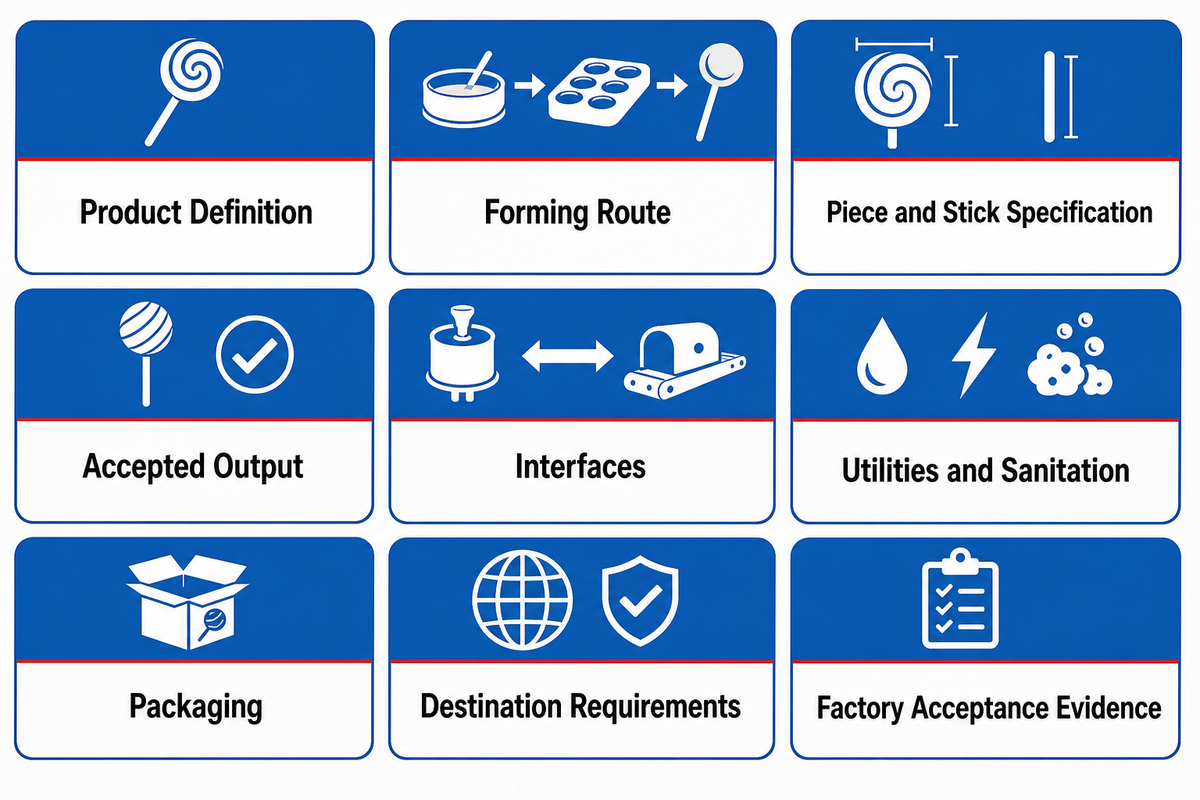
Compare lollipop manufacturing machinery proposals only after each supplier has received the same product definition, forming route, accepted-output basis, interfaces, utilities, sanitation and changeover scope, destination requirements, and factory-acceptance evidence (ISA-95 interface context: https://www.isa.org/news-press-releases/2025/april/update-to-isa-95-standard-addresses-integration-of). A product image and a stated output in kg/hr leave too many hidden assumptions for a fair comparison.
| Brief category | Buyer input | Supplier response |
|---|---|---|
| Product and formula | Hard, filled, layered, soft, acid, inclusion | Boundary and trial needs |
| Piece and stick | Drawing, mass, diameter (mm), stick length (mm) | Tooling, feed, sample proof |
| Forming route | Inlet state, mold or die path, variants | Route limits and trial plan |
| Accepted output | Accepted pieces or packs, rejects, window | Test method and exclusions |
| Interfaces | Cook, form, cool, inspect, wrap, data | Signals, holds, ownership |
| Utilities and sanitation | Air (°C, % RH), power (kW), pressure (bar), cleaning | Consumption and access basis |
| Packaging | Material, barrier, pack format, code | Feed, seal, print interface |
| Destination requirements | Applicable standards and document list | Scope, evidence, exclusions |
| FAT evidence | Materials, duration, sample plan, owner | Procedure, records, open-item route |
Translate Search Language Into a Factory Specification
Search queries mix consumer, recipe, and equipment language; translate each term into material identity, forming route, measurable acceptance, or document ownership.
| Intake language | Specification translation |
|---|---|
| raw materials; ingredients used; sugar and corn syrup; sugar mixture | Identity, grade, lot, quantity, and change control |
| sugary; additive; starch; corn starch | Composition role, approved source, and functional boundary |
| malic; malic acid; malic or citric acid; citrus; sourness; natural flavors; natural extracts; new flavors; colorings; food coloring | Formula, addition window, mass condition, and actual batch record |
| lollipop production; production process; process of making; candy making; create lollipops; lollipop is made; candy factory | Controlled handoffs, owners, records, and accepted output |
| lollipop candy and confection; high-quality; high-quality lollipops; quality control; quality control measures; high-quality output | Sample, test method, limits, evidence, and disposition |
| visual appeal; art and science | Translate broad language into observable acceptance evidence |
| moulding; poured into molds; hard crack; 310°F (about 154°C); batch roller; air bubbles | Route, inlet state, tooling, qualified endpoint, and defect definition |
| lollipop maker; conveyor belts; wrapping machine; cellophane; hygiene | Equipment boundary, interfaces, packaging material, and sanitation evidence |
Discuss Your Lollipop Process Brief
Bring the product format, formulation family, forming route, piece and stick specification, accepted-output basis, utilities, cleaning scope, cooling and wrapping interfaces, destination requirements, and FAT evidence plan.
About SINOFUDE
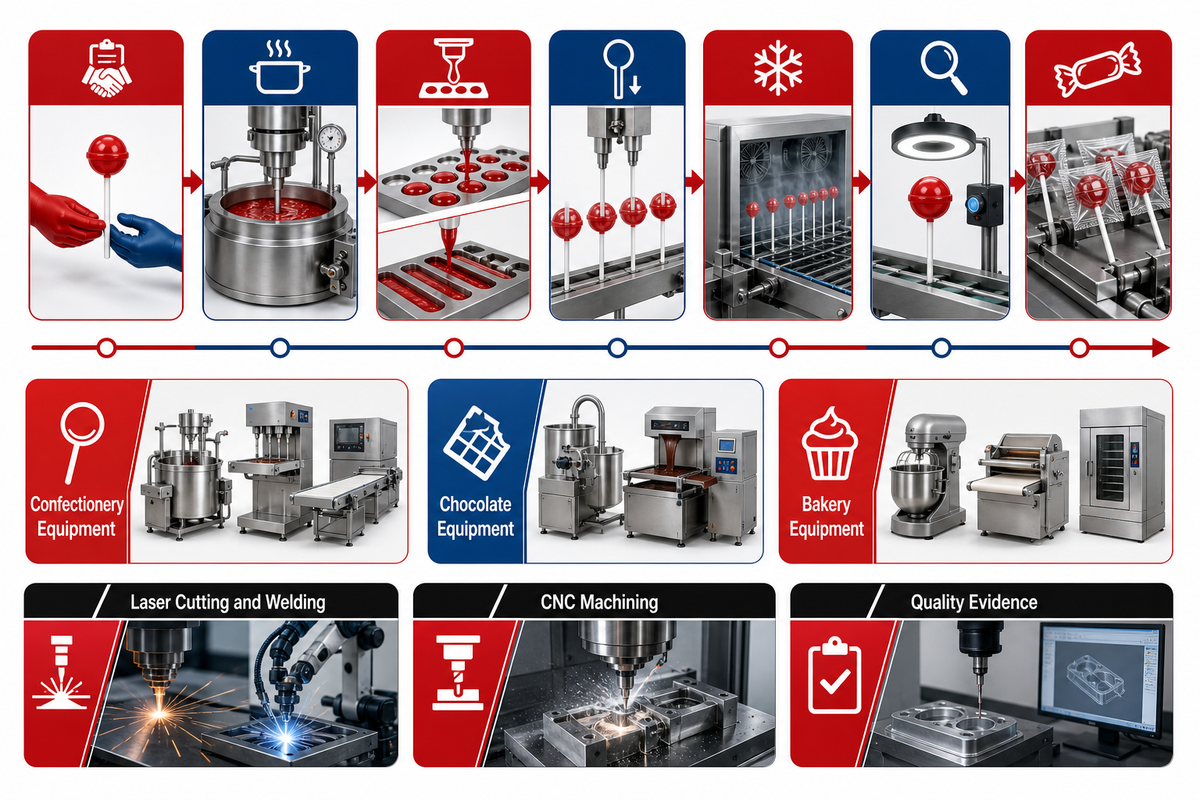
According to the company profile supplied for this article, SINOFUDE was founded in 1998 and now operates three factories with more than 200 employees across confectionery, chocolate, and bakery equipment. The company profile says SINOFUDE has invested in modern machine tools, including laser cutting and welding, friction and tube welding, CNC sawing, wire cutting, machining centers, turning, drilling, and gantry milling.
Founded
1998, company-supplied
1998, company-supplied
Footprint
Three factories, company-supplied
Three factories, company-supplied
Workforce
200+ people, company-supplied
200+ people, company-supplied
Divisions
Confectionery, baking, chocolate
Confectionery, baking, chocolate
The same profile states that SINOFUDE introduced ISO 9001 management in 2004, that most products have EU CE and UL certification, and that the company holds 38 product patents. Buyers should confirm the current certificate, standard, patent, and model scope for the equipment quoted; none of these statements proves a specific line’s performance, and ISO’s public catalogue for ISO 14159 (https://www.iso.org/standard/88584.html) is only a scope-specific reference for defining hygiene-document requirements, not proof of any supplier’s conformance.
Frequently Asked Questions
How are lollipops made in a factory?
Answer
Industrial lollipops are made by releasing the recipe and materials, preparing and cooking syrup, adding flavor, color, and acid in the qualified window, forming the candy, placing or capturing the stick, cooling the piece, inspecting it, and sending accepted product to wrapping. Deposited and rope-sized or die-formed routes handle forming and stick placement differently. Each factory should connect the stages with defined evidence rather than copy a generic setpoint.
Are lollipops just hard candy on a stick?
Answer
Many lollipops use a hard-candy glass as the edible body, but the stick adds feed, placement, retention, cooling, transfer, and wrapper-interface requirements. Filled, layered, soft, or specialty lollipops can also need different mass states and forming routes. The shorthand is useful, yet incomplete for equipment scoping or quality planning in an industrial factory.
How long do lollipops take to harden before wrapping?
Answer
There’s no universal industrial time because release depends on formulation, piece geometry, incoming product state, cooling conditions, ambient exposure, conveyor loading, and wrapper requirements. A validated process may use residence time as one control, but that time should connect to measured product condition and downstream handling. Published recipe or plant-case times shouldn’t be copied without trials and acceptance evidence.
What causes a lollipop stick to come loose?
Answer
Check candy-mass condition, stick identity and feed, placement, piece geometry, cooling, and transfer from the last documented stable point. Appearance alone can’t assign the cause, and public evidence doesn’t provide one universal industrial pull-force threshold.
What should a buyer define before requesting a lollipop machine proposal?
Answer
Define the product format and formulation family, forming route, piece drawing and mass basis, stick material and dimensions, accepted-output definition, cooling and wrapping interfaces, utilities, sanitation and changeover scope, destination requirements, and factory-acceptance evidence. State which recipes and sizes the trial represents, how warm-up and rejects are treated, which inspection method decides acceptance, and who supplies each interface signal. This gives suppliers the same problem to quote and separates a nameplate figure from the accepted wrapped output the project must demonstrate.
Research Transparency
This article uses current eCFR and FDA pages, 2024 peer-reviewed hard-candy research, ISA standards-body material, mechanism-only patent records, and a bounded industry case. It does not invent a recipe, setpoint, pull-force threshold, cooling time, capacity, price, lead time, certification scope, shelf life, or customer result.
References & Sources
Author: XCX · Updated against archived source records on September 24, 2026.