Get in Touch with SINOFUDE Company


![Jelly Candy Line Guide: Process, Sizing & FAT [2026]](https://sinofudecorp.com/wp-content/uploads/2026/09/jelly-candy-line-guide-featured.png)
A jelly candy line is a continuous system used for the manufacture of candy from a controlled syrup or gel. The system includes cooking, dosing, depositing, conditioning or setting, demoulding, finishing, testing, and packaging the candy. The right system is the one that can accommodate your recipe window and support your target output level.
This document addresses process engineers, factory owners and purchasing agents/managers. It explains the essential parameters to evaluate against competitive vendor offerings. Details on existing solutions, configuration and price quotes are provided in the related solutions document and the questions posed by process owners are answered herein.
Results from internet searches don’t always describe this production equipment consistently. Trade literature uses overlapping terms for the same industrial machinery. “Jelly candy machine,” “gummy making machine,” “candy making machine,” “making machine” and even “candy machines” may describe one depositor or an entire candy production line. In this document, the term “candy depositor” describes candy shape-formation equipment, while “jelly candy production line” describes the integrated candy-making system whose customization must be defined at the line boundary.
Quick answer: equipment shouldn’t be sized using the depositor (candy shape formation) equipment rate. Sizing should be done on the basis of the slowest product rate through the entire system and consider practical limits (including buffers), changeover, product mix, quality, and the release decision.
In this guide
- Define the complete recipe-to-release system boundary.
- Map material state and acceptance evidence at every handoff.
- A gel system made from gelatin or pectin can set the equipment production window.
- Compare starch-mogul and starchless routes without assuming a winner.
- Use the Batch-to-Belt Balance to screen capacity claims.
- Adequacy of utility and equipment interfaces, changeover, SAT and FAT should be documented.
What a Complete Jelly Candy Line Includes
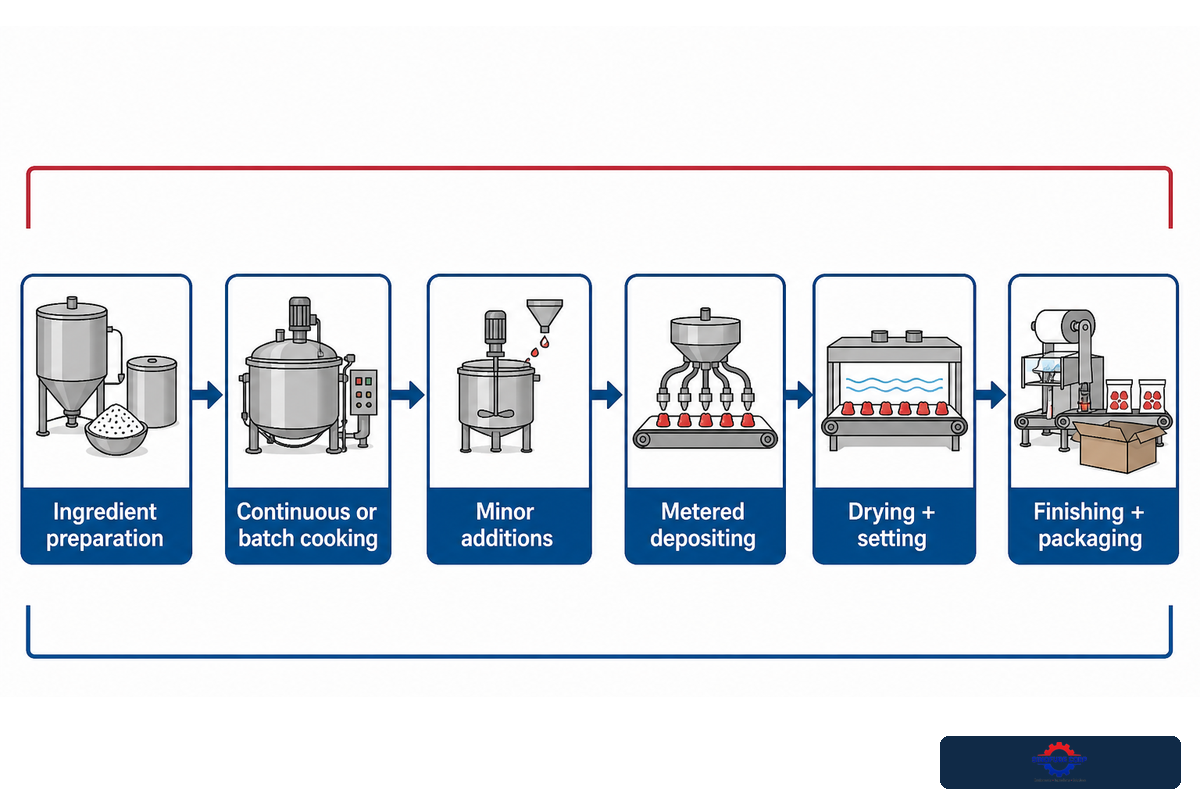
A process starts before a batch is made and ends after it’s released. Dissolving ingredients and handling them precedes the formation of a batch. The continuous or batch cooking process changes the state of ingredients to the desired solids and provides the required thermal history.
The rest of the batch is made by the addition of ingredients, colors and flavors, as permitted by the formula. A gummy depositor is the metering system that performs the portioning of the mass, with operation dependent on formula constraints. Drying and setting of the mass create a structure that permits the demoulding process. Sanding and oiling of the mass prepare the surface for packaging.
Though the process may appear to be linear, in practice it’s often not. A quotation may exclude the ingredient kitchen, acid dosing skid, mould return, conditioning rooms, dust collection, metal detection, checkweighing, conveyors or the final packer. Control of a process may end with a single PLC and not the other automation devices along the process. In such cases, ‘complete’ control of a process should be defined as end control rather than marketing-speak.
The process boundary also changes with the product. A conventional sugar confection and a nutraceutical gummy can use similar forming equipment while carrying different ingredient-control, sampling and batch-release obligations. In the United States, FDA treats human-food current good manufacturing practice under Part 117 separately from dietary-supplement requirements under Part 111 . That distinction belongs in the user requirements before a supplier freezes the line scope.
From Syrup to Packed Candy: Map Every Handoff
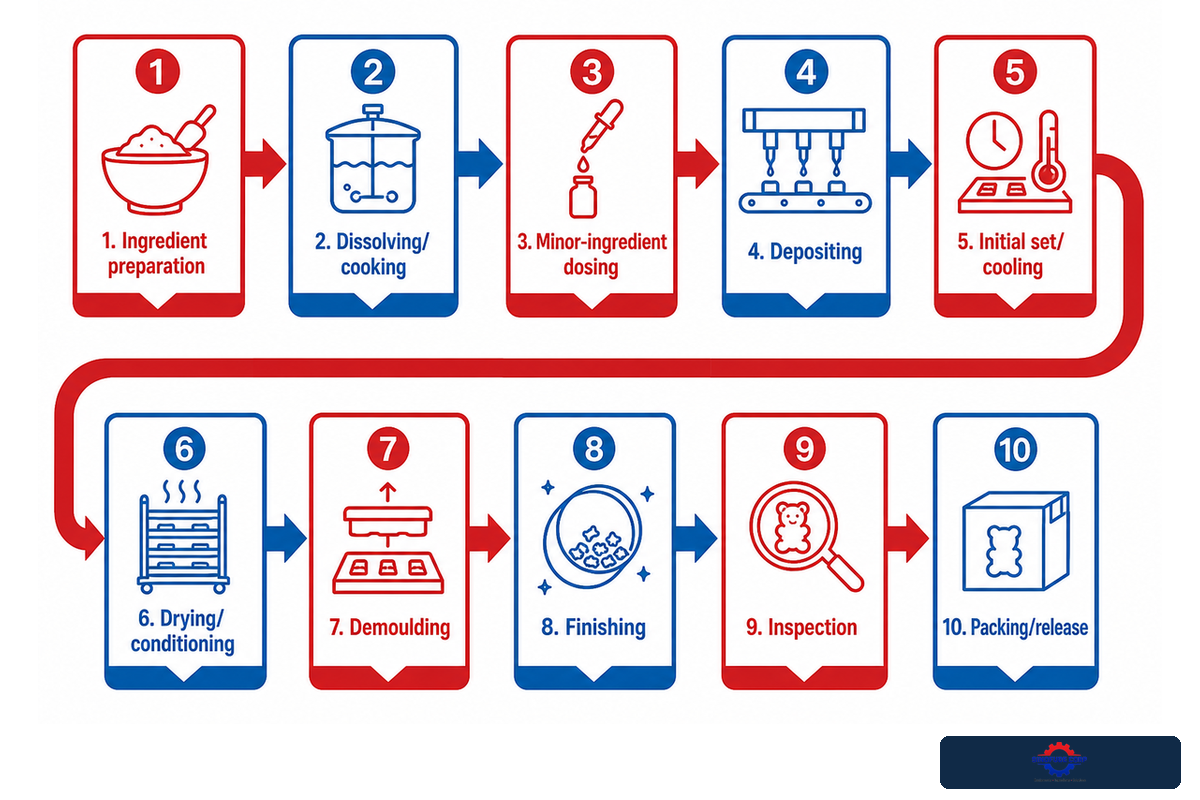
The machine list says what’s been installed. A handoff map describes what conditions need to be met in order for the product to be able to move. This map helps identify delays, unstable recipe window times and hidden rework . Create a map like the one below and fill in the blanks with specific information during a concept review.
| Stage | Material state | Control to record | Visible failure | Acceptance evidence |
|---|---|---|---|---|
| 1. Ingredient preparation | Weighed liquids and powders | Identity, lot, mass and addition order | Lumps, wrong lot, dosing error | Batch record and verified scale status |
| 2. Dissolving/cooking | Hot homogeneous syrup or gel mass | Time, temperature, solids and agitation | Scorching, undissolved solids, excessive water | Recipe endpoint within the approved window |
| 3. Minor-ingredient dosing | Finished mass with acid, flavour, colour or active | Dose, sequence, temperature and hold time | Premature set, streaking or potency drift | Recorded dose and homogeneous sample |
| 4. Depositing | Metered deposits in cavities | Piece weight, temperature, viscosity proxy and cadence | Tails, bubbles, missing cavities or weight spread | Sample weight and cavity-fill check |
| 5. Initial set/cooling | Shape-retaining but unfinished pieces | Residence time and air condition | Collapse, deformation or surface skin | Demouldable structure without damage |
| 6. Drying/conditioning | Moisture-equilibrating candy | Temperature, humidity, airflow and duration | Sweating, hard shell, sticky centre or texture drift | Recipe-specific moisture, water activity or texture result |
| 7. Demoulding | Freestanding candy | Release rate, breakage and mould return | Tearing, residue or cavity damage | Accepted pieces and reject count |
| 8. Finishing | Oiled, waxed, sugared or acid-sanded pieces | Coating addition and residence | Uneven coat, clumping or abrasion | Surface specification and free-flow check |
| 9. Inspection | Pack-ready accepted product | Foreign-body, weight and visual criteria | Metal-detector reject, off-weight or defect | First-pass yield and documented disposition |
| 10. Packing/release | Sealed sale unit or held batch | Count/weight, seal, code, label and batch status | Jam, seal contamination, wrong label or hold | Released package—not merely a packed package |
This form helps adjudicate commissioning disputes. If the depositor ran without product for 30 minutes, the line didn’t prove sellable output. If deposits were made but the conditioning room couldn’t receive them, the system still didn’t prove continuous operation. If the bags were sealed but the batch remained on quality hold, it did not prove released output.
Let the Gel System Set the Equipment Window
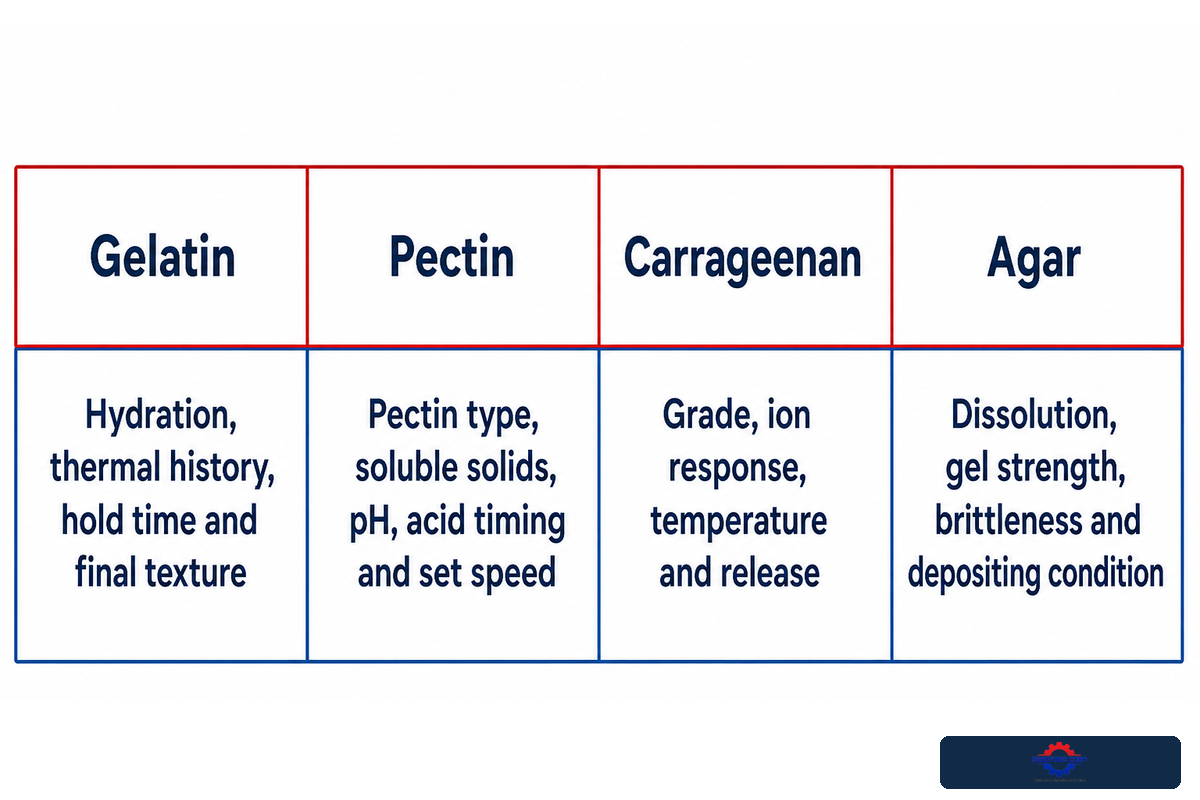
Pectin, carrageenan, and agar are examples of components that may be added to a recipe, but each has different limitations and conditions under which they may be added. Each of these components, in combination with other ingredients and conditions, determines the deposit time, dead volume, and how the candy is released from the mould. Components may be added in a particular order based on the system being run and the conditions under which the system operates.
Other production processes may use default machine settings, but the production process of jelly starts from the formula and the ingredients that make the controlled syrup or gel mass. Not us. In jelly candy making, glucose syrup, sweeteners and water are prepared before the gelling agents and sensitive additions enter at their approved step. Pectin-based gels, for example, need to be processed with different temperature control than gelatins or agar-agar because the process window affects taste and texture. The order in which ingredients are added to the mass affects the final texture and consistency. Gelatin-based gels are processed differently than agar-based gels; the line processes gelatin, but it does not produce gelatin. It’s important to understand the production process because clients may prepare ingredients before they supply them to the line.
| Gel system | What to qualify | Equipment implication | Do not assume |
|---|---|---|---|
| Gelatin | Hydration, thermal history, hold time and final texture | Gentle mixing, controlled heating and stable deposit temperature | One concentration proves every chew profile |
| Pectin | Pectin type, soluble solids, pH, acid timing and set speed | Short, controlled path after acid addition; low uncontrolled hold-up | A gelatin recipe sequence will transfer unchanged |
| Carrageenan | Grade, ion response, temperature and release | Recipe-specific heating, dosing and mould trial | The word “carrageenan” defines one process |
| Agar | Dissolution, gel strength, brittleness and depositing condition | Adequate dissolution and heat control before rapid set | A firm gel will demould or chew acceptably |
A 2024 review of functional gummy development documents the breadth of gelling agents and formulation variables . A separate centre-filled-gummy patent illustrates how specific the window can become: one disclosed method limits filling temperature to 45°C or below and states a filling viscosity range of 500–30,000 mPa·s . Those figures belong to that method; they aren’t universal gummy settings.
Run the target formula on the intended path before committing to scale. A small-scale pilot gummy line can help identify addition order, depositability, cooling and demoulding problems before a factory acceptance test, but the scale-up plan still has to address residence time, surface-to-volume effects and downstream capacity.
For a pectin gummy or other gelatin- or pectin-based soft candy, “equipment to make jelly” isn’t a valid specification. We need to know if the end product is to be jelly in one color or multiple colors, if it should be center filled or coated, and what the requirements are for taste, texture and appearance, including whether the line must produce jelly in a two color format and meet defined dietary needs and visual appeal targets. Knowing these will help better evaluate the feasibility of the equipment, its ability to manufacture jelly to client specification and the useful customization required for jelly candy-making.
Demand for jelly candies, consumer preferences and changes in the jelly candy market can increase the types of candy a plant must run, but a candy factory still needs verified changeover evidence. However, flexibility in product offerings is of little value if the plant can’t produce candy consistently, because the candy industry and broader confectionery industry depend on candy manufacturing that can switch products without losing release control. Changes in market demands for candy and other confectionery products may require a candy plant to be flexible in shifting product offerings. Market demands and requirements should be evaluated on a case-by-case basis.
Starch Mogul or Starchless? Put the Work in the Right Place
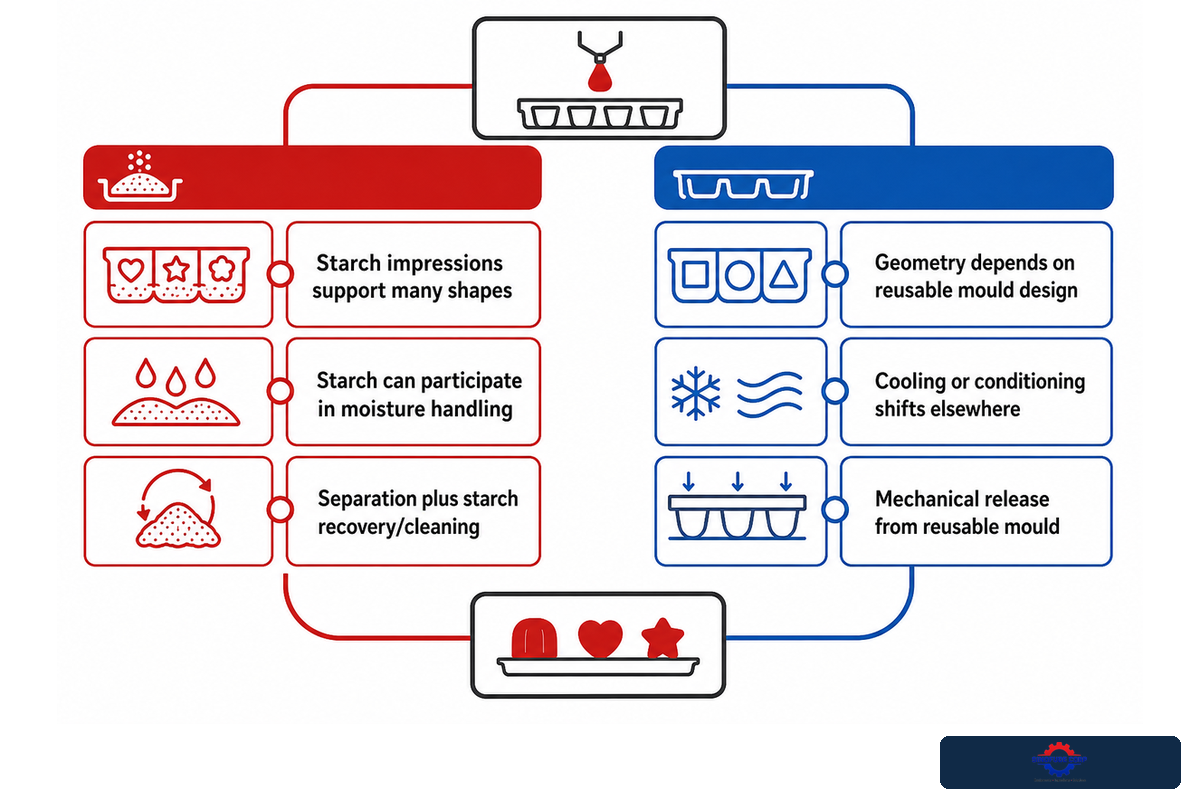
Starch mogul and starchless lines solve the forming problem differently. Starch moguls make impressions in conditioned starch, deposit into those impressions, and dry jelly candies through a set cycle. They separate the dried jelly candies from the conditioned starch. A starchless route deposits gummy bears or other jelly candies into reusable silicone, metal or polymer moulds and depends on controlled release, mould handling and cooling. This method is also called starchless molding. This method, like the starch method, requires control of the process. Neither method eliminates process steps; they relocate process steps.
Starch mogul may fit when
- Shape flexibility and traditional starch moulding are central.
- The factory can control starch condition, handling and separation.
- Set/dry inventory and room footprint are planned as line capacity.
- Dust collection and housekeeping are engineered for the process.
Starchless may fit when
- Reusable moulds match the product family and release behavior.
- Fast mould exchange and a closed route matter.
- Cooling and demoulding can be proven at the target cadence.
- The formula can be deposited at the required final condition.
| Decision factor | Starch mogul evidence | Starchless evidence | Limitation to record |
|---|---|---|---|
| 1. Product geometry | Starch impressions support many shapes | Geometry depends on reusable mould design | Undercuts, centre-fill and release can change the answer |
| 2. Gel system | Traditional route supports many recipes | Recipe must release from the selected mould | Prove each target formulation |
| 3. Set/conditioning | Starch can participate in moisture handling | Cooling or conditioning shifts elsewhere | “No drying room” is process-specific |
| 4. Mould circuit | Tray, starch and impression preparation loop | Reusable mould transport and return loop | Return speed and damaged moulds affect uptime |
| 5. Demoulding | Separation plus starch recovery/cleaning | Mechanical release from reusable mould | Breakage and residue must be counted |
| 6. Environmental load | Starch condition, rooms and airborne dust | Cooling load and mould environment | Use measured local conditions |
| 7. Cleaning | Starch-contact and recovery areas add boundaries | Mould and product-contact circuits need release evidence | Neither route is self-validating |
| 8. Changeover | Impression and starch-system changes | Mould, recipe and release-system changes | Measure last-good to first-good time |
| 9. Factory footprint | Mogul, starch loop and conditioning inventory | Mould loop, cooling and demoulding | Compare equal residence and buffer bases |
Syntegon describes a starchless turnkey route that integrates kitchen, depositing and oiling with reusable plastic moulds . That’s useful route evidence, not a universal verdict. If a product needs a different set profile or fails release trials, the apparently simpler route may move risk downstream. Buyers considering a starch mogul line should likewise include starch condition, dust control, tray handling and room capacity in the comparison.
The 3-Layer Batch-to-Belt Balance: Size the Slowest Sustained Stage
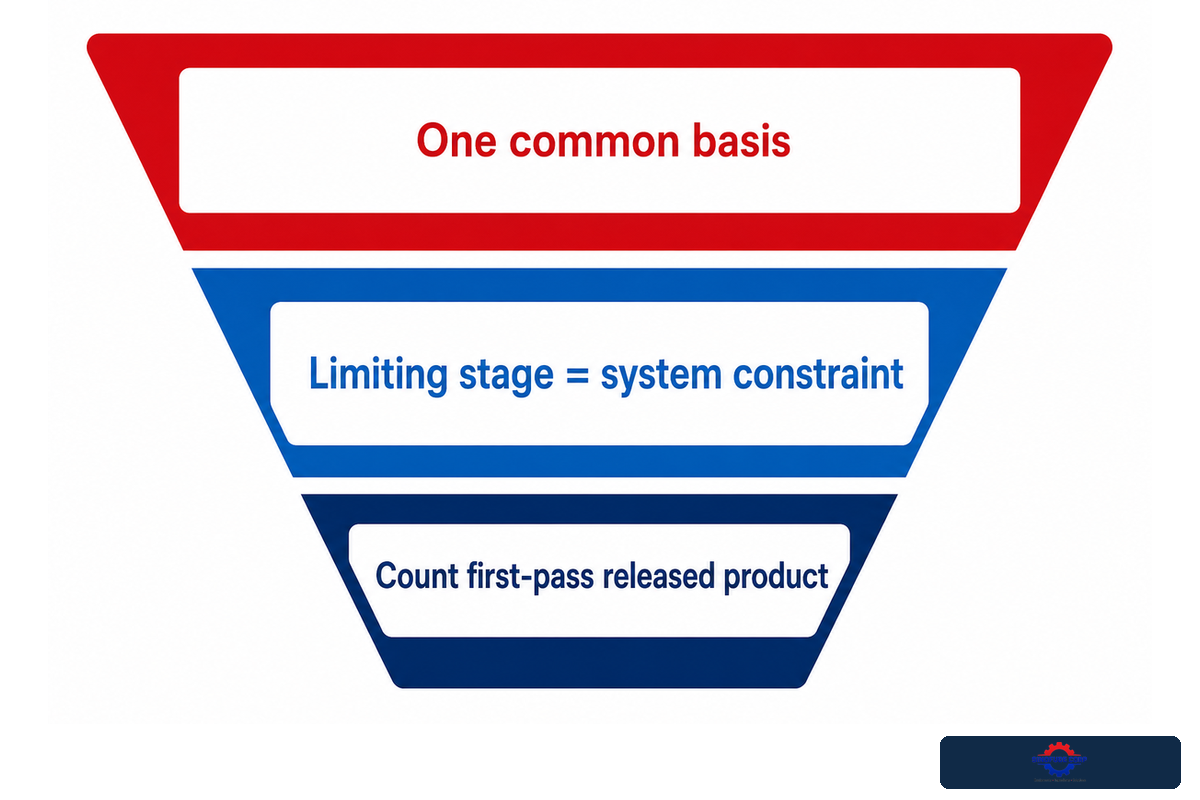
The Batch-to-Belt Balance is a three-level assessment of system capacity. Initially, all steps in the process must be expressed in a common format, for example, accepted kilograms per hour, released packs per shift, or accepted parts per minute. Next, treat the limiting stage as the system constraint and account for actual flow losses from finite buffers and availability, as well as system-efficiency losses caused by product mix, starvation, and blocking. Third, count only first-pass product released under the applicable quality system.
This makes production capacity a property of the integrated manufacturing equipment, not a single high-speed mechanism. Equipping multiple pieces of automated production equipment should improve repeatability as long as the equipment designed for the recipe window is configured to the steps of the process it’s integrating. The production goals of a company should consider the potential effect of increased production, production efficiency and production costs on the profitability of the company. “High-quality equipment” is meaningful only when it can repeatedly produce high-quality product under a written test.
Screening relationship:
Released output ≤ Lowest Verified Stage Rate × Availability of Flow × First-Pass Release Yield.
This relationship is an inequality. It’s an RFQ screening rule, not a guarantee and not a surrogate for a timed product trial.
The correction matters. NIST production-line research models output using machine reliability, finite buffers, product mix and scheduling policy rather than one scalar bottleneck alone . A slow stage can cap the line, but a fast stage can still starve, block or stop often enough to pull the realized rate lower.
Published equipment numbers demonstrate why scope labels matter. Coperion lists a compact ServoForm Mini at up to 50 kg/h and a ServoForm Flexi range of 100–1,000 kg/h . Those are depositor ranges. They don’t state the release rate of a cooker, cooling path, demoulder, coater and packer running one buyer’s formula.
A worked screening example
Assume a buyer has a 4 g jelly and supplier trials report these hypothetical accepted rates on the target recipe: cooking 620 kg/h, depositing 600 kg/h, cooling 520 kg/h, demoulding 480 kg/h, coating 500 kg/h and packing 460 kg/h. Layer 1 sets a 460 kg/h ceiling. If a witnessed run shows 80% flow availability after minor stops and changeover effects, and 95% first-pass release yield, the screen becomes no more than 349.6 kg/h: 460 × 0.80 × 0.95.
This result shouldn’t be considered a line rate. A 30-minute buffer at 460 kg/h gives a buffer of approximately 230 kg. That said, a constraint will eventually occur. A different pack format, a 6 g piece, a pectin recipe with a shorter deposit window, or an allergen changeover can move the constraint. Verify numbers with actual data and describe the system behavior.
An illustrative FAT sheet might target 4.0 g pieces with a ±0.2 g tolerance, sample 30 pieces every 15 min, separate a 60 min warm-up from a 180 min sustained run, and record deposit temperature in °C, cooling residence in min, relative humidity in %, air velocity in m/s, electrical demand in kW, compressed-air pressure in bar and water flow in L/min. While the above examples show the types of process parameters that may be captured on a FAT sheet, the actual parameters, units, and accepted values will be defined in the recipe and verified on site.
To show the format only, a hypothetical data row might read 85°C, 20 min, 45% relative humidity, 1.5 m/s airflow, 50 kW demand, 6 bar air, 400 V at 50 Hz, a 2-hour observation window and 30 kg of buffer inventory. None of those illustrative values should enter a purchase specification until the recipe owner and supplier validate them.
| Receipt line | Common basis | Evidence to request | What a missing value hides |
|---|---|---|---|
| 1. Cooker | kg/h at recipe endpoint | Mass balance, solids and hold profile | Under-cook, over-cook or delayed batch |
| 2. Dosing | kg/h with minor ingredients | Dose accuracy and usable time window | Potency, colour or premature-set loss |
| 3. Depositor | accepted kg/h and pieces/min | Piece weight distribution at cadence | Catalogue speed without weight quality |
| 4. Set/cooling | kg/h at verified residence | Tunnel loading and discharge condition | Deformed or under-set inventory |
| 5. Conditioning | kg per room-cycle | Time, humidity, temperature and airflow | WIP accumulation over hours or days |
| 6. Demoulding | accepted pieces/min | Breakage, residue and mould-return rate | Hidden damaged-piece loss |
| 7. Finishing | accepted kg/h | Coating addition and free-flow result | Clumps and surface rejects |
| 8. Inspection | first-pass yield % | Reject log by reason | Rework counted as good output |
| 9. Packaging | released packs/min | Pack weight/count, seal and jam data | A fast bagger starved by product flow |
| 10. Whole system | released kg/h over stated run | Uptime, buffers, changeovers and disposition | A short demonstration mistaken for sustained output |
If you need a model-level discussion, use depositor model context only after the common basis is fixed. A bigger nominal rating isn’t automatically a better line.
Cooling, Drying, Demoulding and Finishing Are Capacity Stages
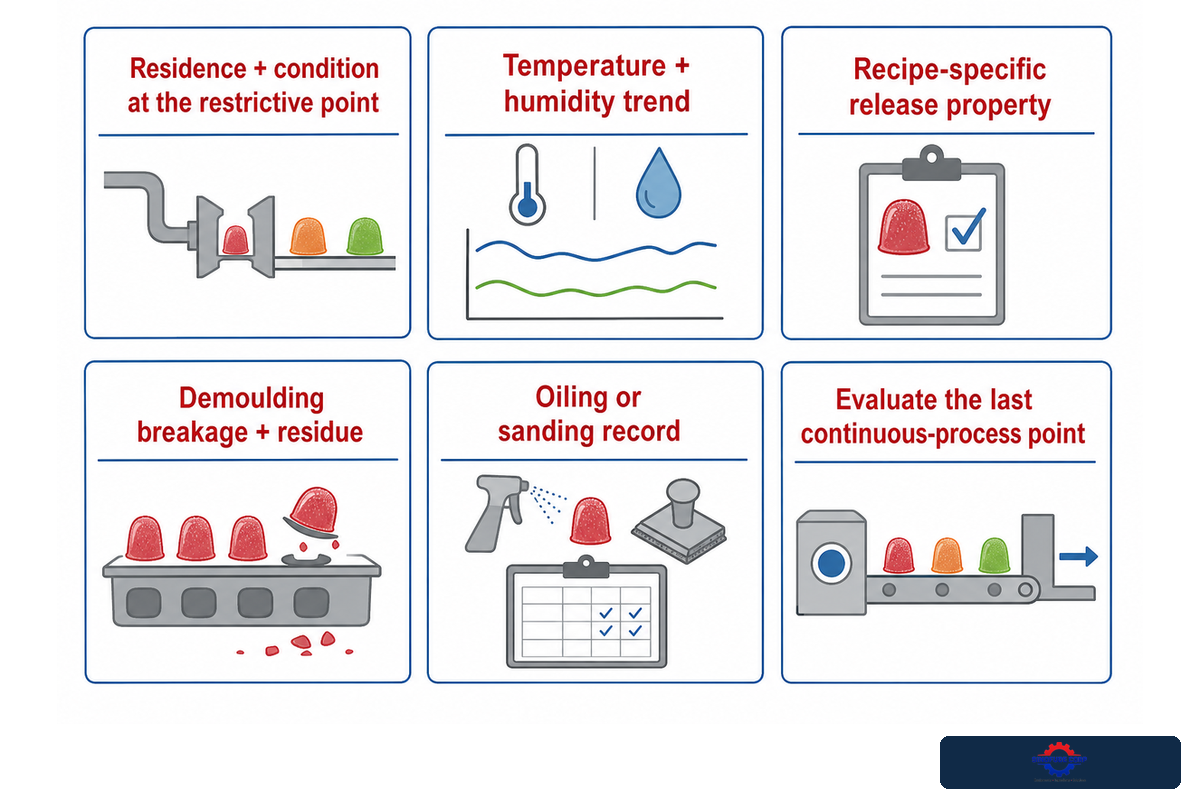
Fresh deposits aren’t finished candy. They must develop enough structure to leave the mould without tearing or permanent deformation, then reach the surface and internal condition required for coating and packing. Tanis describes gummy conditioning as controlled steps of temperature, humidity and airflow that can continue for several hours or days depending on formula . The engineering unit is therefore not only kg/h; it can also be kilograms of work-in-process per room cycle.
During product conditioning, cooling time, the state of the work-in-process and the engineering unit control the state of the product and determine when further processing is required. Cooling to the desired state in a cooling tunnel can’t be verified solely by the use of a timer; the discharge piece must also be chewy, stable and ready for the next stage.
Published literature gives context, not a universal release number. One 2024 stability study notes typical gummy moisture of 10–20%, water activity of 0.45–0.75 for soft confectionery, and roughly 70–76% dry matter in its tested formulations . Moisture and water activity aren’t interchangeable. Sugar profile, humectants, salts and formula structure affect water availability, so the acceptance method must be defined for the actual candy.
Both finishing and demoulding should be dealt with equally. Completed records should include pieces presented, pieces released, residue, mould damage, consumption of coating, clumping, and inspection delivery. If 2% of the pieces broke during release and 3% more failed the pack-ready surface check, those pieces should not be considered good. The test report should show the first-pass yield.
Post-deposit evidence pack
- Evaluate residence and product condition at the most restrictive point under the planned continuous loading.
- Temperature and relative-humidity trend, with sensor locations.
- Recipe-specific release property: A release of product should be evaluated based on its final moisture content, water activity, or other similar property, in accordance with an agreement.
- Demoulding breakage and residue count per defined sample.
- Oiling or sanding addition, recovery and clump/reject record.
- The condition of the product should be evaluated at the last point in the planned continuous process.
Integration and Utility Requirements Before Layout Approval
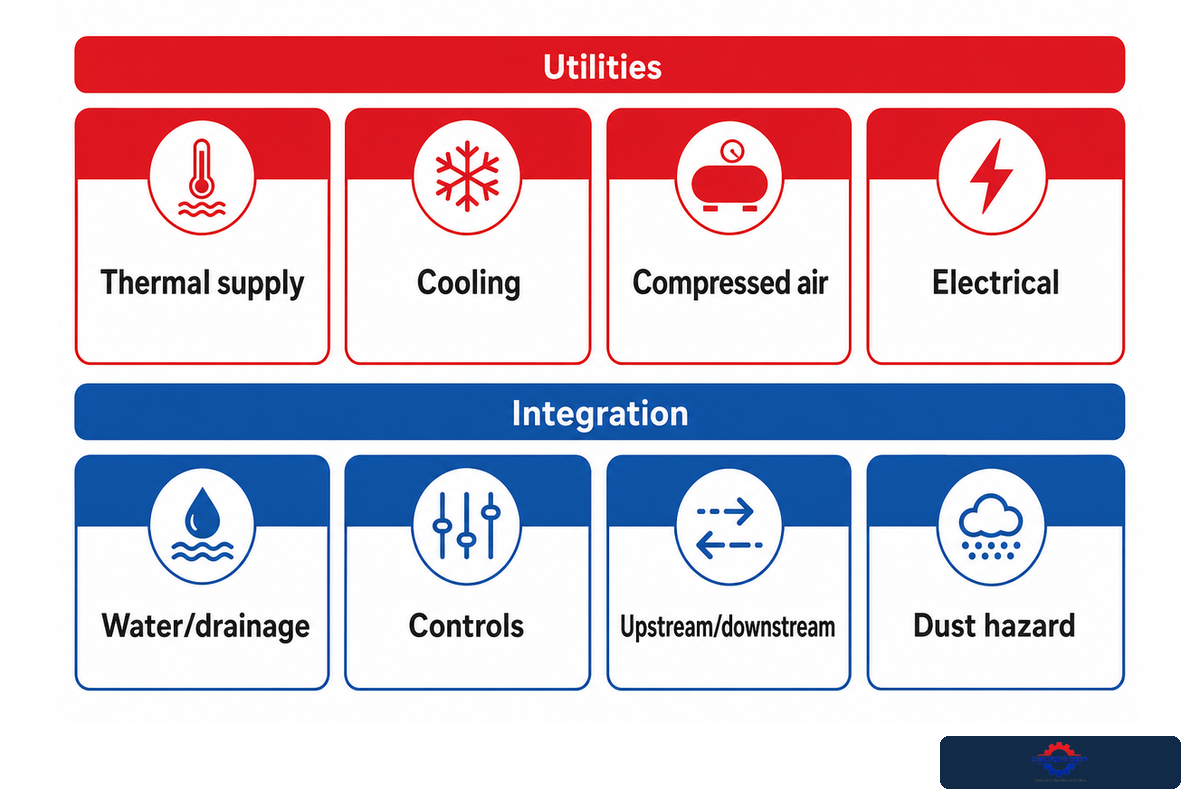
Evaluate the process at one defined operating condition. “Power: 380 V” isn’t a utility brief. The statement should define the frequency, phase, voltage, connected load, and other relevant information. The same should be done for process utilities and other services. Each should be assessed based on the product, process, and condition for which the facility was designed.
Both sides of an interface are important, and the cooker requires both an upstream definition and a downstream permissive. The depositor needs to know about blocked discharge, moulds, and hot mass. Conditioning rooms require logic about maximum inventory. Packing requires the actual product temperature, surface condition, bulk density, and flow behavior. For each of these interfaces, the process controls and product inventory must be reviewed and adjusted. These adjustments must be made before considering alternative equipment arrangements for a gummy production line.
| Input/interface | Freeze before layout | Verification evidence |
|---|---|---|
| Thermal supply | Medium, pressure/temperature, peak and recovery | Load list at stated recipe |
| Cooling | Supply/return condition, ambient design and rejection load | Heat-load and tunnel/room calculation |
| Compressed air | Pressure, quality, normal and peak demand | Pneumatic schedule and treatment scope |
| Electrical | Voltage, phase, frequency, connected and demand load | Single-line and motor/load list |
| Water/drainage | Quality, temperature, flow, drain points and discharge limits | P&ID and cleaning scenario |
| Controls | Signals, ownership, safe-stop and restart sequence | I/O list and cause/effect test |
| Upstream/downstream | Feed, buffer, permissive and fault behavior | Integrated run—not isolated dry cycles |
| Dust hazard | Materials, release points, collection and local requirements | Project-specific hazard review |
OSHA lists candy, sugar and starch among food materials that can be explosible when present as dust . As a result, dust from these substances can be explosive. A generic hazardous area classification for these substances isn’t provided in this guide. Dust from these substances can be explosive; therefore, processes involving sugar sanding, starch moguls, collectors and conveyors require a project-specific combustible-dust assessment. It’s the responsibility of the buyer’s qualified safety team to assess the actual substance and jurisdiction.
Hygienic Design and Changeover Evidence, Not Stainless Steel Alone
Stainless steel doesn’t prove that equipment is hygienic. Product-contact surfaces can still trap syrup at a gasket shadow, un-drained branch, rough weld, hollow frame member or inaccessible corner. EHEDG notes that poor hygienic design makes food-processing equipment and facilities difficult to clean and frames design, construction and installation as a risk-based contamination-control problem .
For covered US human-food operations, 21 CFR Part 117 addresses sanitary operations, facilities and controls, and equipment and utensils . Gummies marketed as dietary supplements require a separate check: 21 CFR 111.75 covers component identity and finished-batch specification verification . Confirm the product category, destination market and current revision with a qualified compliance professional.
If the equipment isn’t easily cleanable, the manufacturer should provide witnessed evidence from the hardest planned recipe.
When conducting a changeover test, there are a number of possible starting cases. These include products with strong colors or flavors, allergen-containing products, products with a pectin mass, and products containing an active ingredient with a low carryover tolerance. Document your process. Record disassembly, cleaning chemistry, concentration, temperature, contact time, flow, rinse endpoint, visual inspection and any swab or analytical method. Perform a visual inspection. Swab samples and/or analytical testing may also be prudent and should be documented as well. Finally, make sure the labels and packaging materials are reconciled to specification before releasing the next recipe.
SINOFUDE reports that it uses laser cutting, laser, friction and tube welding, and CNC machining equipment across three factories covering more than 30 acres, employs more than 200 people, introduced ISO 9001 management in 2004, and holds 38 product patents . First-hand knowledge of the welding processes, component production and manufacturing can justify requests for weld samples, component records, certificates and factory-inspection documents. They do not replace line-specific drainability checks, cleaning access, a witnessed product trial or current certificate verification.
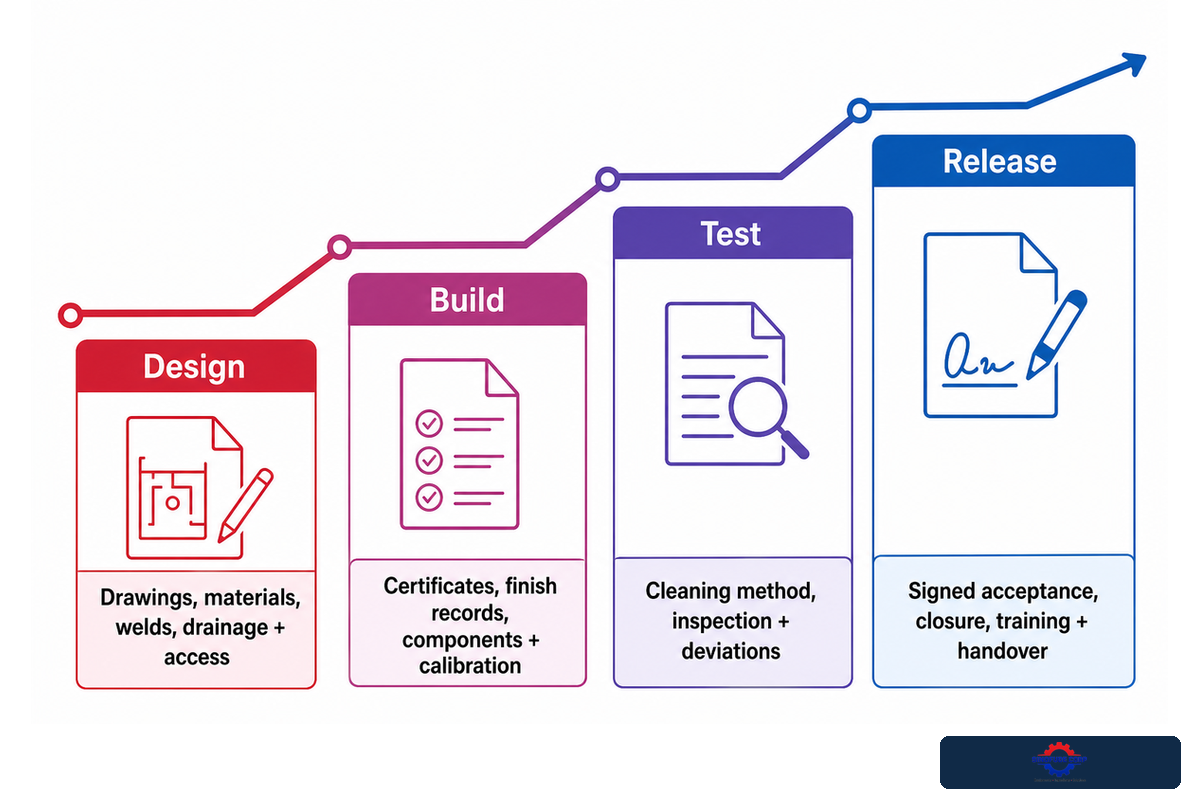
Ask for evidence at four levels
- Design: drawings, materials, surface/weld specification, seals, drainage and access.
- Build: Material certificates, weld/finish records, a list of components, and calibration status.
- Test: cleaning/changeover method, inspection results and deviations.
- Release: signed acceptance, open-item closure, training and document handover.
Make FAT and SAT Comparable Before You Compare Price
A factory acceptance test (FAT) checks equipment at the manufacturer’s facility against agreed function, performance and specification criteria . A site acceptance test (SAT) confirms the installed system under the buyer’s utilities, interfaces, environment and operators. Neither test can be meaningful if the proposal doesn’t freeze the product and acceptance basis first.
Some supplier literature calls depositing “automatic injection,” but a buyer should confirm whether that phrase means volumetric depositing, piston control or something else; it isn’t a substitute for a measured deposit. The same rule applies to after-sales promises: response time, remote access, spare-parts scope, training and escalation contacts belong in the contract.
Prior to the completion of the line, identify the supplier of ingredients, moulds, and packaging; identify target recipe and piece geometry; state nominal mass of piece; acceptability of weight variation; state duration of test; specify treatment during warm-up and planned stops; state acceptability of rejects; specify scope of changeover and cleaning; state sampling of data; state challenges to alarm limits; state document transfer; identify individual(s) that can sign deviation. Additionally, if the product is a dietary supplement, identify the quality-control sampling, analysis and disposition required before release.
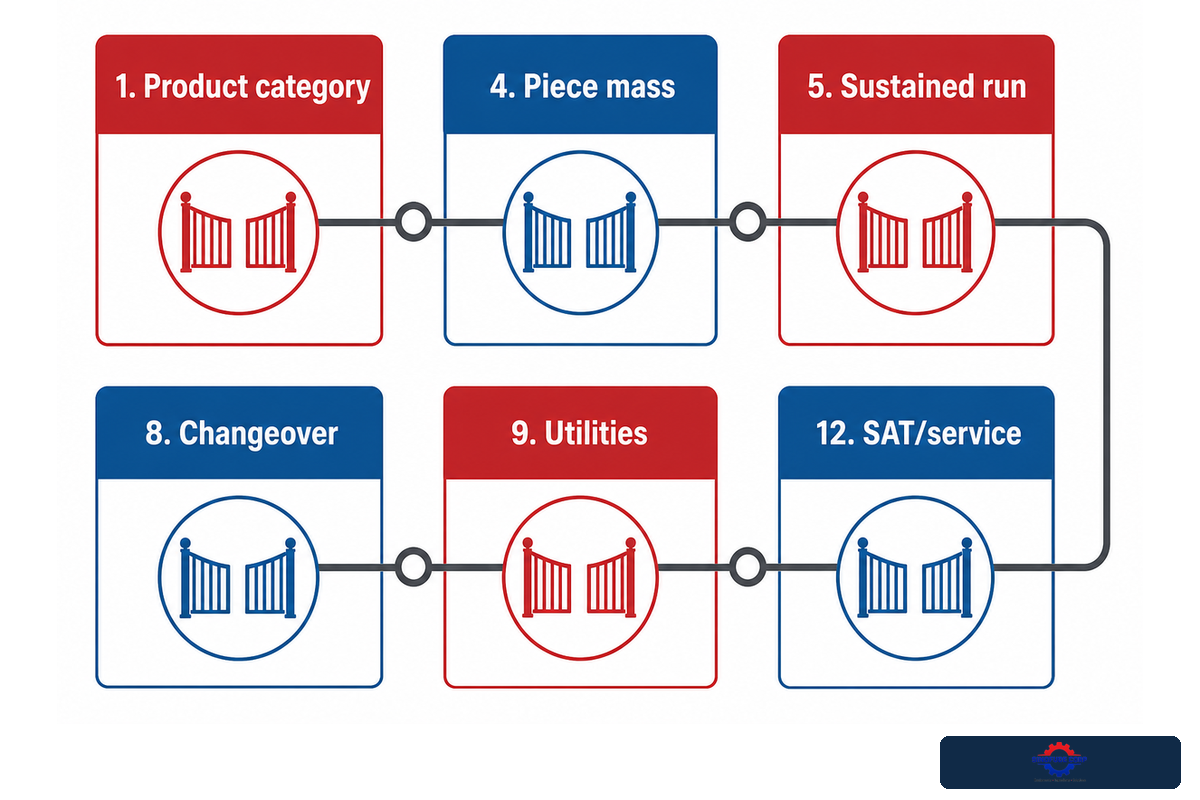
Complete the following 12 lines on your RFQ/FAT:
| Parameter | Buyer input | Supplier evidence | Acceptance rule |
|---|---|---|---|
| 1. Product category | Conventional food or dietary supplement | Applicable quality-system scope | Regulatory path documented |
| 2. Formula | Controlled recipe and ingredient lots | Recipe limits and addition sequence | No unapproved substitution |
| 3. Geometry | Shape, cavities, fill and colours | Approved mould drawing | Visual/sample match |
| 4. Piece mass | Target and tolerance | Sample plan and results | Agreed distribution passes |
| 5. Sustained run | Duration and production mode | Timestamped output and downtime | Released kg/h over full window |
| 6. Buffers | Permitted WIP and hold time | Buffer level trend | No hidden accumulation |
| 7. Rejects | Categories and treatment | Stage-by-stage reject log | First-pass yield passes |
| 8. Changeover | From/to recipes and labels | Last-good to first-good record | Clean, correct and released |
| 9. Utilities | Available conditions | Measured peak/normal demand | Within frozen design basis |
| 10. Safety/alarms | Required scenarios | Cause/effect challenge record | Safe stop and restart proven |
| 11. Documents | Language and format | Drawings, manuals, certificates and backups | Document index complete |
| 12. SAT/service | Installation and training scope | Schedule, responsibility and response route | Open items assigned and dated |
Once those inputs are frozen, you can review a Jelly Candy Line configuration against the same evidence brief. That keeps the guide informational while giving the commercial page the model, configuration, price and enquiry work it’s meant to handle.
Need a recipe-specific evidence plan?
Provide information on the target gel system, mass, shape, and color/fill. Include requirements for output, packaging, format, the destination market and the acceptance basis for the witnessed trial. SINOFUDE then identifies the trial scope and document list required before model selection.
Frequently Asked Questions
What Is Jelly Candy Made Of?
Jelly candy products are usually made from sweeteners, flavour and colour systems, water, and a gelling agent such as gelatin, pectin, carrageenan or agar. Composition, acidity and temperature also set the deposit time, and dictate the order of addition. Assume nothing about a formula; for example, don’t assume that a jelly recipe is the only recipe in the product family.
What Equipment Is Essential for Making Jelly Candies?
The complete industrial system normally includes ingredient preparation, dissolving or cooking, minor-ingredient dosing, depositing or moulding, controlled setting/cooling, optional drying or conditioning, demoulding, finishing, inspection and packaging, with interfaces and responsibilities clearly defined. Other components of the system include buffers, control devices, utilities, process equipment, automation, process interlocks, process safeties, integrity systems, process metal works, quality-release documentation and process recorders, and process cleaners. While quoted prices may be listed separately, all of these components are part of the project scope.
How Are Jelly Candies Produced?
Control is exercised over the endpoint of preparation and cooking of the raw ingredient. Acids, flavors, colors and active ingredients are added within time limits. The mass is deposited into a starch impression or a mould. It’s conditioned or set and later demoulded, either oiled or sanded. It’s inspected and packed. Stable output depends on controlling every stage of the process, including the handoffs around depositing. This includes depositing.
How Does Gelatin Affect Jelly Candy Texture?
Gelatin’s unique property is that it can form an elastic gel network. Recipes for gelatin gummies vary with concentration, hydration, thermal history, the cooker, holding path and depositor used. Predicting texture requires the gelatin percentage, syrup composition, piece size and conditioning conditions.
Can One Line Run Gelatin and Pectin Jelly Candies?
One jelly candy line can do this, but the same processing hardware doesn’t necessarily mean a similar process window across both target recipes under one test basis. Variations between gelatin and pectin recipes may include cooking endpoint, acidity, order of addition, hold time, depositability, mould release and conditioning. Ask the supplier to run each target formula at the intended geometry and weight, then document change parts, cleaning, first-good-piece timing, sustained released output and the quality-control decision for each product.
Additionally, determine who provides the moulds and ingredients. Understand how rework and warm-up are treated, what result is released to the next stage, and what happens if one formula is released and the other is out of spec.
References & Sources
- US FDA, Current Good Manufacturing Practices for Food and Dietary Supplements
- Electronic Code of Federal Regulations, 21 CFR Part 117
- Cornell Legal Information Institute, 21 CFR 111.75
- Multi-Product Bernoulli Lines with Dedicated Finite Buffers
- OSHA, Combustible Dust: An Explosion Hazard
- EHEDG, Hygienic Design Principles
- Foods (2024), Current Innovations in the Development of Functional Gummy Candies
- Polymers (2024), Physicochemical and Sensory Stability Evaluation of Gummy Candies
- Standards (2026), Assessment Methods for Hygienic Design in Food Equipment
- ConfectioneryNews, Pectin-Based Gel Production Context