Get in Touch with SINOFUDE Company


![Gummy Production Lines: Process & FAT Guide [2026]](https://sinofudecorp.com/wp-content/uploads/2026/10/gummy-production-lines-guide-featured.png)
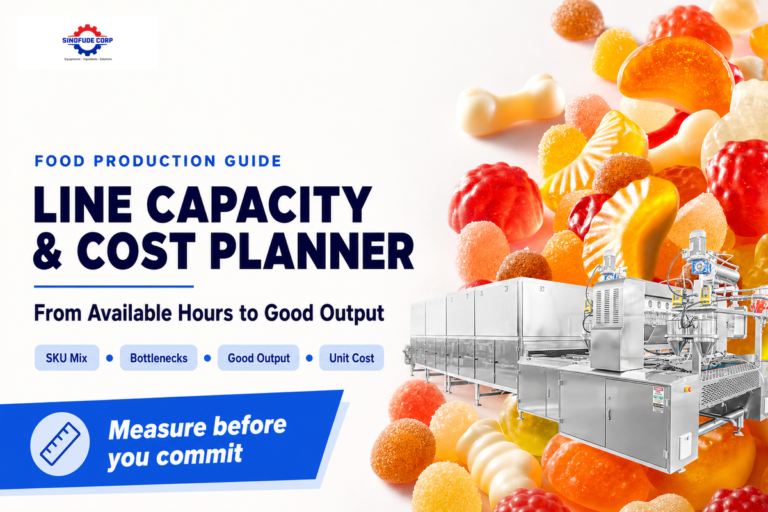
Industrial gummy production lines are connected systems that move released ingredients through cooking, dosing, depositing, setting, demoulding, finishing, inspection and packing. The useful output of the system is dependent on handoffs between these stages rather than the speed of the fastest machine quoted.
This document presents how to describe that system, test its boundaries, and establish what evidence is applicable for a factory acceptance test. It covers conventional deposited confectionery and supplement gummies. Products manufactured using different methods, e.g., extruded or slabbed gummies, home recipes, and special pharmaceutical dosage forms that are manufactured using a 3D printer and other customized special forms, lie outside the scope of this document. If you’ve a qualified product brief, and wish to compare equipment rather than learn the process, you can find SINOFUDE’s webpage on complete gummy production line configurations.
The procurement error to avoid is simple. Buyers shouldn’t focus on a depositor’s nameplate rate while neglecting the recipe, residence inventory, package speed, utilities, cleaning methods and acceptance definition. Briefly touching an advertised rate doesn’t mean a factory is capable of sustaining, releasing and selling that output.
Scope boundary:
This article is an evaluation and acceptance guide rather than a product catalog, price list or standard process recipe. All operating parameters must be related to the product, route, environment and test conditions.
What an Industrial Gummy Production Line Includes
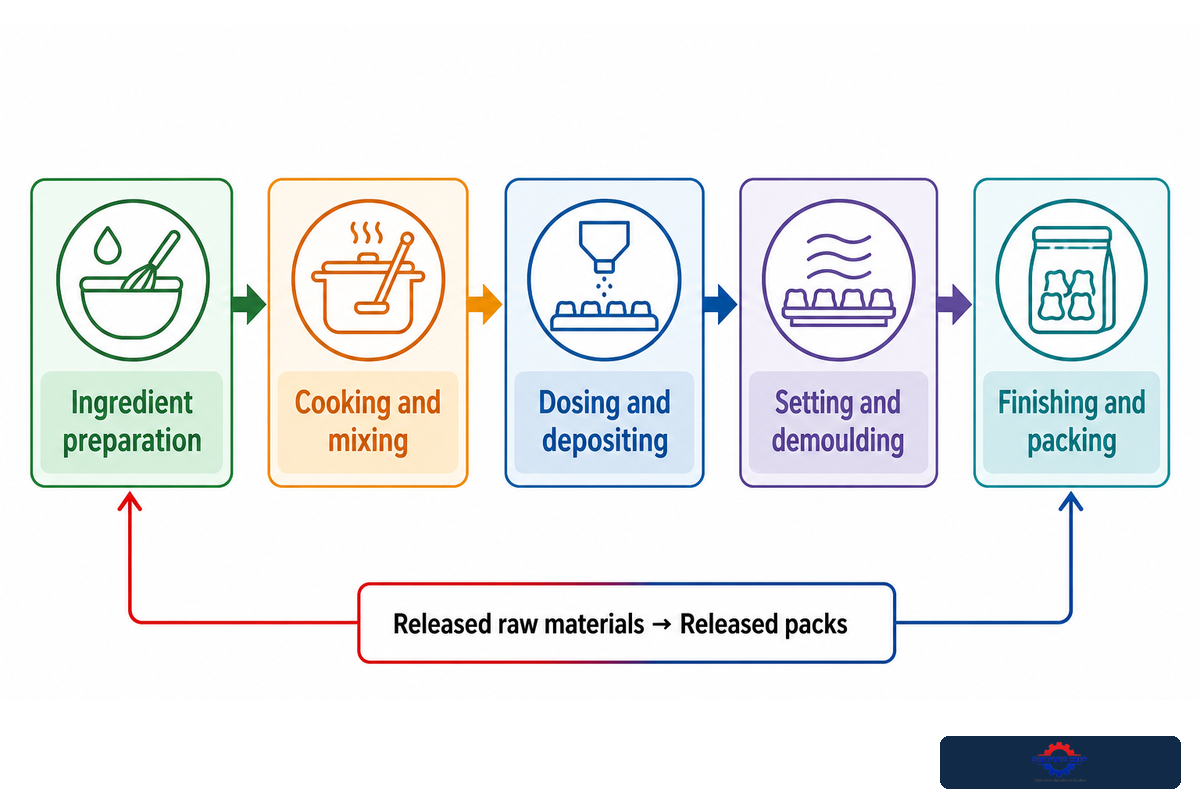
The contracted production line begins when one controlled product state enters the system and ends when another controlled state leaves the system. There are exceptions. For example, a quote labels a depositor, a cooling tunnel and a mold conveyor a “complete line” while omitting the preparation of the syrup, active dosing, conditioning space, inspection and the handoff for packaging.
It would be fair to say a line is “complete” if the requirements capture all the steps in the process, including the product as it leaves the system and the equipment and services that control the product as it leaves the system. If the steps aren’t included, then it wouldn’t be fair to say a line is “complete.”
Hot masses are metered by the depositor into cavities. The forming section of the line adds mould transport, setting, and demoulding. The entire industrial line connects the upstream recipe system to the downstream released pack. The exact location of this boundary may vary, but each location should define the incoming and outgoing product conditions, utility owner, control owner, test owner, equipment and services, and the tests that confirm control.
| Module | Incoming condition | Outgoing condition | Frequent exclusion | Owner to name |
|---|---|---|---|---|
| Ingredient preparation | Released raw materials | Weighed, staged ingredients | Storage and transfer | Factory / supplier |
| Cooking and mixing | Recipe charge | Cooked mass at a defined state | Thermal service and exhaust | Process supplier |
| Dosing and depositing | Transfer-ready mass | Filled moulds | Active or acid dosing skid | Controls integrator |
| Setting and demoulding | Deposited pieces | Released pieces | Room conditions and residence inventory | Line / facility |
| Finishing and packing | Accepted loose pieces | Released packs | Metal detection, checkweighing or cartoning | Packaging supplier |
Auxiliary equipment is included in the scope only if the product being made requires it; for dietary-supplement products, 21 CFR Part 111 separately governs equipment, process controls, specifications and batch records at necessary production stages.
Search Terms vs Contract Scope
Search wording is not a contract definition. Buyers may use gummy manufacturing, gummy making or high-quality as shorthand; this map treats common market phrases as discovery labels, not performance claims.
| Search-language group | Terms buyers may encounter | Contract question still unanswered |
|---|---|---|
| Single-machine labels | gummy making machine; gummy machine; commercial gummy making machines; food machine; manufacturing machines | Which process boundary and handoffs are included? |
| Line and process labels | gummy candy manufacturing; commercial gummy candy manufacturing; gummy candy manufacturing process; gummy manufacturing line; gummy candy production line | Does the scope end at depositing, demoulding or a released pack? |
| Equipment labels | gummy production equipment; manufacturing equipment; confectionery equipment; processing equipment; production machinery; equipment industry | Which modules, utilities, controls and records are supplied? |
| Output language | production process; production runs; scale production; production rate; production efficiency; efficient production | Is the figure rated, sustained or accepted saleable output? |
| Project language | production specifications; production requirements; production needs; production solutions; manufacturing solutions; gummy production solutions | What evidence, owner and acceptance condition define each requirement? |
| Product labels | commercial gummy; gummy bear; gummy products; gummy bases; gummy and jelly | Which recipe family, piece geometry, finish and package are qualified? |
| Adjacent categories | hard candy; soft candy production line; confectionery production; commercial manufacturing; candy manufacturers; gummy manufacturers | Does the same hardware have product-specific trial evidence? |
| Automation labels | automatic gummy; fully automated line; automated production lines; modern production lines | Which functions are automated, and how is each one tested? |
| Design labels | machine design; gummy molds; components of a gummy candy; gummy depositing; food-grade equipment | Which product state, material and cleanability criteria apply? |
| Scale and offer labels | produce gummy; making gummy; manufacture gummy; large-scale gummy; high-quality production; complete production lines | What witnessed run and release record supports the claim? |
Oil or sugar finishing, starch recovery, active-ingredient dosing, clean-in-place equipment and secondary packaging aren’t automatic parts of every gummy candy production line. Write inclusions and exclusions into the same responsibility schedule as the core machinery.
Purchasing contracts often link the production of gummy candies, the production equipment and the production capacity. However, contracts should include more precise language. Each step in the manufacturing process should be traceable to an input, an output, an owner, and a record. Terms like “high quality” or “fully automated” shouldn’t be used to define product quality; the automation level must be stated function by function and linked to an acceptance test. Supplier documents may use either mould or the American spelling mold; the responsibility schedule should treat both as the same cavity-forming component unless the design says otherwise.
Key takeaway: First compare system boundaries, then compare machines. Two quotes with the same headline capacity may cover very different work.
How Gummy Production Lines Work, Step by Step
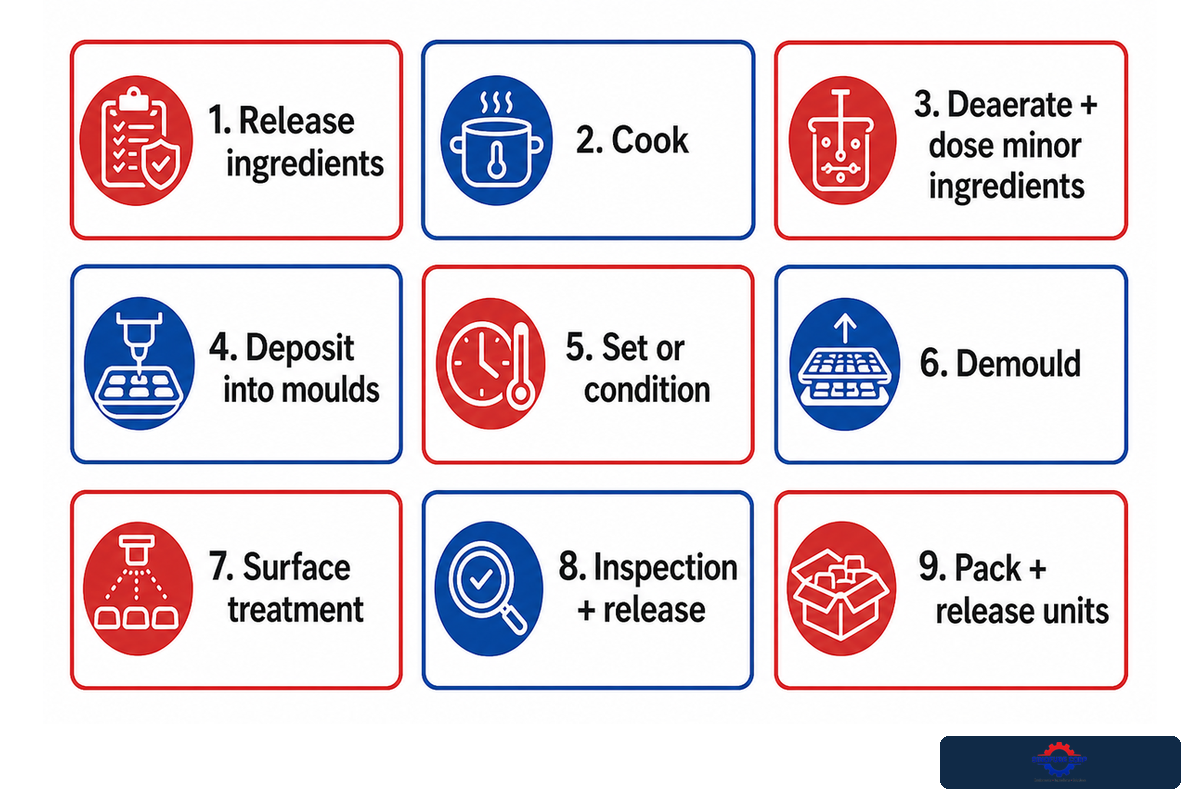
In a conventional deposited line, the product changes state nine times. That sequence turns the system boundary above into a set of observable product handoffs. The sequence is consistent enough to plan, however each release condition is dependent on gel chemistry, geometry, finish and package. The practical question at every stage is: “What evidence allows this material to move downstream?”
- Release ingredients. Identity and lot status, as well as measured quantities, are entered into the record. Choosing the wrong gel system, syrup ratio or active dose can’t be corrected by better automation later.
- Cook. The cooker defines the endpoint from the recipe and thermal history. The release evidence may include batch identity, time, temperature, soluble solids or another product-specific endpoint.
- Deaerate and dose minor ingredients. Colours, flavours, acids and active ingredients enter at controlled points. The product may become less transferable after cooling or acidifying.
- Deposit into moulds. The gummy depositor converts a flowing mass into pieces. Piece weight, nozzle-to-nozzle variation, tailing and cavity fill become visible here.
- Set or Condition. At what point in time can a piece be safely removed from a mould? The answer may vary depending on the factors like the type of gel system used, humidity, temperature, mould routes etc. This may contain a lot of work in process compared to the depositor.
- Demould. Pieces separate from reusable moulds or a starch bed without unacceptable tearing, distortion or carryover.
- Surface treatment. Oil, sugar, acid sanding or another finish is applied only after the piece has the required surface and mechanical condition.
- Inspection and release. Loose pieces are inspected for weight and appearance and any defects. Product specific safety and quality checks are also done. Only acceptable pieces are sent for packaging.
- Pack and release units. The candy packaging machine must accept the real piece flow, format range and inspection logic, not a nominal upstream rate.
Queues occur after cooking, during setting and at packaging. While the cooker has to wait for a depositor, the depositor may need to wait for empty moulds and conditioned pieces may need to wait for a packer. These aren’t the only annoying scheduling issues. While pieces wait, residual heat may still work on the product, affecting its final state. Residence time and surface condition may still change.
One 2024 peer-reviewed stability study illustrates why release can’t be inferred from elapsed time alone. Its formulations measured water activity from 0.69 to 0.79, and selected products showed mould after 2 months at room temperature. Dry matter ranged approximately from 70% to 76%; the no-sugar formulations reached about 75% to 76% under the same preparation protocol. Those figures aren’t universal gummy limits. They show why a line needs product-state evidence tied to the actual formulation and package.
Key takeaway: the general sequence is stable, but every transfer needs a recipe-specific release condition. Elapsed time by itself is rarely enough.
The 9-Checkpoint Production Passport
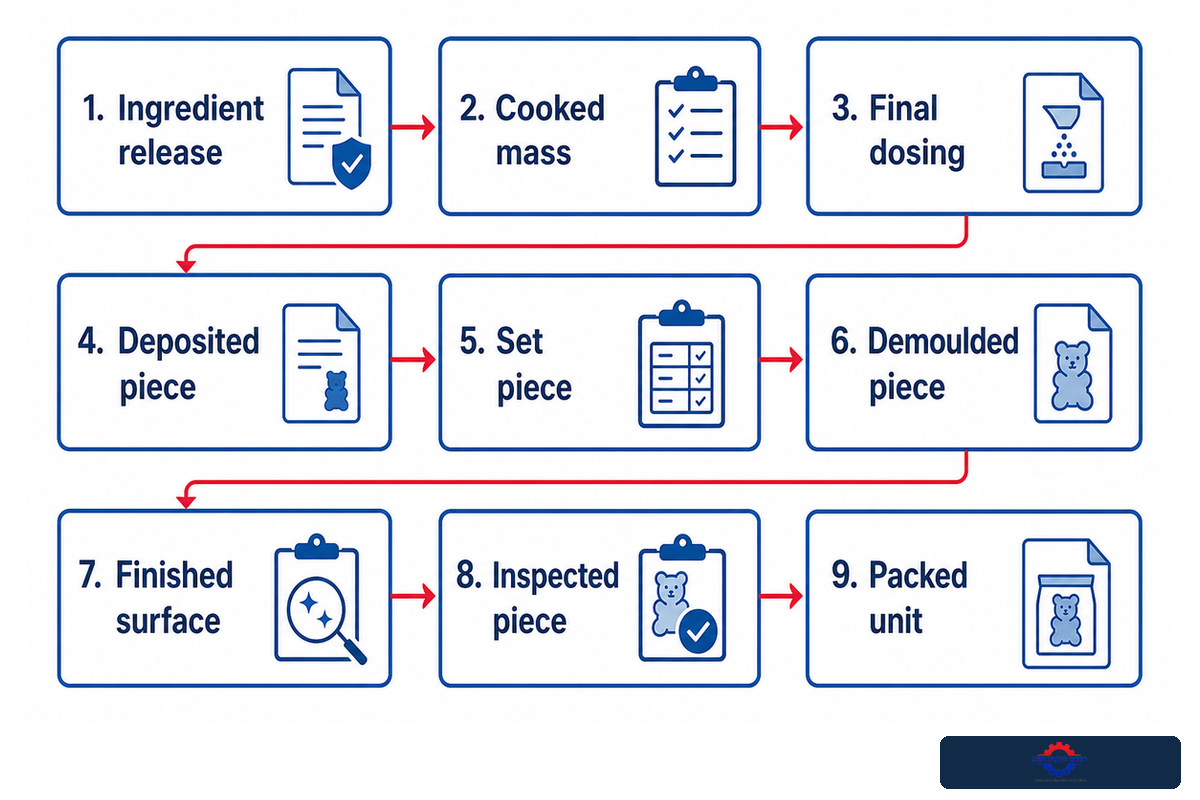
The 9-Checkpoint Production Passport is a buyer-side record that follows the material from ingredient release to a packed unit. It is not an FDA form and it does not claim that a particular supplier already records these fields. Its purpose is to identify the last accepted condition before a defect appears.
Prior to Checkpoint 1, include only one classification field on the cover sheet for conventional confectionery, dietary supplement or other regulated product category. The classification field defines which specifications, examinations, records, and release approvals are behind the same physical line. The nine rows below provide space to describe handoffs of product state.
| Checkpoint | Incoming state | Controlled variable | Release evidence | Responsible party | What fails if missing |
|---|---|---|---|---|---|
| 1. Ingredient release | Received lots | Identity and quantity | Released lot and weigh record | Quality / operator | Wrong base, dose or traceability |
| 2. Cooked mass | Recipe charge | Product-specific endpoint | Batch and endpoint record | Cooker operator | Texture and stability drift |
| 3. Final dosing | Cooked base | Addition amount and timing | Dose and mix confirmation | Operator / quality | Colour, flavour, pH or active error |
| 4. Deposited piece | Transfer-ready mass | Fill weight and cavity quality | Sample plan and results | Line operator | Underfill, overfill or tails |
| 5. Set piece | Filled mould | Release condition | Defined test, not time alone | Process / quality | Tearing, sticking or later instability |
| 6. Demoulded piece | Set product | Release integrity | Defect count and carryover check | Line operator | Distortion or contamination |
| 7. Finished surface | Loose pieces | Coating amount and uniformity | Appearance and handling check | Finishing operator | Clumping or package fouling |
| 8. Inspected piece | Finished bulk | Acceptance specification | Good, reject and rework counts | Quality | Unknown saleable yield |
| 9. Packed unit | Released pieces and packaging | Count, weight, seal and code | Pack inspection and disposition | Packaging / quality | Unreleasable finished stock |
For United States dietary-supplement gummies, current 21 CFR Part 111 makes the classification field operational rather than decorative. Specifications, master manufacturing records, batch production records, examinations or tests, quality control review and disposition belong to the manufacturer’s regulated control system. The Passport can organize evidence, but it cannot replace those duties.
Key takeaway: record what released the product at each handoff. This allows the team to go back to the last accepted checkpoint when a defect shows up instead of remembering what happened.
Deposited Routes: Starchless or Starch Mogul?
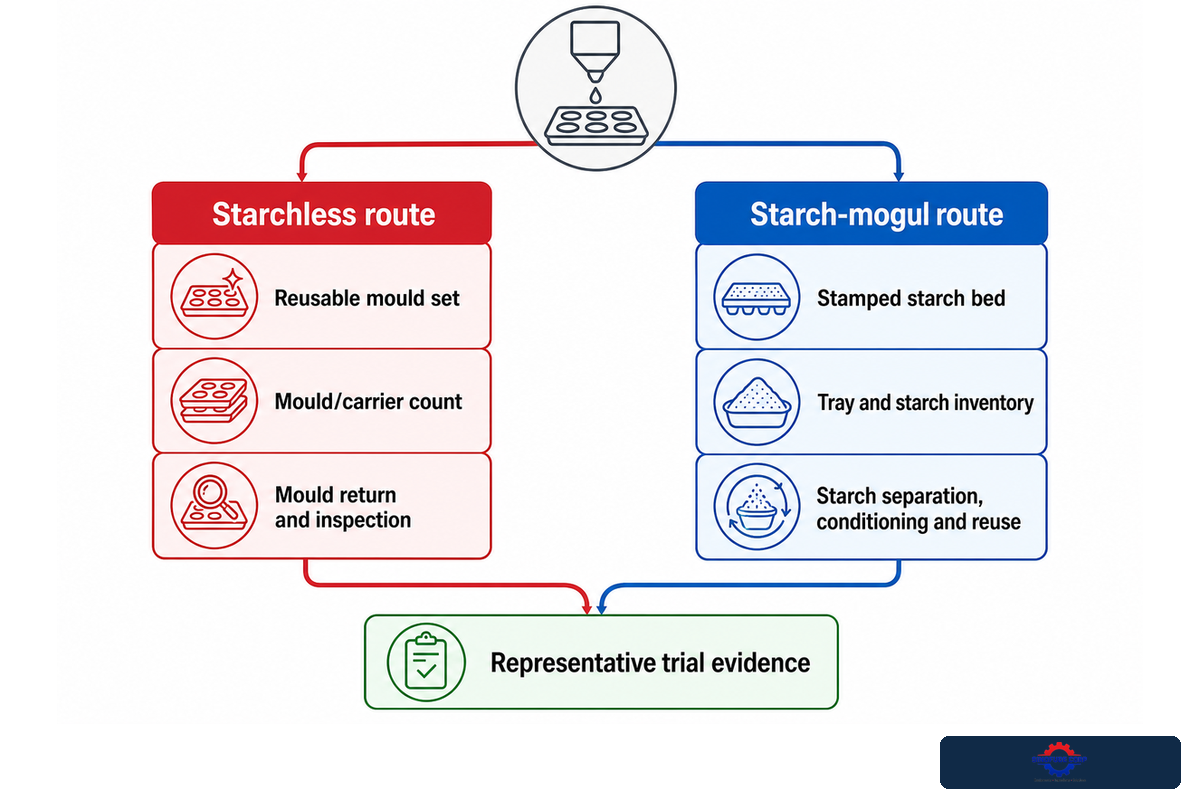
Starchless and starch-mogul systems are two common deposited routes, not an exhaustive map of every gummy-like product. Those handoffs stay visible in the Passport, even though each route assigns the work to different equipment and environments. A starchless line deposits into reusable rigid or flexible moulds and moves setting, cooling and release work into the formulation, mould and controlled environment. A starch mogul line stamps cavities into conditioned starch, deposits into the bed and later separates product from starch.
The correct question is, “Where does each route place the work that this product needs completed?” The answer to that question varies by gel system, shape, residence inventory, dust controls, cleaning method and the evidence a representative trial produces.
Use the following 9-row Route Burden Comparison as an evidence checklist, not as a supplier ranking. Each row identifies work that remains in the process even when a different forming route moves that work to another machine, room or operating team.
| Decision type | Starchless route | Starch-mogul route | Evidence to request | Condition that changes the answer |
|---|---|---|---|---|
| 1. Mould medium | Reusable mould set | Stamped starch bed | Mould/starch specification | Shape and release behaviour |
| 2. Shape flexibility | Bound to qualified moulds | Bound to print and starch condition | Trial pieces for each geometry | Undercuts and piece size |
| 3. Gel-system fit | Relies on mould and controlled set | Starch participates in handling | Recipe-family trial matrix | Gelatin, pectin or mixed system |
| 4. Setting location | Tunnel, room or off-line carriers | Starch trays and conditioning area | Residence map at target output | Release condition |
| 5. Residence inventory | Mould/carrier count | Tray and starch inventory | Hours of product in process | Recipe and environment |
| 6. Recovery loop | Mould return and inspection | Starch separation, conditioning and reuse | Loss and contamination records | Starch-management design |
| 7. Airborne-material burden | Product/finish dependent | Starch and sugar dust can be material | Qualified dust-hazard assessment | Dust generation and facility controls |
| 8. Cleaning/changeover | Mould, hopper, manifold and conveyor | Food path plus starch circuit | Witnessed clean-out and inspection | Allergen and recipe change |
| 9. Qualification trial | Representative mould and environment | Representative starch and conditioning | Good output, defects and release state | Actual product family |
Food hygiene and process safety are separate evidence packages. OSHA includes candy, sugar and starch among materials that can be explosible in dust form. That doesn’t mean that all mogul rooms have the same hazard and control design. It means the project needs a qualified dust assessment wherever these materials can become airborne; a stainless-steel food path and a sanitation certificate don’t answer that question.
Key takeaway: Choose the route following a representative trial and a facility review. Movement of setting work out of starch doesn’t make the work disappear.
Let the Recipe Define the Operating Window
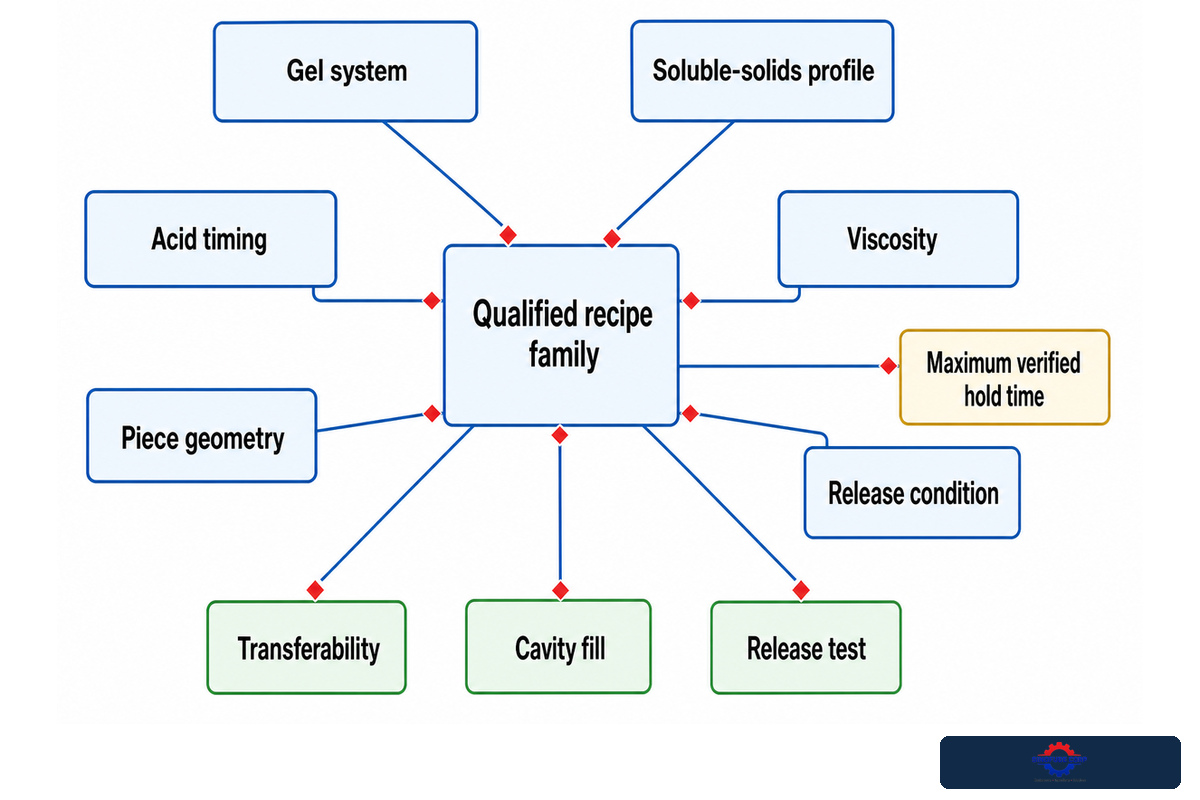
No line runs “gummies” as one material. That route choice becomes useful when it is tied to a qualified recipe family. It runs a recipe family with a certain gel system, soluble-solids profile, acid timing, viscosity, active load, piece geometry and release condition. That family determines how long the mass retains its transferability, how it fills a cavity and what’s required before demolding.
Pectin processing makes timing visible. The gelling response depends on the pectin system, soluble solids, acidity and temperature history. If the final acid or buffer change brings the mass into its gel-forming window too early, the material can thicken before the nozzle bank completes a clean deposit. Gelatin uses a different hydration and cooling mechanism, so sharing hardware does not mean the two recipes share set points or residence time.
Azelis names Zachary Wong in its 2024 pectin interview as Technical Application Manager. He goes on to explain some of the factors affecting gel formation, including water, buffers, temperature, and acid timing.
“Pectins in general require hydration and dispersion to a media.”
Use a trial sheet rather than a universal recipe table. For each product family, document:
- ingredient and gel-system identity, including permitted substitutions;
- hydration, cook and transfer sequence;
- the point at which acids, flavours, colours or active ingredients enter;
- mass condition at the depositor and the maximum verified hold time;
- piece geometry, target weight and sampling method;
- mould route, setting environment and release test;
- finish, package and shelf-life study linkage; and
- cleaning and first-good-piece evidence after changeover.
Product classification changes the dossier. FDA states that dietary supplements are regulated under a different set of regulations from conventional foods and drug products. Nutraceutical gummy production may share cookers, pumps and moulds with confectionery, but for United States dietary-supplement production, 21 CFR Part 111 places finished-product specifications, master manufacturing records, batch production records, examinations or tests, quality-control review and disposition within the manufacturer’s regulated system.
Compatibility limit
Shared machinery can be technically capable of running gelatin, pectin and fortified products while the business case can still fail. Long cleanouts, wasted work in process, or slow first good piece approval can negate the use of shared equipment.
Key takeaway: qualify representative recipes, not ingredient labels. “Runs pectin and gelatin” is a starting hypothesis, not an acceptance result.
Rated Speed Is Not Saleable Output
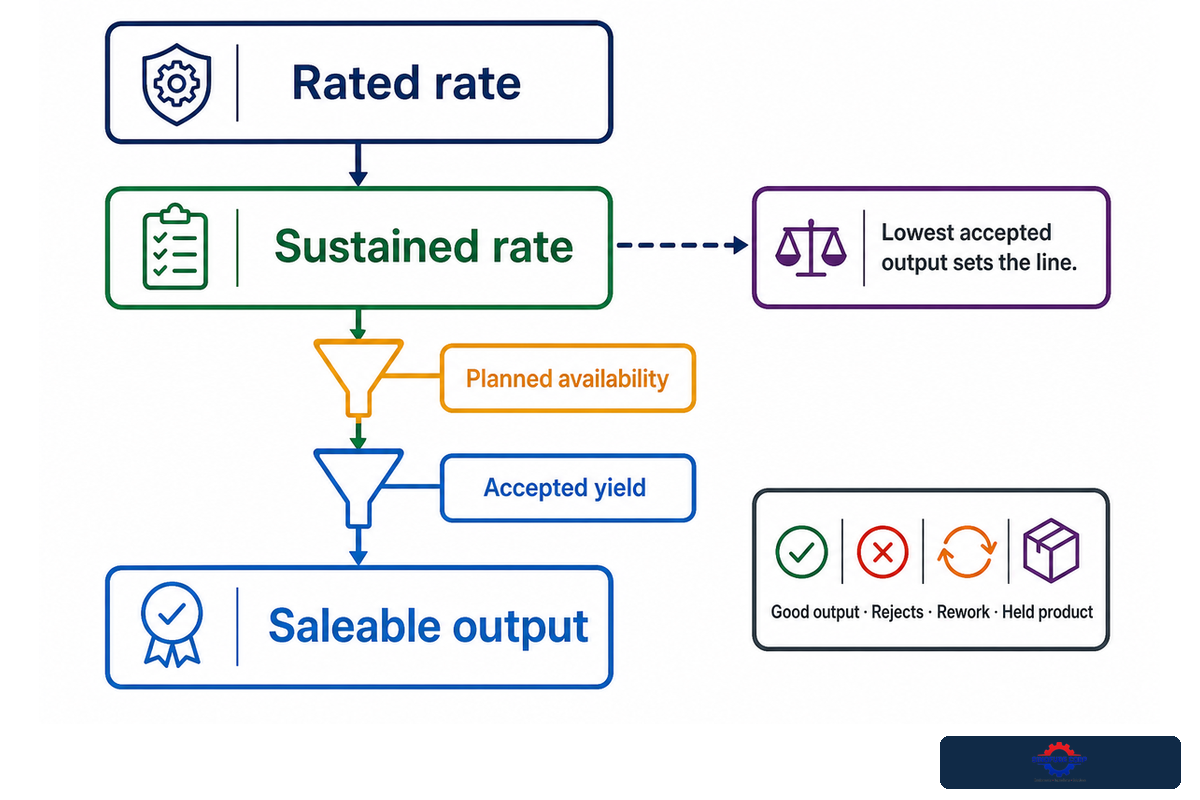
Rated rate is what the machine is capable of given defined or often unstated limitations. Sustained rate is what a stage maintains across a representative run. Saleable output is the accepted product that survives stops, start-up loss, rejects, rework and downstream packing. Only the last figure is a concern for planning.
Normalize both batch and continuous processes to a time basis, then determine the least sustained accepted output rate among process stages. Apply planned availability and accepted yield, and this is a constraint methodology.
Hypothetical worked example, no SINOFUDE performance claim
Suppose a recipe yields 240 kg of transferable mass every 60 minutes. The depositor is rated at 300 kg/h, the available setting carriers sustain 220 kg/h, finishing sustains 230 kg/h and the chosen pack format accepts 200 kg/h. The line constraint is therefore 200 kg/h.
If planned availability is 85% and accepted yield after rejects is 96%, the planning result is:
200 kg/h × 0.85 × 0.96 = 163.2 kg/h saleable output
Across an 8-hour scheduled shift, that’s about 1,306 kg, not 2,400 kg obtained by multiplying the depositor’s 300 kg/h rating by 8 hours.
Second hypothetical normalization check: a 90 min observation window excludes a 15 min warm-up and leaves a 75 min measured run. If the log shows 210 kg input, 180 kg good output, 12 kg rejects and 18 kg held product, the demonstrated good-output rate is 144 kg/h. For 2.5 g pieces packed at 20 pieces/bag, a packer sustaining 60 bags/min has an equivalent flow of 180 kg/h. These figures illustrate unit conversion only; they aren’t supplier specifications.
The same illustration could reserve 30 kg for start-up hold, withdraw 6 kg for samples, classify 4 kg as spill loss, return 2 kg to authorized rework, record 25 min of planned cleaning and 10 min of an unplanned stop, then hold release for 3 hours. It could also sample 5 pieces every 20 min against a ±0.1 g acceptance band. None of these numbers is a design value.
A worksheet rehearsal might also record a 22°C room, 50% relative humidity, a 120 mm mould pitch, a 6 g target piece, a 30 min hold window and a 100 kg/h downstream handoff. They are placeholder fields for testing the calculation and record structure, not SINOFUDE equipment specifications.
The example is intentionally transparent. Real calculations must define whether rework counts as good output, when the clock starts, how product held in setting is treated, and whether the packaging format is available for the whole run.
One integrator case illustrates the role of loss data. Corso Systems reports a Tanis gummy line increased production by 14% after measuring and reporting recipe throughput and downtime and changeover and quality losses and adjusting operating speed and ingredient staging (i.e., process changes) without acquiring additional equipment or staff. The 14% increase is a result of the project and isn’t a guarantee for other situations. The lesson is to evaluate constraints before expanding capacity.
Ask suppliers to state capacity alongside the product, piece weight, route, run duration, good-output definition, reject handling, residence inventory and package interface. Configuration-specific capacity belongs in a quotation after these conditions are fixed; that is the right point to evaluate a proposed line configuration.
Key Takeaway: The lowest accepted output sustained at a station sets the line output.
Hygienic Design and Changeover Evidence
Equipment in contact with a food product must be cleanable in its normal use; alloys don’t guarantee this. Sustained accepted output therefore depends on the cleaning and changeover evidence behind the schedule. Access and drainage must be considered as well as joints and seals, hollow sections, product retaining ledges, and removable parts. Consider the route of the cleaning fluids and tools and instrument locations.
For United States food production, 21 CFR 117.40 requires equipment to be adequately cleanable, installed to support cleaning and maintenance, and constructed so automated or closed systems can remain sanitary. It also addresses food-contact materials, seams and the accuracy of instruments used for conditions such as temperature, pH and water activity. None of that means a machine is “FDA approved”; it defines design and operating duties for the food facility.
Use three separate changeover evidence packages:
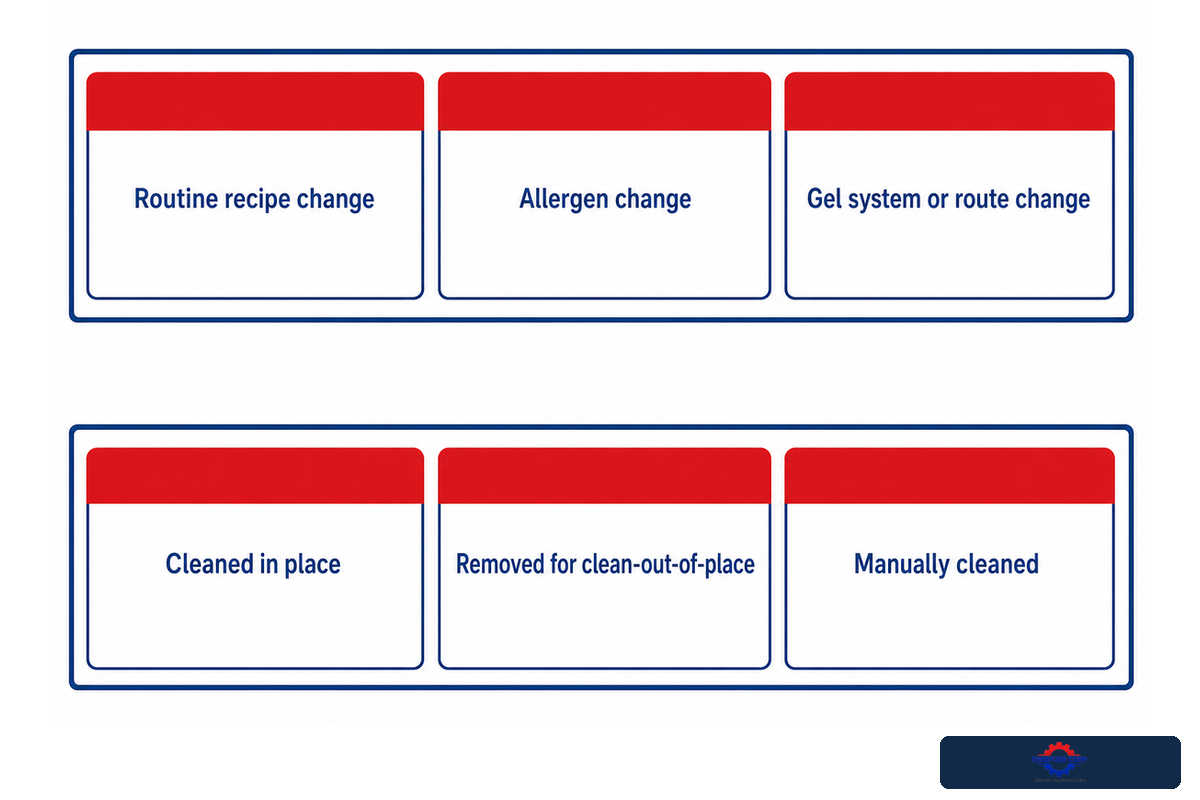
- Routine recipe change. Record the remaining mass, teardown or flush steps, inspection points, cleaning time, restart loss and the first acceptable product.
- Allergen change. Add the plant’s hazard analysis, and validated or otherwise justified control, monitoring, verification and release records.
- Gel system or route change. Confirm that manifolds, nozzles, moulds, carriers and environmental conditions can move from one validated operating window to another without uncontrolled residue or work in process.
Using a clean-in-place system may reduce manual work on a compatible closed circuit. It does not guarantee that every dead leg, mold, hopper, conveyor, or other surface is cleaned-in-place. Mark what is cleaned in place, what is removed for clean-out-of-place, what is manually cleaned and how each result is verified.
It’s important to separate combustible dust from hygiene. In the case of assessing any starch or sugar dust, we must consider ignition and dispersion, as well as containment and collection, and of course the system and facility. Passing a sanitation check doesn’t answer process safety questions and passing a dust review doesn’t guarantee allergen removal.
Key takeaway: request a witnessed changeover with inspection and release evidence. Stainless steel and easy to clean are descriptions, not tests.
Utilities, Layout and Interface Readiness
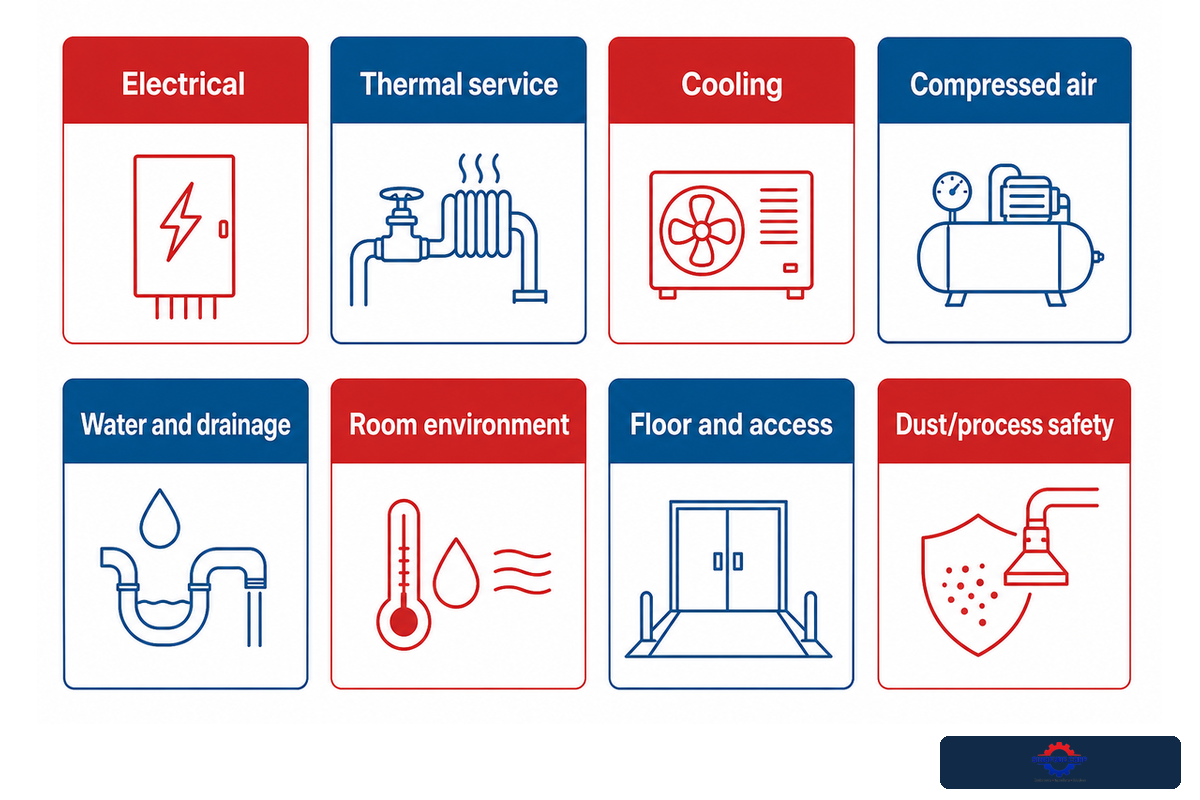
Utility figures become useful only when their boundary and operating condition are stated. The same changeover evidence also defines the operating cases used for utility and layout decisions. Normal demand and peak demand are different from connected electrical load. Cooling duty depends on product load, inlet condition, outlet condition and ambient design. Steam or another thermal service needs pressure, quality, return scope and simultaneous demand.
NASA’s interface-management guidance offers a method that can be used in other scenarios: define physical, electrical, mechanical, human and performance interfaces; identify ownership; control changes; and feed interface parameters into verification and validation plans. For a gummy factory, for example, that means one interface register instead of several different assumptions about equipment scattered in different drawings, utility schedules and packaging emails.
| Interface | Condition to state | Supplier evidence | Site evidence |
|---|---|---|---|
| Electrical | Voltage, frequency, connected/normal/peak load | Load list and protection | Available supply and coordination |
| Thermal service | Medium, pressure, quality and demand case | Consumption schedule | Generation and return capacity |
| Cooling | Inlet/outlet conditions and heat load | Duty at stated product rate | Water/chiller/air availability |
| Compressed air | Pressure, quality, average and peak flow | Point-of-use requirement | Header capacity and treatment |
| Water and drainage | Quality, temperature, flow and effluent case | Connection and discharge data | Supply, drain route and treatment |
| Room environment | Temperature, humidity and ventilation envelope | Equipment heat/moisture loads | HVAC design condition |
| Floor and access | Loads, anchors, service clearance and routes | General arrangement and loads | Structural and access approval |
| Dust/process safety | Materials, release points and hazard ownership | Emission/source data | Qualified hazard assessment and controls |
According to IEC 62381:2024, in process-industry automation, factory acceptance and integration testing are different from site acceptance and integration testing. The distinction calls for an agreement by the owner, buyer and seller to define their respective test responsibilities. If the project adopts the standard, use the distinction as a method, and do not claim the standard always governs contracts for confectionery.
Not every layout value is project-specific. Applicable law can impose general minima. In the United States, 29 CFR 1910.22 requires maintained drainage where wet processes are used and requires walking-working surfaces to support their maximum intended load. The process load still has to be calculated for the actual installation.
Key takeaway: freeze interface conditions and owners before layout approval. Utility numbers without defined operating cases should not be used as design inputs.
Define FAT, Site Acceptance and Commissioning Before Price Comparison
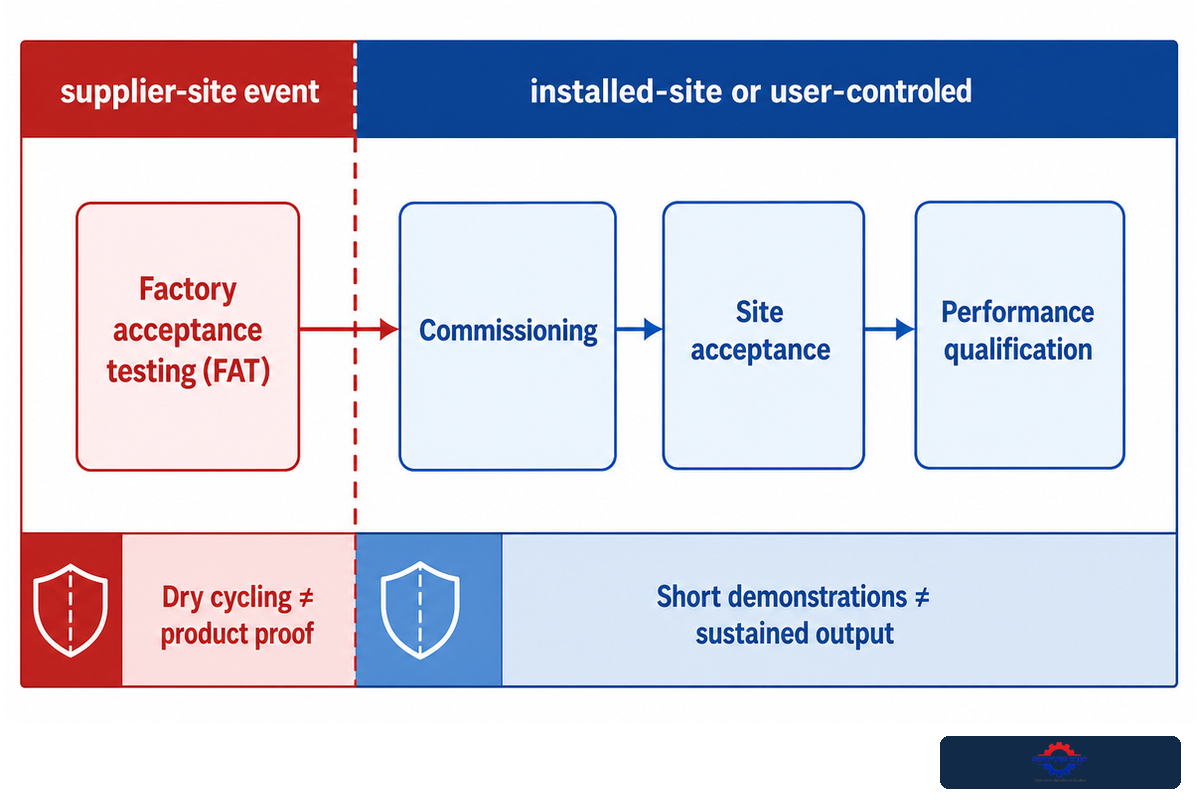
Factory acceptance testing (FAT) asks whether the completed equipment meets agreed pre-shipment requirements that can be tested at the supplier’s site. The interface register from the layout stage then separates supplier-site checks from conditions that remain site-dependent. Commissioning makes the installed equipment operational. Site acceptance checks requirements that depend on the buyer’s utilities, room, upstream supply and downstream integration. Performance qualification, where applicable, belongs to the user’s controlled process and regulatory system.
Keep those events separated. Dry cycling may show motion and interlocks without showing product handling. Short product demonstrations can show that pieces emerge without proving sustained accepted output. Successful factory testing cannot prove the quality of utilities that do not yet exist at the supplier’s factory.
Gummy Line FAT Evidence Brief
- agreed product, recipe version and ingredient responsibility;
- piece geometry, target weight, sampling plan and acceptance band;
- run duration, start/stop rule and steady-state definition;
- good output, rejects, rework and held-product accounting;
- mould/carrier inventory and residence condition;
- alarm, interlock, safe-stop and recovery challenges;
- representative recipe or allergen changeover;
- cleaning-access demonstration and inspection record;
- utility basis and items deferred to the site;
- packaging handoff at the agreed format and rate;
- document pack, training, spares and software backups; and
- open-item owner, evidence, due date and effect on release.
For a dietary-supplement gummy, include the applicable product specifications, master manufacturing record, batch-production record, examinations or tests, quality-control review and disposition evidence. Machine suppliers may be able to demonstrate a function or provide records; however, they aren’t able to perform the legal batch-release duty of the manufacturer.
SINOFUDE supplied the following company context for this project: the brand was founded in 1998; the business reports three factories covering more than 30 acres, more than 200 employees, ISO 9001 management introduced in 2004, CE and UL certification for most products, and 38 product patents. It also reports laser cutting, laser and friction welding, CNC sawing, wire cutting, machining centres, lathes, drilling and gantry milling. These are company-provided facts; the live About page did not expose matching text during verification.
Use those facts as prompts for evidence, not as substitutes for it. Ask which parts on the proposed line use which process, which drawings and inspections control them, which certifications apply to the quoted scope, and what the witnessed product trial proves. An ISO management-system statement, CE documentation or UL mark does not replace project acceptance criteria.
Key takeaway: Acceptance must be defined before comparing prices. Otherwise, the lowest quotation may include the least testable promise.
When to Delay the Purchase and What to Prepare First
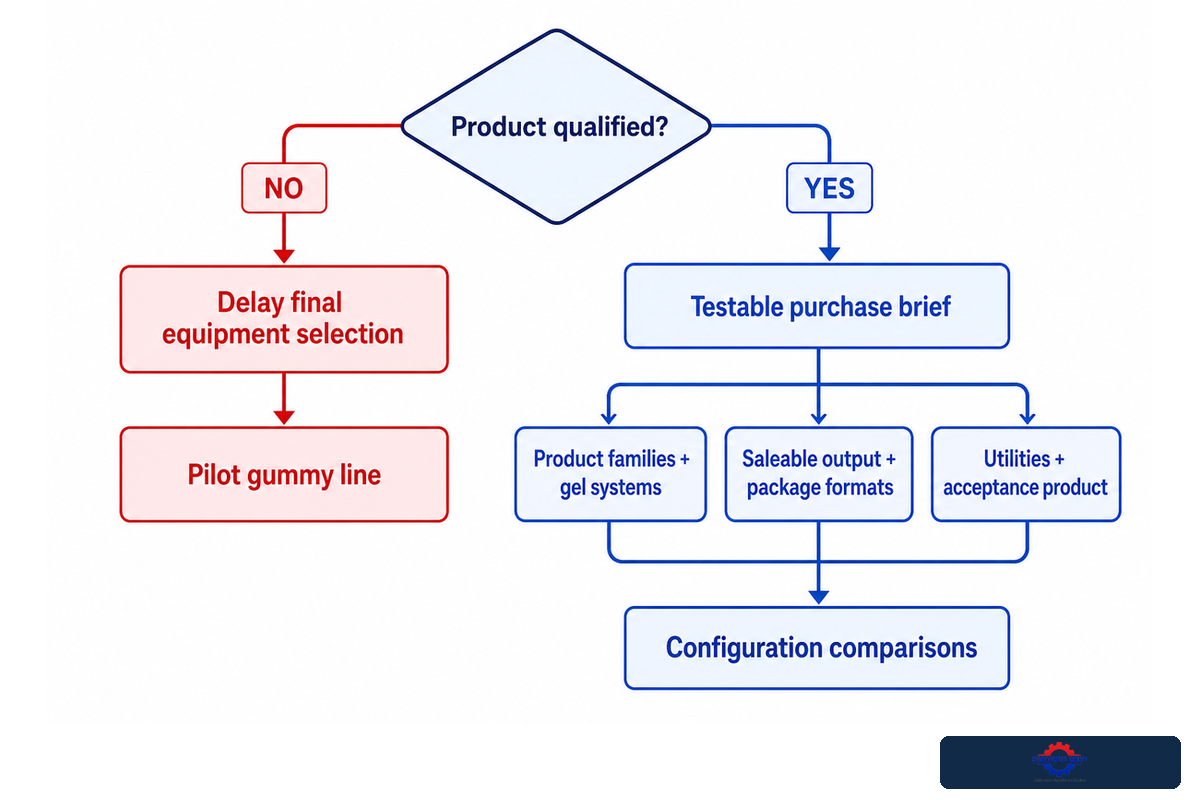
Delay final equipment selection until the product has been qualified. The acceptance plan then turns that qualified product definition into a testable purchase brief. Know the forming route and flow. Understand what “capacity” means in the context of the package being designed. Is it a single machine, a group of machines, or a cell? Be sure that the equipment selected can perform the required flow and meet the package demands.
Good project briefs include the product families, gel systems, piece weights and shapes, target saleable output, shifts, finishes, package formats, desired changeover time, utility conditions, room envelope, regulatory destination and acceptance product. If the product is still in development, a small-scale pilot gummy line or tightly controlled product development program may be the next step.
Once the brief is stable, configuration comparisons become very useful. They show where cooking, depositing, residence inventory, finishing, inspection and packaging should be placed, as well as which assumptions still belong to the factory.
Key takeaway: do not request a final line around an unfinished product definition. Prepare the evidence brief first, then compare configurations against it.
Frequently Asked Questions
How does a gummy production line work?
A gummy production line prepares and cooks a specified recipe, deposits it into molds, sets and releases the pieces, and finishes them under defined and documented process conditions. The equipment then hands the finished and accepted product to the packaging station.
Can the same gummy line run gelatin and pectin recipes?
Potentially, but shared hardware is not qualified performance. Gelatin and pectin can require different conditions for hydration, cooking, addition of acid, transfer, depositing and setting. Run representative trials for both families, measure the verified transfer window, document cleaning and record changeover time, first-good-piece delay and work in process that must be cleared.
What determines the real capacity of a gummy production line?
The real capacity is the minimum of the sustained accepted output rate of the process after planned stops, start-up losses and rejects, for cooking, dosing, depositing, setting, demoulding, finishing and packing. Convert both batch and continuous processes to the same time basis, then assess using the target recipe, piece weight, geometry and package format. Count good output separately from scrap, rework and held product; record duration, stoppages, package handoff and sampling conditions so the figure remains reproducible during witnessed runs.
Is a cooling tunnel always required?
No. The required setting environment depends on the gel system, mould route, piece geometry, target surface condition and the condition needed before demoulding. The selected residence method may be a tunnel, controlled room, carrier inventory, or some other validated method. It should be demonstrated and documented, using representative product, with respect to airflow, temperature, humidity, residence time and release criteria.
The trial also should have enough molds or carriers to define the true inventory limit. Evidence of this type is more useful than assuming every recipe requires the same tunnel.
What should a gummy production line factory acceptance test include?
An effective factory acceptance test freezes the recipe, geometry, target weight, run length and accepted-output definition. Record good output, rejects, rework and stops; challenge alarms and interlocks; demonstrate changeover and cleaning access. Assign site-dependent checks and owners before release approval.
References & Sources
- Electronic Code of Federal Regulations – 21 CFR Part 117 (food equipment, sanitation and process controls).
- Electronic Code of Federal Regulations – 21 CFR Part 111 (dietary-supplement manufacturing controls).
- U.S. FDA, Dietary Supplements (classification and regulatory overview).
- U.S. FDA, Part 111 Small Entity Compliance Guide (specifications, records, quality review and disposition).
- Vojvodić Cebin et al. – Physicochemical and Sensory Stability Evaluation of Gummy Candies (2024).
- NASA Systems Engineering Handbook, Interface Management.
- IEC 62381:2024 (factory/site acceptance and integration test scope).
- OSHA 29 CFR 1910.22 (wet-process drainage and maximum intended load).
- OSHA, Combustible Dust: An Explosion Hazard.
- Corso Systems – Tanis Gummy Candy Machine OEE (attributed implementation case).
- Azelis, Ask Your Experts: Pectin in Gummies.
- EHEDG, Hygienic Design Principles.