Get in Touch with SINOFUDE Company

Soft Biscuit & Cookie Line Guide: From Dough Behavior to Finished Cookie

A Soft Biscuit & Cookie Line transforms dough into products that are formed, baked, cooled and packed. Consistent cookies depend on tracking what changes between those stages: dough condition, raw-piece mass, spread, moisture and handling damage.
A cookie can leave the former at the correct weight and still bake too wide. Meanwhile, another can look perfectly sound at the exit of an oven and still develop cracks during storage. The first measurable change provides production and quality teams a better starting point than changing the recipe for every defect.
The process questions below pertain to dough behavior and physical quality. Regarding equipment range, forming options and project configuration, see SINOFUDE’s soft biscuit and cookie production line.
Start with the product: describe the finished bite, raw dough condition and required shape separately. “Soft” alone does not specify all three.
What Does Soft Biscuit Mean on an Industrial Line?
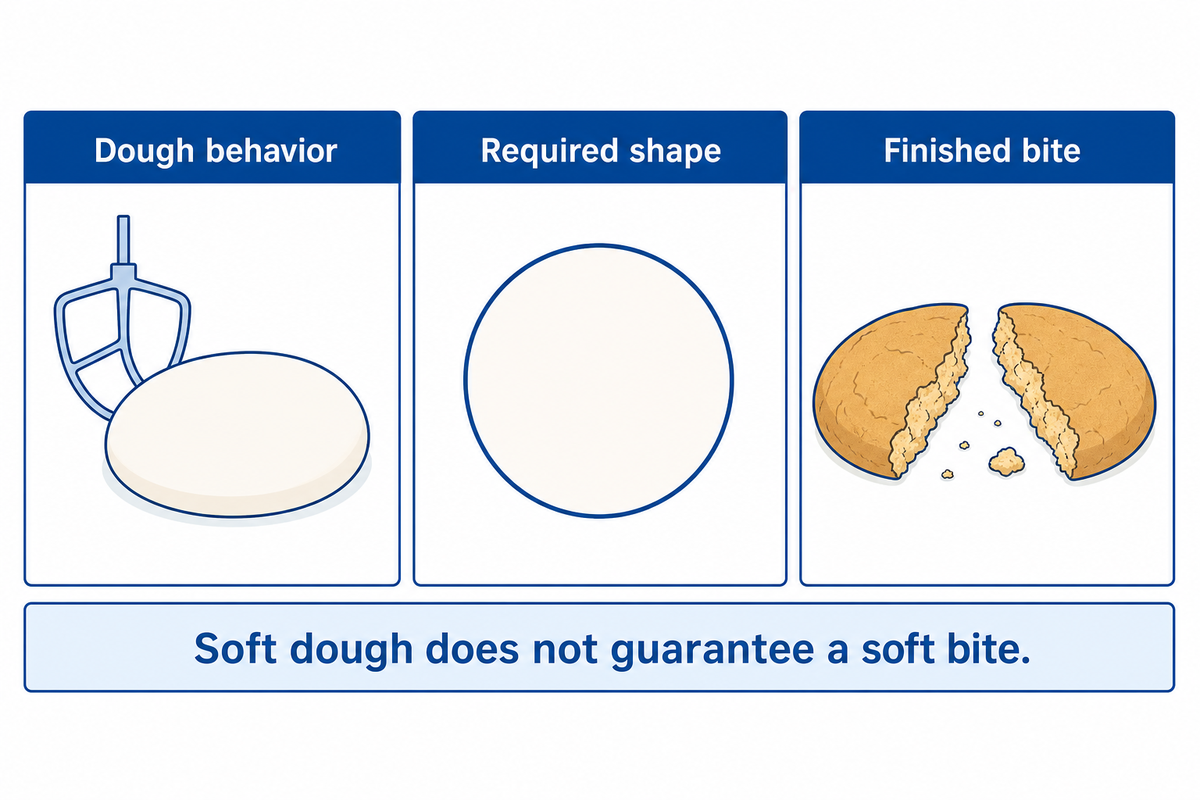
In industrial biscuit making, soft or short dough describes a processing category; it doesn’t always indicate a soft finished bite. A useful product description can separate dough behavior from the baked texture. Rotary molded biscuits and wire cut cookies can be part of short-dough production, though they can have a completely different form, structure and eating quality.
Molina and colleagues’ 2021 study of rotary-moulded biscuits places sugar-snap, rotary-moulded and wire-cut products within short doughs. The paper describes relatively high sugar and fat with less water than other biscuit categories. Those relationships explain the category; they don’t establish fixed recipe percentages for every factory.
Are cookie and biscuit the same?
The definitions of biscuit and cookies vary by market. In Britain a biscuit may be called a cookie in the US where biscuit also may refer to a soft, quick-bread product. So, a clear specification must go beyond either name to describe a product, for example in a discussion of forming machinery.
When presented a sample with the description “soft biscuit,” determine what the buyer means when they say short, easily formed dough, tender crumb, or chewy finished cookie. A photograph won’t help here. Compare a retained sample after cooling, including thickness, surface detail and how it breaks.
Elastic dough that needs sheeting and cutting raises different process questions, discussed in SINOFUDE’s hard biscuit line guide. Buying a former solely because two products share the word biscuit leaves the dough’s mechanical requirements unresolved.
How Ingredients and Mixing Change Dough Behavior
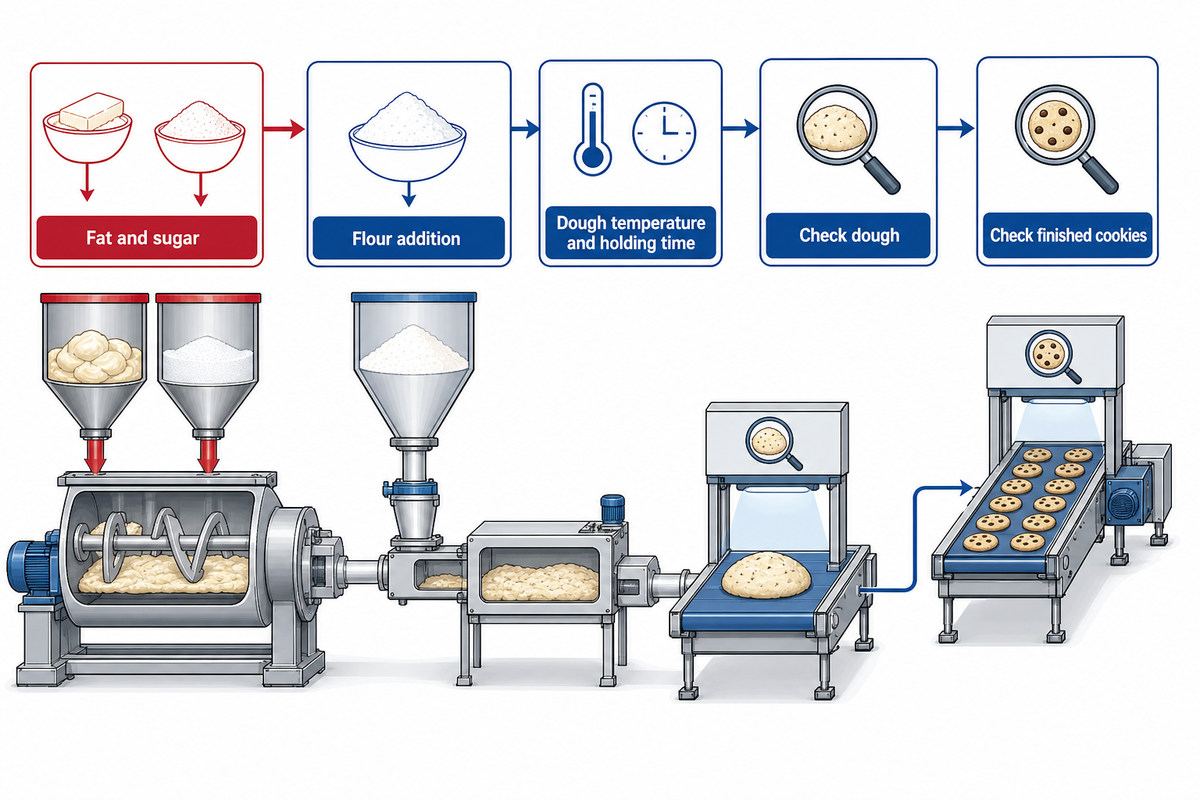
Dough behavior depends on the condition of ingredients and the amount of each ingredient in a recipe. Hydration, sugar characteristics and condition of fat affect deformation and movement of dough. A batch record becomes more helpful if it describes the conditions of the ingredient lots, the mixing sequence, dough temperature and the time between mixing and forming.
What is biscuit dough made of?
Biscuit dough usually consists of flour, sugar, fat and water, with other ingredients chosen for the product. Eggs, milk ingredients, salt, flavors and inclusions may also be present. Baking powder or another leavening system is typically recipe-specific. Knowledge of ingredient functions is important because changing a sweetener or fat can change handling, even if the finished flavor seems similar.
Think about flour addition as a separate process from creaming. Fat and sugar are often mixed before flour, while subsequent mixing distributes the dry ingredients and changes the hydrated dough. Longer mixing is not automatically a correction for poor handling: the dough can change without the finished cookie changing in the same way.
A 2023 whole-wheat cookie experiment by Dhal and colleagues examined dough mixing for 1, 3, 5, 7.5 and 10 minutes. Changes were noted in the dough, but the final dimensions of cookies from the different treatments didn’t show a significant difference. Their mixing-time study used a laboratory formulation and a hand mixer. Time settings are in minutes and don’t represent production settings.
“Despite the variation in creaming stability, no significant differences were observed in the sensory profile”
The creaming result gives a useful caution. Not all smooth-looking intermediate mixtures indicate a better finished biscuit. Record the condition of the intermediate mixture, compare dimensions and texture, and do a sensory check against the product target. Also, the papers haven’t established that mixing isn’t important.
In an illustrative shortbread trial, the first dough batch releases cleanly but the next develops rough edges after waiting beside the former. The operator suggests more flour. Before changing the formula, the team checks the ingredient lot, dough temperature, holding time and the affected cavities. They retain pieces from both batches and bake them under the same conditions. After cooling, they check them for defects. If the defect follows one cavity, a change in the formula would alter good pieces in the next trial. If all cavities deteriorate with holding time, the next trial can examine dough handling while keeping the former settings fixed. Either way, the result suggests an answer and narrows the focus without assuming the true cause of the defect is known.
Dhal and colleagues’ laboratory formula included 100 g whole-wheat flour, 40 g butter, 40 g sugar and 25 g water. The value for a bakery is the conditional result: assess dough and finished cookies separately. Another flour, mixer or holding history needs to be evaluated separately.
Rotary Moulding, Wire Cutting and Depositing: What Changes?
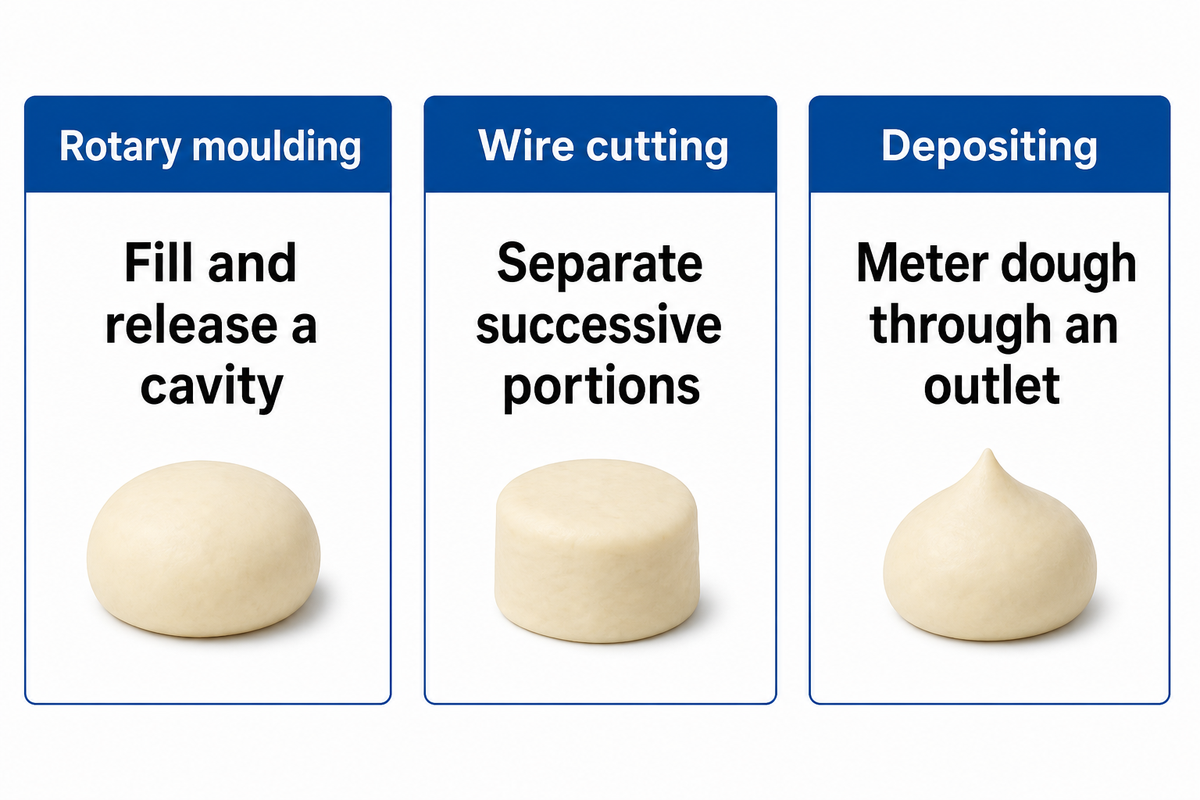
The mechanical effects of moulding, wire cutting and depositing differ on cookie dough. In moulding, you fill and release a cavity. In wire cutting you separate successive portions from an extruded dough stream. In depositing you meter dough through an outlet onto a surface. Failure of any of these actions requires you to determine whether the consistency of dough or machine needs adjustment.
- Rotary moulding: inspect cavity filling, edge definition and release. Missing corners and retained dough deserve a cavity-by-cavity comparison.
- Wire cutting: compare portion mass across lanes, the cut surface and inclusion damage. A repeated lane pattern differs from random variation throughout a batch.
- Depositing: examine dose, separation from the nozzle and shape retention. Flow through a nozzle doesn’t prove that the deposited shape will survive baking.
A shortbread producer’s public forum question describes one rotary roller as much less forgiving than others, with missing dough and small holes. The question documents a symptom, not a verified remedy. It supports recording which roller or cavity produces the defect instead of treating every release failure as a recipe problem.
Inclusions add another constraint. Chocolate chips and nuts need to pass through the forming path, and separate, without unacceptable displacement or damage. Patent US8431172B2, filed by Kraft Foods Global Brands LLC, describes ultrasonic cutting of inclusion-containing dough ropes. That specialized disclosure isn’t a capability claim for an ordinary wire cutter or for SINOFUDE.
As an illustration, matching a 10g target portion while changing the inclusion specification creates a new test condition. Ask to see the intended inclusion specification in the tooling to be used. A plain dough demonstration can’t help settle whether large chips will remain large and intact, or will break, or whether all lanes will portion consistently.
Follow Spread, Setting and Drying Through the Oven
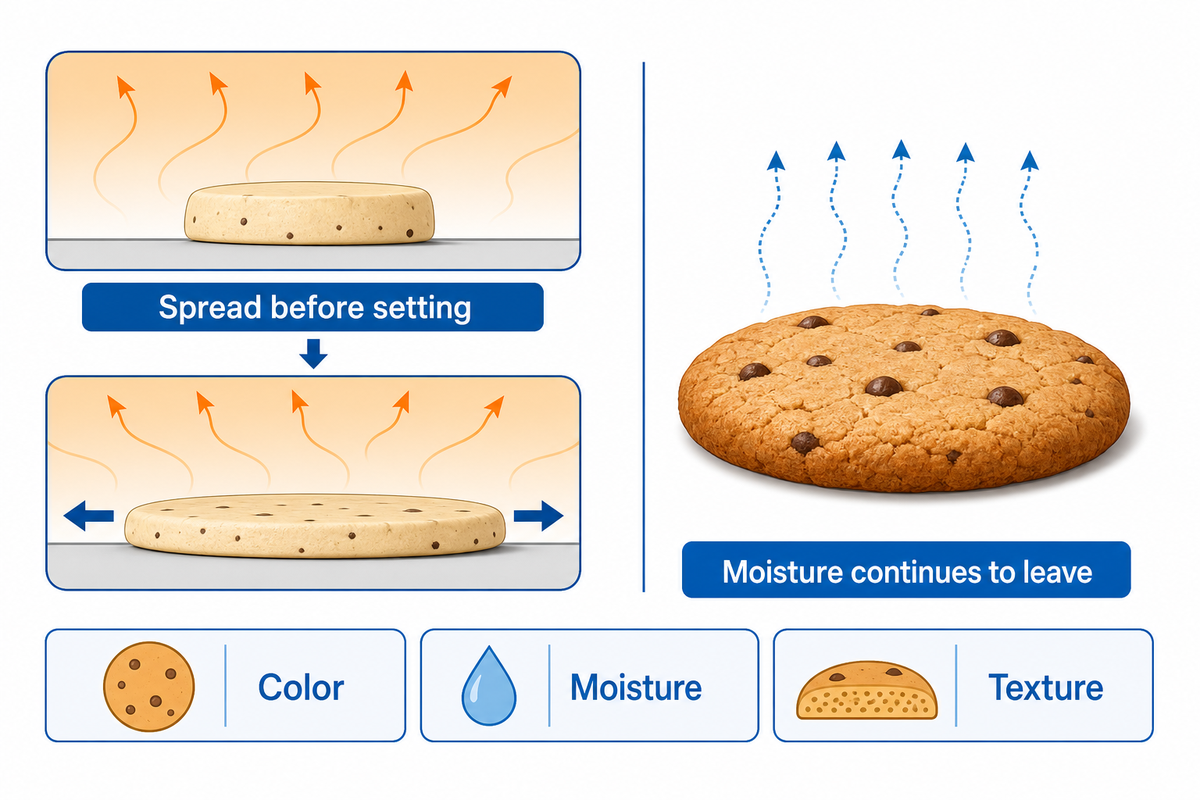
Moisture and texture of cookies change with time, so mass of raw pieces and baked dimensions provide different information. Dough may spread before it sets, and moisture continues to leave the product. Oven comparisons should therefore retain the forming measurements and add baked width, thickness, color and an appropriate moisture measurement.
In a 2018 experiment with sugar-snap cookies by Panghal and colleagues, interactions among ingredients and processing conditions were identified. Response surface results showed some settings as favorable. Duplication of one reported temperature in a different recipe would negate the study’s purpose: interaction of formulation and process.
When doing a pilot test on a baking sheet, record sheet, loading pattern and dough geometry. An industrial oven band and a laboratory tray don’t create the same heating conditions. A result that transfers successfully should be demonstrated with the intended product and equipment, not assumed from an oven setpoint alone.
Darker cookies can entice an operator to call a batch done, but Leiva-Valenzuela and colleagues’ biscuit-model study showed that formulation affected browning, and the relationships between moisture and color also varied among the formulations. Color is a good indicator, but a relationship of color to moisture should be established with product-specific evidence.
Moisture is not the same as water activity, which is the availability of water through an equilibrium vapor-pressure relationship. The FDA’s water activity explanation defines types of water. The same moisture content does not ensure the same behavior in storage among different recipes.
Measurements at 7, 13 and 19 minutes in the biscuit-model experiment were made under the specified baking conditions. They aren’t instructions for an industrial oven. Color may not always be an accurate indication of doneness. Accepting a sample because its surface looks sufficiently brown isn’t a good way to decide on product. Comparing color with moisture and texture provides a better basis to make the decision.
Why Cookies Crack or Break After Baking
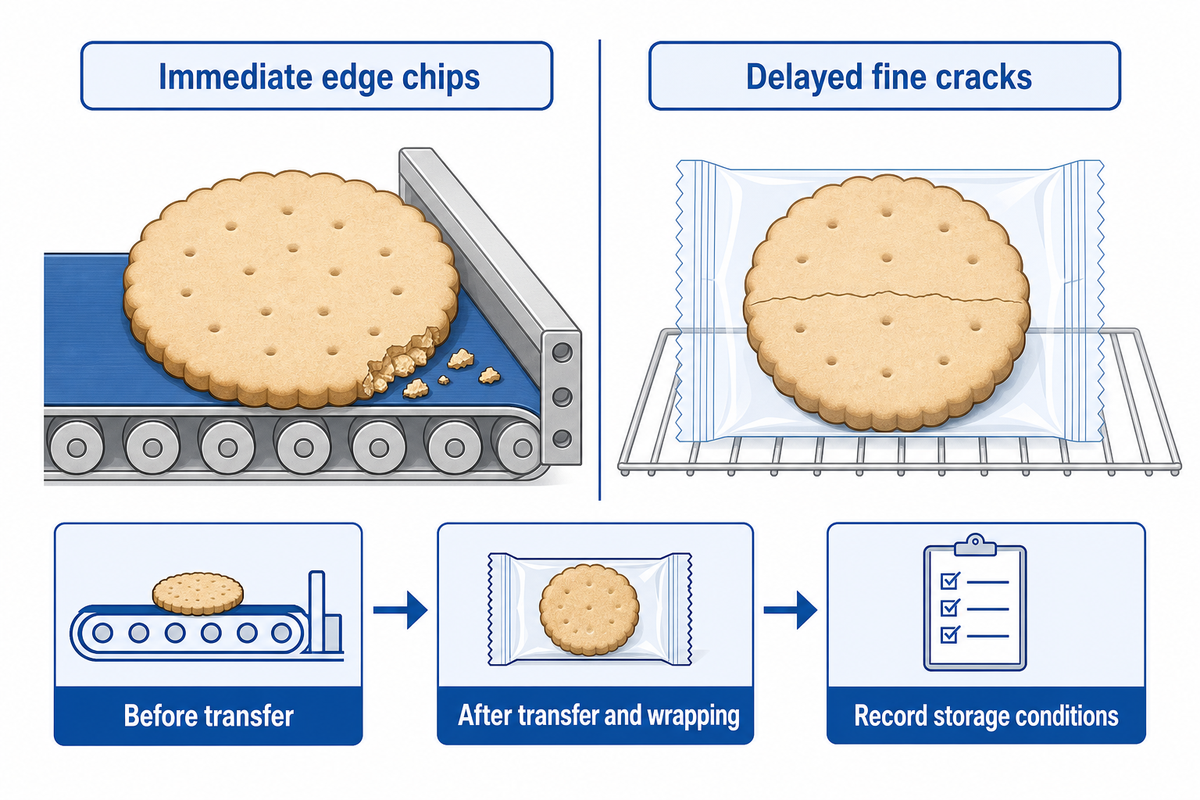
Cookie breakage can begin during transfer, and some crisp biscuits develop fine cracks later through checking. Moisture redistribution after baking can create internal stresses. Separating immediate handling damage from delayed cracks can help discern which measurements are important; a sound-looking biscuit at oven exit doesn’t describe its condition after cooling and storage.
In a 2025 low-fat biscuit study, researchers heated a sample using various time/temperature combinations, and checked for cracking after 1, 7 and 14 days. The intent of the formula was to induce checking. The study describes a behavioral phenomenon with that product family and doesn’t predict the failure rate of commercial cookies.
Table 5 reports day-one moisture of 4.88% at the center, 1.84% at the edge and 2.88% for the whole biscuit in the conventional-oven condition, all on a wet basis. Those values are study observations, not moisture targets for a soft-baked cookie.
Consider a hypothetical crisp biscuit that passes visual inspection before wrapping but shows hairline cracks the following morning. Quality employees retain samples at various positions, including before and after wrapping and packing. The batch and storage conditions are recorded. Pieces already chipped before the wrapper direct attention toward transfer or earlier damage. Moisture distribution and storage conditions warrant an investigation of how fine cracks form. The team doesn’t simply slow the cooler. They compare the next controlled batch using the same inspection points. A retained sample helps to identify damage that occurred during handling.
A difference in moisture of about 3 percentage points from the edge to center occurred in the condition studied conventionally. Procurement shouldn’t consider that a universal rejection limit. The real request is a defined sampling method and a specified period of observation for the product concerned. The request should include inspections beyond oven exit.
Diagnose Defects Before Changing the Recipe
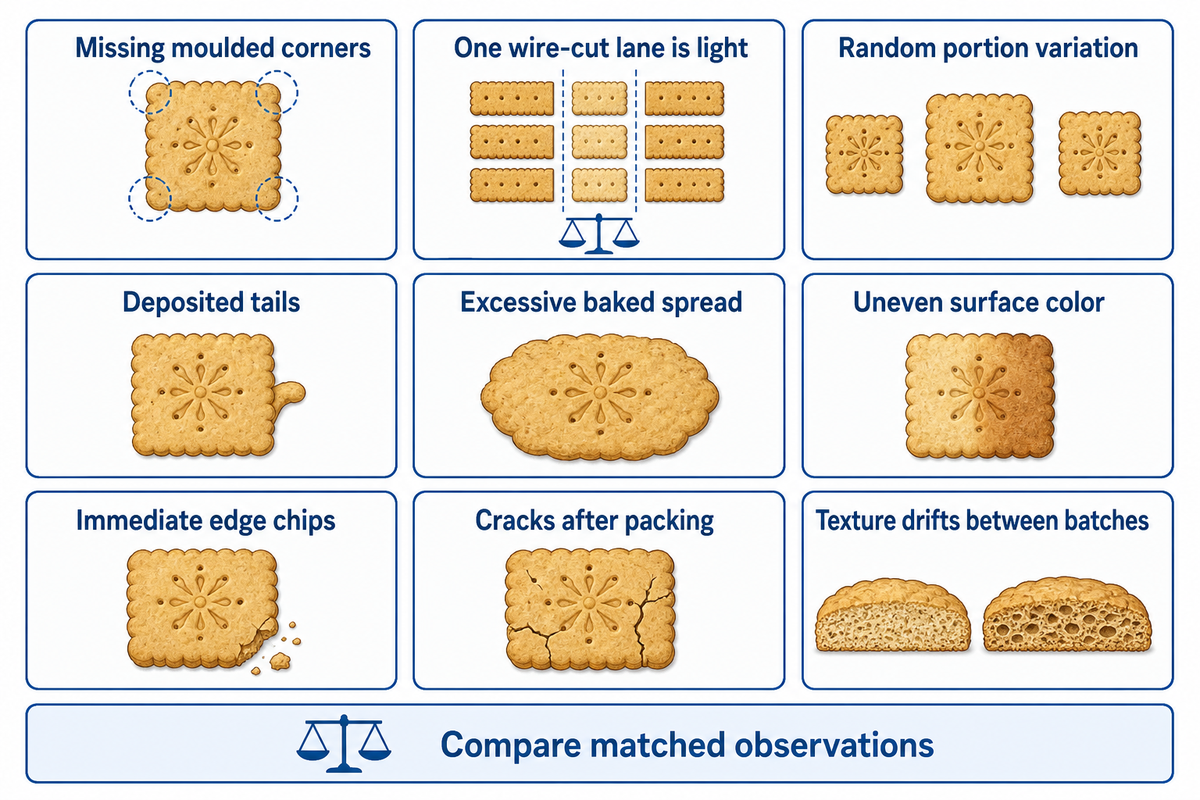
The first change in a matched set of observations is where diagnosis begins. Compare newly formed pieces, baked cookies and doughs, as well as cooled samples, all from the same batch. The Dough-to-Defect Comparison Sheet below links common symptoms to measurements while keeping each proposed cause open until a controlled change has been tested.
| Symptom | Compare first | Next controlled check | Limitations / not suitable for |
|---|---|---|---|
| Missing moulded corners | Cavity position and raw-piece photograph | Inspect release with recipe held constant | Appearance alone cannot identify adhesion versus incomplete filling |
| One wire-cut lane is light | Raw mass in g by lane | Check feed distribution, wear and alignment | A whole-band mean hides local variation |
| Random portion variation | Mass in g against hopper level and batch time | Compare matched feed conditions | Do not change feed and recipe simultaneously |
| Deposited tails | Nozzle position and separation behavior | Observe dough condition with a fixed dose | A clean tail cut does not prove baked shape |
| Excessive baked spread | Raw mass in g, diameter and thickness in mm | Compare oven conditions with forming held steady | Baked diameter alone cannot identify the cause |
| Uneven surface color | Lane, loading and measured moisture | Check the pattern across the oven band | Color is not a universal moisture conversion |
| Immediate edge chips | Damage before and after each transfer | Examine the first point where damage appears | Chipping does not prove delayed checking |
| Cracks after packing | Timed retained samples and storage conditions | Investigate delayed checking in applicable crisp products | The low-fat study does not cover every cookie recipe |
| Texture drifts between batches | Recipe lot, dough age, temperature and cooled texture | Repeat one changed factor against a retained control | A single pair cannot establish long-term process capability |
Editorial diagnostic synthesis from cited studies on mixing, browning and checking, plus Baker Perkins’ guidance on cookie weight variation has been referred to in the table. The table proposes checks; it doesn’t prescribe validated machine adjustments.
Common failure modes in diagnosis
Making several changes together can lead to an improved sample, but little evidence to support why. Adding flour, reducing dose and changing oven speed in the same run leaves the team unable to explain which change mattered. Keep the comparison narrow enough to interpret.
Baker Perkins states that variations in hopper distribution, dough inconsistency, and component wear and tear may cause weight variation. Worn tooling should be inspected and an automatic weight-control system can’t confirm if the baked texture and dimensions are according to buyer’s specification.
Judging samples based on appearance can be very deceptive. Don’t commit to a new machine solely because one demonstration batch looks better than a poor baseline. Confirm that both samples use the same ingredients, mass, geometry and inspection timing. Record rejected pieces as well as the selected display samples. For stage relationships, the biscuit and cookie bakery lines guide provides additional information. The buying decision becomes clear when the production team is able to explain the defect and quality is able to reproduce the measurement.
Turn Recipe Trials into Comparable Evidence
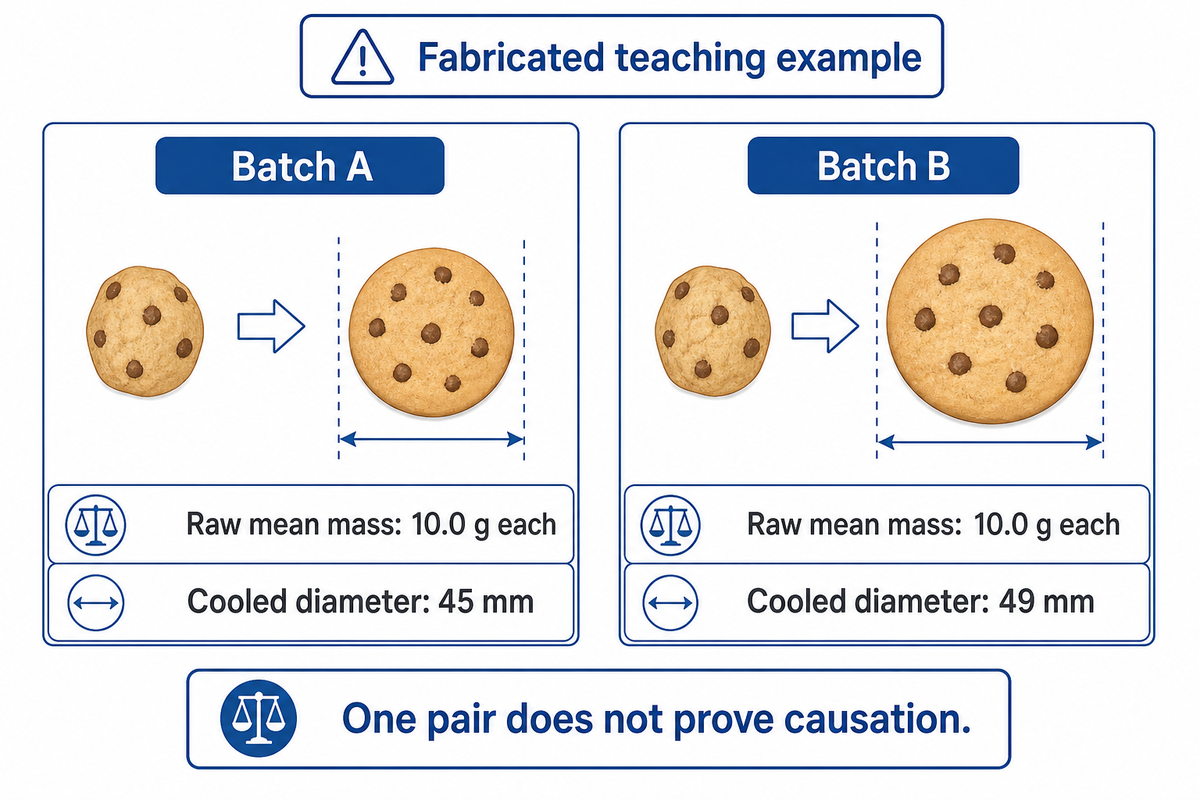
A cookie trial gives production the opportunity to articulate the change, and quality the ability to replicate the measurement. Procurement needs to understand the limits of the demonstration. The 2-Batch Controlled Trial is a good starting point to record a physical quality comparison and repeated trials for stronger evidence if a decision hinges upon it.
| Record | Batch A | Batch B | Limitations / interpretation |
|---|---|---|---|
| Recipe and ingredient lots | Same recorded recipe | Same lots as A | No ingredient-change claim can be tested here |
| Dough temperature at forming | 22°C | 22°C | Illustrative observation, not a target |
| Recorded holding time | 10 min | 10 min | Does not test longer hopper residence |
| Raw-piece mean mass | 10.0 g | 10.0 g | Means can hide piece-to-piece variation |
| Raw-piece mean diameter | 35 mm | 35 mm | Thickness and shape must also match |
| Raw-piece mean thickness | 8 mm | 8 mm | Use the same measurement method |
| Oven trial setting | Recorded baseline | One documented adjustment | No universal temperature is proposed |
| Cooled mean mass | 8.5 g | 8.4 g | Mass loss alone does not measure water activity |
| Cooled mean diameter | 45 mm | 49 mm | Compare with the agreed product tolerance |
| Cooled mean thickness | 7 mm | 6 mm | Width-to-thickness ratio changes too |
| Sampling | 20 pieces, same lane positions | 20 pieces, matching positions | Illustrative sample size, not capability validation |
All values in this example are fabricated teaching values. The measurement choices are derived from the cited cookie mixing experiment; none of its results is shown as a SINOFUDE trial.
Suppose a quality technician receives the two illustrative batches above. Raw mass and geometry match, but batch B finishes wider and thinner. The diameter increase is (49 – 45) / 45 × 100 = 8.9%. That’s a diameter comparison, not an increase in area or saleable output. Production can now repeat the documented oven adjustment while checking if the other documented conditions remain stable. Procurement should check if the wider cookie still fits in the intended pack and target bite. Finance needs reject and giveaway measurements before assigning a saving. The example narrows the next experiment; one matched pair doesn’t prove the oven adjustment caused all the observed differences.
Establish the physical acceptance limits before evaluating trial results. The comparison sheet doesn’t validate the shelf life or the baking process’s microbial lethality. Make those assessments as part of the bakery’s product specific validation. A machine demonstration and finished-product release decision require different levels of assurance.
Matching two raw means of 10.0 g removes only one obvious difference. Keep individual measurements, lane positions and the full result distribution. A buyer can’t judge sustained consistency with two averages, and a supplier should have the opportunity to repeat a favorable result under the intended operating conditions.
Connect Dough, Oven and Packing Conditions on a Biscuit Production Line
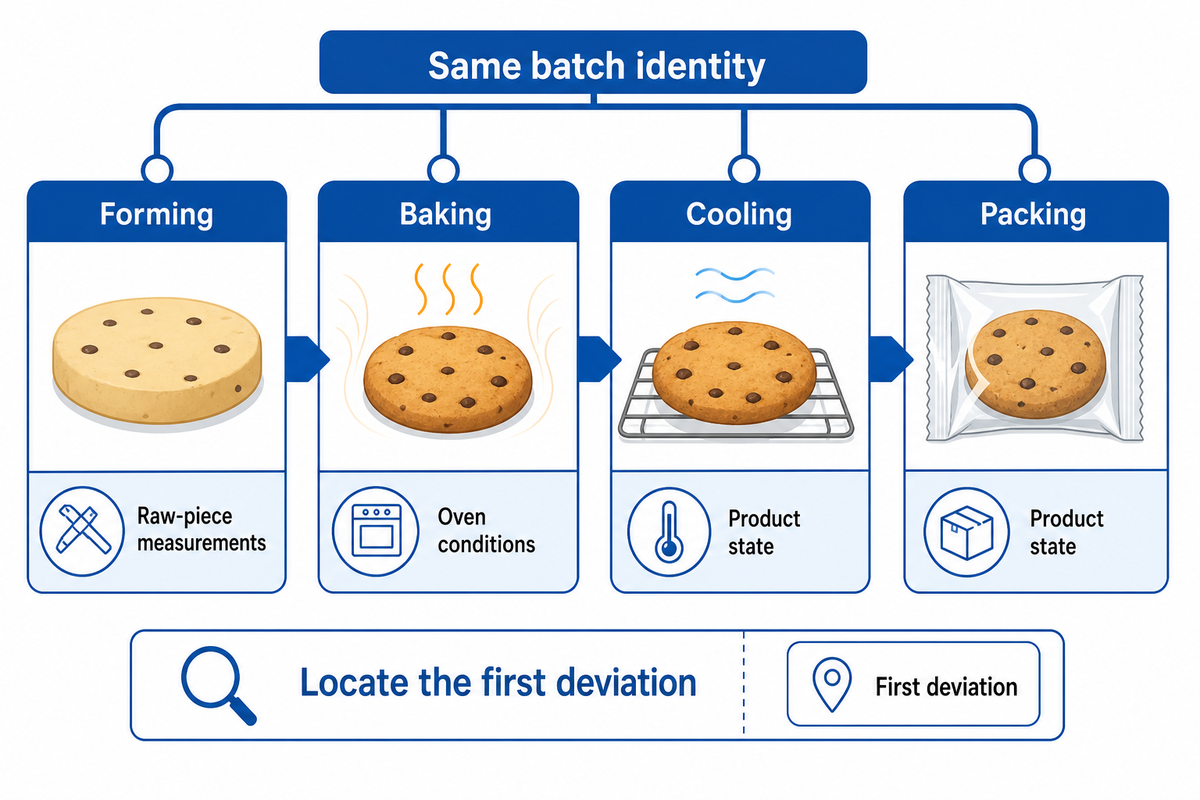
Connected biscuit production lines:
traceable conditions are required between stages because an upstream change can appear as a downstream defect. Batch identity is preserved through forming, baking, cooling and packing. A useful record connects the recipe and dough age with raw-piece measurements, oven conditions and the state of the product entering the wrapper.
A delayed hopper refill can change dough residence time; changed spacing can alter oven loading; a fragile cooled cookie can fail at transfer. Record where the first deviation occurs. Adding machinery at the end of the line can’t automatically resolve a problem that occurred earlier.
SINOFUDE’s biscuit production lines range covers several product routes. A hard biscuit line and a soft biscuit production line should be discussed through their intended dough and forming process, not treated as interchangeable because both make biscuits.
When sending SINOFUDE samples, include the target product, inclusion details, the observed defect and comparison measurements. State the unresolved process question. Measurements will allow the machinery discussion to begin with the cookie the factory needs to make.
Discuss a cookie process trial
Frequently Asked Questions
What are the three types of biscuits?
Biscuit classifications vary; a three-type list needs a stated context.
Consumer lists may group biscuits by texture, recipe or preparation method. Industrial discussions often distinguish dough families and forming routes instead. For a manufacturing brief, describe the product’s dough behavior, shape and finished texture, then identify the required process. Do not assume that a familiar retail category specifies the equipment or its operating conditions.
How are biscuits made in a factory?
Factory biscuit production typically combines mixing, forming, baking, cooling and packing.
The detailed sequence changes with the product. A short dough may be rotary moulded or wire cut, while another dough requires sheeting and cutting. Ingredients, forming consistency and oven conditions influence the result. Quality checks should connect raw-piece observations with baked and cooled samples so defects can be traced to a stage rather than guessed from appearance.
Can one line make both hard and soft biscuits?
A shared line needs the equipment and operating range for both intended products.
Hard-dough sheeting and short-dough moulding impose different forming requirements. Shared baking or packing equipment does not establish that the full system can handle both recipes. Ask which modules, tooling and changeovers are required, then compare trials using representative doughs. The proposed combination should be judged against the actual products and the agreed quality measurements.
Is there one correct dough temperature for every cookie line?
Dough temperature targets must be established for the recipe and process.
Fat condition, formulation and holding history affect handling. Record temperature at a defined point and compare it with release, portioning and finished quality. A laboratory temperature or another bakery’s operating value is not a universal target for your machine.
Why can biscuits crack after they have been packed?
Delayed checking can develop as moisture redistributes within some crisp biscuits.
Internal moisture differences can create stresses after baking. Handling damage and packaging forces remain other possibilities, so record when and where cracks first appear. Retain matched samples before and after transfers and wrapping, with storage conditions recorded. Compare immediate chips with fine cracks that develop later. The cited low-fat experiment demonstrates checking under its tested conditions; it does not establish that every cracked cookie has the same cause or that one cooling adjustment will solve every case.
Does a darker cookie always contain less moisture?
Color alone cannot establish moisture across different cookie formulations.
Ingredients and baking conditions both influence browning. A useful color target needs to be checked alongside moisture and texture for the specific product. Keep water activity separate too; total moisture and available water describe different properties.
What should I send SINOFUDE for a useful cookie trial?
Send representative product samples, process observations and the question the trial needs to answer.
Describe the intended bite, size, inclusions and forming route if known. Include raw-piece and cooled-cookie measurements from the same batch, with photographs showing the defect and its location. Record when the problem appears and which variables have already changed. State the proposed acceptance criteria before the trial. Recipe details can then be discussed through the appropriate commercial process, while the comparison focuses on a defined production question rather than a general request for a better-looking sample.
References & Sources
- The Creaming of Short Doughs and the Quality of Rotary-Molded Biscuits, Molina and colleagues, 2021; formulation-specific experiment.
- Effect of Mixing Time on Properties of Whole Wheat Flour-Based Cookie Doughs and Cookies, Dhal and colleagues, 2023.
- Processing Parameters and Principal Ingredients in Sugar-Snap Cookies, Panghal and colleagues, 2018.
- Formulation, Baking Conditions and Browning in Biscuit Models, Leiva-Valenzuela and colleagues, 2018.
- Microwaves, Checking and Sensory Characteristics in Low-Fat Biscuits, 2025; Tables 4–5.
- Water Activity in Foods, FDA technical explanation; cited for the physical distinction from moisture content.
Published experiments inform the explanations. Trial worksheets and hypothetical scenarios are editorial teaching aids; they aren’t customer case histories or SINOFUDE performance data.