Get in Touch with SINOFUDE Company


An industrial hard candy cooking process is a controlled sequence that prepares a uniform sugar syrup, removes water under controlled heat and pressure, confirms a validated discharge state, and transfers the mass before temperature or moisture drift changes its forming behavior; hard candy temperature control is therefore bound to the route, sample, method, and transfer timing. It validates the cooking state and discharges the mass while the behavior of the forming mass hasn’t changed due to shifts in temperature or moisture levels. A hard-crack recipe that’s used at home differs from factory cooking because the factory can’t base its decision on one thermometer reading. There are a number of factors that influence what a thermometer reading means, e.g., formula, pressure, elevation, sample location, analytical method, calibration, and heat history.
Cooker discharge creates a controlled precursor for the next step in the process. Cooker discharge doesn’t indicate that cooled candy has reached its final glassy state or that it will satisfy the expectations for shelf life or has been cleared under the food safety plan of the facility.
Updated September 2026 · By XCX
Industrial scope: this guide does not prescribe a universal recipe, moisture target, cooking temperature, or release setpoint.
Why consumer candy terms do not define an industrial endpoint
A hard candy recipe, homemade hard candy recipe, or step-by-step guide may discuss how to make hard candies, making candy, candy making, a candy making process, candy making stages, or cooking sugar. Such a guide may name a saucepan, pan, cookie sheet, mold, granulated sugar, powdered sugar, corn syrup, sugar syrup, candy sugar, sugar mixture, sweetener, extract, flavoring, flavoring oil, food coloring, color and flavor, or various flavors.
Consumer candy stages include thread stage, soft ball, firm ball, hard ball, hard crack, and hard crack stage. Cold water test, water test, syrup dropped into cold water, dropped into cold water, brittle threads, bend slightly before breaking, and degrees Fahrenheit are home candy-making descriptions. Phrases such as use a candy thermometer, thermometer is essential, temperature stages, temperature of your sugar, highest temperature, medium heat until sugar dissolves, or without stirring don’t replace industrial method control.
Rock candy, lollipop, fudge, dessert, baked goods, chewy texture, perfect candy, create delicious, customize, flatten, form thin, form a solid, solidify, pieces and store, airtight container, freshness, avoid burns, grainy candy, and understanding candy or the science behind candy describe other intents. Confectioners may use them, but a factory still needs route-specific evidence, including at higher altitudes or a stated number of feet above sea level.
- Prepare: verify the formula, ingredients, charge, and syrup condition.
- Concentrate: remove water through the selected cooker route.
- Verify: interpret temperature, composition evidence, pressure, and time together.
- Transfer: control additions, discharge, and the immediate handoff to forming.
Industrial Hard Candy Cooking Is a Controlled Concentration Process
Cooking removes water and prepares the candy mass for the later glass-forming cooling step. In industrial practice, discharge means that a defined formula has reached a method-bound state under recorded pressure, time, sampling, and instrument conditions. It does not mean that a syrup simply touched a familiar temperature.
As water volatilizes from the mass, the sugars become more concentrated and the mass behaves in a different manner. Either a candy thermometer or a fixed sensor can track that change, but its reading remains a process indicator until it is connected to a validated recipe, known pressure, identified measuring point, and suitable composition test. Product-quality evidence and food-safety release are separate decisions.
The 2024 peer-reviewed hard-candy review describes heating followed by cooling to obtain the final glassy matrix. That sequence is why this guide treats cooker discharge as a precursor state, not as proof that the cooled candy is brittle, glassy, and stable.
Control boundary
Process indicator ≠ product proof. Only the formula, method, pressure, sampling, and calibration conditions that gave a cooker reading meaning can support its discharge decision.
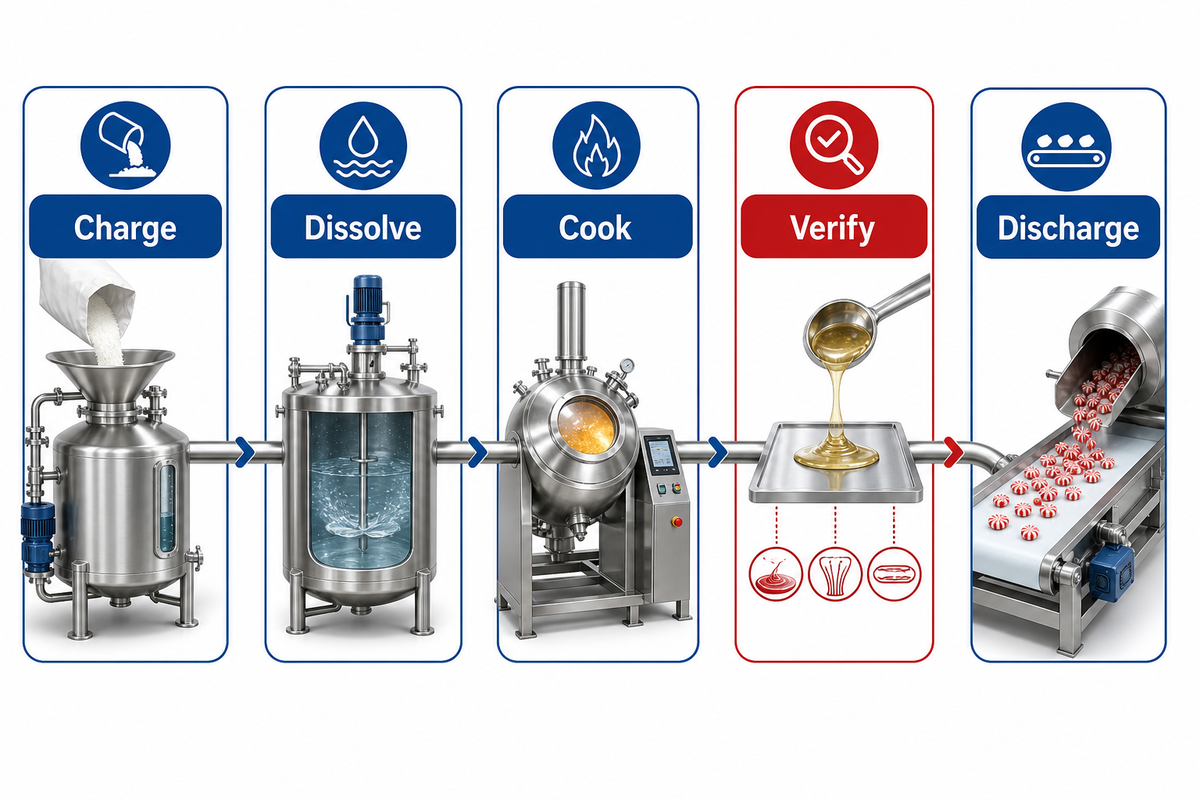
Process map: from ingredient charge to cooker discharge
The control chain starts with a released formula and acceptable ingredients. Sugar, syrup, and water are charged and dissolved by the validated method; filtration or preheating is included only where the line design calls for it. The feed then enters the selected batch or continuous cooker, where evaporation is controlled and endpoint evidence is collected at a defined location.
After the discharge decision, flavors, acids, or colors can be added according to the recipe. The mass then is transferred to the forming operation under the controlled timing and temperature. The University of Michigan process overview presents this preparation, cooking, post-cook mixing, tempering, and forming as one representative arrangement, not a spec for each line.
Charge
Formula and lots
Formula and lots
Dissolve
Syrup condition
Syrup condition
Cook
Heat and pressure
Heat and pressure
Verify
Method-bound evidence
Method-bound evidence
Discharge
Controlled handoff
Controlled handoff
Before the Cooker: Dissolve the Syrup Without Seeding Crystals
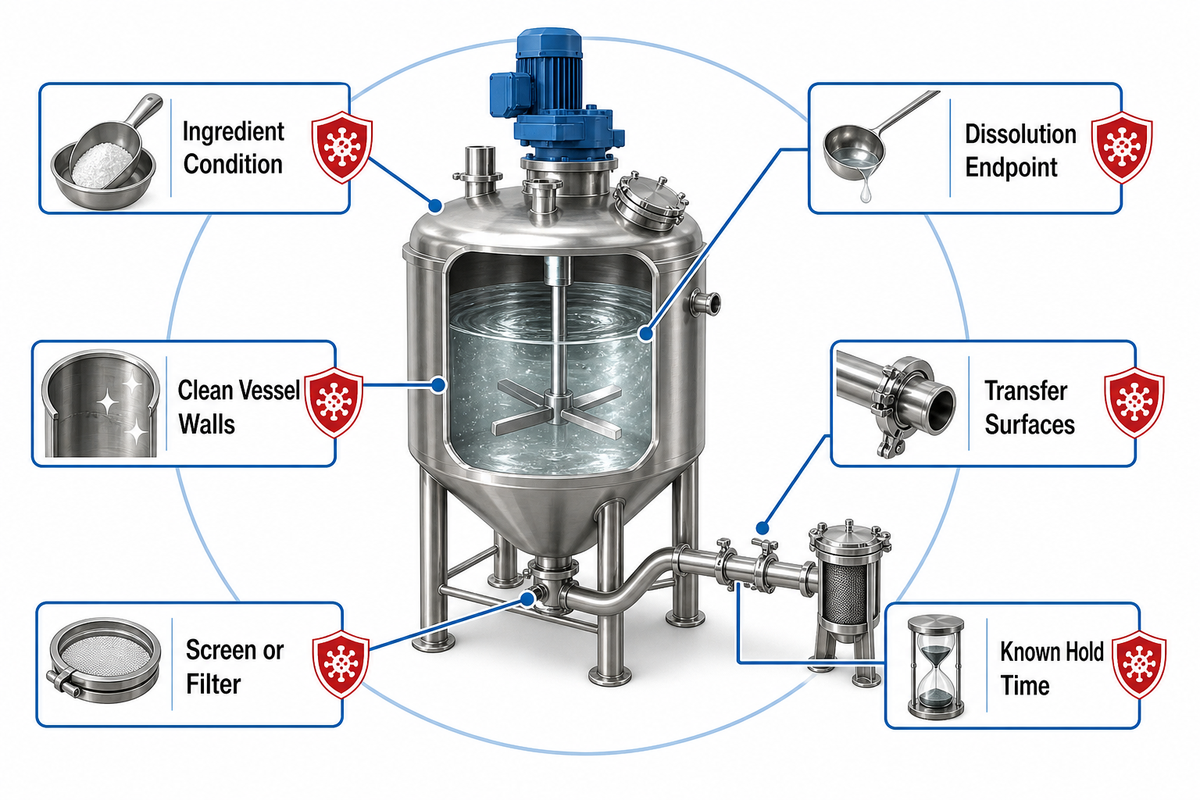
Complete, repeatable dissolution decreases one controlled route to later graining, i.e., undissolved sugar, dry particles, or wall deposits can supply crystal nuclei. Formula balance, holding history, and later moisture exposure can still promote crystallization even when no visible seed was found at the dissolver.
Freeze the ingredient order and final charge before making the comparisons. Consider the condition of dry sugar, syrups, water addition, vessel wall, transfer pathway, and any screens or filters designed into the system. Uncontrolled agitation, scraped deposits, or long and hot holds can affect the starting material delivered to the cooker. These conditions should be recorded as deviations.
Glucose syrup and other interfering sugars can change crystallization behavior, but the useful amount depends on the formula and desired product. No syrup family can be promised to prevent graining in every recipe. The PubMed-indexed sucrose study also shows that absorbed water can increase molecular mobility and promote crystallization from an amorphous state.
Evidence capsule: The review reports low-moisture hard candies at approximately 2% to 3% in the glassy state, but their table provides other ingredient data and temperature and testing data. This data should be considered as literature data and not as a pillar for setting the SINOFUDE machine or as a desired end point.
Crystal-seed risk checklist
- Ingredient identity, condition, and actual charge
- Documented dissolution endpoint for the recipe
- Clean vessel walls and transfer surfaces
- Defined screen or filter status where the design includes one
- Known hold time before the cooker
- Separate review of later moisture pickup and storage conditions
Choose the Cooking Route Before Choosing a Setpoint
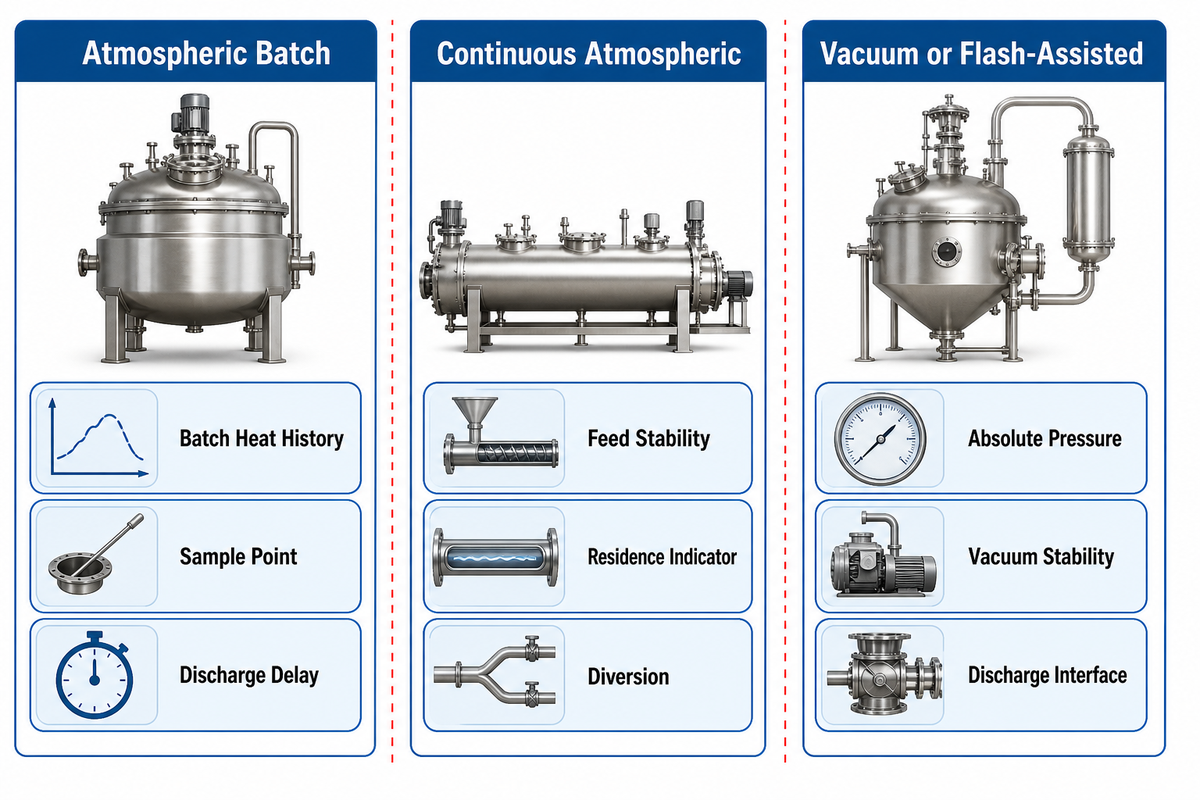
Choose the cooker pathway before moving any setpoint. Atmospheric batch, continuous atmospheric, and vacuum and/or flash assisted systems subject the mass to dissimilar pressure, residence, startup, shutdown, and discharge conditions. Copying a temperature between those routes may compare a different concentration history and a different sample.
| Route | Process context | Evidence to capture | Buyer questions |
|---|---|---|---|
| Atmospheric batch | Batch heat history near local atmospheric pressure | Charge, time, temperature, sample point, discharge delay | Batch basis, heat source, operator steps, cleaning |
| Continuous atmospheric | Metered feed and continuous concentration | Feed stability, residence indicator, endpoint signal, diversion | Turndown, startup material, interface stability |
| Vacuum or flash-assisted | Water removal under reduced pressure or after pressure release | Absolute pressure, temperature, time, method result, vacuum stability | Vacuum source, condenser, entrainment, discharge interface |
Changes in pressure affect the boiling relationship, but neither equalize all formulas nor make vacuum optimal in all cases. Decisions on process routes should include consideration for feed stability, history of residence, startup material, ease of cleaning, entrainment, and the condition of the next machine. Nameplate cooker rate doesn’t mean sellable finished-line output.
Evidence capsule: A 1967 third-party continuous cooker patent describes a short heated passage followed by an atmospheric flash discharge. The patent indicates that this construction was disclosed. The patent doesn’t speak to best practice or superior performance or the architecture being owned by SINOFUDE.
A Cooker Endpoint Needs Four Kinds of Evidence
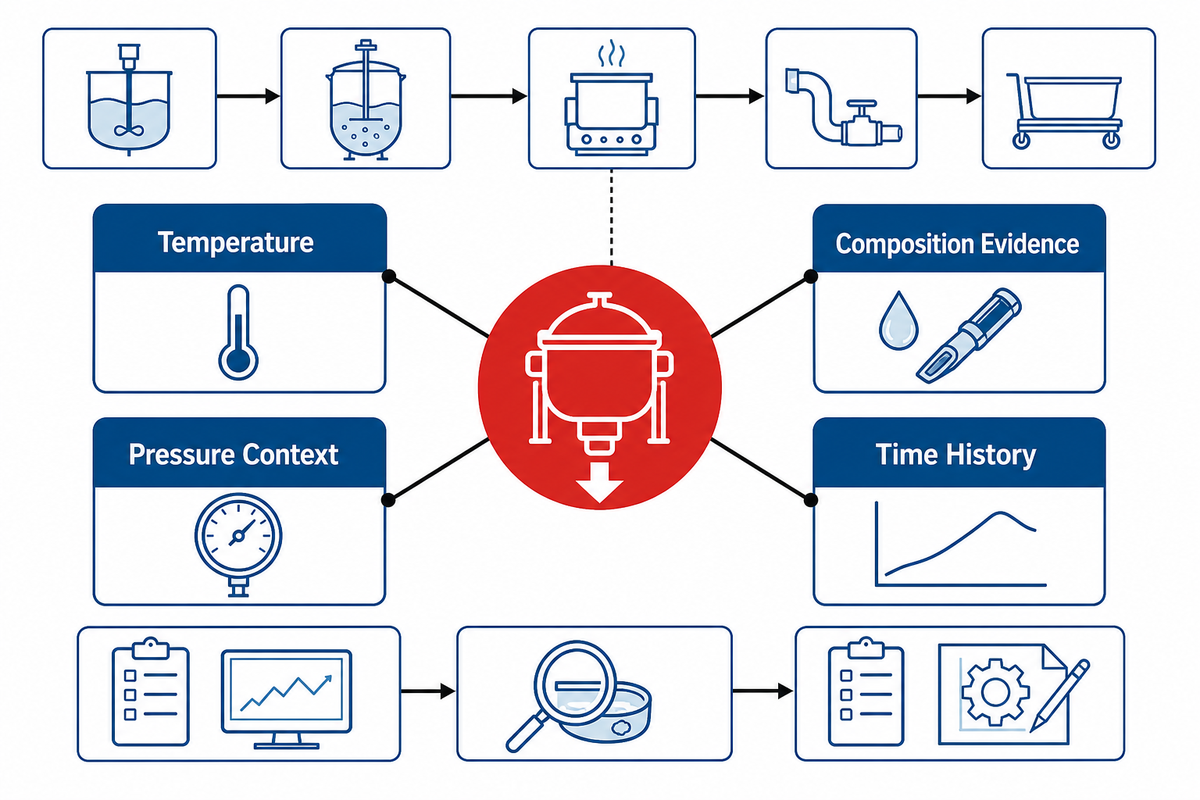
A defensible discharge decision combines four evidence families: temperature at a defined point, matrix-appropriate composition evidence, pressure context, and time history. Each value must retain its method and sampling basis. The stack supports a validated cook endpoint, but it does not by itself prove final glass formation, shelf stability, or food-safety release.
1. Temperature
Calibrated instrument, defined location, working range, and time of reading.
2. Composition evidence
Named moisture or refractometric method, formula basis, sampling, and calibration.
3. Pressure context
Atmospheric pressure, absolute vacuum, and relevant elevation.
4. Time history
Batch time, residence indicator, vacuum history, and discharge timing.
12-Context Published Number Map
Published numbers can test the logic of a control plan, but each number keeps its original formula, method, and purpose. This map prevents a literature example from silently becoming a factory setpoint.
| Evidence category | Published number | Permitted use here |
|---|---|---|
| Review context | 2% to 3% moisture | Common glassy-state context, not a target |
| Jaggery formula | 140°C to 142°C | One formula in the review table |
| Milk candy formula | 118°C to 130°C | Formula-specific comparison only |
| Sucrose-free formula | 170°C | Different ingredient system |
| GOS glass formula | 153°C | Study condition, not line release |
| Sea-level water | 212°F | Pressure relationship example |
| Elevation effect | 1°F per 500ft | Counterexample to transferability |
| Extension example | 202°F at 5,000ft | Household illustration only |
| Extension adjustment | 2°F per 1,000ft | Not an industrial release rule |
| Cooling study | 35.36±1.48°C to 36.37±1.63°C | Measured glass-transition range for that formula |
| Cooling study | ≤34°C | Study-specific cooling exit, not cooker discharge |
| Historical patent | 40s to 120s; 320°F to 350°F; about 20% to below 2% | Architecture history, not a current claim |
Refractometric dry substance, measured moisture, and water activity aren’t synonyms. The International Commission for Uniform Methods of Sugar Analysis definition calls refractometric dry substance an approximate determination and ties its calculation to solution composition. State the actual method, the formula or matrix revision, the sample’s treatment, the calibration, and the basis of the report.
This is important far from a vacuum vessel as well. According to the Colorado State University Extension, water’s boiling point is reduced approximately 1°F for every 500 ft of elevation, and they provide a household example. This is a clear example of why a temperature is not universal, yet it isn’t an industrial release requirement.
- Where is temperature measured, and when is the value captured?
- Is the instrument calibrated across its working range?
- Where is the composition sample taken, and how is it handled?
- Does the result guide process adjustment, quality release, or both?
- How are startup, diverted, and off-spec materials identified?
Evidence capsule: A 2024 formulation study measured total soluble solids and water activity separately and reported that the glass-transition behavior was altered by the addition of glucose or fructose syrup. The time-domain nuclear magnetic resonance work is analytical evidence and can’t be used to establish inline control.
Residence time and heat load change the mass
Two runs may end at similar measured temperatures, but have differing heating rates, hold times, wall exposure, and pressure histories. These may influence color development, flavor retention, sucrose inversion, and/or specific chemical degradation of the formula. These effects can’t be assessed based on the operator’s experience; they must be evaluated based on experimental data and process records.
Same finish temperature, different heat history
Compare feed condition, heating rate, residence or hold time, hot-surface contact, pressure trace, sample location, and discharge delay. Continuous-feed stability and batch-charge consistency are part of that comparison.
Add Acids, Flavors, and Colors Inside a Bounded Post-Cook Window
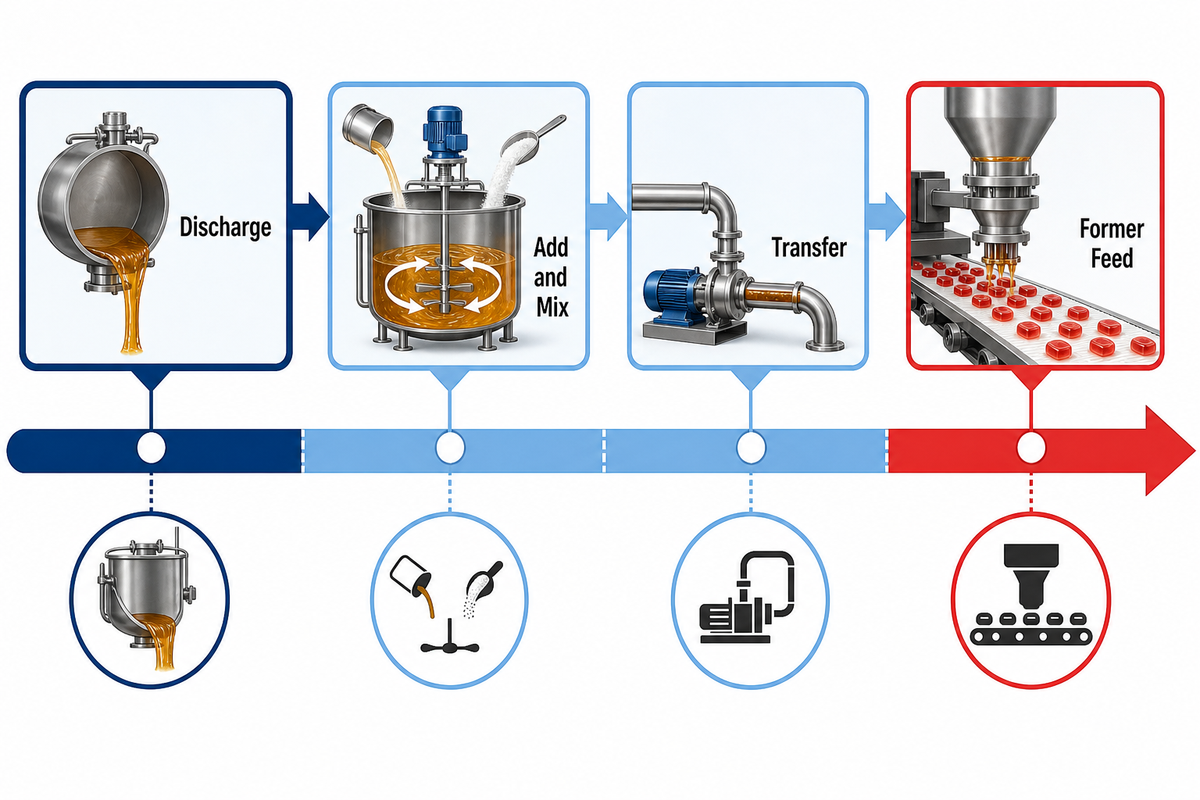
Post-cook additions require mixing to ensure consistent distribution and minimal exposure to heat. The range of time available is dependent on the formula and ingredients, the mixing equipment, the discharge condition, and the formation interface. It should be established in trials and acceptance records, not cited as a universal addition temperature.
Record addition sequence, dose verification, mass temperature at addition, mixing condition, and time to forming. Factors like flavor volatility, color stability, and the effect of acid, and the level of mixing energy, have to be considered on a case by case basis. A weak flavor result doesn’t warrant an increased dose before the hot-hold history and distribution record are reviewed.
Quality control systems shouldn’t replace a hazard analysis.
For U.S. facilities subject to 21 CFR Part 117, exposed addition and transfer events should be addressed within the facility-specific analysis of known or reasonably foreseeable hazards.
Bounded window, not a temperature prescription
Start with the validated discharge condition. Record addition order, dosing evidence, mixing, post-mix condition, and delay to forming. Investigate any drift before changing more than one validated variable.
The cook-to-form transfer is part of cooking control
The post cook mixing, an intervening hold designed to be stable, transfer, and a stable feed into the depositor or former is captured by the transfer clock and begins upon discharge from the cooker. Evidence should expose uncontrolled cooling, moisture pickup, excessive holding, unstable feed, and ambiguous remelt or rework handling. It ends at the forming interface, and later cooling and packaging are part of the broader manufacturing process.
Discharge
clock starts
clock starts
Add and mix
dose and condition
dose and condition
Transfer
time and exposure
time and exposure
Former feed
stable handoff
stable handoff
For facilities subject to the rule, 21 CFR 117.130 states: The hazard analysis must be written regardless of its outcome.
Build a Batch Record That Can Explain Drift
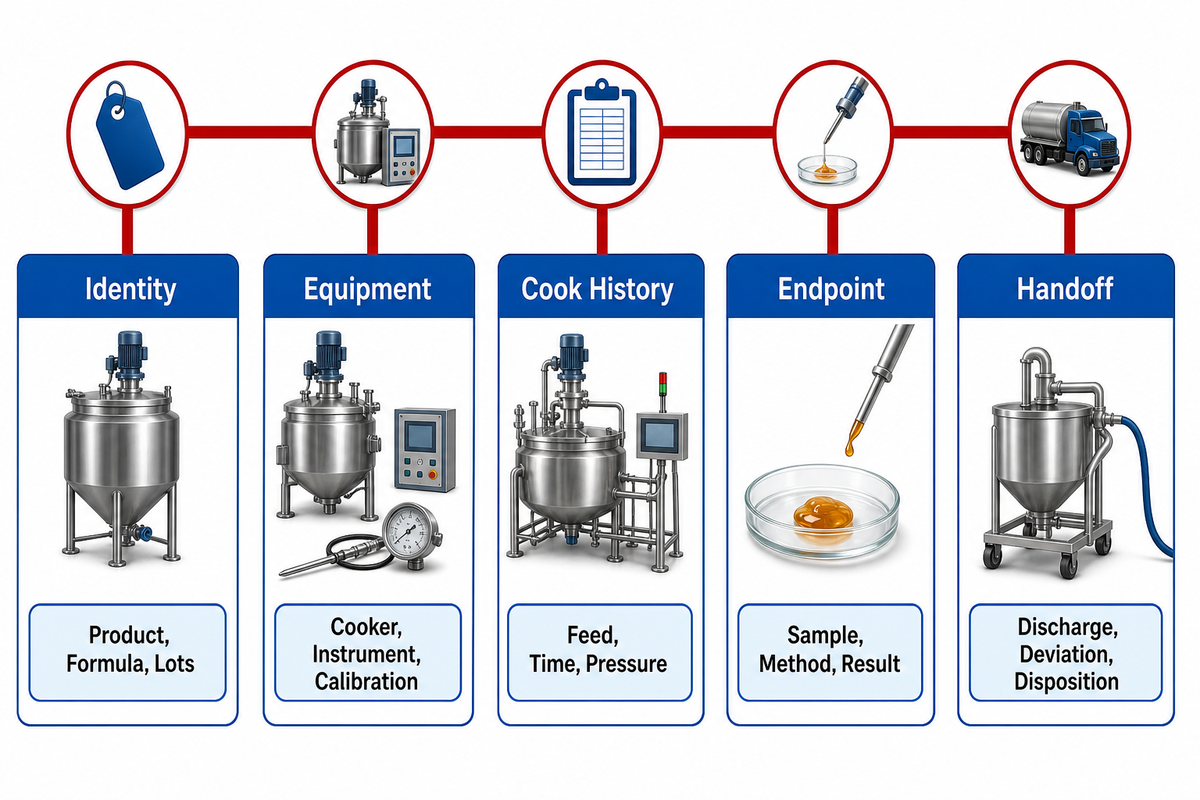
A good batch record should include what entered the process and what the cooker experienced, how the endpoint was measured, and what happened at discharge. It has to consist of the revision of the formula, the lots and charge of ingredients, equipment, status of instruments and their pressures, time or feed evidence, the method of sampling, additions, transfers, deviations, and the disposition.
| Record group | Minimum useful fields | Question it can answer |
|---|---|---|
| Identity | Product, formula revision, lots, actual charge | Was the same material basis used? |
| Equipment | Cooker route, identifier, instrument, calibration status | Can readings be compared? |
| Cook history | Feed, time, residence indicator, pressure or absolute vacuum | What heat and evaporation context occurred? |
| Endpoint | Sample location, method, result, time | What supported discharge? |
| Handoff | Discharge, additions, transfer, deviation, containment, disposition | Where did the run diverge? |
For applicable U.S. food operations, food-production equipment and utensils must be adequately cleanable and maintained under 21 CFR 117.40(a)(1). Section 117.40(f) separately applies its accuracy, precision, maintenance, and adequate-number requirements to instruments and controls used for measuring, regulating, or recording conditions that control or prevent the growth of undesirable microorganisms in food. These provisions do not prescribe a candy recipe, alloy, brand, or machine model.
Evidence capsule: The regulation refers to temperature, pH, acidity, water activity, and other designated controls. In contrast, hard-candy studies use composition and glass state. A plant record must state the quantity actually measured and not simply rename one result as another.
Troubleshoot Cooking-Stage Defects Without Guessing
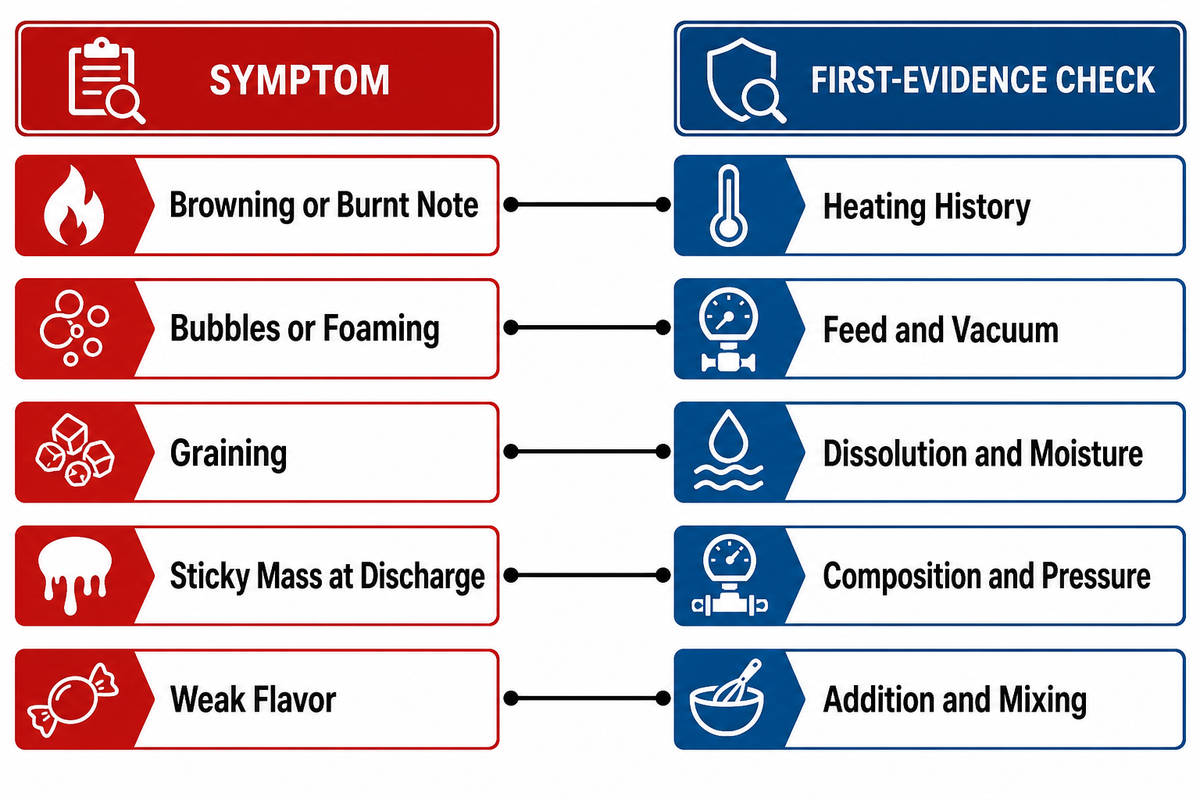
Troubleshooting starts with containment and a preserved record, not an immediate setpoint change. Verify the instruments, compare the affected cook with a known stable run, and separate formula, dissolution, heat history, pressure, endpoint sampling, post-cook additions, and transfer. Change one validated variable at a time so the result remains interpretable.
| Symptom | Evidence to review first | Avoid assuming |
|---|---|---|
| Browning or burnt note | Heating rate, wall exposure, residence or hold time, formula change | Finish temperature is the only cause |
| Bubbles or foaming | Feed condition, vacuum stability, entrainment, mixing, discharge | More vacuum always fixes it |
| Graining | Dissolution, deposits, formula revision, hold and moisture history | One syrup always prevents crystals |
| Sticky mass at discharge | Composition result, method, pressure, sample location, delay | Room humidity is always the source |
| Weak flavor | Addition order, mass condition, mixing, time to forming | Simply increase the flavor dose |
Do
- Contain and identify affected material
- Preserve raw readings and samples
- Check instrument and sample basis
- Compare one known stable run
Do not
- Change several variables at once
- Treat appearance as endpoint proof
- Assume one defect has one cause
- Release food outside the facility plan
The cooling-stage boundary continues to hold significance when reaching a diagnosis. A peer-reviewed hard-candy cooling study establishes a connection between glass formation and cooling in a range below the glass transition. The value obtained in the study represents the tested honey-flavored formula and can’t be extrapolated as a cooling or cooker value for all cases.
Turn the Product Brief Into Cooker and Line Requirements
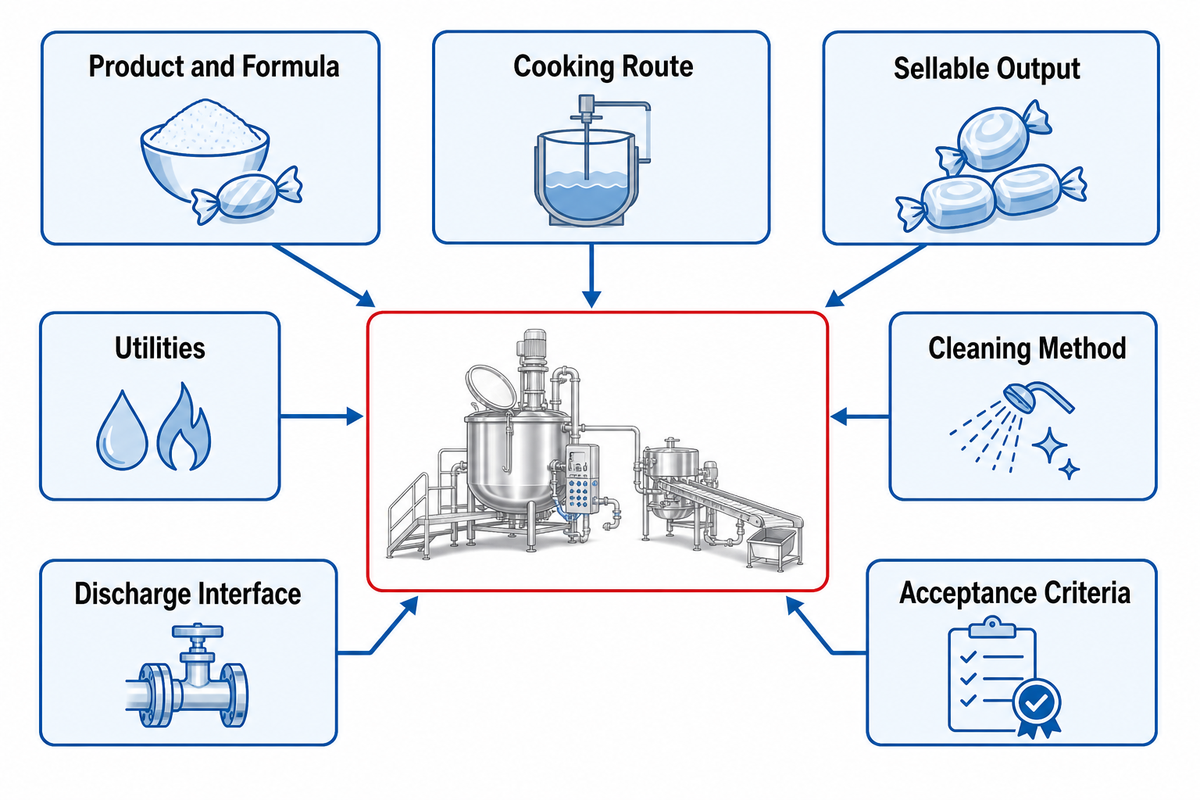
The scope of the equipment request defines the range of product and formula, the validated cooker route, output basis, utilities, cleaning expectations, discharge interface, sampling method, and acceptance criteria. It separates sellable output from catalog throughput and states planned losses, changeovers, startup handling and the allocation of responsibilities for trials and release.
- Product format and formula range, including alternative sweetener systems
- Required cooking route and the evidence behind that choice
- Sellable-output basis, operating time, planned losses, and changeovers
- Heat, power, water, compressed air, and vacuum utilities available
- Cleaning method plus allergen and changeover expectations
- Cooker discharge condition and forming-system interface
- Trial materials, sample method, acceptance criteria, witnesses, and records
Compare all proposals using the same boundary. One supplier may state cooker feed while the other states wrapped product, or one may exclude startup and changeover material. Normalize those definitions before cost, floor space, and utility discussions.
In order to compare equipment families without making this guide a catalog, analyze hard candy machine configurations and line interfaces. SINOFUDE is the equipment company and consultation service; a specific model’s performance still needs a formula, utility, output, trial, and acceptance basis.
Bring evidence, not just a target rate
Prepare the formula range, cooker route, utilities, discharge interface, expected operating pattern, cleaning method, and test plan for a useful configuration discussion.
Frequently Asked Questions
What is the hard candy cooking process in an industrial line?
Industrial cooking verifies the formula, dissolves a uniform syrup, removes water through a defined cooker route, checks a method-bound endpoint, and transfers the discharged mass to post-cook mixing and forming. Its evidence remains tied to the formula, pressure, sample, method, and time. The full line continues into forming, cooling, wrapping, and storage.
What temperature is hard candy cooked to?
Published hard-candy studies report different cooking conditions, often within roughly 135°C to 160°C for their specific formulas, but that range isn’t a release instruction. Formula, atmospheric pressure or vacuum, elevation, sensor location, calibration, composition method, and heat history change the meaning of temperature. A plant should establish its own validated endpoint evidence and keep the method and sample basis attached to every result.
Why does hard candy crystallize during or after cooking?
Possible contributors include incomplete dissolution, dry particles, vessel-wall deposits, formula balance, uncontrolled agitation, holding history, and later moisture exposure. A visible seed can start nucleation, but it isn’t the only route. Water can plasticize an amorphous sugar matrix, increase molecular mobility, and support later crystallization, so an investigation must cross the cooking, transfer, cooling, and storage boundaries.
What is the difference between atmospheric and vacuum cooking for hard candy?
Atmospheric cooking removes water near the local atmospheric pressure, while vacuum cooking lowers pressure and changes the boiling relationship. That difference may alter temperature, residence, entrainment, startup, and discharge histories, but it doesn’t make vacuum automatically better. Compare absolute pressure, feed condition, residence evidence, analytical endpoint, vacuum stability, condenser duty, cleaning access, startup diversion, and the receiving interface under the same formula and output basis. Then test the proposed route with representative materials and an agreed sampling plan. Record stable operation plus startup, shutdown, and a planned changeover, because a short demonstration can hide the material and time losses that determine sellable output.
What records should a factory keep for each hard candy cook?
Keep the product and formula revision, ingredient lots and charge, cooker and instrument identifiers, calibration status, local pressure or absolute vacuum, feed or time history, endpoint sample location, analytical method and result, discharge time, post-cook additions, and transfer event. Also record deviations, containment, rework rules, and final disposition. The exact record must follow the facility’s validated process, quality system, and hazard analysis.
References and Sources
- Current advances and challenges in hard candy production: a review, Open Research Europe, 2024.
- Hard Candy, University of Michigan Visual Encyclopedia of Chemical Engineering Equipment.
- Correlation of low field nuclear magnetic resonance relaxation with composition and glass transition of hard candies, Frontiers in Food Science and Technology, 2024.
- Refractometric dry substance content, ICUMSA.
- 21 CFR 117.130, Hazard analysis, Electronic Code of Federal Regulations.
- 21 CFR 117.40, Equipment and utensils, Electronic Code of Federal Regulations.
- Crystallization of amorphous sucrose and its inhibition by polymeric additives, PubMed.
Key takeaway
The best hard candy cook is not the one that copies a familiar temperature. It is the one that prepares a repeatable syrup, concentrates it through a defined route, verifies a method-bound endpoint, and transfers the mass with enough evidence to explain the next result.
Prepare, concentrate, verify, and transfer form one evidence chain. Bring the product, formula range, utility constraints, output definition, discharge interface, and acceptance plan to the equipment discussions, so that all the proposals address the same production issue.