Get in Touch with SINOFUDE Company

Confectionery Equipment Cleaning: A Risk-Based Factory Guide

Confectionery equipment cleaning is a defined process for removing product residue and achieving a safe line release. The cleaning route within a confectionery manufacturing process changes with soil type, food-contact zone, surface, moisture tolerance, access, allergen concern, product quality, and the evidence required for each target contaminant; the cleaning equipment and any removable tray also need a defined inspection path before production resumes.
1. ClassifyIdentify the residue, zone, hazard, and hard-to-reach surfaces.
2. ControlSecure energy, product, people, chemistry, and nearby equipment.
3. CleanUse the approved dry, controlled-wet, out-of-place, or in-place route.
4. ReleaseInspect, test, correct failures, document, and obtain authorization.
Effective procedures begin with a specific question: what needs to be removed from which surface, and what evidence satisfies the objective? In food processing, this decision is critical as it impacts the safety and quality of food. Using a cleaning machine or a generic cleaner doesn’t prove that a tray, belt, or other surface is free of the target contaminant.
“All food-contact surfaces … must be cleaned as frequently as necessary to protect against allergen cross-contact and against contamination of food.”
Scope note: United States Food and Drug Administration, federal regulation, and Occupational Safety and Health Administration sources below apply within their own legal scope. They provide useful control principles, but this article is not worldwide legal advice or a substitute for a machine manual.
What Is Confectionery Equipment Cleaning?
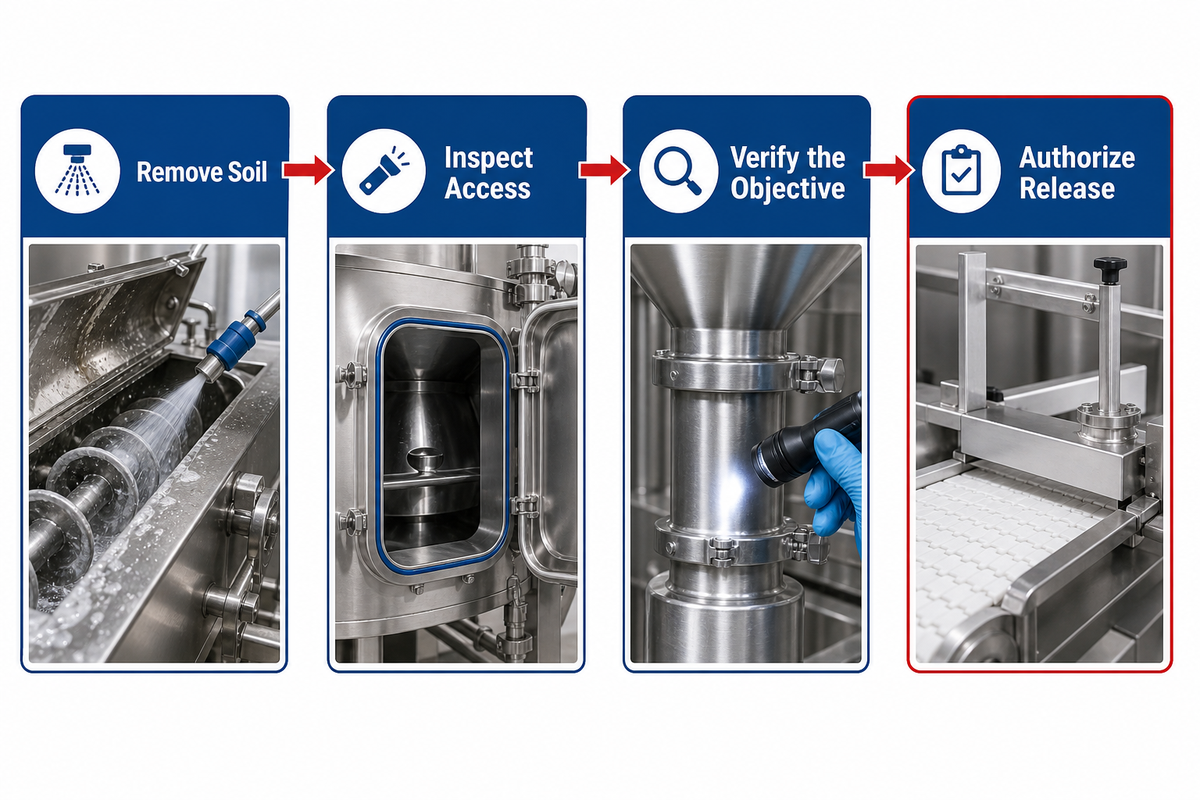
Cleaning involves the removal of food soil and residue from equipment, a baseline aligned with the sanitary-operations rule. This can include the removal of sugar, fat, powder, allergens, and other soils. The equipment is inspected, then dried or drained to its specified safe and acceptable condition. The equipment is then reassembled safely, checked against the plant’s acceptance basis, and released by its designated owner.
CleanWas the approved soil-removal procedure completed?
InspectAre target surfaces accessible and visibly acceptable?
VerifyDoes the selected test answer the stated hazard question?
ReleaseDid the authorized owner review failures, records, and guard restoration?
Soil removal is the primary concern. Sanitizing applies a defined treatment when the approved program requires it. Validation or technical qualification establishes what a procedure can achieve. Routine verification checks a particular execution.
Key takeaway: A clean-looking machine is not automatically sanitized, verified, or ready for production. Each word marks a different decision.
Classify the Residue, Zone, and Risk Before Choosing a Method
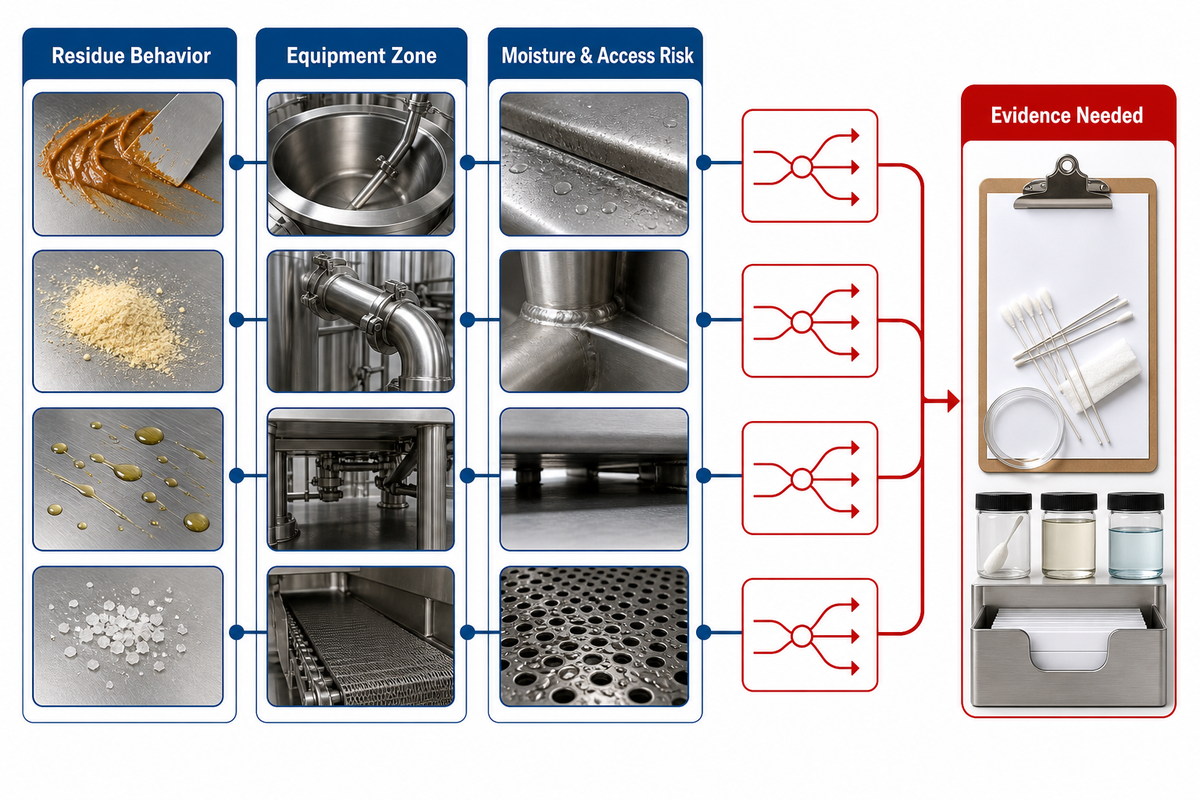
The residue type and location should drive the original selection of cleaning method. Cooked sugar film, cocoa-butter layers, starch dust, dairy residue, and nut-containing soil can behave very differently on a polished contact surface, on a belt return, at valve seats and electrical boundaries, and in inaccessible joints.
| Residue or condition | Zone and behavior | Starting route to assess | Release evidence | Limitations / not suitable for |
|---|---|---|---|---|
| Cooked sugar film | Food-contact; hardens as moisture and temperature change | Approved controlled-wet or removable-part route | Full-surface inspection plus site check | Do not add water near unprotected electrical or moisture-sensitive areas |
| Hard sugar deposit | Crevice, edge, or heat-transfer surface | Authorized disassembly and approved mechanical removal | Access check after parts are open | Force can scratch a food-contact surface or damage a seal |
| Chocolate or fat film | Pipe, valve, conche, belt, or holding surface | Qualified purge, scrape, flush, out-of-place, or wet route | Target residue or allergen evidence | One geometry’s purge result does not transfer to another |
| Dairy-containing residue | Direct contact and downstream transfer points | Allergen-cleaning procedure for milk protein | Representative, protein-relevant plan | Adenosine triphosphate is not milk-specific |
| Nut or sesame residue | Joints, fabric, plastics, containers, and tools | Contained removal plus material-specific cleaning | Allergen-specific evidence where required | Visual cleanliness can miss residual protein |
| Starch or powder dust | Dry zone, ledge, guard, or adjacent surface | Filtered vacuum and controlled tools | Zone inspection and site-approved test | Compressed air can redistribute dust |
| Color or flavor carryover | Food-contact path and dead ends | Changeover procedure tied to the next product | Appearance, sensory, or specified analytical basis | Appearance alone may not answer an allergen question |
| Conveyor transfer residue | Belt top, underside, scraper, roller, and return | Authorized belt-access and cleaning route | Both product and return sides inspected | Cleaning only the visible belt face leaves transfer points unchecked |
| Seal, joint, or valve-seat residue | Difficult access with reassembly risk | Part-controlled removal or engineered in-place cycle | Part accountability and post-assembly check | Do not open pressure, heat, or energy boundaries without authorization |
Stop and check: Tools, utensils, part bins, gloves, footwear, reused solution, compressed air, and high-pressure overspray can move residue after the fixed surface looks clean. FDA allergen-cleaning guidance warns that air, spray, and reused cleaning solution can spread or reintroduce allergenic material.
Key takeaway: The matrix routes a question; it does not issue a chemical recipe. Surface compatibility, concentration, temperature, pressure, and contact time must come from approved labels and machine and site procedures.
Choose Dry, Controlled-Wet, COP, or Documented CIP Cleaning
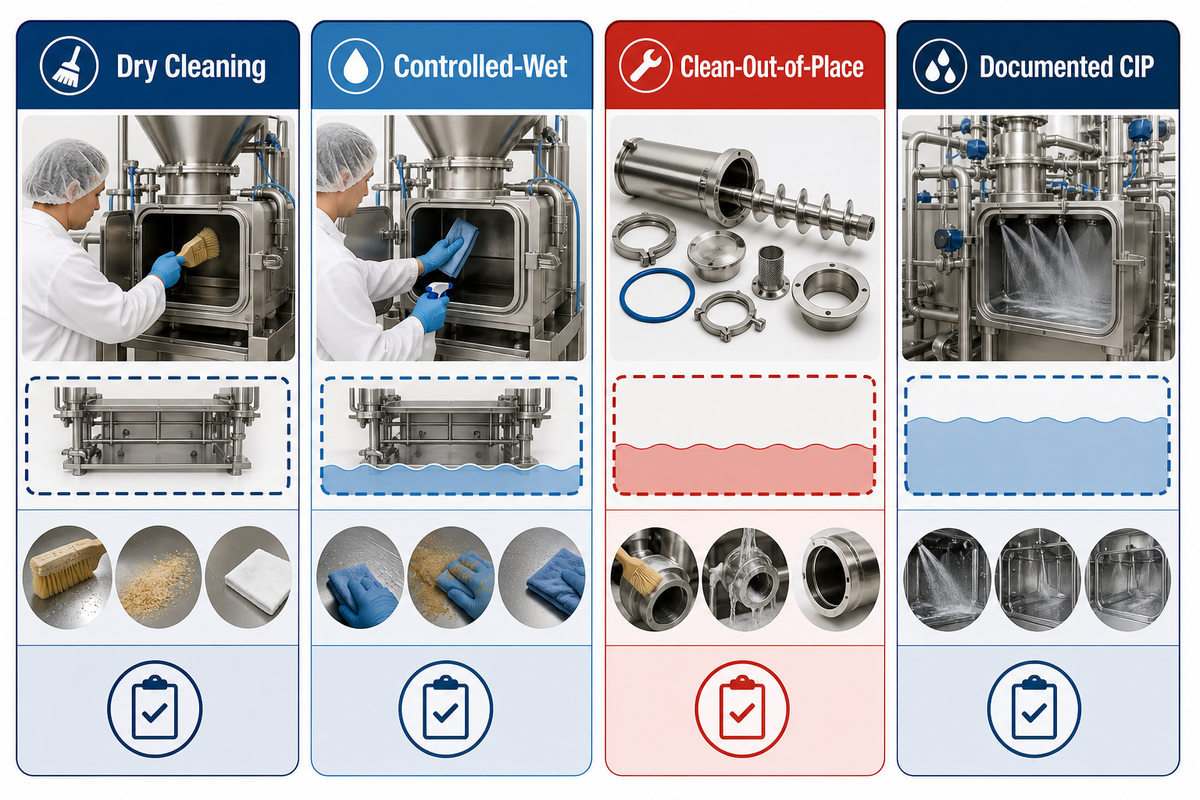
Dry, controlled-wet, clean-out-of-place, and clean-in-place cleaning address different access and soil removal issues. A chocolate production line still needs a component-level residue and access brief; the product-page route is not a cleaning instruction. The right method contains residue without spreading it, harming the equipment, trapping moisture, endangering employees, or creating false confidence that an automated rinse equals an engineered in-place circuit.
Dry cleaningVacuuming, scraping, brushing, pigging, or another qualified route without intentionally adding water.
Controlled-wet cleaningLocalized liquid use with containment, compatibility, rinsing where required, and complete drying to the defined condition.
Clean-out-of-placeAuthorized removal of parts to a controlled station with identity, storage, inspection, drying, and reassembly records.
Clean-in-placeAn engineered circuit with defined flow path, sequence, operating conditions, drainage, evidence, and documented limitations.
Method names are not approvals: Manual cleaning, dry ice blasting, or a steam cleaner can represent very different cleaning technology and cleaning systems. “Thorough cleaning” is not a measurable acceptance criterion, and labels such as food-grade, low water, clean water, or warm water do not establish surface compatibility. Any abrasive method, scrubbing decision, or route that can introduce moisture needs authorization for the actual residue, material, electrical boundary, and hard-to-reach areas.
The Dry-First Escalation Rule
In a moisture-sensitive zone, first check whether a qualified dry method can remove the target soil without dispersing it. If that isn’t the case, proceed through the documented decision in the plant and consider a controlled alternative. Dry-first is a screening question and isn’t a rule that dry methods always prevail.
Why the qualification mattersA 2024 pilot-scale chocolate study by FDA and university researchers found that push-through, pigging, a 40 °C cocoa-butter flush, and wet cleaning produced different results across valves, pipes, a ball mill, and a conche. Push-through alone required at least 16.2 kg of dark chocolate to fall below a 2.5 µg/g test limit in one setup, while a butterfly-valve route still showed milk until at least 18.7 kg had passed. For cross-unit review, 16.2 kg is about 35.7 lb, 18.7 kg is about 41.2 lb, and 2.5 µg/g equals 2.5 mg/kg; these conversions do not turn the experiment into a factory limit. Those figures describe the experiment, not a factory recipe. Read the study.
Study boundary, not operating settings: The same study pumped chocolate at 40 °C, collected some samples at 7 sec intervals, used about 9 kg in one 3-roll-refiner push-through, took 0.3 kg samples at 5 min intervals, and ran trials in triplicate. In one ball-mill/conche sequence, a cocoa-butter rinse reduced milk by at least 89%, but none of those study values should be copied into a plant procedure without site evidence.
Technical qualification also needs careful legal wording. Under 21 CFR 117.160(c), food-allergen and sanitation controls do not require validation under that specific section. Each facility may still need studies and routine verification to show its chosen procedure meets its own objective.
Key takeaway: A hose is not automatically clean-in-place, steam is not automatically low risk, and dry cleaning is not automatically suitable. Name the soil, path, material, hazard, and evidence before choosing the route.
A Safe Cleaning Sequence From Shutdown to Reassembly
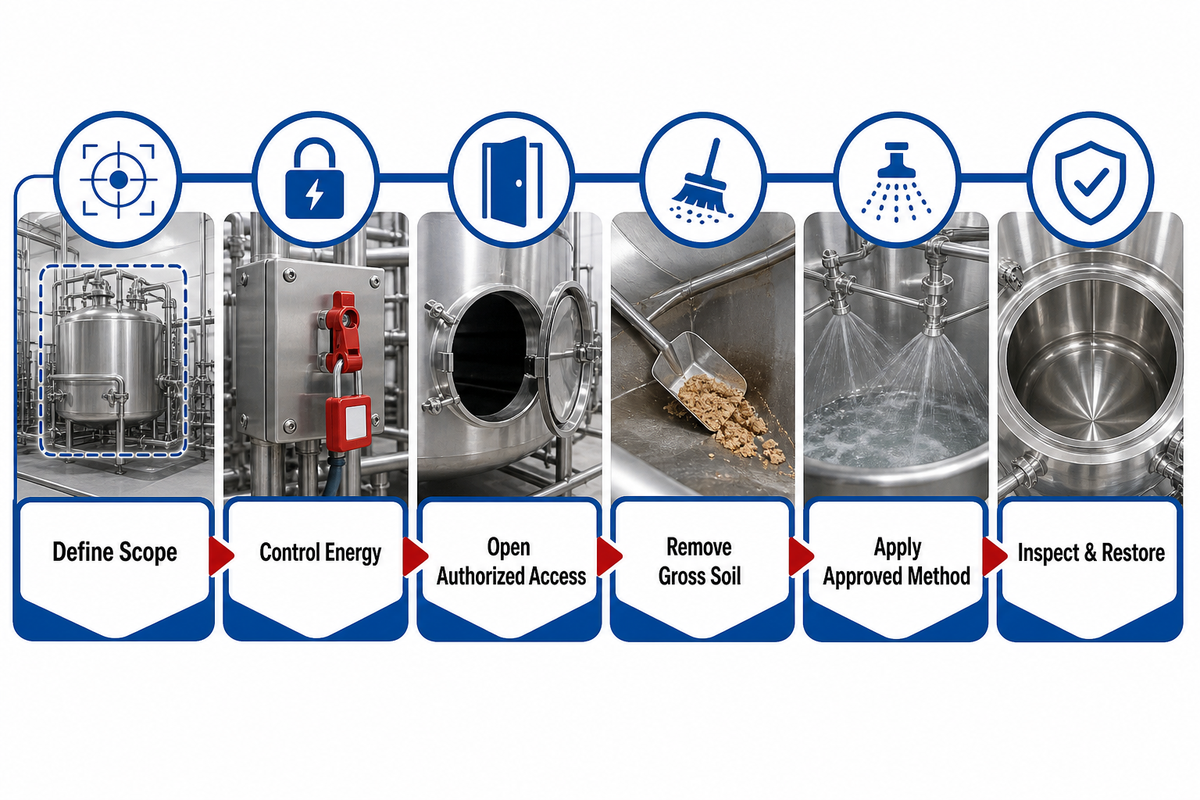
Safe sequencing controls people and energy before anyone reaches into the product path. It also keeps chemical exposure, removed parts, nearby product, overspray, reassembly, and production release inside defined procedures instead of leaving those decisions to the sanitation crew at the machine.
- Define the scope. Stop production, identify affected product and surfaces, protect or remove exposed materials, and assign the release owner.
- Control the hazardous energy. Apply the plant procedure where cleaning, guard removal, unjamming, or access could expose a person to unexpected movement or stored energy.
- Open only authorized access. Allow the machine to reach route-specific safe conditions, then remove guards and parts according to the machine procedure.
- Remove gross soil. Keep debris from entering bearings, electrical enclosures, hollow structures, drains, and equipment that has been cleaned.
- Apply the approved method. Follow the chemical label, safety data sheet, hazard-communication program, personal-protective-equipment assessment, and sanitation procedure.
- Inspect and restore. Dry or drain to the defined condition, account for parts, restore guards, complete the pre-operation check, and remove energy controls through the authorized process.
OSHA 29 CFR 1910.147 includes cleaning or unjamming when unexpected energization may expose a worker. Chemical communication and personal protective equipment are separate duties addressed by 29 CFR 1910.1200 and 29 CFR 1910.132 for covered United States workplaces.
Translate words into conditionsMaintenance and cleaning on production equipment can create both worker exposure and cross-contamination. A microorganism question needs a method suited to that target, while phrases such as clean surfaces or completely dry need a defined inspection or measurement basis. The plant procedure and manufacturer’s instructions must settle those conditions before work starts.
Key takeaway: Food-contact acceptance never replaces worker protection. A procedure needs both boundaries before work begins.
Verify Cleanliness Before Releasing the Line
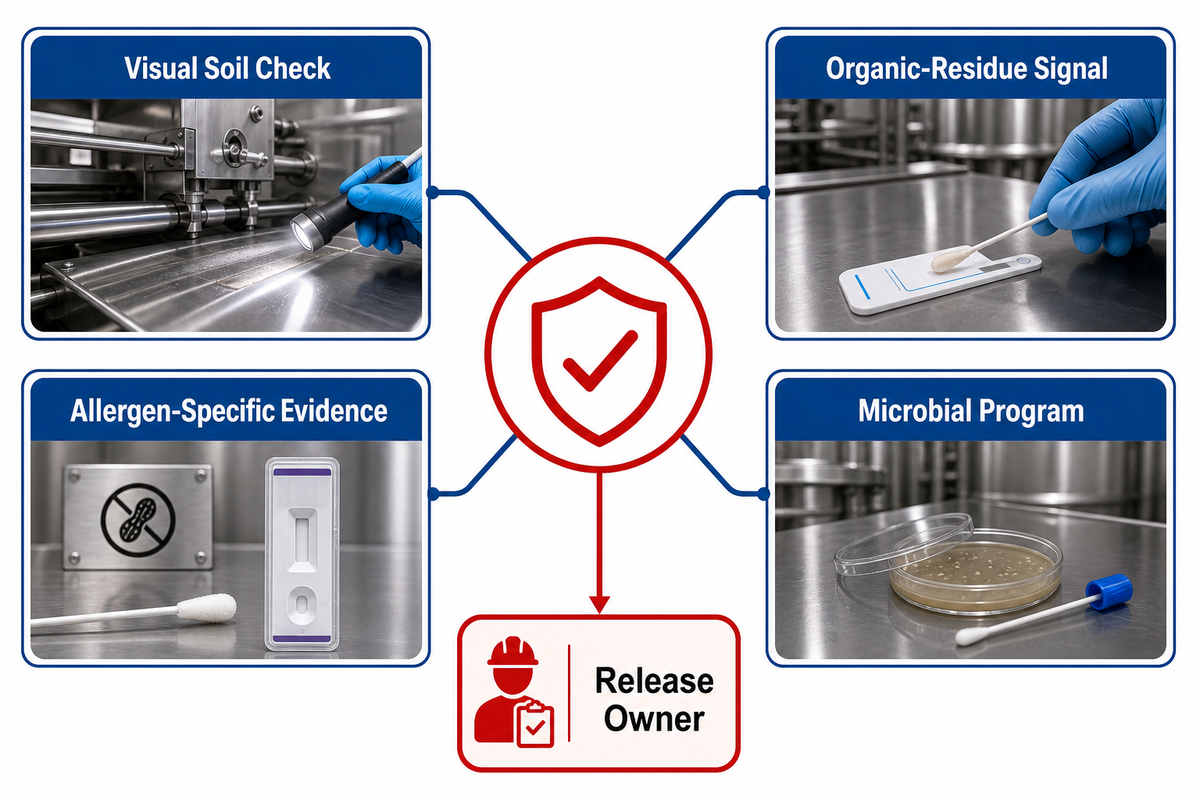
Line release needs evidence related to the stated hazard. Accessible residue can be visually assessed, a rapid hygiene test can signal organic material, and an allergen-specific test can target a named protein, and a microbial program can answer another question; no result automatically substitutes for another.
| Evidence type | Question answered | Owner or basis | Failure response | Limitations / not suitable for |
|---|---|---|---|---|
| Procedure record | Were the required steps signed off? | Sanitation record and assigned operator | Hold and complete or repeat missing work | Paper completion does not prove the surface condition |
| Part accountability | Were removed items cleaned, stored, and returned? | Machine procedure and parts list | Stop reassembly and locate the item | Does not detect invisible residue |
| Visual inspection | Is accessible visible soil absent? | Defined light, access, and inspection scope | Re-clean and inspect again | Fine particles and invisible protein can remain |
| Tactile check | Is a permitted surface free from a detectable film? | Site procedure and safe-access rule | Hold and reassess the method | Not suitable where touch is unsafe or contaminating |
| ATP or total adenylate | Is an organic-residue signal above the site limit? | Validated site method and instrument | Investigate and re-clean under the plan | Cannot directly identify bacteria or allergenic protein |
| General protein swab | Is detectable protein present at the sample point? | Selected kit and sampling plan | Hold, correct, and repeat the defined check | Does not name the protein source |
| Allergen-specific swab | Was the target allergen detected at sampled sites? | Qualified method, matrix, and acceptance basis | Keep the line on hold and follow corrective action | Untested areas and clumped residue can be missed |
| Rinse or product sample | Does the selected sample represent the defined circuit? | Sampling design and laboratory method | Contain affected material and investigate | Representation can fail in dead ends or nonuniform residue |
| Pre-operation release | Are safety, assembly, records, and evidence acceptable? | Named release authority | Do not start production | Release is invalid if a required input is missing |
According to a 2022 peer-reviewed review written by a Kikkoman Biochemifa employee, adenosine triphosphate tests can’t detect bacteria or allergen proteins directly. A separate 2025 study by Campden BRI and university researchers found 1.6 to more than 10.0 mg/kg sesame protein on tested materials after commercial warewashing even though they appeared visually clean, and later cycles could receive transferred allergen under the study conditions.
Sampling boundary: The FDA’s 2026 meeting summary notes that allergen cross-contact is nonuniform, samples can miss particles or clumps, and oily foods can challenge analytical reliability. A negative spot result supports the defined sampling plan; it does not prove that every line location is residue-free.
Why published limits do not travelOne tofu-facility study used 100 cm² swab areas and retained 5,196 measurements. ATP and microbial results agreed on site hygiene 75.1% of the time, while ATP either agreed or prompted extra cleaning in 86.8% of cases; the plant also had an 88 °C (190 °F) extraction step, a stated 60-day shelf life, samples held below 4 °C for as long as 6 days, and laboratory windows that included 1 day at 35 °C, 2 days at 30 °C, 3 days at 25 °C, and a 90 sec handling interval. The study was supported by a 3M-sponsored research contract with Cornell University, included four 3M coauthors, and received additional United States Department of Agriculture and Cornell funding; those study conditions explain why another product or plant may need different tests and critical limits.
Key takeaway: Evidence strength comes from matching the method, target, sample location, matrix, and corrective-action rule. One green number cannot carry the entire release decision.
Set Cleaning Frequency by Trigger, Not by One Universal Schedule
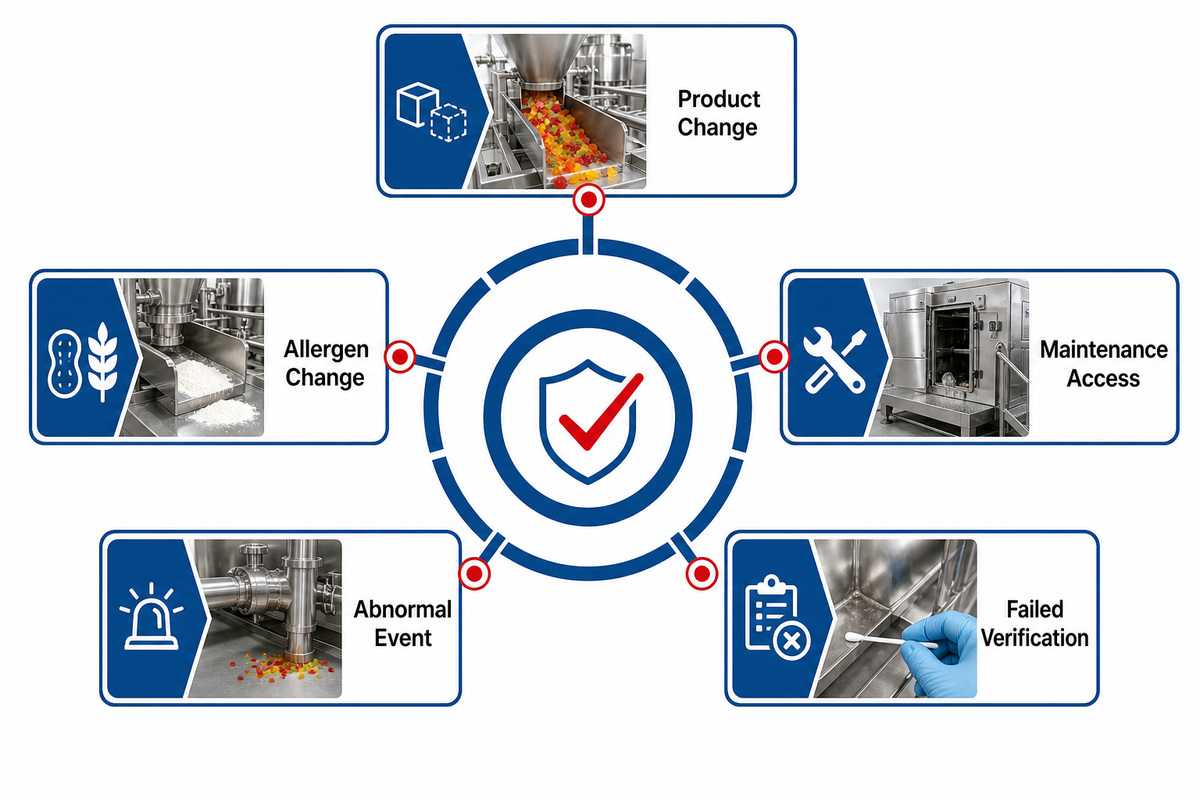
Cleaning based on documented evidence of triggers and risk shouldn’t be based on a schedule obtained from another plant. A between-batch, daily, weekly, or campaign rule should apply only to the surface and condition it covers, with earlier cleaning required after a spill, maintenance opening, failed check, or abnormal event.
| Trigger | Risk question | Scope decision | Release record |
|---|---|---|---|
| Product-family change | Will the next formula tolerate carryover? | Define affected contact path | Changeover record |
| Allergen-profile change | Could a named protein enter the next product? | Use the allergen-control procedure | Target verification |
| Color or flavor change | Can residue alter the next batch? | Inspect known retention points | Defined quality check |
| Maximum run condition | Has the qualified operating limit been reached? | Clean the listed components | Run and sanitation log |
| Extended idle period | Could exposed surfaces or residue change during idle time? | Assess pre-start cleaning | Restart authorization |
| Maintenance access | Were product zones opened or exposed? | Clean affected and adjacent areas | Maintenance handback |
| Spill or contamination event | How far could material travel? | Contain and expand scope as evidence requires | Incident closeout |
| Failed verification | Which step, site, or assumption failed? | Hold, investigate, and re-clean | Corrective-action record |
| Abnormal restart | Were energy, guards, product, and sanitation restored? | Repeat defined pre-operation checks | Release sign-off |
Scheduling a campaign may help to decrease the number of allergen changes, but it can’t eliminate the need for line cleaning or label control. The US rule says it should be done ‘as frequently as necessary,’ which indicates a risk-based decision rather than a uniform approach to each machine.
Key takeaway: A calendar can remind the team; the trigger ledger decides whether the documented scope still fits current production.
Use Cleanability as an Equipment-Buying Criterion
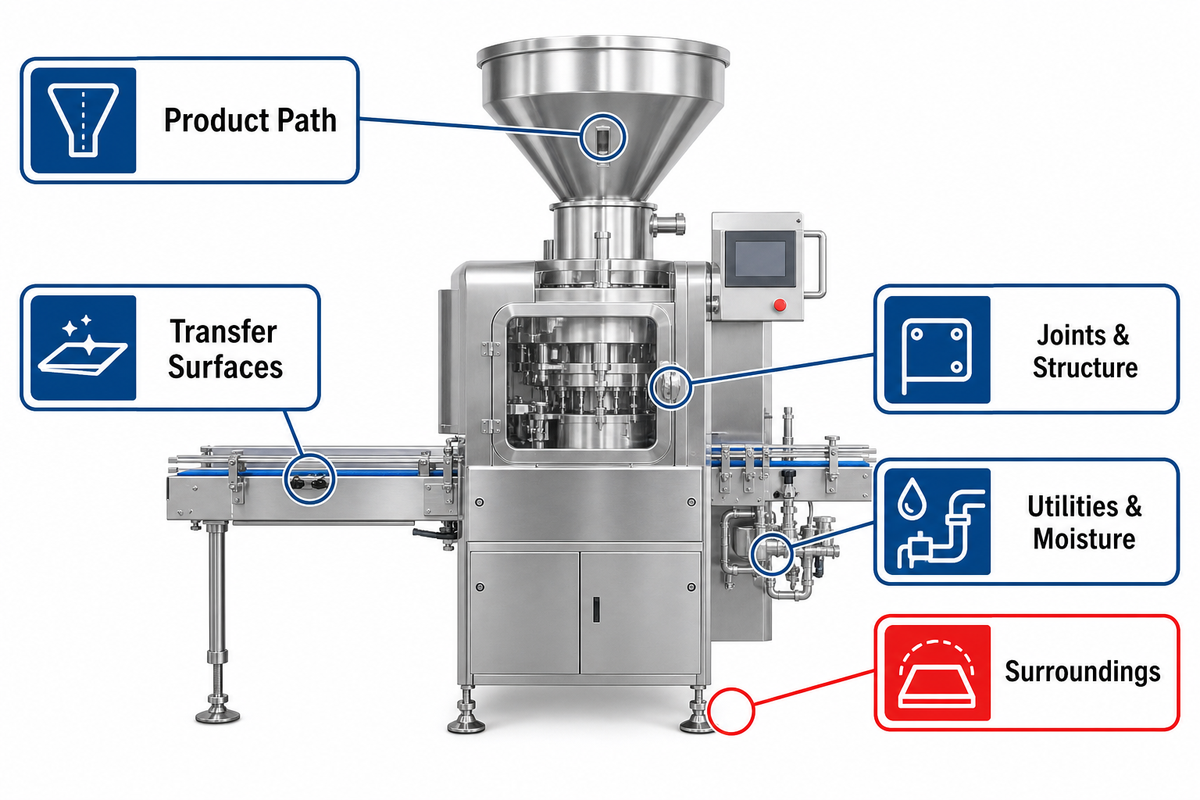
Cleanability belongs in equipment selection because a difficult product path on a hard candy production line turns every future changeover into a labor, safety, and verification problem. Areas to inspect include access, seams, hollow spaces, drainage, belt returns, valve seats, removable parts, utility boundaries and cleaning evidence.
5-Surface Cleanability Walkdown
1. Product pathFind dead ends, valves, nozzles, corners, and retained product.
2. Transfer surfacesOpen belts, scrapers, moulds, rollers, catches, and returns for inspection.
3. Joints and structureReview seals, welds, fasteners, hollow members, and contact faces.
4. Utilities and moistureCheck drains, pneumatics, electrical interfaces, jacketed lines, and dry-zone boundaries.
5. SurroundingsConfirm access around guards, platforms, frames, and adjacent spaces.
For covered U.S. facilities, 21 CFR 117.40 addresses adequate cleanability, installation access, resistance to cleaning conditions, smooth seams, and cleanable closed systems. A 2026 review of hygienic design includes practical warning signs, such as poor drainage, zones of product retention, difficult welds, and perforated surfaces that can’t be sufficiently cleaned.
Procurement objection: Stainless steel on the outside does not prove hygienic design inside. Ask the supplier to demonstrate safe disassembly, access, drainability, drying, reassembly, part accountability, and inspection with your actual residue and changeover cases.
Scope the real machine familyThe machine manufacturer should map cleaning needs across the delivered confectionery processing equipment, including conveyor belts, chocolate molds, each kettle or vessel, and any automation that changes access or retained product. Buyers should evaluate sanitation downtime and the plant’s hygiene standards rather than treating HACCP as a machine feature or purchase certificate.
When evaluating hard candy machines, include capacity, residue families, cleaning boundaries, access, and release evidence in the equipment brief. According to the supplied company profile, SINOFUDE was founded in Shanghai in 1998 and supplies confectionery, chocolate, and bakery equipment; company-level certifications or patents are not proof for a specific model unless its documents say so.
Key takeaway: Buy the cleaning and inspection path with the production path. If the supplier cannot show how a hidden surface is reached and checked, the buyer inherits that uncertainty.
Troubleshoot Common Confectionery Cleaning Failures
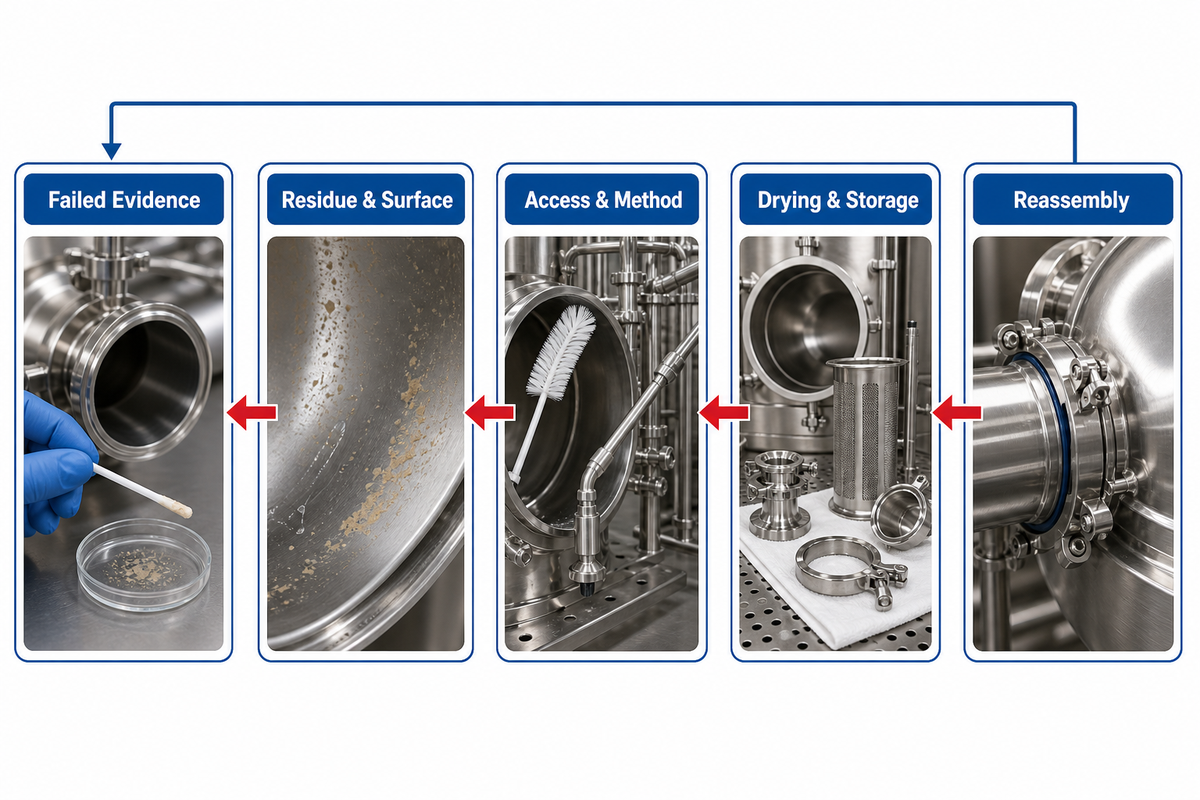
Troubleshooting should trace failed evidence backward through residue, surface, access, method, chemistry, mechanics, time, drying, storage, and reassembly. Failure at release is a signal for containment; it isn’t permission to adjust the chemistry strength, extend the cycle time, or restart processing without the plant’s corrective action.
| Observed failure | Evidence path to check | Immediate decision | Limitations / not suitable for |
|---|---|---|---|
| Sugar film returns after drying | Hidden soil, rinse path, drying, and contact faces | Hold and reopen the defined scope | Do not assume stronger chemistry is compatible |
| Greasy chocolate film remains | Fat-soil fit, geometry, temperature boundary, and removed parts | Reassess the approved route | Do not copy the 16.2 kg study result into a factory purge |
| Powder appears in a clean zone | Vacuum filter, brush, air movement, footwear, and tools | Contain redistribution | Compressed air can widen the affected area |
| Moisture remains | Drains, seals, hollow areas, low points, and dry time | Keep the line on hold | A surface-dry view may miss trapped water |
| Allergen check fails | Target protein, sites, matrix, tools, solution, and adjacent equipment | Follow the corrective-action and re-cleaning plan | One passing resample may not explain the original failure |
| Residue appears after reassembly | Part storage, contact faces, fasteners, tools, and accountability | Stop pre-operation release | Cleaning the main frame alone cannot resolve a part-control gap |
Scenario: the clean-looking containerA 2025 controlled study found 1.6 to more than 10.0 mg/kg sesame protein on tested materials after commercial warewashing, even where surfaces appeared clean. Those mass fractions equal 0.00016% to more than 0.001%, but neither figure is a release threshold. The washer could also transfer more than 10.0 mg/kg into a later cycle under the study conditions, so the investigation must include equipment, material, sequence, and recontamination paths.
If residue remains after the documented cycle, keep the line on hold and investigate the failed assumption. Repeating an unchanged cycle doesn’t explain whether the miss came from chemistry, access, transfer, drying, storage, or reassembly.
Key takeaway: Re-cleaning without a cause review can repeat the same miss. Hold the line, locate the failed assumption, correct it, and then repeat the evidence required by the program.
Build a Cleaning Brief With the Equipment Supplier
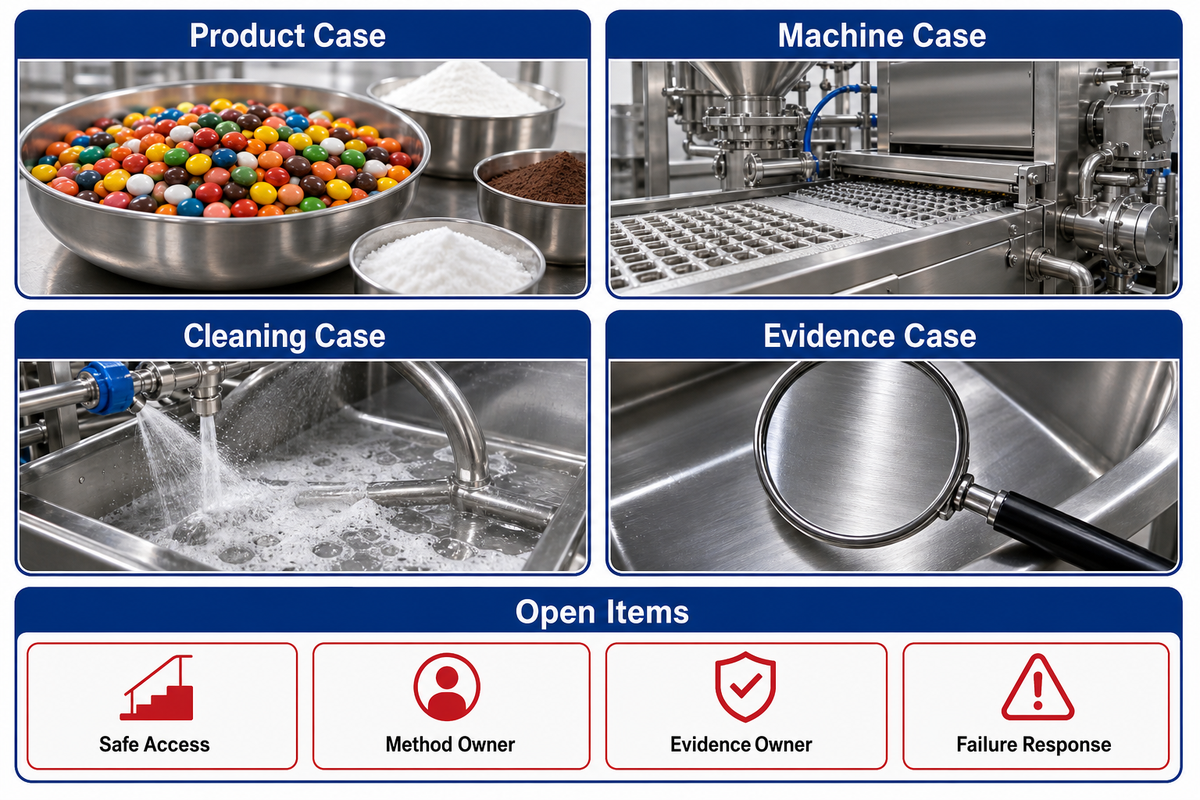
A useful supplier brief turns sanitation needs into reviewable equipment inputs before fabrication or acceptance. For a gummy production line, keep sanitation inputs inside the same buyer-supplier brief rather than assuming that the product route answers them. It assigns who supplies material data, access instructions, utility limits, safe disassembly, cleaning boundaries, compatible procedures, test points, training, and the records needed for factory and site acceptance.
Product caseList residue families, allergens, colors, flavors, changeovers, run conditions, and abnormal events.
Machine caseList contact materials, removable parts, belts, valves, seals, dead ends, guards, utilities, and safe access.
Cleaning caseMark dry, controlled-wet, out-of-place, and in-place boundaries plus chemical and moisture limits.
Evidence caseName inspection access, sample points, acceptance owners, corrective actions, documents, and training.
The food business retains ownership of its hazard analysis, sanitation program, chemical controls, verification plan, and the decision to release production. For the delivered scope, the equipment handoff should provide accurate material, access, disassembly, operation, maintenance, cleaning, limitation, and utility information.
Handoff test: Ask an operator, sanitation lead, maintenance technician, food-safety owner, and supplier engineer to walk through the same changeover. Any surface or decision with no named owner belongs on the open-items list before acceptance.
Key takeaway: A cleaning brief is complete when each residue and surface has a safe access route, an approved method owner, an evidence owner, and a failure response.
Frequently Asked Questions
How do you clean a candy machine?
Follow the machine manual and the plant’s sanitation and hazardous-energy procedures. Identify the residue and affected product path, protect nearby materials, secure the equipment, open only authorized access, and remove soil through the approved route. Then inspect, dry or drain to the defined condition, reassemble, restore guards, verify the objective, and obtain release before production.
What is the correct order for cleaning and sanitizing food equipment?
A common logic is secure, clear product, remove gross soil, clean, rinse where required, inspect, sanitize where applicable, dry or drain, reassemble, verify, and release. The approved program dictates the necessary order for each machine and zone. Sanitizer isn’t a substitute for cleaning. An added rinse can be wrong where moisture or material compatibility is constrained.
How often should confectionery equipment be cleaned?
There’s no responsible universal interval. Frequency follows product and allergen changes, the qualified run condition, extended idle time, maintenance access, spills, abnormal events, verification history, and the food-safety program. The written trigger should identify the affected surface and release evidence. Failure of an approved-program check can require immediate containment and re-cleaning even if the stated interval hasn’t been reached.
Is dry cleaning better than wet cleaning for confectionery equipment?
No. Match the route to the residue, zone, moisture tolerance, access, safety, machine instructions, evidence, and corrective-action plan.
How do you verify that allergen residue has been removed?
Build the verification program around the named allergen, product, surface, matrix, and changeover. Initially, carry out an inspection of accessible retention sites. Then use the qualified allergen-specific surface, rinse, or product method assigned by the program. Sampling sites should reflect potential residue rather than only easily accessible stainless steel sites. The plan needs acceptance criteria, controls, competent interpretation, and a corrective action that keeps affected production on hold. A negative spot result supports only the sites and method sampled; nonuniform particles, clumps, oily matrices, tools, cleaning solution, adjacent equipment, and reassembly can leave other paths unresolved.
Turn Cleaning Requirements Into an Equipment Brief
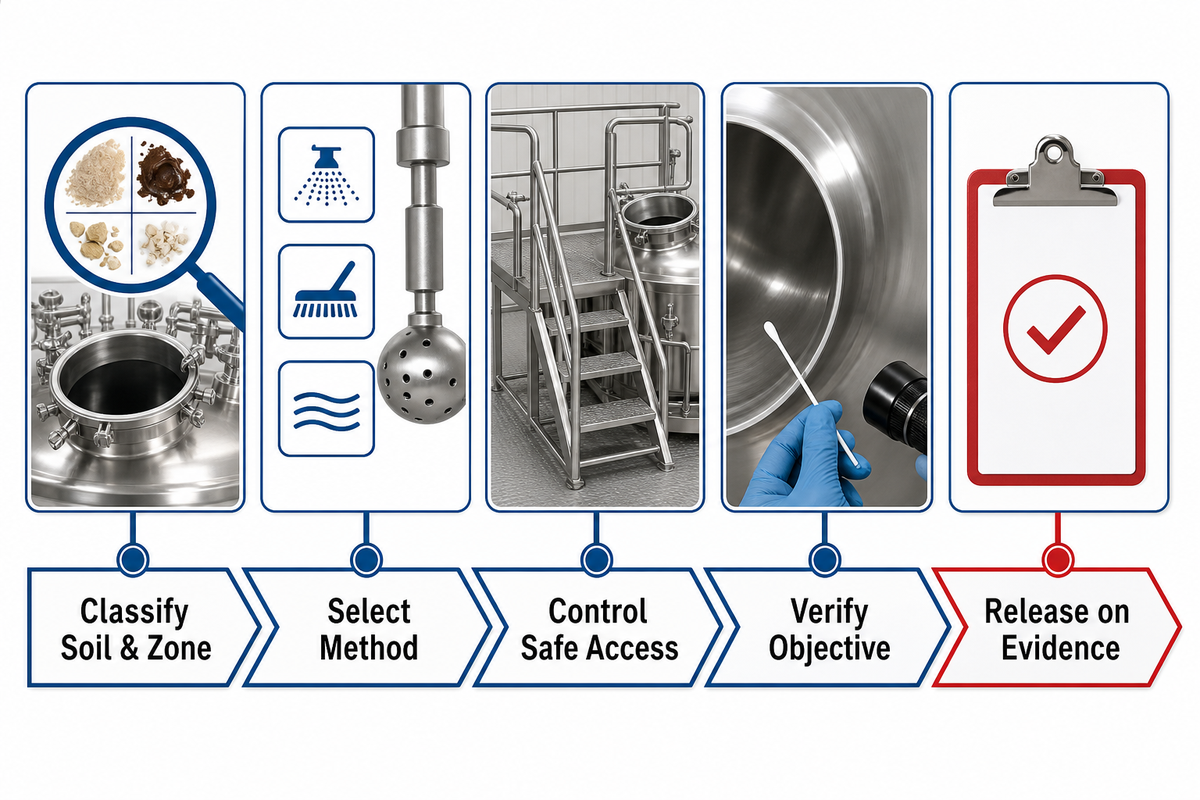
Classify the soil and zone, select a documented method, control safe access, verify the stated objective, and release only on the required evidence. Put cleanability into the equipment brief before purchase; if hidden surfaces have no inspection path, the buyer inherits unresolved residue and release risk.
Discuss Your Cleaning and Equipment Brief
By XCX · SINOFUDE
References and Sources
- eCFR: 21 CFR 117.35, Sanitary operations
- eCFR: 21 CFR 117.40, Equipment and utensils
- eCFR: 21 CFR 117.160, Validation
- OSHA: 29 CFR 1910.147, Control of hazardous energy
- FDA: Food Allergen Cleanliness and Cross-Contact guidance material
- Journal of Food Protection: Dry-cleaning treatments for chocolate equipment, 2024
- Journal of Food Protection: ATP test use and limitations, 2022
- Journal of Food Engineering: Allergen removal from contact materials, 2025
- MDPI Standards journal review: Assessment and standards in hygienic design of food equipment, 2026
- Food Safety Magazine: Allergen cleaning and validation considerations, 2026