Get in Touch with SINOFUDE Company


Updated October 2026 · Industrial process and acceptance guide
This guide treats popping boba production lines as linked wet-process control systems, not as a model catalogue. Each line consists of multiple units that accomplish various functions such as preparing separate liquid streams, controlling droplets, creating an edible film at the interface of the two liquid streams, separating and washing the beads, moving the beads without breaking them, and finally filling the selected package. The key performance indicator of a depositor’s line isn’t the peak rate. The key performance indicator of the line is the mass of conforming beads reaching the pre-defined acceptance point.
This manual is for processors, project engineers and procurement specialists who want to transition a bench-top process to large scale, repeatable production. It covers process limits, reverse-spherification controls, recipe documentation, line balance and automation, site interfaces, sanitation, and factory acceptance. If your focus is to compare current models, published specs or quotes, check out popping boba production-line configurations on our commercial webpage.
Distinction is important. A model page should allow a buyer to shortlist a piece of equipment. An engineering page should help a buyer define the equipment specification. The framework that follows avoids formulaic recipes, shelf life and kilogram per hour cutoff claims. It incorporates measured inputs, samples, decisions and retention of evidence.
For the bubble tea and foodservice programs, the final product that’s produced by a given process is called a pearl. The process team uses the term popping pearls to describe the final product. Specifications of the product may state the pieces as boba balls. A fruit juice core is one possible product, not a universal formula. This article uses those market terms while keeping popping boba manufacturing separate from gummy production and other candy making routes.
Short answer: Control six different clocks, compare each stage on a single, mutually accepted output basis, and create product, machine and package tests prior to the factory trial. A stable bead at the nozzle is only the beginning of a valid popping boba process.
Six decisions this guide will close
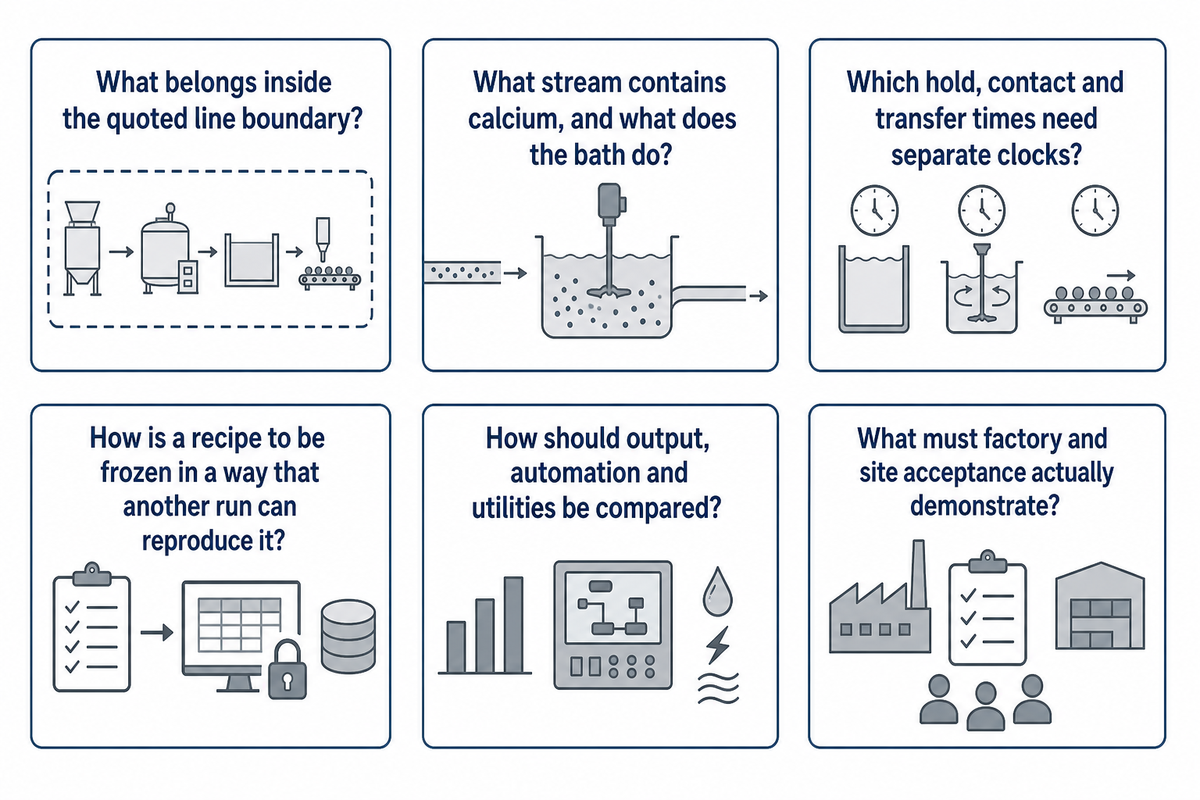
Use these six decisions to turn a broad equipment request into a defined process boundary, a measurable operating window and a witnessed acceptance plan. Each of these decisions also stipulates the evidence that the Buyer, Supplier or site team must generate prior to the next commitment. For U.S. projects, 21 CFR 117.40 provides a baseline for equipment and food-contact-surface design, while the acceptance plan still needs project-specific limits.
- What belongs inside the quoted line boundary?
- What stream contains calcium, and what does the bath do?
- Which hold, contact and transfer times need separate clocks?
- How is a recipe to be frozen in a way that another run can reproduce it?
- How should output, automation and utilities be compared?
- What must factory and site acceptance actually demonstrate?
What a Complete Popping Boba Process Boundary Includes
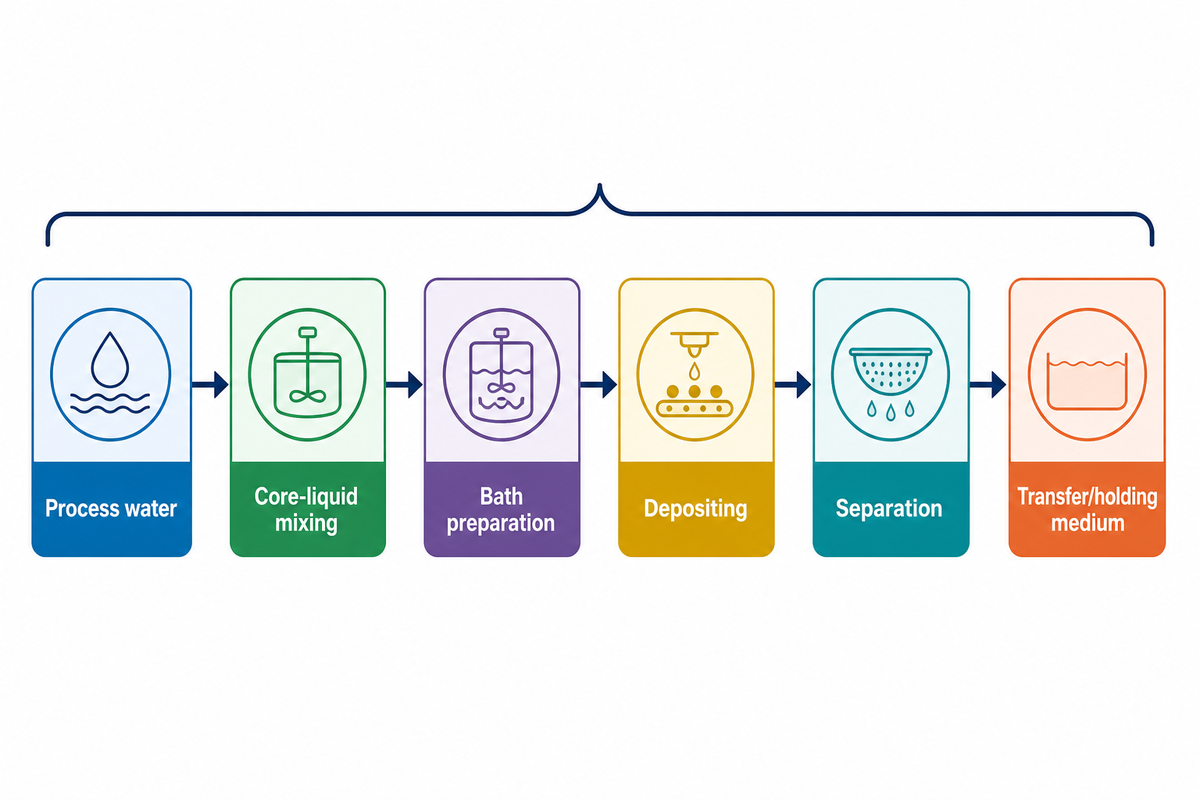
A complete popping boba production line links product preparation, controlled droplet formation, membrane development, separation, rinsing, transfer and the agreed packaging interface. “Complete” is a scoped contract word and shouldn’t be construed to mean that all utility services and preservation steps as well as the packaging machine are covered.
A depositor is a single module. A forming system incorporates a conditioned bath and time or distance for the development of the membrane. A production line may incorporate separation, rinsing and transfer as well as temporary holding and filling. The buyer still needs to identify where the supplier’s scope begins and ends.
Titles of equipment vary among suppliers. So, a popping boba making machine may refer only to the forming module. Some making machines contain linked rinsing or transfer. Other machines for popping boba go through the filling stage. Titles don’t define the supplied machinery boundary. In boba manufacturing, the purchase specification should name the connected production systems and their interfaces instead of relying on a title.
That boundary can’t stop at the machine frame. In the United States, 21 CFR 117.37 covers the water supply, appropriate temperature and pressure, drainage, and protection against the backflow and cross-connection of wastewater. Other jurisdictions have their own rules, but the procurement lesson travels: site utilities and waste handling need named owners.
| Module | Incoming state | Outgoing state | Common exclusion | Owner to name | Evidence required |
|---|---|---|---|---|---|
| Process water | Plant supply | Qualified water at point of use | Treatment skid | Site | Quality, pressure, temperature, peak flow |
| Core-liquid mixing | Released ingredients | Measured core batch | Ingredient handling | Shared | Batch record, temperature, pH, solids, viscosity method |
| Bath preparation | Water and hydrocolloid | Conditioned bath | Long-term storage | Vendor/process owner | Identity, concentration basis, hydration and release check |
| Holding/deaeration | Freshly mixed liquids | Feed-ready liquids | Vacuum source | Shared | Hold limit, air check, recirculation status |
| Depositing | Stable feed | Droplets in bath | Upstream preparation | Vendor | Nozzle map, pressure/pump setting, startup sample |
| Membrane formation | Fresh droplets | Formed liquid-core beads | Product release limits | Process owner | Contact-time distribution and product sample |
| Separation | Beads plus bath | Separated beads | Reject classification | Vendor/process owner | Carryover, damage and retained-mass check |
| Rinsing | Separated beads | Rinsed beads | Wastewater treatment | Shared | Water condition, time, carryover and drain method |
| Transfer/holding medium | Rinsed beads and medium | Pack-ready blend | Shelf-life validation | Product owner | Ratio, observation window and composition-retention test |
| Filling/sealing | Pack-ready blend | Closed package | Labeler or secondary pack | Named package owner | Drained dose, gross/net weight and closure test |
Only when a quotation specifies the same start and finish points as this map and includes the same exclusions, can it be compared to others. If one supplier stops at separated beads and another includes filling and sealing, their headline capacities and prices answer different questions. For more information about module-level process flows, see the popping boba machine overview.
How the Line Controls a Liquid-Core Bead Interface
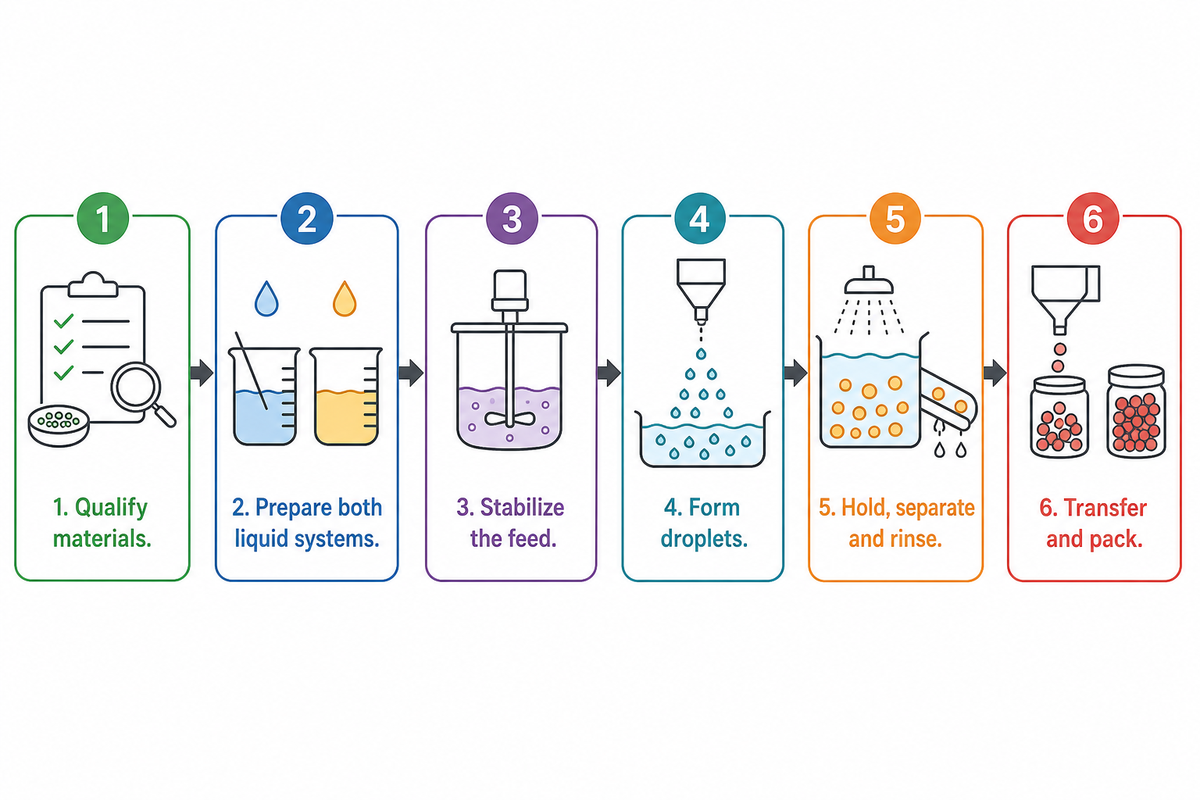
Reverse spherification is a common method in which a calcium-bearing center liquid is placed in a sodium-alginate bath. Calcium ions act at the interface and link alginate chains into a thin hydrogel. The qualified process flow, not a copied internet recipe, must govern the actual ingredient assignment and operating window.
Pennsylvania College of Technology’s direct and reverse spherification comparison offers a good example showing the reverse route placing a calcium-containing product in an alginate bath. This corrects the mistake of describing the direct route and reverse route as if their streams were interchangeable.
Three mechanisms should always be kept separate during an investigation. Droplet formation is a fluid dynamics issue. Interfacial shell formation is a calcium-alginate reaction and transport problem. Later change is a product-and-package problem that can include diffusion, osmotic movement, mechanical stress and interactions with the packing medium.
The chemistry behind popping boba is often simplified too far. In a qualified reverse route, ingredients like sodium alginate and a compatible calcium source are assigned to different streams. The calcium-bearing flavored liquid enters the sodium alginate solution so interfacial gelation can form the outer membrane around the liquid core. This gel-like membrane creates the familiar burst of flavor, but there’s no single standard popping boba recipe.
Popping boba is made under a controlled production process. Popping boba made with another acid, solid content or hydrocolloid lot may need a different stable window even when the nominal ingredient ratios appear unchanged.
The shorthand phrase “sodium alginate and calcium” still doesn’t clarify the stream assignment. The outer membrane of popping boba forms only under the actual interface and contact conditions recorded for that route.
A comparative study of various alginate spherification methods published in a peer-reviewed journal identified method- and residence-time-dependent variations in water release, texture and structure. Its formulations aren’t commercial popping boba specifications. The useful lesson is narrower: Contact time and methodology should be reported with the results.
Rinsing only removes surface carryover. It doesn’t prove that every subsequent transport and quality change has stopped. That is why the line record needs an immediate bead check and a second observation after the agreed packing-medium interval.
The 6-Clock Boba Control Map
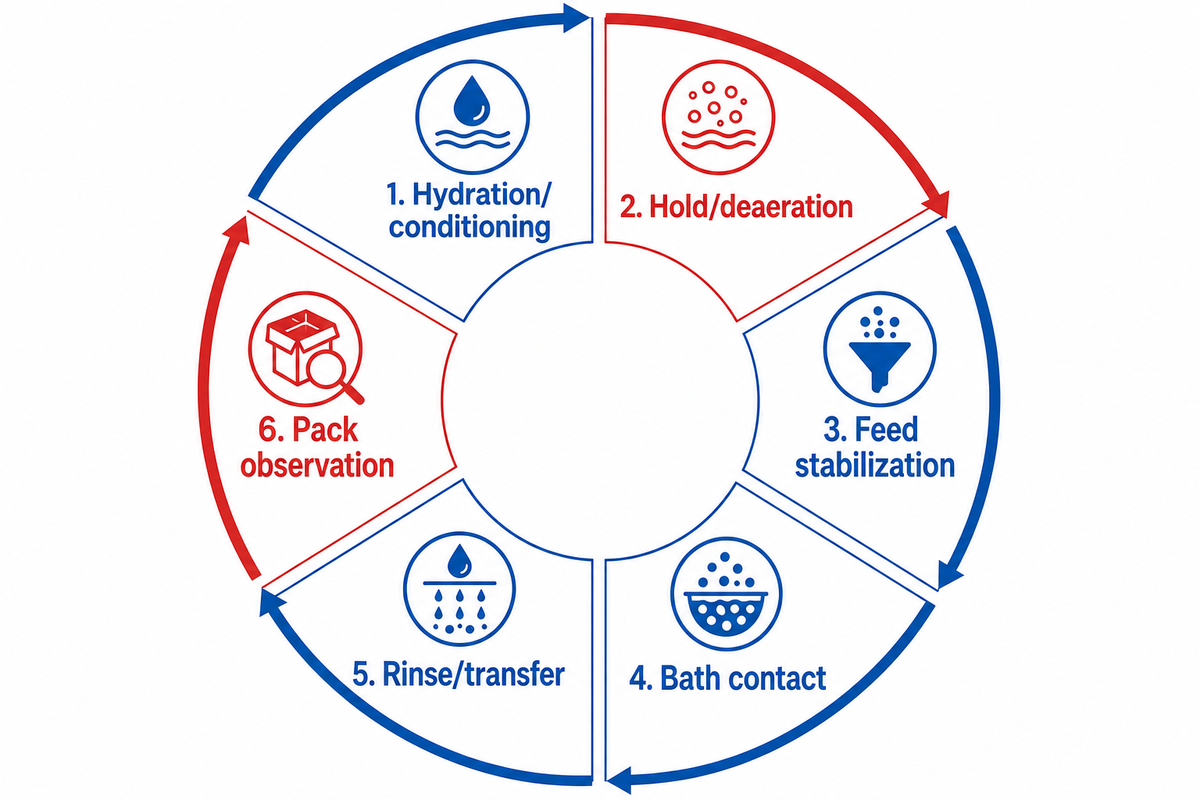
The 6-Clock Boba Control Map™ separates bath conditioning, core hold, feed stabilization, bath contact, rinse/transfer and pack observation. A single cycle-time average hides queues and exposure differences; the six clocks show where a bead actually changed and which sample can explain that change.
The six clocks can overlap. For example, a core batch can continue to wait while earlier product is being deposited. A formed bead can be rinsed quickly, but can still sit in a transfer hopper before being loaded into the pack. If the record only shows the line start and finish times, both situations aren’t evident.
Precise control means the record can explain product quality and consistent size without hiding variation in an average. It does not mean that every bead is identical or that one setpoint guarantees the result.
| Checkpoint | Active clock | Product state | Measured variable | Sample method | Observable defect | Decision owner | Retained evidence |
|---|---|---|---|---|---|---|---|
| Bath release | 1. Hydration/conditioning | Prepared bath | Elapsed time, temperature, method-bound viscosity | Top/middle/bottom sample | Uneven formation | Process lead | Bath batch record |
| Core release | 2. Hold/deaeration | Prepared core | Hold time, temperature, visible air | Vessel and feed-point sample | Bubbles, density or flow drift | Product owner | Core batch/hold log |
| Startup | 3. Feed stabilization | Liquid at nozzles | Pressure or pump setting and first-good time | Mapped nozzle sample | Tails, doubles, size drift | Line operator | Startup sheet |
| Early run | 3 + 4 | Droplet/bead in bath | Nozzle variation and contact-time distribution | Timed entry/exit sample | Thin or excessive shell | Process engineer | Timestamped sample |
| Steady run | 4. Bath contact | Forming bead | Residence and bath loading trend | Beginning/middle/end samples | Texture or leakage drift | Quality lead | Control chart |
| Separation | 5. Rinse/transfer | Fresh bead | Queue, rinse and drain time | At separator and after rinse | Sticking, rupture, carryover | Line operator | Queue/stop log |
| Transfer hopper | 5 + 6 | Bead in medium | Age distribution and agitation | Oldest/newest product | Settling, damage, composition drift | Production lead | Hopper residence record |
| Filling | 6. Pack observation | Bead plus packing medium | Drained dose, medium ratio and closure result | Defined pack sample | Underfill, damage, package leak | Packaging/quality | Fill and closure record |
| Post-pack check | 6 | Closed product | Appearance, shell response and internal retention | Agreed observation intervals | Delayed leak, toughening, migration | Product authority | Stability/qualification file |
| Changeover restart | All six | New lot/formula | Reset completeness and first-good time | Full startup set | Old settings carried forward | Shift supervisor | Changeover release |
Portable rule: never average six clocks into one cycle time. Put the defect beside the clock that could create it, then sample before changing a setting.
Why can a good bench bead fail after continuous transfer?
A bench trial gives each bead ample space and quick processing. A continuous line adds a distribution of wait times, collisions, bath loading, separator forces, queues and mixed product ages. A bead can pass an immediate visual check and still fail later due to a transfer or packing interval.
A 2024 study on reverse-spherified tea spheres measured release of internal compounds to external water, weight loss and changes in appearance after rinsing. Its approximately 5 mL spheres, tea/ethanol/syrup formula and distilled-water storage are not commercial popping boba specifications. They do prove a useful boundary: an intact shell does not by itself prove stable internal composition. Test the actual bead in the final packing/packaging medium and environment.
Freeze the Recipe-to-Line Transfer Window

A percentage list isn’t a transferable recipe. It binds raw-material identity, measurement method and temperature, input condition, equipment setting, sampling point and finished-bead result. Without this chain, a repeat of the numbers can lead to a different product.
Research on the rheology of sodium alginate solutions and the gel properties of calcium alginate explains why using a single viscosity number isn’t sufficient. Not all solutions that behave the same way lead to gels with the same behavior. The instrument, speed or shear condition, geometry, temperature and sample history should be listed with the measurement.
| Transfer field | Record | Why the field matters | Release evidence |
|---|---|---|---|
| Ingredient identity | Name, supplier, grade, specification revision | “Alginate” is not a complete material definition | Certificate/specification match |
| Lot | Raw-material and finished-batch IDs | Enables repeat-run and variation analysis | Traceable batch sheet |
| Water | Source and relevant test result | Minerals and treatment can move formulation behavior | Point-of-use record |
| Core solids and pH | Method, temperature and result | Defines the tested formula condition | Calibrated instrument record |
| Viscosity | Instrument, spindle/geometry, speed, temperature, sample age | Makes the number reproducible | Method-bound result |
| Calcium system | Compound, concentration basis and addition order | Prevents stream-assignment ambiguity | Weighed batch record |
| Alginate system | Identity, concentration basis and hydration method | Links bath behavior to the actual material | Released bath record |
| Hold limit | Start event, temperature and maximum elapsed time | Stops an old batch from inheriting a fresh-batch setting | Timestamp and disposition |
| Nozzle/feed condition | Geometry, active positions, pump/pressure setting | Connects the formula to droplet formation | Setup sheet and mapped samples |
| Bath condition | Temperature, motion, age/loading and residence | Defines the actual shell-forming environment | Trend and product sample |
| Rinse/medium | Water condition, drain method, medium ratio | Connects immediate bead quality to packed behavior | Immediate and delayed observations |
| Finished result | Diameter distribution, defects, shell response, accepted yield | Closes the input-to-outcome chain | Signed sample report |
In 2025, a designed spherification experiment varied sodium alginate, calcium lactate, and hardening time, and assessed predicted encapsulation, roundness, circularity, and yield. It optimized the formulation for which the test was designed. The transferable practice is multivariable testing followed by a confirmation run.
Do not use “high-quality ingredients” as a substitute for this record. The specified lots of material, ingredient ratios, and the measured bead response allow a reproduction of the approved window for a new run.
Which recipe facts belong in the user requirement specification?
Product characteristics impact user acceptance and equipment selection. Put every product fact that could alter equipment selection or acceptance into the user requirement specification: formula ownership, ingredient grades, worst-case acidity and solids, pulp or particulate limits, allergen families, bead sizes, package media, cleaning transitions and measurement methods. Keep buyer-entered formula values separate from settings discovered in the supplier trial.
Control Droplet Size, Shape and Feed Stability
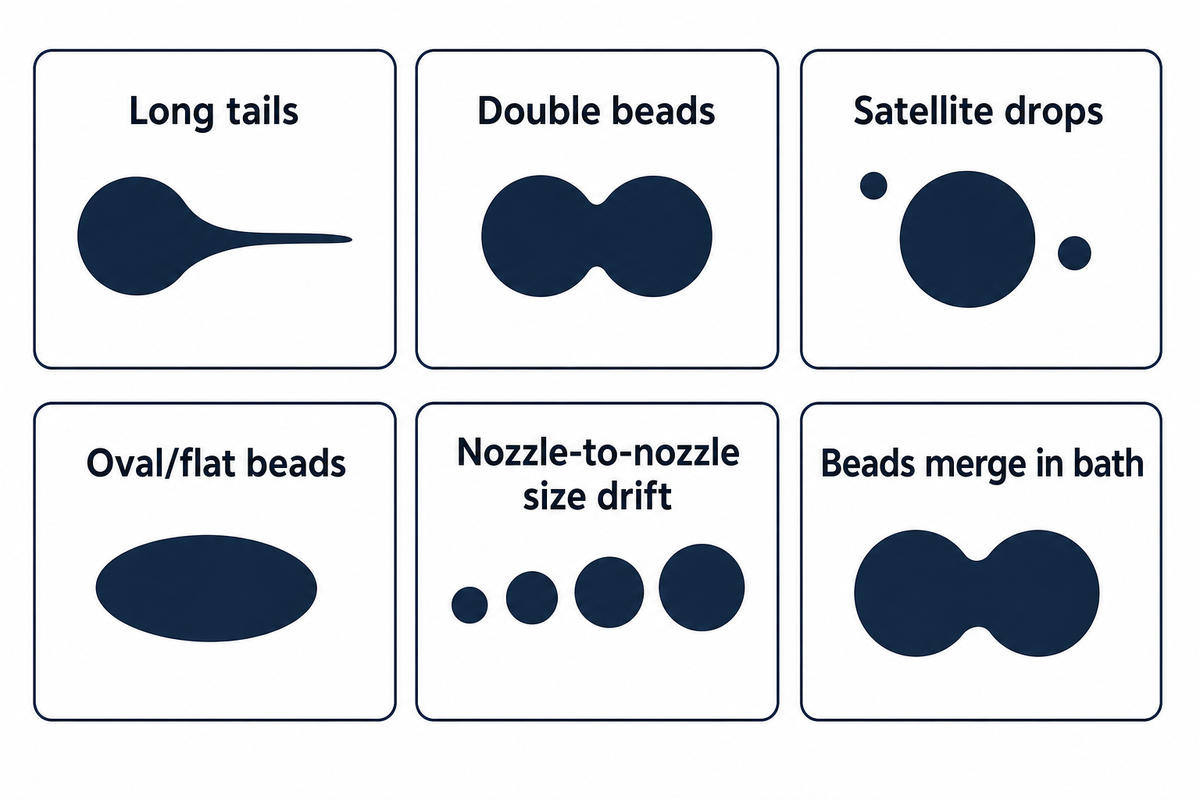
Bead geometry is the combined outcome of fluid properties, feed condition, nozzle behavior, fall into the bath, bath motion and handling. Nozzle diameter alone cannot explain tails, doubles, satellites, oval beads or nozzle-to-nozzle drift across a production run.
One study relating to solution viscosity, surface tension and formation of alginate microbeads provides insight into mechanisms relevant to droplet formation, fall and bath penetration. It provides specific examples in terms of size and shape. The ranges it captures are measurement results as opposed to physical limits. Use this information to construct a fault tree; don’t copy steps directly from a procedure.
| Observed defect | Confirm before adjustment | Possible control family | Evidence to retain |
|---|---|---|---|
| Long tails | Method-bound viscosity, release behavior, fall distance | Fluid, nozzle, release timing | Video and mapped sample |
| Double beads | Pulse pattern, nozzle wetting, droplet spacing | Feed stability and timing | Defect count by nozzle |
| Satellite drops | Pressure/pump ripple and surface tension condition | Feed and formulation | Slow-motion sample or high-speed observation |
| Oval/flat beads | Drop height, bath surface and entry speed | Geometry and bath interaction | Diameter/circularity distribution |
| Nozzle-to-nozzle size drift | Active-head map, blockage, pressure balance | Distribution and maintenance | Per-nozzle sample chart |
| Beads merge in bath | Landing separation, bath motion and loading | Spacing and bath transport | Entry-zone observation |
| Weak shell | Stream identity, batch records and contact distribution | Chemistry and residence | Method-bound shell response |
| Excessive shell/tough bite | Contact, queue and age distribution | Residence and downstream delay | Timed sensory/mechanical result |
| Transfer breakage | Bead condition before transfer and local handling forces | Product plus mechanical handling | Before/after defect counts |
For an illustrative 8 mm target, a buyer might define its own diameter tolerance, sample count and reject classes. Those aren’t SINOFUDE assurances. A usable method provides where the beads are sampled, if and how they’re drained, how many are measured, what instrument is used, and how long after formation they’re measured.
Increasing pump speed can move more liquid, but it can also change droplet release, nozzle balance and bath loading. Adjust one controlled family at a time and preserve the before/after sample. Otherwise a temporary visual improvement can hide a worse accepted yield downstream.
The same fault tree should identify too rapid outer shell formation and premature gelling in the feed path. A flexible membrane at release can still be damaged by a later transfer, so the sample location belongs beside every conclusion.
The size of the boba must be reported as a distribution rather than one selected sample. A gel-like outer layer can look round while its thickness, liquid retention or handling response remains uneven.
Size the Line Backward from Accepted-Output Evidence
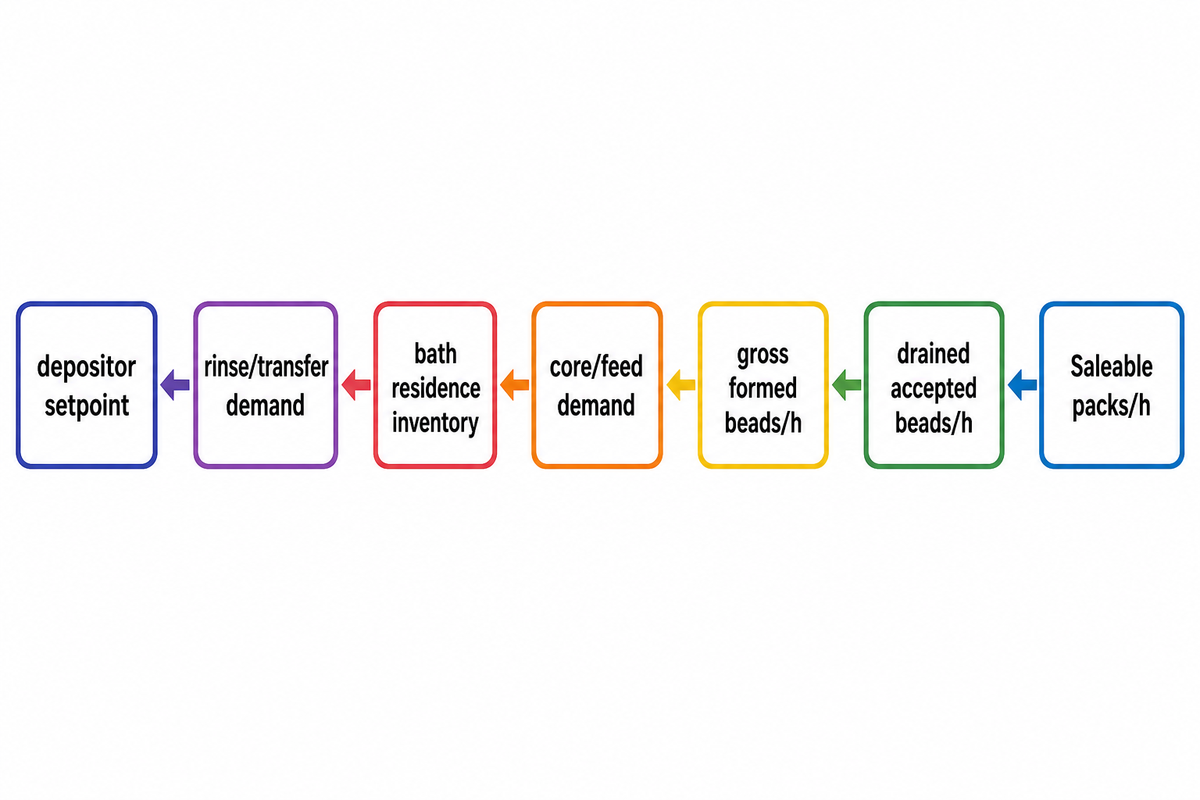
Real popping boba line capacity starts with saleable packages and works backward through drained-bead demand, accepted yield, gross forming demand, bath inventory, separation, transfer and depositing. Every step must be done using one declared mass and time basis, and be measured at a named acceptance point.
“Kilograms per hour” is ambiguous until the measured material is named. Core feed excludes shell and bath carryover. Gross formed beads include defects. Drained accepted beads depend on the drain method. Packaged mass includes the specified packing liquid. None can be compared directly, without conversion.
Packaging line instructions on why faster machines do not always raise throughput state that defining the slowest repeatable point and disruption pattern as the system constraint gives an explanation as to why a faster depositor can build a queue rather than increase accepted packaged output.
Common-basis accepted-output worksheet
Saleable packs/h → drained accepted beads/h → gross formed beads/h → core/feed demand → bath residence inventory → rinse/transfer demand → depositor setpoint
Which mass basis belongs in a popping boba line balance?
Use drained accepted bead mass as the internal bridge when product demand is in packed form. It removes most packing-liquid ambiguity while keeping product rejects visible. State the drain device, orientation and duration to ensure the same method is used at development, factory acceptance test and site qualification.
Illustrative backward-sizing example
A buyer plans 3,000 accepted packs per hour. Each pack contains an example 0.20 kg net mass, of which an example 40% is drained accepted beads. The buyer’s trial shows an example 92% bead acceptance yield. These are buyer-entered teaching values, not published machine performance.
Packaged mass = 3,000 × 0.20 = 600 kg/h
Drained accepted beads = 600 × 0.40 = 240 kg/h
Gross formed beads = 240 ÷ 0.92 = 260.9 kg/h
Therefore, the forming section needs to show at least 260.9 kg/h gross-bead formation prior to any startup loss, planned sampling, recipe adjustments, cleanings, and allowances for interruption. The filler has to demonstrate 3,000 packs/h accepted at the specified bead-to-medium ratio.
Packaging Digest’s filling-control discussion covers gross weight checks and corrective dosing, separates sampling into periodic and in-line checking, and describes examples of deviations in filling. That’s a different measurement loop than the depositor. One can’t deduce that package mass is equal to the average bead-forming rate.
Next, reconcile continuous and batch stages. A batch-preparation step must replenish the process so that the depositor isn’t starved. A transfer hopper must absorb normal index variation without making beads wait outside the qualified window. The accepted rate is the minimum sustained linked-stage result after planned stops and counted rejects.
High output at one module does not prove high output across the entire production line. A common basis balance may reduce waste by identifying where conforming mass disappears, but only measured losses, not marketing efficiency claims, should be included in the analysis.
Only after this calculation should you use the commercial popping boba production-line page to compare current configurations. The line-balance checker can organize buyer inputs, but it doesn’t replace a supplier data sheet or witnessed product run.
Semi-Automatic or Integrated: Use Variation, Not a Generic kg/h Cutoff
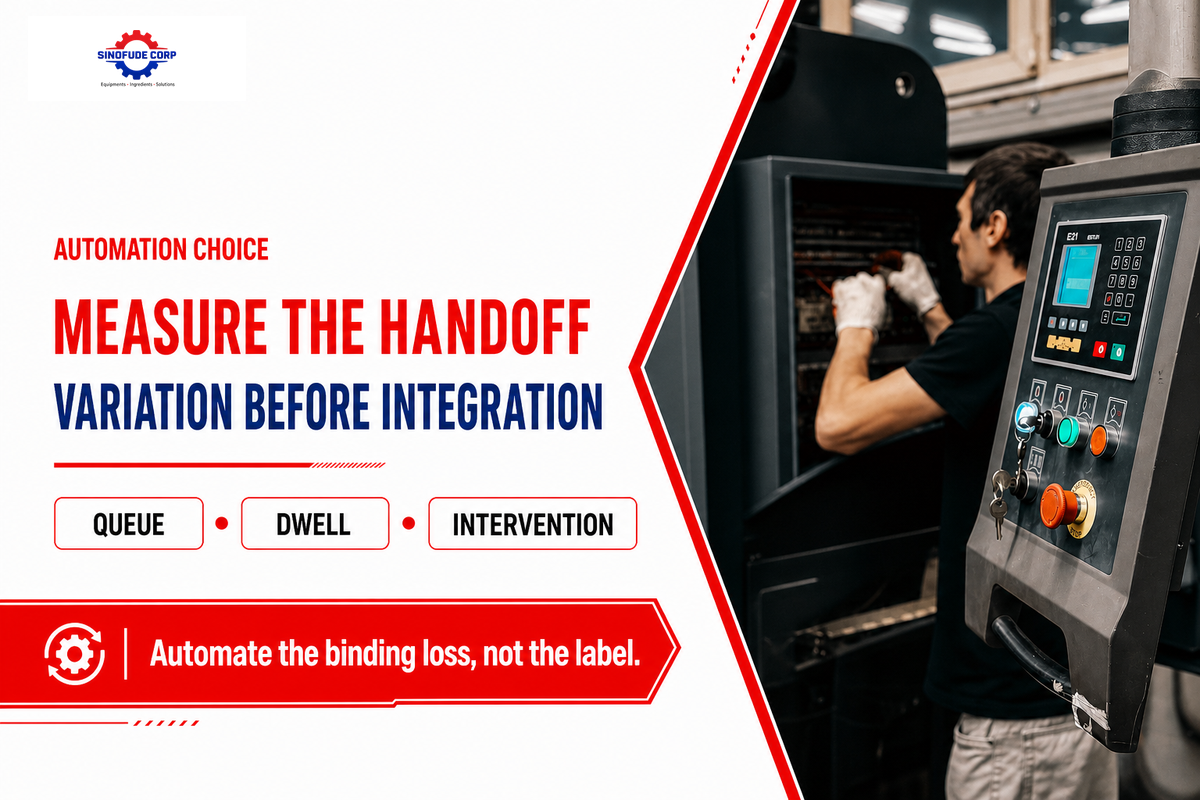
Keep a semi-automatic setup when trained operators can hold the approved window and the required output is met, and if short-run flexibility is important. Integrate a handoff when measured queue time, dwell variation, damage, missing records or unsafe intervention, not a generic kg/h number, shows that the handoff is the binding loss.
NIST’s discussion of high-mix, low-volume automation describes the value of redeployable flexibility while noting that collaborative systems can run more slowly than standard automation. The lesson is that when designing a system, the product mix, task speed, and capital, as well as safe human interaction, need to be balanced. Therefore, it’s incorrect to say that for any given situation, a collaborative system would always be more beneficial than a traditional automation system.
A 2025 production economics study suggests the best configuration is still dependent on batch size and reduction of setups. It presents a model-specific batch threshold, not a popping boba kg/hr number. Setup and changeover work can influence that threshold, so volume alone is an incomplete automation brief.
Semi-automatic can fit when
- campaigns are short or varied;
- operators hold the approved timing and sample plan;
- manual transfer causes no material queue or damage;
- records are complete and traceable;
- safe access and ergonomics are demonstrated.
Integration deserves a trial when
- handoff time moves outside the qualified window;
- operator-to-operator variation drives defects;
- repetitive contact damages beads or creates risk;
- the batch genealogy or stop record is incomplete;
- the loss persists after method and training fixes.
| Touchpoint | Variation to measure | Product consequence | Proof before automation | Possible automation | New failure mode introduced |
|---|---|---|---|---|---|
| Recipe dosing | Mass and sequence errors | Formula drift | Weighing study and error log | Recipe-controlled dosing | Wrong recipe or calibration |
| Bath preparation | Hydration and release variation | Uneven shell response | Method-bound samples | Controlled mixing/transfer | Sensor blind spot |
| Core holding | Age and air inclusion | Flow or density drift | Timed before/after samples | Level/age interlocks | False release signal |
| Feed stabilization | First-good time | Startup rejects | Mapped startup count | Closed-loop feed control | Poorly tuned response |
| Depositing | Head-to-head output | Size and shape variation | Nozzle-level distribution | Recipe/PLC setpoints | Common-mode setting error |
| Residence control | Contact-time spread | Thin or excessive shell | Timed entry/exit study | Synchronized transport | Speed mismatch after stop |
| Separation | Carryover and damage | Loss and breakage | Mass/defect balance | Continuous separator | Hidden retained product |
| Rinsing/transfer | Queue and handling force | Sticking or rupture | Before/after defect count | Gentle linked transfer | Inaccessible product hold-up |
| Filling | Bead/medium dose variation | Pack under/overfill | Drained and gross checks | Indexed dosing/checkweighing | Feedback instability |
| Data capture | Missing times and causes | Untraceable decisions | Record-completeness audit | Historian/batch record | Bad tags or unsynchronized clocks |
Automation also alters the failure mode. A sensor can be out of calibration. A recipe can be selected incorrectly. A synchronized transfer can restart out of sequence. For every automated function, detection, alarm, safe-state and recovery tests must be added. “Fully automatic” isn’t an acceptance criterion.
Commercial descriptions may call a system an automatic popping boba line, highlight servo-driven motion or present modern production as a category. Each manufacturing technology must be evaluated as a function. A food machine manufacturer must show what the control does, what’s measured, and how the production process recovers after a failure.
A fully automated label states nothing about cost efficiency, unless comparison includes changeover, rejects, labor, maintenance and downtime. Automation should help the process achieve consistent results, under certain conditions, as defined by the process control system, rather than solely eliminate an operator from view.
Check the Site and Downstream System Before Ordering
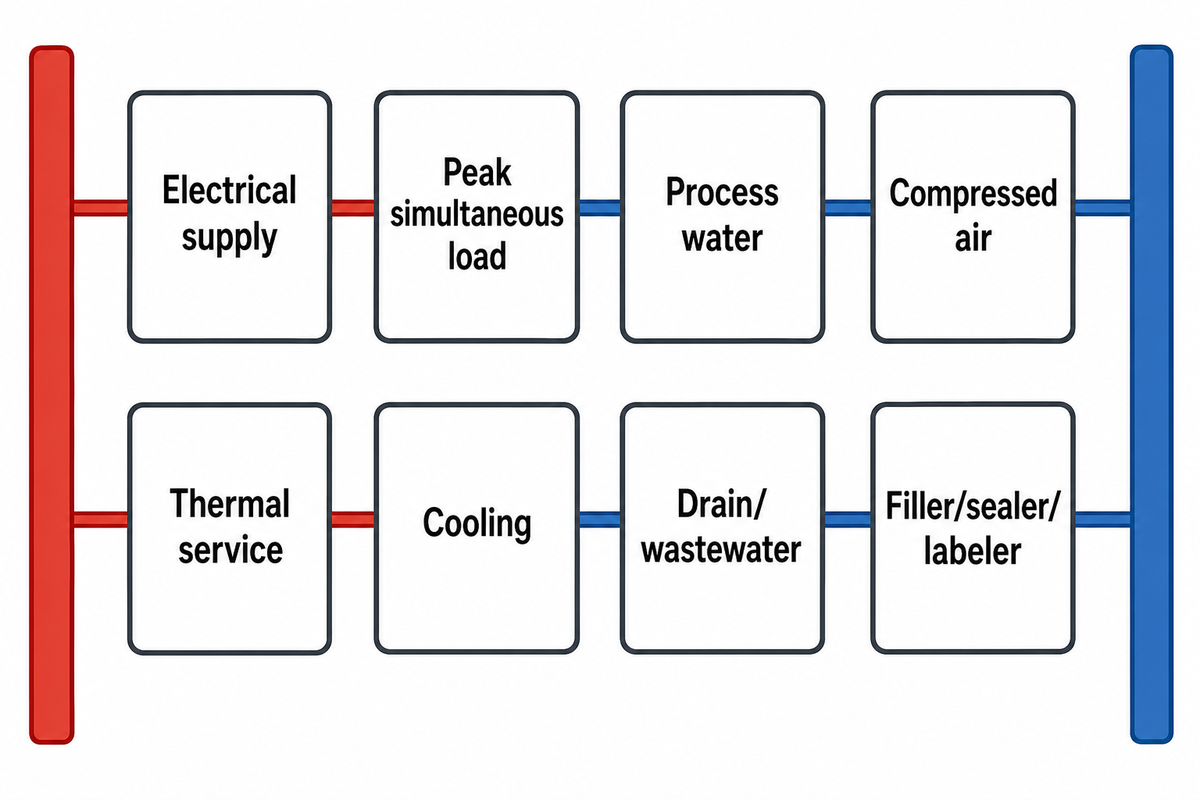
Close the vendor site boundary before layout approval. Make sure each connection has an owner. Record the unit, operating condition, simultaneous-use assumption, tolerance and connection point for every utility and downstream interface. Connected load, typical running demand and starting or cleaning peak loads aren’t the same.
A SINOFUDE Korean popping boba project case describes supplier work covering design, recipe/process support, installation and commissioning while the buyer prepared layout and site connections. It does not publish a witnessed yield, sample plan or sealed-package acceptance result.
| Interface | Condition to state | Vendor evidence | Site evidence | Owner |
|---|---|---|---|---|
| Electrical supply | Voltage, frequency, phases and tolerance | Load list and protection needs | Available supply and fault level | Electrical leads |
| Peak simultaneous load | Startup, production or cleaning case | Simultaneous-user schedule | Capacity check | Project engineer |
| Process water | Quality, temperature, pressure, peak flow | Point-of-use demand | Treatment and supply test | Site utilities |
| Wash water | Cleaning mode and simultaneous users | Flow/temperature envelope | Supply and recovery route | Sanitation/site |
| Compressed air | Pressure, quality and peak consumption | Demand and connection | Compressor/dryer capacity | Shared |
| Thermal service | Medium, pressure/temperature and duty | Heat-load case | Available source and condensate path | Shared |
| Cooling | Supply/return temperatures and peak duty | Required envelope | Plant capacity | Shared |
| Drain/wastewater | Peak flow, chemistry and solids | Discharge description | Capacity and permitted route | Site environmental |
| Ventilation | Heat, moisture and chemical use | Emissions/heat summary | Room assessment | Facility |
| Floor/access | Loads, route, clearance and maintenance removal | GA drawing and point loads | Survey and structural check | Facility |
| Cleaning chemistry | Concentration, temperature and exposure | Material/seal compatibility | Approved chemical program | Sanitation |
| Filler/sealer/labeler | Pack, drained dose, medium ratio and index rate | Interface and buffer limits | Approved packaging specification | Packaging lead |
It isn’t correct to assume reverse osmosis, pasteurization, hot fill or a particular room temperature. Decisions about product safety and preservation are made by the validated formula, package, and storage condition. The market of destination and qualified process authority play an important role. Record plant values in the connected-load planner, then reconcile them with the quoted configuration.
Food processing equipment descriptions also need a material boundary. Phrases like “mainly made of stainless steel” or “sus304 stainless” don’t identify all product contact parts, welds, or seals. Utility circuits also need defined material boundaries. Request a material schedule; don’t rely on a bare sus304 label to make an assumption about hygienic design. If separate downstream packaging is required, define its product and interface before choosing it.
A general candy packaging machine category doesn’t establish equipment compatibility with fragile liquid-core beads.
Clean the Wet Process Without Blurring Responsibilities

Stainless-steel construction or one cleaning-in-place connection does not prove full coverage, allergen removal, microbiological release or readiness for the next product. Cleanable equipment design, the facility sanitation program and verified post-clean release are separate obligations.
21 CFR 117.40 sets food-equipment design and food-contact-surface requirements; it does not provide approval for a particular machine.
The review should assess access, drainability, product-contact materials, seals, dead areas, removable parts, spray coverage, retained water, rinse disposal and chemical compatibility with respect to cleaning compounds. Determine which circuits are truly cleaned in place, which parts are cleaned out of place and which operations remain manual. “CIP-ready” without a circuit boundary, flow evidence and inspection points is not a complete statement.
What does a clean final-rinse record prove, and what does it not prove?
A defined final rinse result can show that the sampled rinse met its chemical or visual criterion at the sampled location and time. It doesn’t prove that all contact surfaces were reached, that retained product or allergens aren’t present, that microbiological or other requirements of the product are met, that the process is validated or that the product’s preservation process is valid. Those conclusions need their own methods, locations, limits and authorities.
There’s also an exposure boundary at the production step. As described in 21 CFR 117.130(c)(1)(ii), a hazard evaluation must consider environmental pathogens when a ready-to-eat food is exposed before packaging and the packaged food receives no later treatment or other control that significantly minimizes the pathogen. Relevance to the product and process determines applicability. This is not a claim that any SINOFUDE line is contaminated; it is a reminder to place open forming, rinsing and transfer steps correctly in the hazard analysis.
Flavor, color, allergen and formulation-family changes may require different evidence. A clear-to-clear flavor change may not represent a dark color, dairy core, or allergen change. Build the cleaning matrix around the most difficult justified transition, then verify it at the intended sample points.
Therefore, ‘hygiene’ refers to an operating system and not a surface finish. It connects equipment access, cleaning instructions, trained execution, inspection, verification, records and the food-safety plan.
‘global standards’ by itself is a poor cleaning requirement. Name the applicable jurisdiction, standard or customer specification and show how its exact requirement enters the design and release record.
Design FAT/SAT Evidence for the Bead, Machine and Package
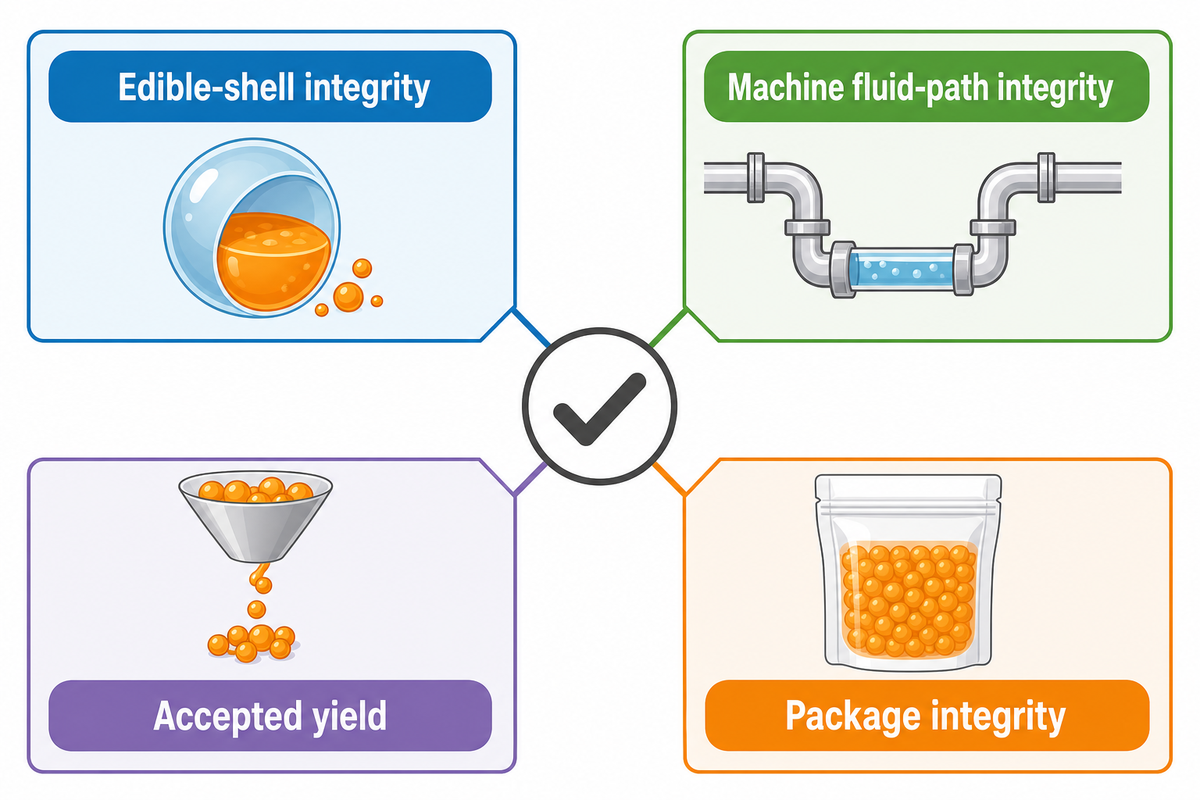
Before a popping boba factory acceptance test, the recipe and raw material lots should be finalized along with the run condition, sample plan, measurement method and disposition. It must treat edible-shell response, machine fluid path, accepted yield, and sealed package as separate questions.
Edible-shell integrity assesses whether a bead survives a defined handling or burst/leak test. Machine fluid-path integrity assesses whether components such as pipes, vessels, seals and connections leak or retain product. Accepted yield accounts for input, good beads, defects, rework and residue. Package integrity assesses whether closed packages meet their closure and leakage criteria. Passing one family can’t close another.
Don’t use terminology such as “bubble point,” “membrane filter” or “pressure decay” when evaluating an edible shell unless a separate machine component is being tested. A food bead isn’t a filter cartridge. Operations and quality teams must be able to repeat the test method defined by the product owners.
High-quality popping boba is a commercial description, not a measured acceptance result. Consistent quality requires the same methods to follow quality across the beginning, middle and end of the witnessed run.
| Acceptance item | Fixed condition | Measurement/sample | Evidence | Disposition rule |
|---|---|---|---|---|
| Recipe identity | Approved revision and stream assignment | Batch-record review | Signed formulation record | Mismatch stops comparison |
| Raw-material lot | Named lots and specifications | Identity/specification review | Lot genealogy | Unapproved substitution documented/retested |
| Diameter distribution | Buyer-approved target and tolerance | Defined count by nozzle/time | Distribution, not one average | Limit and retest plan |
| Shape defects | Named defect classes | Random/time-stratified sample | Counts with images | Agreed defect limit |
| Shell/leak response | Age, temperature and handling method | Product-specific method | Immediate and delayed results | Separate from machine leak test |
| Internal retention | Packing medium and observation window | Qualified composition/appearance test | Trend by interval | Product authority decides |
| Sustained accepted output | Full linked boundary and run clock | Drained accepted mass/time | Mass and stop ledger | Meet rate for agreed window |
| Reject/rework balance | Defect and rework definitions | Weigh/count all streams | Input-good-reject-residue balance | Unreconciled mass is an open item |
| Alarms/interlocks | Cause, safe state and reset | Challenge each function | Timestamped challenge sheet | Every critical test closes |
| Cleaning repeatability | Soil, method, chemistry and endpoints | Defined inspection/test points | Cycle record and release result | Open inaccessible areas block release |
| Changeover | From/to product family | Elapsed time and first-good sample | Task and loss record | Meet both time and product criteria |
| Package integrity | Material, fill, closure and process | Package-specific test | Closure/leak record | Separate product and process release |
Distinguish a dry machine check, product trial, factory acceptance test and site acceptance test from production qualification. A dry test verifies motion and function. A product trial establishes process evidence. Factory acceptance checks the contracted system under agreed factory conditions. Site acceptance repeats the site-dependent functions and interfaces. Production qualification shows repeatable performance with installed utilities, trained operators and controlled materials.
Food-safety boundary: the four-integrity acceptance model prevents edible-shell leakage from being confused with machine fluid-path, accepted-yield or sealed-package tests; it is not a shelf-stability release.
For applicable US shelf-stable acidified or low-acid foods, product classification, water activity, finished equilibrium pH, package and scheduled process require their own qualified evidence. There are separate sample prep procedures in 21 CFR Part 114 for liquid/solid mixtures. Spot-checking syrup pH or using a leak-tight container can’t be used to qualify a product process.
The FDA’s three-page acidified-food inspection form addresses scheduled process, pathogen control, finished equilibrium pH and container integrity. Not all popping boba products are in that category; the point is that equipment acceptance must not imply a product-safety conclusion it did not test.
SINOFUDE reports that its brand was founded in 1998, now operates three factories totaling more than 30 acres with more than 200 employees, introduced an ISO 9001 management system in 2004, holds 38 product patents, and has many products with CE or UL certification. They state they have laser cutting, laser and friction welding, CNC sawing, wire cutting, machining, turning, drilling and gantry milling. These company-level facts can justify requests for document review and manufacturing inspection. They do not replace a witnessed test of the buyer’s product, output basis and package.
Use the acceptance test specifier to freeze the inputs before the witness date.
When to Delay the Project and What to Prepare
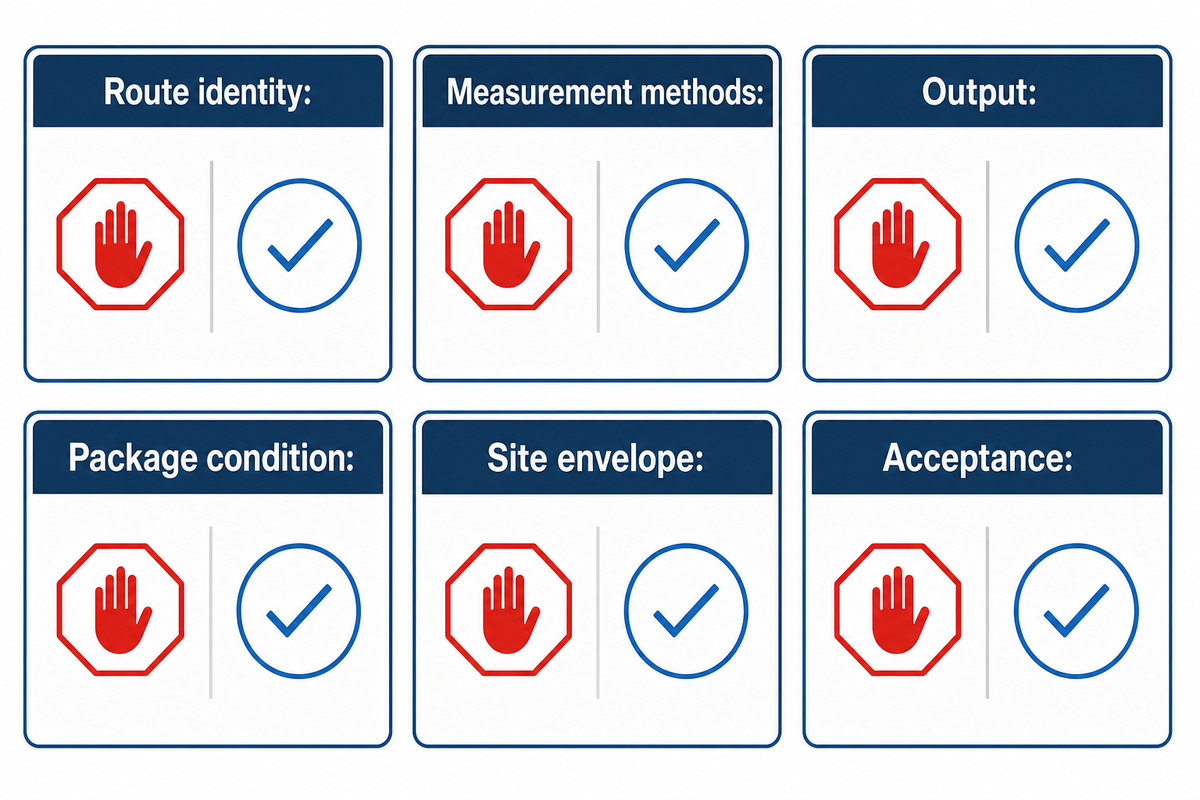
Equipment purchase can be deferred when a load-bearing input remains undefined: the process route, transferable recipe, measurement method, accepted-output basis, package condition, utility envelope or acceptance plan. Product development can continue through controlled pilot work or a suitable co-packer while those inputs are closed.
Oregon State identifies pilot manufacturing as a means to test, adjust and confirm the production of food products in a simulated real-world manufacturing environment. Its published service prices are institution-specific; they are not a general popping boba project budget.
NC State’s guide for selecting and using a co-packer cautions that the first plant trial may yield unusable product and calls for specification documents pertaining to ingredients, packaging, process and finished product as well as regulatory requirements. A co-packer can be a bridge, but verification of fit and availability is necessary.
The minimum project brief should name shifts, batch or campaign pattern, destination market, formula owner, evidence owner and the language of the required documents. When these are named, suppliers can also address the same issues. When they aren’t, an expedited quote is often a less comparable quote.
Expert support should be assigned by discipline: product/process authority, food safety lead, equipment engineer, packaging owner and site utility owner. A generic service promise can’t address the separate decisions.
Small batches may be the right route for product development, bottled drinks or limited food applications. Scale should follow the evidence required by the intended foodservice or retail pack, not an assumption that the largest line is automatically more efficient.
Turn the process brief into a testable line request

Present the formula family, bead sizes, accepted-output basis, pack formats, site limits, and proposed acceptance plan. SINOFUDE can then discuss actual configurations against one written boundary. For a U.S. site brief, 21 CFR 117.37 identifies water, plumbing, drainage and backflow controls that may need an assigned owner.
Frequently Asked Questions
How do popping boba production lines work?
They control two liquid systems, droplet formation and downstream handling
An industrial line prepares the product and bath under defined conditions, stabilizes the feed, forms repeatable droplets, gives each droplet the qualified contact time needed to develop an edible shell, then separates, rinses, transfers and packs accepted beads. The exact ingredient assignment, concentration, temperature and residence window must come from the qualified formula and trial record. Every stage should connect to a measurement and release decision.
What makes popping boba pop?
A thin edible shell surrounds a fluid core
The sensory “pop” comes from rupturing a thin hydrogel shell around liquid or a fluid core. Shell behavior depends on the actual calcium-alginate system, core formula, bath condition, contact time, bead geometry and downstream handling. A bead can look acceptable immediately yet leak, toughen, stick or exchange components with its medium later, so the qualification plan needs both immediate and delayed observations.
How should a buyer calculate the real capacity of a popping boba line?
Work backward from accepted packs on one mass basis
Start with saleable packs per hour and state the drained accepted bead mass per pack. Work upstream through fill yield, accepted bead yield, gross forming demand, bath residence inventory, rinse/transfer demand and depositor demand. Keep each value on the same time basis and include planned cleaning, product changes, sampling, startup loss and stops. The useful capacity is the lowest sustained accepted-output rate demonstrated with the target recipe, bead size and package.
Can one line make several bead sizes and flavors?
Potentially, but each product family needs a qualified window
Confirm nozzle and feed range, method-bound viscosity, bath loading, residence control, separation, rinse handling, packing fit and cleaning burden for every planned family. One successful flavor doesn’t prove the worst-case acid, solids, color, particulate or allergen transition. Record the settings and first-good-product evidence for each approved change.
What should a popping boba factory acceptance test measure?
Measure the product, linked line and agreed package boundary
Identify the exact recipe and raw-material lots, fix the run duration and sampling plan, and record diameter distribution, shape defects, shell response, drained accepted yield, rejects, rework and every stop. Challenge alarms and interlocks, document cleaning and changeover, and test the agreed package separately. Repeat site-dependent results with installed utilities and operators. Give each open item an owner, due date and release effect rather than issuing a blanket pass.
Company context and evidence boundary
Reviewed for SINOFUDE’s industrial audience. According to company information supplied for this article, SINOFUDE is based in Fengxian District, Shanghai, and serves confectionery, baking and chocolate production. Its stated values include quality, integrity, responsibility, cooperation, sharing and gratitude.
Company history, certifications, patents and machining capabilities support due-diligence questions. Ask for the actual document scope, current model data and product trial evidence for the configuration being purchased. Organization-level credentials do not create a performance guarantee.
References & Sources
- Spherification & Reverse Spherification Pennsylvania College of Technology
- Different Alginate Spherification Methods for Producing Hydrogel Beads PubMed Central
- Influence of Viscosity and Surface Tension on Calcium-Alginate Microbead Formation ScienceDirect
- Sodium Alginate Rheology and Calcium Alginate Gel Properties PubMed Central
- Optimizing Spherification with a Box-Behnken Design PubMed Central
- Alginate Spheres: Membrane Stability and Permeability PubMed Central
- 21 CFR 117.40, Equipment and Utensils Electronic Code of Federal Regulations
- 21 CFR 117.37, Sanitary Facilities and Controls Electronic Code of Federal Regulations
- 21 CFR Part 114, Acidified Foods Electronic Code of Federal Regulations
- 21 CFR 117.130, Hazard Analysis Electronic Code of Federal Regulations
- High-Mix/Low-Volume Manufacturers and Collaborative Robots NIST
- The Intelligent Production Line Configuration Strategy International Journal of Production Economics / RePEc
- Pilot Manufacturing Services Oregon State University
- Choosing and Using a Co-packer NC State Extension