Get in Touch with SINOFUDE Company



Updated September 2026 · By XCX
A Hard Candy Machine is a unit that takes production-ready candy mass, meters and controls its feed, forms repeatable parts, cools them, and moves them to inspection or packaging. It can be a single unit, or a combination of units in a continuous process. This industrial machine definition excludes a countertop cotton candy appliance. Functioning as intended can be observed at a named interface, but product quality cannot be confirmed from that interface observation alone. The functionality of a system can’t by itself determine product quality or process capability from interface observations. Similarly, release for human consumption can’t be determined from machine observations alone; food-safety release remains a separate facility responsibility.
Direct answerThe machine should accept a defined mass condition, create the intended geometry, release pieces without avoidable damage, cool them to a transferable state, and hand them to the next operation under recorded conditions.
5 handoffsFeed, form, release, cool, transfer
3 release layersMachine, product, food safety
1 commercial ownerConfiguration and quotation page
Key takeaways
- Motion isn’t proof of an accepted product handoff.
- A setpoint is a command; an actual value plus product response is evidence.
- A short acceptance run isn’t proof of long-term process stability.
- Stop buttons and alarms don’t replace authorized lockout/tagout.
- Model, capacity, utility, layout, price, and RFQ decisions belong to the SINOFUDE Hard Candy Machine solution page.
What an Industrial Hard Candy Machine Is, and What It Is Not
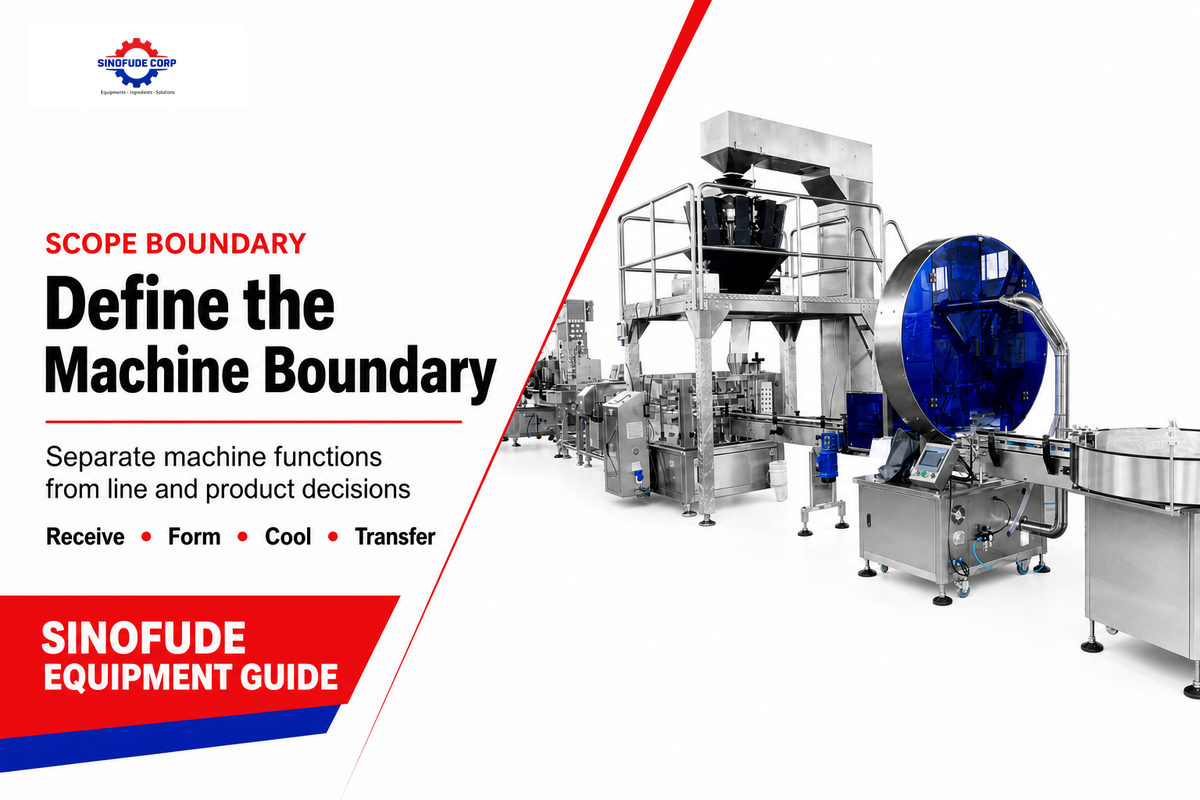
An industrial hard candy machine changes a qualified candy mass into controlled pieces and transfers them toward cooling, inspection, or packaging. One system can be made up of a combination of several units. Countertop candy vending machines and cotton candy spinning machines aren’t part of this industrial hard-candy system.
| Category | What enters | What changes | What leaves |
|---|---|---|---|
| Industrial line | Prepared mass plus production identity | Feed, geometry, cooling, transfer | Pieces ready for the agreed downstream boundary |
| Forming station | Mass in the route-specific receiving condition | Dosing, rope sizing, die cutting, or another forming action | Formed pieces that still need release and cooling |
| Drop roller | A conditioned rope or sheet suited to that roller design | Manual or small-scale shaping between forming rollers | Pieces requiring separation and handling |
| Consumer appliance | Inputs allowed by its manual | A home-use spinning, melting, or novelty process | A consumer sweet, not an industrially accepted lot |
This article covers only the equipment side of confectionery manufacturing. Recipe development, boil endpoint reasoning, and the wider candy making process belong in the hard candy manufacturing process guide, while route selection and project scope belong on the commercial page. Deciding on a route should remain on the commercial page.
Use this guide for
working logic, alarms, interfaces, commissioning observations, maintenance records, and document checks.
working logic, alarms, interfaces, commissioning observations, maintenance records, and document checks.
Use the machine page for
route, model, capacity, utility, layout, change-part, price, and quotation decisions.
route, model, capacity, utility, layout, change-part, price, and quotation decisions.
| Term cluster | Why it appears | Treatment in this guide |
|---|---|---|
| Candy making equipment, machinery, candy sweets, variety of candy, quality candy, candy design, variety of shapes | Broad confectionery search language | Kept only where it describes the industrial machine boundary |
| Gum, caramel, toffee, caramel mass, dragee, lollipop, coating, pillow pack | Adjacent products and package formats | Named as separate routes; no compatibility is implied |
| Sieve, steam jacket, cooling fan, food-grade stainless steel bowl, knead, spray, rollers with a confectionery spray | Possible component or operating phrases | Require configuration evidence; none is treated as standard equipment |
| High-quality, high quality, high-performance, efficiently, enhancing efficiency | Unmeasured marketing language | Rejected unless tied to an observable method and result |
| Nostalgia countertop cotton candy machine, retro cotton candy machine, perfect for home, candy machine with 5 jars, vintage cotton candy maker, commercial cotton candy machine, durable retro design | Consumer and vending-query pollution | Explicitly excluded from the industrial topic |
Scope rule
A buyer can call one former a candy machine, but the contract must state the upstream supply point and the downstream acceptance point. The name alone does not define the line boundary.
A buyer can call one former a candy machine, but the contract must state the upstream supply point and the downstream acceptance point. The name alone does not define the line boundary.
How a Hard Candy Machine Works: Five Machine-Side Handoffs
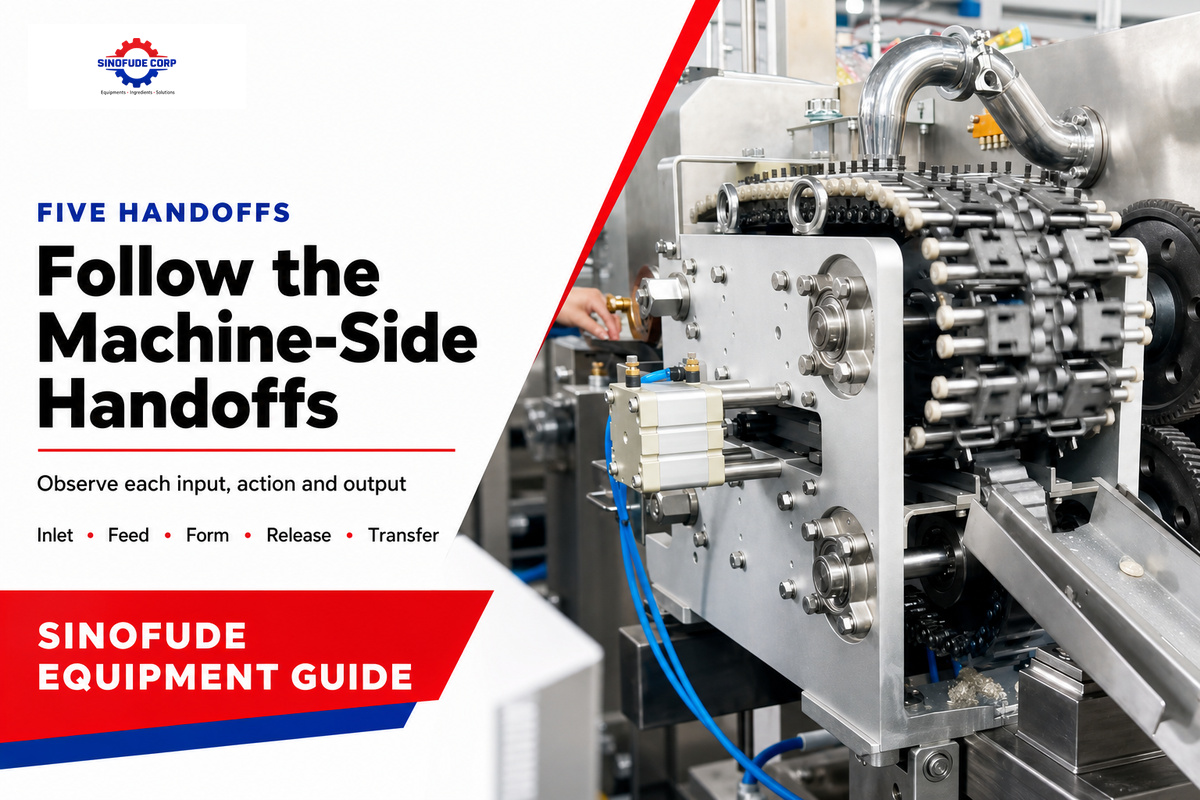
Operators use five observation steps in this Hard Candy Machine guide to record the first unstable interface before changing settings. The first is the control of the feed. The second is the geometry of the parts. The third is cooling. The fourth is releasing the parts. The fifth is moving the cooled parts to the next step in the process. Each step has an input, a process, and an output. Operators locate the first unstable step before adjusting the process.
5-Handoff Observation Framework: Machine-Side Handoff Card
The framework binds every machine action to an observable input and output before an adjustment is made.
- Qualified mass at inlet: identity, route, physical condition, and delivery continuity are known.
- Controlled feed: the machine receives mass without starvation, flooding, or unexplained interruption.
- Repeatable geometry: dosing or forming creates pieces that match the agreed observation method.
- Stable cooling release: pieces separate and travel without unacceptable sticking, fracture, or distortion.
- Undamaged transfer: spacing, orientation, and condition suit inspection or wrapping.
There are two observations that are made at the incoming step. The first is the condition of the candy mass. The second is the behavior of the feeding mechanism. One of the first checks for a forming defect is to record the inlet mass condition and feed behavior before assigning cooling temperature as the cause.
| Handoff | Observable input | Machine action | Output evidence | Do not infer |
|---|---|---|---|---|
| Inlet | Mass identity, arrival condition, continuity | Receive and present | Stable supply to the feed zone | Recipe quality from appearance alone |
| Feed | Level, pressure, load, speed, presence | Meter or size | Continuous route-specific delivery | Accepted output from commanded speed |
| Form | Feed timing and tool position | Deposit, size, cut, or stamp | Piece geometry by an agreed method | Capability from one acceptable sample |
| Release | Piece surface and carrier condition | Separate and cool | Stable release without avoidable damage | Shelf-life stability from machine release |
| Transfer | Spacing, orientation, downstream ready state | Convey and hand off | Accepted receiving response | Wrapper performance from former motion |
Composite troubleshooting scenario: There’s no constant forming; the hard candies begin to drag at release while feed load and piece geometry remain stable. Maintenance first checks the carrier, release surface, airflow, and transfer timing instead of raising forming speed. The quality team reviews retained samples and formulation before assigning a machine cause. The quality team also reviews residual moisture, storage temperature, and relative humidity because those conditions can change sticking independently of machine performance.
The 2024 hard-candy review indexed by PubMed identifies formulation, processing, storage temperature, and relative humidity as quality variables. The machine card helps locate an equipment interface; it does not replace product or storage investigation.
Handoff rule
Record the last supported input, the action taken, and the first unacceptable output. One stable interface narrows the search; it does not prove every downstream condition.
Record the last supported input, the action taken, and the first unacceptable output. One stable interface narrows the search; it does not prove every downstream condition.
Read the Controls: Sensors, Recipes, Interlocks, and Alarms

Operations use recorded setpoints, actual values, permissives, interlocks, alarms, and causes to derive conclusions instead of relying on accumulated knowledge alone. They use separate evidence fields to distinguish set points, actual process values, permissives, interlocks, alarms, trips, and recorded causes. Recipe values command the machine; a qualified result needs an observed process response and accepted product evidence.
| Signal type | What it may show | Evidence to retain | Boundary |
|---|---|---|---|
| Temperature | Measured thermal condition at a named point | Setpoint, actual, sensor identity, time | Does not prove the whole mass shares that condition |
| Pressure or vacuum | Equipment state or delivery condition | Actual value, trend, valve or pump state | Configured location changes the meaning |
| Speed | Commanded or measured axis rate | Command, feedback, product response | Speed alone is not accepted throughput |
| Level | Material availability or hold-up | State change, feed response, alarm time | Sensor fouling can imitate a true level |
| Position | Axis, die, mould, or carrier location | Reference, feedback, timing relation | Position feedback does not prove good release |
| Motor load | Changing mechanical or product resistance | Operating state, load trend, inspection result | Load is a clue, not a diagnosis |
| Presence | Product or carrier reached a sensing point | Sensor state, sequence step, physical check | Presence does not establish orientation or quality |
| Interlock | A required safety or sequence condition is absent | Condition, cause, authorized response | Never treat bypass as routine recovery |
| Alarm | Defined logic detected an exception | First occurrence, related actuals, correction, result | Reset clears a state, not necessarily the cause |
The deposited-candy patent, US20130004622A1, outlines a bounded example containing a controller which employs sensors, encoders, alarms, load, flow, temperature, and timing inputs. It illustrates how evidence is integrated. An embodiment of a machine doesn’t prove another machine’s performance.
“One or more methods of machine guarding shall be provided to protect the operator and other employees.”
Composite alarm scenario: A depositor reports a position fault after several brief feed interruptions. Motion was restored with each reset of the fault. The operator failed to document the level, feed continuity, and encoder position. No record identified the first affected piece. The team, engineering, and maintenance stop repeated resets, check the permitted safe condition, record the signal chain, and then review the control logic and mechanical cause. The permitted state and control logic are assessed by engineering while maintenance inspects the mechanical cause.
Hazardous-energy boundary
Push buttons, selector switches, stop commands, programmable interlocks, and alarms are not energy-isolating devices. Servicing follows the plant’s authorized lockout/tagout procedure and the machine documentation under the applicable OSHA 1910.147 requirements.
Push buttons, selector switches, stop commands, programmable interlocks, and alarms are not energy-isolating devices. Servicing follows the plant’s authorized lockout/tagout procedure and the machine documentation under the applicable OSHA 1910.147 requirements.
Operator owns
Observation, permitted response, evidence entry, and escalation within approved work instructions.
Observation, permitted response, evidence entry, and escalation within approved work instructions.
Maintenance owns
Authorized isolation, inspection, repair, replacement, and return-to-service evidence.
Authorized isolation, inspection, repair, replacement, and return-to-service evidence.
Engineering owns
Logic, limit, design, revision, and validated-setting changes under change control.
Logic, limit, design, revision, and validated-setting changes under change control.
Turn Specifications Into Observable Evidence
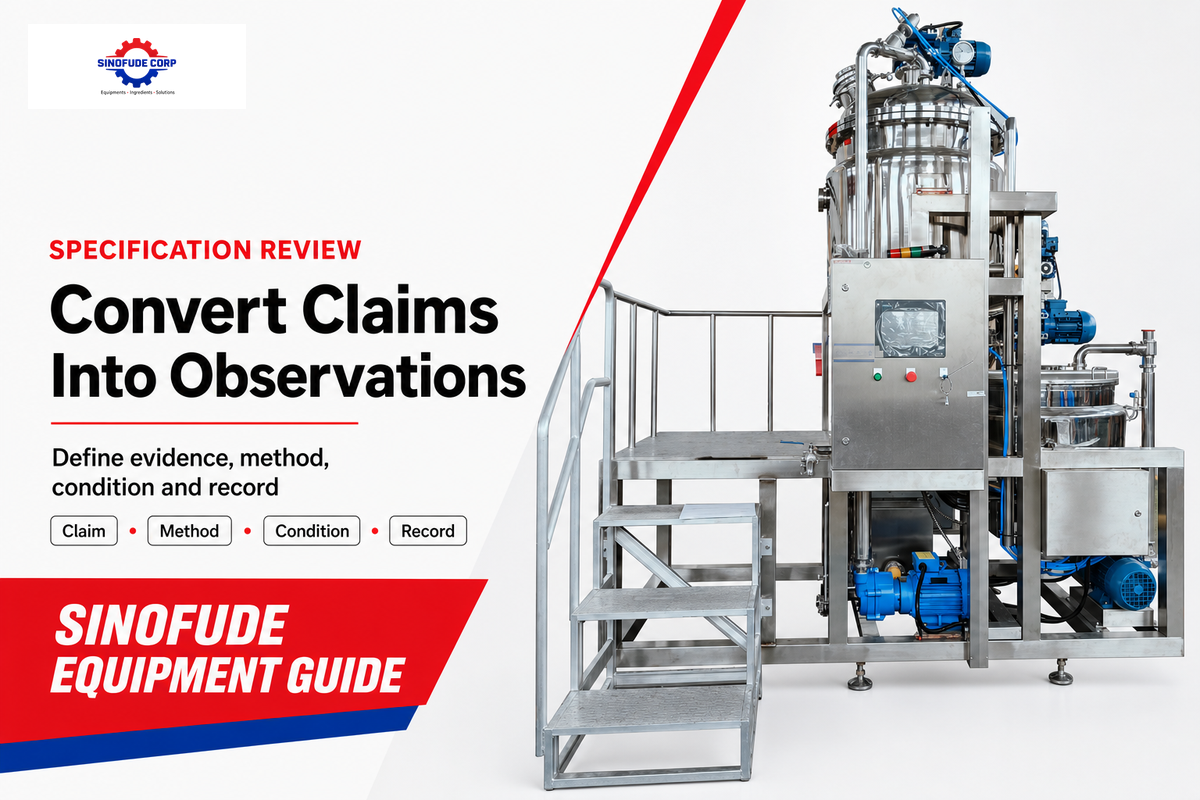
A machine specification becomes useful when the buyer can name the test condition, observation method, sample basis, result record, and acceptance owner. For the remaining specifications, document the product conditions, constraints, allowable exceptions, and acceptance owner used to evaluate each specified requirement.
| Supplier statement | Boundary conditions | Observable measurement | Sampling record | Acceptance owner |
|---|---|---|---|---|
| Rated output | Product, piece, route, feed, shift basis | Accepted kg/h or pieces/min at the agreed boundary | Time window, rejects, stops, retained result | Buyer and supplier sign-off |
| Piece-weight range | Recipe family, tool, feed condition | g/piece by an agreed method | Sample location, sequence, instrument status | Quality and production |
| Depositing speed | Head, cavity, mass, mould, timing | Cycles/min plus accepted piece result | Actuals, faults, piece checks | Production and engineering |
| Rope or die size | Mass condition, sizer, die, cooling | mm geometry at named points | Tool identity and piece sample | Production and quality |
| Cooling residence | Load, spacing, air state, room condition | min plus release and transfer response | Entry, exit, condition, time | Process and quality |
| Connected load | Installed scope and operating state | kW, A, voltage, frequency where applicable | Drawing, nameplate, measured condition | Electrical owner |
| Changeover time | Start and end state, parts, cleaning scope | min under the written boundary | Task timestamps and deviations | Production and sanitation |
| Alarm response | Defined challenge and safe state | s to response plus state evidence | Cause, action, result, reset owner | Controls and safety owner |
| Cleanability claim | Product-contact boundary and soil | Access, dismantling, inspection, verified procedure | Parts, tools, findings, release record | Sanitation and quality |
Rated output and accepted saleable output answer different questions. The first describes a stated machine rate under defined conditions. The saleable output is what the machine actually achieved after subtracting rejected pieces, interface stops, and downstream nonacceptance under the agreed test basis.
Units are fields, not promises.
The grid names kg/h, pieces/min, g/piece, cycles/min, mm, min, kW, A, and s so a test record has a measurable form. It supplies no universal value or acceptance limit.
The grid names kg/h, pieces/min, g/piece, cycles/min, mm, min, kW, A, and s so a test record has a measurable form. It supplies no universal value or acceptance limit.
One bounded run suggests the machine conformed within the limitations of the test. The NIST process-stability handbook (https://www.itl.nist.gov/div898/handbook/ppc/section4/ppc45.htm) states that the discussion on capability of a process won’t be warranted until process stability has been established, so it wouldn’t be appropriate to give a short-term process a capability classification and assign it a long-term process status.
Procurement objection
“The datasheet already lists the number” is not a test method. Ask what product, operating condition, time window, sampling rule, reject treatment, and receiving boundary produced that number.
“The datasheet already lists the number” is not a test method. Ask what product, operating condition, time window, sampling rule, reject treatment, and receiving boundary produced that number.
Depositing and Die Forming Change What Operators Watch

Both die and depositor forming can produce the desired product; however, their mechanisms and constraints differ. Die-forming routes follow batch or rope condition, sizing stability, die timing, piece release, and transfer. A depositor focuses on mass delivery, dosing, cavity or mould interaction, release, and synchronized cooling.
Depositing watchlist
- Mass delivery and level state
- Head, manifold, nozzle, and cavity behavior
- Dose consistency and tailing or stringing evidence
- Mould movement, position, and release
- Cooling handoff and piece separation
Die-forming watchlist
- Batch or rope receiving condition
- Rope sizer stability and alignment
- Die timing, fill, and cut behavior
- Piece release and forming marks
- Cooling and wrapper transfer
A drop roller candy machine operates at a different scale and duty from an automatic, continuous industrial system. Design aspects such as roller surface, engraved shape, drum handling, and separation method should be examined in this context, not treated as a low-cost substitute for every production route.
Terminology boundary: a candy maker machine, vintage candy roller, or countertop candy making machine may appear in search results, but those phrases do not define an industrial project. This guide excludes candy floss makers, a cotton candy machine for kids, jar dispensers, and home-use retro appliances; searches for “small hard candy machine” and “hard candy machine commercial” still require the same industrial-versus-consumer scope check.
Instead of asking “what should the operator be looking for?”, ask “which route fits my product?” and move that commercial decision to the machine owner. Continue on the candy depositing machine project page or the main machine owner. Configuration involves providing information on the product, format, the accepted product output, the available working space, utilities, and product packaging.
Route rule
Compare the observation burden and project boundary, not a generic claim of efficiency. Neither route is universally better, and neither list establishes a model recommendation.
Compare the observation burden and project boundary, not a generic claim of efficiency. Neither route is universally better, and neither list establishes a model recommendation.
Commission From Dry Checks to Product-Qualified Operation
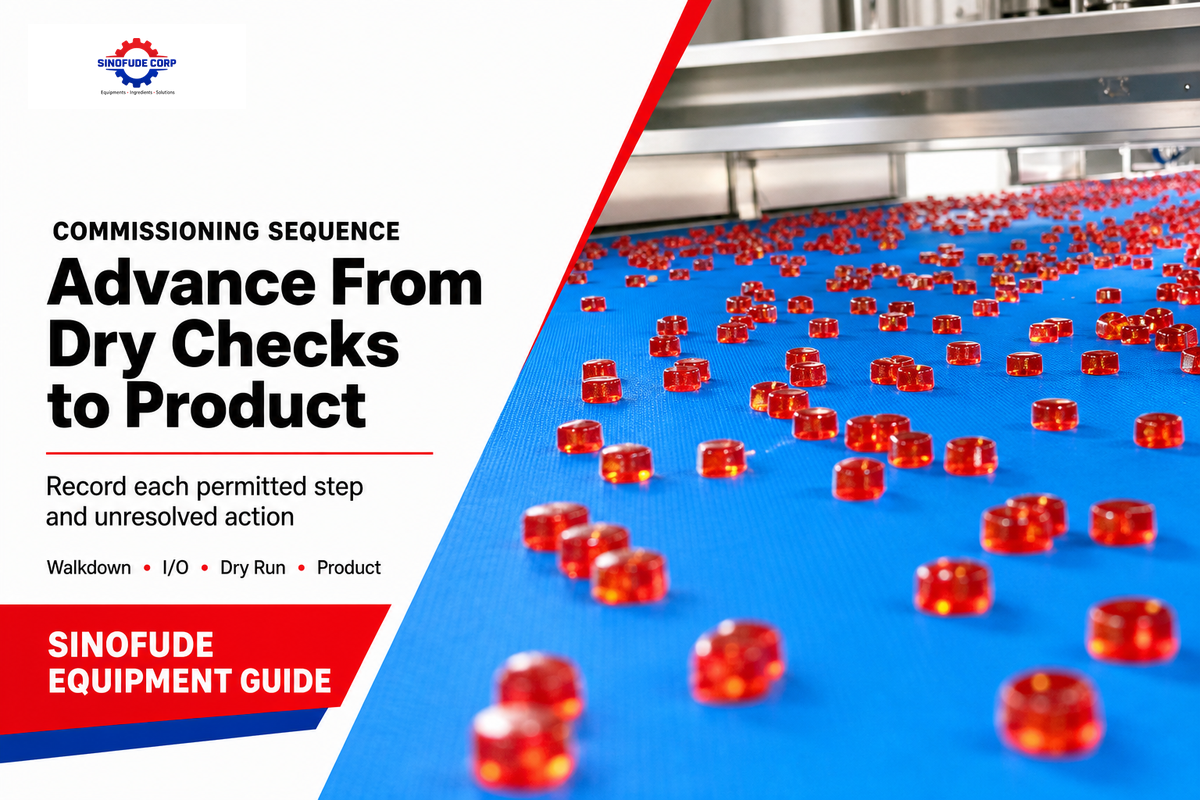
Validation can focus on product samples, but each commissioning stage should answer a different question about the system components and product. The extent to which system components and product behave as intended is checked by moving from documents and safe static checks to utilities, I/O, dry sequence, controlled material introduction, product-qualified observation, and a signed handoff record. An empty system doesn’t validate product quality, cooling release, wrapper acceptance, or food-safety release.
Dry-to-Product Commissioning Sequence
- Document check: approved drawings, manuals, lists, revisions, and open items.
- Safe mechanical walkdown: installation, access, guards, fasteners, parts, and visible condition.
- Utilities and I/O confirmation: supplied conditions, point identity, state, direction, and response.
- Dry sequence: permitted motions, timing, permissives, interlocks, alarms, and safe stops.
- At this stage, Controlled material introduction: low-risk route checks under an approved plan.
- Next, Product-qualified observation: agreed product, sampling, result, rejects, stops, and downstream response.
- Handoff record: deviations, retests, owners, training, documents, and unresolved actions.
Composite commissioning scenario: Dry run and I/O checks, guards, and alarms pass, yet the first articles of product are produced with acceptable shapes that reach the wrapper at unstable spacing. Shapes are produced, but their unstable product spacing leaves the downstream handoff open. As such, the forming machine has satisfied only part of the handoff. Before signing, the team records entry condition, conveyor state, product spacing, wrapper-ready signal, rejects, and open-item ownership. This is done prior to obtaining any acceptance signature.
Three releases must stay separate.
Machine readiness covers installed and functional equipment evidence. Product acceptance covers the agreed output under recorded conditions. Food-safety release remains with the facility’s qualified system and authorized personnel.
Machine readiness covers installed and functional equipment evidence. Product acceptance covers the agreed output under recorded conditions. Food-safety release remains with the facility’s qualified system and authorized personnel.
The FDA preventive-controls overview places hazard analysis, preventive controls, monitoring, corrections, corrective actions, verification, and records inside the food-safety plan. A successful product run does not replace sanitation, allergen, preventive-control, or release obligations.
| Evidence stage | Question answered | Record kept | What remains open |
|---|---|---|---|
| Static and dry checks | Is installed equipment ready for controlled motion? | Walkdown, I/O, interlock, alarm, safe-stop result | Product behavior and downstream acceptance |
| Material introduction | Can the route receive and move the mass as planned? | Input condition, setting, sequence, deviation | Accepted output and long-term stability |
| Product-qualified run | Does output meet the agreed acceptance method? | Samples, rejects, stops, transfer, sign-off | Capability, shelf life, food-safety release |
| Handoff and retest | Are deviations closed or assigned? | Owner, due state, correction, retest, revision | Any item not supported by completed evidence |
Acceptance objection
“The machine already ran product” is incomplete. Ask which product, which conditions, which sampling method, which downstream boundary, which deviations, and who signed the result.
“The machine already ran product” is incomplete. Ask which product, which conditions, which sampling method, which downstream boundary, which deviations, and who signed the result.
Maintain Condition by Recording Drift, Not Just Failures
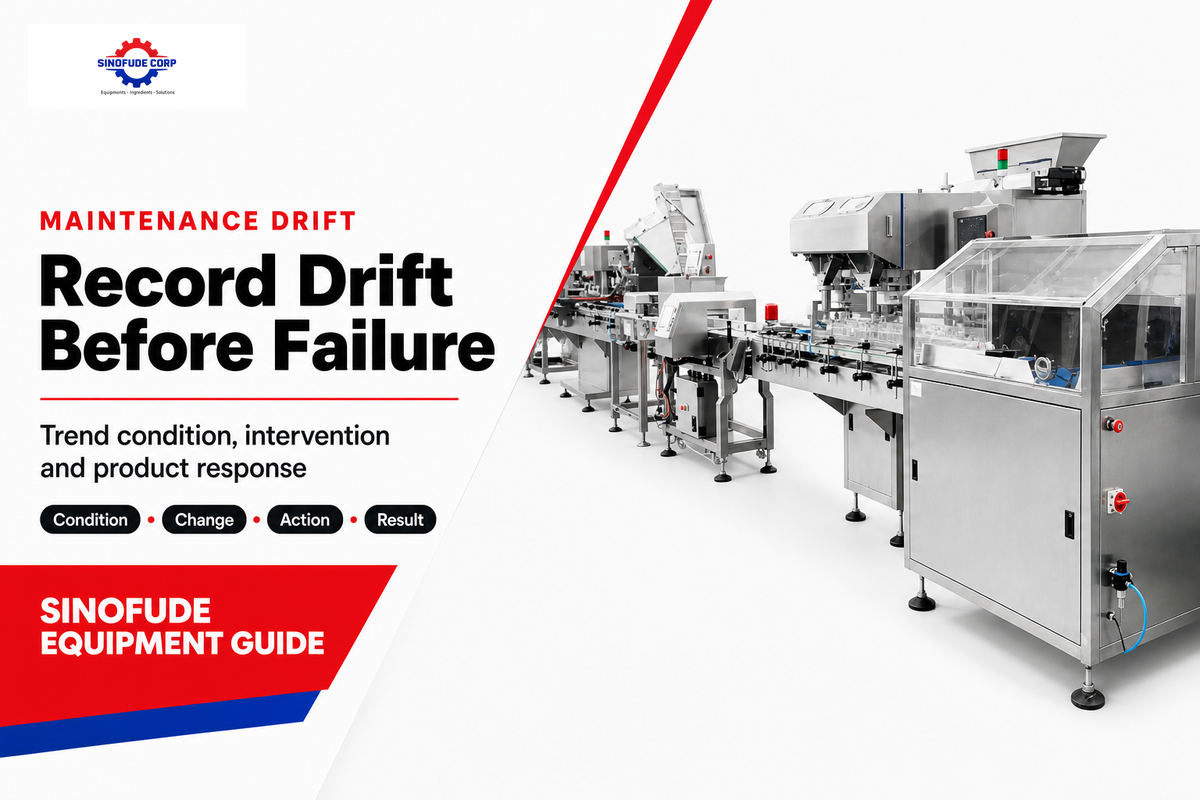
Condition-based maintenance starts with repeatable observations tied to operating context. This process connects evidence across operators, maintenance, and engineering instead of describing only how a device operates. Variation in drive loads, speed, position faults, rope or dose variation, leakage, looseness, abnormal sounds, and temperature drifts become relevant only after documentation of the product state, machine state, and time, along with the inspection, correction and retest.
| Field | Example entry | Why it matters |
|---|---|---|
| Symptom | Repeated position fault after warm-up | Names the observed event, not a guessed cause |
| Operating state | Product run, configured recipe revision recorded | Separates load-dependent behavior from idle behavior |
| First observed | Timestamp and batch reference | Defines the investigation window |
| Affected interface | Feed-to-form timing | Keeps scope narrower than the whole line |
| Inspection result | Alignment, fastener, wear, sensor state documented | Provides evidence for or against competing causes |
| Correction | Authorized repair or setting restoration | Makes the intervention traceable |
| Retest | Dry and product result under named conditions | Shows whether the symptom changed |
| Recurrence | Date, state, same or changed signature | Distinguishes a one-time event from a pattern |
The following row is a hypothetical example; it contains no machine limit. It shows how various kinds of evidence are related to operators, maintenance, and engineering.
Fraunhofer’s predictive-maintenance method separates data acquisition, condition monitoring, prediction, and cost evaluation. An alarm count becomes useful only after the plant can explain the operating context and inspection result.
Finished-candy defects deserve their own investigations because defects can manifest in numerous ways across multiple recipe and product boundaries including machine, room, and storage. Use the hard candy defects guide for information on product-side tracing.
Ask for evidence
Maintenance access, change-part identity, lubrication points, inspection method, cleanability boundary, and return-to-service record.
Maintenance access, change-part identity, lubrication points, inspection method, cleanability boundary, and return-to-service record.
Reject vague claims
“Easy to clean and maintain” without parts, access, tools, sequence, inspection, and ownership.
“Easy to clean and maintain” without parts, access, tools, sequence, inspection, and ownership.
Maintenance rule
Record drift before failure, but do not call every change predictive. The evidence chain needs a stable observation method, context, inspection, correction, and repeat result.
Record drift before failure, but do not call every change predictive. The evidence chain needs a stable observation method, context, inspection, correction, and repeat result.
Build the Evidence Pack Operators and Buyers Need
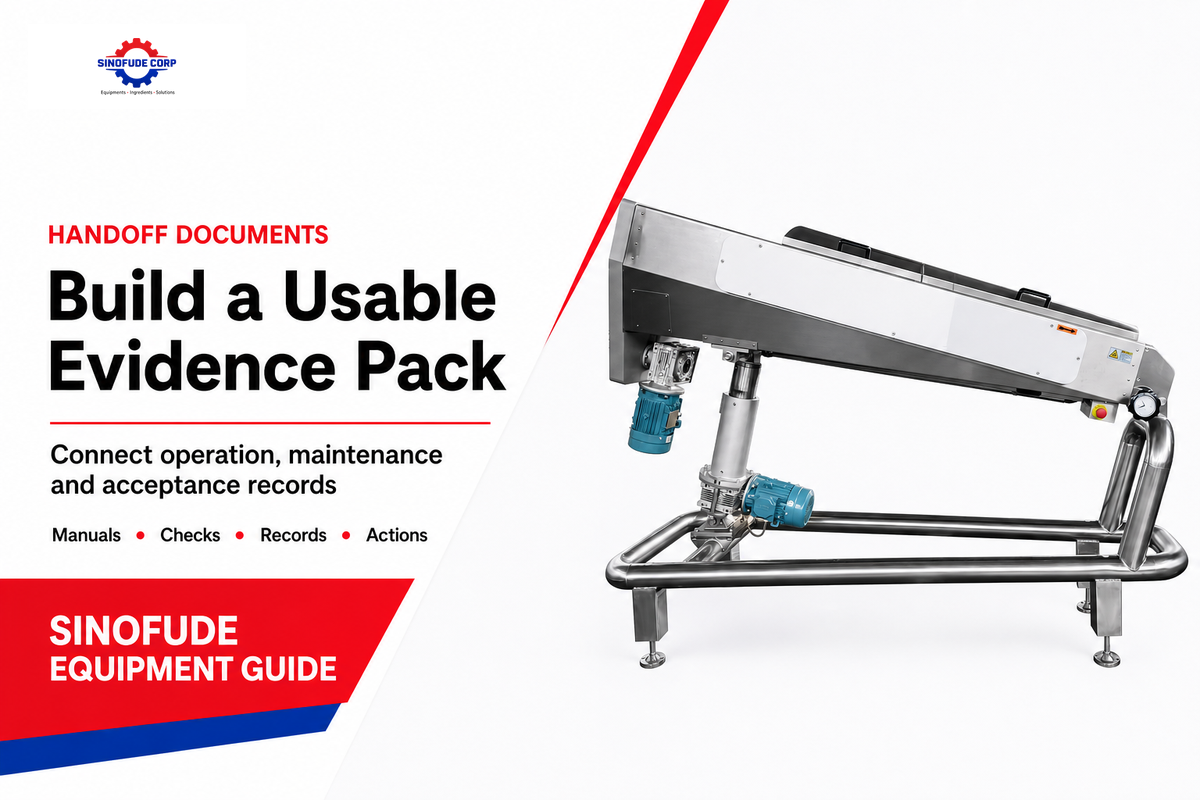
A useful evidence pack ties each document and record to the delivered machine, controlled revision, responsible owner, and verification state. A title in a transmittal list does not prove that the drawing, alarm list, change-part register, cleaning boundary, or maintenance task matches the installed equipment.
| Evidence item | Owner | Verification question | Revision status |
|---|---|---|---|
| Approved layout and assembly drawings | Project engineering | Do installed interfaces and access match? | Approved, redlined, or as-built |
| Component list | Supplier and maintenance | Do identifiers match installed components? | Delivered configuration |
| Utility schedule | Plant engineering | Are connection points and operating basis clear? | Issued for operation |
| I/O and alarm list | Controls engineering | Does each tag, cause, state, and response agree? | Logic-matched revision |
| Change-part register | Production and maintenance | Are parts linked to products, tools, and settings? | Released set |
| Lubrication schedule | Maintenance | Are point, material, method, and interval identified? | Current task revision |
| Preventive-maintenance tasks | Maintenance planning | Do tasks state access, isolation, inspection, and acceptance? | CMMS-linked where used |
| Cleaning boundaries | Sanitation and quality | Are product-contact, dismantling, soil, and inspection scopes defined? | Approved procedure reference |
| Spare-parts basis | Maintenance and procurement | Is the recommendation tied to installed parts and duty? | Quoted and delivered status |
| Training records | Operations and EHS | Who was trained on which revision and task? | Attendance plus competency route |
| Test protocols and results | Buyer and supplier | Do conditions, method, result, deviation, and signature agree? | Executed and controlled |
| Open-item register | Project manager | Does every deviation have an owner and retest path? | Open, closed, or accepted exception |
Cleanability and maintenance access should be checked against the installed configuration, not inferred from stainless steel alone. The Cornell hygienic-design resource and NSF food-equipment standards overview explain the scope of hygienic equipment questions without certifying a particular machine.
Certification boundary: company-level statements about ISO management, CE, UL, or patents cannot be converted into a claim about one quoted model. Buyers should verify the actual declaration, listing, scope, standard, drawing, and revision that apply to delivered equipment.
According to the brand information supplied for this article, SINOFUDE was founded in 1998 and now operates three factories with more than 200 employees. The company says it adopted ISO 9001 management in 2004, holds 38 product patents, and supplies confectionery, chocolate, and bakery production equipment; project documents still need model-specific verification.
Responsibility boundary: machine records support equipment verification. The plant’s food-safety plan owns hazard analysis, sanitation, allergen control, corrective action, verification, and release decisions under the rules that apply to that facility.
Document objection
“The manual was supplied” is not completion. Verify that its model, serial or configuration identity, parts, alarms, procedures, and revision match the machine in front of the team.
“The manual was supplied” is not completion. Verify that its model, serial or configuration identity, parts, alarms, procedures, and revision match the machine in front of the team.
Decision Framework: Learn Here, Configure on the Machine Page

Use this guide when the decision concerns machine behavior, evidence, alarms, commissioning, maintenance, or documents. Use the commercial owner guide when making decisions regarding route, model, capacity, utilities, layout, changeover parts, cost, and quotations. Maintaining this separation prevents duplication of efforts in providing responses to the same query.
| Information need | Correct owner | Next evidence |
|---|---|---|
| How the equipment handoffs work | This guide | Machine-Side Handoff Card |
| How to read an alarm or interlock | This guide plus machine documentation | Signal, condition, response, cause record |
| How to turn a claim into a test | This guide | Spec-to-Observation Translation Grid |
| Which forming route fits the product | Commercial machine owner | Product and route brief |
| Which model and capacity to quote | Commercial machine owner | Accepted-output and project basis |
| How to compare quotation scope | Commercial owner and RFQ tool | Same boundary, exclusions, test, and documents |
For a configured project discussion, review SINOFUDE’s Hard Candy Machine configurations and project-scoping route. Bring the product, operating, and evidence requirements rather than asking the keyword alone to define the machine.
Bring Your Evidence Requirements to SINOFUDE
Share the product family, piece definition, forming route question, accepted-output basis, utility and layout inputs, packaging handoff, document scope, and proposed acceptance method. SINOFUDE can use that brief to discuss a project-specific configuration.
Related project resources
Frequently Asked Questions
The following questions distinguish industrial equipment guidance from household appliances and commercial configuration. Each answer keeps the machine-side evidence boundary intact. Product-specific limits, legal duties, and safe work steps still come from the applicable plant program, machine documentation, and qualified personnel.
What equipment do you need to make hard candy?
Answer
Industrial production generally needs controlled ingredient preparation and cooking, mass transfer or conditioning, a suitable depositing or forming system, cooling, inspection, and a packaging handoff. The exact boundary changes with recipe, format, filling, accepted-output basis, room condition, and pack method. A written interface list should identify which supplier owns each connection. Configuration and quotation belong to the commercial machine owner.
How much does a candy making machine cost?
Answer
There’s no defensible universal price because “machine” can mean a small former, one depositor, or an integrated line. Scope may include cooking, cooling, controls, change parts, installation, training, and acceptance testing.
A comparable quotation needs the product brief, accepted-output basis, utilities, layout, line boundary, and evidence requirements. Buyers should also align the product trial, factory test, site work, documentation, spare-parts basis, training language, and exclusions before comparing totals. A lower number can describe a smaller boundary rather than a better offer, so ask both suppliers to identify buyer-supplied work.
Can I put hard candy in a cotton candy machine?
Answer
Some consumer cotton candy appliances state that certain hard candies are compatible, but that process is different from industrial hard-candy manufacturing. This guide covers equipment that forms manufactured hard candy pieces, not a spinning-sugar appliance.
A consumer device may use candy as a feedstock for spun sugar, while industrial equipment receives a controlled mass and forms separate pieces for cooling and packaging. Food form and sugar size can matter to a listed consumer process. Consumers should follow the exact appliance manual, keep within its stated inputs, and shouldn’t infer brand or ingredient compatibility from this industrial article.
What is the difference between a hard candy machine and a hard candy production line?
Answer
A hard candy machine may mean one cooker, depositor, former, cooling unit, or connected system. A production line defines controlled interfaces from prepared mass through forming, cooling, and downstream transfer. Buyers should write the upstream supply point, downstream acceptance point, utilities, controls, documents, and test boundary instead of assuming them.
What should be checked before restarting after maintenance?
Answer
Follow the plant’s authorized safety release and the machine documentation. Confirm guards and interlocks, account for tools and parts, check completed work, restore approved settings and revisions, observe the permitted dry sequence, perform required first-product checks, record deviations, and obtain the site’s separate food-safety release. A generic list never replaces the local procedure.
Research Transparency
This guide combines current OSHA, FDA, eCFR, NIST, academic, standards-scope, patent, and applied-research evidence with clearly labelled engineering synthesis. It makes no invented claim about machine price, capacity, lead time, efficiency, changeover duration, acceptance limit, certification scope, statistical capability, food-safety release, or customer outcome.
References & Sources
- OSHA: 29 CFR 1910.212, General Requirements for All Machines
- OSHA: 29 CFR 1910.147, Control of Hazardous Energy
- Electronic Code of Federal Regulations: 21 CFR Part 117
- FDA: Preventive Controls for Human Food
- NIST/SEMATECH: Assessing Process Stability
- PubMed: Hard Candy Production and Quality Parameters, 2024 review
- Google Patents: US20130004622A1 deposited-candy mechanism disclosure
- Fraunhofer ITWM: Predictive Maintenance
- Cornell Institute for Food Safety: Cleaning, Sanitizing, and Hygienic Design
- NSF: Food Equipment Standards