Get in Touch with SINOFUDE Company


Updated September 2026
Written by XCX
Technical Guide for Confectionery Project Teams
Hard Candy & Lollipop Production Lines are integrated systems that use common processes of cooking, transporting, forming and cooling. The equipment paths for the two lines are different. In hard candy production, the cooked candy mass may be deposited into molds or conditioned for die forming. In lollipop production, the boiled mass is shaped and a stick is inserted before downstream handling.
The central engineering questionDon’t ask only which machines appear in the line. Ask what product state, record and downstream response allow each module to release work to the next.
This document describes interface mechanisms without replacing a project-specific hard candy production line proposal. Other business aspects addressed on the existing solution page, e.g. choice of model, machinery scope, committed capacity, supplying-partner proof, RFQ scope and quotation for equipment that will produce hard candies, remain project-specific decisions.
| Decision layer | Shared question | Route-specific question |
|---|---|---|
| Product state | Is the mass ready for controlled transfer? | Can it deposit cleanly, form as a rope, or accept a stick? |
| Release | What observation or measurement closes the handoff? | Which geometry, position or stability check belongs to this route? |
| Evidence | Who records the state, deviation and receiving response? | Which trial represents the intended product mix and package? |
What Hard Candy & Lollipop Production Lines Actually Include
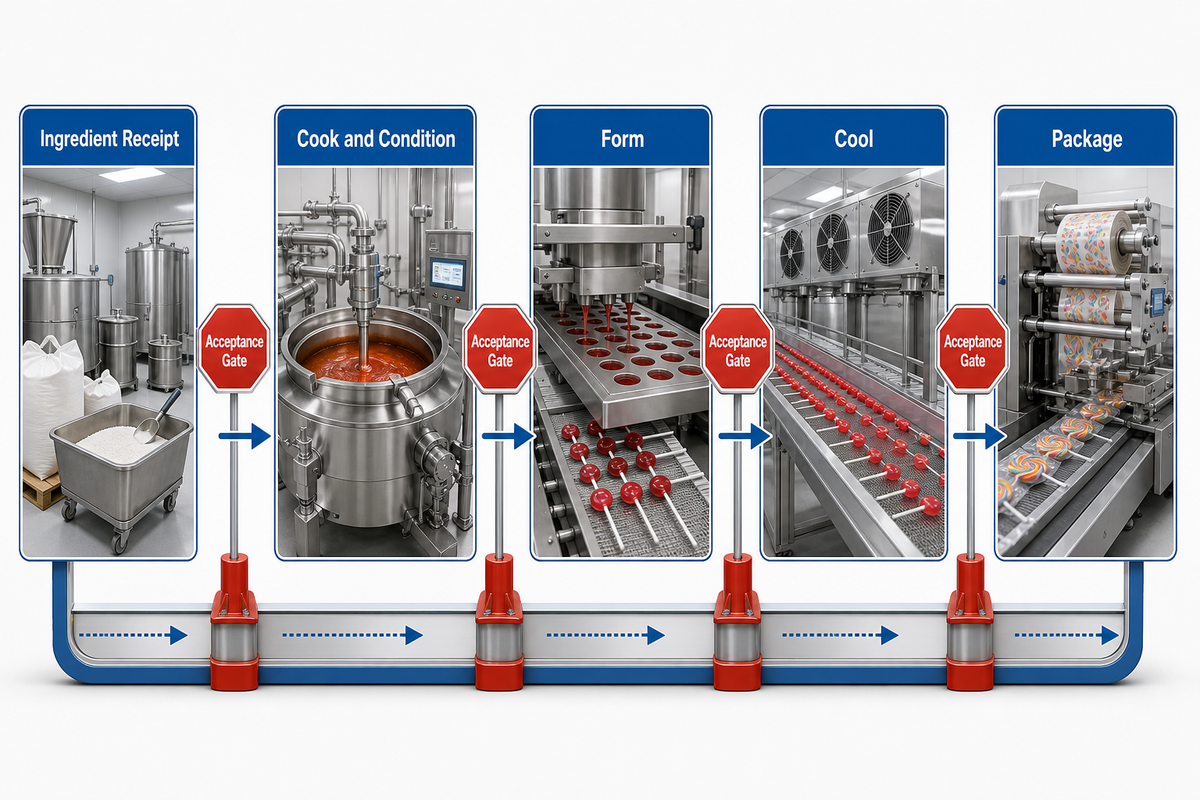
Hard candy production lines integrate a series of processes including receipt of ingredients, cooking, transport and conditioning of the ingredients, forming, cooling and packaging of the candy. The acceptance condition at each module-to-module handoff determines whether the equipment functions as an integrated and continuous production system.
Shared coreIngredient state, cooking, addition timing, controlled transfer, cooling duty, conveying and packaging handoff.
Depositing overlayFlow behavior, deposit cut-off, mold presentation, fill geometry and release from the mold path.
Die-forming overlayConditioning in a batch roller, rope sizing, geometry control, the forming machine and transfer without damaging shape.
Lollipop overlayStick feeding, position, retention, orientation, cooling, ejection and wrapper presentation.
The Engineering chapter of the University of Michigan describes die forming, cooking, batch forming, and tempering as individual processes. It also describes other processes involved in confectionery production, e.g. packaging and cooling. For a step-level sequence, see the hard candy manufacturing process guide; this article remains focused on system interfaces.
Buyer objection: “Every module is listed, so the line is complete.”A module list can still hide an undefined receiving state, buffer assumption, stick check, cooling release or wrapper feed. Completeness is demonstrated at the interfaces, not by counting equipment names.
The Shared Core: Cooking, Transfer and Controlled Product State
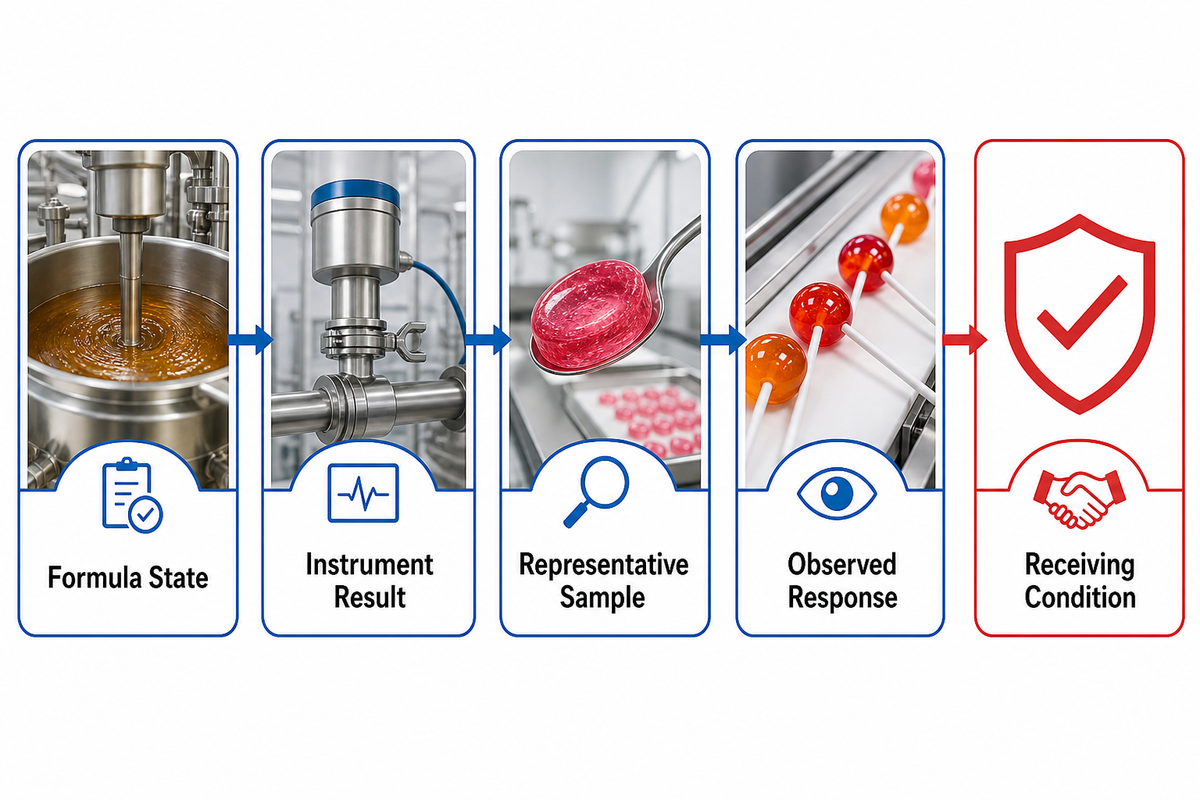
Cooking is only one of the processes involved in production of hard candies. Other processes, including tempering and flavoring, are system and formula dependent.
| Interface question | Evidence to retain | Unsafe shortcut |
|---|---|---|
| What material arrived? | Recipe/batch revision, additions and timing | Product name alone |
| What state was observed? | Instrument status, sample point, observation and method | One dial value without context |
| Did the receiver accept it? | Deposit, rope, forming or stick response plus deviation record | Assuming the previous module’s completion proves the next step |
A 2024 Frontiers study reported moisture contents of 2.04% to 7.08% (by weight) in the tested formulations. It found various water activity and glass transition temperatures based on at least 3 replicates and a 95% confidence interval. Those values describe the study case, not a production range. They aren’t working ranges.
Why experimental values do not transfer as line setpointsThe study prepared samples with 5 mL water per 50 g sugar mixture, heated most samples to 130°C in a 140°C oil bath, and stopped one crystallizing 100% sucrose sample at 121°C. Its method also used a 1 g syrup sample in 50 mL water, 5 min mixing, a 0.45 μm filter, a 250 × 4.6 mm column with 5 μm packing, 80:20 v/v mobile phase, 25°C titration, systems above 70% w/w sugar, a 0.5 T instrument at 20.34 MHz with a 10 mm coil, 10 s relaxation periods, 5–1,500 ms delays, at least 3 replicates and a 95% confidence interval. The paper’s calculation table cited component glass-transition inputs of 5°C for fructose, 31°C for glucose, 87°C for maltose, 66°C for sucrose, 112°C for DP3 and 180°C for higher oligosaccharides. These are laboratory conditions and calculation inputs from one study, not production instructions.
Engineering noteThe peer-reviewed review warns that applying one processing rule across formulations can create process failure. The receiving condition must therefore be tied to the actual formula, method and downstream route.
The need to define evidence and response criteria for hard candy production isn’t removed by additional automation. From a control perspective, it may be easier to observe evidence with a sensor or program, but a control structure comprising a sample, owner, deviation path and responding module still needs to be defined.
- Define the sample point and method before choosing an acceptance value.
- Record instrument identity and checking status with the observation.
- Link the cooking record to the forming route and product geometry.
- Keep exceptions visible instead of averaging them into a successful batch narrative.
Where the Routes Split: Depositing, Die Forming and Stick Handling
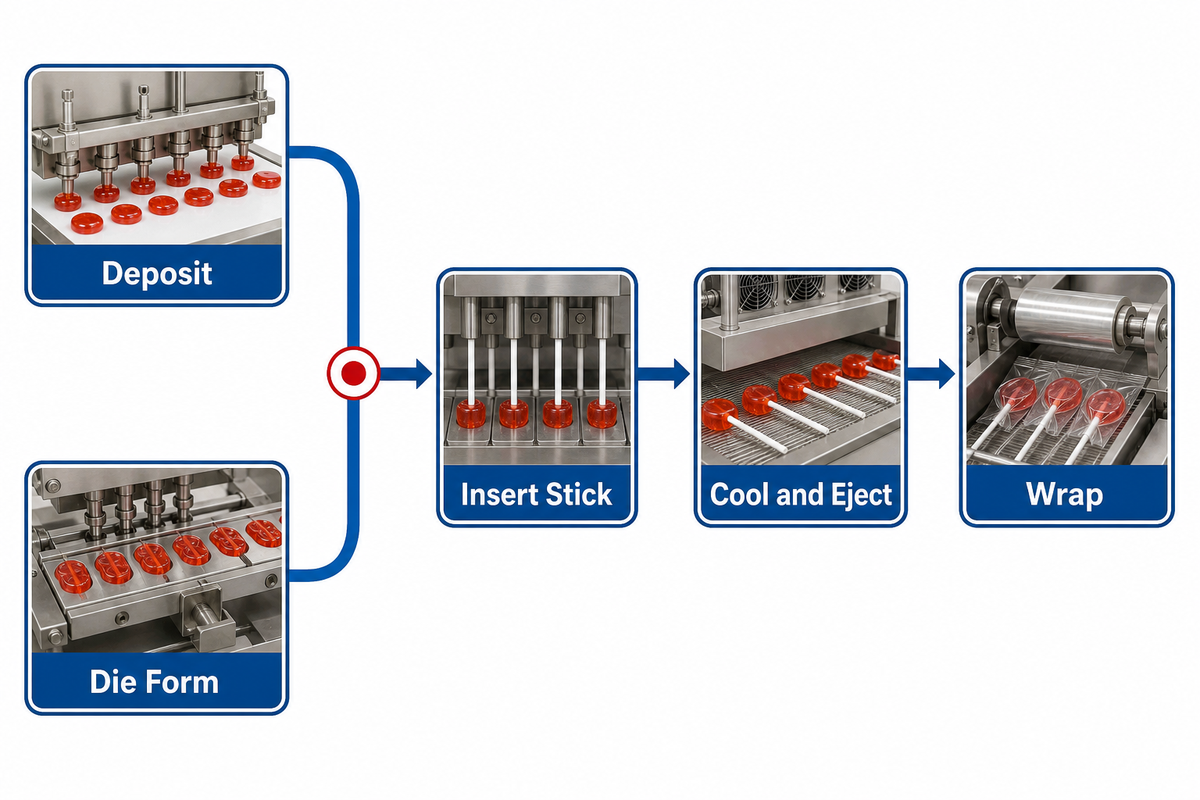
Modules downstream of hard-candy and lollipop production, including depositing, die forming and stick handling, cannot be interchanged because they receive candy mass in different physical conditions and create different transfer obligations. From a control perspective, each of the modules creates a different acceptability requirement.
| Route | Receiving behavior | Route evidence | Downstream consequence |
|---|---|---|---|
| Depositing | Controlled flow and deposit cut-off | Mold presentation, fill geometry, release behavior | Shape consistency and mold-path transfer |
| Die forming | Conditioned plastic mass or stable rope | Rope response, geometry and forming transfer | Shape retention and stable feed |
| Lollipop route | A deposit or formed body that can receive a stick | Stick position, retention, orientation and ejection | Cooling, conveying and wrapper presentation |
The candy-making operations described in US8757997B2 include stick insertion, cooling, ejection, polishing and wrapping, and can be performed by different equipment. The patent treats them separately but does not prove that its arrangement is the only or best route. The lollipop manufacturing process guide covers that sequence; this section compares interface obligations.
Buyer objection: “A hard-candy line becomes a lollipop line by adding a stick feeder.”The stick affects forming or depositing timing, position, retention, orientation, cooling, ejection, conveying and wrapper feed. The project must close those interfaces as a linked route.
Build a Production State Passport Across Every Interface
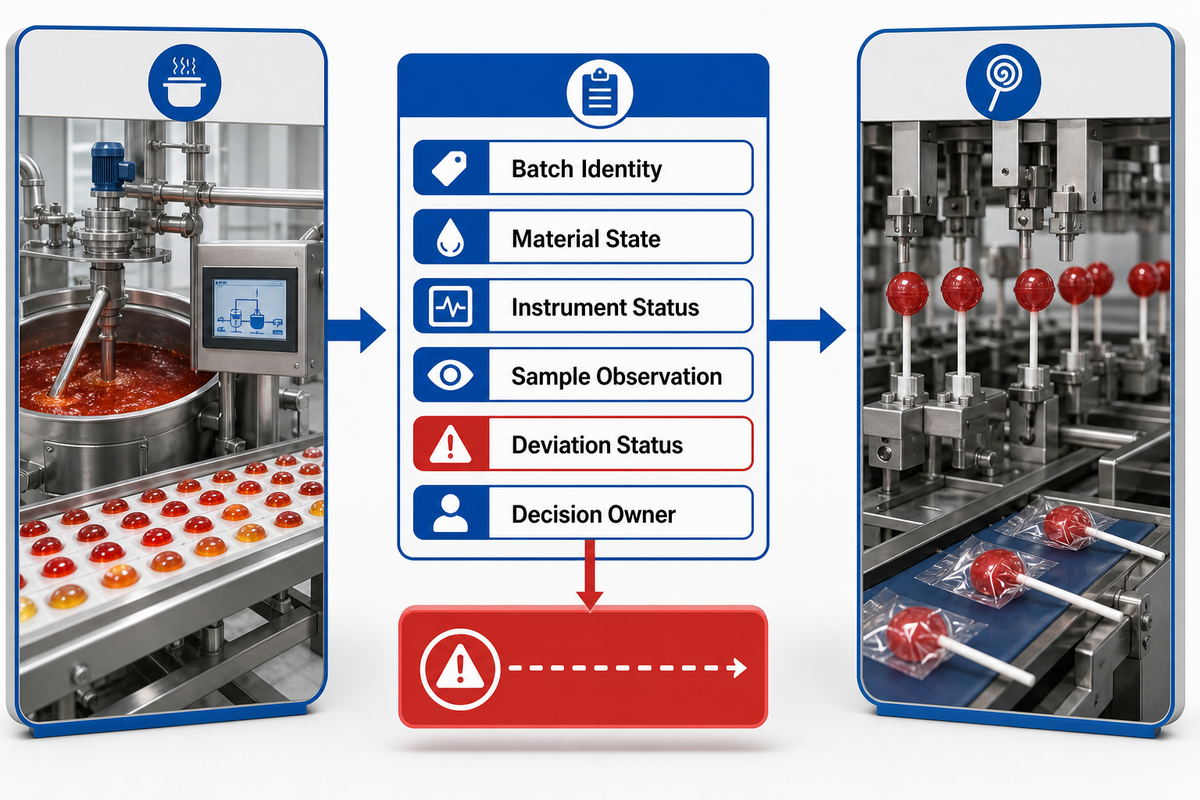
The Production State Passport (PSP) outlines a methodology for defining the state of a batch, specifying the instrument that will be used to measure that state, and defining the action to be taken in response to a deviation. The PSP should be considered an editor’s concept and shouldn’t be misconstrued as a HACCP plan, a preventive control plan or a specification for release of a product.
1. Identity
Recipe and batch revision, material identity, time and interface location.
Recipe and batch revision, material identity, time and interface location.
2. Observation
Sample point, method, instrument status and observed product response.
Sample point, method, instrument status and observed product response.
3. Exception
Deviation, hold, correction, reassessment and affected material.
Deviation, hold, correction, reassessment and affected material.
4. Acceptance
Receiving-module response, release decision, record owner and time.
Receiving-module response, release decision, record owner and time.
The FDA HACCP guidance separates monitoring, corrective action, verification, validation, calibration and recordkeeping, and it identifies assigned responsibilities. Using those categories in this article does not turn the Production State Passport into a legal document.
What the passport should preventA downstream defect shouldn’t force the team to reconstruct the batch from disconnected screenshots, operator memory and machine logs. The record should show which state was observed, what changed and how the receiver responded.
Balance the Line Around Product Mix and Stable Interfaces, Not One Nameplate Speed
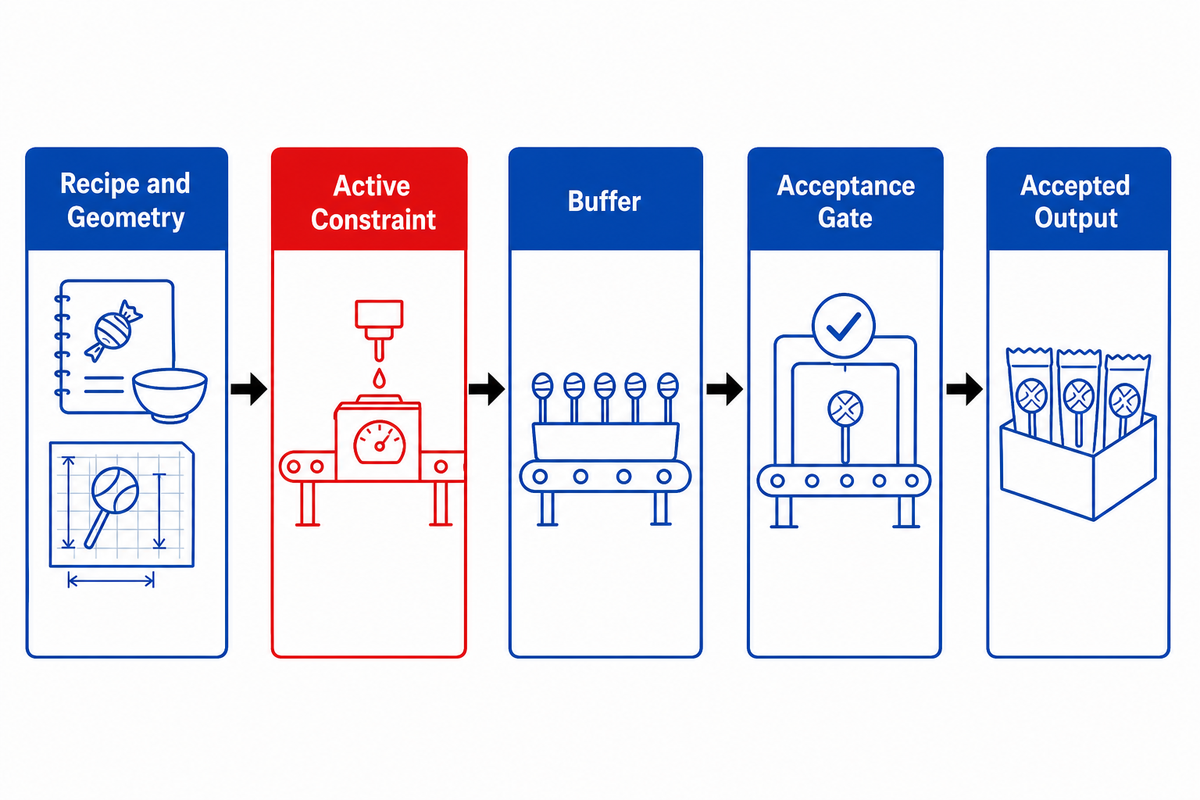
The fastest module doesn’t determine stable or accepted output for the entire line. Output is dependent on the constraint, based on the product mix. That constraint varies when the recipe, geometry, route, changeover, wrapping, and/or acceptance rules change.
Product-mix correctionNIST reports that “the throughput and bottlenecks can be defined as functions of the product mix.” A fixed bottleneck label is therefore too static for a mixed-product line.
| Review level | Question | Evidence |
|---|---|---|
| Product mix | Which recipes, formats and changeovers must the line represent? | Defined cases and trial order |
| Interface | Where do holds, queues, deformation or feed loss appear? | Time-linked state and receiver records |
| Accepted output | Which pieces meet the defined downstream basis? | Accepted count or mass, rejects, holds and reason codes |
Buffers can compensate for variable timing, but they do not change the acceptance criteria at the next module. Fair-line trials consider the product mix and the acceptance condition. Stable output is determined by the relevant constraint, rather than quoting the brochure number.
Buyer objection: “The highest kg/h figure is the line capacity.”A valid comparison needs disclosed test conditions, product mix, route, accepted-output definition and downstream acceptance. Without them, the number describes a named module or test case, not the commercial line commitment.
Cooling and Wrapper Readiness Are Separate Release Decisions
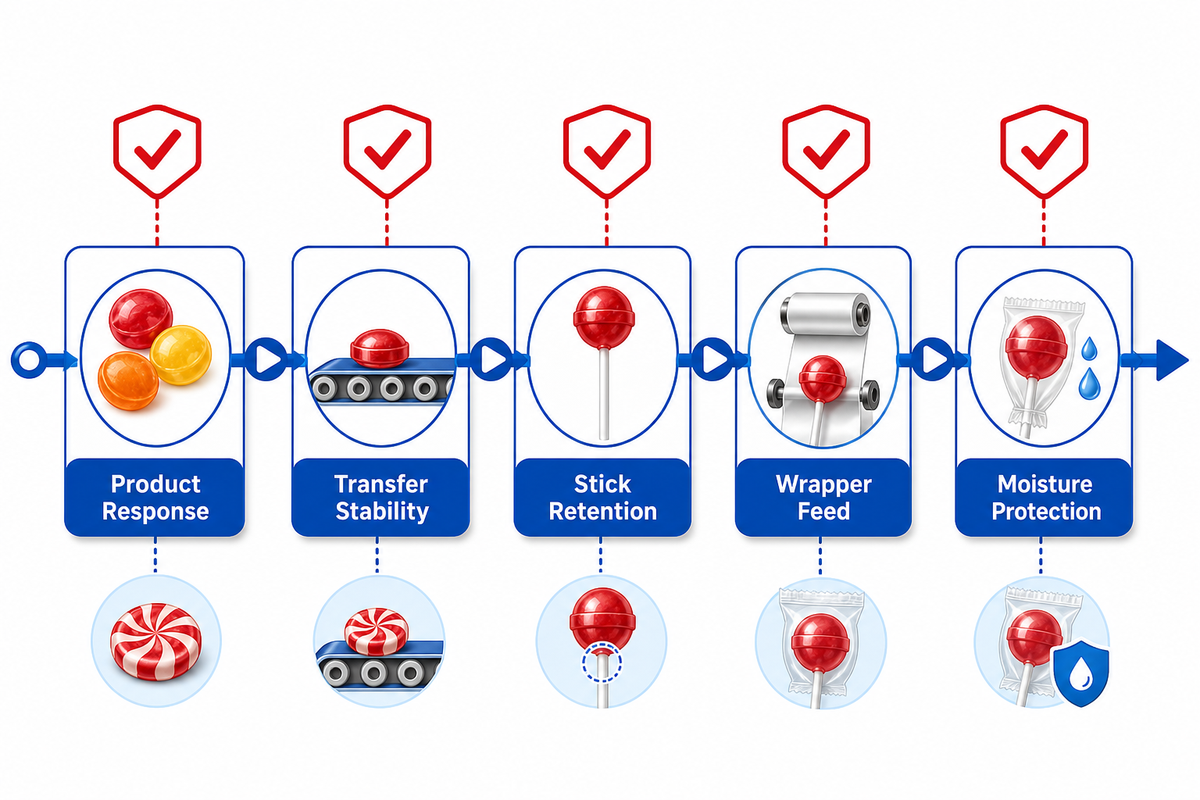
Looks can be deceiving. What appears to be a formed piece may not be stable enough to be transferred and/or wrapped. Release may be determined by the product’s response to various environmental conditions, stability, deformation during handling, and/or the barrier properties of the wrapper.
Patent evidence, bounded correctlyEP1399031B1 treats formed lollipops as vulnerable to sticking or deformation before adequate cooling and connects movement and orientation to handling. It doesn’t provide a universal tunnel temperature, residence time or stick-retention value.
| Release layer | Question | Do not substitute |
|---|---|---|
| Product response | Does the piece resist sticking, deformation or mark transfer under the defined handling? | Visual shape alone |
| Stick and orientation | Does the lollipop retain position through ejection and feed? | Presence of a stick |
| Package handoff | Are ambient humidity, exposure time, film barrier and wrapper presentation defined? | Assuming cooling alone protects storage stability |
Because ambient conditions may affect the product’s behavior and stability, release may need to be determined based on the product’s response during various conditions along the storage and transportation path. The lollipop cooling process guide examines that stage. It would be more appropriate for the project to determine the product’s response and the properties of the finished package than to rely on surrogate limits.
Buyer objection: “If the candy looks finished, it is ready to wrap.”Appearance can’t prove stable conveying, stick retention, wrapper feed or moisture protection. Close each release layer with an observed response tied to the intended package and environment.
Utilities, Hygiene, Allergen Controls and Changeover Belong in the Interface Map
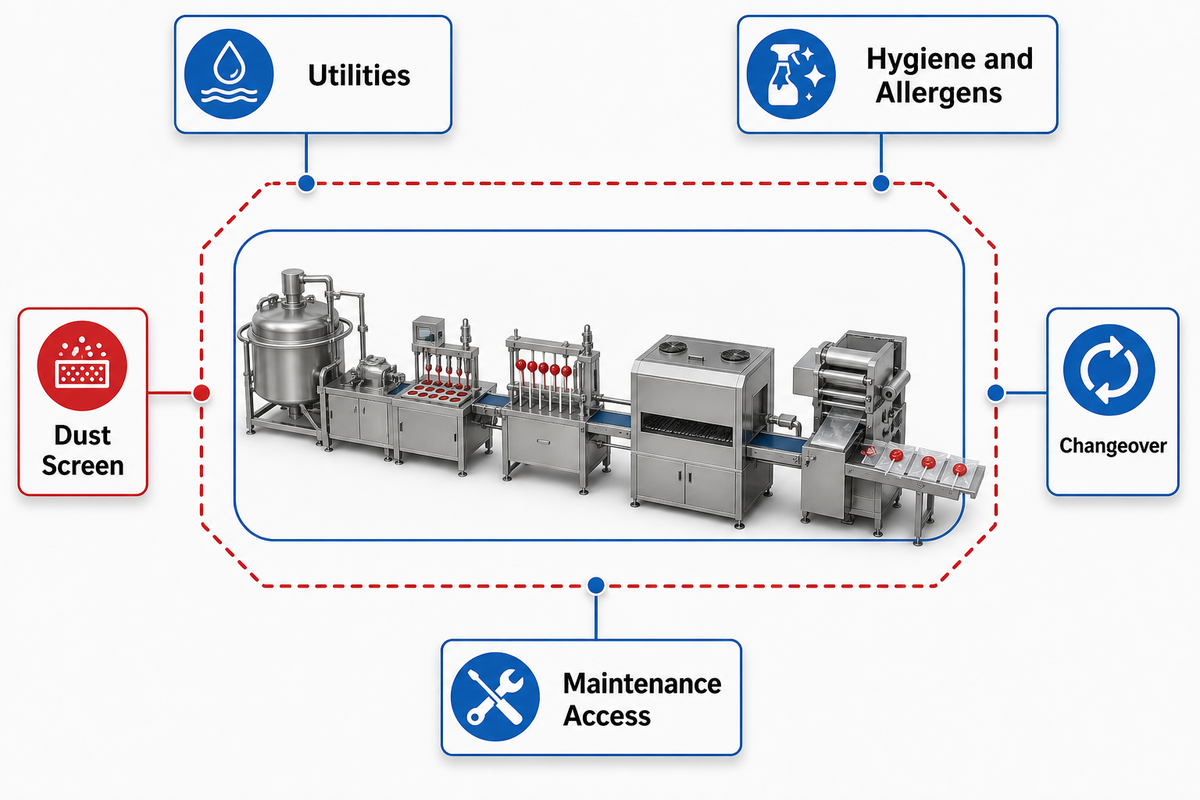
Integral to the selection of processing and equipment systems are the services available on site and the controls for the various hazards. There are a number of considerations that can affect the choice of an equipment interface. These include utility availability and quality, access and drainage, the type and frequency of changeover, allergen and label controls, rework and label releases, dust and other contaminant control, and access for equipment maintenance.
Utilities
State pressure, quality, temperature, load, drain and connection assumptions with the responsible party.
State pressure, quality, temperature, load, drain and connection assumptions with the responsible party.
Hygiene and allergens
Separate material-contact cleaning, allergen cross-contact, rework and finished-label verification from a generic “sanitary” claim.
Separate material-contact cleaning, allergen cross-contact, rework and finished-label verification from a generic “sanitary” claim.
Dust and access
Screen dry-sugar or candy dust conditions, ignition sources, dispersion, confinement and housekeeping with qualified site specialists.
Screen dry-sugar or candy dust conditions, ignition sources, dispersion, confinement and housekeeping with qualified site specialists.
The regulation in Part 117 covers sanitary operations, preventive controls, monitoring, corrective actions, verification and records while applicability varies with the nature of the facility and activity. Section 117.5 contains exemptions and exceptions. For that reason, this guide does not present one legal checklist for every confectionery facility.
Process-safety boundaryOSHA identifies finely divided sugar and candy-related materials among dusts that can become explosible under relevant conditions. That supports a hazard screen; it doesn’t mean every sugar process automatically has an explosible atmosphere.
FDA materials also distinguish allergen cross-contact prevention and labeling controls. Consequently, controls for line transfer of allergens, line cleaning and product labeling should be documented. Use the separate hard candy defects guide for symptom-led troubleshooting; this interface map is not a defect catalog.
- Who defines and verifies utility conditions at each connection?
- Which surfaces, tools and transfer paths are included in cleaning release?
- How are allergen, rework and label states separated and recorded?
- Who assesses dust hazards, ventilation, housekeeping and ignition control?
- Which change reopens the interface review?
According to the user-supplied company profile, SINOFUDE was founded in 1998 in Shanghai’s Fengxian District and operates three factories with more than 200 employees. The company describes other capabilities, including welding and CNC machining. While these capabilities describe the type of equipment available at a given location, they don’t prove a specific line’s performance or certification scope.
Buyer objection: “Utilities and sanitation can be finalized after equipment selection.”Late discovery of an incompatible service, inaccessible cleaning point, allergen boundary, label-control gap or dust condition can change the layout and operating method. Assign those inputs before configuration is frozen.
The Interface Proof Packet: Evidence to Request Before Commercial Handoff
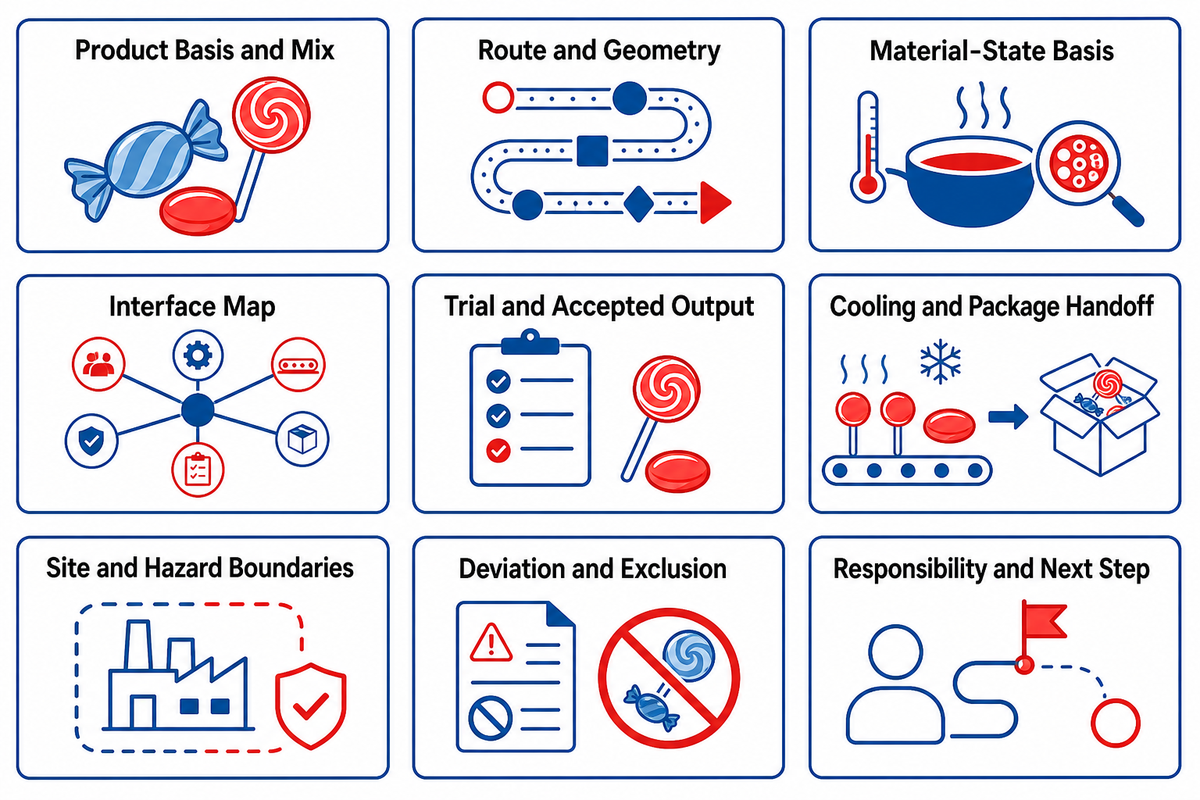
The Interface Proof Packet provides a consistent framework for comparing potential vendors. It isn’t an official certification document, legal document, or detailed FAT/SAT procedure, and applicable formats may require different documents or means of verification.
9-Type Interface Evidence Matrix
| Evidence type | Question it closes | Owner |
|---|---|---|
| Product basis and mix | Which recipes, shapes, sticks, packages and changeovers are represented? | Buyer plus process reviewer |
| Route and geometry | Which forming route and finished geometry are included? | Product and process owners |
| Material-state basis | What receiving condition and method define readiness? | Process reviewer |
| Interface map | What must be true at each handoff? | Named module owners |
| Trial and accepted output | Which test case, observations, rejects and holds support the result? | Supplier and buyer witness roles |
| Cooling and package handoff | Which ambient, exposure, wrapper and barrier assumptions apply? | Quality and packaging owners |
| Site and hazard boundaries | Which utilities, allergen, label and dust assumptions remain? | Site owner and qualified specialists |
| Deviation and exclusion | What failed, changed or remains outside the demonstrated case? | Trial decision owners |
| Responsibility and next step | Who decides, what must be retested and which commercial question remains? | Contracted decision owners |
As described by the Oklahoma State University Extension, the design of a food processing facility is determined by the characteristics of the product, the process, the facility, and the packaging. Other considerations include the utilities, the nature of sanitation, reliability of the equipment, the extent of changeover, the range of products and the speed of the production process. Each of these features creates a unique system. Therefore, it would be more appropriate to provide a project definition packet than to answer in the abstract.
Scope-specific evidence can be stricterFor equipment inside its voluntary authorization scope, 3-A SSI identifies technical files, procedures, material records and third-party verification. That example is a warning against calling one buyer-created packet universal.
The project definition packet should identify the commercial questions that remain open, including price and terms for delivery, capacity, product scope, certification and after-sales support. These discussions should be resolved only in the context of a proposal for the intended hard-candy or lollipop products.
Buyer objection: “A product name, photo and target output are enough for every supplier to quote the same line.”Those inputs don’t define route, product mix, accepted output, utilities, ambient exposure, changeovers, hazard boundaries or evidence ownership. Quotes created from different hidden assumptions aren’t directly comparable.
Decision Framework: When to Move From Technical Guide to Line Selection
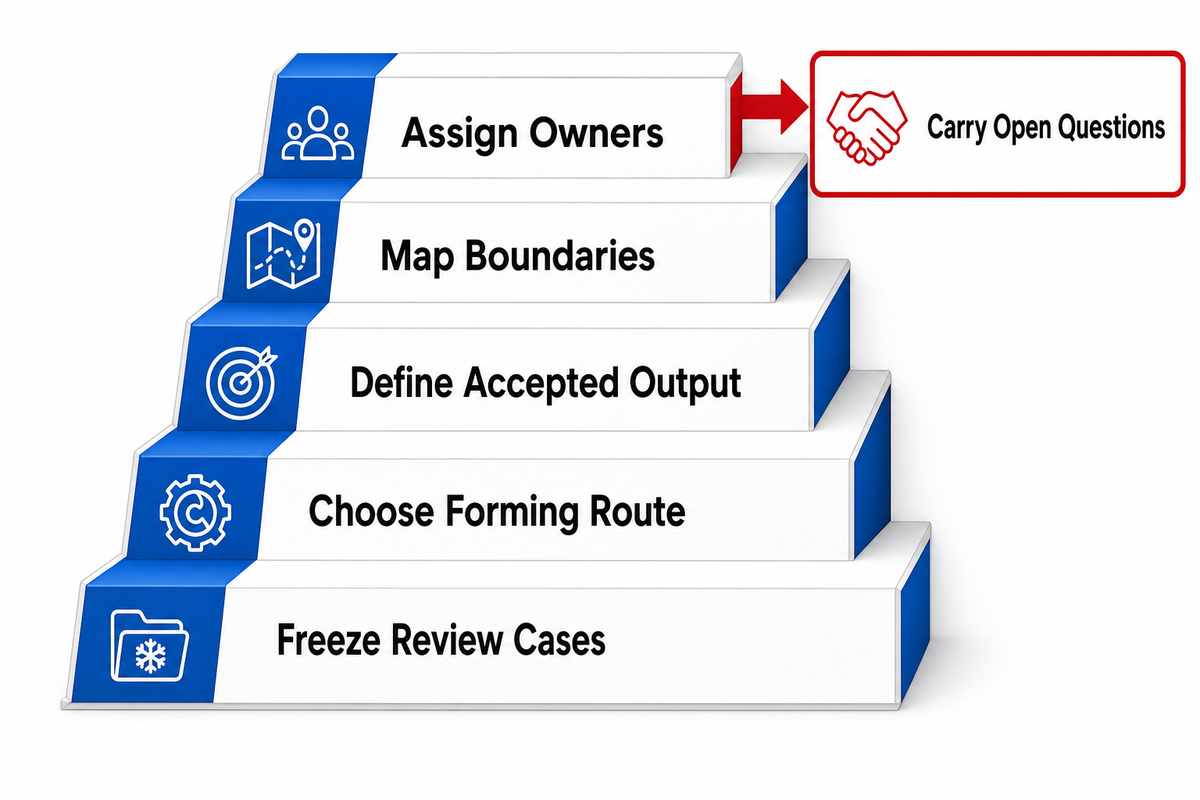
Answers to specific discussions must be provided to define the product, determine the route, assess the stick mix, and describe the product range and accepted level of production. The guide stops here.
- Freeze the review cases: recipes, geometry, stick and package formats.
- Choose the likely forming route and document the receiving-state questions.
- Define accepted output and the product-mix cases that must be demonstrated.
- Map cooling, wrapper, utility, ambient, allergen/label and dust-screening boundaries.
- Assign records, deviations, decisions and responsibility owners.
- Carry open commercial questions into the configured proposal and quotation.
When those inputs are ready, review hard candy and lollipop production-line options in the commercial context where model configuration, capacity commitment, supplier evidence and quotation can be addressed.
The handoff ruleA technical guide should improve the questions used in selection. It shouldn’t pretend to select a machine without product-specific trials, facility inputs and a supplier-bound scope.
Frequently Asked Questions
Are lollipops considered hard candy?
Many lollipops use a hard-candy glass as the edible body, so they share cooking, forming and cooling principles with other hard candies. These hard candies gain stick feeding, position, retention, orientation and downstream handling requirements that unmounted pieces don’t have. Filled, layered, sugar-free or alternative-formulation products may add further controls, so “lollipop” describes a finished format rather than one universal process specification.
What are the main modules in hard candy and lollipop production lines?
A typical architecture includes ingredient preparation, cooking, controlled transfer or conditioning, forming, cooling, conveying and packaging. Depositing, die forming, stick handling and the package route vary with the product. A complete scope also identifies utilities, controls, cleaning access, changeover ownership, interface acceptance and the records that connect one module to the next.
Can one line make both hard candy and lollipops?
A project may share ingredient handling, cooking, selected transfer functions, cooling or packaging equipment, but compatibility must be demonstrated for the intended products. Compare the recipes, receiving states, forming routes, molds or dies, stick formats, geometry, cooling response, wrapper feed, ambient exposure, product-mix trials and changeovers. A shared cooker or conveyor proves only that one asset may serve both routes; it doesn’t prove that every interface can accept every product.
How should buyers compare line capacity?
Compare capacity against the same product mix, accepted-output definition, trial conditions, route and package. Record rejects, holds, changeovers and the active interface constraint; don’t compare one supplier’s module maximum with another supplier’s stable packed output.
Is the Production State Passport a regulatory requirement?
No. It’s an editorial method for linking batch identity, observations, instrument context, deviations and downstream acceptance; each facility must determine its actual legal, food-safety, quality and customer record duties with qualified advisors.
Bring a defined product and interface basis
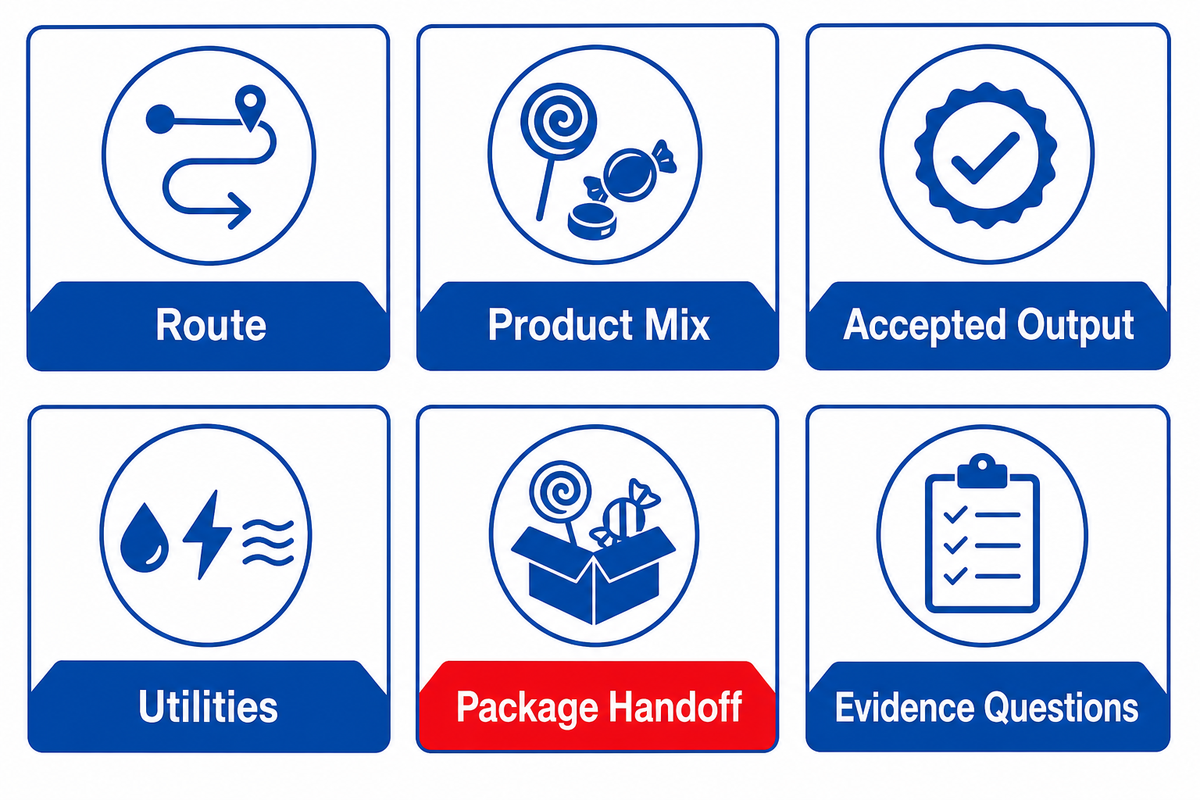
Prepare the route, product mix, accepted-output basis, utilities, package handoff and evidence questions before requesting a configured proposal.
References & Sources
- Peer-reviewed review, Hard candy formulation, processing and physical properties
- Frontiers, Moisture, water activity and glass-transition study
- University of Michigan, Hard Candy process overview
- U.S. FDA, HACCP Principles & Application Guidelines
- eCFR, 21 CFR Part 117
- U.S. FDA, Food Allergies
- U.S. OSHA, Combustible Dust
- NIST, Product Mix Performance in Multi-Job Production Systems
- Oklahoma State University Extension, Planning Food-Processing Facilities
- European Patent EP1399031B1, Lollipop cooling and handling evidence
- U.S. Patent US8757997B2, Deposited lollipop handling sequence
- 3-A SSI, Applicant Instructions
Sources reviewed September 28, 2026. Regulatory applicability, safety duties and supplier evidence must be checked for the actual facility, product, jurisdiction and contracted scope.