Get in Touch with SINOFUDE Company


Biscuit, Cookie & Bakery Lines take prepared ingredients and transform them into finished, baked and cooled products that are then packaged. However, the system is more than just the machinery on the line. Every transfer changes product state, control responsibility or evidence quality. A line can look complete on paper but still have an unmeasured cooling endpoint, an ownership interface for packaging that isn’t defined or an acceptance test that can’t be repeated.
This manual explains how to observe and verify the system. It won’t take a commercial view, predict the outputs, or set prices. Those activities are the domain of the solution page. Here, the goal is to help engineering, quality, operations and procurement ask the same measurable questions before equipment selection, FAT, SAT and handover.
The method is deliberately evidence-first: define the product, name interfaces, say what condition it’s in, and state exceptions. The order makes uncertainty visible and defines demands.
Though bread, pastry, and biscuit production lines may be expressed in commercial baking, they don’t share the same automated process basis. Even within biscuit production, the type of biscuit changes the material state, forming demand, baking process and handling evidence that must be defined.
Quick Specs: the minimum line-level brief
| Product definition | Dough or batter state, geometry, mass, inclusions, surface treatment and pack format |
| Process endpoints | Formed-piece condition, bake endpoint, cooling endpoint and pack-entry condition |
| Interface evidence | Upstream output, downstream acceptance field, signal, hold/reject rule and owner |
| Site boundary | Utilities, ventilation, dust review, guarding, cleaning, access and local-code owner |
| Acceptance record | Condition, method, sample window, witness, evidence file, rule, deviation and disposition |
How a Complete Line Moves Product, and Information, Forward
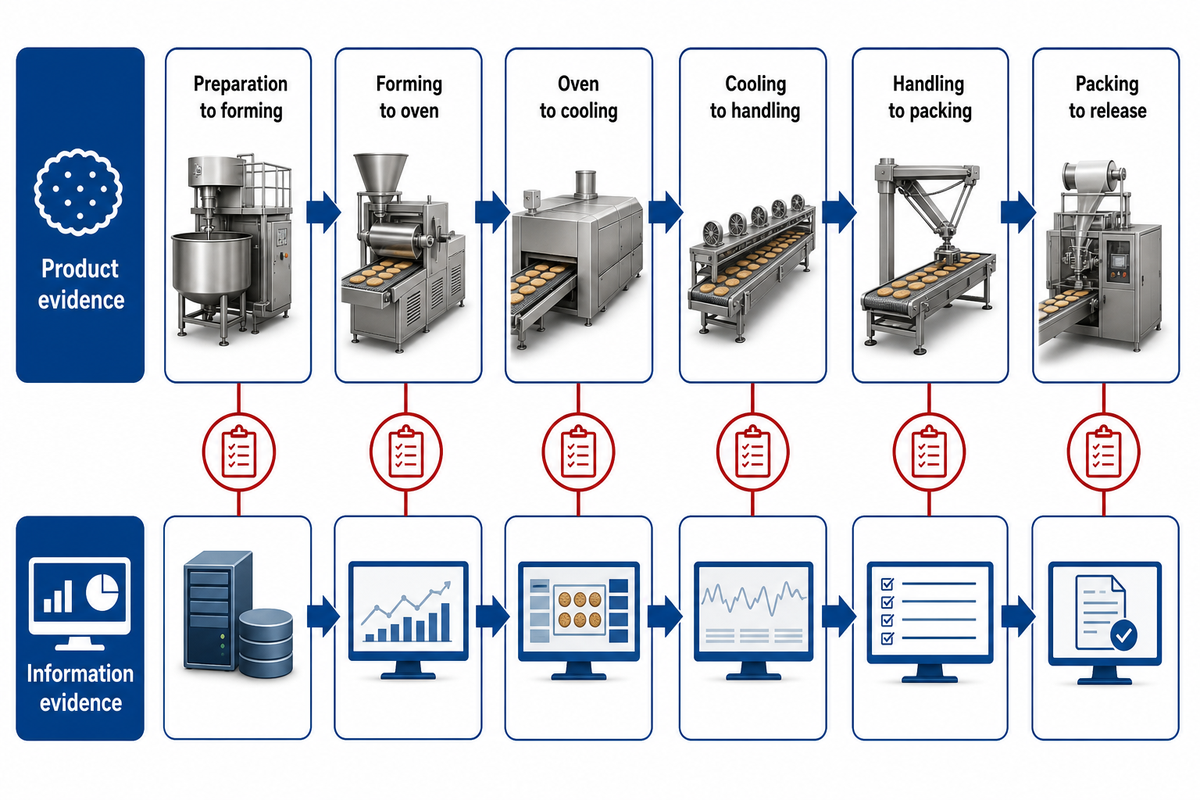
The state of the product and the evidence that supports it must flow concurrently. The two flows must meet at identical defined handoffs. For applicable food-safety records, 21 CFR 117.305 similarly requires actual values or observations and contemporaneous creation.
How do biscuit, cookie and bakery lines work?
They prepare a controlled dough or batter, create pieces with the required geometry, bake to an agreed endpoint, remove heat under defined handling conditions, and present stable product to inspection and packing. Meanwhile, recipes, speeds, alarms, holds, rejects and quality records must move across the same handoffs. The flow of product without the flow of information isn’t a controlled process.
The useful unit of analysis is the handoff. A mixer does not merely discharge dough; it passes a material state that the forming stage must be able to receive. The oven does not merely discharge baked pieces; it passes heat, moisture distribution and mechanical fragility into cooling. At yet another handoff, a conveyor passes product to be packaged that has to be conditioned for packaging. Each handoff needs a measurable output and an owner.
| Handoff | Product evidence | Information evidence | Hidden bottleneck to check |
|---|---|---|---|
| Preparation to forming | Consistency, temperature, rest time, inclusion distribution | Batch identity, recipe version, release status | Dough arrives outside the forming window |
| Forming to oven | Piece mass, thickness, geometry, spacing | Speed ratio, hold/reject rule | Transfer distorts otherwise acceptable pieces |
| Oven to cooling | Color, mass loss, exit condition, breakage | Zone profile, belt speed, event log | Average endpoint hides cross-band variation |
| Cooling to handling | Temperature, fragility, surface condition | Residence time, ambient record | Product is stable at discharge but not after stacking |
| Handling to packing | Orientation, count, spacing, breakage | Buffer state, starvation/blockage events | Wrapper speed exceeds stable feed quality |
| Packing to release | Seal, code, net content, package integrity | Inspection result, hold status, traceability | A pass signal is stored without test context |
Hidden bottleneck map
Visible symptom → earliest measured deviation → interface owner → next check. “Earliest measured” is deliberately cautious: it identifies where evidence first changed, not where the physical cause necessarily began.
Visible symptom → earliest measured deviation → interface owner → next check. “Earliest measured” is deliberately cautious: it identifies where evidence first changed, not where the physical cause necessarily began.
Build a Product-State Passport Before Discussing Equipment
“Cookie,” “cracker,” or “soft biscuit” are product names, and may be helpful when describing product catalogs, but the naming convention may mask considerable variation in product parameters and characteristics. A proposal that fills those gaps with silent assumptions may look precise while its process basis remains open.
Dry ingredients and the balance of flour and butter can affect how a product mixes, rests and releases. Baking powder, sugar or margarine may also affect the condition that forming equipment receives. The original recipe should therefore identify the biscuit dough or cookie dough state actually offered for a trial, not merely list ingredients. A public bakery patent illustrates why product-state details must be specific: it uses product- and filling-specific temperatures rather than a universal biscuit setting.
A filling alters the product boundary and a raisin or walnut piece creates dimension and distribution issues. A chocolate chip cookie also needs the required chocolate chips to be defined prior to dosing, cutting or inspection.
Product labels illustrate the range without selecting a route. A butter cookie, peanut butter cookie or shortbread may be described as crumbly, chewy or even gooey by the product team, but those words need measurable geometry, endpoint and handling definitions. Sandwich cookies add a later boundary for assembly that a baked good doesn’t define.
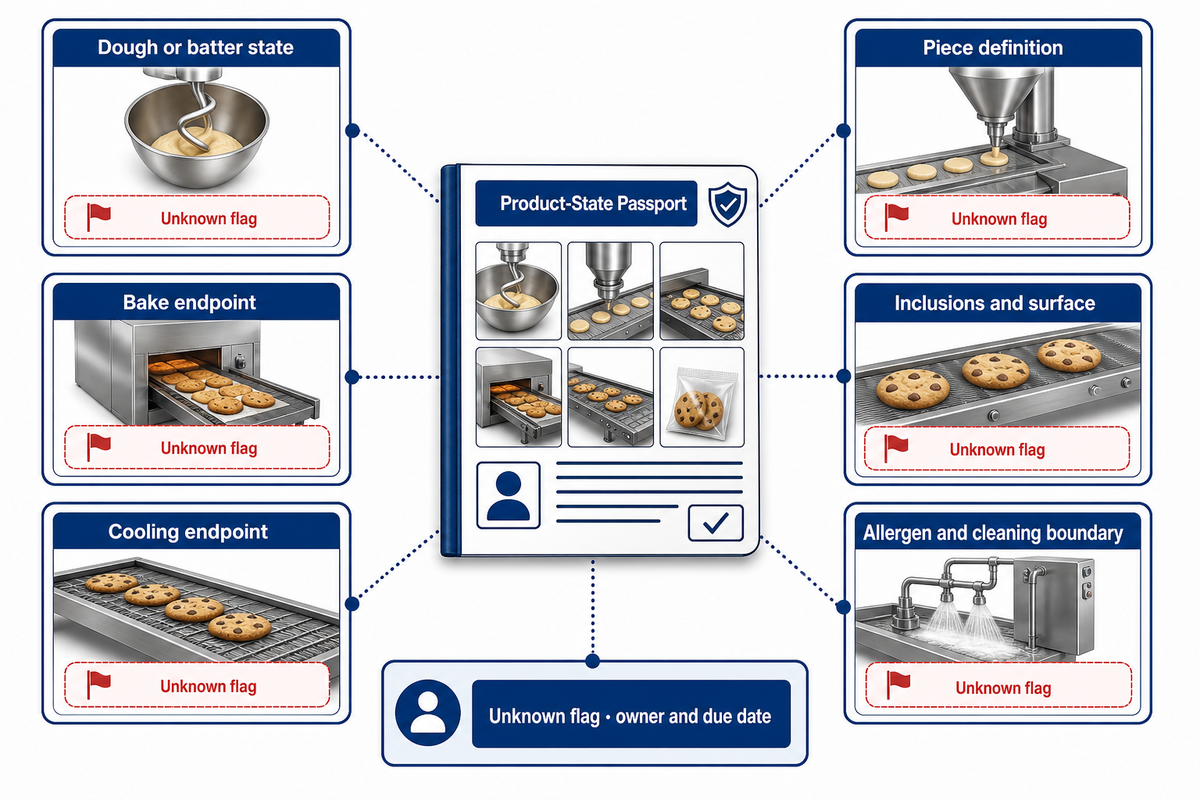
The Product-State Passport is a worksheet that captures information in a systematic way and differentiates what’s known, what varies, what’s the source of the information, and who owns the missing information. An unknown isn’t a mistake. An unknown, especially in the form of a fixed value, is a problem.
| Passport field | Record | Why it matters | Owner |
|---|---|---|---|
| Dough or batter state | Method, temperature, rest/age, observable consistency | Constrains forming and transfer behavior | R&D / process |
| Piece definition | Mass, dimensions, thickness, tolerances | Connects forming, bake and pack entry | Quality / product |
| Inclusions and surface | Size range, distribution, topping or wash | Affects forming, release and inspection | Product / operations |
| Bake endpoint | Defined test, sample position and allowed range | Prevents color alone becoming a release proxy | Quality / process |
| Cooling endpoint | Location, time, ambient and product condition | Defines the packing interface | Process / packing |
| Allergen and cleaning boundary | Prior product, contact surfaces, method and release record | Constrains safe sharing and changeover | Quality / sanitation |
| Pack format | Count, orientation, material, seal and code fields | Defines the stable packing boundary | Packing / quality |
| Acceptance material | Recipe revision, ingredient lots and quantity owner | Makes the witnessed test repeatable | Buyer / supplier |
| Unknown flag | Question, test plan, owner and due date | Stops assumptions from hardening into scope | Project manager |
The passport captures the boundary for allergens and cleaning, planned packaging systems, the destination-market evidence owner, and any product variants intended to share equipment. It isn’t a supplier selection tool and doesn’t contain default recipe setpoints. It is the common language used before route selection, so commercial comparisons begin from the same product definition.
SINOFUDE context, attributedSINOFUDE states that its brand was founded in 1998, that three factories cover more than 30 acres, and that the company has more than 200 employees. The company says it introduced the ISO9001 management system in 2004, holds 38 product patents, and uses laser and CNC processing in its manufacturing base. These are supplier-provided company facts, not proof of a particular project result.
Read Forming Method as a Consequence of Dough Behavior
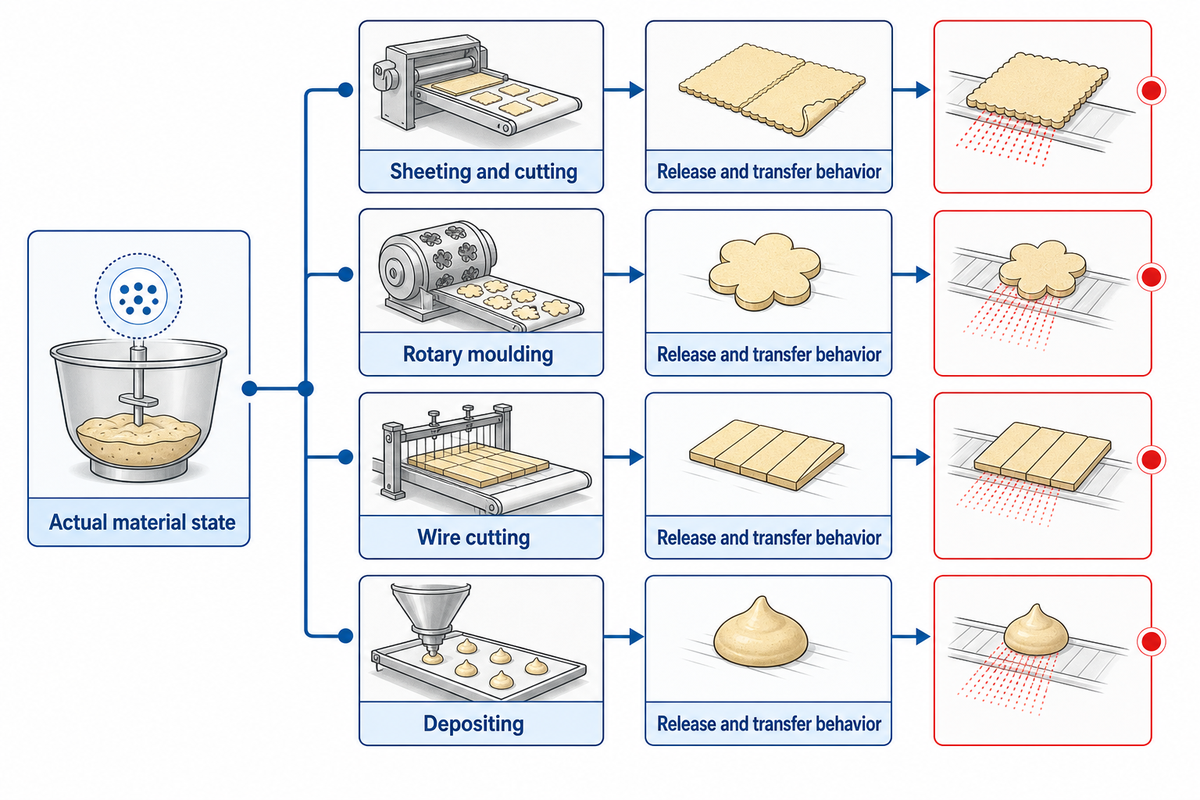
Equipment should be assessed based on the actual material state, release behavior, and other transfer conditions and not based on the finished product name.
How are biscuit and cookie products made on a production line?
Ingredients are combined in a controlled material state and either portioned or sheeted. The material is then baked, cooled, and packed. The forming method follows from how that material flows, releases, holds geometry and carries inclusions. Engineering should work with measured conditions of the dough or batter rather than the finished-product name.
Sheeting and cutting reduce thickness of a material to create and retain a sheet, and relax and transfer it to the required shape. Rotary moulding asks it to fill an engraved cavity, release cleanly and maintain the intended shape. Wire cutting asks a deposited mass to sever consistently without dragging inclusions or deforming the piece. Depositing asks the batter or soft mass to flow predictably through a dosing system. These are state-of-the-material consequences, and not universal rules for product names.
A biscuit production line may meet rolled cookies, drop cookies or bar cookies, but these names can’t define a machine on their own. A cookie cutter requires a sheet and release condition; lamination adds layer and relaxation evidence; depositing a soft dough requires a different flow description. Industrial transfer onto an oven band is also not the same condition as placing a home batch on a baking sheet.
Sweet biscuit, hard cookie and crunchy cookies are outcome labels, and their definitions are pending until texture and test methods are finalized. Almond cookies and chocolate cookies raise inclusion and allergen questions, while fresh-baked cookies await a cooling endpoint prior to packing. The line brief should state how each cookie made in the acceptance run connects to its recipe revision and evidence record.
| Observed condition | Consequence to verify | Evidence request | Do not assume |
|---|---|---|---|
| Material relaxes after reduction | Thickness and shape may change before cutting | Timed geometry checks after each reduction | One roll gap equals final thickness |
| Surface sticks or tears | Release and transfer become process limits | Release observation under intended recipe state | A catalogue product label proves release |
| Large or fragile inclusions | Dosing and cutting can change distribution or piece integrity | Inclusion size range and challenge samples | Nominal mass proves uniform distribution |
| Scrap or rework is returned | Material history can alter later behavior | Defined return point, ratio and hold rule | Rework is identical to fresh material |
When the product state evidence suggests a sheeting and cutting route, the mapped hard biscuit line page can provide commercial details. This guide intentionally stops before model, capacity or configuration selection.
What Can Share a Module, and What Should Stay Separate?
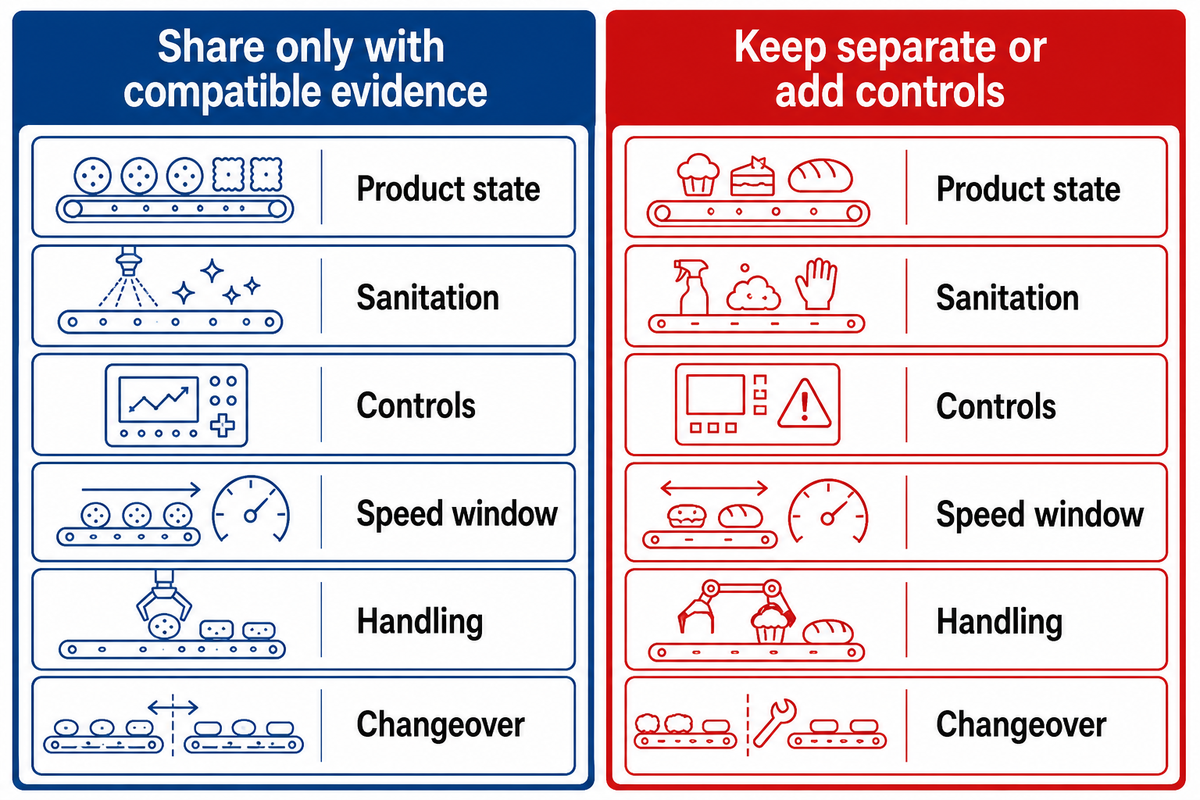
Shared modules are only justified when product compatibility is maintained throughout changes in state, sanitation, controls, speed window, and physical handling and changeover evidence. Mechanical connection is just one aspect. A conveyor may fit both routes physically yet create excessive breakage for one product. An oven may have enough nominal capacity yet lack the usable time-temperature window. A packing section may accept different pack formats, but may not accept one product in a stable condition.
| Dimension | Share only if | Keep separate or add controls when |
|---|---|---|
| Product state | Entry and exit conditions overlap within a proven window | One route distorts, sticks, checks or breaks |
| Sanitation | Cleaning scope covers every relevant contact surface and product history | Allergen, residue or access boundaries cannot be controlled |
| Controls | Recipes, interlocks and change authorization are distinct and traceable | A shared setting can silently cross product states |
| Speed window | All connected stages run stably in the same operating window | Buffers hide chronic starvation or blockage |
| Handling | Transfer height, orientation and contact are acceptable for both | Fragility or geometry needs a different path |
| Changeover | Duration, checks, release and restart evidence are agreed | The schedule saving is erased by uncertain recovery |
An FDA warning letter to one bakery illustrates the boundary: shared equipment and an incomplete documented cleaning scope contributed to sesame cross-contact observations. It is a facility-specific enforcement record, not an industry rate, but it shows why prior-product history and auxiliary food-contact surfaces belong in the sharing decision.
For route-specific commercial context, review the SINOFUDE cookie line. For the separate task of allocating interface ownership, use the line interface boundary planner. Neither of the two references changes the test of evidence described above.
Trace Quality Drift Across Mixing, Forming, Baking, Cooling, and Packing
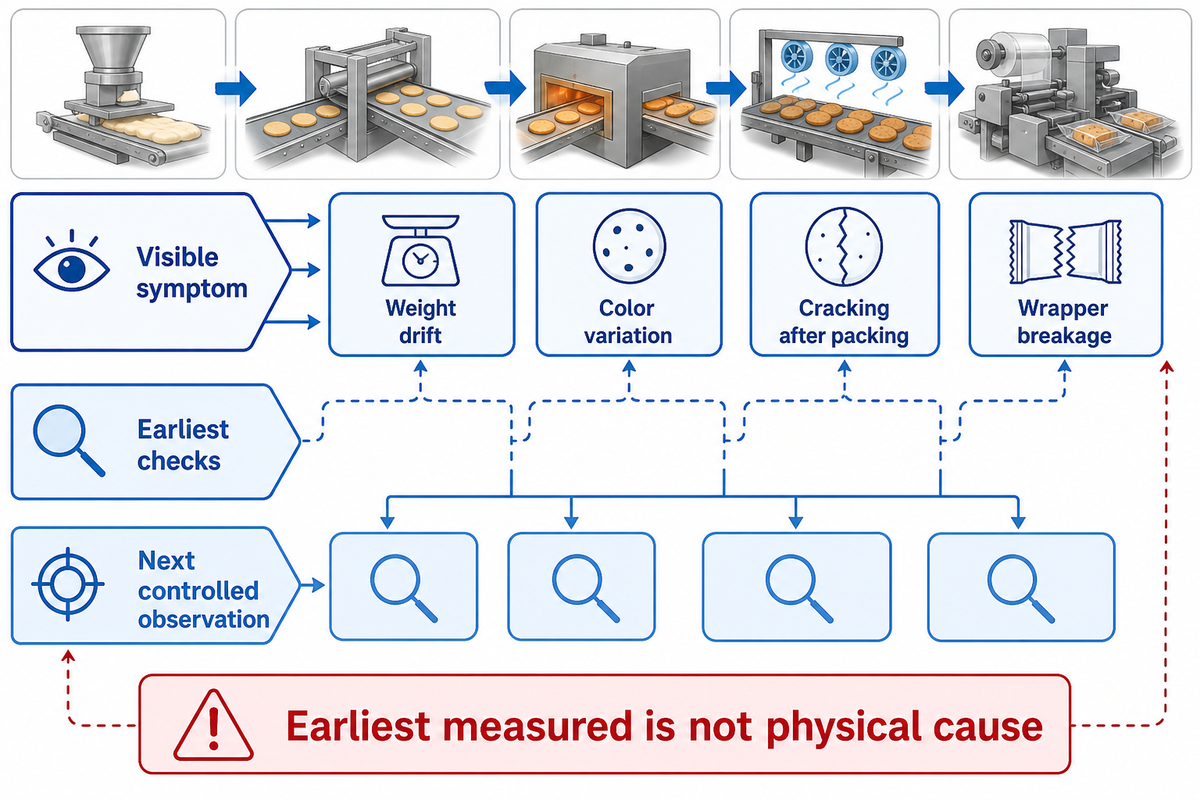
When a wrapper shows breakage, the machine nearest to it is an observation machine, not always the cause of breakage. The product may have entered cooling with an internal moisture gradient, accumulated stress during stacking or arrived at the wrapper with unstable spacing. A useful investigation aligns observations by batch and time, finds the earliest measured deviation, and changes one variable at a time.
Because Band Loading, Piece Geometry and Convection can move together, a color change shouldn’t be assigned to an oven zone from appearance alone. Likewise, a product made with flour and a changed leavening system may preserve nominal weight while its flavor and texture or later structural behavior change. Record the intervention before deciding which variable explains the drift.
| Visible symptom | Earliest checks | Next controlled observation |
|---|---|---|
| Weight drift | Batch state, feed consistency, piece mass before oven | Hold recipe and speed; compare timed piece samples |
| Color variation | Piece thickness, band position, zone profile, loading pattern | Map cross-band results before changing several zones |
| Cracking after packing | Internal distribution, cooling history, storage time, handling load | Retain location-specific samples through an agreed observation window |
| Wrapper breakage | Cooling endpoint, accumulation, transfer height, infeed timing | Record breakage before and after each handoff |
| Seal or shelf-life concern | Pack-entry state, film and seal conditions, package integrity | Separate product-state testing from package-system testing |
In a 2025 low-fat biscuit study, it was reported that process routes can cause different internal moisture distributions and checking behavior. In the studied microwave-assisted process routes, differences in moisture content of biscuit parts were less than 1% (wet basis). The study provides no recommended remedy for other recipes. Its lesson is more restricted and valuable: averages of whole pieces and a short observation window may miss gradients and delayed structural effects.
If cracking is first noted at pack discharge, an adjustment of the wrapper shouldn’t be the first step in the investigation. Hold the recipe and speed fixed, and take samples at oven-band position. Record the data for oven exit and cooling. Check breakage at every transfer. If the first measured difference is noted after cooling, this provides the next constraint; it doesn’t prove that cooling was the physical cause for the drift. For other ways of process-state thinking beyond this guide, see the confectionery manufacturing process companion.
Plan Utilities, Hygiene, Guarding, and Maintenance Access
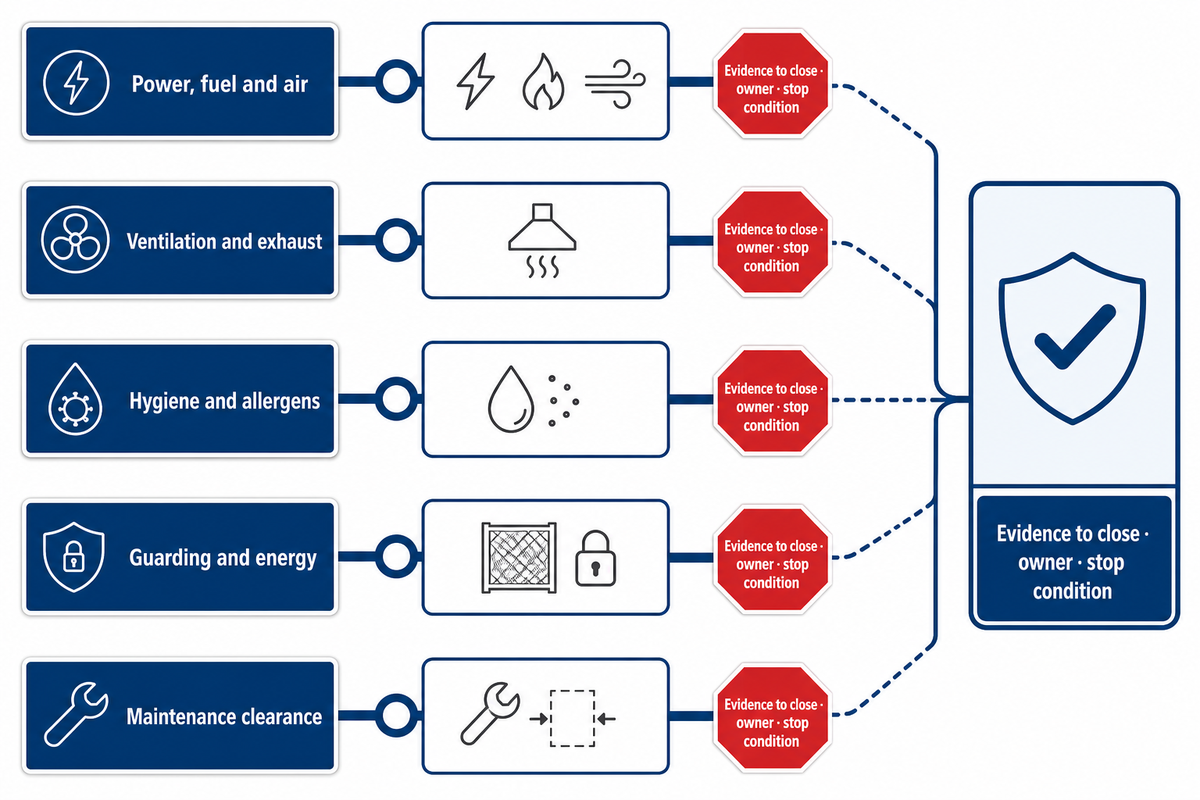
A piece of equipment becomes a site system only after the utility, exhaust, and airflow requirements are defined, as well as access, cleaning, guarding, hazardous energy control, dust, drainage (if applicable), and local approval responsibilities. These often change the footprint, equipment boundary, installation and commissioning sequence, as well as the evidence to demonstrate commissioning. Therefore, they should be defined prior to providing a final configured proposal.
The US OSHA bakery-equipment standard has specific provisions for flour handling, mixers, moulders, ovens and biscuit or cracker equipment. OSHA’s combustible-dust enforcement materials provide inspection context for dust escape, accumulation and ignition. These references are at the category level in the US. They neither certify nor substitute the requirements of the destination jurisdiction or the authorities having jurisdiction.
One particular case is 29 CFR 1910.263(c)(3), which defines an 8 ft 6 in. threshold for certain sprocket and V-belt drive guarding. That value is scoped to the context of the cited U.S. rule and the specific equipment; it isn’t a design or construction standard for clearances. It isn’t a design or construction risk review.
“All gears shall be completely enclosed regardless of location.”
OSHA 29 CFR 1910.263, quoted to illustrate the specificity of one US rule, not as a complete guarding assessment.
| Interface | Evidence to close | Typical owner | Stop condition |
|---|---|---|---|
| Power, fuel and air | Source, limits, quality, connection and responsibility | Buyer / supplier | Supply basis conflicts with equipment design |
| Ventilation and exhaust | Heat load, make-up air, discharge route and approval | Buyer / third party | Room conditions cannot be maintained |
| Hygiene and allergens | Cleaning method, access, product history and release record | Buyer quality / supplier | Relevant surfaces are outside the cleaning scope |
| Guarding and energy | Risk review, access, interlocks and service isolation | Supplier / buyer / authority | Required access defeats the control boundary |
| Maintenance clearance | Removal path, lifting, inspection and sanitation access | Buyer / supplier | A component cannot be safely inspected or removed |
SINOFUDE’s certification and compliance planning page provides other company-specific documentation. Final legal acceptance, certification scope and local engineering decisions remain project- and destination-specific.
Why Early Budgets Drift When Process Assumptions Stay Open
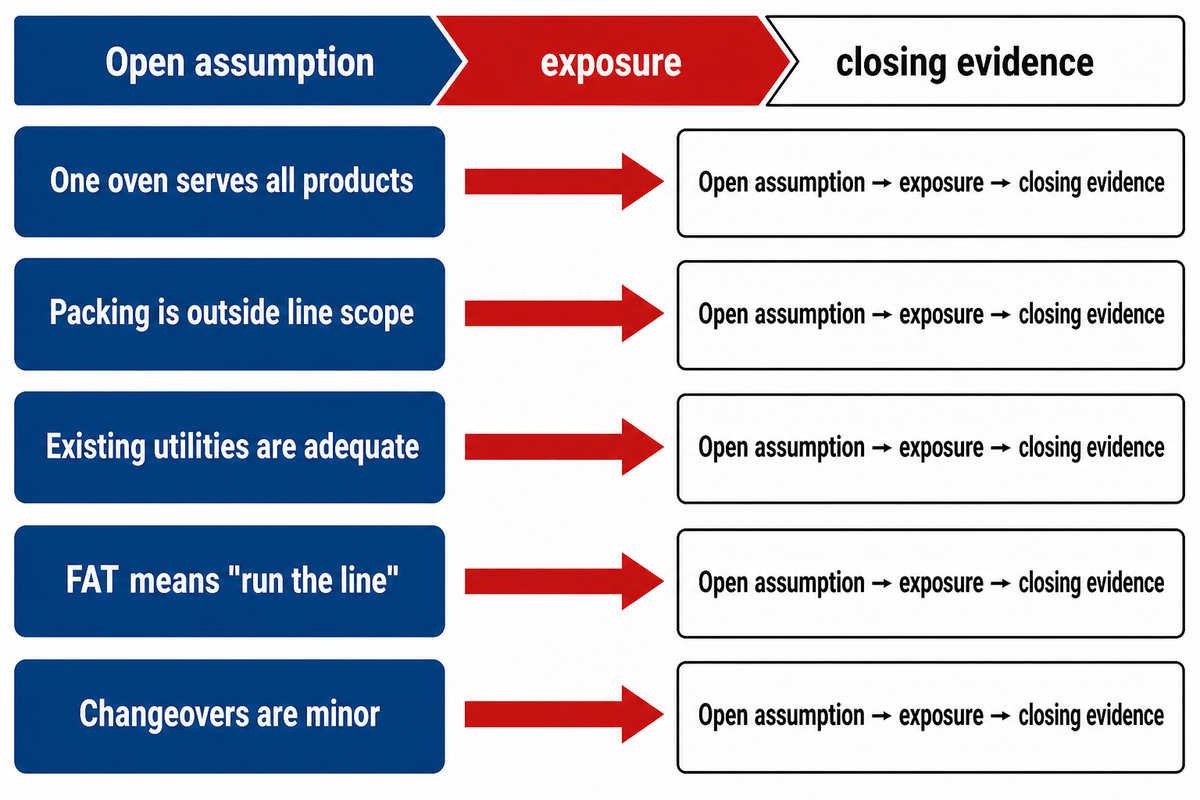
Early bakery-line budgets change when apparently stable equipment lists hide open product states, site utilities, shared module limits, packing boundaries, test materials, and validation or integration work. This is often the case when assumptions are replaced with definitive scope. A useful budget review therefore closes high-exposure unknowns before comparing prices; it does not search for one universal price per line name.
| Open assumption | Possible exposure | Closing evidence | Owner / due date |
|---|---|---|---|
| One oven serves all products | Zones, residence time, width or scheduling changes | Product-state windows and trial plan | Process / dated |
| Packing is outside line scope | Buffers, handling, controls and acceptance gaps | Defined pack-entry and pack-output boundaries | Buyer / integrator |
| Existing utilities are adequate | Site upgrades, recovery delays or derating | Measured source and demand basis | Site engineering |
| FAT means “run the line” | Unplanned materials, duration, instruments and retests | Approved witness-point register | Procurement / quality |
| Changeovers are minor | Cleaning, tooling, verification and lost production time | Observed changeover sequence and release rule | Operations / quality |
Configured route, output, pricing and proposal questions belong on the Biscuit, Cookie & Bakery Lines solution page. That single commercial handoff prevents this educational guide from becoming a second product selector.
Use a Witness-Point Register for FAT, SAT, and Handover
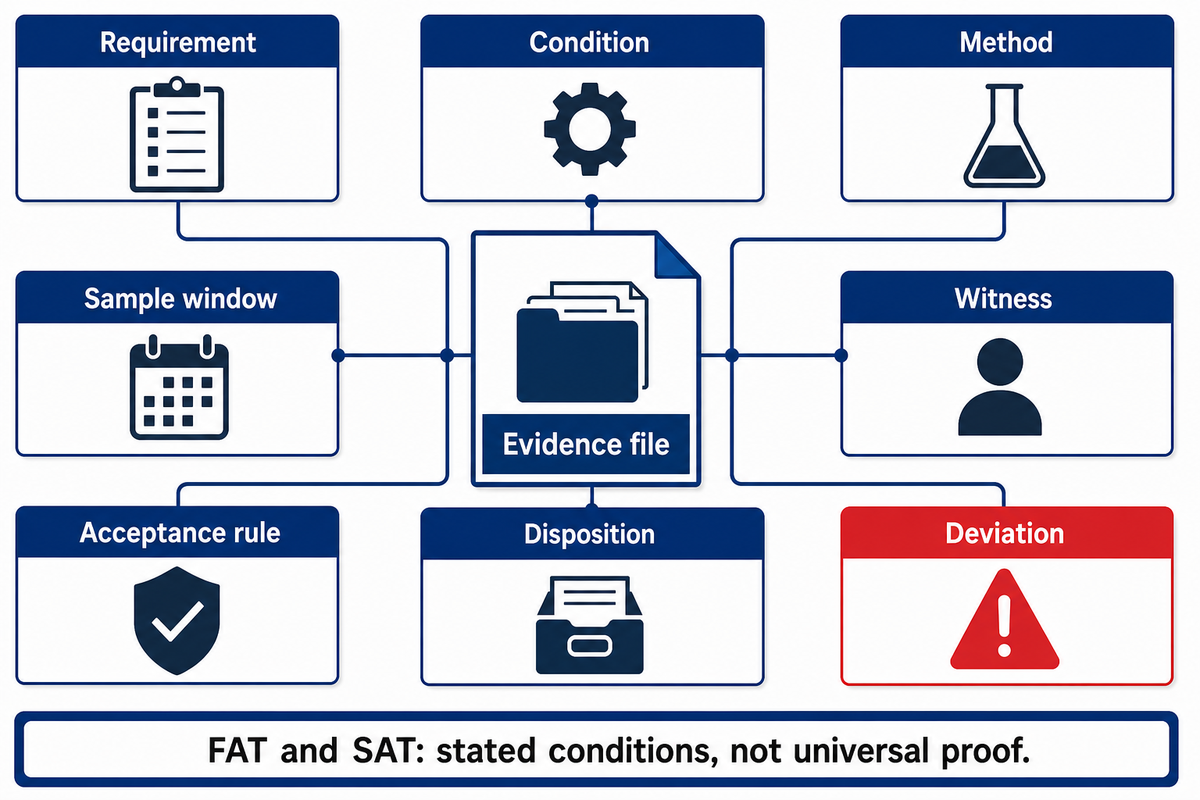
Factory acceptance testing (FAT) or site acceptance testing (SAT) demonstrates agreed scope under stated factory/site conditions respectively. Neither acronym certifies stable commercial production, local regulatory acceptance or food safety control. The result is defensible only when another reviewer can reconstruct what was tested, how, with which materials and utilities, within what sample window, against what rule and with what deviations.
The Witness-Point Register makes such a reconstruction possible. The public summary for IEC 62381:2024 supports agreed scope, responsibilities and project-specific test plans. The NASA product-verification guide offers an engineering analogy for requirements, measurements and methods and discrepancies. Neither document turns the buyer’s method into a bakery law.
The 9-Field Witness-Point Register
| Record category | Qualified example, not a SINOFUDE result | Why retain it |
|---|---|---|
| Requirement | “Piece mass within purchaser-approved range” | Links the test to an agreed document |
| Condition | Named recipe revision, raw material lot, utilities and staffing | Prevents a result losing its context |
| Method | Approved sample locations, frequency and instrument | Makes observation repeatable |
| Sample window | Start/end time plus pauses and restarts | Separates stable operation from selected snapshots |
| Witness | Named supplier, buyer and third-party roles | Records who observed which evidence |
| Evidence file | Raw readings, photos, event log and retained samples | Preserves more than a verbal pass |
| Acceptance rule | Pre-agreed calculation and decision boundary | Stops post-test rule changes |
| Deviation | Actual condition, affected evidence and containment | Keeps exceptions visible |
| Disposition | Accept, reject, retest or conditional close with owner/date | Turns observation into controlled action |
The legal evidence boundary matters. 21 CFR 117.160 requires scientific and technical evidence and qualified oversight for applicable preventive-control validation, with stated exceptions. An equipment FAT record isn’t automatically that validation. Likewise, 21 CFR 117.305 requires actual values or observations and contemporaneous, facility-identifiable records within its scope; it doesn’t make every FAT field a food-safety record.
After the register is drafted, the SINOFUDE commissioning readiness check can support a separate commercial readiness conversation.
What Smarter Inspection Changes, and What It Does Not Prove
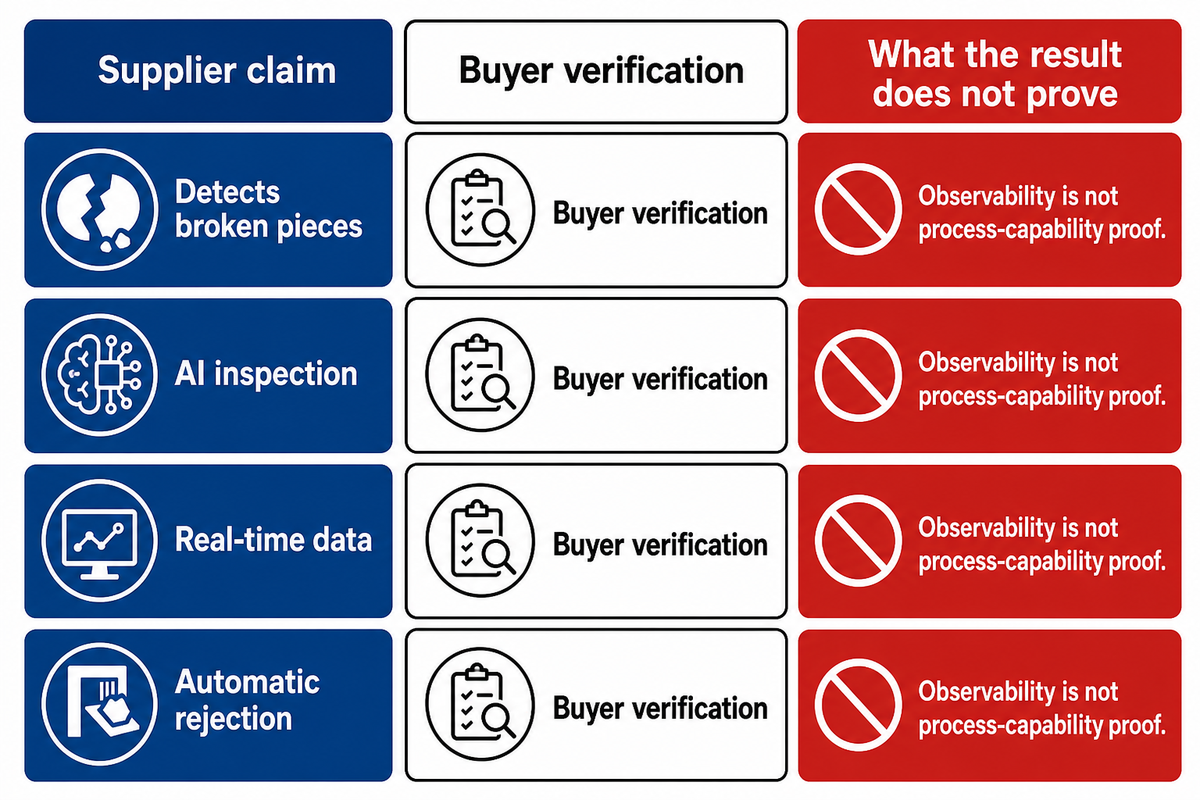
Machine vision and connectivity of drives and controls can make more information observable about line conditions. Defects that are visible can be classified and recorded. Connected drives and controls can log operation and alarm conditions. While these can help bridge the gap from a symptom to a useful check, they don’t prove the process is capable of consistently producing the output within required constraints just because a demo detected a defect. A defect-detection demo also does not replace applicable preventive-control validation, which 21 CFR 117.160 ties to scientific and technical evidence.
| Supplier claim | Buyer verification | What the result does not prove |
|---|---|---|
| “Detects broken pieces” | Define break classes, challenge set, speed and lighting | Detection of subtle defects or all products |
| “AI inspection” | Record model/version, change control and false accept/reject treatment | Stable performance after recipe or lighting changes |
| “Real-time data” | Verify timestamps, retention, access, export and alarm ownership | That a reaction plan exists or is effective |
| “Automatic rejection” | Confirm reject tracking, bin status, bypass and fail-safe behavior | That rejected product cannot re-enter the accepted flow |
The key question isn’t “Does the line have AI?” It is “What have the sponsors agreed to define as a defect? What conditions were challenged? What’s done with classification uncertainty?” They establish useful evidence only when the challenge set, operating conditions, decision rule and reaction plan are agreed.
Bring a measurable line brief
The product-state passport and witness point register should be employed to document assumptions. SINOFUDE can evaluate the commercial equipment boundary without displacing the buyer’s responsibility for product, food safety or local engineering.
FAQ
1. What’s the difference between biscuits and cookies?
For line planning and engineering, teams need a common understanding of the state of the dough/batter, geometry of the piece, inclusions, forming action, endpoints for baking and cooling, and the format of the final package. These specifics give a better understanding of the finished product than just whether it’s sold as a biscuit or cookie.
The consumer page “cookies recipe” may illustrate cookies are made, but usually it doesn’t include the controlled field measurements necessary for integration into an industrial line. The same holds for the fresh-baked retail description: it illustrates an eating expectation, not a controlled pack-entry state.
2. How have biscuit, cookie and bakery lines changed over time?
Newer drives, inspection cameras and logging event controls may add value, but the basic engineering function of controlling quality of a pack while moving it through forming, baking, cooling and packing remains unchanged. Customers should evaluate each claimed feature against agreed conditions including defined product speed, changeover times and product rejection.
Product culture can be explained by history of cookies or early cookies, but it isn’t acceptance evidence. Meaningful change from an engineering standpoint is if the process controls, measurements and records make the current process state observable and repeatable.
3. Are biscuit, cookie and bakery lines halal?
A machine or line by itself doesn’t make the final product halal. Other factors such as ingredients, lubricants or processing aids, cross-contact control, cleaning validation and storage may impact halal determination as well as the certifier accepted in the destination market. Define the required certification route and obtain project-specific evidence instead of relying on generic equipment claims.
4. Which records should follow a product through the line?
At a minimum, connect the batch or time window with material status, observations, oven settings, cooling endpoint, packing conditions, rejects and interventions. The set of records reviewed depends on the product and the quality system.
5. What should a buyer witness during FAT and SAT?
Witness the agreed upon condition of raw materials and recipes, utilities, staffing, run length, line speed, changeovers, sample method, packing line boundary, safety and quality checks, data capture and deviation handling. FAT demonstrates the specified factory test under stated conditions; SAT confirms agreed site interfaces after installation. Record process pauses and any sample rejections, as well as interventions and equipment restarts. A reviewer should be able to determine exactly what was demonstrated and the open issues.
6. Can one cooling or packing section serve several products?
Possibly, but only when temperature, residence time, fragility, transfer geometry, speed window, hygiene, changeover and pack-entry conditions remain compatible. Assume shared-module suitability is a claim, not a default.
References & Sources
- FDA sanitary-design annotated bibliography, used for cleanability and equipment-design principles with its 2004 context visible.
- The Combustible Dust NEP is used for the U.S. inspection, not for project certification.
- NASA Product Verification, used only as an engineering analogy for requirement-linked verification records.
- FDA FSMA frequently asked questions, used for the facility-specific food-safety-plan boundary.
Author: XCX
Editorial note: Facts about suppliers are explicitly provided. Sources for experiments and enforcement are kept within product, facility and jurisdictional limits. No performance, price, certification or project assurances are provided.