Get in Touch with SINOFUDE Company

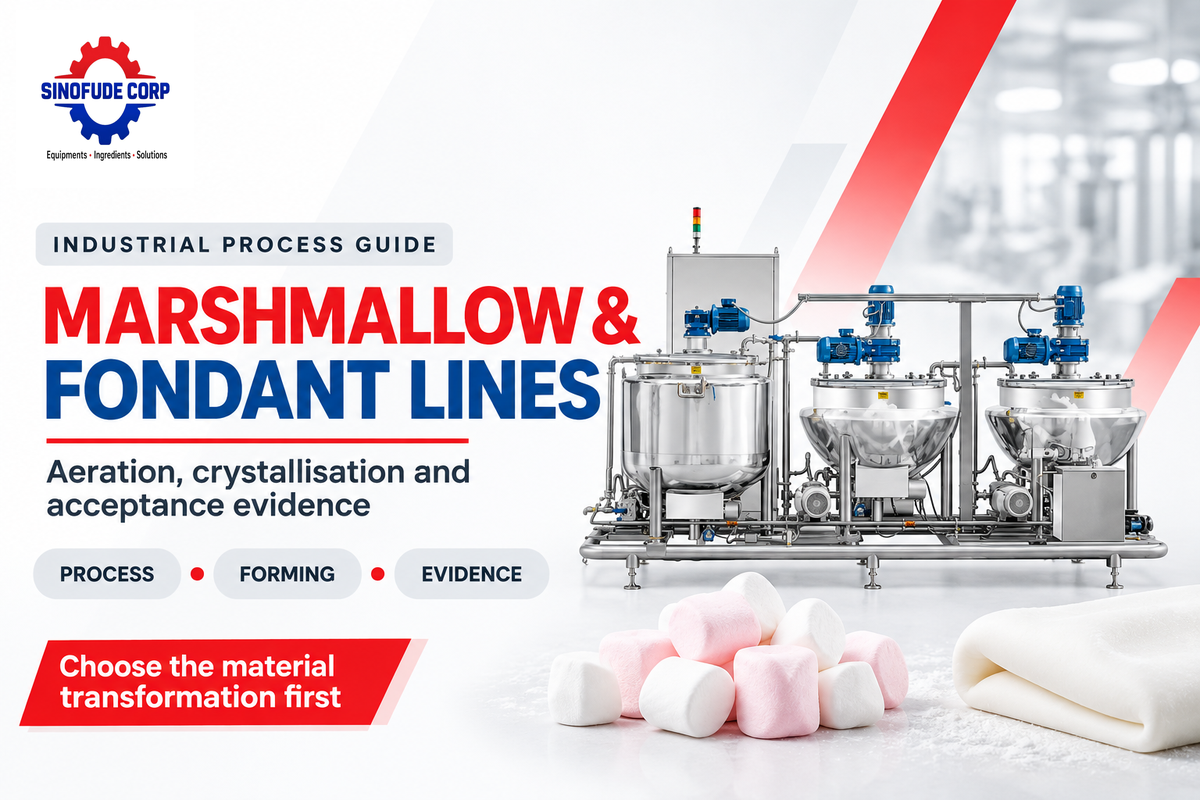
Because of their similar treatment of sugar-based confectionery masses, Marshmallow & Fondant lines are usually discussed jointly. However, their critical transformations are different. Marshmallow production builds and preserves a foam, while fondant production creates and manages a fine crystalline structure. A useful project brief distinguishes their functions before comparing equipment, output or price.
A marshmallow fondant recipe for cake decorating defines a consumer product. It may explain how to make marshmallow fondant from melted marshmallows and powdered sugar, then knead it. Consumer instructions may cover when to start kneading, how to rest the mass, and how to roll a thin layer, prior to using cookie cutters. This guide does not teach how to make the fondant by hand; it covers industrial fondant production.
Updated November 2026
Quick process reference
- Marshmallow critical transformation: aeration followed by forming and setting.
- Fondant critical transformation: controlled cooling and crystallisation before forming, filling or coating.
- Capacity basis: one named recipe, product geometry, forming route and accepted-output definition.
- Project boundary: product, utilities, hygiene, packaging and acceptance evidence must be stated separately.
Marshmallow & Fondant Lines require different core controls: stable aeration for marshmallow and controlled crystallisation for fondant. Select the product route first, then balance preparation, forming and setting around accepted output.
Key points
- The fastest machine doesn’t define complete-line output when another operation controls release or residence time.
- A density problem can begin in formulation or feed condition, not only inside the aerator.
- Confirm packaged storage stability with a storage study; line-end appearance alone can’t show later texture change.
- Factory acceptance and installed-site acceptance need different evidence.
What Are Marshmallow & Fondant Lines, and Where Do the Processes Split?
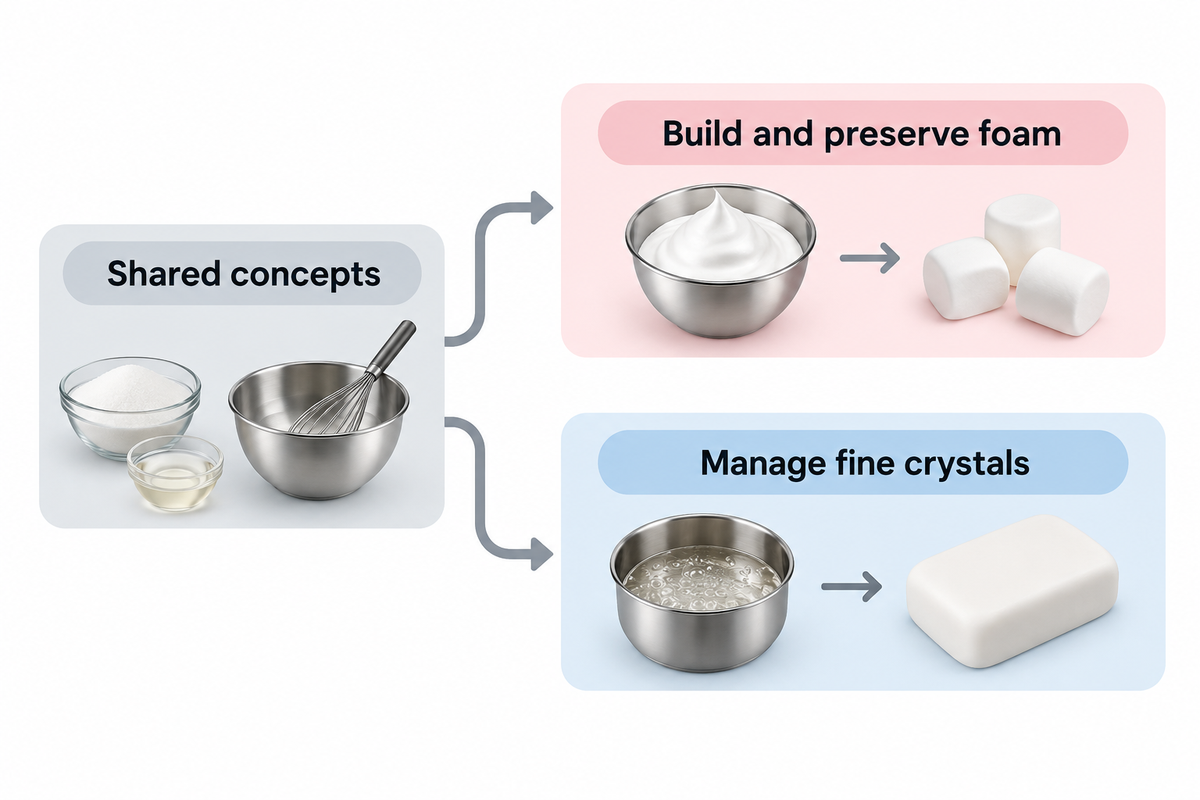
Marshmallow lines prepare a syrup or base, incorporate gas, form the aerated mass and hold it long enough to become handleable, while fondant lines prepare a supersaturated sugar system, cool it under controlled conditions to supercool the mass and promote fine crystallisation. The lines may share ingredient handling, cooking, and packaging concepts, but their defining material transformations are not interchangeable.
For marshmallow, adding gas is just the beginning. The liquid phase and structural ingredients must support bubbles during transport through piping, a depositor, or an extrusion head. A mixture that doesn’t retain enough air may leave the aerator with the wrong density or lose volume later on. A 2026 peer-reviewed study of gelatin-free marshmallow systems links material behaviour, aeration and foam stability under its tested formulations. It suggests evaluating density and feed condition together for the recipe being run.
Fondant is a heterogeneous system with sugar crystals dispersed through a saturated liquid phase, with some incorporated air. Its production sequence usually includes cooking, cooling, and crystallisation before the mass is packed, used as a filling, or fed to a downstream process. The crystal population affects smoothness, machinability, and later on, texture. Treating fondant as “marshmallow without aeration” ignores the process which gives fondant its structure.
Marshmallow route
- Prepare a stable feed for aeration.
- Control gas incorporation and density.
- Form without collapsing the foam.
- Allow the product to set before handling.
Fondant route
- Prepare the sugar solution and recipe.
- Control cooling before crystal development.
- Create a fine, consistent crystalline mass.
- Condition it for packing or downstream use.
A combined plant can produce both families, but a shared building doesn’t mean the same processing equipment or a single continuous process. Define which vessels, transfer paths, forming machines and cleaning procedures are genuinely common. Also identify the product-specific modules and the changeover work between them. The guide on chocolate production-lines uses the same method for another family of confectionery processes.
Control Formulation Before the Line Controls You
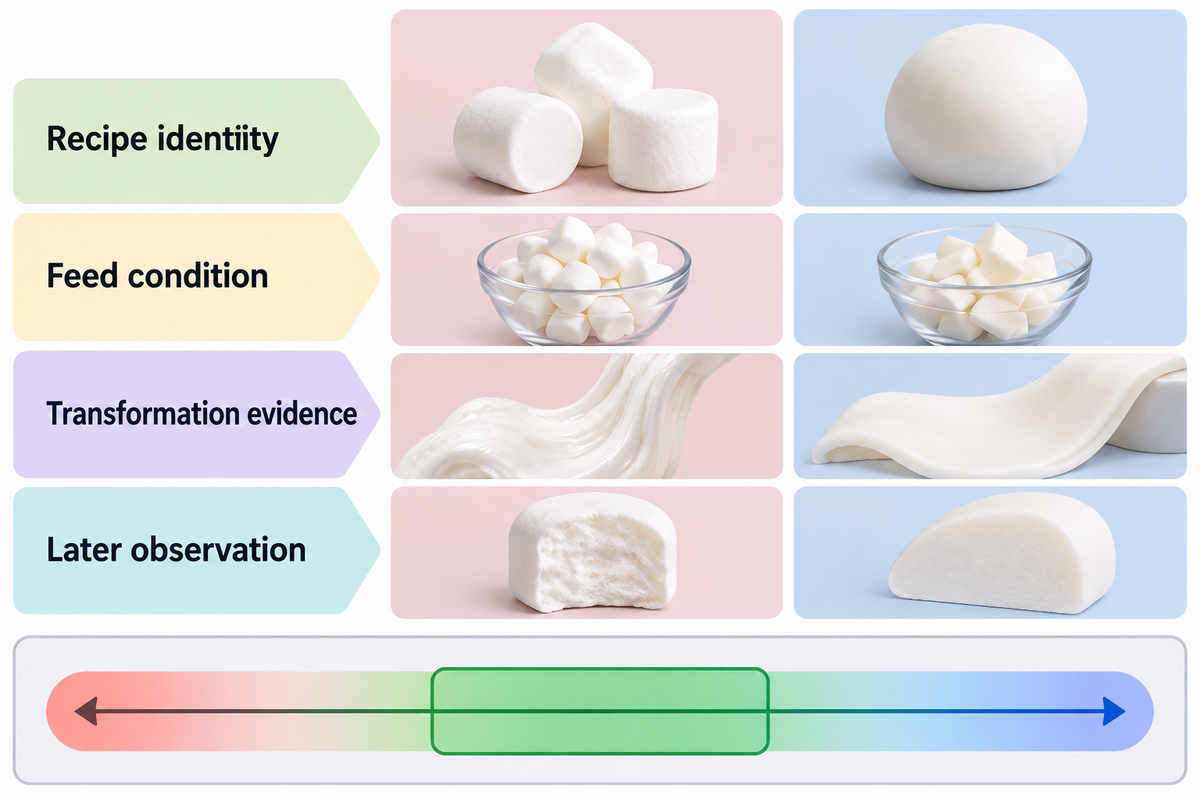
Formulation sets the operating window for both product families. Marshmallow ingredients influence viscosity, bubble retention, stickiness and setting. Fondant ingredients influence its texture during flow and storage. A commissioning trial should therefore preserve the recipe, ingredient specifications and material condition alongside every equipment setting.
When marshmallow density drifts, the aerator is an obvious suspect, but it is not the only one. Feed temperature, dissolved solids condition, syrup history, structural ingredients, and delivery of gas all influence what finally reaches the mixing head. If several variables change together, a successful adjustment cannot be attributed to one cause. Hold recipe constant, evaluate the feed condition, and change one variable at a time.
Fondant requires the same discipline for a different reason. Its smooth texture is a function of the relationship between the syrup phase and the crystalline phase. An enzyme-treated formulation can continue to change after forming. A 2019 peer-reviewed study found that different invertase concentrations affected fondant hardness and rheological behaviour during storage, while adding invertase also changed sugar composition relative to the control. That finding is formulation-specific, but it is enough to show why “acceptable at discharge” and “stable for the intended use” are separate claims.
| Record group | Marshmallow focus | Fondant focus |
|---|---|---|
| Recipe identity | Sweeteners, water and structure-forming system | Sucrose, glucose or invert sugar and optional enzyme treatment |
| Feed condition | Temperature, flow consistency and pre-aeration state | Cooking endpoint and condition before cooling |
| Transformation evidence | Density, foam appearance and retention through forming | Texture, crystal development and machinability |
| Later observation | Setting, surface condition and packaged texture | Hardness, smoothness and storage change |
The record prevents a common commissioning error: finding one workable setting, changing the raw material, and then treating the original setting as a machine guarantee. The defensible operating window belongs to the tested combination of the formulation, machine and environment.
Choose the Forming Route Before You Size the Line
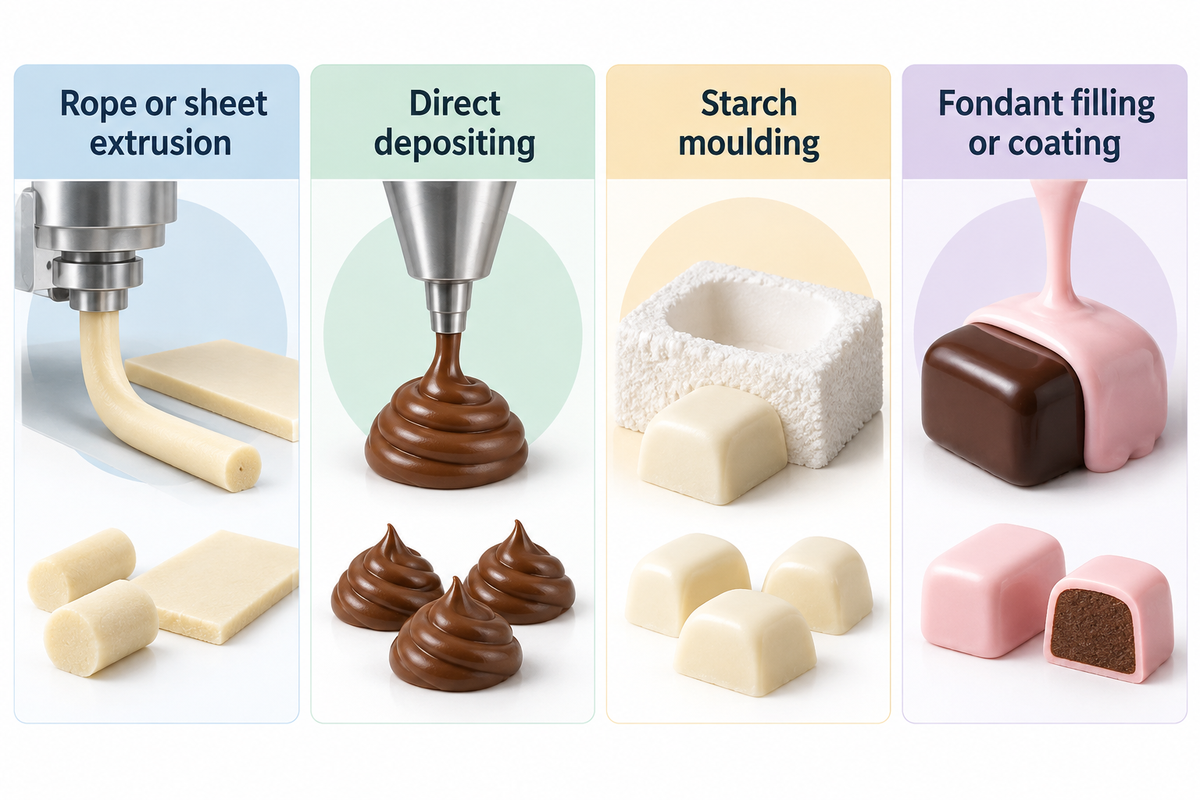
Extrusion produces ropes or sheets; depositing meters mass into discrete shapes or onto another product; and starch-moulded forming adds mould preparation, filling, residence, and demoulding duties. Here, preparation of the mould, filling, residence and demoulding are added tasks. Choose the method to use by the final shape, surface treatment and handling constraints of the product. The method also determines what equipment is used downstream and how the process capacity is measured.
Extruded marshmallow normally leaves a forming head as ropes or a sheet, receives a release material such as starch or dextrose where required, and then moves through setting, cutting, and separation. It receives a release agent like starch or dextrose if needed, and then passes through a setting, cutting and separation stage. The cutter must cut the named cross-section without crushing the aerated structure. Deposited marshmallow is metered into discrete shapes or onto another product. A starch-moulded route adds preparing the mould, filling, residence and demoulding. The same aerated recipe can therefore create different conveying, footprint and cleaning demands.
Starch moulding is the relevant route when a deposit needs cavity-supported shaping and a defined residence before demoulding; it also introduces starch preparation, recovery and cleaning duties. For a similar comparison with a mould residence time, see the starch mogul line guide.
Fondant may be packed as a base ingredient, deposited as a centre, spread as a layer or fed directly into another confectionery operation. The desired flow at the handoff affects downstream selection. For example, a fondant mass intended for later remelting and use by a bakery has a different downstream boundary from a soft center being deposited and coated in the same factory.
Start with a product-family matrix. List intended shape, piece weight, target density or texture, forming route, residence time and package. Mark whether the proposed setup has demonstrated that duty, needs a change part, or needs another module. Once that matrix is stable, the industrial marshmallow production line page is the commercial reference for equipment configurations and project enquiries.
| Route | Best described by | Downstream questions |
|---|---|---|
| Rope or sheet extrusion | Cross-section, density and cutting format | Dusting, setting, cutting, separation and recovery |
| Direct depositing | Deposit geometry, weight and indexing pattern | Surface release, setting, transfer and packing |
| Starch moulding | Cavity, deposit condition and mould residence | Starch preparation, demoulding, cleaning and recycling |
| Fondant filling or coating | Handoff temperature, texture and dose | Centre preparation, enclosure, cooling and storage validation |
Continuous Aeration vs Batch Whipping: The Control Trade-Off
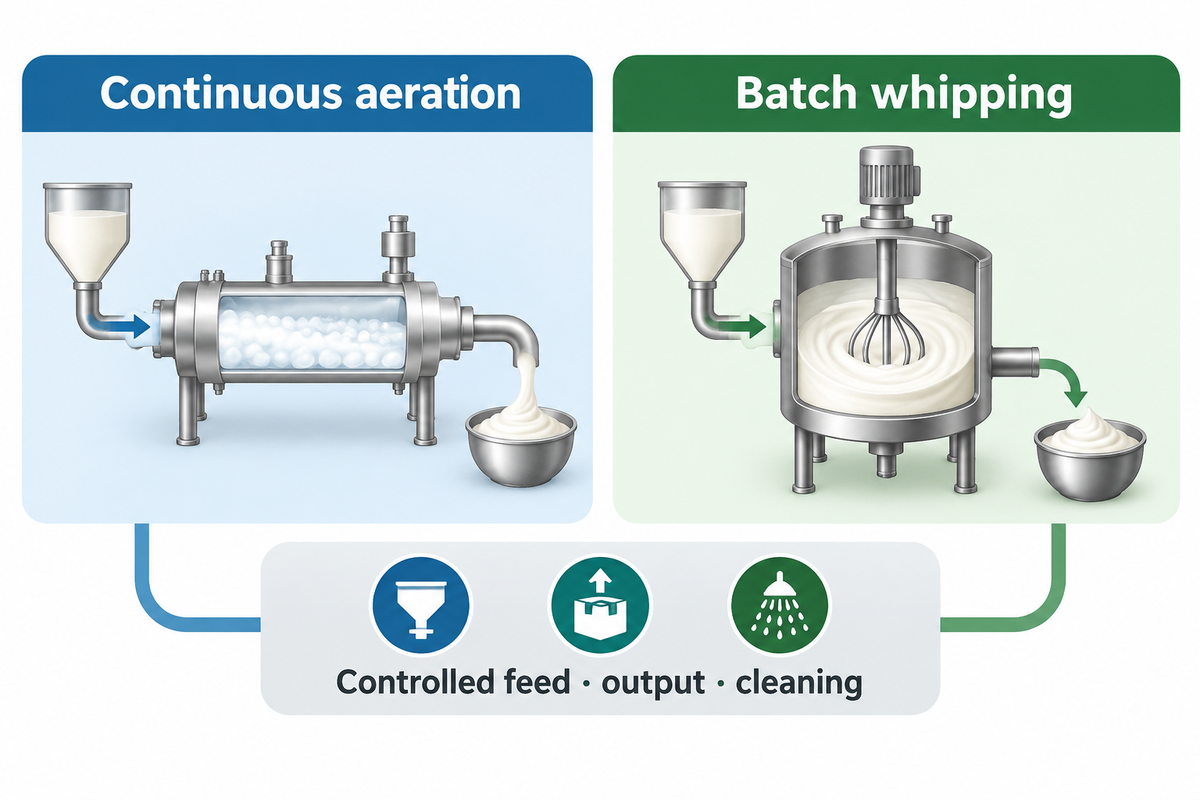
Continuous aeration suits stable feed and sustained production campaigns, while batch whipping suits development, smaller campaigns or frequent recipe changes; both require controlled feed, output and cleaning. Either route can make good marshmallow when forming and setting are matched to its output rhythm.
A continuous system can reduce the interruption between batches, but it makes upstream consistency more visible. Changes in feed can occur further upstream and travel through the system before affecting downstream output, consistent with peer-reviewed work linking formulation, aeration and foam stability under tested marshmallow formulations. Sampling should include startup, steady operation and the transition after an adjustment. Collecting a single sample during discharge won’t capture the inconsistencies that occurred during the campaign.
The traditional batch system provides the operator a defined vessel charge and a specific batch identity. It can be practical when product development, color changes or short runs dominate. Its output rhythm is discontinuous, so the downstream former either waits, uses a buffer or receives batches on a planned schedule. Labor and batch-to-batch variation are part of the comparison.
For continuous aeration, consider feed temperature, pressure and backpressure stability, and startup loss. Also consider the path of the cleaning cycle of the pumps, piping and mixing head. For batch whipping, compare vessel turnaround, batch-to-batch consistency and the cleaning of discrete vessels and tools.
Do
- Define the feed condition before the aerator.
- Sample startup and steady-state output separately.
- Track density through forming and setting.
- Record the transition after every adjustment.
Verify before deciding
- Judge stability from measured product density through forming and setting, alongside gas flow and feed condition.
- Compare batch and continuous rates using the same recipe and accepted-product basis.
- Change feed temperature and gas addition one at a time while recording the resulting density.
- Assess formed and packed product separately from the discharge sample, including its condition during storage.
Build a Saleable-Output Budget, Not a Nameplate Wish
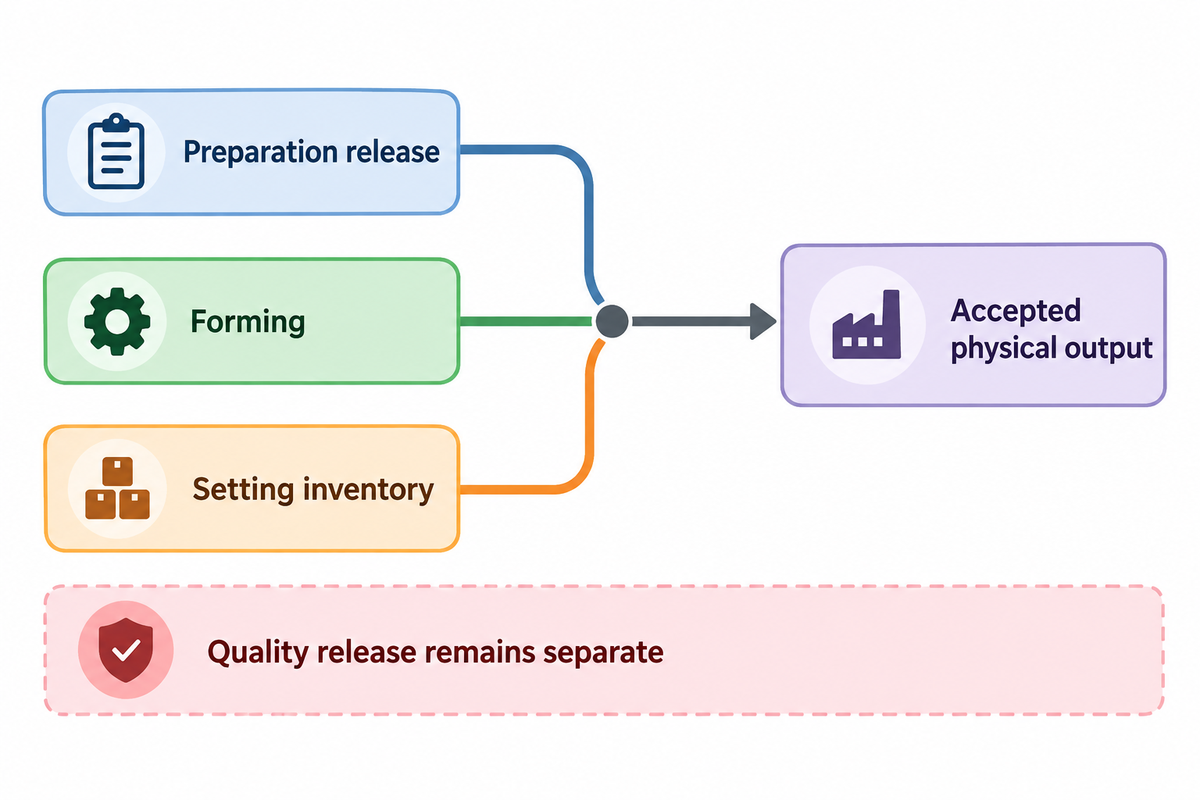
Compare preparation or batch release, forming rate, and setting or conditioning residence. Convert them to the same product basis, and then identify the binding constraint. Account for operating time and physical losses once. Packed good output still remains separate from the factory’s quality release decision.
One Line Release-to-Set Constraint
One Line Release-to-Set Constraint is a constraint model that compares material release, forming throughput and the inventory needed while product sets or conditions.
The first constraint is how quickly suitable mass becomes available. The second constraint is how quickly the former can create the named product. The third constraint is how long that product occupies trays, moulds, a belt, or another holding system before it can be handled. The Institute of Food Technologists observes that the pacesetter in a line that combines batch and continuous operations isn’t always apparent. That is why the fastest catalogued station cannot stand in for a line calculation.
Assumed example: a cooker releases 240 kg every 45 minutes, equal to 320 kg/h before transition losses. The former handles 280 kg/h on the named product. The setting stage has room for 900 kg and needs 4 hours, so its steady inventory basis is 225 kg/h. In this simplified case, setting is the lowest of the three compatible rates. With the setting stage already operating at steady state, a 7-hour output window gives 225 × 7 = 1,575 kg before measured physical losses. The example shows the method; it isn’t a published SINOFUDE capacity.
| Clock | Assumed basis | Equivalent rate or window output |
|---|---|---|
| Preparation release | 240 kg every 45 min | 320 kg/h |
| Forming | Named product at stated density | 280 kg/h |
| Setting inventory | 900 kg held for 4 h | 225 kg/h |
| Operating window | 7 h at steady state | 1,575 kg before measured physical losses |
This model stops at immediate accepted physical output. Packaged marshmallow can gain or lose moisture after production, dependent on formulation, packaging and storage environment. A 2017 study observed formulation-dependent texture deterioration during packaged aging under its test conditions. Retain some samples and define the storage study to be conducted for the target market. The gummy production-lines guide followed the same discipline for another confectionery family.
Treat Utilities and Layout as Process Equipment
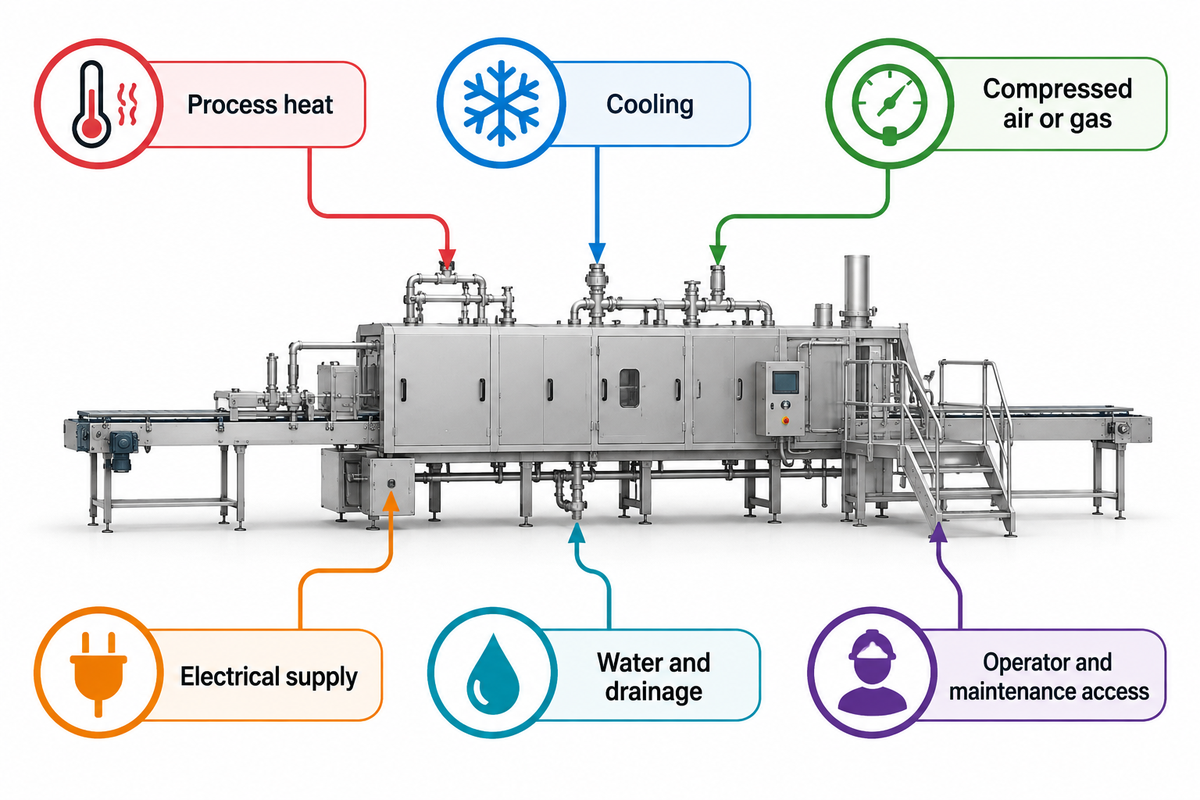
Process heat, cooling, compressed air or gas, electrical supply, drainage, access and buffers are part of line performance. A machine may pass an isolated test but still miss its production duty if its installed services or interfaces are unstable. The utility at the point of use is to be captured as is, together with the intended simultaneous load.
Aeration makes compressed gas particularly important. Pressure and flow influence the operation of a process, while gas quality influences the hygienic boundary when the gas comes into contact with food. For U.S. facilities covered by 21 CFR Part 117, section 117.40(g) addresses compressed air or other gases mechanically introduced into food and requires treatment that prevents contamination by unlawful indirect food additives. That regulatory reference is a U.S. limitation, not a global certification statement.
There must also be a defined boundary for cooling duty. Cooling the product, cooling process water and conditioning the room aren’t necessarily one load. A setting area may require physical inventory space even when its refrigeration capacity is adequate. Layout should show product travel as well as operator and maintenance access, removal paths, and cleaning access. The layout should also show the path for waste and recovered dusting material.
- List every point of use — identify heat, cooling, gas, power, water and drainage connections by module.
- State the operating condition — record required pressure, flow, temperature or electrical duty without treating connected load as consumption.
- Check simultaneous demand — include startup, cleaning and downstream equipment that may run at the same time.
- Mark physical access — preserve operator, sanitation and maintenance routes around the installed line.
- Test at the installed interface — repeat the agreed production duty after connection to the site’s real services.
Design Cleaning and Changeover Into the Process
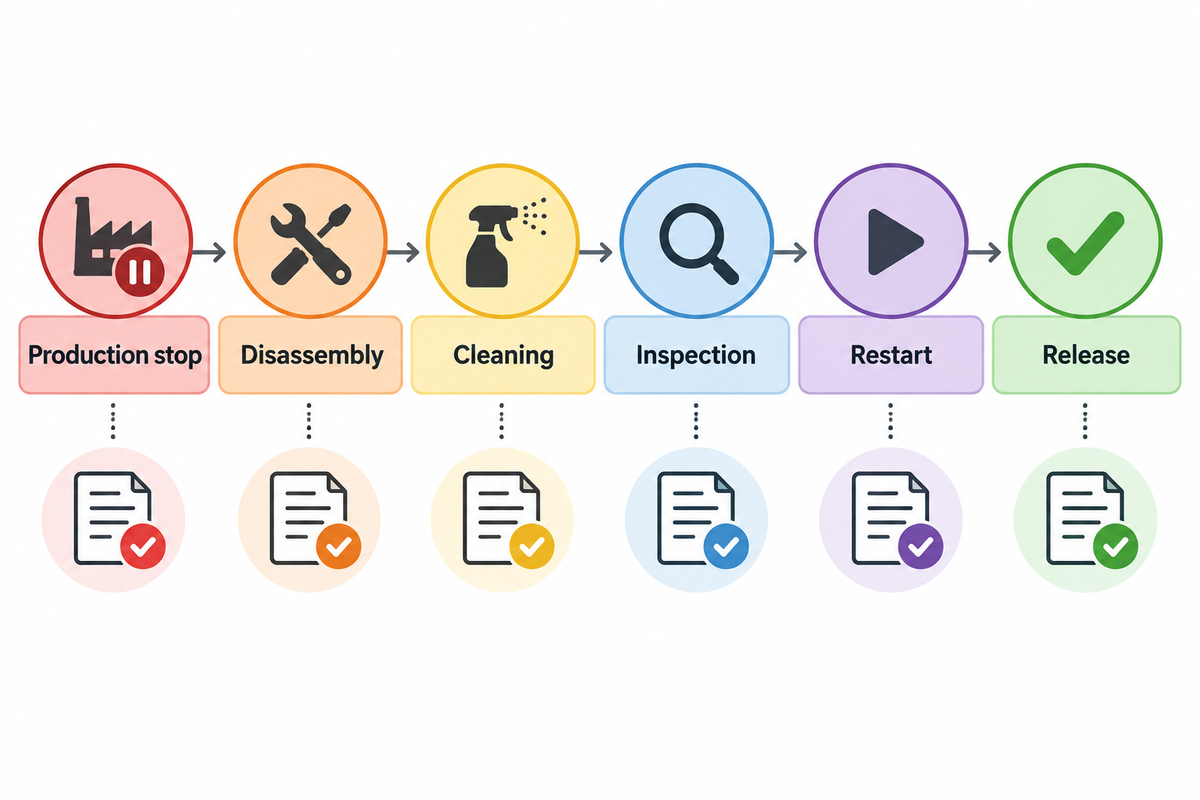
Cleaning scope distinguishes product contact cleaning and external sanitation, inspection, reassembly and release after changeover. Equipment needs cleanable construction and suitable installation, while the factory needs documented cleaning procedures suited to its products, hazards and food-safety plan. Judge the result by the factory’s cleaning completion and inspection records, not by a hygienic brochure claim or operators’ instructions.
Sugar masses can leave behind sticky films, crystals, dusting materials and residues in transfer paths. The method selected depends on equipment design, soil, recipe, the allergen program and the facility’s food safety plan. Prior to purchase, trace every product contact surface, dead space, seal, valve, hose and removable part. Identify what’s cleaned in place, what’s removed, what has to dry and what evidence indicates the line is ready. Do not pour cleaning liquid into a path unless the approved equipment and sanitation procedure permit it.
Current 21 CFR 117.40 requires covered equipment and utensils to be adequately cleanable and properly maintained. The same section also addresses installation arranged to support cleaning and maintenance of equipment and adjacent spaces. Those provisions support a shared responsibility boundary: design and installation must enable sanitation, while the food manufacturer controls the applicable sanitation program and release decision.
| Stage | Evidence to retain | Owner |
|---|---|---|
| Production stop | Last acceptable product and material disposition | Production |
| Disassembly | Parts removed and protected openings | Operations or sanitation |
| Cleaning | Approved method, materials and completion record | Sanitation |
| Inspection | Accessible surfaces, seals and reassembly condition | Qualified factory role |
| Restart | First-product checks and segregated transition output | Production and quality |
| Release | Named decision and applicable verification result | Factory quality system |
Changeover time is therefore more than the minutes spent washing. It includes safe shutdown, material clearance, access, cleaning, drying where required, reassembly, startup and release. Compare quotes on the same boundary.
Diagnose Defects by the Stage That Created Them
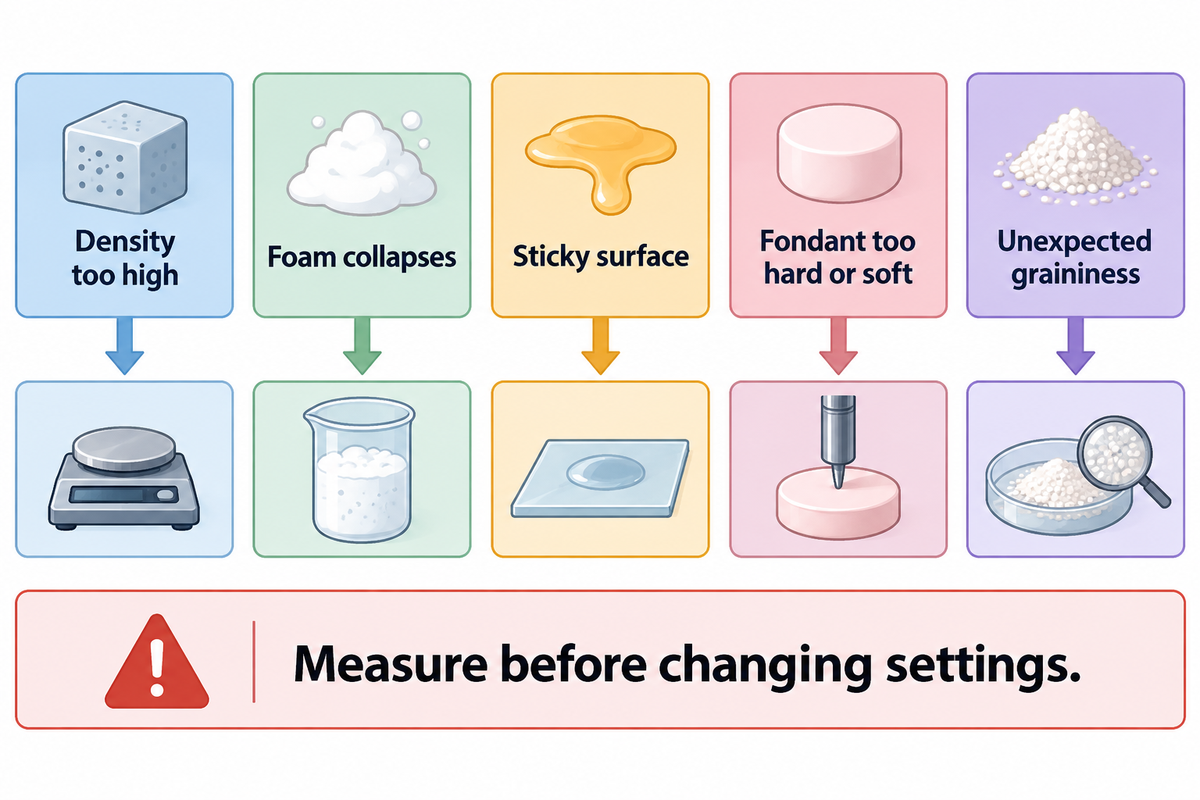
Fondant and marshmallow defects occur at various stages of production. Preserve evidence to assist in determining the cause of a production defect. Discriminating measurements should be taken before changing settings and the result should be confirmed in the next subsequent stage of production.
Low marshmallow volume can be caused by poor gas incorporation or a feed that doesn’t retain air. Shape distortion may be a forming issue, a weak foam or insufficient setting. Sticking may involve surface treatment, moisture movement, package conditions or environmental humidity. Fondant can be gritty because of the development of large crystals. Fondant graininess can reflect crystal development, while later softening in an invertase-treated formula may be an intended or unintended storage effect documented in a peer-reviewed fondant study.
| Symptom | First evidence | Do not conclude yet |
|---|---|---|
| Density too high | Feed condition, gas delivery and density before and after forming | The aerator alone is at fault |
| Foam collapses | Recipe identity, time series and temperature through setting | More gas will solve stability |
| Poor shape | Forming pressure, deposit or extrusion geometry and set condition | The nozzle is the only cause |
| Sticky surface | Surface treatment, moisture, packaging and storage environment | The cutter created the problem |
| Fondant too hard or soft | Recipe, crystal condition, enzyme treatment and storage time | Discharge texture is final texture |
| Unexpected graininess | Cooling history, crystallisation step and later composition change | One faster mixer setting is corrective proof |
| Uneven cut | Blade condition, rope or sheet cross-section and product set state | Cutter speed is the only cause |
| Uneven release coating | Application pattern, recovered material condition and surface moisture | More dusting always fixes sticking |
| Package deformation | Product set state, pack timing and package load | Packaging alone created the defect |
Use time series rather than a single sample. Label material before aeration or crystallization, after the critical transformation, after forming, after setting, at pack-out and during the defined storage study.
What Line Scope Really Includes
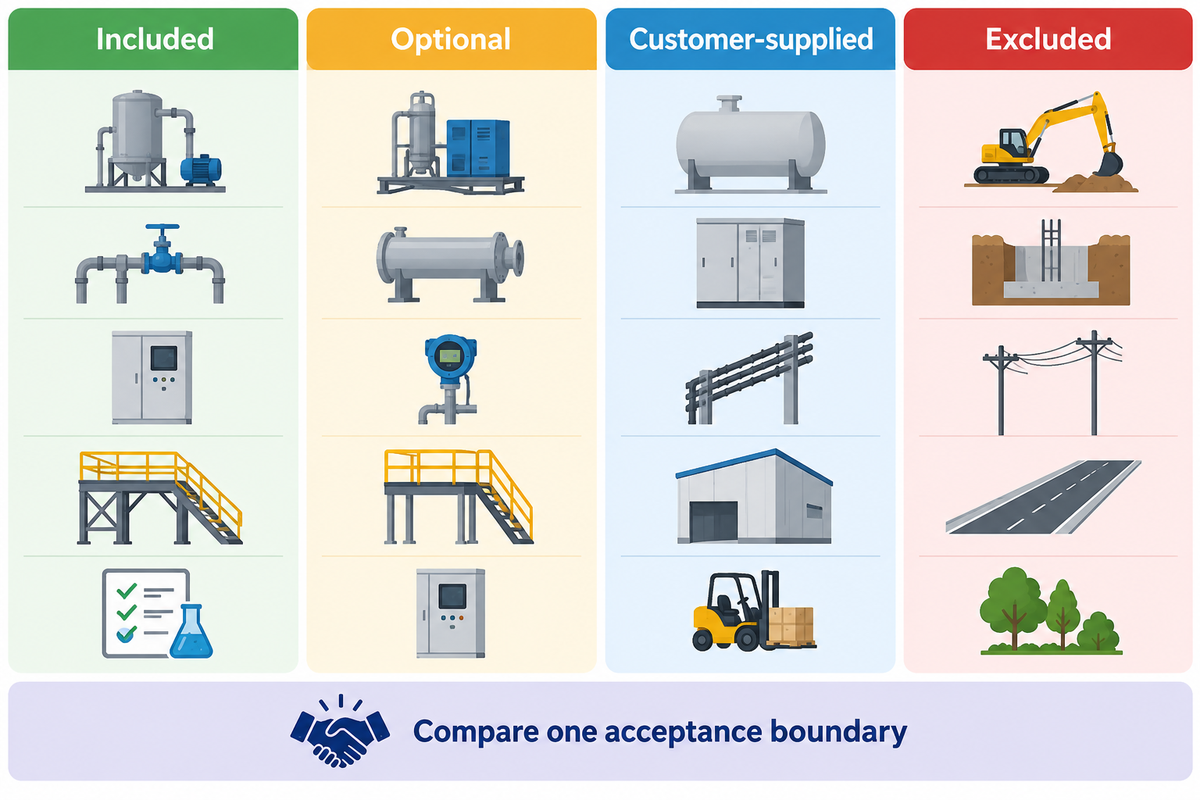
A meaningful line-cost comparison uses one scope: equipment modules, change parts, utilities, controls, installation support, commissioning, training, spares, trial materials and acceptance work. Purchase price alone cannot show the cost of making the intended product.
Separate fixed project items from variable or operating items. A second forming route may require another module, while a second nozzle set is a change part. Site preparation, electrical distribution, cooling services and drainage may be customer-supplied even when the proposal says “complete line”; if hygienic-design requirements are part of the acceptance basis, name the applicable standard in the priced scope, such as ISO 14159. Freight, duties and local installation also depend on destination and contract terms.
Lead time will depend on the number of modules, custom change parts, control integration, fabrication, trial, shipping and site readiness. The scope of utilities will depend on process heat and cooling, food-contact gas, electricity, water and drainage at the points of use.
What gets measured, gets managed. Operating costs need to be connected to measured use and a matching output denominator. Connected motor power is different from energy consumed over a shift. Labour is linked to loading, monitoring, changeover and packing activities. Scrap, rework and retained work-in-progress should be reconciled at the same boundary as the packed output. A cost per kilogram based on the nameplate rating can look low, while the line is waiting for setting space or release.
Scope comparison rule
If two proposals don’t include the same product, modules, utilities, site work, trial and acceptance boundary, their total prices aren’t yet comparable.
For budgeting, have each supplier mark their items as included, optional, customer-supplied or excluded. The resulting gap list is more useful than a fabricated industry average.
How to Compare Acceptance Evidence Without Comparing Brochures
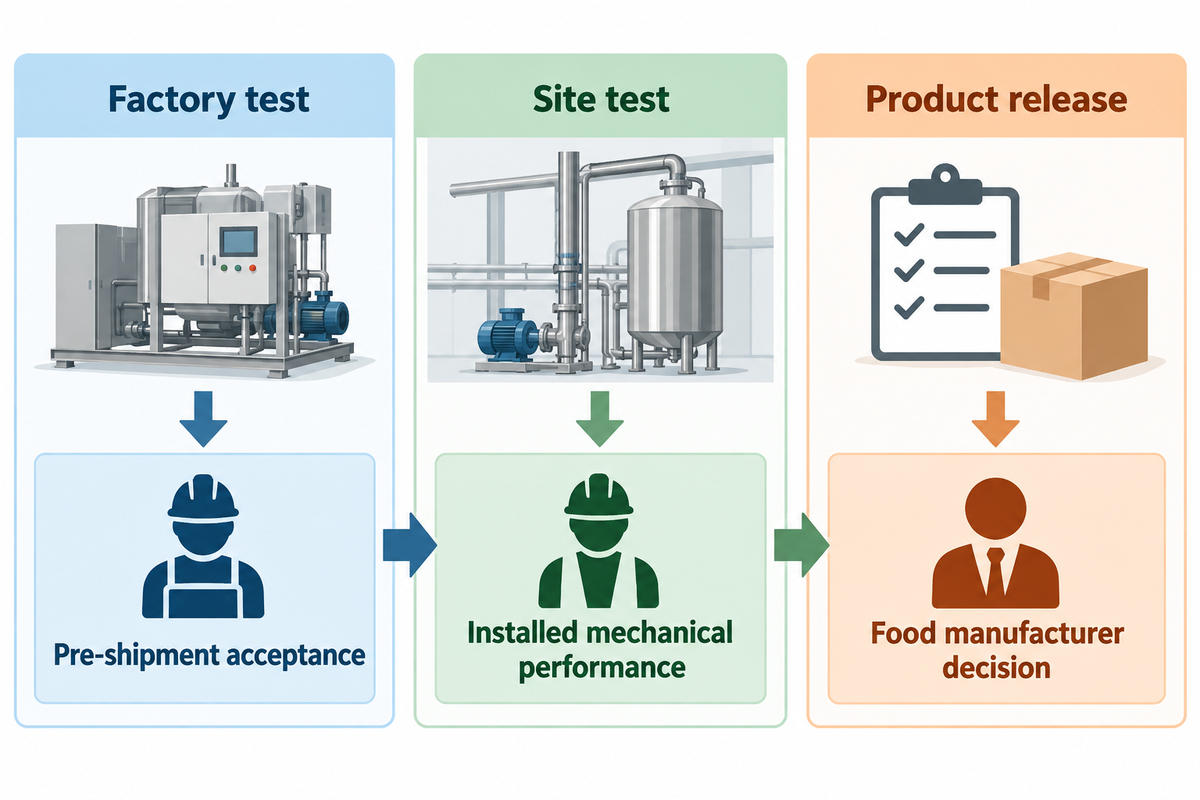
Compare different suppliers by using a single product definition, scope and acceptance criteria. Factory acceptance checks agreed functions before shipment; site acceptance checks the installed line with the buyer’s services and interfaces. Product quality, hygienic validation and storage performance require their own responsible owners and evidence.
A factory test can confirm controls, movement, interlocks and performance on agreed trial material. Site testing should confirm performance with the buyer’s installed utilities, upstream feed, downstream packaging, room environment and local operating team. General factory-acceptance guidance therefore treats the pre-shipment test and installed-site test as different stages.
Write acceptance criteria before running the test. Name the recipe revision, product geometry, density or texture requirement, package format, measurement method, sampling points, run window and treatment of startup product. Note which observations are immediate and which require storage studies. If trial material differs from the intended recipe, record the limitation instead of calling the product proven.
Illustrated supplier webpages demonstrate a number of different process configurations. For example, Oakes presents a continuous mixer-to-depositor configuration, Baker Perkins describes continuous fondant preparation, and Tanis outlines an extrusion make-up route with dusting, cutting and recovery. Use these as configuration examples, not as a ranking, and ask each supplier to respond to the same product brief. The small-scale pilot gummy line guide illustrates how pilot duties define acceptance evidence.
| Process or evidence category | Required evidence | Decision boundary |
|---|---|---|
| Product duty | Recipe, geometry, density or texture and package | Demonstrated, needs change part, or needs module |
| Output | Three constraints, operating window and physical yield | Packed good output on the named product |
| Utilities | Point-of-use condition and simultaneous demand | Factory supply versus supplier scope |
| Cleaning | Access map, removable parts and procedure boundary | Equipment capability versus factory validation |
| Factory test | Functions, trial material and open-item record | Pre-shipment acceptance |
| Site test | Installed services and connected operations | Installed mechanical performance |
| Product release | Factory quality and storage records | Food manufacturer decision |
| Training and documentation | Operating, cleaning and maintenance records | Handover boundary |
| Spares and service | Critical parts list and response path | Post-acceptance support |
Key takeaway
A marshmallow or fondant line is proven for a named recipe, route and acceptance window—not for every product that can be described by the same confectionery label.
Frequently Asked Questions
What is the difference between a marshmallow line and a fondant line?
A marshmallow line creates and preserves an aerated foam, while a fondant line creates and manages a fine crystalline sugar structure. Both may cook syrup and handle similar ingredients, but their critical transformations, measurements and downstream residence needs differ. A combined factory should identify shared utilities and packaging separately from product-specific aeration, crystallisation, forming and cleaning modules.
Is extrusion or depositing better for marshmallows?
Extrusion suits products formed as ropes or sheets before cutting, while depositing suits discrete shapes, layered products or indexed patterns; neither route is universally better. Compare handling control and accepted output for the named product across extrusion and depositing. Include surface treatment, setting space, cleaning access, package handoff and the change parts needed for every intended shape.
How should marshmallow line capacity be calculated?
Calculate capacity by converting preparation release, forming and setting inventory to one product basis. The lowest compatible rate is the current constraint. Apply the measured operating window and physical yield once, then separate packed good output from held or quality-released stock. Recalculate when recipe, density, shape, residence time or package changes.
Can one production line make both marshmallow and fondant?
One installation can share selected preparation, transfer, utility or packaging assets, but marshmallow aeration and fondant crystallisation remain different duties. Confirm compatible materials, cleanable paths, change parts, controls and changeover procedures. A supplier should show which modules are shared and which are product-specific instead of treating the word “combined” as proof of every recipe.
What should be included in a factory acceptance test?
Include the agreed product or representative material, recipe revision, functions, safety checks, forming duty, measurement methods, run window, output calculation, sampling points and open-item process. Record limitations when the actual product or downstream equipment is absent. Repeat the relevant acceptance work at site with the installed utilities and interfaces; keep food-quality release and storage validation as separate factory responsibilities.
Discuss Your Product, Route and Acceptance Plan
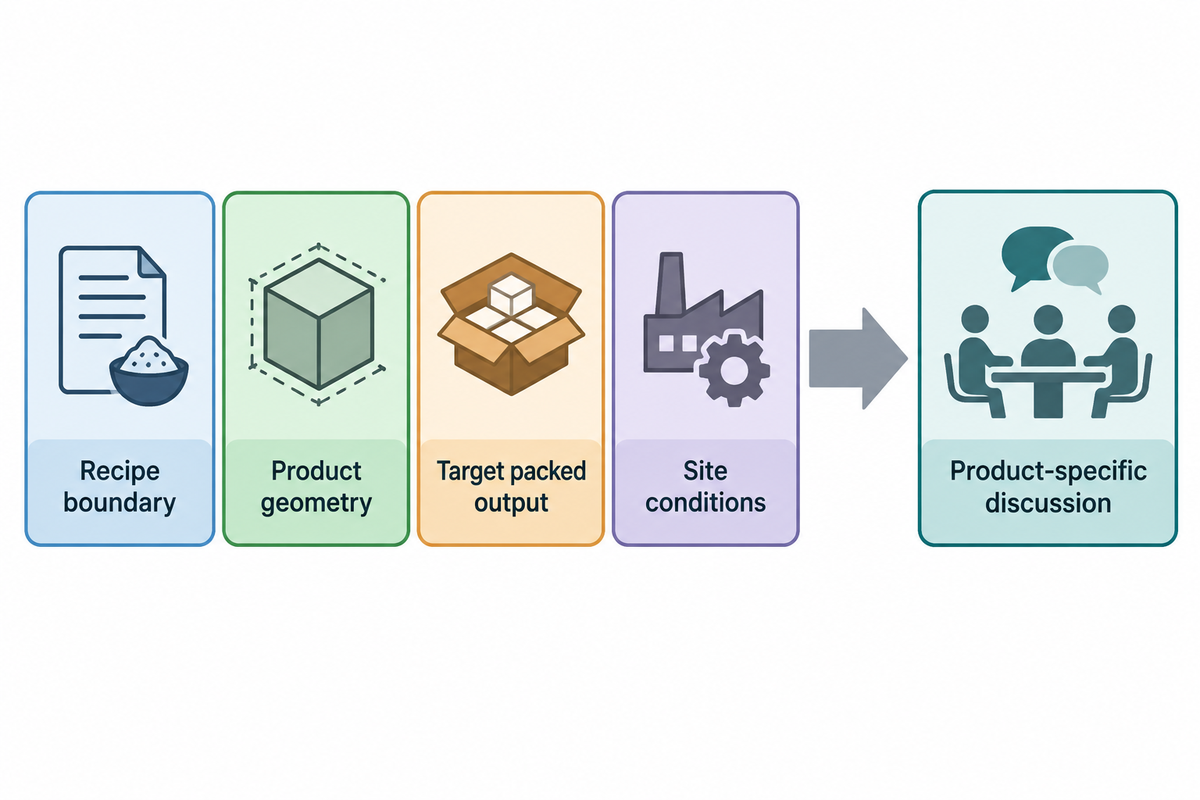
SINOFUDE has developed confectionery, bakery and chocolate equipment projects since the brand was founded in 1998. Bring your recipe boundary, product geometry, target packed output and site conditions to the discussion.
Final equipment performance belongs to the agreed product and installed conditions; food release and shelf-life validation remain with the manufacturer’s qualified system.
References & Sources
- Peer-reviewed marshmallow formulation, rheology and foam-stability study Food Science & Nutrition, 2026.
- The effect of invertase concentration on quality parameters of fondant Journal of Food Science and Technology, 2019.
- Optimizing a Process Line Institute of Food Technologists.
- Investigation of physical properties and moisture sorption behaviour of different marshmallow formulations Acta Horticulturae, 2017, university-hosted abstract.
- 21 CFR Part 117: Current Good Manufacturing Practice, Hazard Analysis, and Risk-Based Preventive Controls for Human Food U.S. Electronic Code of Federal Regulations.
- Light & Airy Confectionery Production, trade context on batch and continuous aeration.