Get in Touch with SINOFUDE Company

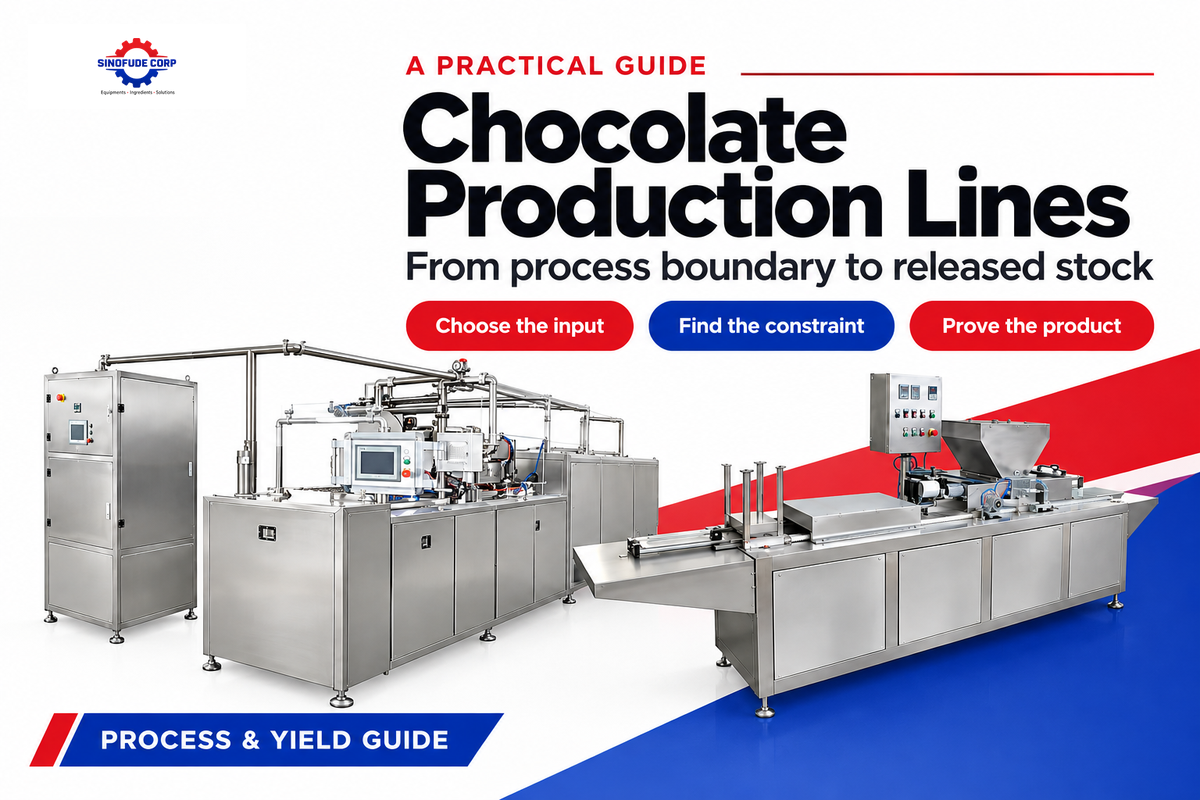
Chocolate production lines transform starting materials into formed, cooled and packed products. The range of the scope is determined by the feed. Finished chocolate is processed for melting. Making chocolate requires a defined process plan that follows the material through each transformation and measures the output that the factory can actually release.
Updated October 2026
Quick process reference
- Starting points: beans, chocolate-mass ingredients, or finished chocolate.
- Forming routes: moulding, enrobing, drops, hollow products and panning.
- Capacity basis: a named recipe, piece weight and packing format.
- Output measure: physical good output in kg per shift, followed by quality release.
Chocolate Production Lines combine material preparation, forming, cooling and packaging. The slowest compatible station limits steady output. Compare rates on one product basis, then count operating time and rejects once.
Key points
- A correctly tempered piece still needs suitable cooling and storage conditions.
- Purchased finished chocolate removes the need to repeat upstream refining and conching.
- A faster depositor increases output only when depositing is the binding constraint.
- Mechanical acceptance and food-quality release need separate records.
Where Your Chocolate Production Line Starts
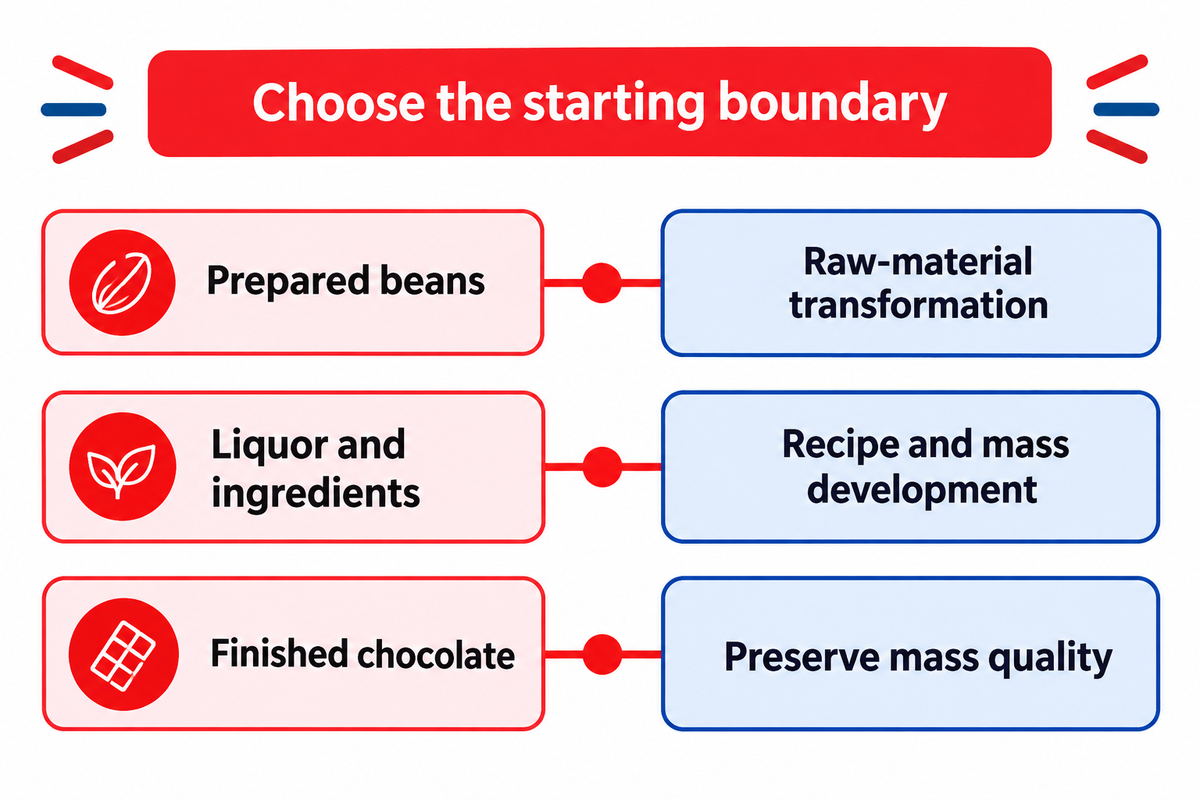
A chocolate production line can start at one of three boundaries: prepared cocoa beans, cocoa liquor with ingredients, or ready-to-use chocolate. The boundary defines the equipment and the factory’s responsibility for flavor and particle size. Define the input material before comparing machine counts or dividing floor space.
Cacao pods, pulp removal, fermentation and drying belong upstream of the chocolate factory’s forming operation. A bean processor receives dried material, often transported in sacks, and manages the appropriate warehouse conditions before processing. In the supply chain, the cocoa bean’s husk is separated from the nib, which is ground into cocoa liquor; pressing can then extract cocoa butter. Cocoa powder isn’t finished chocolate.
The International Cocoa Organization’s processing explanation distinguishes cocoa processing from batching, particle reduction, conching and standardization. Standardization is done separately. Pressing of liquor to make cake for powder is part of cocoa processing, and isn’t a must in every bar factory.
Can a factory start with purchased finished chocolate?
Yes. A factory can melt finished chocolate, establish the required temper condition, form the pieces, cool them and pack them. The purchased mass already has its recipe and particle-size history. Compare machine models on the chocolate production equipment solution page once that supply boundary is fixed. Repeating refining would add a different manufacturing duty rather than complete a missing step in a forming line.
Let’s look at a planned factory making two solid bar sizes from purchased couverture. The project team at first includes a roaster and grinder because the proposal states, “complete chocolate factory.” The team instead focuses on melting reserves and transfers, and the change from 20 g to 40 g moulds. Purchasing finished mass leaves recipe with the ingredient supplier, and the factory does the forming and packing. The same word, complete, describes very different installations.
What Is the Correct Order of Chocolate Production?
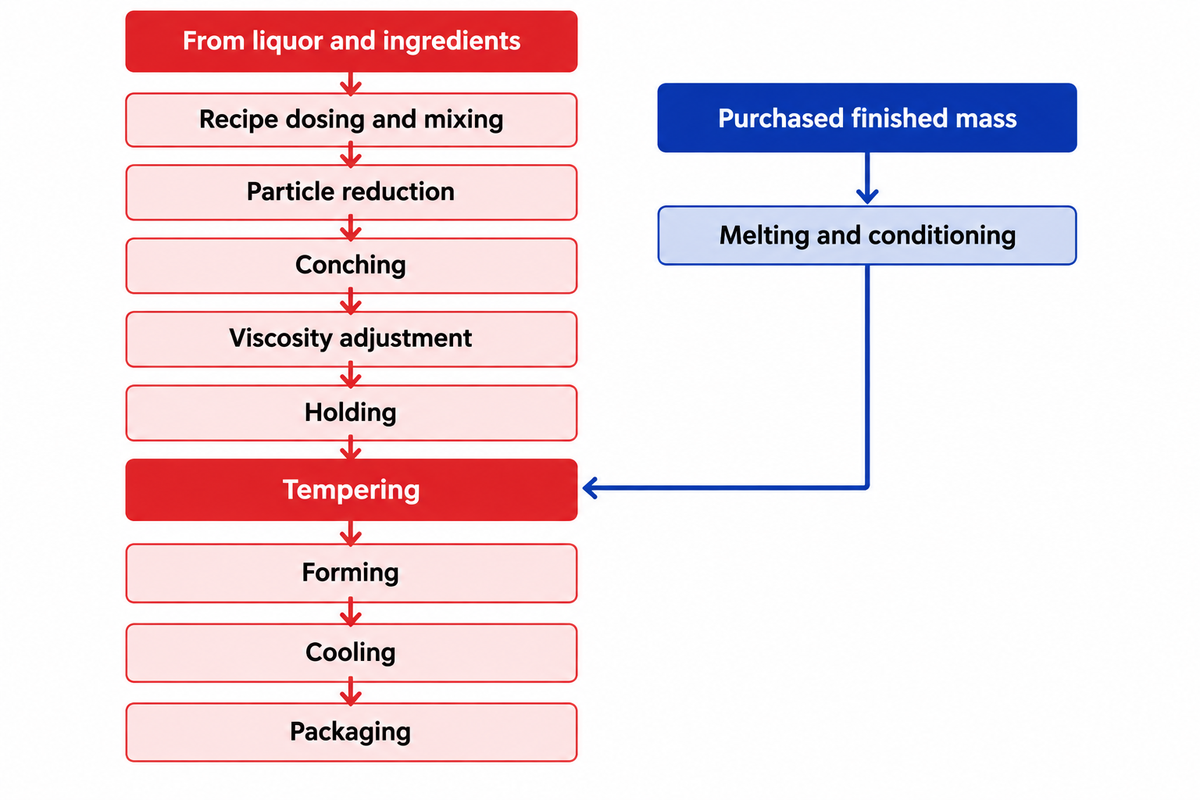
The production of chocolate from liquor and ingredients moves through recipe dosing and mixing, particle reduction, conching, viscosity adjustment, holding, tempering, forming, cooling and packaging. A bean-based route adds cocoa preparation upstream. Purchased finished mass joins later, at melting and conditioning, because its earlier material transformations have already been performed.
Refining decreases the size of solid particles. Roller refiners and ball-milling systems are particle-reduction systems; their arrangements change the equipment sequence. Conching affects changes relevant to flavor by means of mechanical working. The refining process and conching, therefore, address different questions, namely, how coarse are the solids and how has the mass developed?
A mixer distributes the ingredient blend prior to the next operation. Standardization then adjusts flow with fat and emulsifiers such as lecithin, as described by ICCO. Aroma, bitterness and moisture history should be addressed through the recipe process rather than corrected by a packaging adjustment. Aeration may be used for a specific process duty, but uncontrolled air in a deposited shell is a defect risk.
| Input | Work before forming | Process responsibility |
|---|---|---|
| Prepared beans | Roasting, shell separation, grinding and chocolate-mass preparation | Raw-material transformation and finished-piece production |
| Liquor and ingredients | Batching, refining, conching and standardization | Recipe and mass development before forming |
| Finished chocolate | Melting, conditioning and the required pre-crystallization | Preserve mass quality while forming and packing |
Roasting may be done either on whole beans or on nibs, and so the roasting and winnowing order follows the selected cocoa process. The grinding station shouldn’t be moved on a flow diagram merely to conform to a given supplier’s layout. An assembly line for moulded bars also requires a different material flow from a cocoa-powder plant.
A useful handover names both sides of every transfer: the mass released from preparation and the batch received for forming. When a project begins with 1 supplied chocolate mass, the forming specification should describe that mass; adding a second recipe should represent a different process condition rather than the same condition again.
Moulding, Enrobing and Other Forming Routes

Moulding shapes chocolate inside a mould while enrobing coats a centre that has a shape already. Filled moulded pieces can employ one-shot deposition or individual shell, filling and back-off operations. Drops, hollow figures and panned centres add other movement and setting requirements. Product structure should decide the route before nominal speed.
Both “mold” and “mould” refer to the same shaping tool. An operator may pour melted chocolate in a small batch manually; an automatic line doses chocolate into indexed cavities. For a filled piece, the interface between chocolate and filling is as important as the outside shape of the piece. Description in patent publication US20110189370A1 discusses concentric one-shot deposition, and differentiates it from other methods of filling and continuous co-extrusion. These are process descriptions, and not SINOFUDE patent claims.
| Product family | Forming route | Inspection focus |
|---|---|---|
| Solid bar | Mould deposition | Cavity fill, weight and release |
| Inclusion bar | Moulding with inclusion handling | Distribution and passage through the dosing path |
| One-shot filled piece | Co-deposition into a mould | Shell/filling balance and closure |
| Staged filled piece | Shell, filling and back-off | Shell integrity and seal |
| Enrobed biscuit | Coating a preformed centre | Coverage and coating pickup |
| Enrobed soft centre | Centre feeding and coating | Transfer support and deformation |
| Chocolate drops | Deposition onto a suitable belt | Shape, spacing and release |
| Hollow figure | Shell-forming or rotating mould process | Wall distribution and joining |
| Panned centre | Successive coating in a moving bed | Layer buildup and piece separation |
Route synthesis: Consider ICCO process boundaries, patents, and manufacturer product categories. The matrix classifies operations; it doesn’t assign every operation to a machine.
When does a chocolate bar need a mould instead of a coating belt?
Use a mould when the chocolate itself must take the bar’s defined shape. Use enrobing when a center needs a chocolate coat. A 20 g solid bar and a 20 g center coated chocolate can have equal finished weights; however, they may require different feeds, equipment and inspection points.
The solid-versus-filled equipment comparison is the next reference after product family settlement. Keep filled and solid products as separate trials when their forming duties differ.
How Tempering and Cooling Control Product Quality
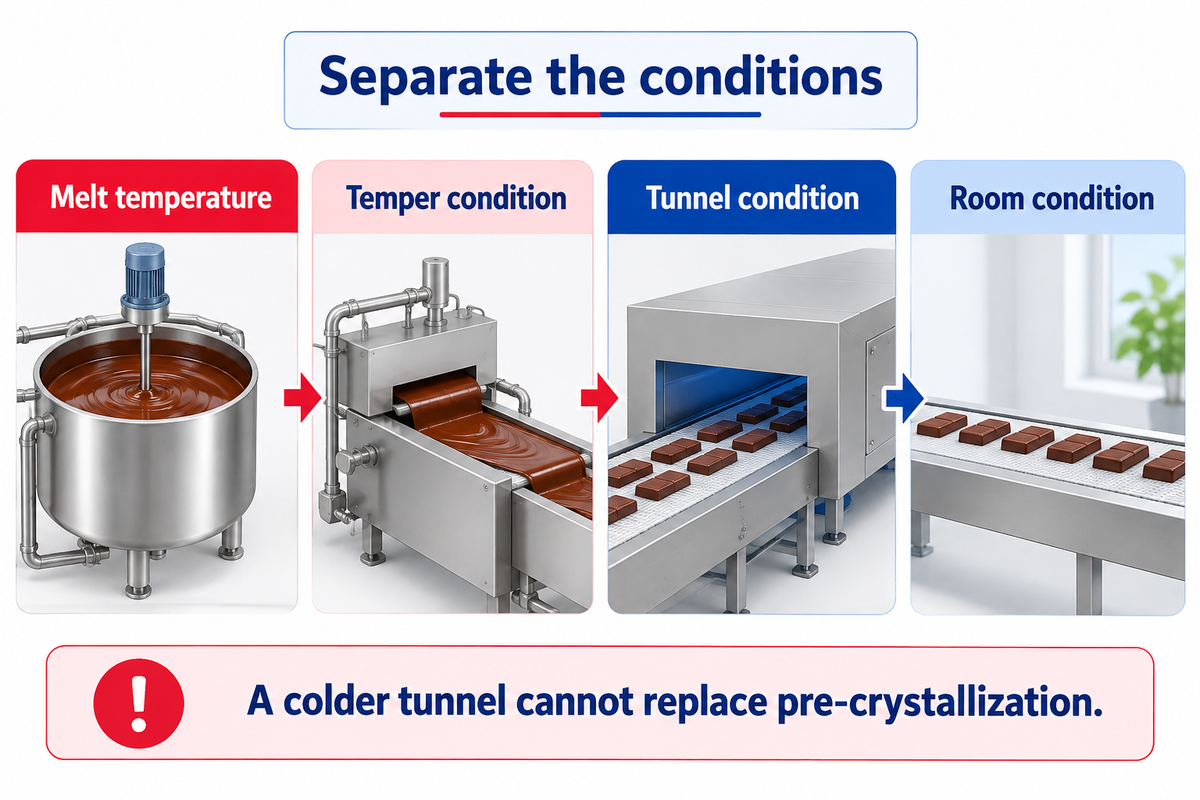
Tempering creates a controlled cocoa-butter crystal population; cooling brings the piece to a state for release. Melt temperature, temper condition, tunnel condition and room condition describe different parts of the process. A colder tunnel cannot replace a suitable pre-crystallization state or repair an incompatible recipe and handling sequence.
How does chocolate tempering work?
Chocolate tempering controls heating, cooling and working so that the mass contains a suitable population of crystals before it sets. The procedure follows the fat and equipment. Dark, milk and white chocolate should use their respective recipe guidance rather than inherit one temperature curve: Callebaut’s machine-tempering tutorial lowers the thermostat to about 31°C for dark chocolate and about 29°C for milk and white chocolate.
Callebaut’s machine-tempering tutorial connects pre-crystallization with gloss, contraction and snap, while limiting its procedure to the described equipment. The 2025 review Chocolate Tempering: A Perspective also explains why the Form V polymorph alone can’t be used to predict chocolate quality. Crystal structures and the rest of processing play an important role as well.
For quality control, track the mass at the depositor alongside the condition of pieces leaving cooling. A product can look acceptable immediately and behave differently during storage. Hendrik and colleagues’ 2024 study found different later crystal evolution among chocolates made using three pre-crystallization approaches, even though the samples were categorized as well tempered.
For a 20 g trial bar, record piece weight together with recipe, line speed and mould conditions before changing cooling settings. If a 40 g product follows, its setting duty changes. Comparing both products under one unexplained tunnel setting conceals the relationship between piece geometry, residence and release. The chocolate cooling-tunnel guide covers the equipment boundary in more detail.
Calculate Capacity From Good Product, Not Machine Speed
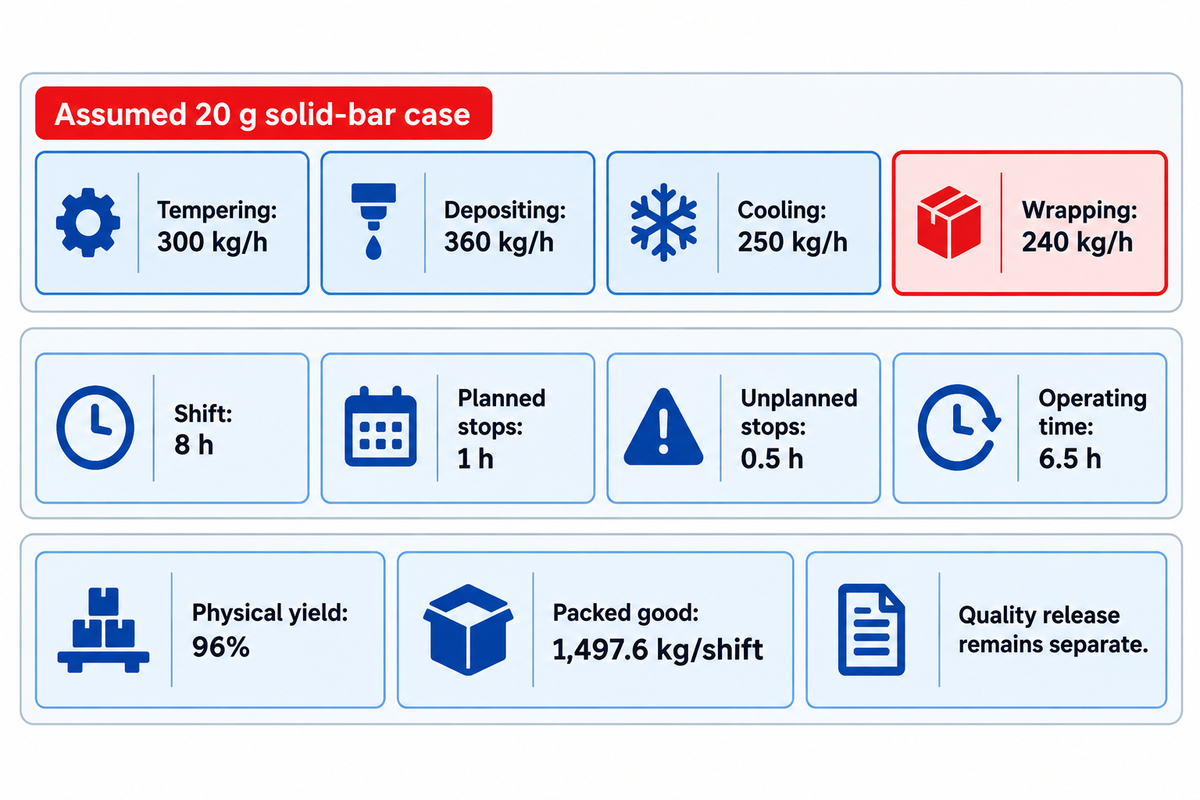
Convert each station on the chocolate line to the same product basis to find the binding rate, and then calculate operating time and physical yield. The depositor’s maximum speed is just one of the several considerations. Packed good output becomes saleable stock after the factory’s quality release requirements are satisfied; held batches are in a different category.
“A process is only as fast as the slowest unit operation.”
Chocolate Saleable-Output Ledger
The chocolate Saleable-Output Ledger reconciles compatible station rates, clock losses and physical rejects, and separates packed good from quality released stock.
Example: assumed inputs for a 20 g solid bar. The tempering supply is 300 kg/h, deposition is 360 kg/h and cooling supports 250 kg/h on that product. Wrapping reaches 200 bars/min, equivalent to 200 × 20 × 60 ÷ 1,000 = 240 kg/h. Wrapping is the lowest compatible rate. An 8 h shift loses 1 h to planned activities and 0.5 h to unplanned stops, leaving 6.5 h. With a 96% final physical first-pass yield, the model gives 240 × 6.5 × 0.96 = 1,497.6 kg of packed good output. That’s the physical output estimate before the batch’s quality-release decision.
| Ledger entry | Assumed value | Decision or calculation |
|---|---|---|
| Piece weight | 20 g/bar | Common finished-product basis |
| Tempering supply | 300 kg/h | Above current constraint |
| Depositing | 360 kg/h | Extra depositor speed alone adds no output |
| Cooling | 250 kg/h | Potential next constraint |
| Wrapping | 200 bars/min | 240 kg/h at the stated weight |
| Shift duration | 8 h | Scheduled clock basis |
| Planned stop time | 1 h | Subtract once |
| Unplanned stop time | 0.5 h | Subtract once |
| Net operating time | 6.5 h | 8 − 1 − 0.5 |
| Physical first-pass yield | 96% | Apply at the final measurement boundary |
| Packed good output | 1,497.6 kg/shift | 240 × 6.5 × 0.96 |
| Quality-released stock | Recorded after release | Separate held or unapproved batches |
Source and Calculation Basis: Editorial worked example using the general bottleneck principle, all chocolate rates, times and yields are assumed inputs.
The model represents one product at steady state. Material balance requires consideration of buffers, start up transitions and work-in-progress. Weigh and record closing and opening inventory, and account for retained or reworked chocolate. If a measured packed rate already includes stops or rejects, applying the same losses again understates output.
Raising the wrapper’s capacity above 250 kg/h would move this simplified constraint to cooling. The 10 kg/h gap between 240 and 250 gives only 62.4 kg per 6.5 h shift at 96% yield. A large speed upgrade at the 360 kg/h depositor would leave the original wrapper constraint untouched.
Find the Cause of Chocolate Production Defects
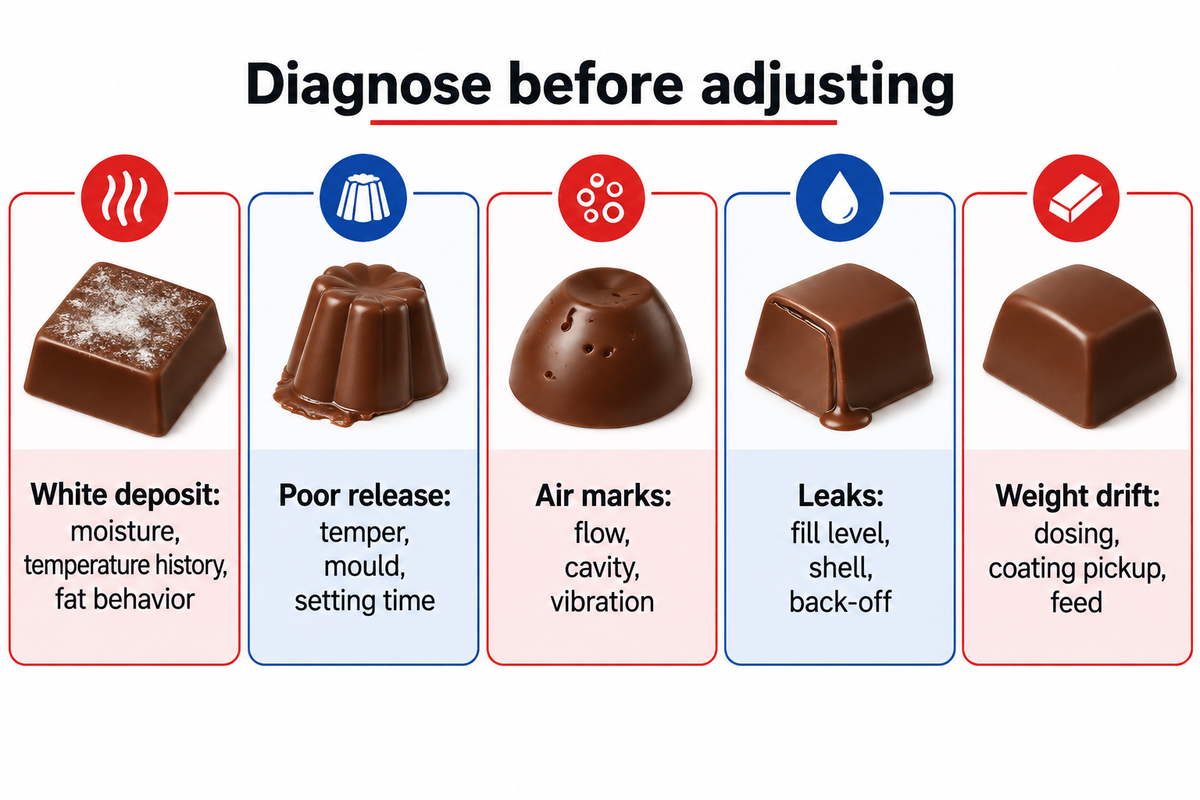
Start chocolate defect diagnosis by separating surface bloom, incomplete release, trapped air, seal failures and weight variation. Each of the above named symptoms of chocolate defects requires a different set of checks. Compare pieces at predefined sampling points and times before making adjustments. A problem created during depositing may become evident during cooling or packing.
According to Jeannie Nichols, Michigan State University Extension, surface moisture dissolves sugar, and as it evaporates, leaves behind crystals. Fat bloom also involves a different mechanism. A white surface deposit can therefore come from either mechanism, so check moisture exposure and temperature history before choosing a correction.
| Symptom | First checks | Comparison to preserve |
|---|---|---|
| White surface deposit | Moisture exposure, temperature history and fat behavior | Fresh and stored samples from one lot |
| Poor mould release | Temper condition, mould condition and setting time | Same cavity and recipe before/after adjustment |
| Air marks | Mass flow, cavity detail and vibration | Location of voids on repeated pieces |
| Leaking filled pieces | Fill level, shell and back-off condition | Opened cross-sections and storage observations |
| Weight drift | Dosing stability, coating pickup and product feed | Time-stamped individual weights |
Diagnostic synthesis: Mechanism of bloom, as explained by MSU, and moulded-chocolate troubleshooting, as explained by Callebaut.
In a 2014 ChocolateLife discussion, chocolatier Al Garnsworthy described coating behavior that changed during longer enrobing runs. Other participants reported different experiences with their equipment. The useful practice is to preserve timing: a first sample at 10 min and another at 60 min can reveal drift that a single attractive startup piece hides. Those sampling times are an example record design, not a universal control schedule.
Plan Changeovers, Utilities and Daily Operating Cost
The cost of a daily chocolate-line requires a clearly defined production boundary, measured resource consumption and a corresponding output denominator. Within that boundary, include preparation, changeover, utilities, labor and rework. Separate electricity energy charges from demand and fixed charges, and compare product-specific operating cost rather than assuming installed motor power equals the day’s electricity bill.
The U.S. Department of Energy’s utility-rate guide separates kWh energy charges, kW demand charges, and fixed charges. Distribute the fixed charges per the appropriate billing basis. The same department defines energy intensity as energy per unit of output. Different product mixes or ambient conditions may alter the ratio without reflecting an improvement.
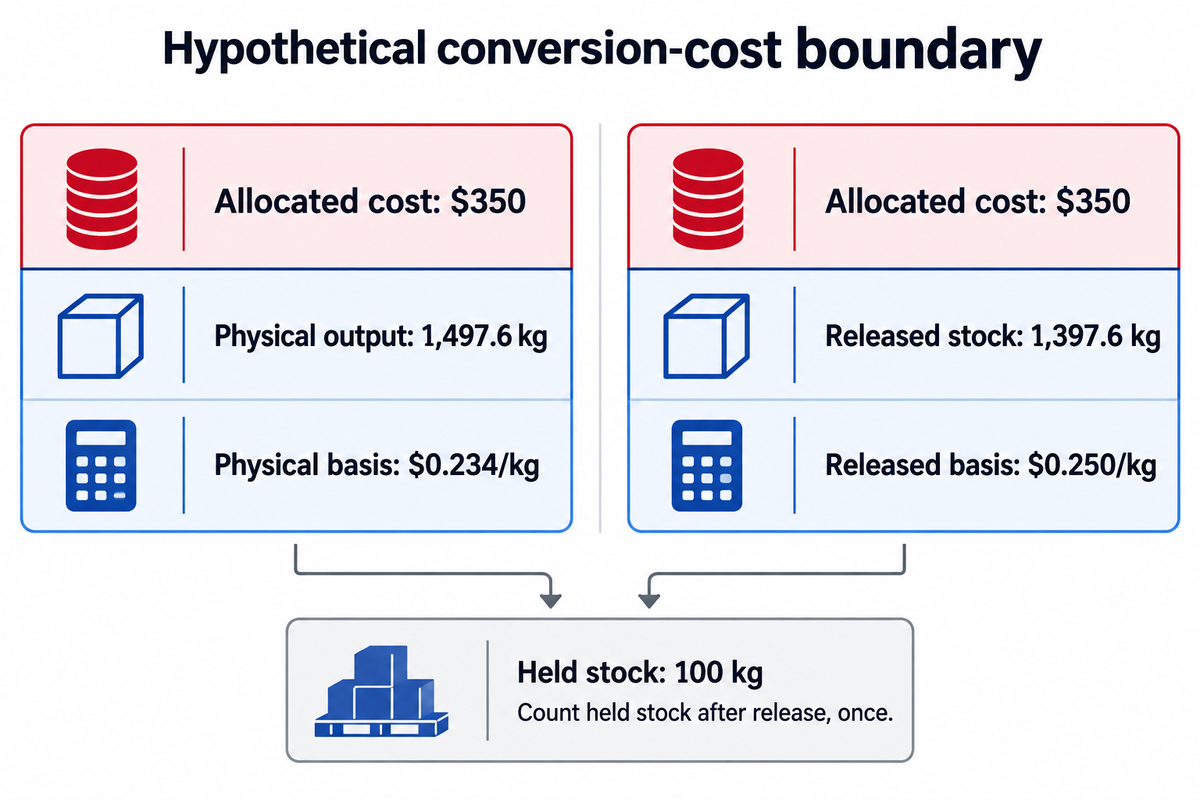
For a second hypothetical shift, keep the 1,497.6 kg physical output estimate and assign $350 to a stated conversion-cost boundary. Dividing $350 by 1,497.6 kg gives about $0.234/kg. That boundary might include the shift’s labour and allocated utilities while excluding ingredients, packaging purchases, financing and freight. Misleading interpretations occur if another quote includes ingredients but uses the same label. If 100 kg remains on hold, the released-stock denominator is 1,397.6 kg and the same allocated cost becomes about $0.250/kg. Keep the production record and release record together so that accounting follows the batch’s status. Include held stock later when it is released rather than counting it twice.
Changeover includes raw material handling and the use of properly approved product identification and factory cleaning procedures. Zhang and colleagues’ 2024 milk-residue study found that pushing dark chocolate through contaminated equipment left milk cross-contact under the tested conditions. Smooth flow and a dark appearance are separate from allergen clearance. Cleaning verification belongs with the factory’s qualified food team and product-control program.
Machine comparison
- State connected power and operating duty.
- List melt, cooling and air-service boundaries.
- Include product and mould change tasks.
Shift comparison
- Measure kWh over the named production window.
- Allocate utility and labour costs consistently.
- Reconcile packed, held and released kilograms.
Run a Product-Specific Line Acceptance Trial
The acceptance trial for a chocolate-line needs to define the product, recipe revision, forming and packing formats, as well as measurable acceptance conditions. Factory acceptance tests verify the functions. Installation acceptance tests validate operation in the production environment. Mechanical performance, storage and food control are separate validation activities, with their own responsible persons and records.
The roadmap for 2021, provided by PMMI ProSource, suggests intended production materials, participation of the operator and measurable criteria, and defines factory and site acceptance in a manner that’s useful for chocolate-related projects. It may be that the test floor of a supplier doesn’t resemble the production floor of the customer, let alone the full production supply and rhythm.
Chocolate Trial-to-Release Record
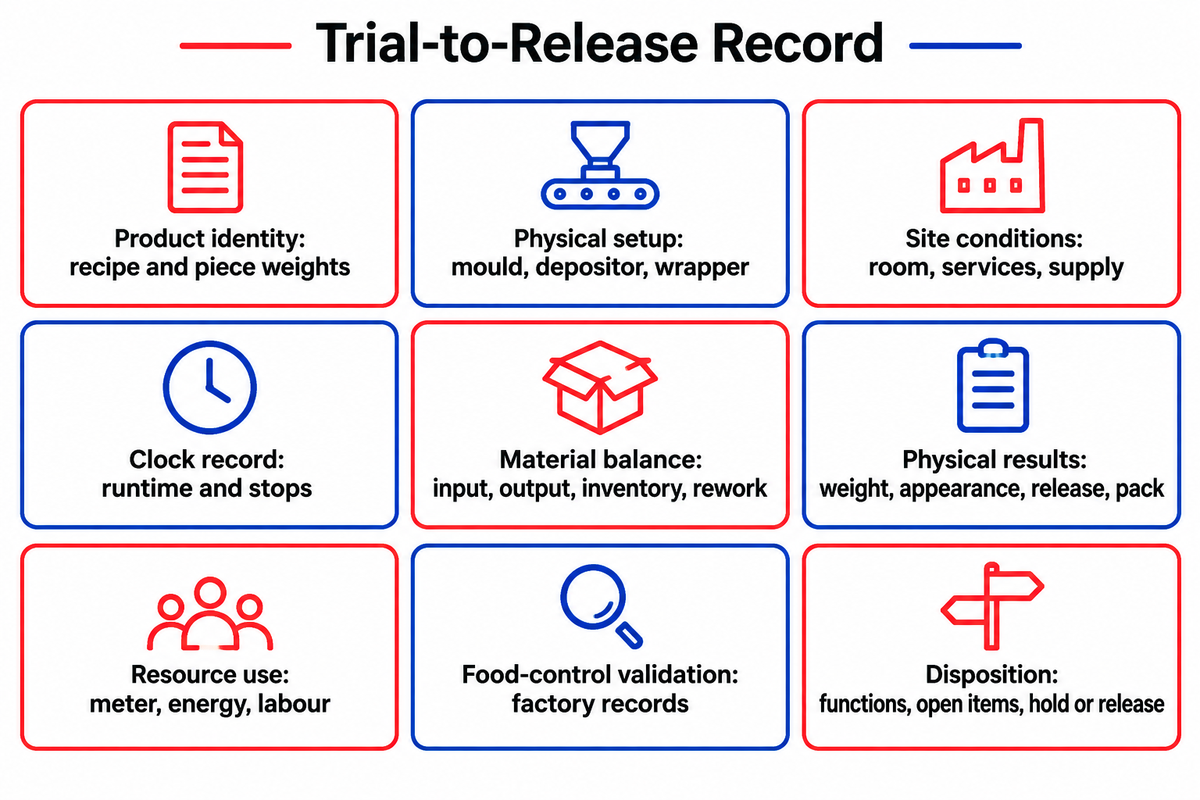
The chocolate Trial-to-Release Record links each measured result to the product, measurement boundary, and trial conditions. It defines the accepting or releasing owner and states the conditions for release.
| Record | What to enter | Responsible role |
|---|---|---|
| Product identity | Recipe revision, mass supplier, piece and filling weights | Product/process team |
| Physical setup | Mould, depositor arrangement, wrapper format and settings | Equipment/process team |
| Site conditions | Room conditions, services and material supply | Factory engineering |
| Clock record | Start/end time, planned stops and fault stops | Production operator |
| Material balance | Input, opening/closing inventory, output and rework | Production/quality team |
| Physical results | Weight distribution, appearance, release and pack condition | Quality inspector |
| Resource use | Meter boundary, kWh and labour hours | Engineering/cost team |
| Food-control validation | Applicable hygiene, allergen and formulation-control records | Qualified factory food team |
| Disposition | Accepted functions, open items, batch hold/release decision | Named acceptance and release owners |
Record design: editorial synthesis of process boundaries and PMMI test-planning principles. Set duration and acceptance limits in the project agreement.
What must change in the test when solid bars become filled chocolates?
A third hypothetical project moves from a 20 g solid bar to a 20 g filled piece. Add filling preparation, shell-to-filling balance, closure integrity and the filling’s storage-validation work. Preserving the finished weight does not preserve the dosing function: some of the mass is fed from a different source. The team focuses on the intended filling and checks cross sections, leakage and packed handling. The food team assesses the formulation and storage program. A glossy shell is not a measure of filling stability; a 2014 study of pralines and syrups examined spoilage organisms tolerant of low-water-activity conditions. The mechanical trial and filling review satisfy different questions.
The FDA’s 2025 Draft Guidance for Low Moisture Ready to Eat Foods, which includes chocolate, addresses sanitation and environmental monitoring differently from product testing. While the guidance remains in draft status, keep hygiene validation and batch disposition with the factory’s food-control processes rather than interpreting a successful machine as food approval.
Discuss the equipment concept using SINOFUDE chocolate production line options. Confirm the incoming mass, route, trial materials, measurement points, utilities, operator tasks and remaining site checks for one project in the brief.
Make Room for Recipe Changes Without Rebuying the Line
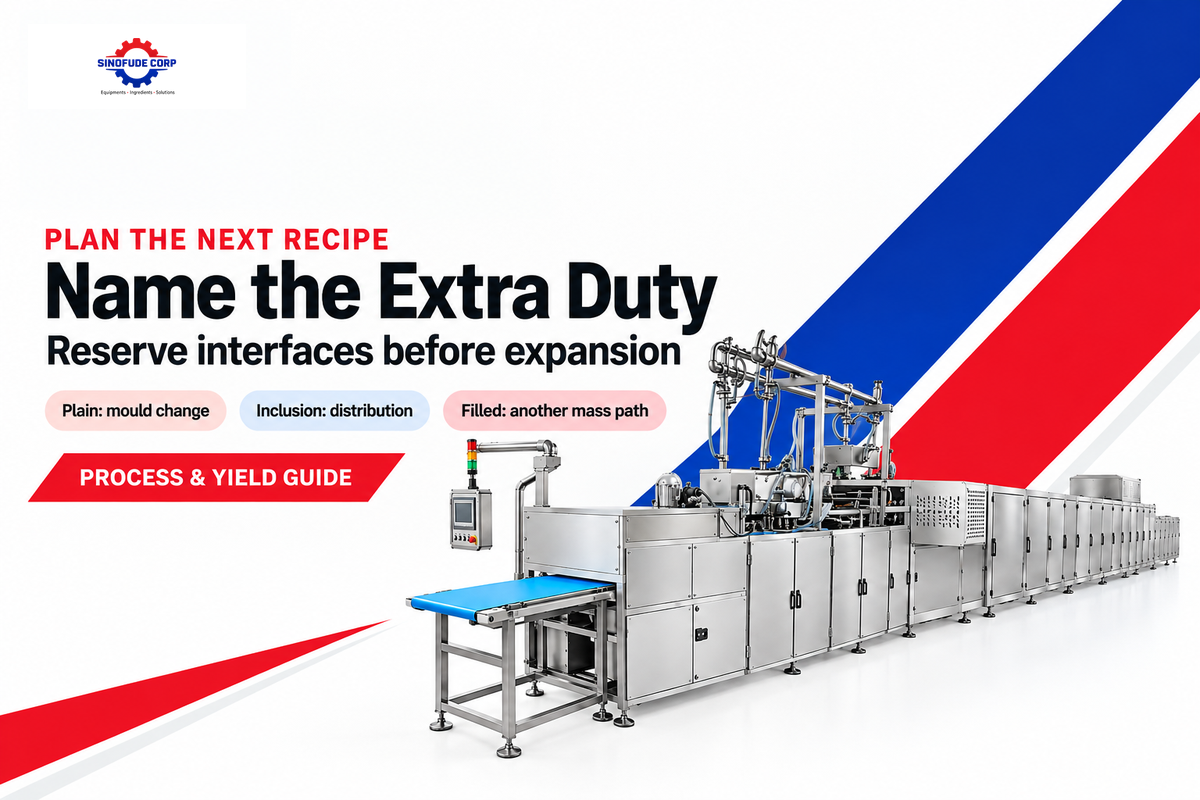
Plan recipe flexibility through interfaces, defined material paths, and space for the next forming operation. A second product may require different flow, setting, inclusion handling or packing, even if it uses the same conveyor. Examine the extra duty station by station, rather than treating one successful recipe as approval for all future chocolate candy.
Confectionery and food production projects often combine machinery of different ages. Confectionery Production’s reporting on chocolate-processing systems describes modular stations and discusses flexibility with WDS technical director Carsten Butz. The practical design question is which module or interface changes when the product changes.
A plant running one 20 g plain bar may need only a mould change for a second size, while an inclusion bar introduces ingredient distribution and passage requirements. A filled product adds another mass path. Reserve the service access, transfer space and agreed utility connections for the named next product. A technician should be able to reach wear parts without dismantling unrelated equipment.
Use the chocolate plant site checklist to associate the layout with the building. Keep the forming requirement separate from the depositor’s product and dosing requirements. List the requested products, as demonstrated on the proposed setup, requiring a further trial or requiring an additional module. Purchase the verified first duty and document the physical changes needed for the next one.
Key takeaway
A chocolate line’s useful capacity belongs to a named product and operating window. Follow the constraint through packed kilograms, then follow the batch through the factory’s quality-release process.
Frequently Asked Questions
What machines are used in chocolate production?
Chocolate production uses preparation, forming, cooling and packaging machines selected for the incoming material.
Bean-based manufacture adds roasting, shell separation and grinding. A mass-making operation needs recipe mixing, particle reduction and conching duties. A factory using finished chocolate begins with melting and conditioning, then follows its selected forming route. The useful machine list follows those boundaries rather than combining every possible operation into one compulsory installation.
What are the options for small-scale chocolate production?
Small-scale production can use batch preparation and manually handled moulds, or a compact linked forming arrangement.
Choose the arrangement around products per batch, available operator time and packing needs. Starting with purchased chocolate reduces upstream processing duties. A compact installation still needs suitable mass conditioning and cooling. Calculate its daily output with the same clock and reject records used for a larger line, including the time spent loading and unloading.
Can a chocolate production project be customized?
Yes, a chocolate project can be configured around its product route, material boundary and building interfaces.
Translate customization into a defined duty: mould dimensions, piece weights, filling path, inclusion handling, transfer height or packing format. Separate an adjustment to an existing module from an additional operation. The project brief should identify the first product, intended expansion product and acceptance conditions so that both parties price and test the same production scope.
Is cocoa processing the same as chocolate manufacturing?
No. Cocoa processing prepares cocoa materials; chocolate manufacturing combines and develops the recipe before forming finished products.
Some factories integrate both. Others buy liquor, butter or finished mass and begin farther downstream.
Does a catalogue kg/h rating equal daily saleable production?
No. A catalogue rate must be reconciled with the other stations, operating time, physical yield and batch-release status.
Keep piece weight and product route consistent when comparing rates. Record planned and unplanned stops separately and apply each loss once. Measure rework and changes in work-in-progress at the same boundary as packed output. A held batch remains outside released inventory until its disposition changes. The resulting shift record explains the gap between equipment speed and the stock available for orders without treating every production loss as a machine-speed problem.
Is a faster depositor the first upgrade to make?
Upgrade the depositor first only when depositing is the current constraint on the named product.
A slower wrapper, limited cooling duty or interrupted mass supply can leave the extra depositing capacity unused; in the assumed 20 g bar example above, wrapping at 240 kg/h, not the 360 kg/h depositor, sets output.
How are chocolate bars made?
Solid chocolate bars are made by conditioning the chocolate, dosing it into moulds, setting it, releasing it and packing it.
The upstream work changes with the supplied mass. Bean-based manufacture includes cocoa preparation and chocolate-mass development; purchased finished chocolate joins at remelting. Inclusion bars add distribution requirements, while filled bars add shell and filling operations. Product inspection follows weight, appearance, release and package condition. The factory also applies its food-control and release procedures before the lot enters saleable stock. Equal bar weights alone do not make the production duties equivalent.
Discuss Your Chocolate Product and Trial Plan

Bring the starting material, product structure, target packed output and site conditions to the equipment discussion.
Editorial basis: Combination of explanations about public process, published research and an explicitly assumed output example. The two record formats are practical editorial tools. Equipment performance is established for the agreed product and installation; batch release remains part of the factory’s quality system.
References & Sources
- International Cocoa Organization: Processing Cocoa.
- Rausch and Erickson: Selection and Purchase of Used Food-Processing Equipment, general equipment-selection principles.
- Jeannie Nichols, MSU Extension: Blooming chocolate, 2015.
- Chocolate Tempering: A Perspective, 2025.
- Hendrik et al.: Monitoring solidification and storage stability of well-tempered chocolates, 2024, author abstract.
- U.S. Department of Energy: Evaluating Your Utility Rate Options.
- U.S. Department of Energy: Energy Efficiency vs. Energy Intensity.
- PMMI ProSource: Roadmap for a Successful Factory Acceptance Test, 2021.
- Zhang et al.: Dry cleaning treatments for removing milk chocolate, 2024, author abstract.
- Nielsen et al.: Organisms associated with chocolate pralines and sugar syrups, 2014, author abstract.
- FDA: Draft sanitation guidance for low-moisture ready-to-eat foods, 2025.
- Patent publication US20110189370A1, process description.
- Confectionery Production: Chocolate processing operations, trade reporting.