Get in Touch with SINOFUDE Company

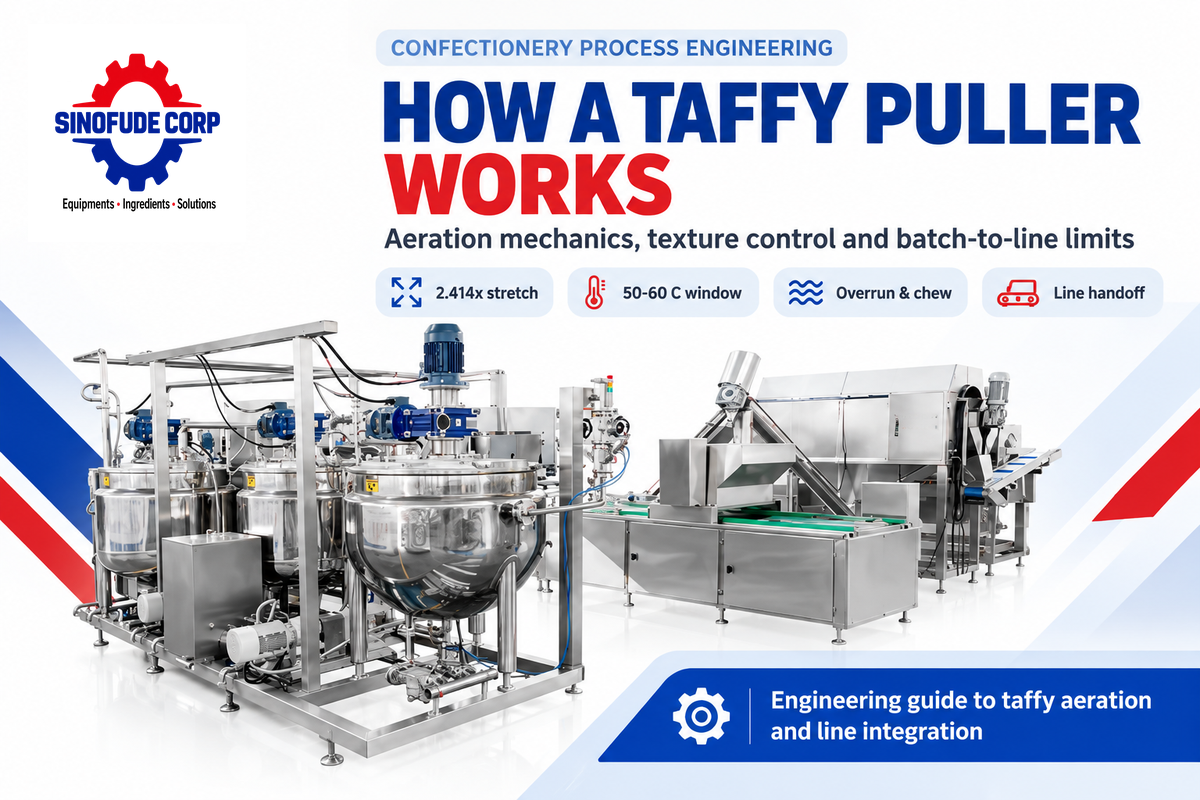
A taffy puller is a mechanical confectionery machine that stretches and folds cooled sugar mass across rotating arms. It traps microscopic air bubbles to create a soft, chewy texture. In commercial pulling guides and US Patent US8920856B2, the syrup is cooked to the recipe’s target solids, cooled on a slab to about 50-60 °C until it reaches a uniform pliable texture, and then loaded onto the puller. In mathematical models studied at the University of Wisconsin-Madison, standard three-rod and four-rod pullers multiply length by 2.414 per half-period to produce perfect taffy.
Key Engineering Takeaways
- In Jean-Luc Thiffeault’s topological model, standard 3-rod and 4-rod pullers share a half-period stretch factor of 2.414. That multiplier reaches roughly 200x over 6 half-periods, while actual shop extension reflects batch load and arm clearance.
- In The Goldenrod’s documented salt-water taffy process, pulling doubles the batch size; dispersed air bubbles and fat droplets act like elastic spheres that scatter light and soften the chew.
- Syrup is cooked to 250-290 °F (92 to 95 percent sugar solids for taffy, adjusted for altitude and recipe). It’s then tempered on a cooling slab to 50-60 °C before loading onto the puller.
- Commercial batch pullers typically run 15 to 20 minute cycles paired with 180 pieces/min kiss-wrappers. High-output factories instead integrate continuous cooking, cooling, aeration, and rope sizing.
What a Taffy Puller Actually Does: Stretching, Folding, and Aeration Mechanics
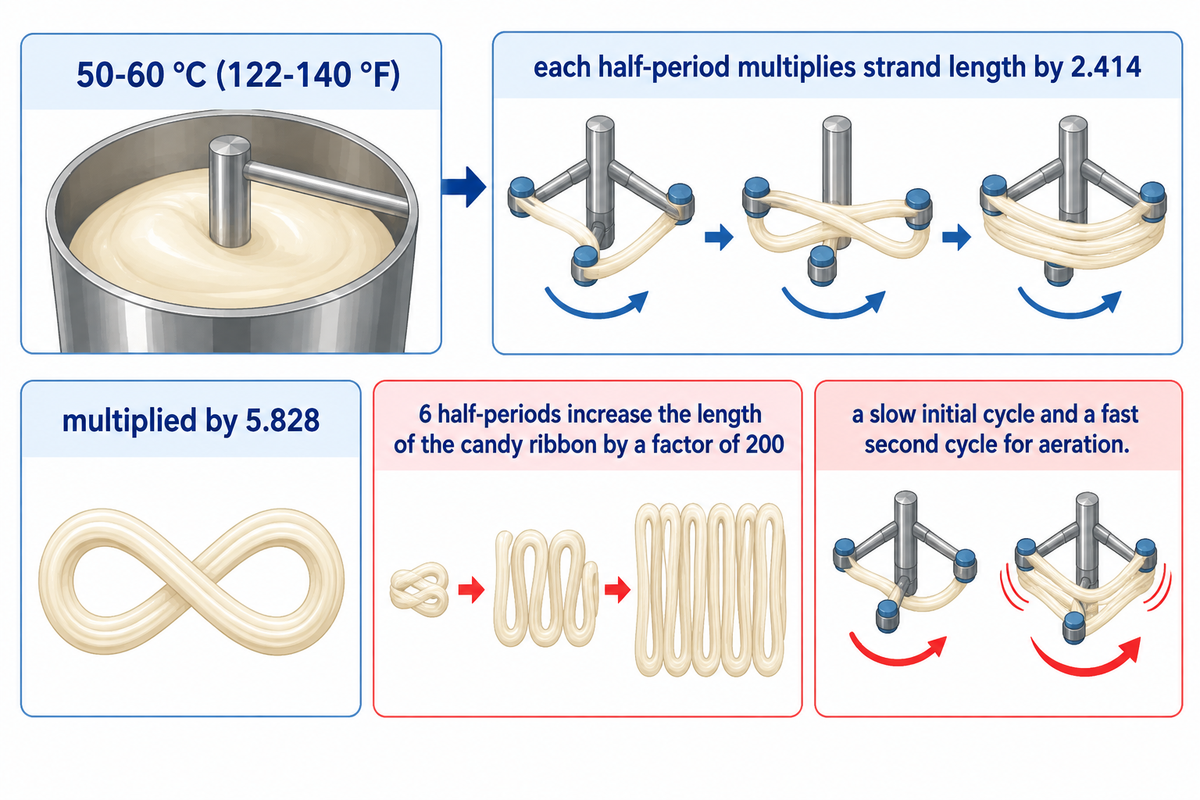
A taffy puller machine conditions tempered sugar mass through repeated stretching and folding rather than rotary stirring. A candy maker boils sugar, corn syrup, water, and fat, then cools the batch on a slab to 50-60 °C (122-140 °F) consistency. Orbiting metal rods then stretch and fold the candy loop until it becomes saturated with air.
According to Smithsonian Magazine, researchers from the University of Wisconsin-Madison studied those orbiting rods. The standard 4-rod puller dates to Thibodeau’s 1903 patent, and the simpler standard 3-rod mechanism followed in a 1908 patent by Robinson and Deiter and is still in use today. In the idealized mathematical model, standard 3-rod and 4-rod planetary taffy machines share a 2.414 silver-ratio multiplier.
- According to the idealized topological model, each half-period multiplies strand length by 2.414. Depending on gear-tooth linkages, that multiplier can vary.
- Two half-periods complete one full planetary period, after which modeled strand length is multiplied by 5.828. This folds air into thin layers.
- From the idealized model, 6 half-periods increase the length of the candy ribbon by a factor of 200. Real commercial batches are bounded by folding overlap, viscoelastic recovery, and pin geometry.
- As described in US Patent US8920856B2, a gelatinized chewy candy is kneaded to about 35–65 °C before a double-arm puller runs a slow cycle and then a fast cycle, and it finishes at about 30–50 °C.
An active video of a taffy pulling hook captures the attention of boardwalk visitors. Behind the act is a machine that accomplishes laminar folding on a thick viscous, viscoelastic mass. Traditional liquid mixers can’t achieve enough aeration to work with stiff, sugar-based doughs.
How Pulling Changes Taffy Density, Opacity, and Chewiness
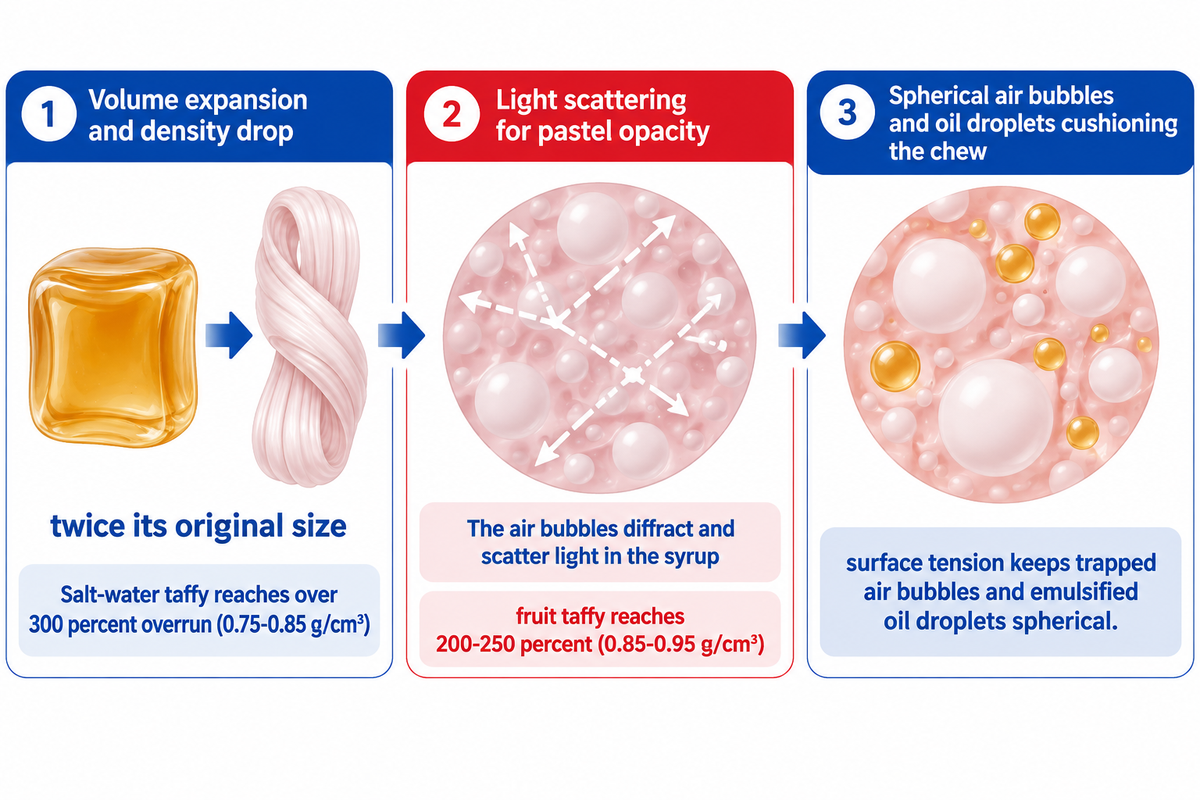
Pulling taffy reduces bulk density of a sugar mass by folding in air pockets. The air bubbles diffract and scatter light in the syrup, making the mixture appear white or pastel. In The Goldenrod’s commercial salt water taffy workflow, each batch is pulled until it’s twice its original size.
Industry formulation benchmarks track overruns specific to varieties of pulled candies. Salt-water taffy reaches over 300 percent overrun (0.75–0.85 g/cm³), while fruit taffy reaches 200–250 percent (0.85–0.95 g/cm³).
A September 2023 study in Physics of Fluids from the American Institute of Physics (AIP) examined saltwater taffy rheology. Researcher San To Chan and colleagues combined Small Amplitude Oscillatory Shear (SAOS) testing with X-ray micro-CT scans. They showed that pulled taffy behaves as a viscoelastic Fractional Maxwell Gel between liquid and solid. While it is called salt water taffy, it actually contains no sea water. Inside the pulled candy, surface tension keeps trapped air bubbles and emulsified oil droplets spherical. Those tiny spheres act like elastic rubber balls that cushion the chew.
What Does Pulling Taffy Do?
Pulling taffy transforms a dense, translucent cooked sugar mass into a lighter, opaque, and elastic confection. The rotating arms fold microscopic air bubbles into the sugar matrix. The presence of those air bubbles and other interfaces scatters light. Clear syrup turns bright white, dyed batches shift into pastel pink or citrus tones, and the chew softens. The sugar mass turns lighter and softens.
Lecithin emulsifier stabilizes fat droplets during stretching, while excessive shear on high-fat chocolate candies or cocoa-butter recipes can squeeze fat out of the sugar phase and leave a greasy film on the puller pins. In the case of fruity or vanilla extract recipes, operators fold the flavor into the tempered sugar slab right before pulling. This practical tip protects delicate flavor notes from kettle heat and yields a delicious treat for every customer.
| Candy Variety / Type | Target Cook Stage & Temp (Sea Level) | Typical Solids & Formulation Role | Reported Overrun & Density Benchmark | Optical & Chew Texture Outcome | Primary Process Reference |
|---|---|---|---|---|---|
| Classic Salt Water Taffy | Hard-ball to soft-crack (250–290 °F / 121–143 °C) | 92 to 95 percent sugar solids; low fat with corn syrup and salt | Pulled to 2x batch volume (>300 percent trade overrun; 0.75–0.85 g/cm³) | Bright white or pastel opacity; light, soft chew | The Goldenrod / ThermoWorks |
| Acidulated Fruit Taffy | Hard-ball to soft-crack (250–290 °F / 121–143 °C) | 92 to 95 percent sugar solids; fruit acid folded in during tempering | 200–250 percent trade overrun benchmark (0.85–0.95 g/cm³) | Vibrant pink or citrus pastel; lively elastic bite | ThermoWorks |
| Chocolate Taffy | Hard-ball stage (250–265 °F / 121–129 °C) | 92 percent sugar solids base; cocoa butter and chocolate liquor fat | Capped at 180–220 percent overrun (0.90–1.00 g/cm³) to prevent fat separation | Lighter satin brown; denser, fudge-like chewiness | AIP Physics of Fluids (2023) |
| Licorice & Molasses Pulled Chew | Hard-ball to soft-crack (250–290 °F / 121–143 °C) | 92 to 95 percent sugar solids; high dark syrup and molasses solids | 150–200 percent trade overrun benchmark (0.95–1.05 g/cm³) | Golden bronze to matte amber; firm, slow-yielding chew | ThermoWorks |
| Cream & Vanilla Extract Taffy | Hard-ball stage (250–265 °F / 121–129 °C) | 92 percent sugar solids; cream and vanilla extract emulsified with lecithin | Fluffed to roughly 2x batch volume under moderate hook speed | Opaque ivory sheen; smooth, creamy mouthfeel | The Goldenrod / AIP Rheology |
| High-Altitude Pulled Taffy | Adjusted by -2 °F (-1.1 °C) per 1,000 ft elevation | 92 to 95 percent sugar solids matched to sea-level evaporation | Reaches standard 2x batch expansion when boil point is calibrated | Consistent pastel opacity without premature sugar graining | Colorado State University Extension |
| Pulled Satin Hard Candy | Hard-crack stage (300–310 °F / 149–154 °C) | 99 percent sugar solids; boiled sugar-and-glucose glass | Stretched briefly while warm for directional micro-capillaries | Pearlescent silver satin gloss; brittle snap | ThermoWorks Hard-Crack Chart |
| Unpulled Chewy Caramel Reference | Firm-ball stage (245–249 °F / 118–121 °C) | 87 to 91 percent sugar solids; dairy cream and butter emulsion | Not pulled on hooks; dense un-aerated emulsion | Rich amber color from caramelization and dairy reactions | ThermoWorks Caramel Guide |
Taffy vs. Toffee vs. Caramel: Cooking Temperature, Fat Content, and Pulling Needs
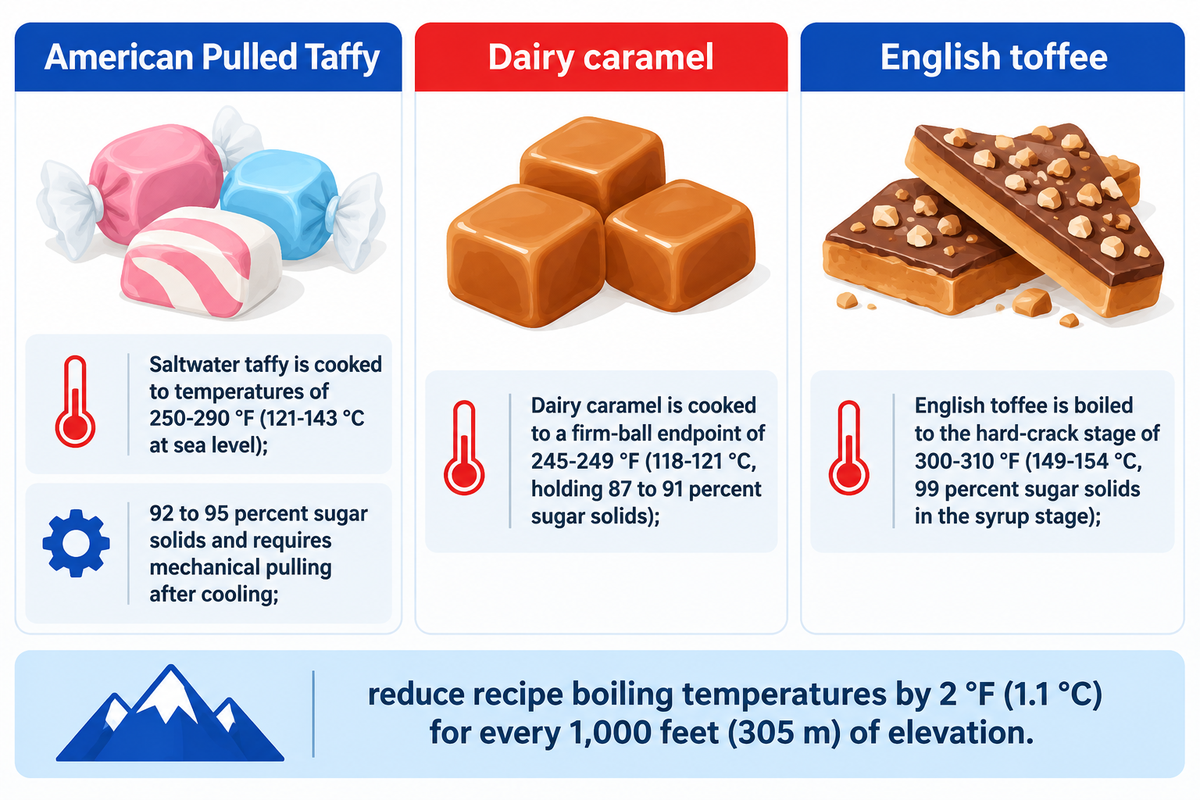
The characteristics that distinguish American pulled taffy from caramel and toffee include cooking temperature, sugar solids concentration, fat content and pulling. Saltwater taffy is cooked to temperatures of 250-290 °F (121-143 °C at sea level), according to the ThermoWorks Confectionery Temperature Chart. In this temperature range, the cooked saltwater taffy is in the hard-ball to soft-crack stage with a sugar solids concentration of 92-95%. That hard-ball to soft-crack window holds 92 to 95 percent sugar solids and requires mechanical pulling after cooling.
Dairy caramel is cooked to a firm-ball endpoint of 245–249 °F (118–121 °C, holding 87 to 91 percent sugar solids). It contains cream or butter and is usually mixed rather than pulled on hooks. Its rich color and flavor develop through sugar caramelization together with dairy reactions. English toffee is boiled to the hard-crack stage of 300–310 °F (149–154 °C, 99 percent sugar solids in the syrup stage). That high boil forms a crisp buttery, rich brittle, which is never pulled.
When making taffy or toffee above sea level, operators must adjust boiling targets for local atmospheric pressure. The Colorado State University Extension talks about the standard high altitude rule for boiled confections. Candy makers reduce recipe boiling temperatures by 2 °F (1.1 °C) for every 1,000 feet (305 m) of elevation. That adjustment keeps the syrup at target solids without over-concentrating into a brittle glass.
Is It Toffee or Taffy?
In North American confectionery terminology, taffy is a low-fat sugar and corn-syrup candy cooked to 250–290 °F (121–143 °C). Operators cool it on a slab to 50–60 °C and mechanically aerate it on a taffy puller. Toffee is a butter-rich confection boiled to the hard-crack stage at 300–310 °F (149–154 °C). It cools flat on a slab without pulling to create a brittle snap.
Caramel and toffee usually don’t use taffy-style hook aeration, and as such, industrial plants use other types of cooking, cooling, forming and wrapping machines, which are designed for dairy fat based formulations. Manufacturers running unpulled dairy confections use a dedicated toffee and caramel production line with scraped-surface kettles and cooling drums rather than planetary pulling hooks.
| Confection Category / Process Dimension | American Pulled Taffy | Chewy Caramel | English Toffee | Pulled Hard Candy Ribbon | Published Standard / Source |
|---|---|---|---|---|---|
| Sea-Level Cooking Temperature | 250–290 °F (121–143 °C) | 245–249 °F (118–121 °C) | 300–310 °F (149–154 °C) | 300–310 °F (149–154 °C) | ThermoWorks Candy Chart |
| Sugar Stage Classification | Hard-ball to soft-crack stage | Firm-ball stage | Hard-crack stage | Hard-crack stage | ThermoWorks / CSU Extension |
| Target Solids / Formulation | 92 to 95 percent sugar solids in syrup matrix | 87 to 91 percent sugar solids with dairy ingredients | Butter-rich hard-crack confection (99 percent syrup stage) | 99 percent sugar solids in boiled sugar glass | ThermoWorks Sugar Solids Data |
| Elevation Temperature Correction | Subtract 2 °F per 1,000 ft | Subtract 2 °F per 1,000 ft | Subtract 2 °F per 1,000 ft | Subtract 2 °F per 1,000 ft | CSU Extension High-Elevation Guide |
| Dairy & Fat Formulation Role | Usually low fat; designed to stay pliable and release from pins | Cream and butter contribute richness and emulsion body | Butter contributes richness and crisp hard-crack structure | Typically fat-free sucrose and glucose syrup glass | AIP Physics of Fluids (2023) |
| Post-Cook Tempering Window | Cooled on slab or drum to 50–60 °C (122–140 °F) plastic mass | Cooled on slab or cooling drum before cutting or extrusion | Poured onto cooling slab to solidify into brittle sheet | Tempered on warming table before brief pulling | US Patent US8920856B2 / Gondor |
| Taffy Puller Mechanical Action | Required: repeated stretching and folding incorporates air | Usually mixed and formed without taffy-style hook pulling | Never pulled: hard-crack confection shatters on rotating arms | Optional brief pull: creates opaque satin sheen before forming | The Goldenrod / UW-Madison |
| Downstream Forming Route | Batch roller, rope sizer, and cut-and-wrap (e.g. 180 pieces/min) | Slabbing, guillotining, or depositing and wrapping | Slab scoring, breaking, or depositing with chocolate coating | Batch roller, rope sizer, and die stamping | The Goldenrod / SINOFUDE Scope |
Pulling vs. Mixing and Cooling: Why Intermeshing Arms Cannot Replace Upstream Prep
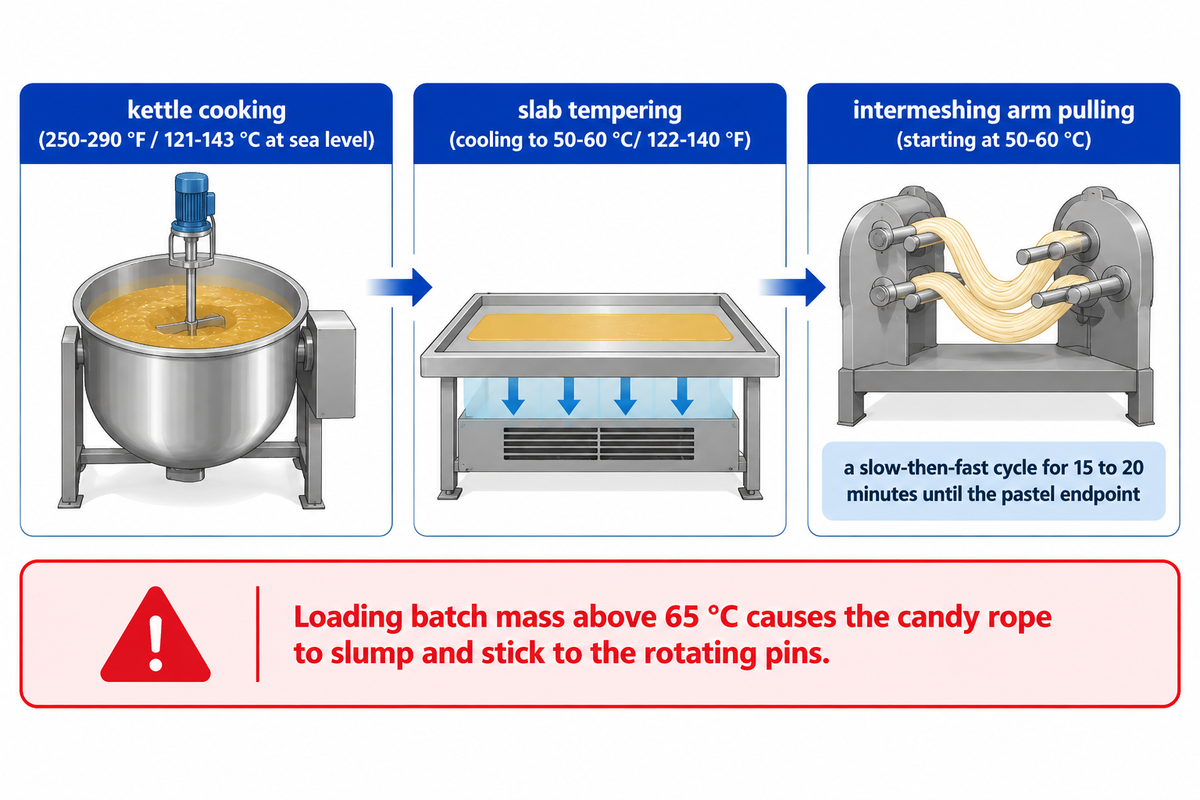
Taffy pullers can’t replace upstream cooking pots, planetary mixers, and cooling tables. Rotating puller arms only fold air into sugar mass already tempered to a 50–60 °C (122–140 °F) plastic state. Freshly boiled syrup at 121–143 °C (250–290 °F) is far too hot and fluid for direct pulling on hooks.
Both US Patent US8920856B2 and commercial pulling guides from Gondor Machinery recognize the same limitations. A standard kitchen dough mixer or rotary stir pot applies a different shear pattern from a taffy puller. It cannot reproduce the puller’s repeated whole-mass stretching and folding. Therefore, taffy making requires three distinct unit operations to be performed consecutively:
- During kettle cooking (250–290 °F / 121–143 °C at sea level), sugar, corn syrup, water, and fat boil together. Evaporation concentrates the batch in a copper kettle or vacuum cooker to 92 to 95 percent sugar solids.
- During slab tempering (cooling to 50-60 °C/ 122-140 °F), syrup is spread out on a water-cooled table and the edges are folded in to produce a uniform plastic mass.
- During intermeshing arm pulling (starting at 50-60 °C), the user drapes the tempered pillow on puller hooks. Commercially available batch units run a slow-then-fast cycle for 15 to 20 minutes until the pastel endpoint.
Operators should check core slab temperature with an infrared or probe thermometer before draping the candy rope on puller hooks. Loading batch mass above 65 °C causes the candy rope to slump and stick to the rotating pins. Following this simple advice prevents pin wrap on both homemade and commercial batches.
Critical Taffy Pulling Parameters: Temperature Window, Pull Time, and Process Limits
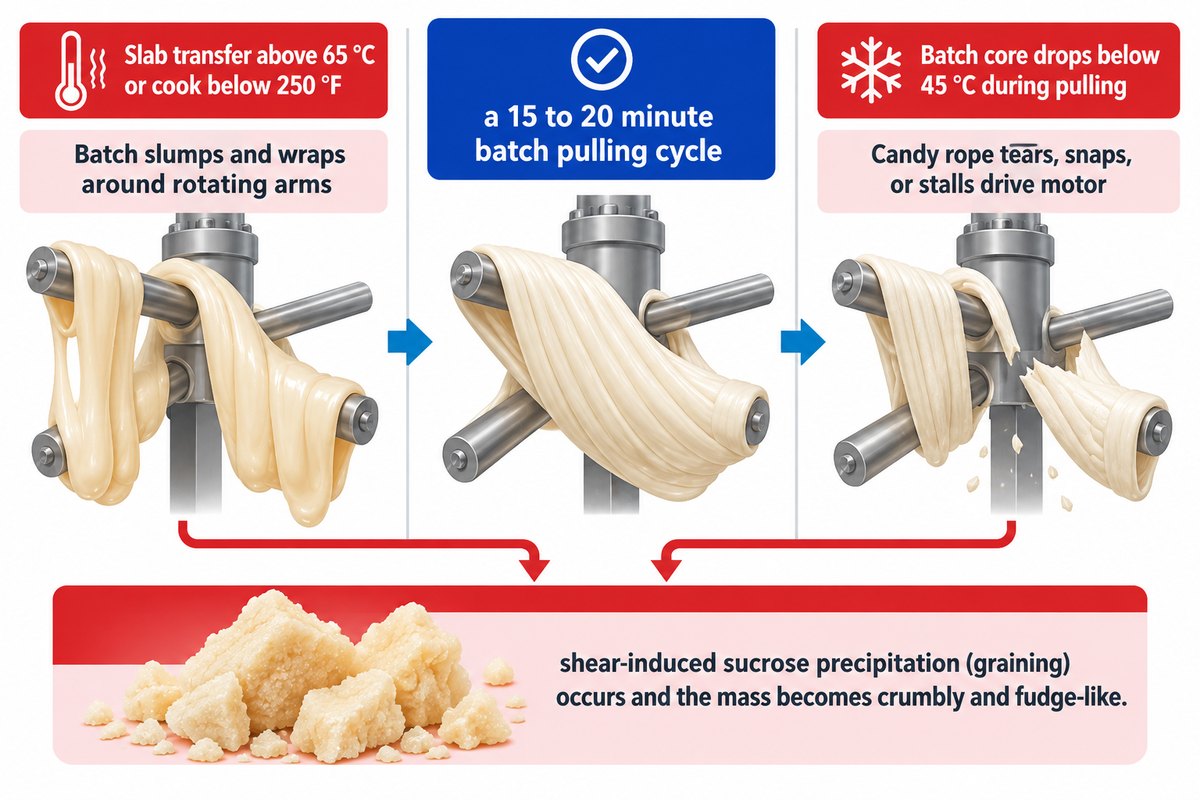
The duration of the pulling process is determined by the viscosity and opacity of the batches, as well as the humidity in the environment. Commercial brochures from Gondor Machinery cite a 15 to 20 minute batch pulling cycle. However, industrial patents (US8920856B2) and storefront producers (The Goldenrod) adjust cycle time to humidity and batch viscosity. Since the puller arms aren’t heated, they’re cooling the candy as it turns, and therefore the batches tend to stiffen continuously during the pulling process.
Precise endpoint control distinguishes high quality taffy from scrap. Process analyses from Gelken Confectionery and Taffy Town define two failure modes bracketing the pull window. If the batch is under-cooked, exposed to high room humidity, or pulled too briefly while hot, excess mobile moisture remains in the mass, leaving it sticky and prone to cold-flow in wrappers. On the other hand, if pulling is carried out too long beyond the endpoint of a silky-opaque mass, shear-induced sucrose precipitation (graining) occurs and the mass becomes crumbly and fudge-like.
Pull-Window Diagnostic Matrix
The observable behavior of puller arms determines the decision to discharge. Adjustments to cook temperature and slab tempering temperature also contribute to the decision. See the Pull-Window Diagnostic Matrix below for more information during floor troubleshooting.
| Failure Symptom on Puller | Primary Root Cause | Cook or Slab Temperature Deviation | Viscoelastic State (G’ vs. G”) | Immediate Operator Adjustment | Published Reference / Source |
|---|---|---|---|---|---|
| Batch slumps and wraps around rotating arms | Loaded too warm or under-cooked with excess moisture | Slab transfer above 65 °C or cook below 250 °F | Viscous loss modulus dominates; mass cannot hold air | Cool batch on water-cooled slab until core reaches 50–60 °C | US8920856B2 / Reddit CandyMakers |
| Candy rope tears, snaps, or stalls drive motor | Loaded too cold or cooled below plastic window on pins | Batch core drops below 45 °C during pulling | Elastic stiffness spikes; brittle tearing replaces stretch | Shorten pull cycle or load batch strictly at 50–60 °C | AIP Physics of Fluids / Reddit |
| Chalky, crumbly, grainy texture after pulling | Over-pulling or too little corn syrup relative to sucrose | Extended pulling past matte satin opacity endpoint | Shear-induced sucrose precipitation creates gritty crystals | Stop pulling at satin pastel ridge; verify glucose syrup ratio | Gelken Confectionery / Taffy Town |
| Surface oil weeping or greasy film on puller hooks | Excessive shear on high-fat chocolate or dairy formulas | Pulling chocolate taffy beyond 180–220 percent overrun limit | Emulsified oil droplets coalesce under excessive strain | Stabilize fat with lecithin and cap total pull cycles | AIP Physics of Fluids (Chan et al.) |
| Wrapped pieces slump and stick to wrapper (cold flow) | High ambient humidity or excess residual moisture in mass | Under-boiled syrup or unadjusted elevation boiling point | Excess mobile moisture lowers glass transition stiffness | Calibrate boil temp (-2 °F per 1,000 ft) and control room humidity | CSU Extension / Gelken / Taffy Shop |
| Center of batch stays translucent while edges turn opaque | Batch mass is too small to bridge fixed and orbiting pins | Normal 50–60 °C window, but poor geometric hook engagement | Uneven folding; center escapes planetary stretch path | Match batch weight to arm span and fold slab edges inward first | UW-Madison Topological Model |
| Premature surface hardening during dry-room runs | Rapid surface cooling on open puller arms | Outer skin cools below 50 °C while core stays warm | Surface crust forms before internal air cells stabilize | Keep final boil at target solids; manage cooling rate and humidity | ThermoWorks / Taffy Town |
| Texture feels overly firm after cold storage | Chilling finished taffy unnecessarily in a refrigerator | Storage temperature held well below room temperature | Amorphous sugar matrix stiffens at low storage temperatures | Store wrapped taffy at room temperature in sealed containers | Taffy Shop Storage Guide |
Countertop Hook, Storefront Batch Puller, and Continuous Aeration Compared
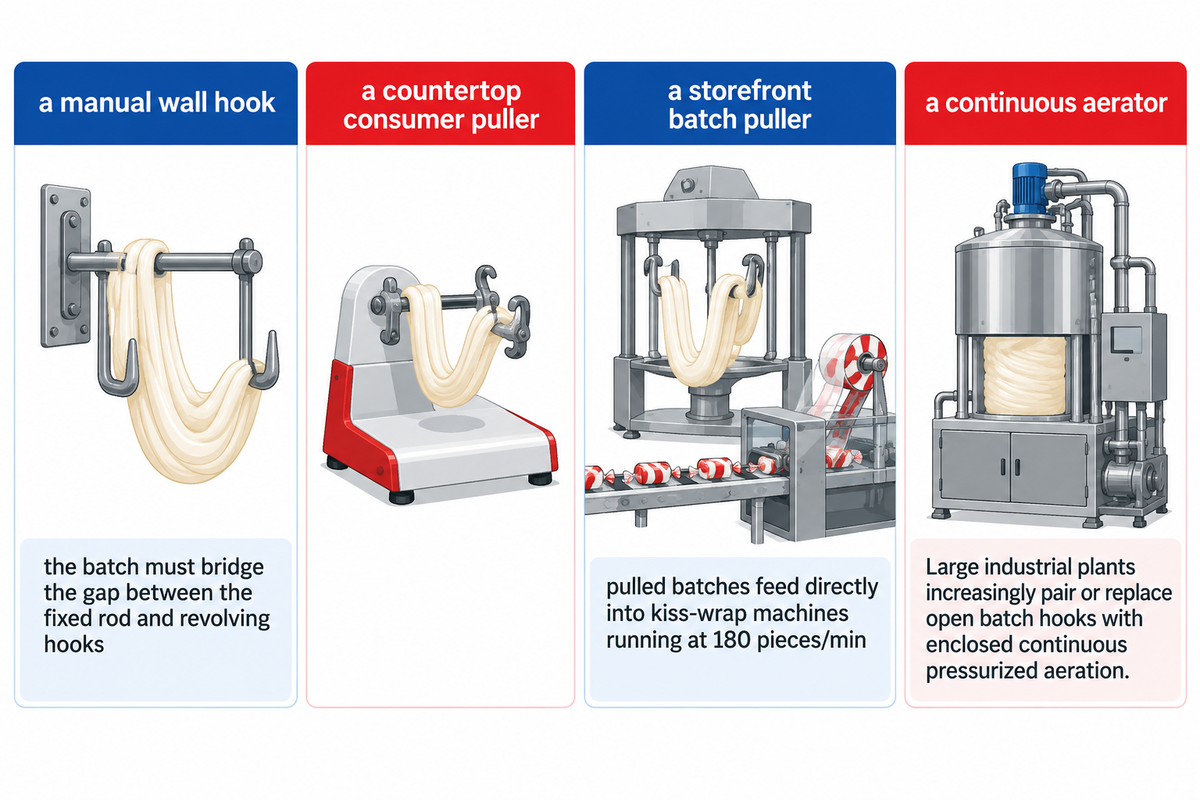
There are five main classes of equipment selected by facilities based on a combination of batch weight, minimum pin bridge geometry, and hourly throughput targets. Equipment options include a manual wall hook, a countertop consumer puller, a storefront batch puller, or a continuous aerator. On any planetary puller, the batch must bridge the gap between the fixed rod and revolving hooks. Otherwise, a small test batch simply rides around on a single pin without stretching.
Boardwalk candy shops rely on planetary batch pullers for theatrical window appeal and seasonal holiday demand. In 2025, US Halloween confectionery retail sales reached USD 3.9 billion. In The Goldenrod’s storefront operation, pulled batches feed directly into kiss-wrap machines running at 180 pieces/min. Meanwhile, Candy Industry reports a USD 3.9 billion non-chocolate chewy candy category across North America. Large industrial plants increasingly pair or replace open batch hooks with enclosed continuous pressurized aeration. That inline gas-mixing principle mirrors a marshmallow production line and delivers uninterrupted multi-shift efficiency.
| Equipment Tier / Line Stage | Typical Configuration Class | Aeration / Conditioning Mechanism | Upstream Thermal Input Requirement | Downstream Handoff & Forming Pairing | Primary Application & Reference |
|---|---|---|---|---|---|
| Tier 1: Stationary Wall Hook | Manual wall-mounted hook | Hand stretch-and-fold over a fixed stainless steel hook | Stovetop pot or small copper kettle + marble cooling slab | Hand rolling into ropes and manual scissor cutting | Home kitchen and artisanal recipe testing |
| Tier 2: Consumer / Countertop Puller | Compact tabletop or hand-crank unit | Small rotating arms for hobbyist batch conditioning | Small batch boil + cooled slab transfer at 50–60 °C | Manual rope rolling and hand twist wrapping | Home candy maker and culinary demo (Chef’n) |
| Tier 3: Storefront Batch Puller | Pedestal or floor planetary puller | 3-rod or 4-rod planetary arms (often 15–20 min batch cycle) | Copper kettle or steam cooker + water-cooled slab (50–60 °C) | Transfer to kiss-wrap machine (up to 180 pieces/min) | Boardwalk retail shop (The Goldenrod / Gondor) |
| Tier 4: Industrial Multi-Arm Puller | Heavy-duty double-arm pulling system | Staged slow-then-fast double-arm pulling cycle, finishing at about 30–50 °C | Vacuum cooker + cooling drum or water-cooled table | Batch roller, rope sizer, and high-speed cut-and-wrap | Wholesale chewy candy production (US8920856B2) |
| Tier 5: Continuous Pressurized Aerator | Inline pressurized mixing head | Metered compressed gas sheared into continuous sugar stream | Continuous dissolving, vacuum cooking, and inline cooling | Continuous extrusion or multi-rope sizing and wrapping | High-output industrial chewy candy plant |
| Stage A Handoff: Cooking to Cooling | Kettle or vacuum cooker discharge | Sensible heat removal without triggering sucrose graining | 250–290 °F (121–143 °C) cooked taffy syrup at 92–95 percent solids | Cooling table or drum tempers mass uniformly to 50–60 °C | Prevents hot liquid syrup from sticking to puller pins |
| Stage B Handoff: Pulling to Forming | Aerated batch transfer | Preserves aerated micro-bubbles during cone tapering | Pulled mass discharged after slow-then-fast aeration cycle | Batch roller and multi-stage rope sizer draw uniform rope | Buffers batch pulling into continuous rope feed (WO2008067207A1) |
| Stage C Handoff: Rope Sizing to Wrapping | Synchronized cut-and-wrap feed | Cuts calibrated rope and seals against ambient moisture | Uniformly sized chewy candy rope fed into wrapping station | Kiss-wrap or twist-wrap machine (e.g. 180 pieces/min) | Protects finished chew texture (The Goldenrod / SINOFUDE) |
Commercial Taffy Puller Selection Checklist: Batch Capacity, Arm Geometry, and Hygiene
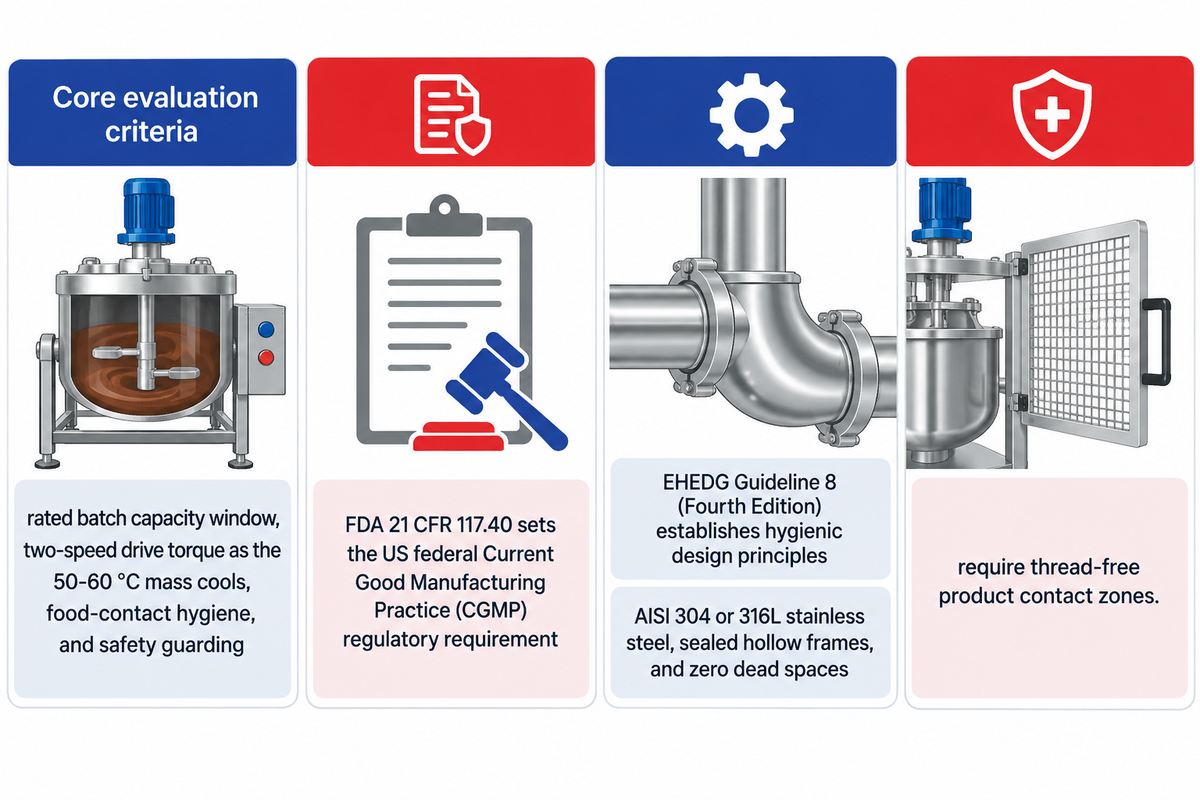
Clients evaluating a commercial candy puller should review four core technical areas before placing an order. Check the model’s rated batch capacity window, two-speed drive torque as the 50–60 °C mass cools, food-contact hygiene, and safety guarding. Published sources document 15 to 20 minute commercial batch pulling cycles (Gondor Machinery) and 180 pieces/min downstream kiss-wrapping (The Goldenrod), while exact kilogram batch ratings vary across machine builders. Commercial machine price reflects frame construction, electrical configuration (110V, 220V, or 380V), and guarding package, so buyers should request a formal manufacturer quote.
For sanitation and compliance, it’s important to distinguish Federal regulatory requirements from Engineering Design Guidelines:
- FDA 21 CFR 117.40 sets the US federal Current Good Manufacturing Practice (CGMP) regulatory requirement. Under 21 CFR 117.40, food-contact equipment and utensils must use adequately cleanable, nontoxic, corrosion-resistant materials with smoothly bonded seams.
- EHEDG Guideline 8 (Fourth Edition) establishes hygienic design principles from the European Hygienic Engineering & Design Group. As detailed by Velec Systems, engineering guidelines recommend AISI 304 or 316L stainless steel, sealed hollow frames, and zero dead spaces.
- Both EHEDG Guideline 8 and Velec Systems sanitary audit criteria require thread-free product contact zones. Exposed screw threads in the food zone can harbor microbes and trap sugar residue between washdowns.
- Select pullers with tool-free removable guards for fast sanitation access between flavor runs. Incorporate staged, slow then fast drive control for the viscous batch as it cools (US8920856B2).
From Batch Taffy Pulling to Industrial Chewy Candy Line Integration
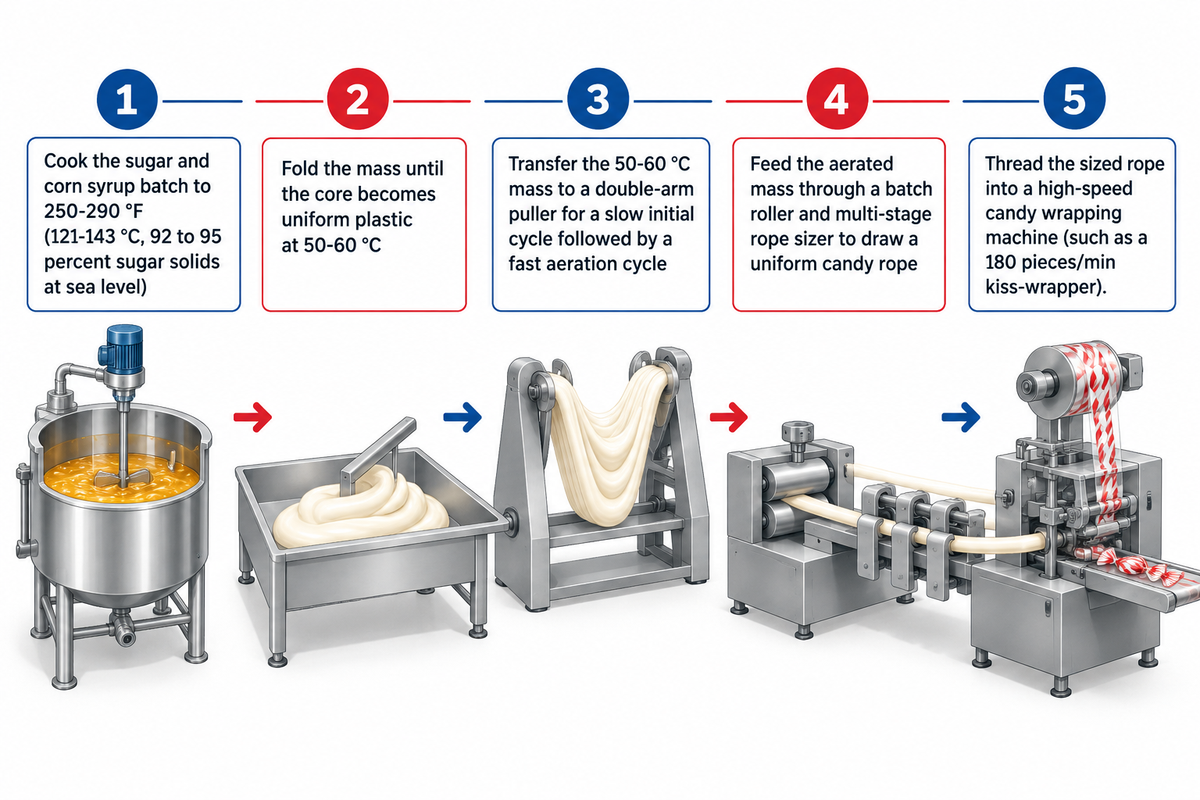
Scaling pulled candy manufacture beyond a standalone batch puller requires synchronizing upstream thermal prep with downstream forming. Plants link cooking and cooling directly to batch rolling, rope sizing, and high-speed wrapping. According to Data Bridge Market Research, the North America confectionery processing equipment market reached USD 2.32 billion in 2024. As shown in Patent WO2008067207A1, pulling, graining, rope sizing, and forming must be balanced together to lock in final chewy candy density.
Batch-to-Line Handoff Map
The Batch-to-Line Handoff Map preserves aerated structure from the kettle to the wrapper via a series of unit operations:
- Cook the sugar and corn syrup batch to 250–290 °F (121–143 °C, 92 to 95 percent sugar solids at sea level). Reduce target boiling temperature by 2 °F per 1,000 ft of elevation.
- Temper the boiled syrup on a water-cooled table or cooling drum. Fold the mass until the core becomes uniform plastic at 50-60 °C.
- Transfer the 50-60 °C mass to a double-arm puller for a slow initial cycle followed by a fast aeration cycle.
- Feed the aerated mass through a batch roller and multi-stage rope sizer to draw a uniform candy rope. Don’t collapse the air cells in the rope.
- Thread the sized rope into a high-speed candy wrapping machine (such as a 180 pieces/min kiss-wrapper). Seal out ambient humidity and store finished boxes at room temperature rather than refrigerating (Taffy Shop).
SINOFUDE’s public catalog (sinofudecorp.com/turnkey-projects/ and toffee-and-caramel-line) covers integrated upstream dissolving, cooking, cooling, batch rolling, rope sizing, forming, and downstream candy wrapping line synchronization. It doesn’t list standalone retail or storefront batch taffy pullers, framing the exact batch-to-continuous line handoff boundary. Our engineering team provides complete candy process and line integration for commercial chewy candy, gummy candy, toffee, and caramel facilities. We configure each line from target recipe solids, batch weight, and hourly wrapping output; contact our engineering team for pilot trials.
Frequently Asked Questions About Taffy Pullers
1. Why does taffy turn white or pastel when pulled on a taffy puller?
Taffy turns white or pastel when a puller stretches and folds its clear or amber sugar mass. According to the study published in the AIP Physics of Fluids, this action captures and disseminates microscopic air bubbles and fine fat droplets throughout the mass. Unpulled syrup allows light to pass through. Pulled syrup scatters light. Uncolored candy becomes bright white, and other colors become pastel.
2. Can a candy pulling machine be used to pull hard candy for a satin finish?
Yes, confectioners use a heavy-duty candy pulling machine to aerate boiled hard candy sugar mass. The batch must stay warm and plastic on the warming table before pulling. That stretching action provides a pearlescent satin gloss on ribbon candy or mints. However, hard candy is cooked to 300-310 °F with less moisture than chewy taffy. It cools rapidly and requires higher drive torque and strict timing to avoid snapping puller arms.
3. Why does taffy stick to the puller arms or tear instead of stretching smoothly?
Taffy sticks and wraps around the rotating arms when the batch is loaded above 65 °C. Excess moisture from under-cooking causes the same sticky failure. Conversely, candy tears, fractures, or stalls the motor when the mass cools below 45 °C during pulling. Over pulling causes early sugar graining across the stretched rope.
4. What state is famous for salt water taffy?
New Jersey—particularly Atlantic City—is historically famous for popularizing boardwalk salt water taffy in the late 19th century. It quickly gained popularity and attracted visitors.
5. How do 3-arm and 4-arm taffy pullers compare in stretching efficiency?
In Thiffeault’s topological model at the University of Wisconsin-Madison, the 3-rod and 4-rod planetary taffy pullers share a 2.414 silver ratio multiplier per half-period. On the production floor, actual extension is dependent on the geometry of the arms, batch load and the overlap of folds. The 4-rod planetary layout remains the most common design, and simpler 3-rod mechanisms are still in use. Four-rod gearboxes also even-out drive torque and ease pin sanitation between runs.
6. Can taffy pull out dental fillings if it is under-pulled?
Yes – under-pulled or under-cooked taffy remains dense, cohesive, and adhesive. Proper aeration of a taffy puller introduces micro-bubbles and distributes fat evenly. This structure reduces tackiness and creates a cleaner, softer bite.
7. What equipment follows a batch candy puller when a shop scales up production?
Once a storefront or floor batch taffy puller finishes its 15 to 20 minute aeration cycle, operators transfer the 50–60 °C plastic mass to a batch roller. The roller tapers the candy to a cone. A multi-stage rope sizer draws a uniform diameter rope. Finally, the rope feeds a high-speed cut-and-wrap or kiss-wrapping machine running up to 180 pieces/min. Rope sizing and batch puller cycle time are synchronized, preventing a cooling bottleneck on the packing floor.
References & Sources
- University of Wisconsin-Madison Department of Physics. Colloquium: Topological Fluid Mechanics of Taffy Pullers (Jean-Luc Thiffeault)
- Smithsonian Magazine. Using Math to Build the Ultimate Taffy Machine
- American Institute of Physics (AIP) / Physics of Fluids. The Sweet Physics of Saltwater Taffy (San To Chan et al., 2023)
- The Goldenrod (York Beach, Maine). The Art and Science of Making Saltwater Taffy
- Colorado State University Extension. Candy Making at High Elevation: Boiling Point Adjustments.
- ThermoWorks. Confectionery Sugar Stages and Temperature Chart (Firm-Ball to Hard-Crack)
- United States Patent US8920856B2. Co-extruded layered candy and gum apparatus and methods
- World Intellectual Property Organization Patent WO2008067207A1. Confectionery compositions including an elastomeric component and a saccharide component
- European Hygienic Engineering & Design Group (EHEDG). EHEDG Guideline 8 (Fourth Edition): Hygienic Design Principles.
- Velec Systems. Hygienic Design for Food Processing Equipment in 2026, EHEDG & FDA Standards.
- Gelken Confectionery Science. Preventing Confectionery Crystallization and Stickiness During Production.
- Taffy Town. Why Is Candy Sticky? Tips on How to Prevent It.
- Taffy Shop. Salt Water Taffy Pulling, Wrapping, and Storage.
- Candy Industry. State of the Confectionery Industry: Chewy Candy Category & Processing.
- Data Bridge Market Research. North America Confectionery Processing Equipment Market Analysis.
- SINOFUDE Confectionery Machinery. Turnkey Confectionery Production Line Integration & Engineering Scope.