Get in Touch with SINOFUDE Company

Cupcake & Swiss Roll Line: A Practical Production Guide

A Cupcake & Swiss Roll Line turns mixed batter into two products with different handling requirements. Cupcakes take their shape in individual cups or molds; Swiss rolls start as a baked sheet that has to make it through the release, filling and bending process. Knowing the difference helps explain defects and useful outputs and shows the true limits of shared equipment.
This document follows the product from the air in the batter through to the number of acceptable cakes leaving the packer. For machine configuration and other project discussions, use SINOFUDE’s cake production line solution . The process descriptions that follow will help you determine what you should be observing prior to changing a setting.
Cupcake and Swiss Roll Production: Two Different Product Flows
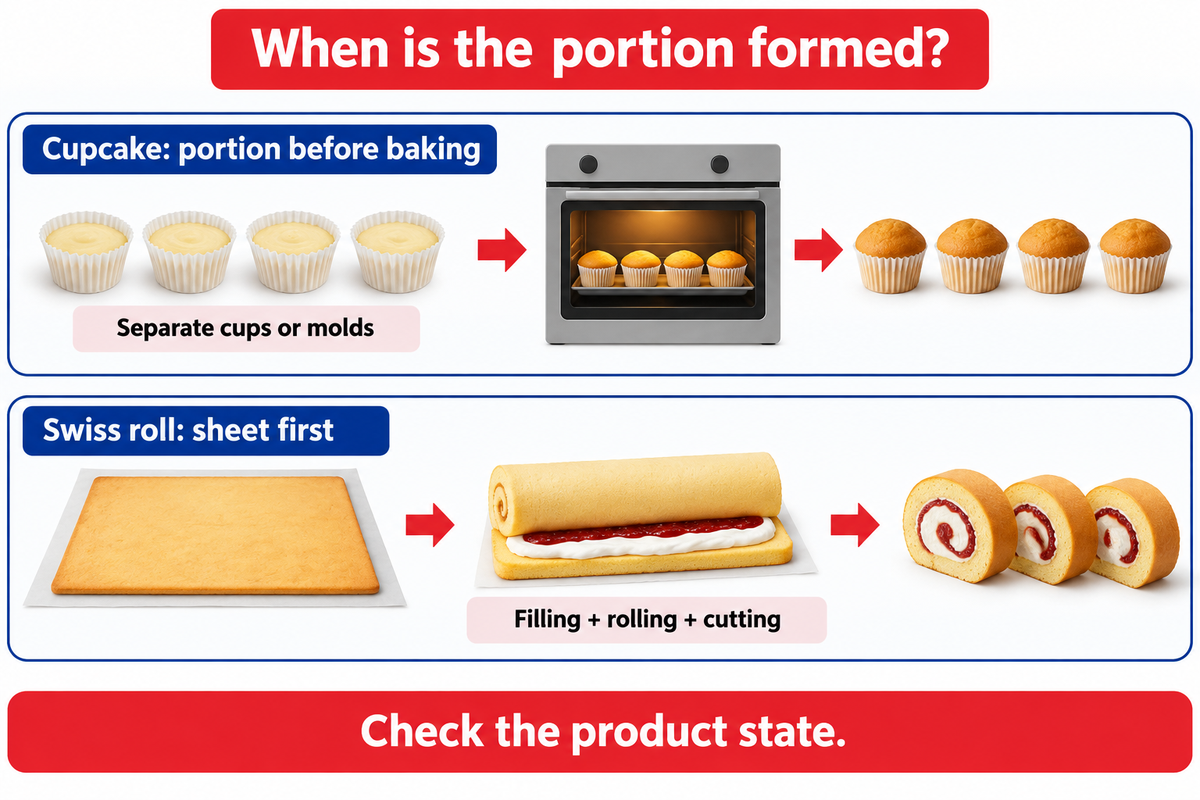
Cupcake production separates the batter into individual portions before baking. Swiss roll production forms a continuous sponge sheet which is filled, rolled and cut. Both production routes require controlled mixing and heat transfer. Their different carriers and finishing steps determine where the first signs of defects in weight, shape and handling appear in a production run.
| Stage | Cupcake route | Swiss roll route |
|---|---|---|
| Batter preparation | Mix for the required portion structure | Mix for a sheet that can be handled and bent |
| Carrier preparation | Position cups or a suitable mold | Prepare the sheet carrier or baking belt |
| Depositing | Meter separate portions | Spread a layer with controlled width and thickness |
| Baking | Set individual cake bodies | Set a continuous sponge sheet |
| Release | Remove cakes or retain their cups | Separate sheet from its support without tearing |
| Cooling | Manage separate portions and their spacing | Manage sheet condition before filling and rolling |
| Filling | Inject or finish individual cakes when required | Spread the selected filling across the sheet |
| Shape formation | Shape largely formed in baking | Form the filled sheet into a roll |
| Final portioning | Check each cake’s weight and appearance | Cut the roll to produce individual portions |
| Packing | Present separate cakes consistently | Present cut slices without damaging the spiral |
The difference is in the published routes of manufacturers: MASDAC’s cupcake line describes handling of cups, supply, deposit, baking and removal while BakeryTurnkey’s Swiss roll process describes handling of sheets, filling and rolling. They’re arrangements of equipment for the processes rather than specifications of SINOFUDE equipment.
Watch the material at each station. Suppliers may use “filling” to indicate adding batter to a carrier and use a different term to add jam or cream. Ask whether the station handles raw mixture, baked sponge or finished filling before comparing two diagrams. A machine name may be the same across several products, but the product state may be different.
A good first record is when a product is individuated. For example, a cupcake may already be a 30 g batter portion before the oven; a Swiss roll slice may reach its target weight only after sheet thickness, filling mass and cut length combine.
Map the production process in product terms and then analyze baking equipment. For both baking products, determine the carrier, material addition, and the point at which the final portion is formed. This gives a food machinery engineer something more useful than a list of machine names: a sequence whose transfers and measurements can be checked.
How Batter Mixing and Depositing Shape the Cake
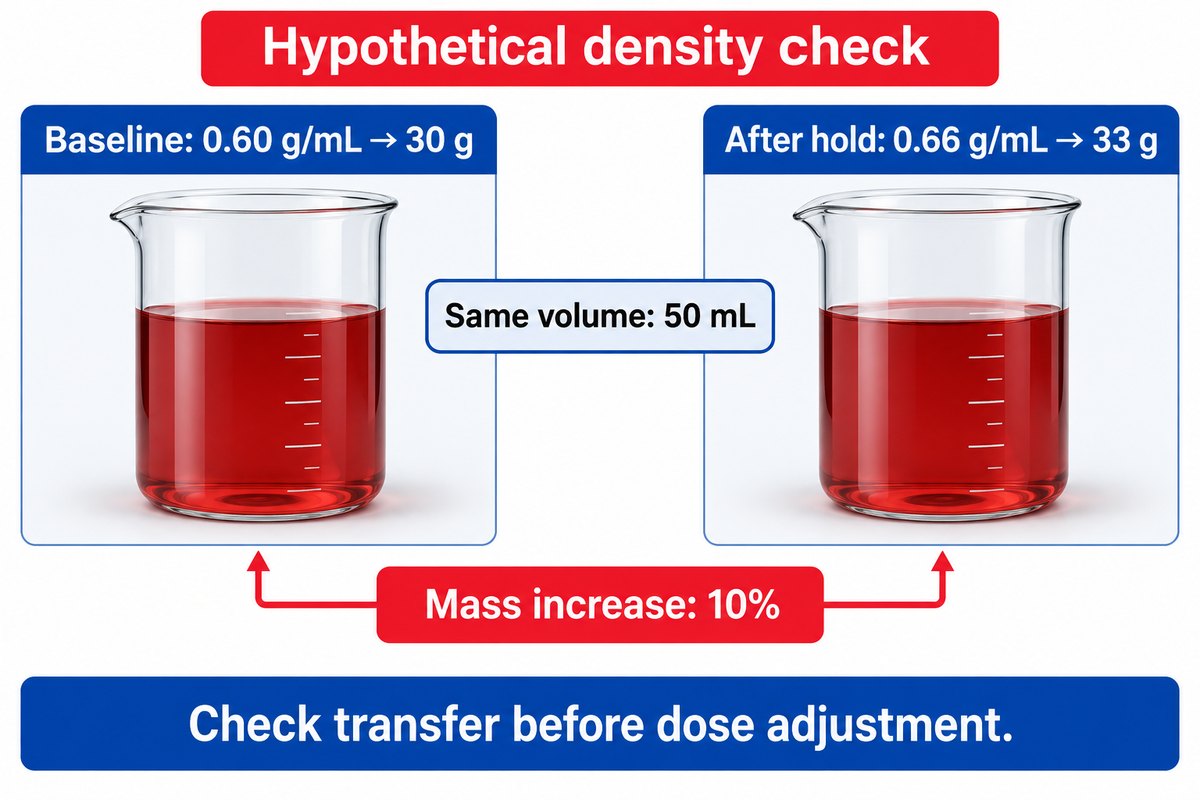
Batter mixing establishes the air distribution and consistency of mixture which depositing must preserve. The same deposited volume can give a different cake weight. This is because density can vary while holding, pumping or transferring. Compare batter at the mixer and depositor before correcting the making machine’s dose, particularly when the crumb changes with the weight.
Egg, flour, sugar, fat, water and any emulsifier or baking powder have different functions in a formula; air incorporated during mixing provides gas cells; the recipe and mixing method affect how those cells survive. Heat changes the starch and protein structure of the batter. Pycarelle and colleagues’ sponge-cake research examines that interaction, rather than offering a universal recipe for industrial cake equipment.
The American Society of Baking’s sponge-cake explanation describes hot and cold mixing methods. Its method-specific batter examples give 32–34 °C for the hot process and 20–22 °C for the cold process. Those temperatures are for method descriptions, not recipes. Compare the temperature methods from your approved documentation with the corresponding baseline.
How are Swiss roll cakes made?
A Swiss roll production line mixes and deposits sponge batter as a sheet, bakes and releases it, then prepares it for filling, rolling, cutting and packaging. This process links the whole process: the sheet must have enough structure to be supported throughout its journey, and remain suitable for the chosen rolling mechanism. A change in batter can therefore appear much later as a handling defect.
Let’s use a hypothetical bakery with a 50 mL dose. At 0.60 g/mL, the deposit weighs 30 g. After a longer hold, a sample measures 0.66 g/mL and the same 50 mL weighs 33 g, a 10% increase. An operator decreased the volume of the deposit to reclaim the original weight; however, the cake still had a different crumb. Adjusting the weight of the deposit has concealed the true cause of the change rather than explained it. Compare known volumes using the same measurement technique, from the mixer, holding vessel, and the head of the deposit. If the density shift appears during transfer, investigate that step before changing the formulation. The example demonstrates mass equals volume multiplied by density; neither density is a target for your recipe.
More air isn’t automatically better. The University of Valladolid’s cake-processing article explains that insufficient aeration can reduce volume, while excessive aeration can make some foams unstable. Record mixing time in minutes, batter temperature in °C, sample volume in mL and mass in g. Keep sampling technique consistent enough for the comparison to mean something.
Baking, Release and Cooling: Control the Sheet Before Filling
Baking, releasing, and cooling should produce a sheet that’s suitable to accept a filling and bend without tearing. Oven settings alone don’t indicate that condition. For formulation-dependent effects during baking, see the University of Valladolid’s processing guidance. There are many variables: the recipe, the thickness of the deposit, how the sheet is handled, and how long it’s held over the heat source. Compare the sheet across its width and along the length before diagnosing a downstream rolling defect as a roller problem.
A tunnel oven’s heating profile and conveyor speed work together. At a fixed heated length, a faster conveyor reduces residence time; changing electric or another heating input changes a different element of the process. Both should be recorded before making any changes. A darker edge and a pale center on the same sheet suggest a different investigation from a uniformly changed sheet.
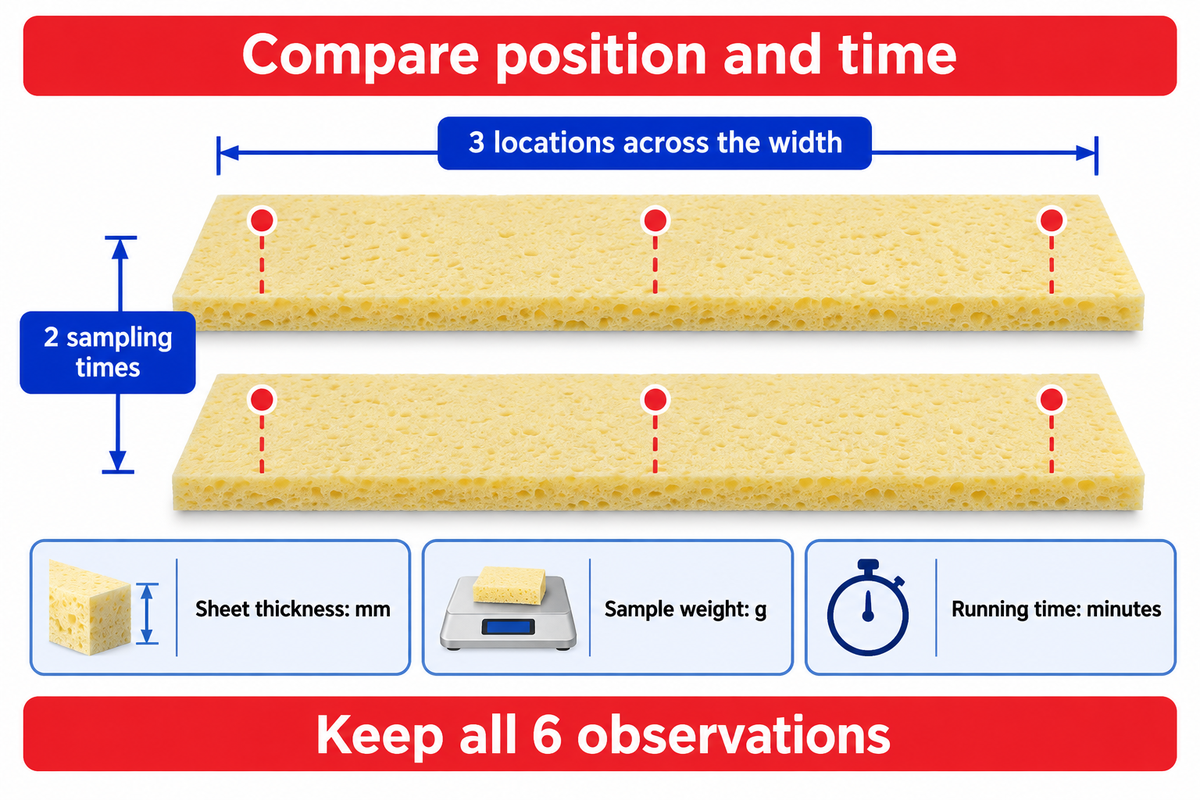
Checkpoint measurements should include thickness of the sheet in mm, the weight in g, and time in minutes. Taking a center sample only may miss where the edge that breaks is located. If a trial uses 3 locations across the width and 2 sampling times, preserve all 6 observations rather than averaging them into one attractive result.
The separation of the sheet from the carrier has its own checkpoint. The backside of the sheet should be inspected immediately after release and before the first bend. A tear already present before filling cannot have been created by the later cutting station. The condition of the carrier, the method of release, and the transfer of the sheet without support should be examined.
Changes to the cooling arrangement must consider the actual sponge and filling, whether the filling is jam, a creamy formulation, or another type of material. Do not substitute a generic “cool completely” instruction for a tested product condition. The real endpoint must be considered to maintain product integrity and to meet the needs of the validated bakery controls.
For example, assume there’s a change to a different cream based filling from a strawberry jam filling. The oven still produces 100 sheets per hour; however, the new filling smears at the original cutting condition. The team lowered the speed of the cutter to 80 sheets per hour and sheet accumulation began before rolling. Increasing the output of the oven would increase the sheet accumulation. Compare the filling’s condition at the time of application, the time to cutting and the quality of the cut face before selecting a change. New filling also requires its own storage and handling evaluation; having an acceptable cut face doesn’t ensure microbiological suitability.
Post bake conveying, filling and packing expose a ready to handle cake to an environment different from that of the Raw Batter. These processes must be incorporated in the Hazard Analysis of the plant and the control strategies validated. Set safe hold times and shelf life from the plant’s validated controls, not from how a cooled sheet looks.
Why Swiss Rolls Crack and Cupcakes Lose Shape
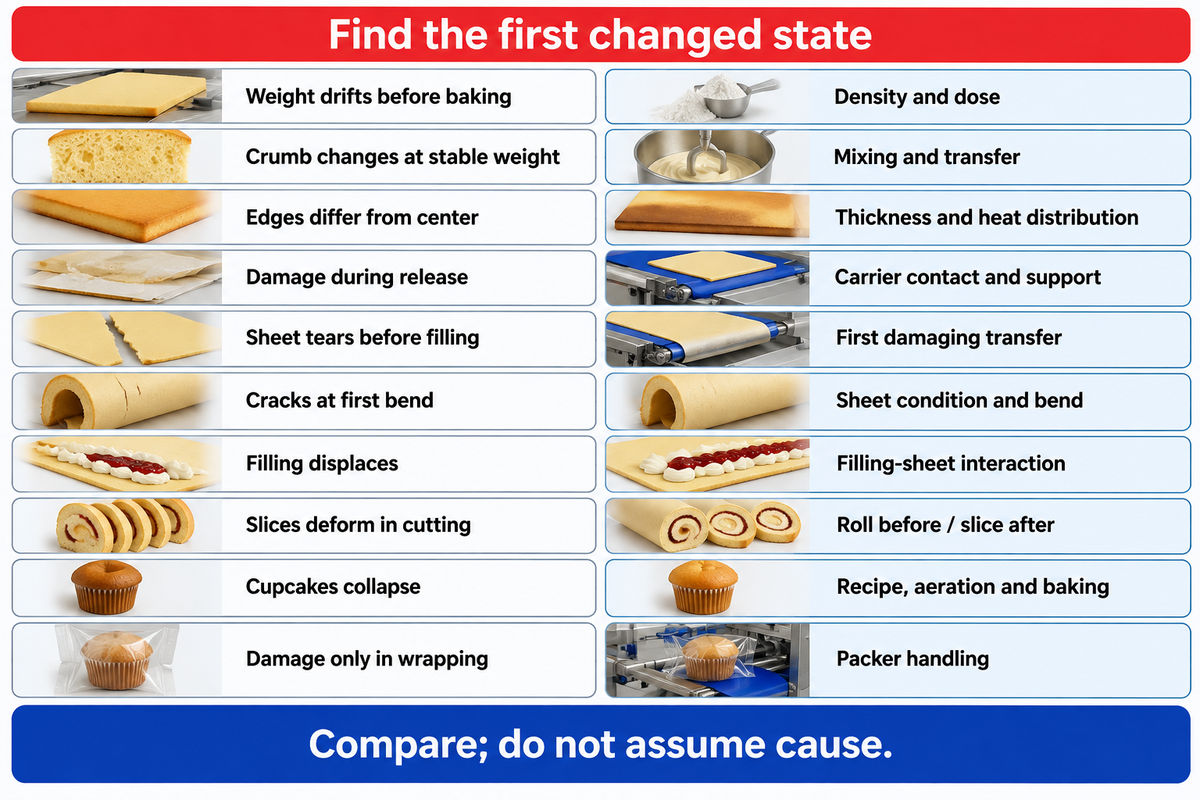
Symptoms such as cracking and collapsing can result from many causes, so identify the first changed state in the product and adjust equipment accordingly. Compare a representative good sample and a defective sample with respect to depositing, baking, releasing, and finishing. A defect visible before rolling calls for an upstream investigation; damage appearing only during bending points toward that interaction.
Supporting evidence for cautious inference about simple causes exists. A 2021 sponge-cake experiment found changes in aeration and texture without corresponding changes in structure-setting timing under its tested conditions. The related research team includes Puratos employees Bosmans and Pareyt; the paper also acknowledges Puratos support for KU Leuven’s cake research.
| Defect category | First comparison | Trial direction |
|---|---|---|
| Portion weights drift before baking | Density and dose at the same time | Separate density change from metering change |
| Crumb changes with stable portion weight | Mixing and transfer samples | Check air distribution and stability |
| Edges differ from the center | Matched thickness and baked-sheet samples | Investigate deposition and heat distribution |
| Damage appears during release | Sheet underside before and after separation | Examine carrier contact and support |
| Sheet tears before filling | Transfer points and sheet condition | Locate the first unsupported or damaging contact |
| Cracks appear at the first bend | Sheet condition and bend geometry together | Change one controlled factor per comparison |
| Filling displaces during rolling | Applied filling mass and product condition | Check the filling-sheet interaction |
| Slices deform during cutting | Roll before cutting and slice after cutting | Separate upstream weakness from cutting damage |
| Cupcakes collapse after baking | Recipe, aeration and matched baking records | Investigate structure formation and stability |
| Damage appears only in wrapping | Products immediately before and after packing | Investigate presentation and packer handling |
Causes can be many for one effect, and several changes can occur together. Photograph the first visible defect and identify the lane and/or position. Maintain a matched good sample for comparison. This aids in interpretation of changes made later.
Consider a hypothetical roll trial in which 8 of 100 slices have cracked edges. The team compared strips in the center and edge before filling and at the first bend. Cracking occurred at the edge after bending; no release tears were observed. Instead of changing several settings together, the team agreed to change one variable and keep the recipe and carrier constant. If the defect moves to a different stage or the center deteriorates, the change is not an improvement merely because the original edge count falls. The trial required the same observation points and slice definition as the first run.
Home-baking experiences often bring up questions, but they don’t always answer the industrial setting. One AskBaking discussion brings up different experiences with pre-rolling and no pre-rolling. Take this as an opportunity to evaluate the actual recipe, as opposed to incorporating a household method into a continuous line.
Count Good Cakes: A Worked Loss and Unit-Cost Example
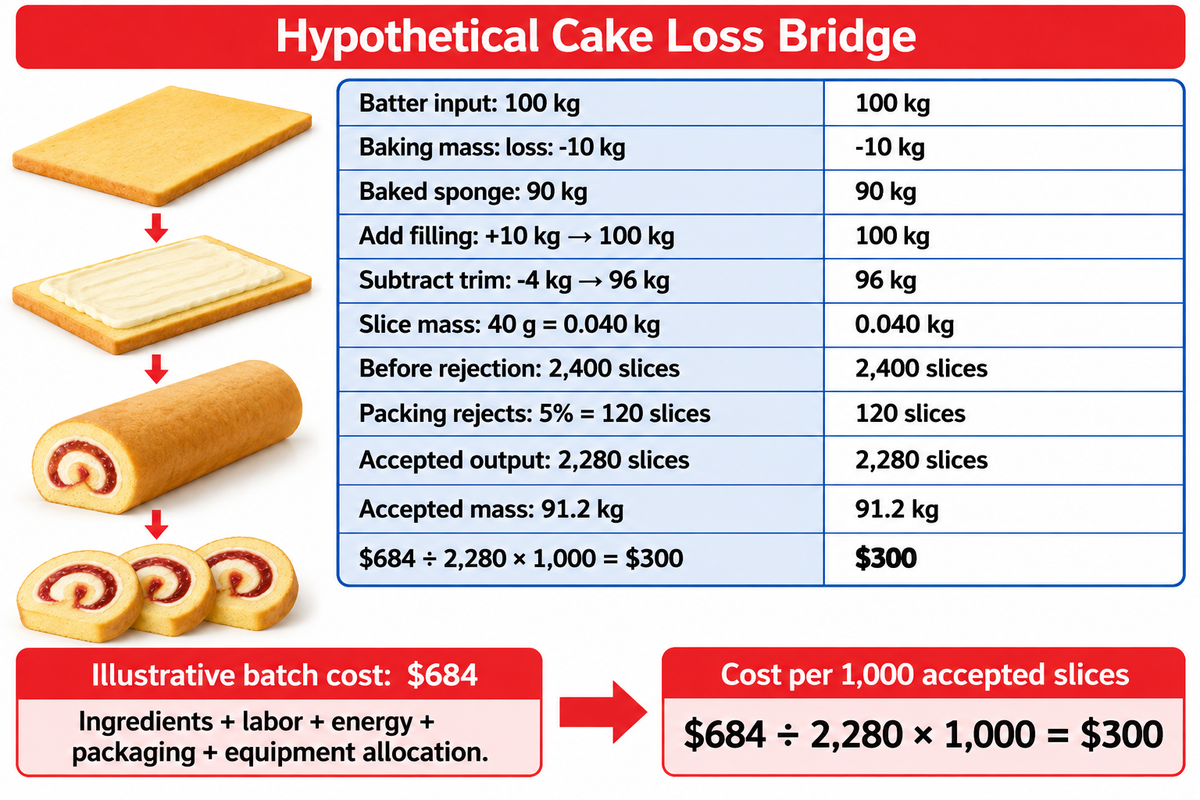
The cost per accepted cake requires a finished-piece denominator, while baking loss and trimming are measured as mass at earlier stages. Be sure to combine any filling and keep those numbers separate before computing portions. The worked example below ties mass to pieces and doesn’t count evaporated water as a second batch of rejected cakes.
I call this accounting sequence the Cake Loss Bridge. Follow material additions and losses until the product can be counted, then apply piece rejects. In this example, all figures are purely illustrative, and actual figures must be determined for a valid calculation for production.
| Step | Calculation | Result |
|---|---|---|
| Start with batter | Batch input | 100 kg |
| Subtract baking mass loss | 100 kg × 10% | 10 kg lost |
| Retain baked sponge | 100 kg − 10 kg | 90 kg |
| Add filling | 90 kg + 10 kg | 100 kg |
| Subtract trimming | 100 kg − 4 kg | 96 kg |
| Set slice mass | 40 g per slice | 0.040 kg per slice |
| Calculate portions before rejection | 96 kg ÷ 0.040 kg | 2,400 slices |
| Reject at packing inspection | 2,400 × 5% | 120 slices |
| Count accepted pieces | 2,400 − 120 | 2,280 slices |
| Check accepted mass | 2,280 × 0.040 kg | 91.2 kg |
| Calculate cost per 1,000 | $684 ÷ 2,280 × 1,000 | $300 per 1,000 accepted slices |
Imagine the bakery’s finance lead starts with a $684 batch cost covering ingredients, direct labor, energy, packaging and the chosen equipment-cost allocation. Production records 100 kg of batter, 10 kg of baking mass loss, 10 kg of added filling and 4 kg of trim. The remaining 96 kg yields 2,400 slices at 40 g each. Inspectors reject 120 slices for the defined weight or presentation checks, leaving 2,280. The finance lead divides $684 by 2,280, then multiplies by 1,000 to obtain $300. Dividing by the 2,400 slices before rejection would report $285 instead, understating this example’s cost by $15 per 1,000 accepted pieces.
The example’s 10% baking loss is an assumption. A 2015 Rubus coreanus sponge-cake study measured 11.20–14.54% across its specific formulations with 0–40% substitution. That range illustrates recipe dependence; it isn’t a normal factory-loss allowance. Baking mass loss does not determine water activity or shelf life.
When assessing costs, use the same cost scope when comparing trials. As materials already charged to the batch include materials that become scrap, adding their full purchase cost again as a separate loss charge double counts those costs. Add genuinely additional costs of disposal and/or rework, only if they’re outside the cost scope of the original trial. “Accepted” here means passing the stated production checks. Final food safety release is separate.
Can Cupcakes and Swiss Rolls Share a Production Line?
Partly: cupcakes and Swiss rolls can share upstream modules such as the mixer or oven when the carrier, thermal recipe, handling and cleaning requirements are compatible. Past the oven, Swiss rolls still need their own sheet support, filling, rolling and cutting. Analyze the changes and the schedule along with the campaign, because the slowest finishing step and changeover time can consume the apparent benefit of efficiency.
Start with physical differences. Cupcakes require discrete cups/pans, whereas a roll cake requires sheet support and filling, spreading, and rolling and cutting. A cake production line described as flexible may contain common upstream equipment and a different downstream equipment path. Ask the equipment manufacturer which units are shared, which are exchanged and which operate independently.
A fully automated route still requires a defined basis for scheduling production efficiency. Separate running speed from the accepted output over a shift and assess if cleaning, changes of product and planned stops are covered. Otherwise two perfectly accurate capacity figures may describe different things and lead to a wrong scheduling decision.
A Kansas State University food-processing equipment guide states that the slowest unit is what constrains process capacity. Faster baking won’t increase saleable output if cooling, filling or packaging, etc. can’t accept the product.
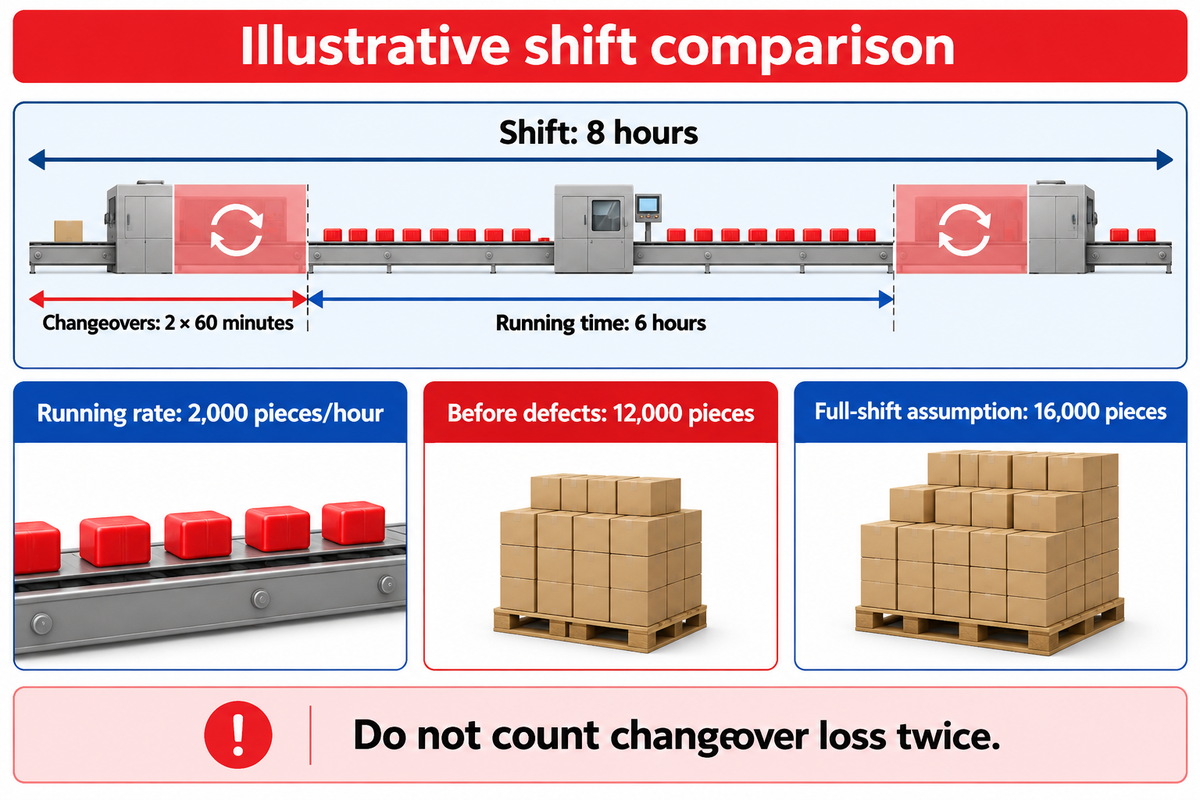
Consider an illustrative 8-hour shift with two 60-minute product changeovers. Only 6 hours remain before considering other stoppages. At a rate of 2,000 pieces per hour while running, that leaves 12,000 pieces before defects, not the 16,000 pieces implied by multiplying the running rate by the total shift. If the 2,000 pieces per hour figure already reflects the changeover loss, don’t consider them again. The capacity definition must be coupled with the capacity figure.
Allergens and cleanability must also be considered when assessing shared-line suitability. Canadian Food Inspection Agency guidance favors dedicated production lines where possible and addresses scheduling and cleaning when sharing is necessary. Apply the requirements of the actual market and the bakery’s validated controls. Two recipes containing some of the same ingredients do not automatically have identical allergen profiles or label requirements.
When assessing capacity to produce a product, use SINOFUDE’s product route brief builder to describe product routes and sequences. The technical guide says to separate the observations from commercial promise. A professional manufacturer must assess the route requested and prevailing trial conditions before affirming customized production.
From Product Trials to a Repeatable Production Run
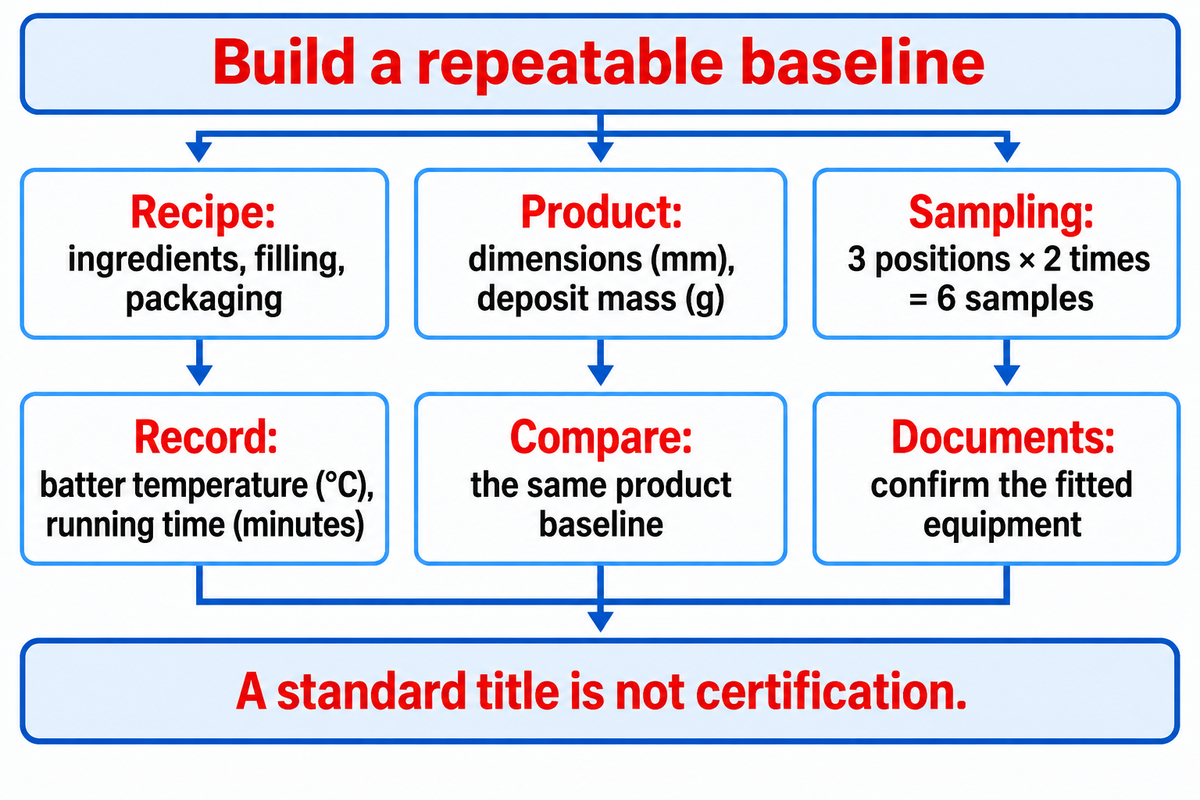
A good test of cake establishes a reproducible product baseline, and then evaluates if the same result occurs at different positions and over time. Record the recipe, product dimensions, sampling method and accepted-piece definition before changing a control. One good demonstration sample doesn’t show if the entire run meets the weight, structure, and presentation requirements.
“From mixing to the oven has to be a consistent process with a consistent time element.”
The report describes aeration beyond the mixer through transfer and depositing. Specialists mention their own equipment. Quotations aren’t endorsements of SINOFUDE. A good practice is to carry measurements through the process and keep a baseline for comparison by an engineer. A record of a standard run is kept for comparison so a process change can be evaluated against the same baseline.
For an initial comparison, you’ll need to identify 3 positions across the product path and 2 sampling times, and then record 6 samples. For each sample you’ll need to record batter temperature in °C, deposit mass in g, relevant sheet dimensions in mm and running time in minutes. The product team will need to define the tolerances; the suggested record doesn’t define acceptance limits. If a result varies with position, a single average may hide the reason.
A PLC or intelligent control system may help store settings, support precise manufacturing adjustments and improve traceability; however, a saved recipe is only as good as the measurements behind it. Automatic control cannot compensate for an unrecorded ingredient change. R&D trials should keep the original recipe, and identify precisely what changed, including filling and packaging requirements.
Equipment documentation needs the same precision. EN 1672-2:2020’s public scope concerns hygiene and cleanability of food-processing machinery. Confirm the documentation applies to the equipment in question. Do not use a general company credential or patent count to support the outcome of a product trial.
SINOFUDE was founded in 1998 and supplies confectionery, chocolate and bakery production equipment. For your baking project, you should bring the product observations to the RFQ and factory acceptance test readiness checker. Detailed machine selection and project commitments should be addressed in line-specific discussions.
Frequently Asked Questions
Can the same line make cupcakes and Swiss rolls?
Some modules can be shared, but the complete routes need separate assessment. Cupcakes use discrete portions and carriers, while Swiss rolls require sheet handling, rolling and cutting. Compare the proposed product paths, thermal recipes, changeover time and validated cleaning controls before treating shared machinery as a complete dual-product production solution for your bakery.
Can production capacity be customized for a different cake size?
For a different cake size, define the required capacity using the new dimensions, portion mass and product route. A different size can change deposited mass, baking load, cooling demand, cutting and packaging requirements. Specify capacity as accepted pieces per defined period, with the campaign schedule included, so a customized output figure has a clear operating basis.
Can I test my own recipe before selecting the production line?
Testing your own recipe helps assess the line before selection; SINOFUDE must confirm the available trial arrangement for the proposed product format. Agree beforehand on the ingredients, filling, sample quantities, observations and acceptance criteria. Retain records from matched positions and times, then compare weight, structure and handling through finishing; judge repeatable production performance from those matched records rather than from a single attractive sample.
Why can a Swiss roll crack even when the roller is working?
The sheet may already have a release defect, an uneven structure or a condition that doesn’t tolerate the bend. Compare samples before release, before filling and at the first bend. Change one controlled factor rather than assuming roller speed explains every crack.
How should baking loss be treated in a cake cost calculation?
Subtract measured baking mass loss from the batter mass before adding filling and subtracting trim. Convert the remaining product mass into portions using the defined portion mass, then subtract rejected pieces. Divide the agreed batch cost by accepted pieces. Keep the cost scope consistent, and don’t charge the purchase cost of the same lost material twice. State which stages were weighed, whether filling was included and where the piece count was taken. Use consistent units for every mass entry. If two runs have different portion sizes, compare their accepted mass as well as their piece counts before drawing a cost conclusion. Baking loss isn’t a finished-piece rejection rate, and it doesn’t establish shelf life or food-safety release.
Does automatic depositing remove the need to check cake weights?
No. A stable deposit volume can produce a different mass when batter density changes. Check sample mass and volume together using a consistent method. Compare the mixer and deposit-head samples before adjusting dose, so an upstream aeration change isn’t hidden by a weight correction.
Where should I start when planning a SINOFUDE cake line?
Start with the cakes you need to make: their dimensions, portion mass, filling and packaging format. Describe the intended campaign schedule and whether cupcakes and Swiss rolls must share modules. Use SINOFUDE’s product and factory discussion page for the equipment discussion, supported by your product observations and a clearly defined capacity requirement. Ask which trial and documentation arrangements apply to the proposed configuration rather than assuming every option belongs to every line.
Planning a Cupcake & Swiss Roll Line? Bring SINOFUDE your product format, recipe constraints, target output and the process observations that matter most. Visit the project requirements page to discuss the equipment path, or send the team your cake-line requirement. Confirm the project’s trial scope and acceptance criteria before committing to a configuration.
References & Sources
- Sponge-cake aeration and structure-setting research Pycarelle and colleagues, primary experimental study, 2020.
- Sponge Cake American Society of Baking.
- Cakes: Processing University of Valladolid grain research team, 2024.
- The Role of Intact and Disintegrated Egg Yolk Low-Density Lipoproteins during Sponge Cake Making and Their Impact on Starch and Protein Mediated Structure Setting Pycarelle and colleagues, Foods, 2021.
- Rubus coreanus sponge-cake formulation study primary experimental article, 2015.
- Selection and Purchase of Used Food-Processing Equipment Rausch and Erickson, Kansas State University.
- Preventive controls for food allergens, gluten and added sulphites Canadian Food Inspection Agency.
- Safeguarding aeration during cake production Charlotte Atchley, Baking Business, 2019.
- EN 1672-2:2020 public standard scope Estonian Centre for Standardisation and Accreditation.
WHY WE SHARE THESE GUIDES
About SINOFUDE Insights
SINOFUDE designs and manufactures production lines for confectionery, chocolate and bakery products. These guides help equipment buyers and engineering teams compare process routes, recipe requirements and line layouts before discussing a project.
- Gummy and jelly depositing
- Hard candy and lollipop processing
- Cooking, cooling and packaging
- Equipment selection and line planning