Get in Touch with SINOFUDE Company

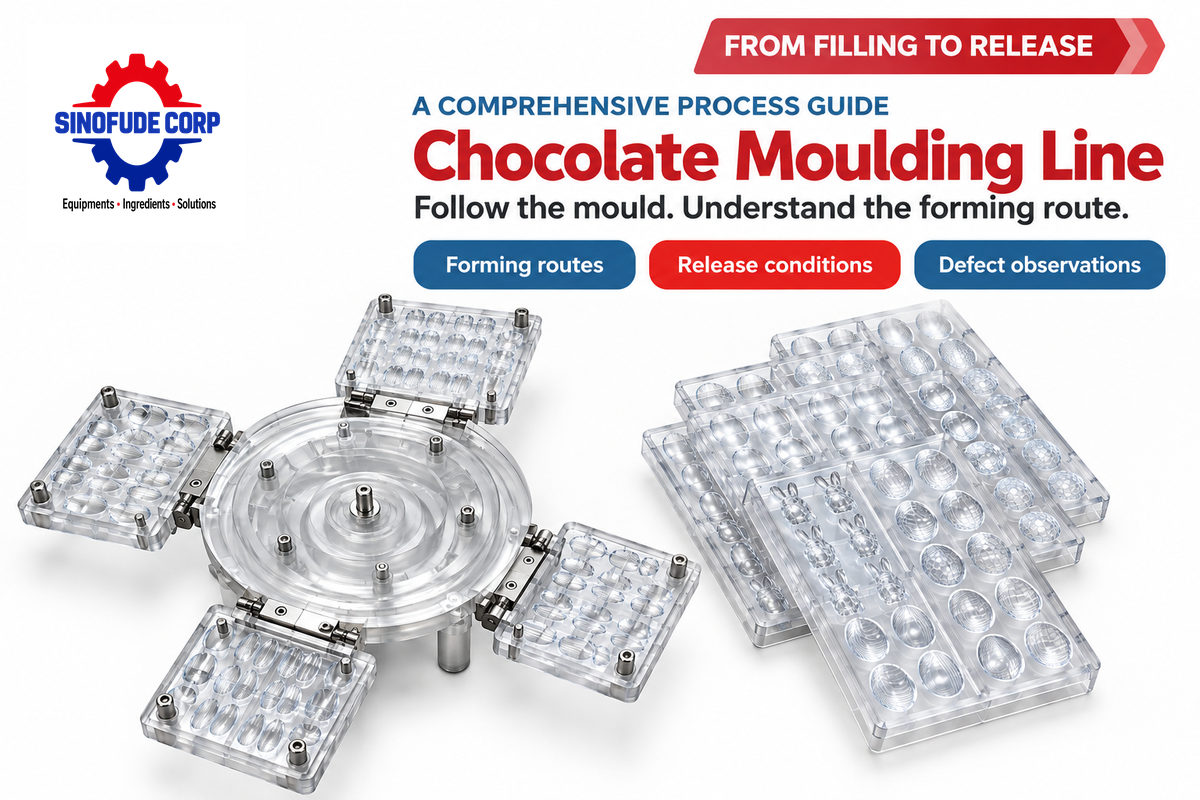
A chocolate moulding line shapes chocolate into bars, tablets, pralines and the like by filling moulds. The useful starting point is cross sections. A solid bar, an inverted shell and a one-shot filled piece follow different forming sequences, even if their shape varies little from one another.
This guide provides those forming sequences and the checks that follow. For current equipment configurations and model specifications, see SINOFUDE’s chocolate moulding line solutions.
Three distinctions to keep in view
- Prepared chocolate mass enters the forming section; cocoa-bean processing belongs upstream.
- A mould that moves through the line may be empty, filled, held or carrying rejected pieces.
- Chocolate temperature, crystal state and mould condition describe different parts of the process.
How a Chocolate Moulding Line Works
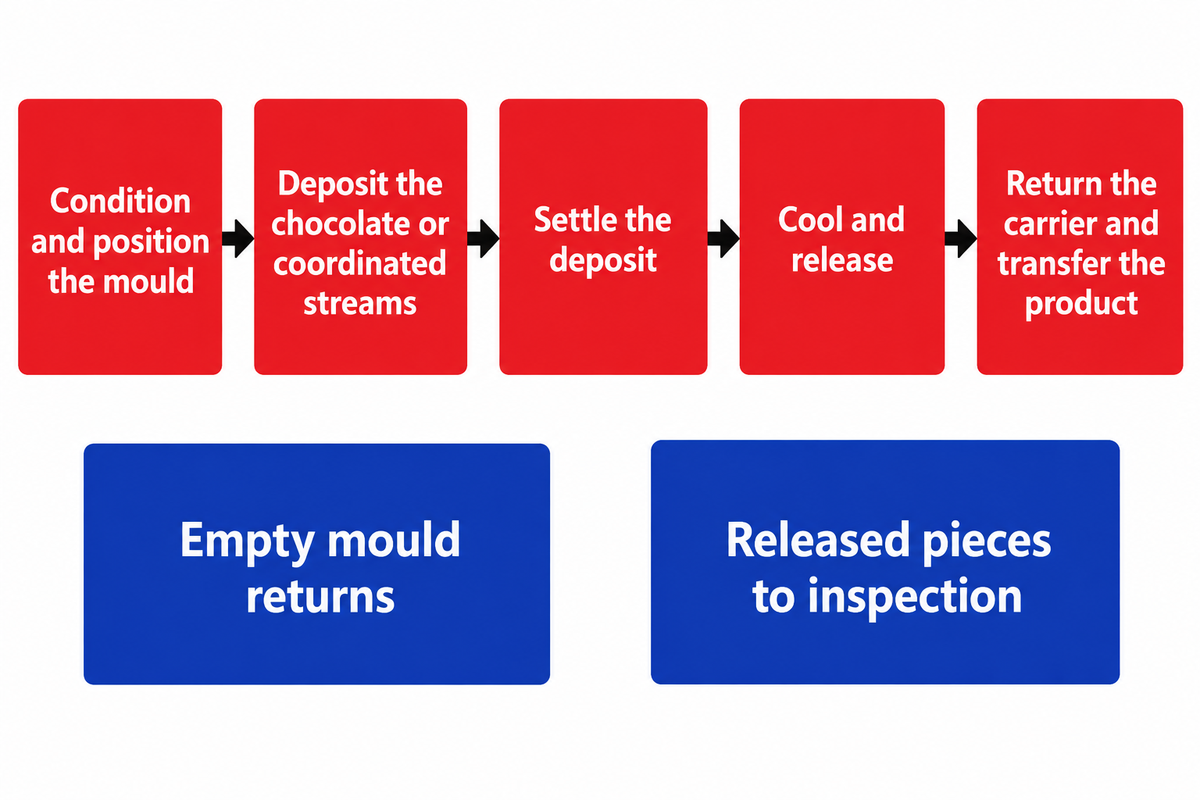
The moulding process on a chocolate molding line coordinates chocolate and a reusable mould around a forming circuit. Chocolate supply, mould conditioning, depositing, vibration, cooling, demoulding and mould return pass the material to the next stage in the right state. Other machines may work with continuously moving moulds. The automation describes how those duties are performed.
Think of the mould as a reusable carrier with a pre-determined shape. Its cavity gives the final chocolate its shape and detail. Before filling, the mould must be in the required condition for the recipe and process. Preheat settings are a part of that starting condition and the actual geometry of the mould. For repeatability, materials preparation and mould arrival must remain coordinated. A melting tank supplies liquid material; chocolate tempering establishes a controlled crystal population for cocoa-butter chocolate. Continuous tempering may be upstream equipment rather than part of the moulding machine.
- Condition and position the mould. Inspect the cavity and bring the mould to its required starting condition.
- Deposit the chocolate or coordinated streams. During automatic chocolate depositing, the forming route determines whether the cavity receives solid chocolate, a shell deposit or shell and filling together.
- Settle the deposit. Vibration helps the mass reach details and lets trapped air escape.
- Cool and release. The product sets, contracts and passes through the demoulding station.
- Return the carrier and transfer the product. Carriers convey the empty mould back while the released pieces move toward inspection and packing.
What is the difference between a chocolate moulding machine and a depositor?
A depositor meters and delivers material; a chocolate moulding machine coordinates that delivery with mould handling and other forming duties. Selmi’s Moulding Line 275 description, for example, identifies filling and vibration equipment that works with a separate tempering machine and connected tunnel. The name alone doesn’t define the complete production line.
For piston, valve and nozzle behaviour, use the separate chocolate depositing machine process guide. The whole-circuit question is whether the next station can accept the material and mould that the preceding station sends.
Solid, Shell, One-Shot and Cold-Stamped Chocolate
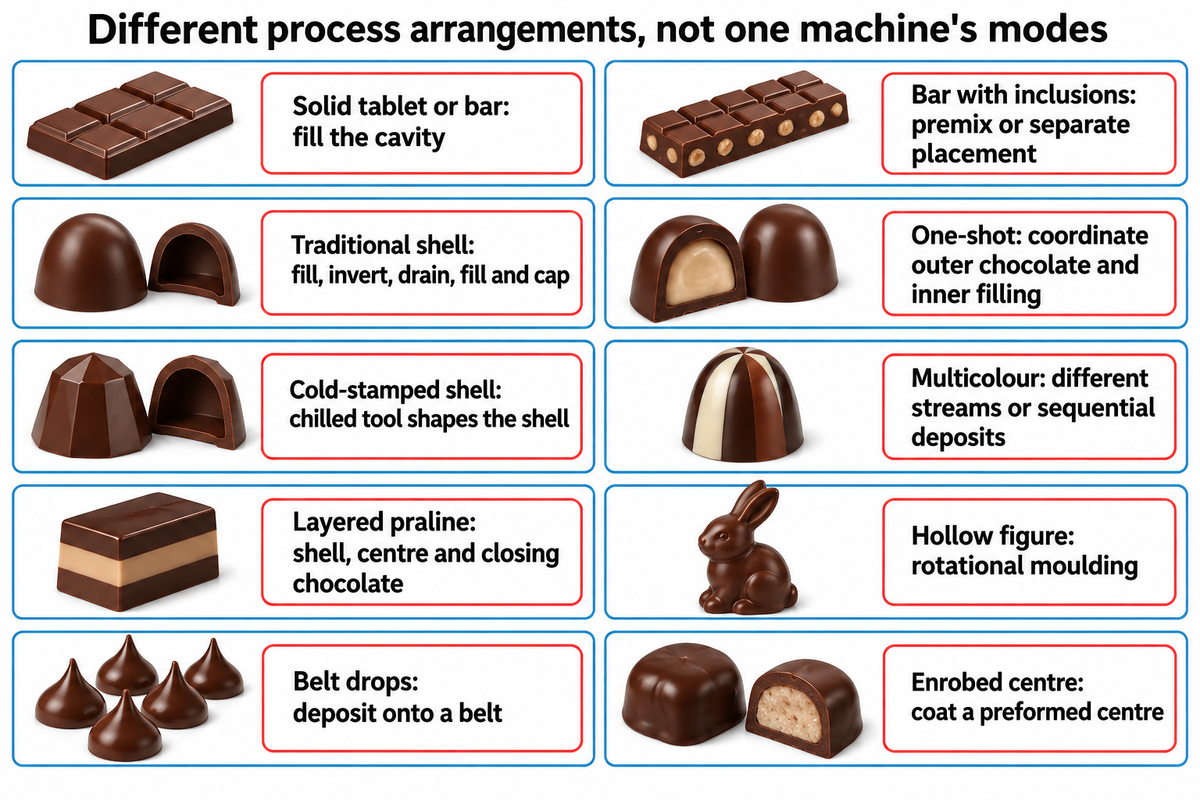
Solid moulding fills the product cavity directly. Traditional shell moulding, on the other hand, first leaves a chocolate wall within the mould, then adds the center and closes the base. In one-shot depositing, filling and shell chocolate are coordinated during one depositing operation. Chilled stamping of chocolate uses a chilled tool to form the shell before filling.
| Product or route | How the shape is created | The handoff that matters |
|---|---|---|
| Solid tablet or bar | Chocolate fills the cavity, is vibrated and sets in the mould. | The deposit reaches corners and details before setting. |
| Bar with inclusions | Chocolate carries suitable premixed inclusions, or a separate system places them. | The ingredient path and forming method suit the inclusion. A wafer insert also needs its own placement and cavity allowance. |
| Traditional shell moulding | Fill, invert and drain excess chocolate; set the shell, add filling and cap. | A formed shell exists before the centre enters. |
| One-shot filled chocolate | Outer chocolate and inner filling pass through coordinated concentric passages. | Stream timing encloses the centre; it is not simply two simultaneous on/off signals. |
| Cold-stamped shell | A chilled stamp shapes deposited chocolate against the mould cavity. | Stamp, mould and deposit together define the shell space. |
| Multicolour moulded piece | Different chocolate streams or sequential deposits create the colour layout. | The deposit sequence preserves the intended interface. |
| Layered filled praline | Shell, centre and closing chocolate are built in stages. | Each layer leaves the correct space for the next. |
| Rotational hollow figure | Chocolate is distributed inside an appropriate closed or paired mould. | The rotating-mould process differs from flat tablet production. |
| Belt-deposited drops or chips | Chocolate is deposited onto a belt rather than shaped inside a tablet cavity. | Belt release and product handling replace the tablet-mould circuit. |
| Enrobed centre | A preformed centre receives an outer chocolate coating. | The centre is made before coating; this is a different forming boundary. |
The background of US20110189370A1 specifically differentiates one-shot depositing from conventional shell moulding. Its own invention deposits onto a planar surface, so its experimental settings shouldn’t be transferred to a mould circuit. The background of EP2543258A1 explains the formation of chilled-stamp shells; WDS’s chocolate cold-stamping page describes the related industrial technology.
How does the required chocolate product change the forming sequence?
A solid chocolate bar needs a single filled cavity, while a staged praline requires a shell, space for filling, and a closed base. In one shot chocolate moulding, a one shot chocolate depositor combines the shell and center delivery, while a cold-stamping unit adds a shell-forming tool. Match the required section through the finished piece to that sequence prior to treating two automatic chocolate moulding systems as equivalents.
Tempering, Mould Condition and Cooling
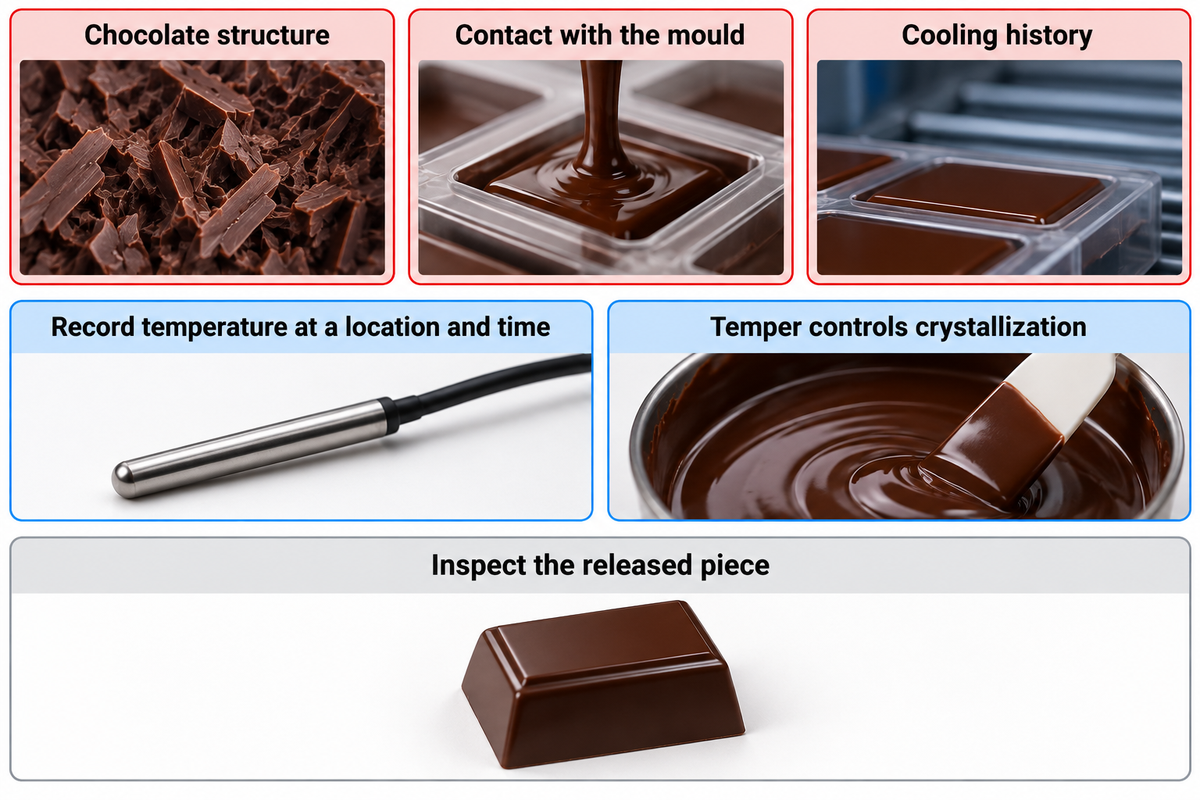
Clean release depends on the chocolate’s structure, its contact with the mould and its cooling history. Tempering aids in controlling crystallization; a temperature reading records condition at a particular location and time. The surface and geometry of the mold further impact release. The same displayed temperature can be associated with different forming outcomes after a recipe change, a hold or renewed agitation.
“The temperatures described are reference values for a dark chocolate without the addition of milkfat or other fats components.”
This qualification in the tempering publication by Purdue University is important, especially when making chocolate involves different fat systems. Their reference curve isn’t a standard recipe for dark, milk and white chocolate and compounds. Terms like “pure chocolate” aren’t a substitute for an actual ingredient description.
Keijbets, Chen, and Vieira’s Demoulding study revealed that separation from a flat polycarbonate surface was influenced by processing conditions. In their 2025 Perspective on tempering, Stobbs and colleagues note that Form V alone doesn’t always indicate the presence of stable chocolate quality.
What changes between depositing and demoulding?
The deposited mass hardens and contracts as it cools; the mould then has to release an intact piece. Total processing time around the mould circuit includes conditioning, forming, transfer and return, and thus exceeds the product’s time within the cooling tunnel. Detailed temperature profiles are part of the chocolate cooling system and the product being run.
Trace Moulding Defects Back to the Forming Stage
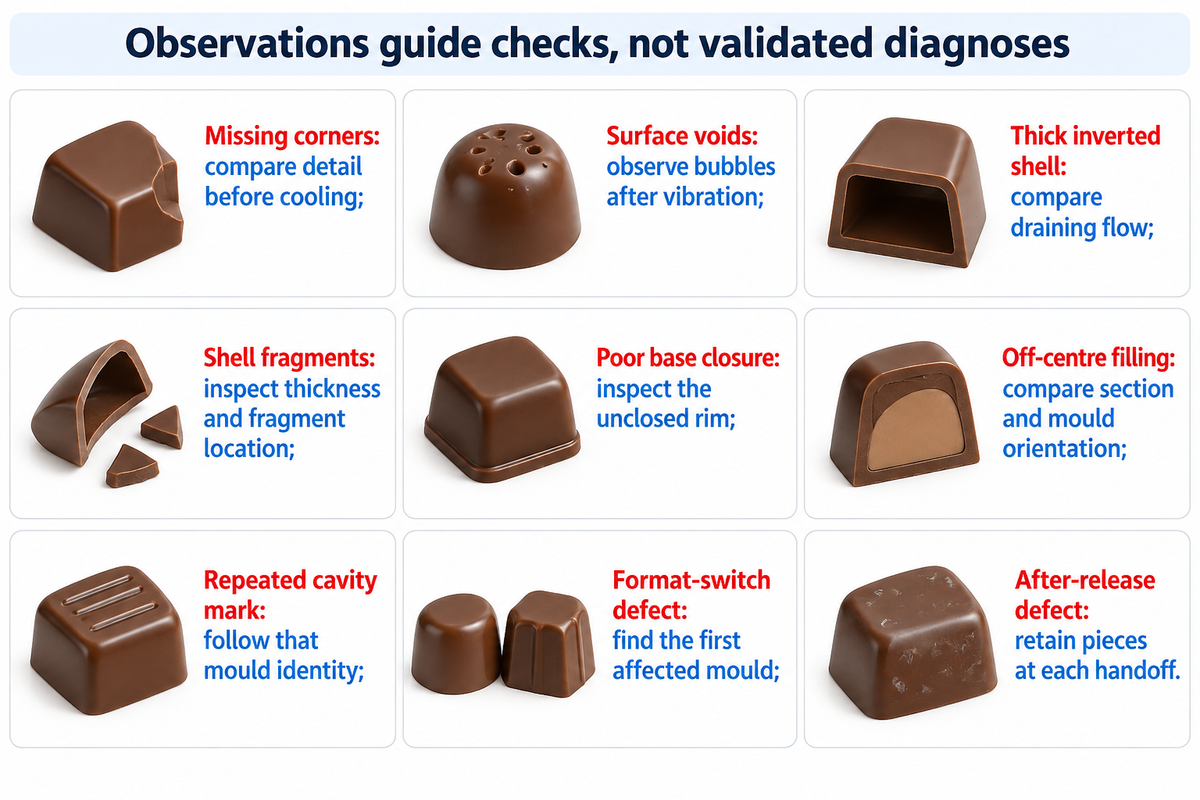
A defect occurring in the mould is easier to identify and investigate when its location and first appearance are recorded. However, the location and time of first occurrence are critical. For example, a missing corner in the same cavity may indicate a different check from the many bubbles observed in other newly filled moulds. Before randomly changing many controls, study the behavior of the material and the sequence of forming. The pattern of the observation should be used to determine the next observation, as treating it as a cause may be misleading.
| Observed defect | Possible forming explanation | Useful distinguishing observation |
|---|---|---|
| Missing corners or fine detail | Fluidity or crystal state prevents the mass reaching the cavity detail. | Compare the same feature across moulds and inspect the deposit before cooling. |
| Rounded surface voids | Air remains after filling and settling. | Observe whether bubbles are already visible after vibration. |
| Thick shell after inversion | The mass drains differently or has thickened. | Compare freshly formed shells and the material’s flow during draining. |
| Thin shell fragments left behind | A fragile shell breaks during release. | Look at wall thickness and where fragments remain. |
| Base will not close cleanly | The filling leaves too little space for closing chocolate. | Inspect the unclosed shell and the rim before the capping station. |
| Centre displaced to one side | The cavity position or coordinated stream delivery needs investigation. | Compare cut sections with mould orientation and depositing alignment. |
| Mark repeated in one cavity | The cavity surface or local detail differs. | Follow that mould identity through another observation. |
| Defect starts at a format switch | A tooling, material or sequence setting changed. | Locate the first affected mould and compare it with the last previous-format mould. |
| Defect appears only after release | The release or subsequent handling may contribute. | Inspect a retained piece at each handoff before packing. |
Callebaut’s moulded-chocolate troubleshooting guide links holes to several possible causes, for example, fluidity, over-crystallization, angular detail and trapped air. It also connects excessive filling to poor closure. The mould-identity and handoff comparisons earlier give additional observations for a line investigation; they aren’t validated defect diagnoses.
What can the location of a moulding defect tell you?
Repeated cavity-local marks direct attention to an interaction between the cavity in question and the deposit. A change across numerous moulds points to an event impacting the material or process in the same way. Both patterns require confirmation: a worn mould and a changed chocolate mass can happen concurrently. Retain the identity of the mould, the product section, and the point of first appearance and make one authorized change.
Read Mould Movement and Accepted Output Together
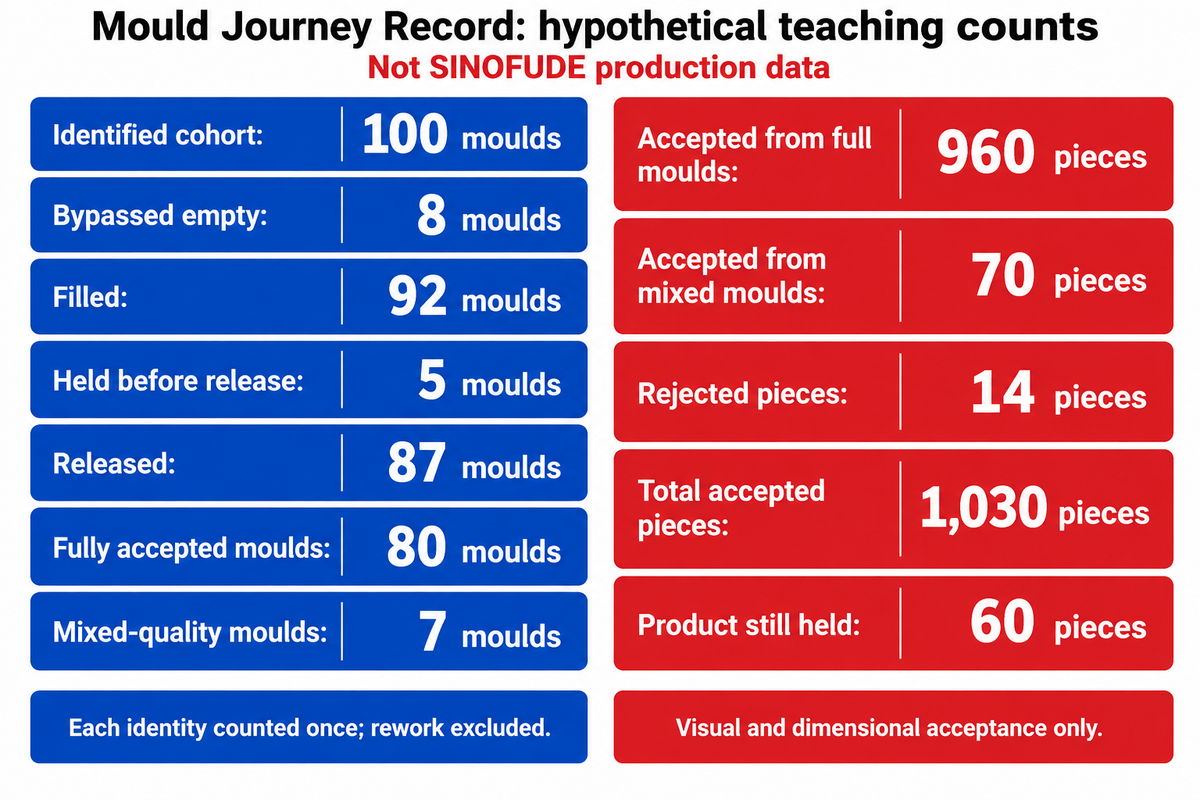
Count accepted pieces separately from moving moulds. A carrier can bypass filling, be held before release or contain a mixture of accepted and rejected cavities. The Mould Journey Record (MJR) captures a closed group of mould identities as they transit through those states. It provides a production and quality team a shared understanding of the status of the product without treating the conveyor count as finished output.
Hypothetical worked example: Follow 100 identified moulds once through the process. Each filled mould has 12 occupied cavities. Eight moulds bypass filling. Five filled moulds remain held. Of the 87 released moulds, 80 have all pieces accepted against the example’s visual and dimensional standards. Each of the other seven has 10 accepted pieces and two rejected pieces. Rework isn’t counted.
| Record item | Count in this invented example | Meaning |
|---|---|---|
| Identified cohort | 100 moulds | Each identity is counted once. |
| Bypassed empty | 8 moulds | No product was deposited. |
| Filled | 92 moulds | 100 − 8. |
| Held before release | 5 moulds | Product remains inside the process. |
| Released | 87 moulds | 92 − 5. |
| Fully accepted moulds | 80 moulds | 12 accepted pieces in each. |
| Mixed-quality moulds | 7 moulds | 10 accepted and 2 rejected pieces in each. |
| Accepted from full moulds | 960 pieces | 80 × 12. |
| Accepted from mixed moulds | 70 pieces | 7 × 10. |
| Rejected pieces | 14 pieces | 7 × 2. |
| Total accepted pieces | 1,030 pieces | 960 + 70. |
| Product still held | 60 pieces | 5 × 12. |
Reconciliation of filled product shows 1,104 pieces, of which 1,030 were accepted, 14 rejected and 60 held. Empty mould positions are ignored for deposited product. Partial rejection matters: discarding all seven mixed moulds from the accepted count would hide 70 acceptable pieces, while accepting their entire contents would hide 14 rejects.
This distinction is consistent with the separation of production measures described in NIST’s original indicator study and the starting-versus-ending throughput discussion in Spearman’s yield-loss analysis. The example is a closed-cohort count, not a steady-state capacity model. Formal product release, net mass, packing losses and rework require their own records.
Keep Whole-Line Changeovers Under Control
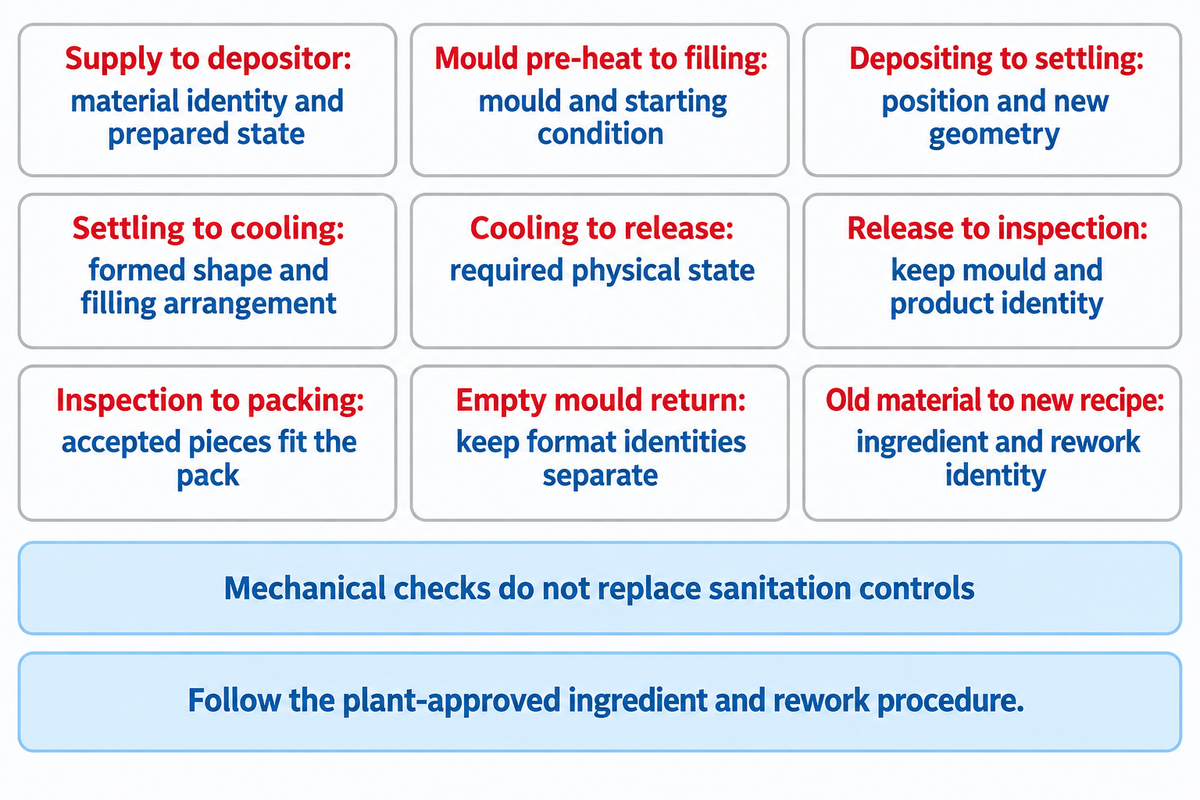
A whole-line changeover follows the first new-format mould through every affected station. Alignment, deposition, vibration, release and packing can be affected by a cavity-layout change. A recipe change also affects the identity of the material. The last previous-format mould and the first new-format mould should be documented so the team can distinguish a transition effect from an ongoing forming problem.
| The handoff to check | What should follow the new product |
|---|---|
| Chocolate supply → depositor | Correct material identity and the required prepared state. |
| Mould pre-heat → filling | Correct mould, cavity pattern and starting condition. |
| Depositing → settling | Deposit position and settling sequence suit the new geometry. |
| Settling → cooling | Product enters with the intended formed shape and filling arrangement. |
| Cooling → release | The product reaches release in the required physical state. |
| Release → inspection | Mould and product identity stay connected to the observed result. |
| Inspection → packing machine | Accepted pieces fit the downstream handling and pack format. |
| Empty mould → return circuit | The correct mould returns without mixing format identities. |
| Old material → new recipe | Ingredient and rework identity follow the plant’s approved changeover procedure. |
For modular machinery, a mechanical connection and a stored recipe in the PLC are just part of the changes. Semi-automatic chocolate operations have manual transfers to account for; fully automatic systems still require people to supervise transitions and investigate exceptions. A compressor, electrical components and conveyors may serve several modules, so a shared interruption may occur at several stations.
Keep mechanical format checks separate from sanitation and material release checks. Canadian Food Inspection Agency chocolate guidance has an example of incorrectly adding rework as a material control issue. A visually clean mould, a successful color change or good shape doesn’t replace plant ingredient and sanitation controls.
Equipment Scope, Price and Makers
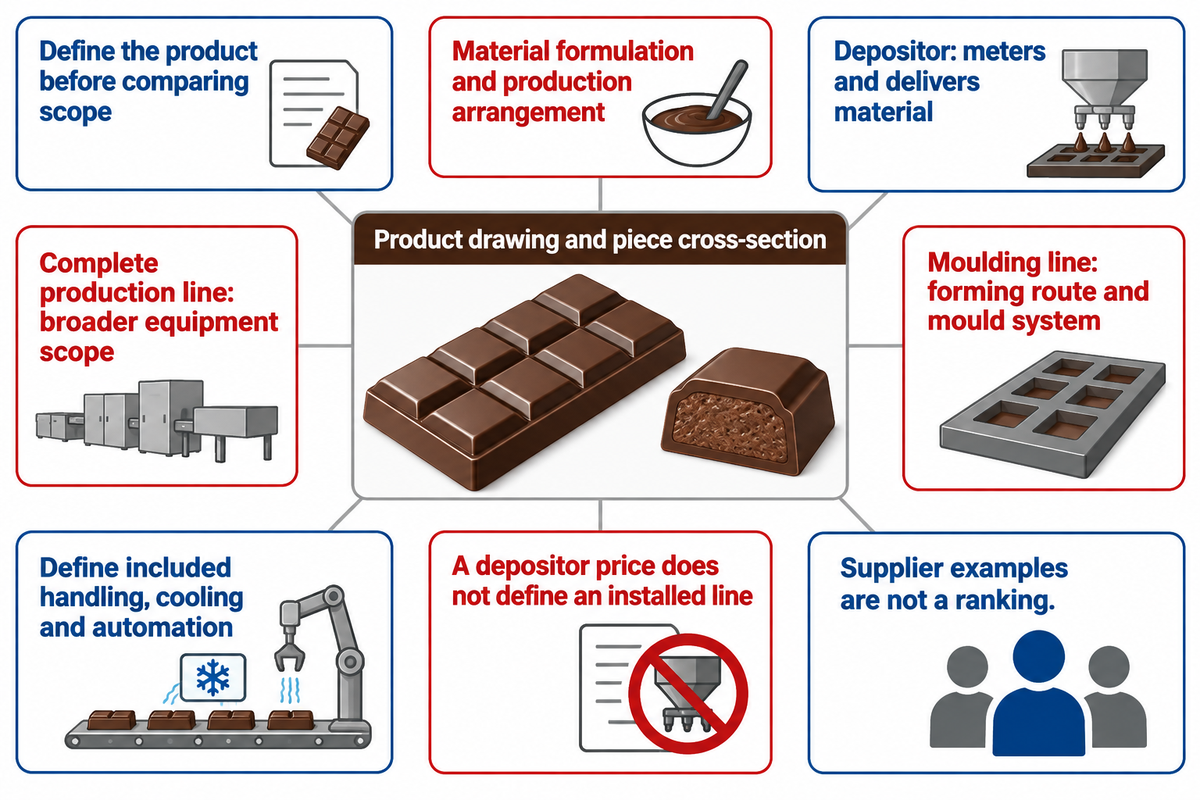
Line prices vary based on forming route and the mould system. They also depend on material handling, cooling and automation included. A semi-automatic loader and an automatic moulding line describe different equipment scopes. A complete chocolate production line describes a broader equipment scope. A low price for a depositing machine isn’t a valid reference for an installed line with tempering, mould return and packing.
Which manufacturers make chocolate moulding lines?
Bühler publishes modular and continuous moulding systems for different chocolate product families; WDS describes chocolate cold stamping and Selmi describes automatic filling and vibration arrangements. SINOFUDE describes moulding lines. These examples describe equipment scope and not supplier ranking or a claim that the machines are interchangeable.
When assessing solutions for chocolate production, start with a product drawing, piece cross-section, material formulation and required production arrangement. The SINOFUDE configuration page describes the company’s current models and provides a starting point for a quotation. Broader scope upstream machinery is included in chocolate production equipment.
Frequently Asked Questions
How long does chocolate take to set in a mould?
View Answer
Cooling time follows the recipe, product geometry, crystal state and cooling conditions. A thin shell and a thick solid piece don’t follow the same setting path. Use the established process for the actual chocolate and mould, then assess release and product condition at the relevant handoff. Household refrigerator timings shouldn’t be transferred to an industrial line.
Can one line run solid bars and filled pralines?
View Answer
A line can make both when its depositing, mould handling and associated stations support the required sequences. Solid pieces need direct cavity filling; staged pralines need shell forming, filling and closure, while one-shot equipment coordinates chocolate and centre delivery. The mould, material paths, cooling and release arrangement must suit each product. An automation label doesn’t define that capability.
Why are moulded pieces dull the next morning?
View Answer
Dullness can involve crystal development, mould condition, release or later storage conditions. First distinguish a mark already present at demoulding from a change that appears overnight. Preserve examples from both stages and compare their handling history. Callebaut’s possible causes of dull spots on moulded pralines include unmoulding too quickly, over-crystallised chocolate and cooling at too low a temperature.
Do chocolate moulds need to be greased?
View Answer
No, not in conventional polycarbonate chocolate moulding: release relies on the prepared chocolate and suitable mould condition. Follow the mould and chocolate process instructions; adding grease isn’t a general remedy for poor temper or sticking.
Is a moulding line the same as a chocolate production line?
View Answer
Moulding is the forming part of production. The phrase chocolate production line may also include ingredient handling, refining, conching, storage, tempering, finishing and packing, depending on the plant’s starting material. The production of chocolate from cocoa beans adds further upstream operations and processing machinery. A moulding machine equipped with automatic filling therefore covers a different boundary from an entire chocolate-making installation. An artisanal or semi-automatic setup may transfer moulds between separate machines, while automated systems connect more duties. Define the actual inlet material and required finished product before comparing scope.
Does fully automatic mean no operators?
View Answer
No. Automated chocolate moulding coordinates machine duties, while people still manage materials, changeovers, inspection, maintenance and exceptions. Staffing depends on the actual installed process.
How long will moulded chocolate last?
View Answer
Shelf life depends on the complete formulation, filling, packaging and storage conditions. For solid pieces, Iowa State University Extension gives dark chocolate a best-quality shelf life of at least 2 years and milk chocolate 1 year. Use product-specific shelf-life work rather than a general number attached to the moulding method.
Start with the product section and follow one identified mould through forming and release. If you’re planning equipment, use that route description to discuss the required modules with SINOFUDE. The current solution page brings together the chocolate moulding line configuration options for that next conversation.
Our Focus on the Moulding Circuit
SINOFUDE supplies confectionery, chocolate and bakery machinery. This guide focuses on how chocolate forming routes, mould handling and release fit together. The Mould Journey Record is an editorial teaching example built from public process descriptions; its counts don’t describe a customer installation or a measured SINOFUDE production result.
References & Sources
- Cocoa Processing: Tempering Chire-Fajardo and colleagues, Purdue Extension and Universidad Nacional Agraria La Molina.
- Chocolate demoulding and effects of processing conditions Keijbets, Chen and Vieira, Journal of Food Engineering, 2010.
- Chocolate Tempering: A Perspective Stobbs and colleagues, Crystal Growth & Design, 2025.
- A Hierarchical Structure of Key Performance Indicators for Operation Improvement in Production Systems Kang and colleagues, 2016.
- Little’s Law in Production Systems with Yield Loss Mark L. Spearman, 2019.
- Chocolate preventive controls Canadian Food Inspection Agency; cited for material and rework identity.
- First-party process descriptions: Selmi Moulding Line 275, WDS Cold stamping technology and Bühler moulded products.
- Praline Problems? Common Moulded Chocolate Issues & Fixes Callebaut Chocolate Academy.
- Technical background: Process for the preparation of centre-filled chocolate products and Method for manufacturing a confectionery shell. Patent descriptions are used for process distinctions, not ownership or legal advice.