Get in Touch with SINOFUDE Company

Updated October 2026
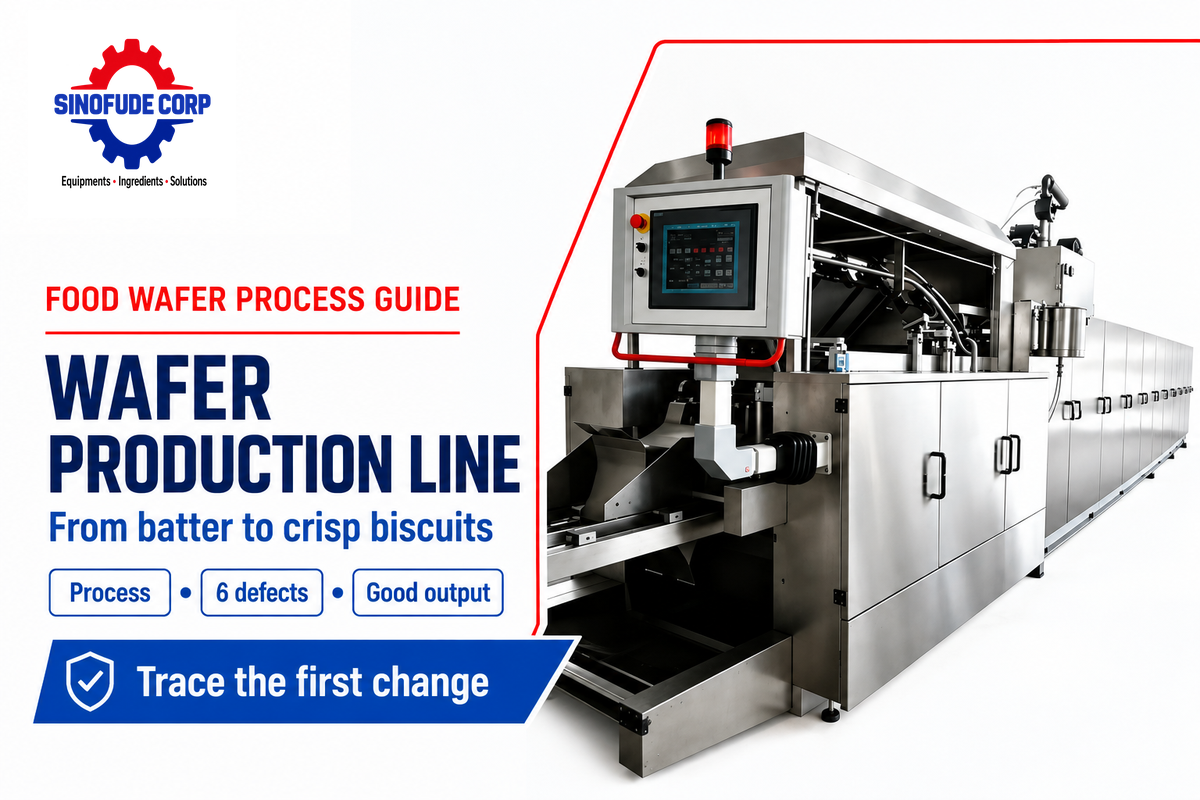
A Wafer Production Line changes batter to thin baked sheets, performs cooling, cream spreading, stacking, cutting and packing to produce flat wafer biscuits. Constant output is dependent on the state of the product during transfer. To investigate a defect, first identify where it appears, then compare the material before and after that stage.
A flat wafer production line is part of a food production system and thus extends beyond the oven. The production process must preserve the product through assembly and packing. This guide separates flat layered biscuits from rolled wafer sticks, cones and other hollow shapes which differ in their forming and processing equipment.
Start with the state of the product: An uneven baked sheet, a slipping filled book and a biscuit that softens in storage are all different problems. Relevant factors may be the speed of the oven, cooling temperature or the film used in packaging. However, none of these identifies the problem on its own.
How a Wafer Production Line Works
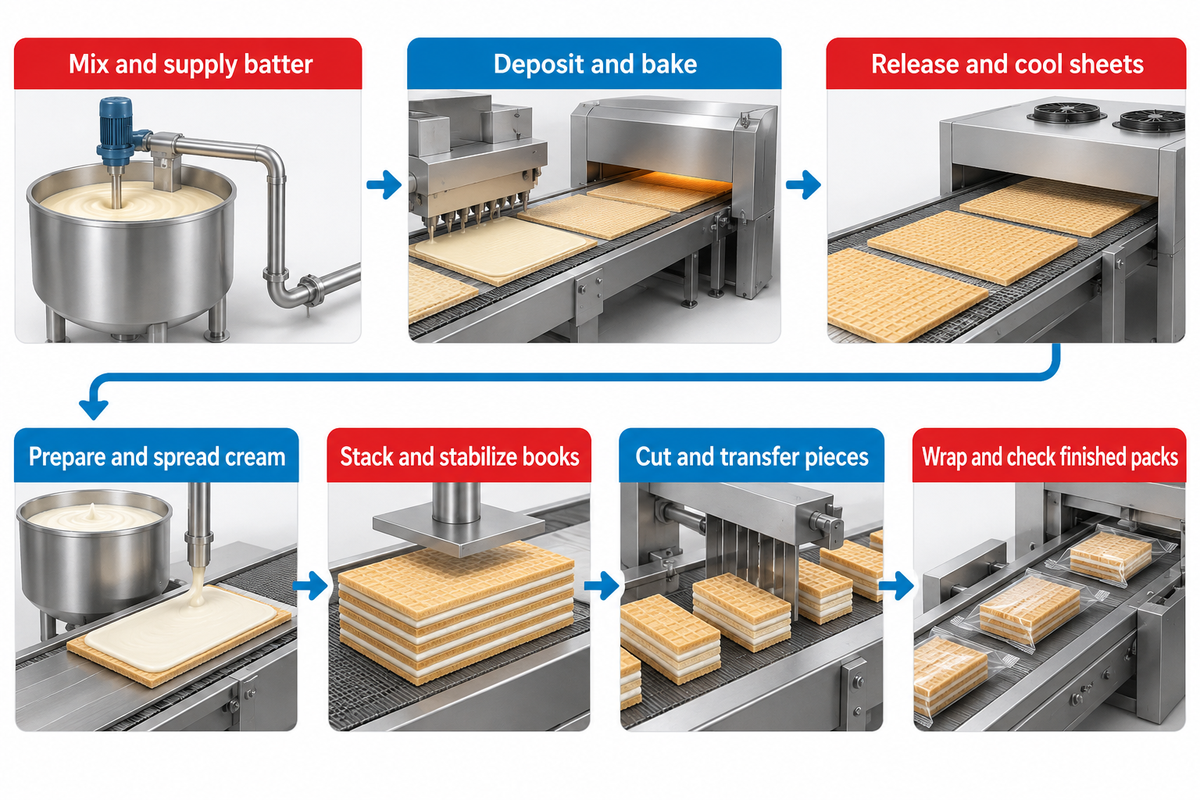
A flat wafer biscuit production line bakes and assembles separate sheets to produce the finished layered product. Batter preparation supplies a steady feed; the baking process forms a sheet; the cooling process conditions the sheet for handling; and the book (wafer) is built by the application of cream and stacking. The book then reaches a suitable condition for cutting before the pieces enter packaging equipment.
Bühler describes its Franz Haas SWAKT wafer baking oven as employing a plate-baking mechanism. Batter enters an open plate pair, the plates close, water vaporizes during the baking circuit, and the finished sheet transfers onward. [1]
- Mix and supply batter. Weigh raw material, follow the recipe sequence and deliver a consistent suspension.
- Deposit and bake. Form a sheet between baking plates by the process of heating and evaporating moisture.
- Release and cool sheets. Maintain their shape for the first transfers.
- Prepare and spread cream. Match the cream condition and distribution to the sheet.
- Stack and stabilize books. Build the required layers and establish a suitable state for cutting.
- Cut and transfer pieces. Control edges and orientation, and reject out of spec product.
- Wrap and check finished packs. Maintain texture and integrity for the finished packs.
Wafer types change this route. A wafer stick is formed while the baked material remains workable, often around a mandrel. A hollow wafer or hollow ball requires its own shape. Other products in the broader biscuit production line category also employ different routes of forming. Compare these routes by their forming equipment, not by whether a supplier calls every production machine a wafer machine.
The level of automation identifies what equipment does versus what operators do. So, an automatic wafer system should be explained based on what it actually does. Automation is concerned with sequence, but the full line is concerned with changing materials. A conveyor is able to transfer a weak sheet and break it. PLC controls can retain a temperature control setting while flour or filling behaves differently. Materials that leave one stage become the input to the next.
Batter Mixing and Baking: Build a Consistent Wafer Sheet
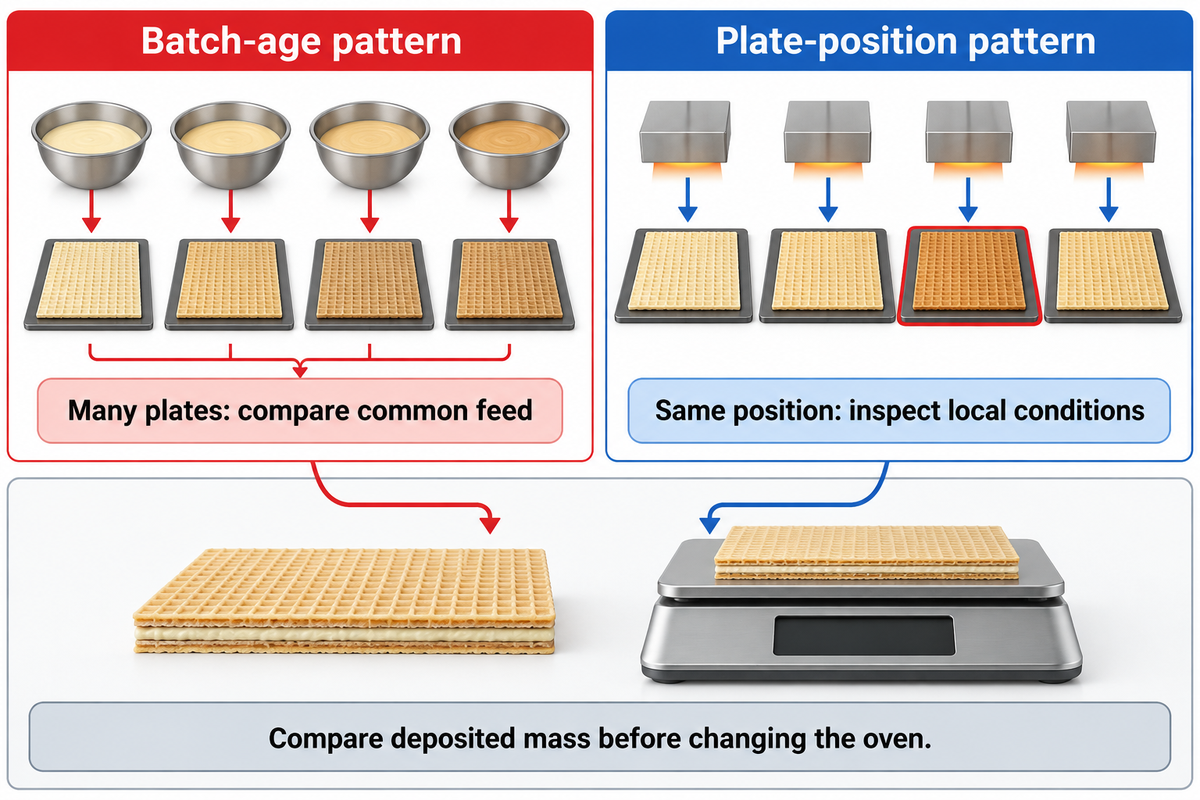
Repeatable wafer sheets involve consistent batter and heat transfer. Capture the identity of ingredients, the sequence of mixing, mixing time, temperature of batter, holding time, and how batter flow is assessed. Compare these records with the deposit mass, thickness and color of the sheets. A recipe change and a plate-specific problem can look similar at the cutter while needing different investigations.
Why can a familiar batter behave differently?
Changes to formulation and shear conditions affect batter flow. Record the conditions of the measurements along with each viscosity result. In a study by Tufan and colleagues, partial replacement of wheat flour with legume flours altered batter flow and baked sheets. Their formulations showed shear-thinning behaviour: measured responses depended on the shear conditions applied. The study supports recording the conditions of the measurements and formulation along with flow, rather than considering a single flow reading as a prediction of sheet texture.[2]
For comparison purposes, use the same sampling point and method on each occasion. A reading from freshly mixed batter cannot be compared confidently with one taken after a long hold if temperature and sample handling also differ. Pair a “lump-free” check with a flow reading taken at a recorded point in the batch.
Illustrative plant situation: sheets become heavier and less uniform late in a batch. Retain the early and late batter records and compare the deposited mass before changing the oven. If the change follows batch age across many plates, investigate that common feed. If it stays at one plate position across fresh batches, widen the inspection to the local plate and transfer conditions.
The material of the baking plates is part of this view. An industrial study, released in 2025, noted differences in two materials of cast-iron baking plates when used at two production rates. This study showed differences in heat distribution, sheet thickness and color uniformity. Record plate material and position with sheet thickness and colour before deciding whether baking plates need replacing. [3]
In industrial wafer production, record the complete set of ingredients and their revision, including leavening agents when the recipe uses them. The specific characteristics of a replacement flour can alter the interpretation of an otherwise familiar batter measurement. Keep the reference sheet identified by plate position and time. Color alone can’t distinguish all formulations, deposits, heating and release problems. Pair appearance with dimensions, mass and approved product tests.
Sheet Cooling, Conditioning and Cream Setting Compared
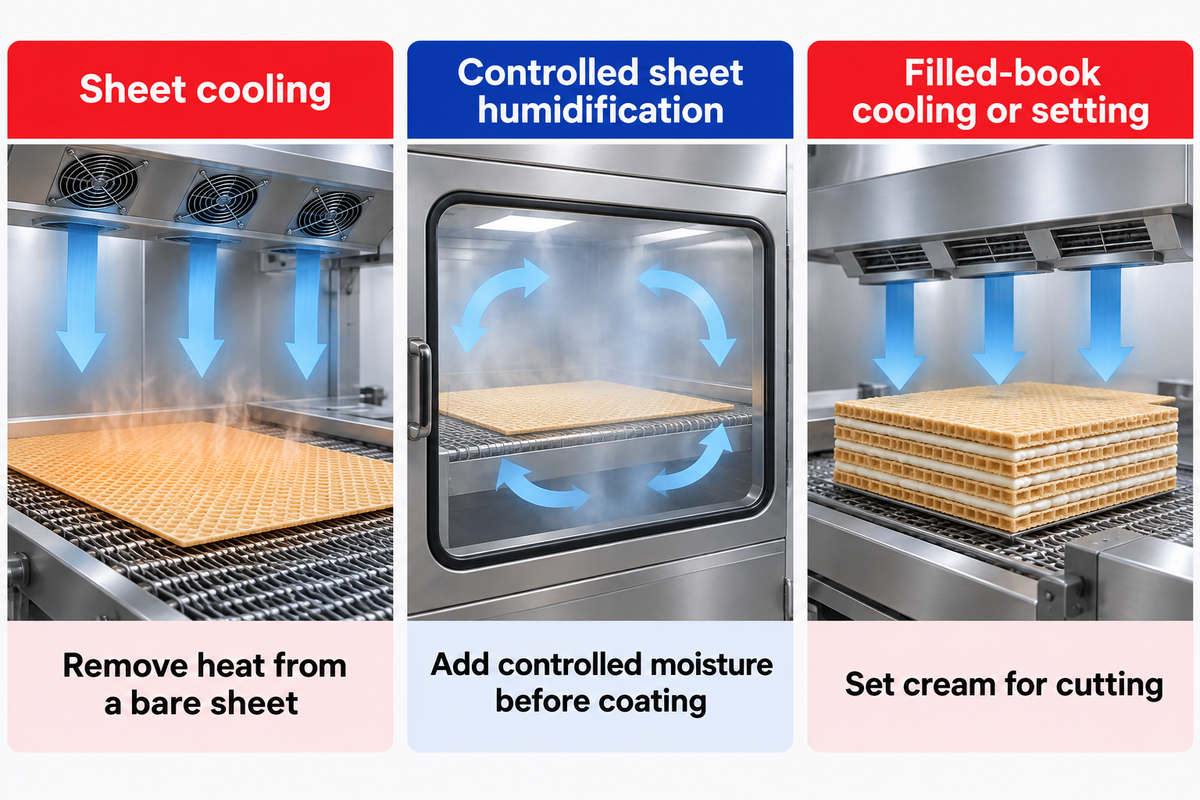
Sheet cooling and conditioning and filled-book cooling have different functions. Cooling is the removal of heat from a bare sheet. Some chocolate-coated routes deliberately add controlled moisture to sheets before coating. A filled wafer book may then need a cooling tunnel to set the cream sufficiently for the next operation. Identify the incoming product and describe the change it will undergo before equipment comparison.
| Treatment | Material entering | Purpose to verify |
|---|---|---|
| Sheet cooling | Freshly baked, unfilled sheets | Suitable temperature and handling condition |
| Controlled sheet humidification | Sheets for a specified chocolate route | A defined moisture condition before coating |
| Filled-book cooling or setting | Stacked sheets and cream layers | Stable filling and book condition for cutting |
Bühler’s Franz Haas KTU is a good example of this. Their product sheet states that moisture is added to sheets prior to being molded with chocolate or enrobing to avoid cracking in the coating. A general instruction to keep drying every wafer would miss this product requirement.[4]
Historical wafer research also links moisture uptake and expansion with coating cracking. For example, US4545997A discloses a unique wafer, cream and coating sequence and is a historical disclosure, not a general production recipe or SINOFUDE technology.[11]
If a proposal only gives a “cooling conveyor” or “conditioning machine,” ask what enters and what the outgoing material must be prepared to do. This is particularly important when an existing cooling section is retained during an upgrade. The right module name with the wrong thermal or moisture duty can leave a process mismatch.
Keep Layers Stable Through Cream Spreading and Cutting
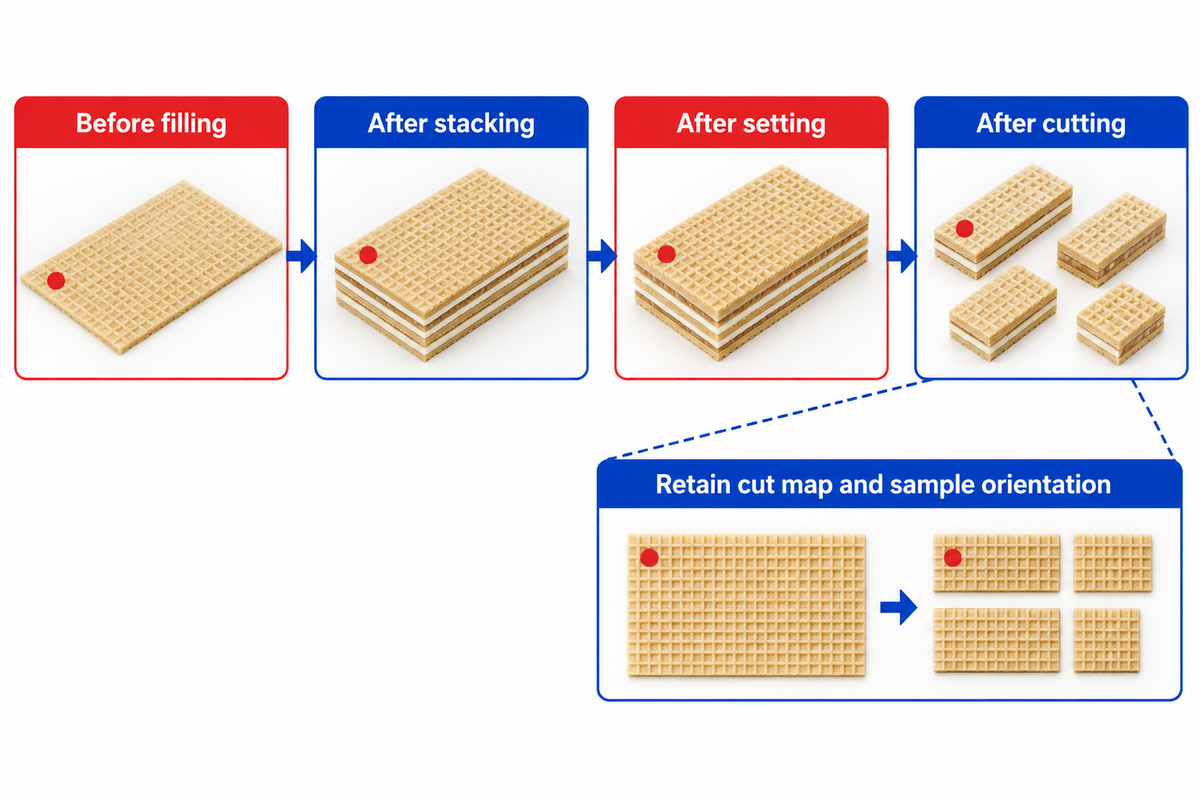
Cream spreading and cutting are closely related material processes. The filling must distribute at the required mass, and remain compatible with sheet handling and stacking. The resulting book must be in condition for cutting. Compare samples before filling, after stacking, after the setting stage and after cutting to detect first occurrence of misalignment or damage.
Filling composition can affect how a filling behaves, even if the settings of the machine are kept unchanged. A 2026 study by Miedzianka and others showed that different plant protein preparations changed the viscosity and other properties of fat-rich cream fillings. [5]
The same study on cream illustrates why a test condition belongs with a viscosity value. The following reported means were measured at 40°C. Changing shear rate changes the control result; changing formulation changes the comparison at the same shear rate. These are laboratory observations, not spreading-temperature recommendations.
| Study sample | Shear rate | Apparent viscosity |
|---|---|---|
| Control at 40°C | 60 s−1 | 0.80 Pa·s |
| Control at 40°C | 2 s−1 | 2.45 Pa·s |
| Brown-rice preparation: 5% palm-fat replacement at 40°C | 60 s−1 | 1.95 Pa·s |
Illustrative Recipe Change: While the existing spreader and cutter settings remain the same, a new cream is introduced. The layer begins to slip after stacking. Comparing only the final cut edge won’t reveal previous movement. Check the spread mass, sheet alignment, and the condition of the cream being used. Follow the same book through the cooling process. A new filling may require a new process trial, even if the package dimensions remain the same.
What should a cutting trial separate?
- Damage already present: cracks or bent sheets entering the cutter.
- Book instability: Layers that slip and/or uneven construction before the cut.
- Cutting interaction: Defects localized at a particular edge, direction, or position of the cutting tool.
- Later handling loss: Damage to an otherwise acceptable cut piece during the spacing process or while it was being fed into the wrapper.
Retain the cut map and the orientation of the pieces used for cut mapping. A clean outside surface is useful evidence, but it cannot by itself demonstrate an undamaged internal structure. Likewise, reducing speed may change the result without identifying the original mechanism. Evaluate each trial against retained samples and observations of the product, rather than how a demonstration piece appears to be.
Why Wafer Biscuits Lose Crispness
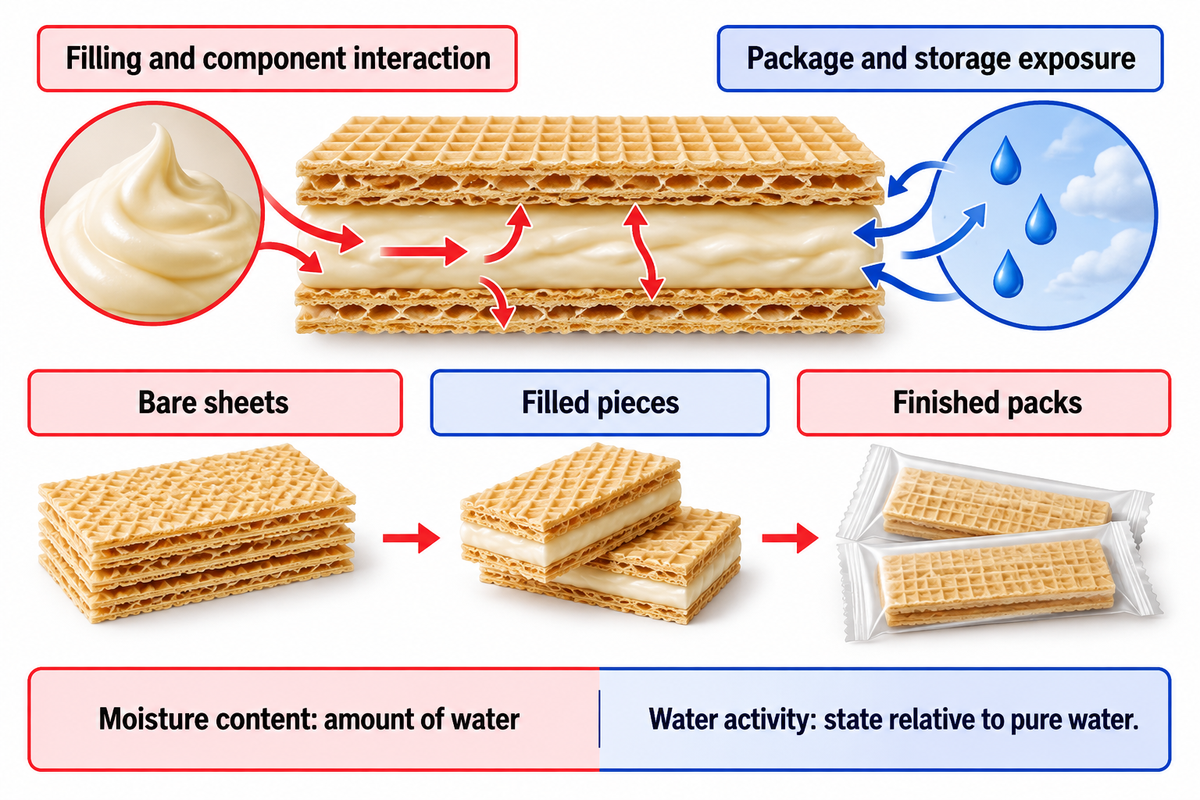
Crispness may be lost on Wafer biscuits due to a change in environmental or product moisture levels. The moisture may be from another product or component. Test the assembled product and its package as well as the bare sheet: a wafer that is crisp at the oven exit can still soften once the biscuit is filled and wrapped, when moisture moves in from another component or the environment.
Martínez-Navarrete and team studied water sorption and plasticization in commercial wafers. For their tested product at 20°C, the reported critical water activity for glass transition was 0.591. They also described a fragile regime at lower moisture and rubbery behaviour above the reported crisp range. [6]
Water activity and moisture content address different questions. Moisture content describes the amount of water; water activity describes its thermodynamic state relative to pure water under the measurement conditions. The relationship between moisture content and water activity depends on the material and temperature. An accepted moisture limit for one recipe shouldn’t be silently adopted as the release limit for another.
ISO 18787:2017 describes water-activity determination methods, but its scope has exclusions, including water-in-fat emulsions. Confirm that the chosen laboratory method applies to the actual sample. The standard does not supply a wafer crispness limit, and texture evaluation does not replace the factory’s separate food-safety controls.[10]
Packaging is an active element of the investigation. Cevoli and colleagues compared two packaging types in a wafer-cookie storage study and found improved sensory crispness with an additional multi-material packaging layer under their conditions. [7]
Keep bare sheets, filled pieces, and finished packs from the same run. Store identified samples under defined conditions and compare their texture over the period of the intended evaluation. If filled pieces appear to have changed while the bare sheets stayed acceptable, evaluate the interactions of the components. If the change appears mainly in one package or storage condition, examine the corresponding barrier, seal and exposure differences. This narrows the focus of the investigation without assuming every soft wafer has the same root cause.
Investigate 6 Common Wafer Production Faults
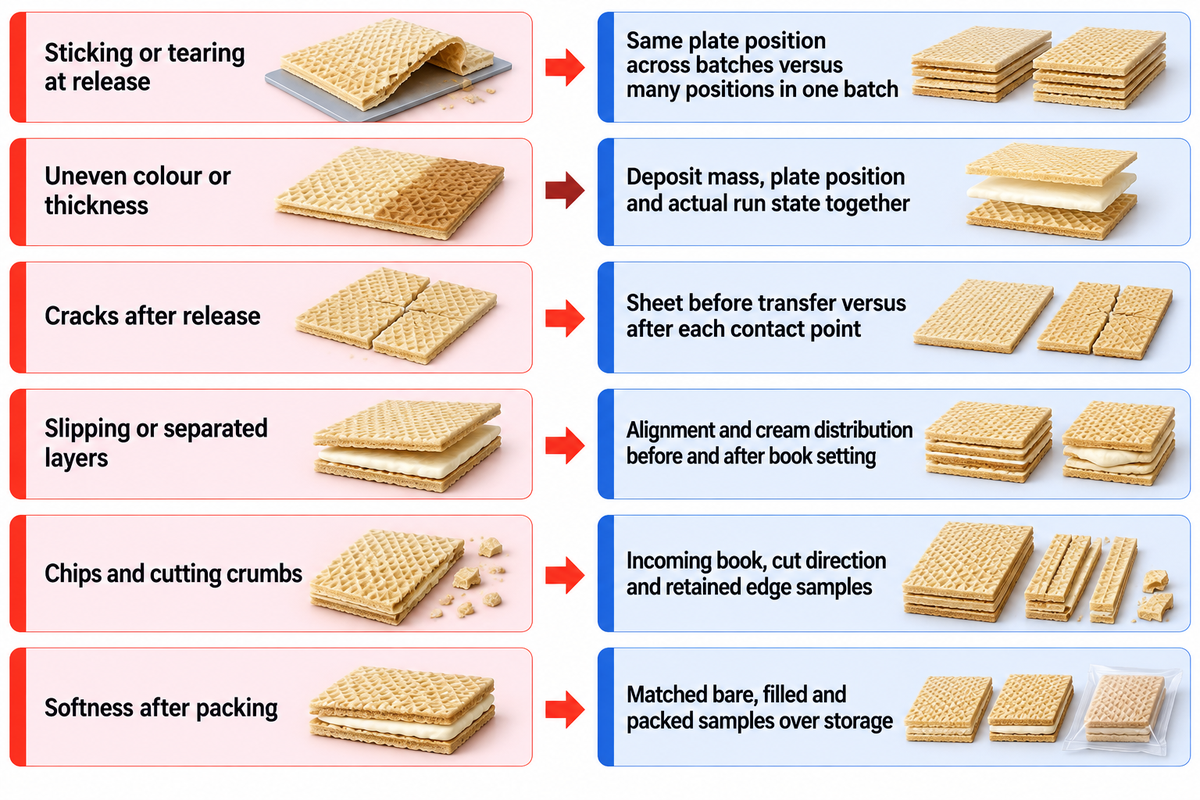
The Wafer Defect Onset Map is a tool to organize observations by the first point in time a defect becomes noticeable. Use the map to select a comparison, not to declare a root cause. Keep the product definition and sampling methodology steady, retain a good standard, and change one variable within the scope of an approved experimental plan. A change in a trial isn’t always evidence of a cause.
| Observed fault | First comparison | What it helps distinguish |
|---|---|---|
| Sticking or tearing at release | Same plate position across batches versus many positions in one batch | Local plate/release conditions versus a common material change |
| Uneven colour or thickness | Deposit mass, plate position and actual run state together | Feed variation versus spatial or operating-state variation |
| Cracks after release | Sheet before transfer versus after each contact point | Pre-existing weakness versus damage appearing during handling |
| Slipping or separated layers | Alignment and cream distribution before and after book setting | Assembly variation versus a change during stabilization |
| Chips and cutting crumbs | Incoming book, cut direction and retained edge samples | Incoming damage versus cutting or later transfer loss |
| Softness after packing | Matched bare, filled and packed samples over storage | Component interaction versus package/environment differences |
The first change isn’t always the most noticeable. The most noticeable change may not be the real root cause. In some cases, a different event further upstream may have caused a sheet to crack. Record the state of the material and the point of contact of the equipment before adjusting a setting.
Transitional effects can be masked by shorter videos. In a public discussion of wafer manufacture, a commenter questioned the apparent lack of conditioning but mentioned the entire process had to be evaluated in order to give an opinion. [12]
In a food factory, sampling also requires a repeatable procedure. Use the approved hygienic sampling method and suitable food-grade utensils so sample handling does not become an uncontrolled variable. At the end of each trial, retain the samples, record the actual conditions, results, and the next decision to be made. If a number of process variables changed simultaneously, indicate this as a limitation rather than attribute the improvement to the easiest variable to identify.
Find the Stage That Limits Good Output
Which records connect the loss to its first appearance?
Connect samples to be discussed later using a common identifier. This sampling record combines the material distinctions in the cited batter, filling, conditioning and storage sources with the onset map above. The distinctions provide a basis for comparison and an investigation plan. They don’t define limits for acceptance of the product.
| Evidence to retain | Compare with | Question answered |
|---|---|---|
| Ingredient and recipe revision | Last acceptable batch | Did the material change before the fault? |
| Batter sample and measurement conditions | Early and late samples from the same batch | Does the change follow holding time? |
| Deposit mass record | Sheet mass at identified plate positions | Does sheet variation follow feed variation? |
| Released-sheet photograph and dimensions | The same sheet after its next transfer | Was the visible damage present at release? |
| Sheet condition at treatment entry | Exit condition and stated cooling or humidification duty | Did the treatment produce its intended material change? |
| Cream identity, spread mass and application condition | Distribution across a retained filled sheet | Does uneven filling precede book movement? |
| Book alignment before setting | Alignment after setting and before cutting | At which handoff do layers begin to move? |
| Identified book before cutting | Its cut pieces and rejected fragments | Is the loss created or exposed at the cutter? |
| Bare-sheet and filled-piece retained samples | Matched packs under recorded storage conditions | Does texture change follow filling, packaging or exposure? |
| Processed and accepted finished-piece counts | Converted upstream counts over the same elapsed time | Is good output limited by rate, rejection or unavailable time? |
Compare good output across the entire line on the same finished-product and time basis. Different kinds of output (oven sheets, filled books, cut pieces and accepted packs) count different objects. Convert them before comparing rates, then separate a station’s rate limit from losses caused by rejects, stops or handling. A faster upstream machine can otherwise increase accumulation without increasing saleable product.
“A process is only as fast as the slowest unit operation.”
Kent D. Rausch and Donald B. Erickson, Kansas State University extension guide on used food-processing equipment.[8]
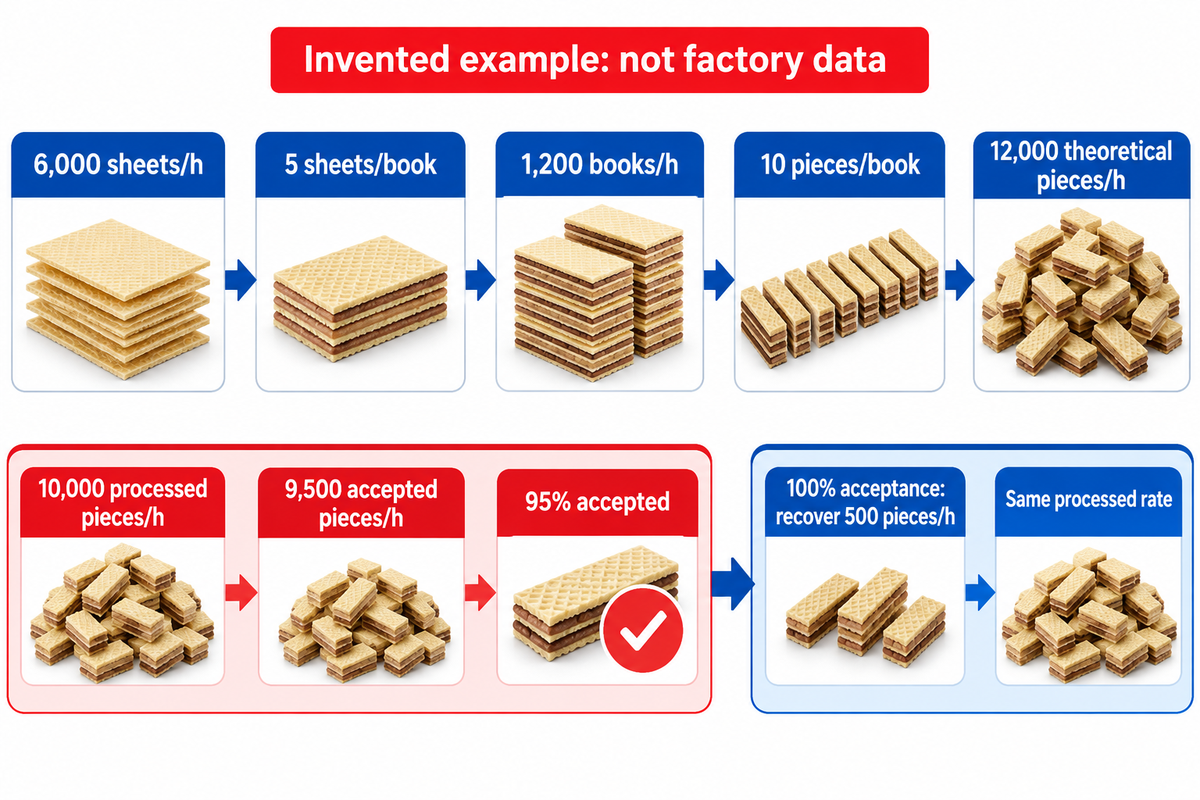
Invented worked example, not factory measurements: assume 6,000 sheets per hour, five sheets per book and ten finished pieces per book. Before trim and rejects, the sheet stream represents 6,000 ÷ 5 × 10 = 12,000 pieces per hour. For the same invented run, take 10,000 processed pieces per hour and 9,500 accepted pieces per hour at the wrapper. Acceptance is 9,500 ÷ 10,000 × 100 = 95%.
| Calculation type | Illustrative input or result | What it counts |
|---|---|---|
| Sheet stream input | 6,000 sheets/h | Individual baked sheets |
| Book construction input | 5 sheets/book | Sheets needed for one assembled book |
| Book-equivalent rate | 1,200 books/h | 6,000 divided by 5, before losses |
| Cut-pattern input | 10 pieces/book | The assumed finished-piece pattern |
| Piece-equivalent rate | 12,000 pieces/h | 1,200 multiplied by 10, before losses |
| Wrapper rate input | 10,000 pieces/h | Pieces processed at the limiting station |
| Calculated acceptance | 95% accepted | 9,500 accepted divided by 10,000 processed, as a percentage |
| Accepted-piece rate | 9,500 pieces/h | 10,000 multiplied by 0.95 |
| Finished-piece mass input | 20 g/piece | An additional invented input, including filling |
| Accepted mass rate | 190 kg/h | 9,500 multiplied by 20, divided by 1,000 |
Improving the example’s wrapper acceptance from 95% to 100% would recover 500 pieces/hour at the same processed rate. A larger oven alone would not remove the assumed 10,000-piece wrapper limit. Real daily output also needs the actual time available, changeovers and stops; do not subtract downtime twice if it is already included in an observed elapsed-time rate.
Use the wafer output normalization calculator with your own observed counts and piece mass. This is critical to plant managers and finance. Labor costs, energy consumption and other operating costs are spread over accepted product, not an isolated machine’s headline speed. State the target output and capture uptime on a defined elapsed-time basis. The next investment should address the observed constraint or loss, with a measured baseline and a clear product boundary.
New Baking Technology: What to Verify in Process Trials
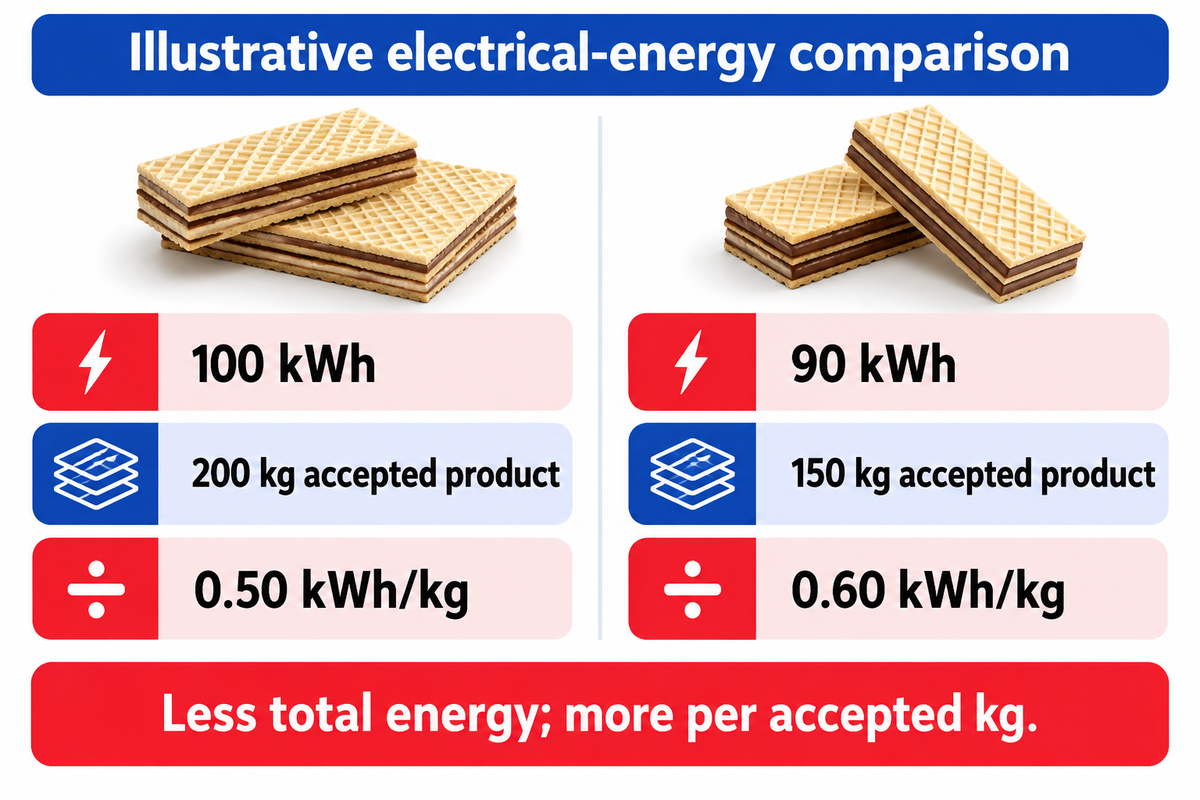
Evaluate newer baking technology by its effect on your accepted product and complete process. A 2026 industry report identifies Bühler’s inductive wafer baking oven among its interpack offerings. A matched trial must connect energy use, sheet quality and downstream acceptance.[9]
For a purely illustrative electrical-energy comparison, suppose one one-hour run uses 100 kWh and yields 200 kg of accepted product: 0.50 kWh/kg. A second uses 90 kWh but yields only 150 kg: 0.60 kWh/kg. So, even though the second process run used less total energy, it used more energy per kilogram of accepted product in comparison to the first process run.
Ask what the energy consumption includes: baking, cooling, compressed air, other auxiliaries, warm-up and changeover. Separate fuel and electricity, unless a documented conversion and comparison method is agreed upon. Compare equivalent product, bake endpoint, load and operating state before claiming cost savings or overall efficiency.
Repeat the relevant product trial when market demands prompt a different filling or pack. Automated machines can reproduce a motion sequence, and the other material behaves differently. A fully automated process still needs identified samples, actual-condition records and a clear response to rejected product. In food manufacturing, production equipment and automated production should be evaluated at their handoffs as well as when studied independently. Does a change in sheet condition affect the spread of the cream, cutting losses, and/or the packaging infeed? A highly automated oven doesn’t make the rest of the process automatically compatible. Electrical and mechanical interfaces, controls, cleaning access and technical support remain production requirements even when the immediate goal is a better wafer sheet.
For food packaging, compare the filled product and sealed pack against the stated storage conditions. A wafer line that can produce wafers at the oven hasn’t demonstrated the same output as finished packs that are accepted. Bring a short evidence package to the engineering discussion: the product construction, recipe revision, retained good and defective samples, first-defect location, run conditions and common-basis stage counts. Use the existing SINOFUDE wafer production line configuration page when that evidence is ready to become a defined equipment scope. The wafer line configuration builder can organize the module boundary, while the quotation scope comparator helps record which items an offer states. A wafer production line manufacturer needs the product and interface evidence to distinguish a process adjustment from a change in food equipment. SINOFUDE supplies confectionery, chocolate and bakery food machinery; the proposed wafer route should be reviewed for the actual product rather than inferred from a general company description.
Frequently Asked Questions
How does a wafer production line work?
Read answer
A wafer production line mixes a fluid batter, bakes it between heated plates, releases and cools the sheets, then adds filling where required. Layered products are stacked into books, stabilized, cut and packed. The important control points connect these stages: consistent batter, even baking, gentle transfers, suitable cream condition and protection against moisture uptake.
What type of production line should be used in wafer manufacturing?
Read answer
Flat layered wafer biscuits need plate baking followed by sheet handling, cream spreading, stacking and cutting. Wafer sticks need a hot-forming route, while cones and hollow products require their own forming geometry. Choose by the finished product and its process, then check whether cooling, filling and packing equipment already in the factory can be retained.
How many wafers can these machines produce?
Read answer
In the invented example above, accepted output is 9,500 pieces per hour; actual machine output varies with product construction and the observed run conditions. Count accepted finished product over a stated time and use one unit across the comparison. A sheet rate becomes a packed-biscuit rate only after layer count, piece mass, trim and losses have been included.
Is wafer sheet conditioning the same as cooling?
Read answer
No. Cooling removes heat, whereas some sheet-conditioning processes deliberately add controlled moisture before chocolate coating. Cooling a filled wafer book serves another purpose: establishing a suitable cream and product condition for cutting. Identify the incoming material before comparing the duty.
Why are wafers crisp when packed but soft later?
Read answer
Moisture can move between the wafer and filling or enter through the package; in one study of commercial wafers at 20°C, the critical water activity for glass transition was 0.591. Compare retained bare sheets, filled pieces and finished packs from the same run under recorded storage conditions. Inspect seals and film suitability, but also evaluate component compatibility. The first point where texture changes helps direct the next comparison.
Keep the samples identified through the storage trial and assess the assembled product, not only an isolated sheet. If all the samples are soft before wrapping, changing the film by itself won’t correct the upstream problem. Establish acceptance limits based on the actual product tested and storage results; a published result for another wafer is a research reference, not a replacement.
Conclusion: Choose the Next Trial From the First Defect
Begin with a good sample and the first change in the product. Compare material condition, contact points and common-basis output before changing equipment. If the evidence suggests a recipe, thermal duty, transfer or packing issue, then test that circumstance. Turn the result into a configuration decision only after the observations support it.
References & Sources
- Bühler: Franz Haas SWAKT operating principle. Description of a proprietary oven by the manufacturer.
- Tufan et al.: Utilization of legume flours in wafer sheets. Original formulation study.
- Köklü et al.: Effects of wafer-baking plates. University record and abstract, 2025.
- Bühler: Franz Haas KTU wafer-sheet conditioning tunnel. A product-specific humidification duty.
- Miedzianka et al.: Plant-based protein preparations and cream filling. Original research, 2026.
- Martínez-Navarrete et al.: Water sorption and the plasticization effect in wafers. Study-specific findings, 2004.
- Cevoli et al.: Storage of wafer cookies. University record and abstract, 2023.
- Kansas State University: Selection and Purchase of Used Food-Processing Equipment. Conceptual line balancing.
- Confectionery Production: Bühler technology at interpack 2026. Trade press, 28 April 2026.
- ISO 18787:2017: Determination of water activity. Official method scope.
- US4545997A: Wafer-containing candy-bar process. Third-party patent disclosure.
- Public wafer-manufacturing discussion.