Get in Touch with SINOFUDE Company

How Konjac, Crystal and Tapioca Pearl Equipment Actually Differs


Konjac, Crystal & Tapioca Pearl Equipment is made up of several machine categories. Tapioca pearls start as starch dough; solid konjac crystal boba and konjac pearls start as hydrated gel systems; liquid-centre popping boba follows a depositing and reaction route used for boba tea. The correct comparison starts with the feed state, forming core, forming machine, setting or cooking, cooling, washing, inspection, and packing.
That distinction matters to a plant manager who has to stabilize texture, to procurement when two quotes use different output bases, and to quality when a supplier calls a forming demo an acceptance test for high-quality output. This guide will take the product state route to answer some of the key questions found in SINOFUDE’s konjac and pearl equipment solution. The solution page will always be the primary source for current model, utility, and quotation details; this article will describe the reasoning and the questions to ask for that case.
Why one pearl name can hide three different equipment routes
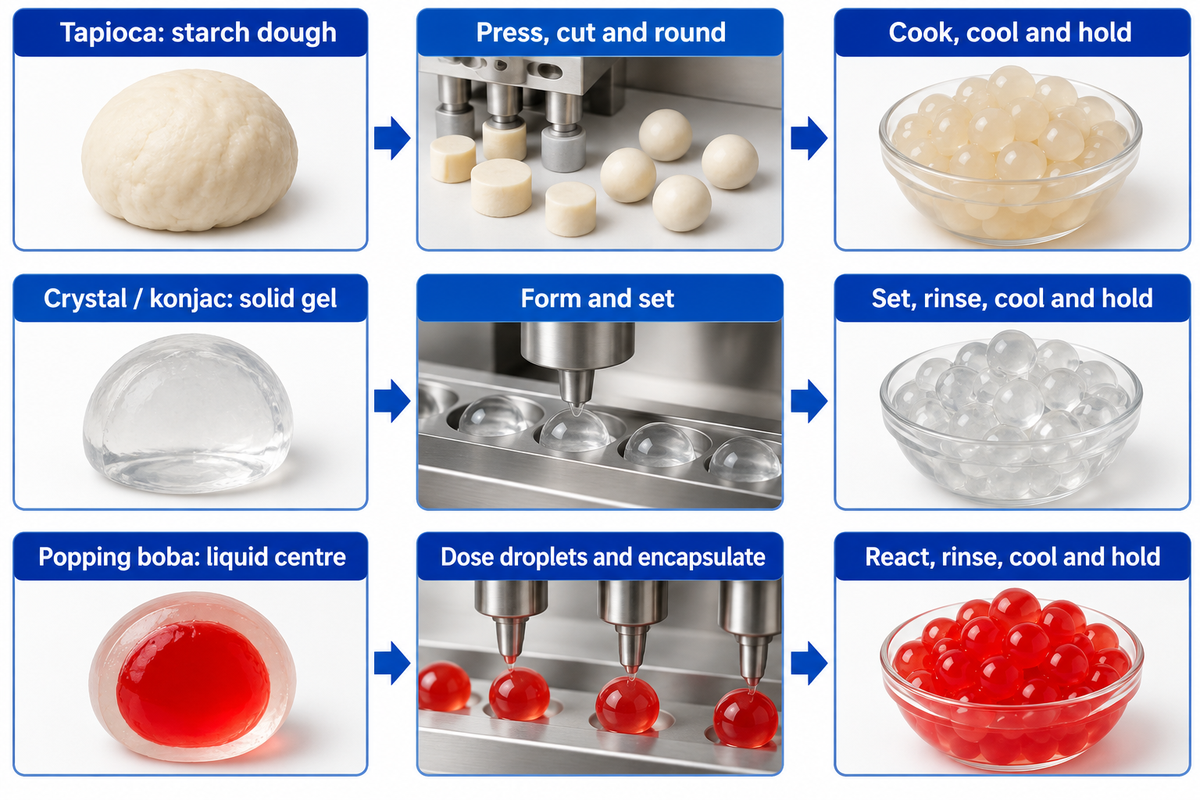
Tapioca boba pearls, crystal or konjac pearls, and liquid-center popping boba can look similar in a drink while entering different physical states when being processed; the same comparison includes bursting boba and agar boba. Starch dough is pressed, cut and rounded. A gel system is deposited or formed and set. A liquid center is encapsulated through a chemical or reaction route. Therefore, the forming core and downstream controls can’t be inferred from the word “pearls.”
| Route | Feed state to define | Forming question | Set, cook or react | Proof to request |
|---|---|---|---|---|
| Traditional tapioca | Starch dough, hydration and batch identity | How are pieces pressed, cut, rounded and dusted? | Cooking, cooling and holding history | Centre texture, size band, good-piece mass and reject rule |
| Solid crystal or konjac | Hydrated gel system, concentration, pH or alkalinity, viscosity window | Extrusion, depositing, cutting, template or nozzle? | Gel setting, washing, cooling and storage medium | Gel integrity, bite, syneresis, package and observation window |
| Liquid-centre popping boba | Filling, shell liquid and reaction bath | How are droplets dosed and encapsulated? | Reaction, rinse, cooling and protective medium | Leakage, shell thickness, fill retention and downstream handling |
Boundary: The table is a tool for classification of routes. A supplier must fill the blank spaces with the buyer’s real product and a witnessed trial.
What is the difference between konjac boba, crystal boba and tapioca pearls?
Konjac and crystal boba are commercial labels for gel-based toppings whose ingredients and setting systems can vary; tapioca pearls are commonly built from starch dough and then cooked. A peer-reviewed starch review explains gelatinization and retrogradation, while hydrocolloid sources show that water binding and gel behaviour differ by system. Treat the name as a starting clue, then confirm the formulation and process route.
When requesting a quote, include the product state, target diameter, center or gel requirement, holding medium and package. If those fields aren’t filled in, two quotes may be describing different foods under the same marketing word.
For pearls for bubble tea, the intended serving medium belongs in the trial brief. A milk tea brand and a dessert factory may request the same shape but supply different samples and packaging requirements. State whether the pearl will contact milk, fruit juice, yogurt or sugar syrup, then agree when to compare its texture in that medium.
Liquid-centre popping boba is made through controlled depositing and encapsulation. TG Machine describes a flavored filling, a sodium alginate-based coagulation liquid and a protective liquid as separate process inputs. For pearls used in bubble tea, ask the supplier to identify those inputs before choosing a beverage-line configuration. The finished bubble tea drinks are the application; the liquid system is what the equipment must handle.
Tapioca pearls: the starch-dough route and the hard-centre problem
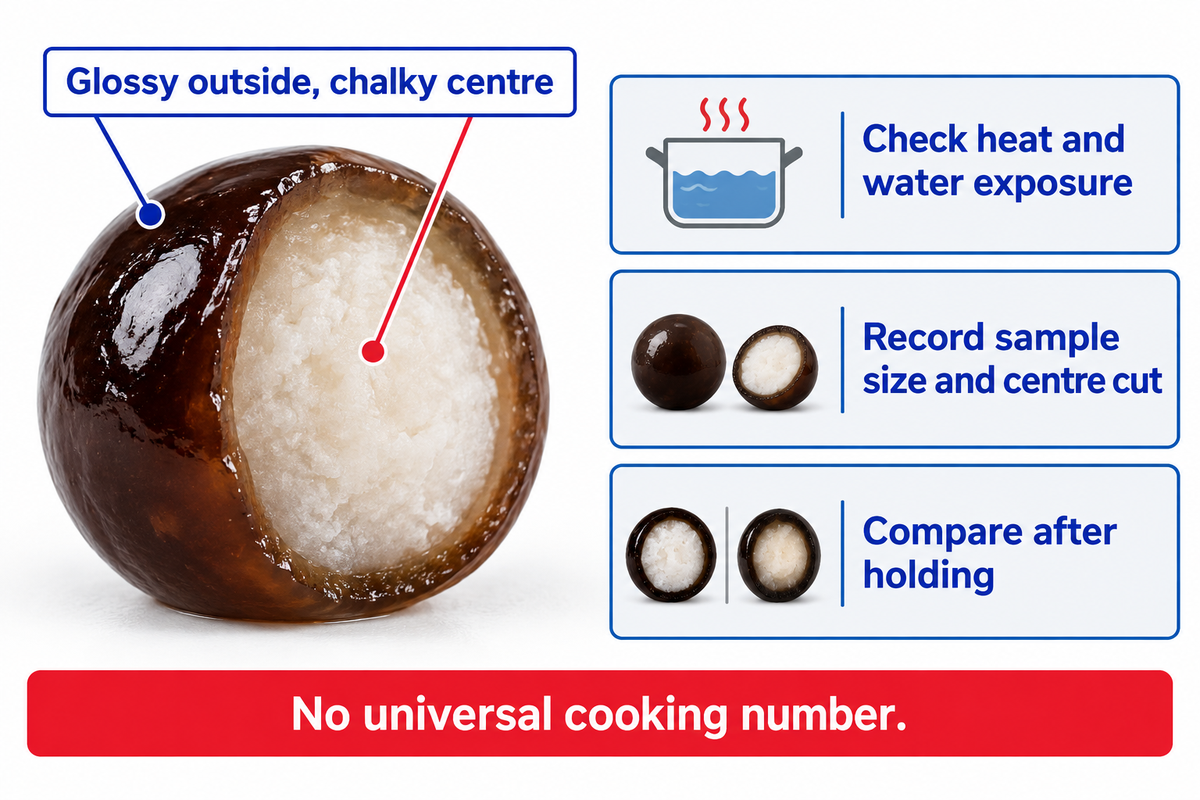
Tapioca pearl equipment handles a starch-dough route in which several jobs within the same process chain function interdependently (i.e., hydration, mixing, forming, cooking, and cooling). An issue with one of the jobs within the same process chain can explain the hard centre. The correct answer to this question is a sample diagnosis, not a universal cooking number.
For a brown sugar variant, supply the actual formula instead of treating the flavor name as a process setting. If the product team changes a sweetener or the amount used to sweeten the holding syrup, include that version in the trial record. Compare the resulting sample against the agreed texture target before accepting the revised production setup.
“Starch gels are formed by gelatinization and retrogradation.”
The source review explains why a dough pearl can’t be judged by its surface alone. Water and heat change starch structure; cooling allows molecular reassociation. The same review also warns that composition and processing conditions alter gel strength. That’s why a trial record should identify starch lot, dough preparation, pearl size, heating history, cooling path and holding medium.
| Observed symptom | Questions to ask first | Control to record |
|---|---|---|
| Glossy outside, opaque or chalky centre | Did the centre receive the same heat and water exposure as the surface? Did size or dough moisture change? | Sample size, centre cut test, cooking or heat-history record |
| Soft at release, firm after holding | What happened during cooling, syrup or medium contact, package and storage? | Time-stamped texture checks and holding-medium identity |
| Uneven size or sticking | Was dough conditioning stable? Did dusting, cutting or rounding change? | Diameter distribution, change parts, dusting and reject reasons |
Scenario, troubleshooting handoff
A private-label buyer receives a visually attractive batch but finds a powdery centre after the pearls cool. The supplier first asks for the recipe ID, dough conditioning record, sample diameter and time from cooking to the test. The buyer then compares a centre cut, a surface texture check and a retained sample after the agreed holding period. That sequence separates a forming problem from a heat-history or storage problem. It also gives quality a repeatable record for the next trial instead of asking the operator to “cook a little longer.”
Why are my tapioca pearls not soft after cooking?
A firm centre usually means the sample hasn’t received the same hydration and heat history as the outside, or that cooling and holding changed the texture. Consumer troubleshooting sources describe undercooking, water, temperature and holding as separate possibilities; industrial teams should translate those possibilities into a controlled sample record rather than copy a home-cooking time.
Konjac and crystal pearls: the gel route, setting window, and downstream handling
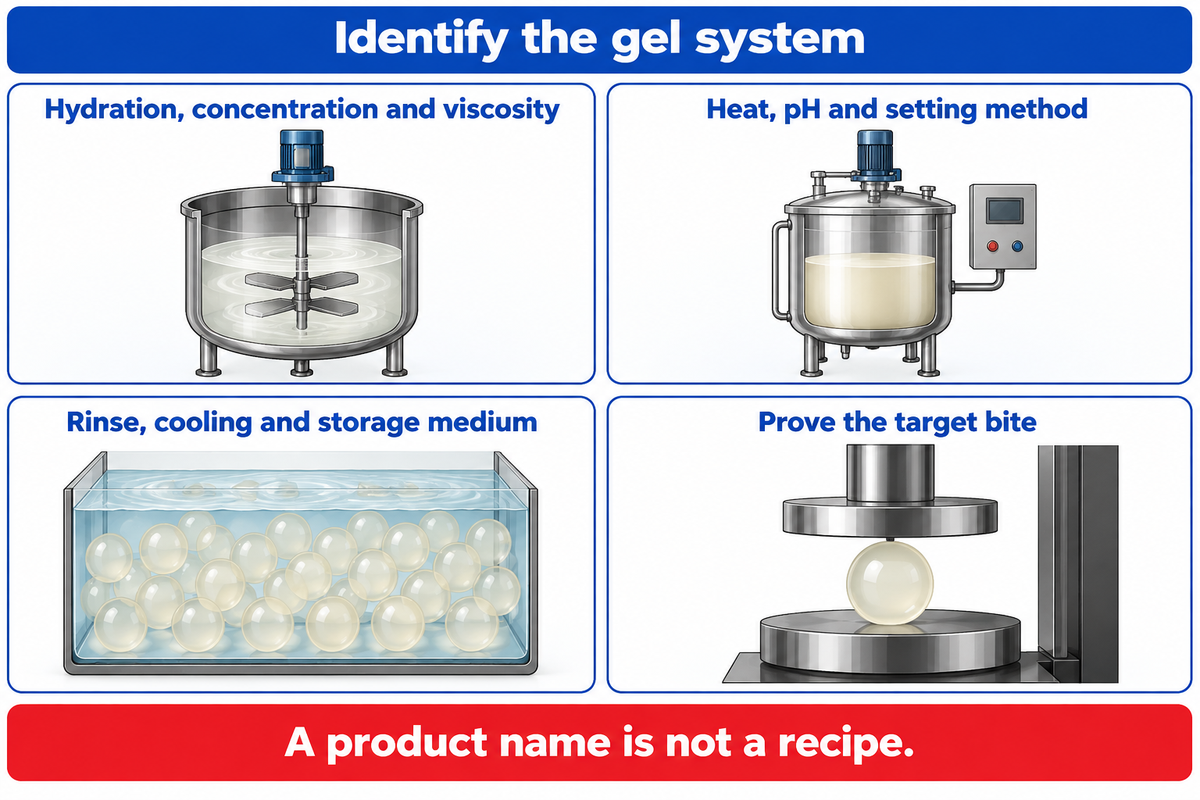
Konjac and crystal pearl equipment begins with a gel system in which hydration, concentration, pH, ions, viscosity, and thermal history determine how material made with konjac can be formed and set; crystal jelly and white crystal are product labels that still require route confirmation. “Crystal boba” isn’t a single universal recipe. A supplier may describe mixing, extrusion, boiling and cooling, but the buyer would also need to include the exact gel system, change parts, setting method and storage medium in the trial.
Hydrocolloid references distinguish systems that form reversible gels, systems that remain mostly intact after setting, and systems that need another compound to gel. The practical consequence is simple: a gel’s name doesn’t tell an engineer whether it should be heated, cooled, reacted, cut, rinsed or held in a medium.
The hydrocolloid trade reference describes a xanthan-and-carrageenan combination that forms a thermoreversible gel. This example explains why the complete gel system matters; it is not a recommended pearl recipe. Ask whether the proposed formulation sets by cooling, heat treatment or reaction, and have the supplier identify the corresponding control and observation points.
In a gel-route specification, identify the ingredient system before discussing the powder preparation equipment. Ask how to hydrate or dissolve konjac powder for a konjac jelly product, and record the required feed state before forming. SINOFUDE distinguishes konjac or agar jelly processing from calcium-alginate reaction. The supplier should demonstrate the target chewy texture with the declared formulation; whether it sets by cooling, heat treatment or reaction follows from the declared formulation, not the product name.
SINOFUDE separates a solid jelly route from a liquid-centre reaction route and from starch dough in its public solution page. That distinction is useful for a quotation, but it isn’t a substitute for a formulation brief. State ingredient family, target bite, diameter, color, medium, package and observation period before asking whether one platform can be configured for more than one family.
gel-route brief
Give the supplier one row for each formula: gel system / concentration or viscosity window / pH or alkalinity / feed temperature / forming core / setting or reaction medium / rinse and cooling / storage medium / target bite / package / observation period. A blank field is a trial question, not permission to assume the route.
Can one line make all three? Separate the shared modules from the forming core
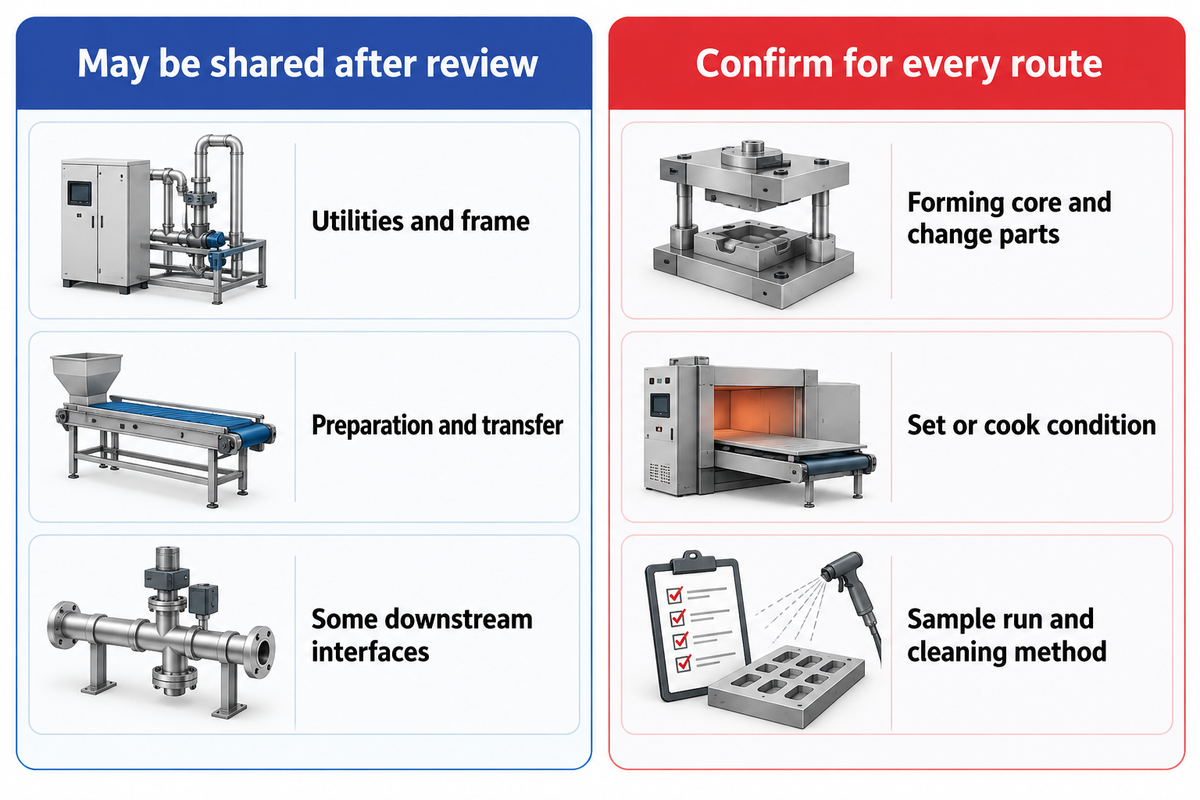
One project may use the same utilities, preparation, washing, and cooling as well as the same inspection and packaging as other projects, but still require a route-specific forming core. A catalogue label that groups together tapioca, crystal, konjac and popping boba doesn’t show that all routes use the same nozzles, templates, wires, reaction bath, cooking path and cleaning process.
| Module boundary | May be shared after review | Must be confirmed per route | Evidence to request |
|---|---|---|---|
| Utilities and frame | Power, water, drainage, controls and access envelope | Heat load, compressed air, product-contact materials and sanitation access | Utility schedule, layout, material list, instrument list |
| Preparation and transfer | Mixing support, transfer or buffer space | Starch dough versus gel viscosity, deaeration, temperature and shear | Recipe window, transfer test and changeover record |
| Forming core | Sometimes the same frame or drive architecture | Press/cut/round, extrusion/cut, template/nozzle or droplet encapsulation | Route drawing, change parts, sample run and cleaning method |
| Downstream | Some washing, cooling, inspection and packing interfaces | Set or cook condition, rinse medium, damage rule and package hold | Handoff mass basis, reject definition and retained samples |
ANKO’s tapioca page provides evidence for a starch dough route using a cutting and rounding forming core. It shows sieving and mixing starch dough, followed by pressing, cutting, and rounding.
Procurement rule: have the supplier mark each module as shared, route-specific, optional or excluded. Require a change-part list and a cleaning/changeover boundary for each product family.
For an automatic production line, ask the manufacturer which transfers, inspections and packing operations are included. A fully automatic forming cycle can still leave transfers, inspections or packing as separate steps outside the quoted scope. ANKO describes an automatic cutting and rounding machine within a wider system of preparation and packaging equipment; use the same module-by-module question when comparing a tapioca making machine with a popping boba production line.
Can one production line make solid konjac or agar crystal pearls as well as traditional tapioca starch pearls?
It’s possible for a single project to cover both families, but the forming core and process controls must be demonstrated separately. The starch route requires controls for dough forming and cooking, while the gel route requires formulation, gelation, cooling, and often different product handling. A multi-product label is a request for a route matrix and trial, not proof of interchangeability.
Pearl Route Decision Matrix: choose by product state, not marketing name
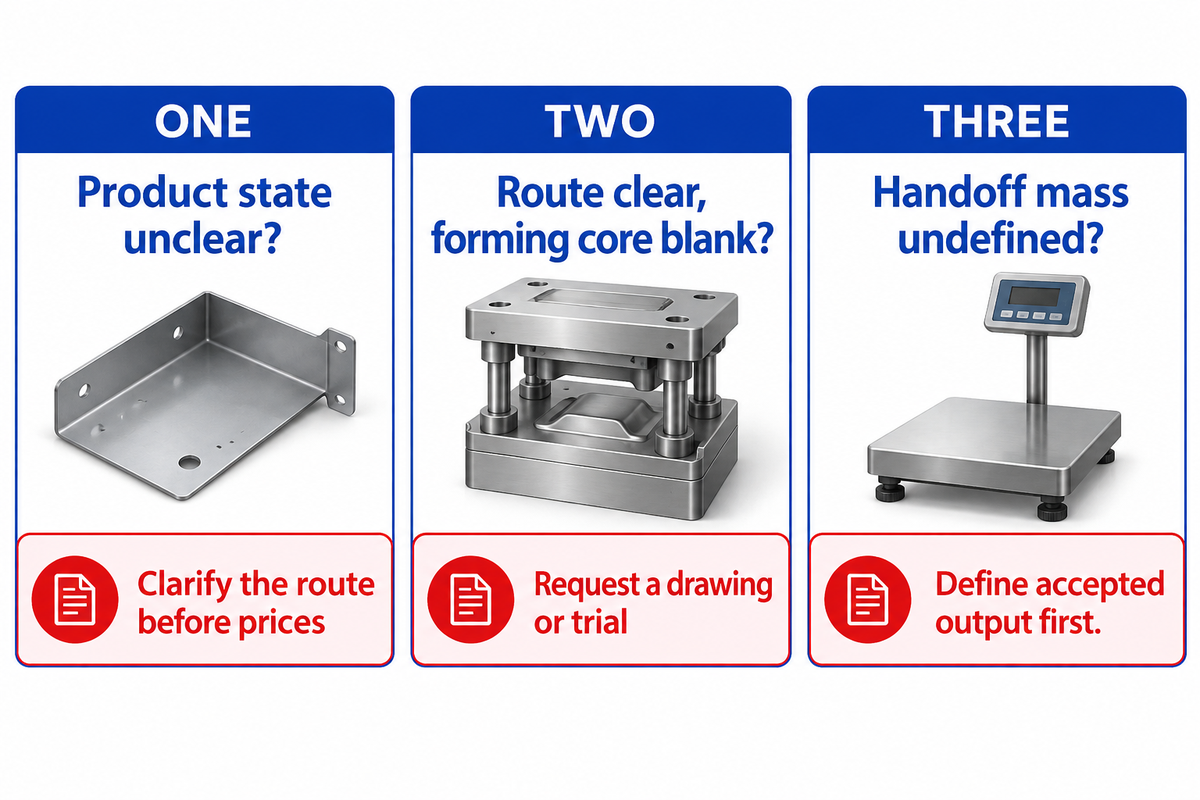
The Pearl Route Decision Matrix converts a product name into a procurement decision, starting with the feed state, center, setting mechanism and handoff. It’s used by plant managers to narrow the equipment family, by quality to identify a test sample, and by finance to compare quotations on the same downstream boundary. The peer-reviewed starch-gel review provides general gel-structure context; the equipment route still needs a product-specific trial.
Pearl Route Decision Matrix
| Decision question | Starch dough | Solid gel | Liquid centre | What the buyer records |
|---|---|---|---|---|
| What enters the forming core? | Conditioned dough | Hydrated gel system | Filling plus shell/reaction liquids | Formula ID, batch and temperature |
| What creates the shape? | Press, cut and round | Extrude, deposit, cut or template | Dose droplets and encapsulate | Core, nozzles, wires, templates and change parts |
| What creates final texture? | Cook, cool and hold | Set, rinse, cool and hold | React, rinse, cool and hold | Centre, gel or shell acceptance rule |
| Where is good output measured? | After agreed cooking and cooling boundary | After agreed set, rinse and cooling boundary | After agreed reaction, rinse and cooling boundary | Good-piece mass, rejects and package state |
| Which variable changes first? | Hydration and dough conditioning | Concentration, pH, ions and viscosity | Filling, shell liquid and bath condition | Recipe window and batch record |
| Which failure appears first? | Hard centre, sticking or uneven rounding | Weak gel, syneresis or shape loss | Leakage, thin shell or fill loss | Defect definition and sample point |
| What happens at changeover? | Dough residue and dusting parts | Gel residue and setting path | Filling, bath and rinse separation | Cleaning sequence and time |
| What does packaging receive? | Cooked pearls and holding medium | Set pearls and storage medium | Reacted pearls and protective medium | Pack format, temperature and seal rule |
| What must the supplier prove? | Size, centre and good mass | Shape, bite, gel integrity and good mass | Leakage, shell integrity and good mass | Trial record, retained samples and sign-off |
Use it this way: when the answer in the first column is unclear, don’t compare prices. When the answer is clear but the forming core is blank, request a route-specific drawing or trial. If the route is clear but the handoff mass is blank, comparing capacities isn’t justified.
Route Evidence Classification
| Category | Class | Public figure or boundary | How to use it |
|---|---|---|---|
| Product route | Starch dough | Press, cut, round and cook | Use for tapioca route questions |
| Product route | Solid gel | Form, set, rinse and cool | Use for crystal or konjac scope |
| Product route | Liquid centre | Deposit, react, rinse and cool | Use for popping-boba scope |
| Supplier figure | Nominal rate | 50–500 kg/h | Supplier claim; require accepted-output proof |
| Supplier figure | Diameter range | 3–10 mm | Supplier claim; confirm change parts |
| Supplier figure | Tapioca example | 30 kg/h or 33,000 pcs/h | ANKO reference-only example tied to 0.9 g pieces |
| Regulatory class | United States CGMP | 21 CFR 117.40 | Cleanability checkpoint, not certification |
| Acceptance class | Good-piece basis | Mass after the agreed handoff | Compare quotations on one boundary |
| Facility context | BOH-BAH trade report | 50,000 sq. ft. facility | Industrial context, not machine output |
These figures remain qualified: they illustrate classes of examples and measurement boundaries, not a universal benchmark for all formulas and lines.
Why equipment prices are not comparable until the scope is normalized
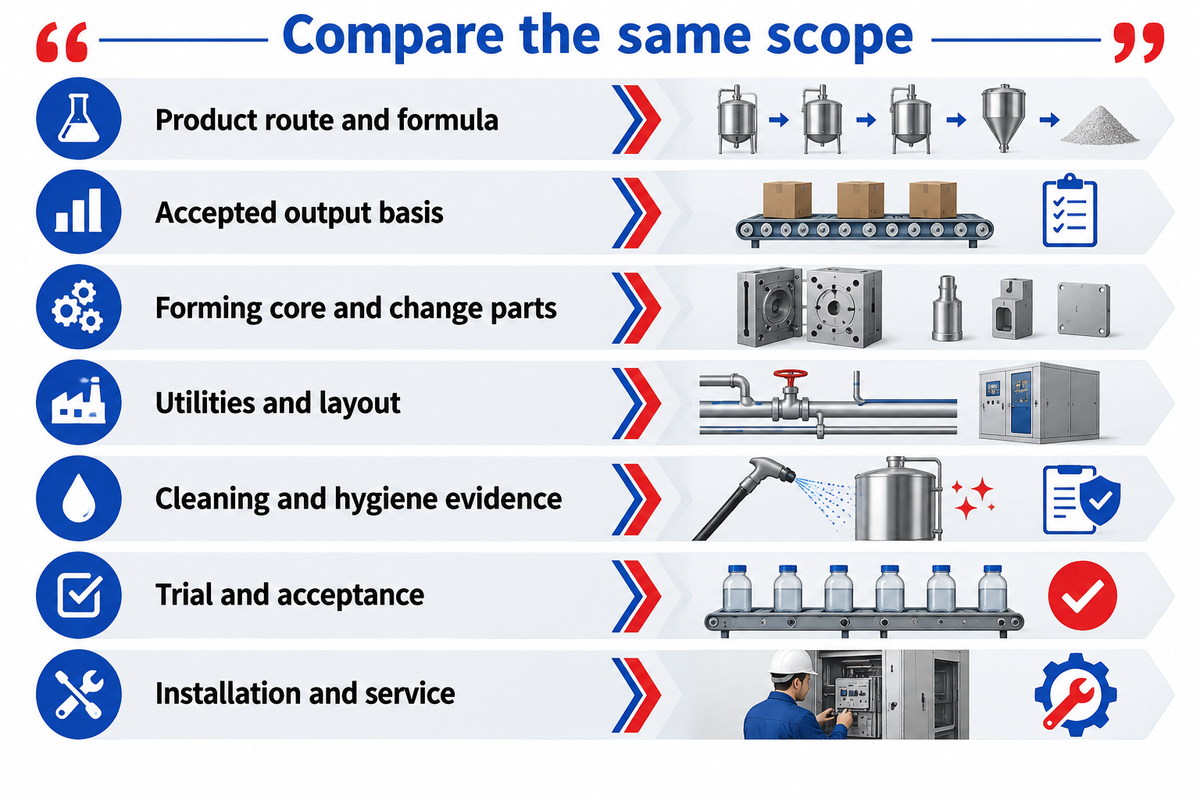
Two pearl quotes are comparable only if they have a common route, product brief, accepted output basis, utility boundary and commissioning scope. Model name, nominal kg/h and price may cover different forming cores, cooking or setting modules, change parts, inspection and other obligations. The eCFR equipment and utensils checkpoint is a compliance reference for cleanability and scope; it does not set a universal supplier price.
Quote Normalization Scorecard
| Quote field | Quote A | Quote B | Decision note |
|---|---|---|---|
| Product route and formula | Starch, solid gel or liquid centre; formula and batch identity | ||
| Accepted output basis | Good-piece kg/h, size band, reject rule and downstream boundary | ||
| Forming core and change parts | Nozzle, wire, template, cutter, rounding or deposit system | ||
| Utilities and layout | Power, heat, water, drainage, compressed air, access and floor space | ||
| Cleaning and hygiene evidence | Food-contact materials, seams, access, instruments and cleaning method | ||
| Trial and acceptance | Samples, retained product, deviations, sign-off and observation window | ||
| Installation and service | Installation, training, commissioning, spare parts and response boundary |
Scorecard rule: don’t give a supplier a “better price” label until every blank has either a value or an explicit exclusion. This gives finance a basis for comparison and provides sales with a clean engineering handoff.
Scenario, finance and procurement
Finance receives one quote with a forming head and another with forming, rinse, cooling and a packing interface. The first price is lower, but both suppliers are asked to re-quote the same route, formula, accepted good-piece mass, utility boundary and trial record. After normalization, the “cheaper” quote may still win, or it may reveal that its downstream work remains on the buyer’s side. The decision is now about scope and risk rather than a headline number.
How much does industrial tapioca or crystal boba equipment cost compared with a small pearl maker?
For scale, one online listing prices a small boba pearl machine at $1,800-$3,000 per unit; an industrial quote has to be compared on the scope below. The scope may include preparation, forming, cooking or setting, washing, cooling, inspection, packaging, utilities, installation and commissioning; a small maker may cover only one of these. Normalize these boundaries and request a route specific quote from the existing solution page.
Capacity is a chain: utilities, cooling, inspection, and packaging can set the ceiling
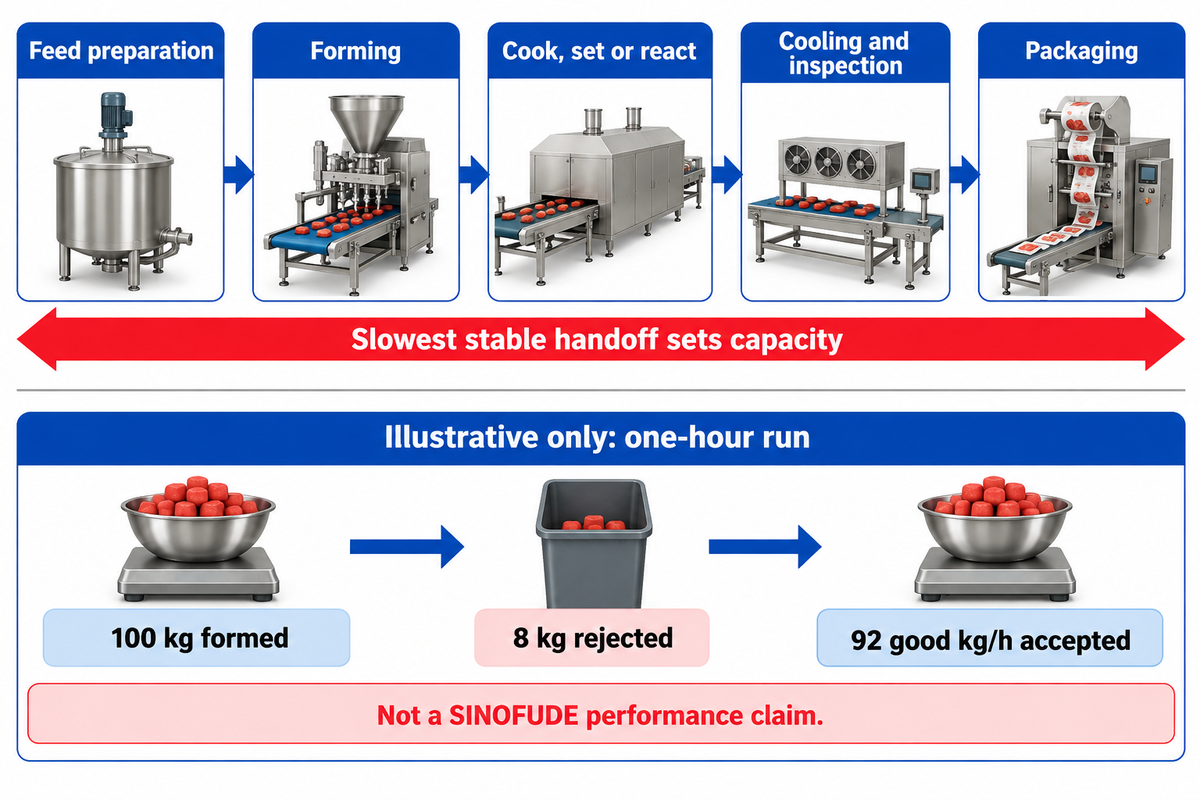
Capacity is measured at the agreed accepted-output point and is set by the slowest stable handoff in the chain. Forming rate can be higher than saleable packed rate when cooling, inspection or packaging cannot keep up. Therefore, a capacity claim needs a mass basis, product size, run duration and downstream boundary.
The Handoff Bottleneck Map
| Stage | What can slow it | Measure at the handoff | Owner |
|---|---|---|---|
| Feed preparation | Hydration, viscosity, temperature, deaeration or batch variation | Batch identity, feed condition and transfer stability | Process / QA |
| Forming | Core speed, size change, sticking, shape or dosing variation | Formed pieces and immediate rejects | Engineering / operator |
| Cook, set or react | Heat recovery, gelation window, bath condition or dwell | Texture, centre, shell or gel integrity | Process / QA |
| Cooling and inspection | Residence time, rinse, damage, visual checks or hold space | Good-piece mass, reject reason and sample condition | QA / plant |
| Packaging | Medium, fill, sealing, storage, line speed or changeover | Packaged good mass and package defect rule | Packaging / finance |
A simple comparison formula: Accepted good kg/h = good product mass/ measured run hours. Illustrative only: if a hypothetical run forms 100 kg, rejects 8 kg and takes one hour to the agreed handoff, the accepted basis is 92 good kg/h. The values are placeholders for the buyer’s trial record, not a SINOFUDE performance claim.
TG Machine’s public guide lists 50–500 kg/h and 3–10 mm for its own medium/large popping-boba or konjac systems and says the lowest-capacity machine isn’t always the right choice. That’s useful decision context, not a universal benchmark or a substitute for your route-specific trial.
You can use the map when a plant manager requests more speed. First identify the slowest stable handoff. A larger forming head won’t fix a cooling queue, or a bottleneck in inspection or package hold.
Four-Clock Pearl Trial: a practical acceptance protocol
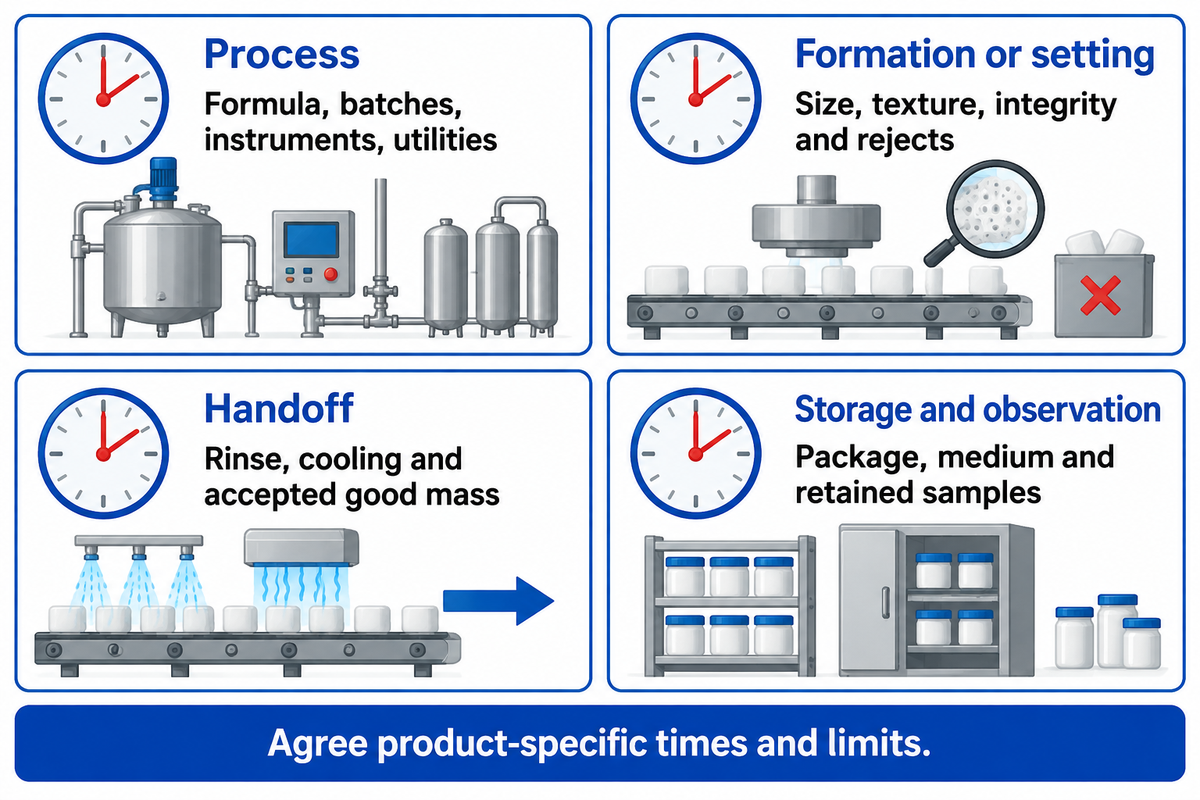
The Four-Clock Pearl Trial is a proposed buyer-supplier template for proving a pearl line across process, formation or setting, downstream handoff and storage observation. It doesn’t fix a universal time, temperature, pH, viscosity, yield or reject limits. The buyer agrees to these values, and they are quoted in the contract.
Four-Clock Pearl Trial
- Process clock: record formula ID, batches, instruments, calibration status, utilities, agreed process variables.
- Formation or Setting Clock: Record diameter, shape, center, gel integrity, texture, color, leakage, breakage, and all reasons for rejection.
- Handoff clock: record rinse, cooling, inspection and the agreed accepted-good-piece mass at the stated downstream boundary.
- Storage and Observation clock: record package, medium, storage condition, any retained samples, observations on drying or leakage, final sign-off.
| Trial record field | Why it protects the buyer |
|---|---|
| Reference sample and target texture | Prevents “looks good” from replacing a defined product target |
| Size band and appearance rule | Separates forming consistency from downstream damage |
| Centre, shell or gel integrity | Locates a failure inside the route instead of blaming the final package |
| Good mass and reject mass | Creates a comparable accepted-output basis |
| Retained samples and observation time | Shows whether texture changes after cooling or storage |
| Deviation and sign-off record | Prevents an exception from becoming an undocumented acceptance rule |
Regulatory note: 21 CFR 117.40 is a United States current good manufacturing practice equipment-and-utensils checkpoint. It says equipment must be adequately cleanable and installed to support cleaning and maintenance, among other requirements. It is not an FDA certificate for a named machine, and destination-market rules still need separate review.
Buyer worksheet: The supplier figures below refer to the named external sources, not SINOFUDE performance guarantees. Rows marked buyer template are proposed record fields: agree the actual times, sampling quantities and output units for your trial. The facility example is background context, not a machine-capacity value.
| Buyer check | Public figure or record to label | Evidence boundary |
|---|---|---|
| Size band — engineering | TG Machine: 3–10 mm | Supplier-published example; confirm change parts and route |
| Size band — quality | TG Machine: 3–10 mm | Record actual measured distribution beside the supplier range |
| Size band — procurement | TG Machine: 3–10 mm | Keep the range attached to the named product route |
| Size band — finance | TG Machine: 3–10 mm | Do not price unlike size bands as one line |
| Nominal rate — engineering | TG Machine: 50–500 kg/h | Supplier-published range; request accepted-output proof |
| Nominal rate — quality | TG Machine: 50–500 kg/h | Separate forming rate from good-piece mass |
| Nominal rate — procurement | TG Machine: 50–500 kg/h | Write the downstream boundary into the quotation |
| Nominal rate — finance | TG Machine: 50–500 kg/h | Use the same mass basis before comparing cost |
| Tapioca example — engineering | ANKO: 30 kg/h | Reference example; verify recipe, size and run conditions |
| Tapioca example — quality | ANKO: 33,000 pcs/h | Reference example tied to a stated piece mass |
| Piece-mass example — quality | ANKO: 0.9 g | Reference example; do not transfer it to another recipe |
| Facility reference — planning | BOH-BAH: 50,000 sq ft | Public facility context; not a SINOFUDE site claim |
| Trial duration — buyer template | Set for this trial | Buyer-entered run record; not a universal acceptance time |
| Trial duration — buyer template | Set for this trial | Buyer-entered run record; compare like-for-like runs |
| Observation — buyer template | Set for this trial | Buyer-entered storage observation point |
| Observation — buyer template | Set for this trial | Buyer-entered storage observation point |
| Replicate label — buyer template | Set for this trial | Proposed record label; set the protocol with the supplier |
| Replicate label — buyer template | Set for this trial | Proposed record label; set the protocol with the supplier |
| Retained sample label — buyer template | Set for this trial | Proposed record label; set the sample plan with quality |
| Retained sample label — buyer template | Set for this trial | Proposed record label; set the sample plan with quality |
| Good-output basis — buyer template | Set for this trial | Example worksheet unit; replace with the agreed handoff mass |
| Good-output basis — buyer template | Set for this trial | Example worksheet unit; replace with the agreed handoff mass |
| Cooling record — buyer template | Set for this trial | Record the actual cooling interval, not a promised value |
| Cooling record — buyer template | Set for this trial | Record the actual cooling interval, not a promised value |
| Quote normalization — engineering | TG Machine: 3–10 mm | Attach the requested size band to the drawing |
| Quote normalization — quality | TG Machine: 50–500 kg/h | Ask whether the range is forming or accepted output |
| Quote normalization — procurement | ANKO: 30 kg/h | Keep the reference example tied to its route |
| Quote normalization — finance | ANKO: 33,000 pcs/h | Keep the reference example tied to its piece mass |
| Quote normalization — quality | ANKO: 0.9 g | Retain the stated piece-mass context |
| Quote normalization — planning | BOH-BAH: 50,000 sq ft | Keep the facility figure in its source context |
| Buyer worksheet — size | TG Machine: 3–10 mm | Illustrative label for the supplier range |
| Buyer worksheet — rate | TG Machine: 50–500 kg/h | Illustrative label for the supplier range |
Scenario, quality sign-off
Quality rejects a short demonstration because the supplier recorded only the formed appearance. The revised trial keeps a reference sample, checks centre or gel condition, weighs good and rejected material at the agreed handoff, records the package medium and retains samples for the agreed observation period. The supplier can still show a fast forming cycle, but acceptance now covers the product the customer will actually ship.
A public patent application for frozen instant tapioca pearls is a useful reminder that thermal history can be a sequence, not a single number: its abstract describes cooking, hot-water soaking, ice-water cooling and cold-air freezing for that disclosed method. The external patent application describes a method and isn’t a universal operating instruction.
What to ask an equipment supplier before you compare models
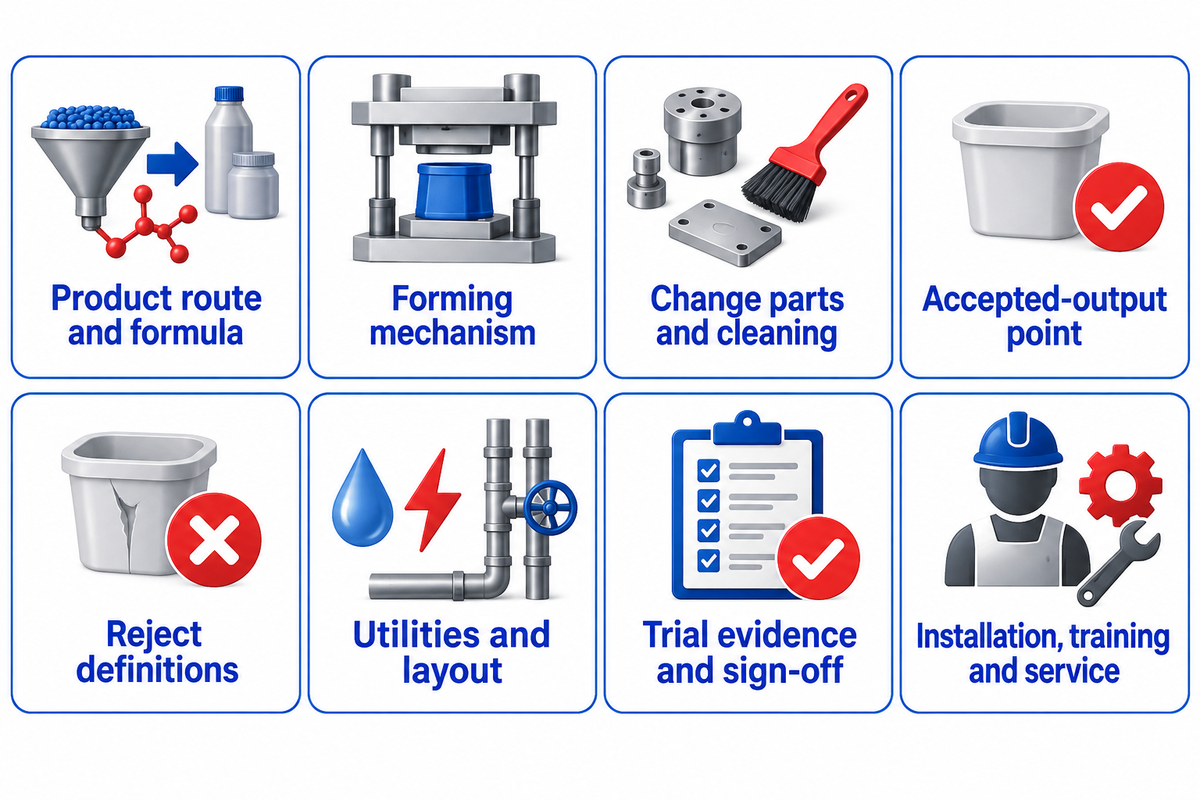
To give the supplier enough information to identify the forming core, downstream modules and acceptance boundary, a route-specific request for quotation should include the product sample, formula or gel system, diameter and texture, mass of good piece, utilities, changeover parts, cleaning access, packaging handoff, service scope and trial record. Only after providing this information should “what model is ‘best’?” be asked.
- Start with the product route: Starch dough, solid gel or liquid center . What’s the exact batch identity and formula?
- Describe the forming mechanism: press/cut/round, extrusion, template, nozzle, or another mechanism.
- List what changes between product families: nozzles, wires, templates, hoppers, baths, temperature controls, and cleaning steps.
- State where accepted output is measured: before or after cooking, setting, rinse, cooling, inspection and packaging.
- Define the reject rule for size, shape, center, gel, shell, leakage, damage and package conditions.
- List utilities and layout: power, heat, water, drainage, air, access, cleaning clearance and storage.
- Ask what evidence comes with the trial: recipe ID, instruments, calibration, samples, deviations, retained samples and sign-off.
- Confirm the service scope for installation, commissioning, training, spare parts, changeover and response time.
Prepare routes, scope, and quotations with this information, then proceed to the konjac and pearl equipment solution for the current model, utility and quotation details. SINOFUDE’s public company information is on the About Us page. Company identity is different from product-performance proof.
Ready to compare a pearl route?
Send the product sample, route, target accepted output, size, texture, package and destination market through the equipment enquiry form. The goal is a comparable trial record and quotation scope, not a model selected from a product name alone.
Frequently Asked Questions
What is a konjac pearl?
A konjac pearl is a gel-based topping made from a formulation that may include konjac and other hydrocolloid components. Its texture, setting method and storage behaviour depend on the formulation and process. Confirm the gel system and trial conditions rather than treating the word “konjac” as one universal recipe. For a factory trial, also record the target bite, diameter band, storage medium and observation period so the sample can be compared later.
Is there a machine that makes boba pearls?
There are machines and production systems for different pearl routes, including starch-dough tapioca, solid gel pearls and liquid-centre popping boba. The useful question is which forming core and downstream modules match the product state, size, texture and accepted-output definition. A shop-scale cooker and an industrial line may both make boba, but their scope, utilities, inspection and packaging boundaries can be very different.
Are konjac pearls the same as crystal boba?
They can overlap as commercial labels for translucent or gel-based toppings, but the formulation and gel system can differ. Treat them as related product descriptions until the supplier confirms ingredients, setting mechanism, forming method, cooling, storage medium and texture target. That confirmation protects procurement from comparing a gel depositor, a starch-dough former and a liquid-centre system as if they were one class.
Can a tapioca pearl machine make crystal boba?
Don’t assume it can. A tapioca system commonly forms starch dough by pressing, cutting and rounding, while a crystal or konjac system may require gel deposition, extrusion, cutting, setting and cooling. Ask for a route matrix, change-part list and a witnessed sample run. The quotation should also state whether the same forming core, contact parts, cleaning method and downstream handoff are retained across the two products.
What should a pearl sample run record?
Record product and batch identity, formula or gel system, raw-material lots, utilities, instruments and calibration, forming or setting variables, size and appearance, centre or gel integrity, texture, rejects and reasons, good-piece mass, downstream boundary, package, retained samples, observation period, deviations and sign-off. Keep the supplier’s nominal figures beside measured results so a later review can separate a machine rating from accepted saleable output.
Does a higher kg/h rating guarantee lower cost per good kilogram?
No. A nominal forming rate can be reduced by cooking or setting, cooling, inspection, rejects, packaging and changeover. Compare good-piece mass at the same downstream boundary and record the assumptions behind any cost-per-good-kilogram model. A route that looks slower at the forming step can still be cheaper when it produces fewer rejects and a more stable packed handoff.
Which details should appear in a quotation?
State the route, accepted output, size, utilities, change parts, trial and service boundary. Attach the source and handoff for every public figure.
References and Sources
- SINOFUDE konjac and pearl equipment solution outlines first-party limits on routes, scope and quotation.
- SINOFUDE About Us — company identity only.
- Factors and modification techniques enhancing starch gel structure, a peer-reviewed article, provides starch gel basics.
- eCFR 21 CFR 117.40 — equipment and utensils cleanability checkpoint.
- ANKO Tapioca Pearls Machine, illustrates a qualified sample starch-dough sequence and expected output.
- Food Business News: Hydrocolloids, provides trade technical information on gel behaviour.
- US20140335244A1 identifies an external public patent record only for process stage attribution.
Editorial scope: Public sources and qualified supplier claims are used for education. No private plant trials, independent yields, certification, savings, ownership or universal recipe claims are implied.
WHY WE SHARE THESE GUIDES
About SINOFUDE Insights
SINOFUDE designs and manufactures production lines for confectionery, chocolate and bakery products. These guides help equipment buyers and engineering teams compare process routes, recipe requirements and line layouts before discussing a project.
- Gummy and jelly depositing
- Hard candy and lollipop processing
- Cooking, cooling and packaging
- Equipment selection and line planning