Get in Touch with SINOFUDE Company
Nutraceutical & Vitamin Gummy Line: From Premix to Verified Batches

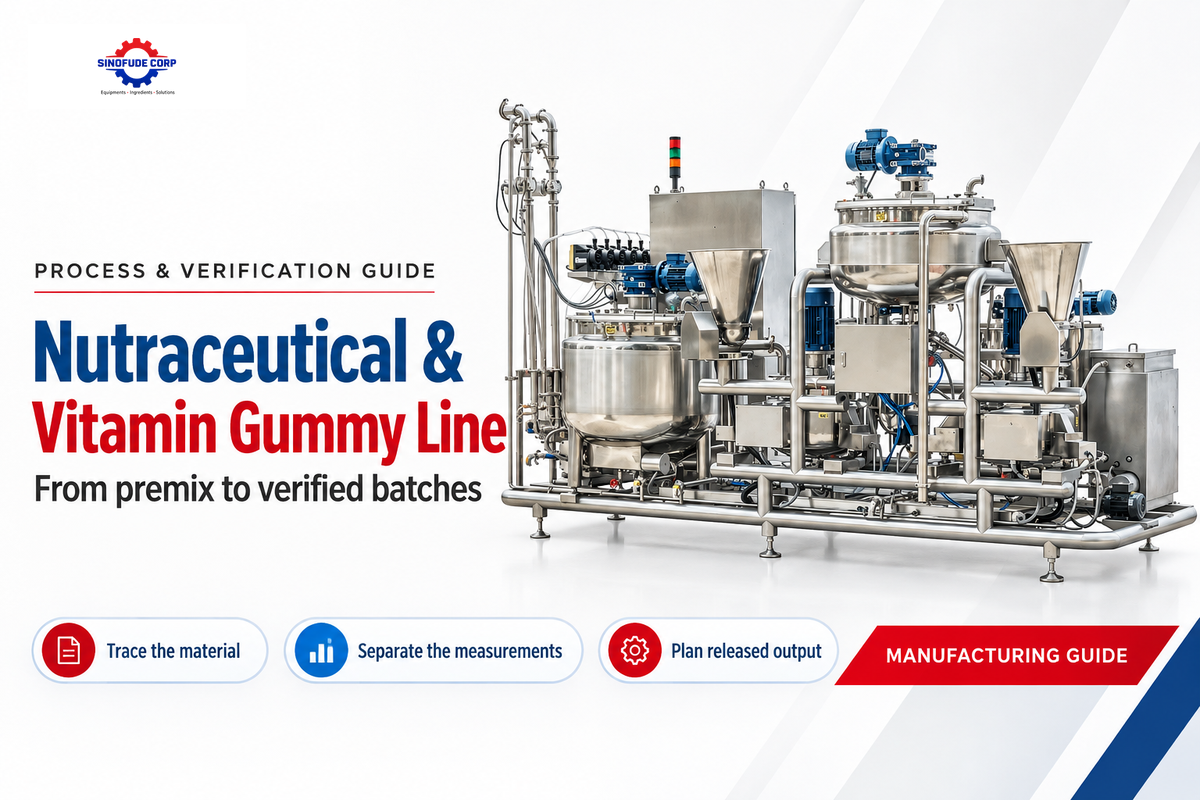
A Nutraceutical & vitamin gummy Line is made up of units for ingredient preparation, cooking, addition, deposit, setting and packaging. It’s used for transforming a defined quantity of formula into gummies that satisfy the manufacturer’s requirements for finished product. Planning the process starts with the recipe and its measurements before fixing the nominal hourly capacity.
Gummy vitamins can leave the mold, but their active concentration, texture or stability while packaged remain to be determined. For a supplement brand, these differences largely affect usable output. For an engineer, these differences define measurements and operating conditions the line must support.
This guide demonstrates nine process checks throughout the factory. It emphasizes manufacturing and verification for US dietary-supplement programs. Decisions for product formulation, labeling and release are the responsibility of the qualified technical and quality personnel of the manufacturer.
Manufacturing Process: From Premix to Gummy Batches
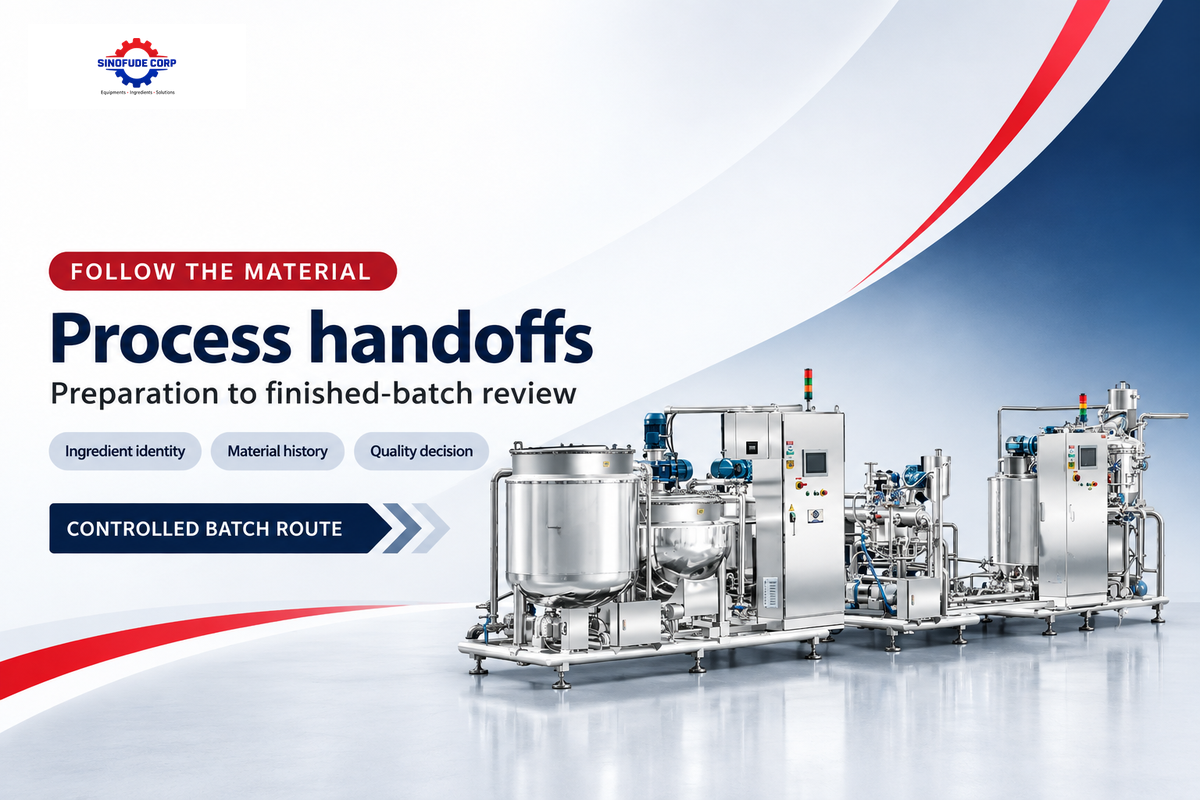
Industrial gummy production moves a recipe through a sequence of material changes and quality handoffs. It starts with the identity of the ingredients, a controlled syrup and gel. Active addition, deposit and conditioning create the final form. Packaging and batch review complete the route to a product approved for distribution.
The useful supplement manufacturing chart provides a name to an output at each of the transformations. A tank temperature is an equipment reading. A laboratory potency result is a product measurement. Separating the two makes a deviation easier to identify and assigns the next step to the proper person.
| Stage | Material or output | Control evidence | Typical record owner |
|---|---|---|---|
| 1. Receive | Identified ingredients and packaging | Lot identity, approved status and storage conditions | Receiving and quality |
| 2. Weigh | Recipe-specific weighed components | Material lot, quantity and scale identity | Dispensing operator |
| 3. Hydrate | Prepared gelatin or pectin base | Addition sequence and actual mixing history | Production operator |
| 4. Cook | Syrup at the recipe’s defined endpoint | Product temperature and solids measurement | Production operator |
| 5. Prepare active | Defined solution, dispersion or premix | Identity, preparation method and hold history | Dispensing and production |
| 6. Combine | Active-containing gummy mass | Addition time, mixing settings and sample identity | Production operator |
| 7. Deposit | Formed individual pieces | Piece mass, nozzle position and run time | Line operator |
| 8. Set and finish | Conditioned and coated gummies | Recipe-specific texture, moisture and handling checks | Production and quality |
| 9. Package | Counted, protected product | Count, closure and packaging identity | Packaging operator |
| 10. Review and release | Accepted finished batch | Specifications, results, deviations and disposition | Quality control |
US 21 CFR Part 111, Subpart E outlines requirements for production and process controls, specifications and their verification. Boundaries of control for a machine supply and a batch control system of a manufacturer therefore need to be documented.
An initial point can be a single recipe with each material movement identified. Starch and starchless routes place forming and conditioning work in different locations. Comparison of gummy forming routes by SINOFUDE is of assistance, when that’s still open; this manual describes necessary measurements that remain to be taken once a route is chosen.
For a 2 g finished piece, a 1,000 kg batch target describes mass, not the number of released packs. For handoff to occur, the production and quality teams need to be able to reconcile the same batch, rather than work with the totals from different machines.
Match Gelatin, Pectin and Sweetener Systems to the Line
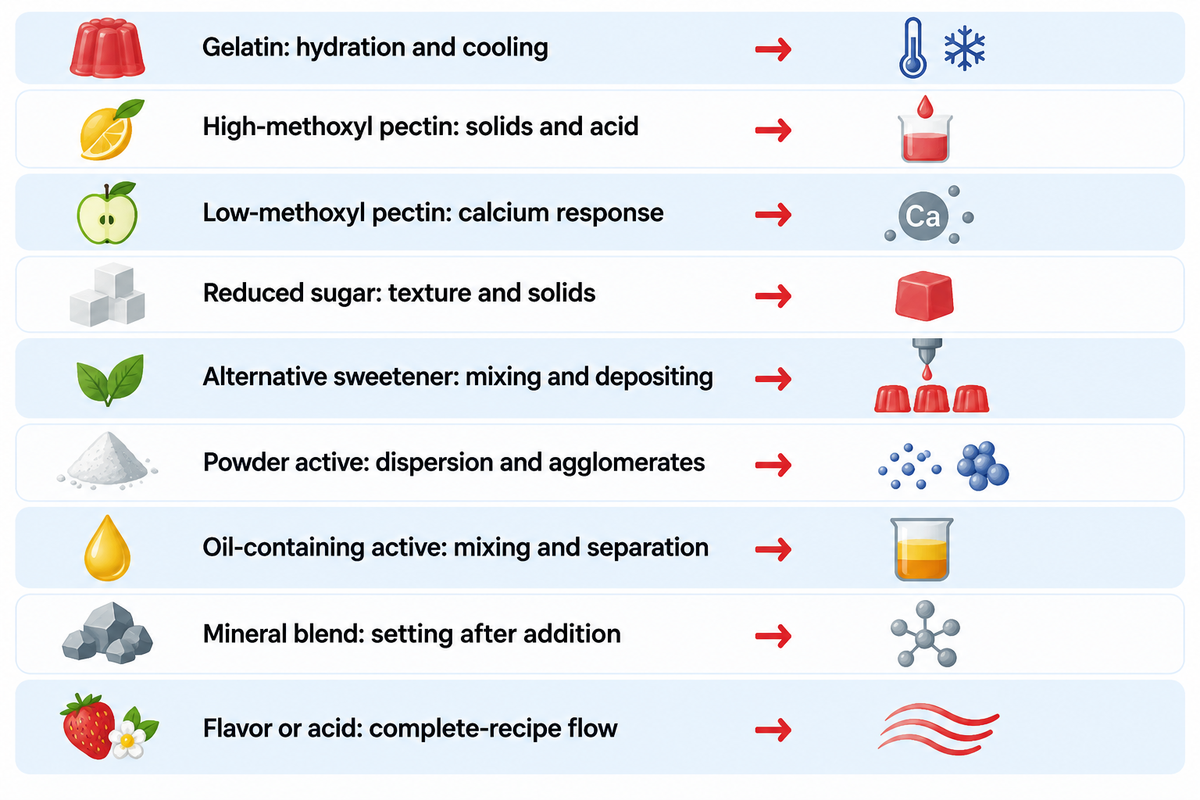
The gel system should be fixed prior to finalizing the addition sequence and transfer arrangement in the line. Gelatin and high and low methoxyl pectin respond differently to formulation conditions. Changes in the sweetener also change the material that enters the depositor. Thus, a recipe change can affect mixing, setting and handling of the gel even when the mould is the same.
Baker Perkins explains the effect of acid, soluble solids and pectin choice in its pectin processing explanation. That equipment-supplier account identifies premature setting as a processing problem. Low-methoxyl pectin also reacts with available calcium: Fan and co-workers studied the salt-dependent behavior in an LM-pectin/sodium-caseinate complex. Their formulation was a model material system, so its settings should stay with that experiment.
| Change or attribute | Process implication | Trial observation |
|---|---|---|
| Gelatin base | Hydration and cooling behavior shape the route | Prepared base consistency and setting response |
| High-methoxyl pectin | Solids and acid addition interact with setting | Flow after acid addition and through the nozzle |
| Low-methoxyl pectin | Available calcium and formulation affect the gel | Response to the actual mineral system |
| Reduced sugar | The original solids and texture balance changes | Texture, solids method and storage behavior |
| Alternative sweetener | The syrup entering the gel system changes | Mixing and depositing behavior with that sweetener |
| Powder active | Preparation must address dispersion | Visible agglomerates and linked analytical samples |
| Oil-containing active | For mixing into the gummy base, define the dispersion or emulsion | Separation during the intended holding period |
| Mineral blend | The gel system receives a different ionic environment | Setting behavior after the complete blend is added |
| New flavor or acid | Addition order and final composition may change | Flow and texture for the complete recipe |
Can the same production line run gelatin and pectin gummies?
Yes, a line can be designed to do both, provided its preparation, dosing, transfer and setting elements accommodate both recipes. Compatibility lies within a defined operating range. A successful gelatin trial and a successful pectin trial should each incorporate the complete ingredient system rather than substitute one gelling element on the same screen setting.
Example: a brand moves a strawberry multivitamin from gelatin to pectin while retaining a 3 g piece. The team changes the sweetener and introduces a zinc-containing blend. Keeping the old piece weight makes the project look like a small change, however, three formulation decisions have been made together. An efficient trial separates them: the pectin base is evaluated first, the complete active blend follows, and the revised sweetener system is then assessed as a finished recipe. Samples retain the formula version. This helps the engineer understand the change, before a long run combines all the variables.
A 3 g gelatin gummy and a 3 g pectin gummy may require different process sequences. Analyzing their trials by recipe versions, the order of addition, and the actual transfer behavior gives the buyer a key compatibility decision. Equal piece mass alone doesn’t address the process differences.
Texture is a product specification too: the target chew for multivitamin gummies should be assessed after the intended conditioning and storage route. A complete multivitamin blend adds the full ingredient system to that comparison. Suppliers can customize the process arrangement around defined requirements; using recipe family names on their own doesn’t explain the behavior of the materials.
Add Vitamins Without Losing Control of Heat Exposure
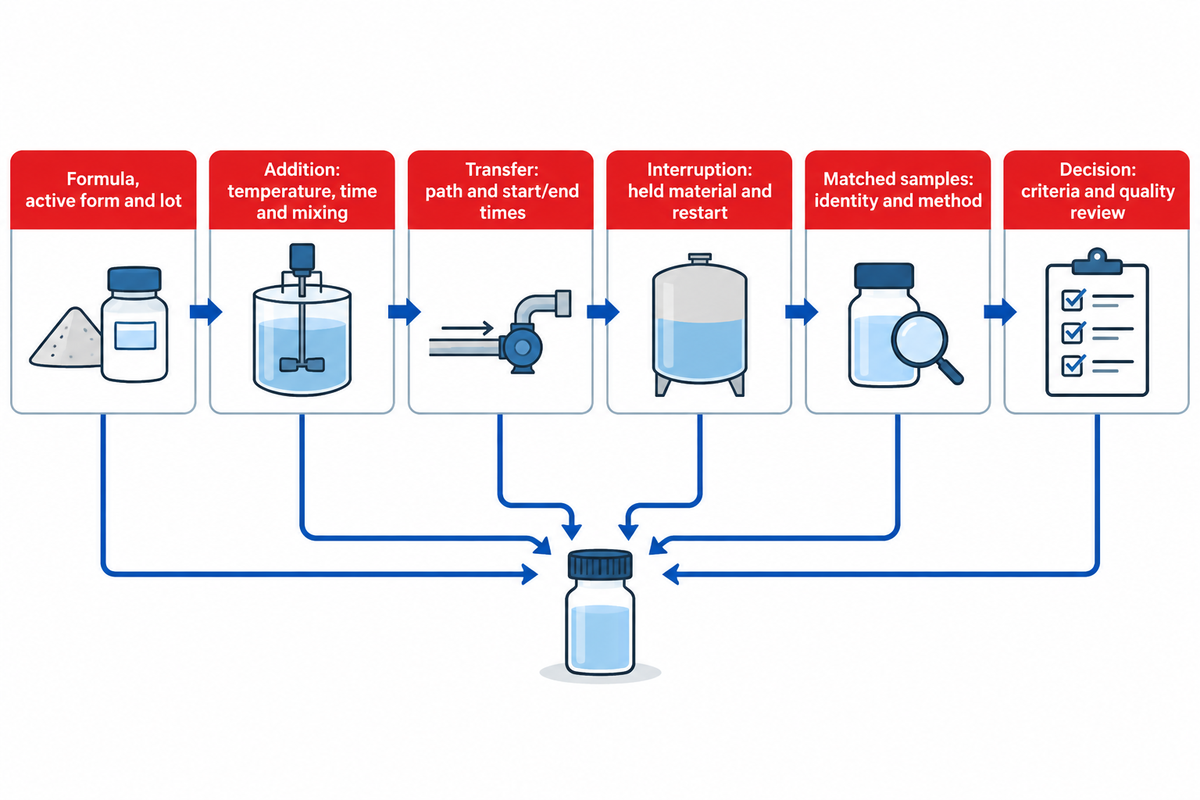
Process control means tracking the actual active-containing material from the time it’s added to the process, to the time it’s deposited. The temperature during the processing is important, along with the time, the exposure to oxygen and formulation. A useful trial connects that history to matching analytical samples, including planned interruptions. Nominal addition temperature of the material is just one of the many conditions the material is processed in.
Direct gummy research illustrates why ingredient form matters. A 2026 study of ISSI liposomal vitamin C gummies reported total preparation losses below 10% for its protected formulation, compared with approximately 25% for conventional vitamin C under comparable processing conditions. Its methods also describe a 150 L pilot batch. These results are for that formulation and the study; the authors had biotech and pharma company affiliations.
The same paper reports addition of its coated liposomal ingredient at 60-80 °C. Repeating this range for biotin, vitamin D3 or an unprotected vitamin C blend would alter the active system and the experiment. The main lesson is to trace the true route of the ingredient being manufactured.
Use the Heat-Exposure Trial Record
Place the record next to the material-flow chart. For each active-containing batch, link the following fields:
- Formula and ingredient: version, active form, ingredient lot and preparation identity.
- Addition: actual material temperature, timestamp, location and mixing conditions.
- Transfer: tank, hose or pipe path, hopper identity and start/end times.
- Interruption: stop time, restart time, material held in each location and disposition.
- Matched samples: collection time/location, sample ID, analytical method and result basis.
- Decision: agreed acceptance criteria, deviations and quality review.
Example: an assumed trial includes a 12 min packaging stop while active-containing mass remains in a feed hopper. A discharge-temperature reading taken before the stop misses the held material’s extra exposure. The record of the trial shows the stoppage and restarts, and where the material was held. Restart pieces are linked to sampling. Production also shows material that has been formed downstream of the depositor. Quality can then assess the sample against the recipe and remove or hold it as needed. The important outcome is an event and product relationship rather than a computer screen showing the temperature eventually returned to the target.
For a 12 min interruption, the relevant history includes where active-containing material waited and when that material reached the mould. Matching those timestamps to samples makes a restart review possible. The absence of a recorded holding history raises a different manufacturing query.
Verify Piece-to-Piece Consistency With the Active-Mass Accountability Map
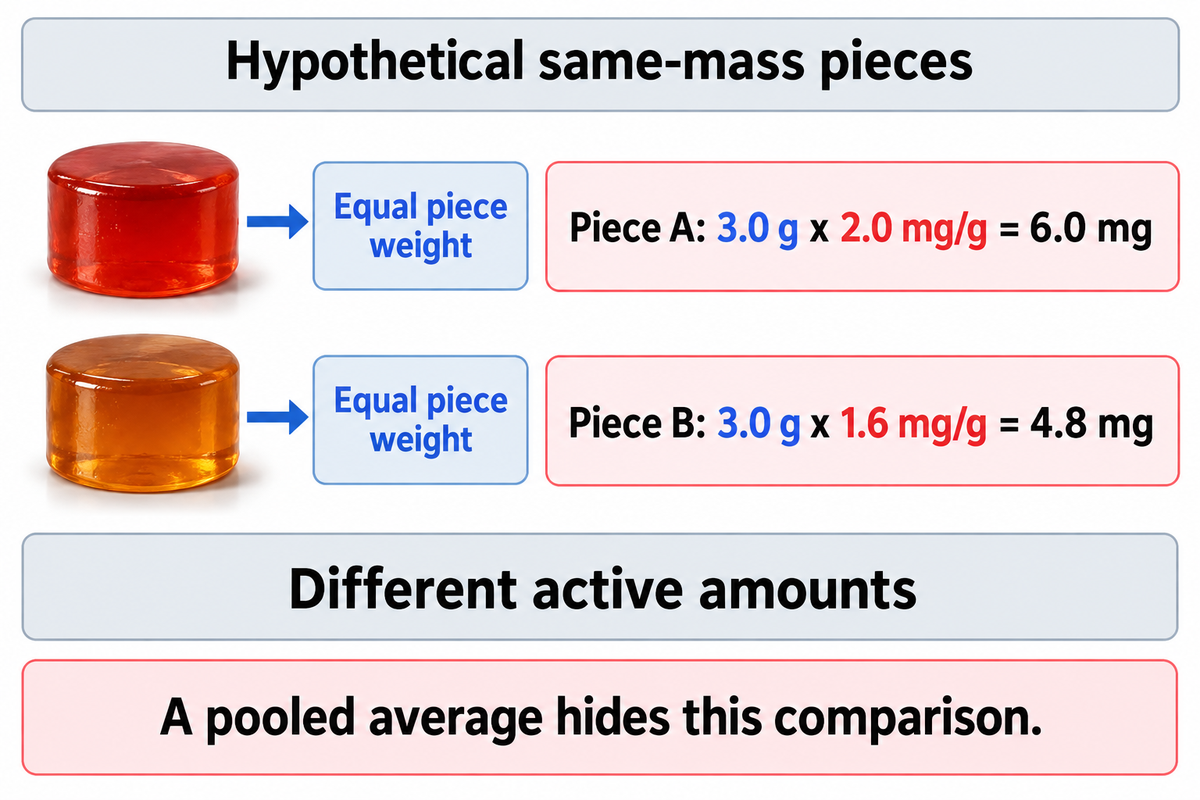
Assessing active consistency requires linked measurements of sample mass, active ingredient distribution and analytical performance. The depositor controls the mass delivered; the active consistency of that mass also has to be assessed. Sampling procedures must record production time and position so variations in active ingredient distribution can be distinguished from weighing variations and analysis variations.
“Nutraceutical production also calls for high dosing and depositing accuracy to ensure the right supplement content in the gummies”
Can uniform gummy weight prove uniform vitamin content?
No. Uniform weight describes mass variation; active content also depends on concentration. On the same measurement basis, active mass per unit is equal to unit mass multiplied by active concentration. For active mass to be uniform, active content also must be uniform. Many things can change active content, including variability of the active ingredient concentration and differences in piece mass within the batch.
Example: Two assumed uncoated pieces, each weighing 3.0 g. One contains 2.0 mg/g, and the other contains 1.6 mg/g, active content, on an as-is basis. Each contains 6.0 mg and 4.8 mg, respectively, of active mass. Both pieces pass an identical mass comparison, while their calculated active amounts differ by 1.2 mg. Using a unit comparison, the first piece contains a different active content from the second. However, sampling and assay variability should be considered before deciding that active content uniformity isn’t present. Combining both pieces for a single composite assay would describe the pooled sample average and would hide the individual comparison made here.
The Active-Mass Accountability Map assigns observation and decision-making ownership to each potential source of variation.
| Observation type | Traceable identifier | Question it addresses | Decision owner |
|---|---|---|---|
| Incoming active identity | Ingredient lot | Was the specified ingredient used? | Quality and dispensing |
| Weighed quantity | Scale and dispense record | Was the recorded quantity added? | Dispensing |
| Premix preparation | Premix batch and time | Was preparation performed as defined? | Production |
| Tank distribution | Sample position and time | Does distribution change within the planned sampling scheme? | Quality and process engineer |
| Piece mass | Nozzle and collection time | How does deposited mass vary? | Line operator |
| Individual-piece assay | Individual sample ID | What was measured in that particular piece? | Laboratory and quality |
| Composite assay | Defined pooled-sample ID | What average does this specified pool describe? | Laboratory and quality |
| Method recovery | Method and matrix validation | Does preparation recover the analyte adequately? | Laboratory |
| Analytical repeatability | Replicate preparation IDs | How much variation comes from the method? | Laboratory |
| Finished-batch disposition | Batch review record | Does the batch meet its established specifications? | Quality control |
As stated in 21 CFR 111.320, laboratory methods must be appropriate for their intended use and scientifically valid for the requirements assessed. The method is part of the measurement system. Label accuracy starts with connecting that measurement with the declared product and reporting basis. A third-party laboratory should receive the same sample identities and method requirements as an internal laboratory.
A single-laboratory folic-acid validation study employed dosage form-specific extraction, and evaluated recovery and repeatability. Funded by Pharmavite LLC and authored by its staff, the study used a gummy preparation that homogenized multiple pieces; laboratory replicates from such a preparation raise a different question from assessments of individual production pieces. A sampling plan should name the question it’s meant to address.
In the example given, the 3.0 g of the uncoated final product had an active concentration of 2.0 mg/g; thereby, each piece contained 6.0 mg of the active ingredient. It’s essential to retain the unit and basis of the sample. For example 2 mg/g of dry material and 3 g of the coated final product describe different quantities. The laboratory and the process team should agree on basis before judging piece-to-piece consistency.
Control Depositing, Water Activity and Packaging
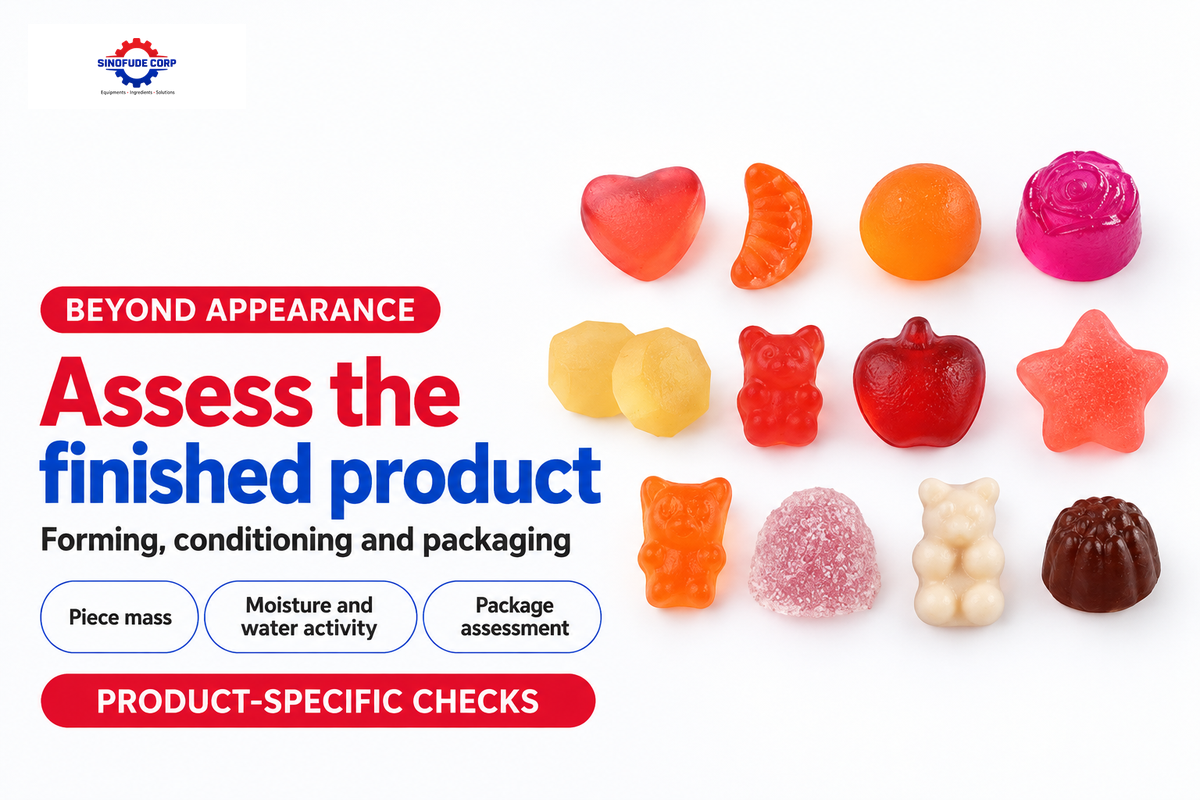
Depositing, conditioning and packaging may be treated as connected operations and may be measured separately. Piece mass and shape define forming. Moisture content describes the amount of water present while water activity describes the availability of water. Stability of a packaged product may be because of formulation, hygiene and selected packaging. Moisture management connects water measurement to the packaged product.
A gelatin-based gummy study by Vojvodić Cebin and colleagues followed botanical-extract formulations with different sugar and prebiotic systems for two months of storage. Appearance and texture outcomes differed, and some formulations developed mold. Those were specific botanical gummies, not a vitamin shelf-life validation. Their different outcomes explain why a sugar replacement should be evaluated in the finished package. A chewy product should retain its specified texture through the intended storage period. Microbial specifications and the required active content at the end of shelf life belong in the product assessment too.
| Symptom | Useful comparison | Action supported by the comparison |
|---|---|---|
| Mass drifts during a run | Mass by nozzle, time and material condition | Locate the change before adjusting the depositor |
| Flow changes after a stop | Material hold history and product temperature | Separate restart material and review the affected interval |
| Pieces stick during handling | Texture, conditioning history and coating state | Evaluate the complete finishing route |
| Texture changes in a bottle | Package/storage condition and formulation version | Investigate package and recipe together |
| Microbiological specification fails | Relevant samples, hygiene records and batch traceability | Place the batch under quality disposition procedures |
An anonymous production operator describes gummy-line troubleshooting in this discussion. Blocked nozzles are discussed, along with probe faults. The useful maintenance lesson is modest: compare a suspect instrument with an appropriate checked reference before changing the recipe around its reading. Anonymous accounts are prompts for troubleshooting, not diagnoses of other people’s factories.
The depositor forming section should be evaluated with the feed material it will receive. Packaging should have the intended gummy count, container and closure. Pleasing packaging aesthetics can’t compensate for closure or material systems that fail to meet the assessment of the product’s storage definition.
A 60 count bottle and a 30 count bottle place different piece demand on the same packer. At an assumed 100 bottles/min, they require 6,000 and 3,000 pieces/min respectively, before losses. Hence, matching packaging to depositing begins with count and piece mass, as well as the measured conditioning route.
Clean Changeovers and Keep Batch Records That Support cGMP
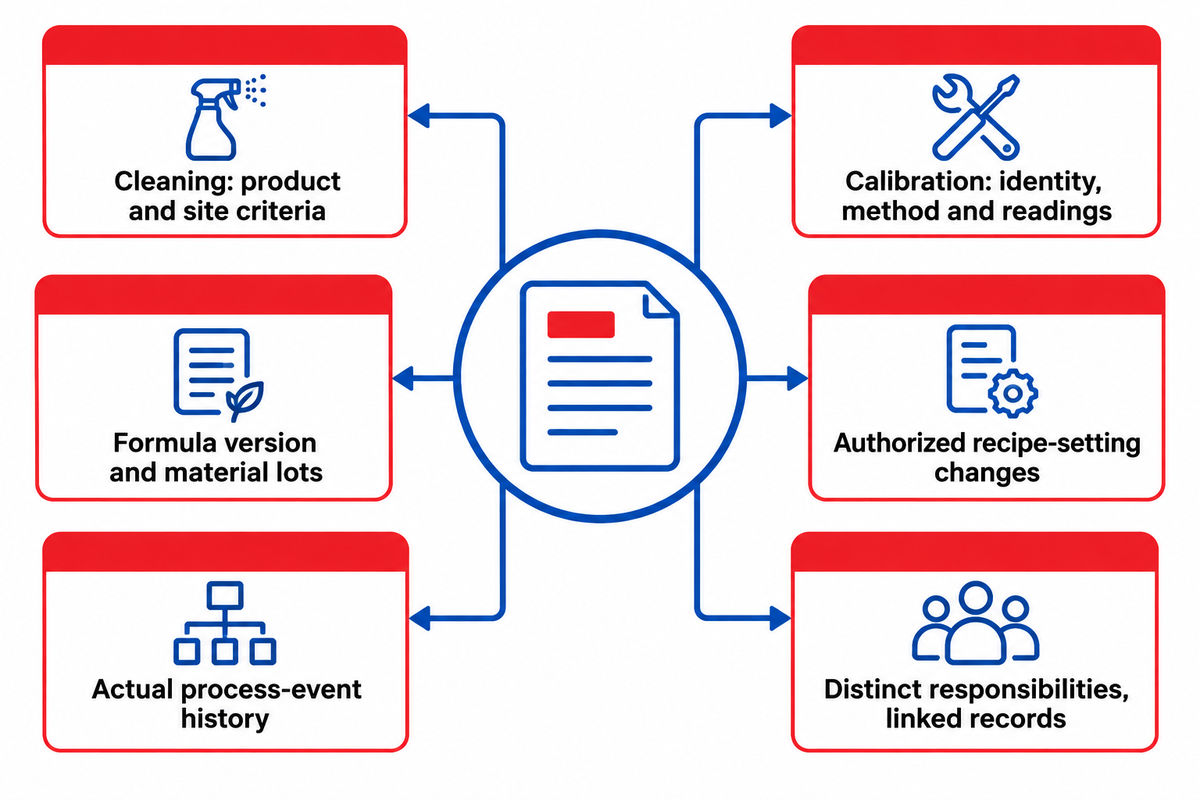
Implement cleaning, calibration and batch traceability in the production process. Operator-controlled changeovers rely on accessible contact parts and documented procedures. CGMP requires operating a quality system: Equipment suitability, approved controls and finished-batch decisions involve distinct responsibilities, even if records pertaining to the same production run reflect the same information.
For US dietary supplements, 21 CFR 111.30 and 111.35 address equipment suitability, calibration, controls and records. Calibration documentation includes the instrument identity, method, reference standard and actual readings. A temperature trend becomes more useful when those records establish what the instrument was measuring.
Product classification matters when the same factory makes ordinary confectionery and gummy supplements. 21 CFR 117.5(e) provides a conditional exemption from subparts C and G for specified compliant dietary-supplement activities. The provision doesn’t exempt every activity from all of Part 117. The operator’s quality and regulatory personnel should establish the applicable route for each product.
When conducting a changeover, operating personnel must determine where the previous material can remain: in preparation vessels, transfer connections, feed hoppers and contact parts. The method for cleaning contact parts as well as the acceptance criteria belong to the product and the site. Changeover from a single-active gummy to a multivitamin blend, for example, affects the type of residue; a single cleaning time conceals this type of information.
Documentation should connect the formula version to material lots, production observations and deviations. Access controls should allow only certain users to change recipe settings. An engineer reviewing a restart should be able to see the actual process event history, as opposed to just the most recent value displayed. During a quality audit, that history connects an adjustment to the person and batch concerned. These in-process controls support an investigation when the released result doesn’t meet the manufacturing expectation.
For two formulas sharing a 150 L vessel, the changeover record should identify both the previous product and the next product, along with the defined cleaning procedure and its outcome. The vessel size doesn’t give the customer much insight on the effort required to clean it. The type of contacting surface, the residue left behind, and the method utilized determine the effort required.
Plan Output and Cost Around Released Product
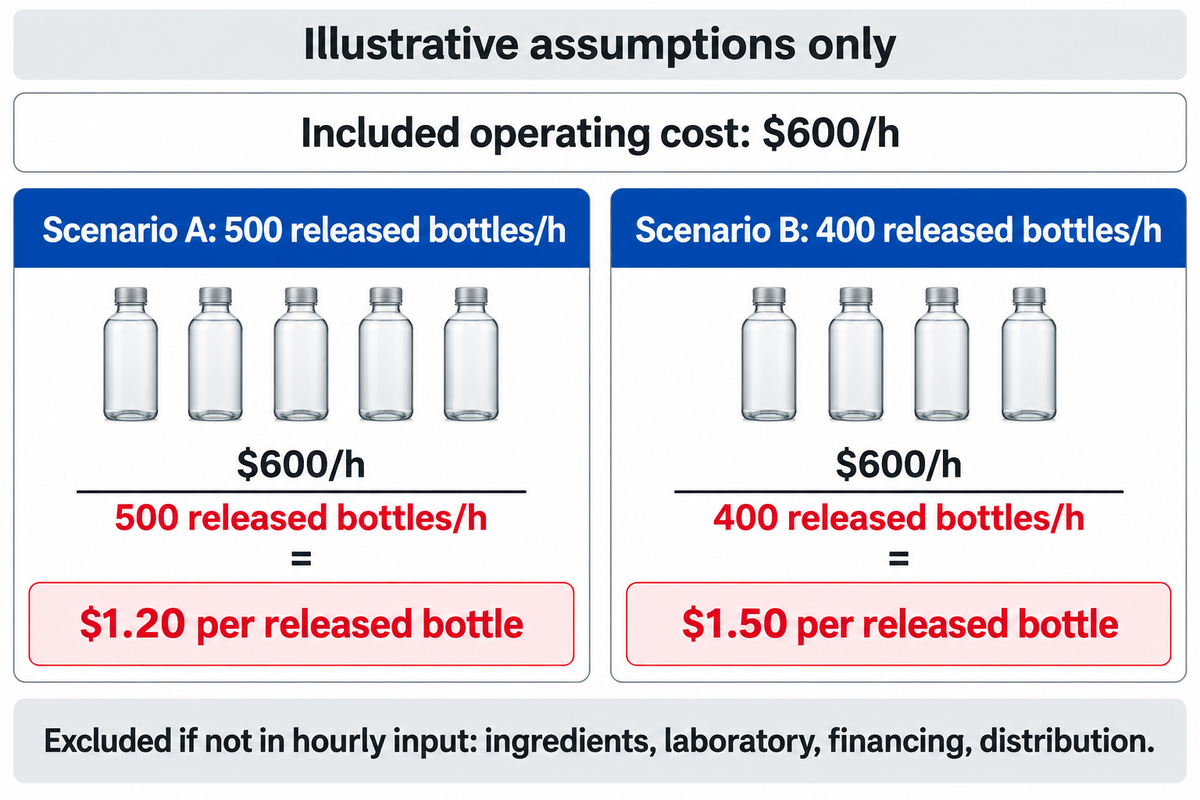
Compare production options using released product on the same specification. Estimate the output of the slowest sustained step, include the time for changeovers, and take into account the amount of product that was rejected. Provide evidence that connects those operations to the manufacturer’s batch release. The largest machine number is only one of several inputs for a plan.
Assumed inputs: One line deposits 100 kg/h of 3 g pieces, and a bottle contains 60 gummies. Each bottle contains 180 g before any difference in the accounting basis, so deposited mass corresponds to about 556 bottles/h. If 90 kg/h ultimately becomes accepted packed product on the same basis, the usable output is 500 bottles/h. An assumed $600/h operating cost then gives $1.20 per released bottle for the costs included in that hourly figure. A change to an assumed accepted output of 400 bottles/h adjusts the above to $1.50. Ingredient, laboratory, financing and distribution costs need their own entries if the hourly input excludes them.
How can I create my own supplement brand?
First, define a product, a manufacturing route and accept quality responsibility. As a contract manufacturer, a plant can provide production while the brand develops its market; owning a line places the equipment, staff and site with the owner. Compare both options with the same formula, testing, packaging and accepted-product specification; price per undefined gummy shouldn’t be used.
For private label work, the division of formulation ownership, testing and release responsibilities deserves the same attention as the price. Strong brands still need a product that can be manufactured consistently. Quotes for capsules and tablets aren’t direct gummy comparisons, because the preparation, forming and packaging route change. Gummy brands should align the operations included before comparing unit prices.
The pilot-scale planning route can help define the trial scope before committing to factory output. From a manufacturing standpoint, cost discipline means using the same denominator in every quotation: accepted pieces, accepted kilograms or released bottles, with the included operations identified.
At 3 g per piece and 60 pieces per bottle, 90 kg/h means 500 bottles/h on a mass basis. That relationship allows a discussion on capacity. The comparison should include observed losses, changeover times and the cost of quality of the actual product program.
Turn Recipe Trials Into Supplier Acceptance Evidence
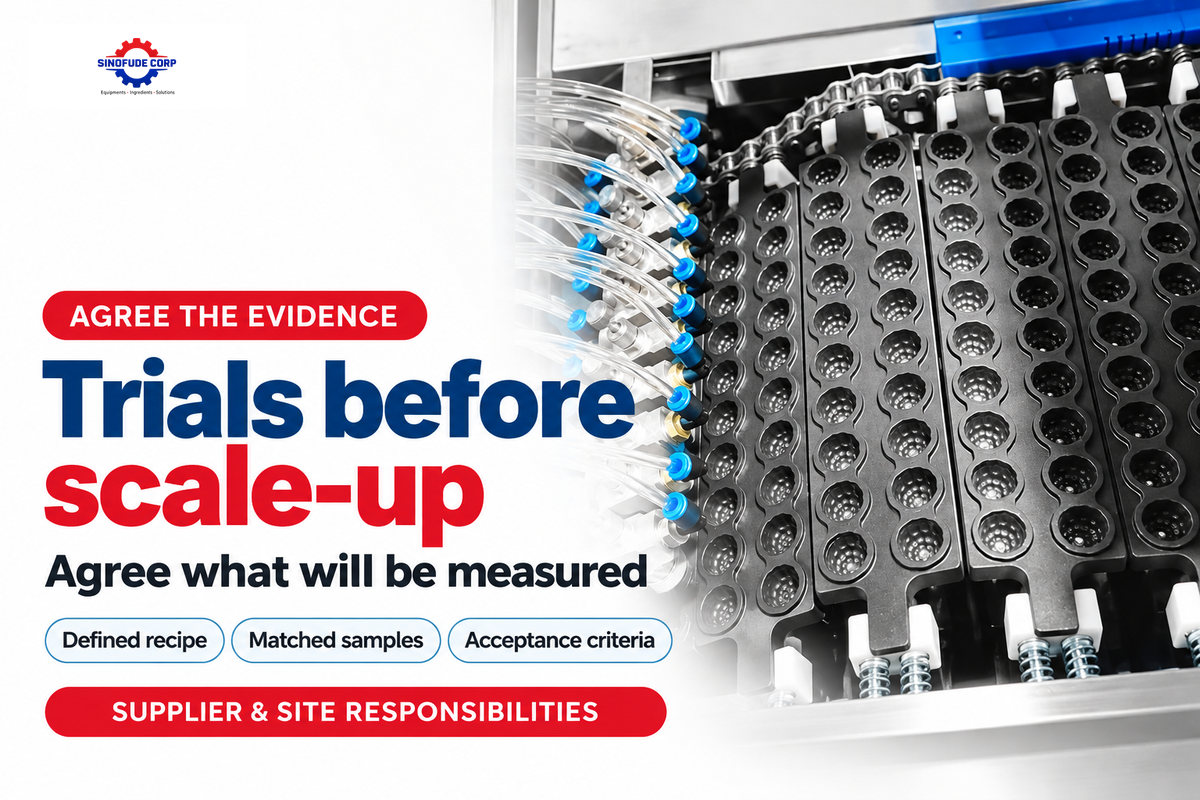
Define supplier trials around a specific recipe, operating sequence, and measurable acceptance criteria. The trial should identify what equipment functions and product observations are accepted, who supplies the material and who verifies the results. Factory automation testing, site equipment suitability and finished-batch release remain separate decisions in this arrangement.
The public description of IEC 62381:2024 describes the automation system acceptance against the applicable specification and agreement of responsibilities among the owner, purchaser and vendor. For US supplement manufacture, 21 CFR 111.123 assigns finished-batch approval and release or rejection to quality control personnel.
Prepare one trial brief before requesting equipment
- Define the product: gel system, active form, sweetener, target piece mass, shape and package.
- Identify the trial material: complete formula or placebo, ingredient lots and permitted substitutions.
- Agree the operating sequence: preparation, addition, transfer, depositing, planned stop and restart.
- Assign measurements: instruments, sampling locations/times, laboratory method and reporting basis.
- Set acceptance criteria: the actual agreed operating and product specifications, with deviation handling.
- Assign decisions: supplier function checks, site commissioning responsibilities and quality disposition.
A placebo trial can be used for transporting, depositing, and basic types of handling. An active-containing trial adds the ingredient system and raises analytical questions. Keeping the two records separate allows one not to accept the second set of conclusions from the first set of materials. The same distinction applies when an engineer uses a lower-cost test ingredient to commission part of the line.
SINOFUDE equipment spans confectionery, baking and chocolate production. For equipment scope, use our nutraceutical gummy line configurations to bridge a completed process brief with the commercial solution. The sampling map and thermal record capture the recipe and operating history for the discussion.
What Changing Gummy Programs Mean for Equipment Planning
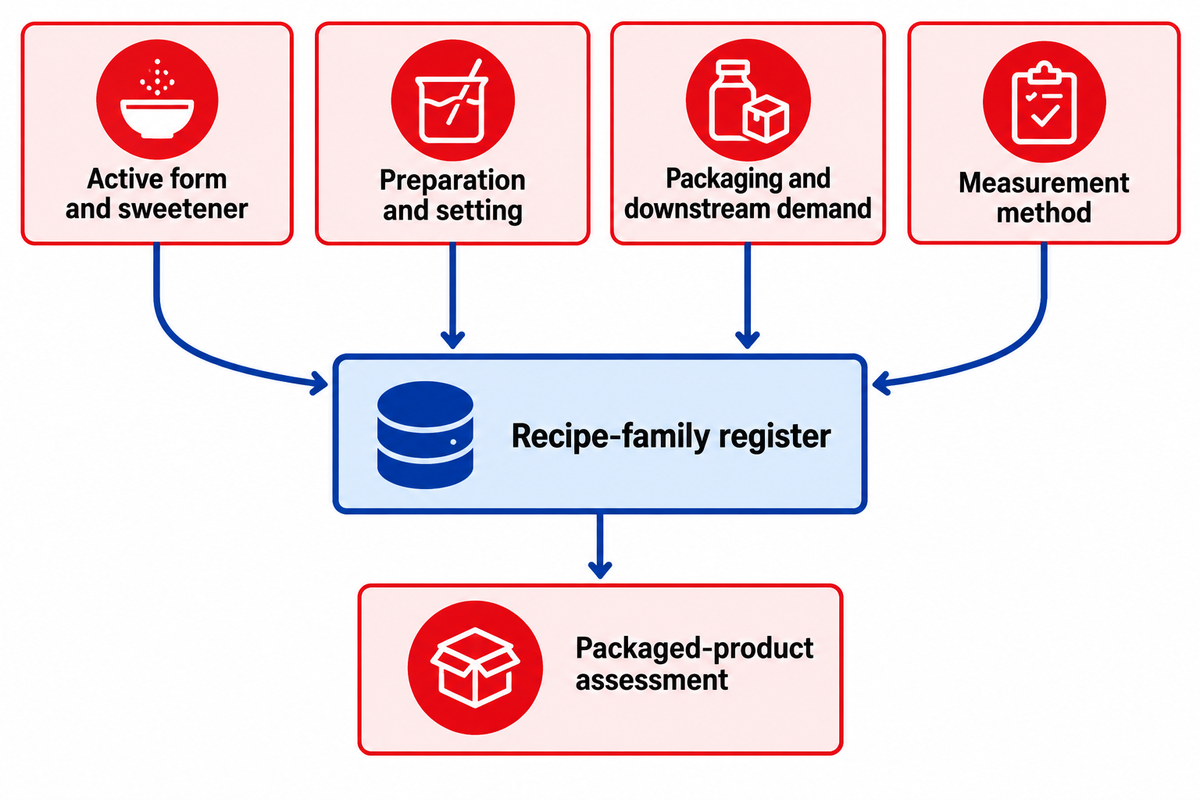
Identify which materials and measurement systems change with product modifications. A change of active form or sweetener can alter the method of preparation and setting. Changes in product packaging can affect downstream demand. Expanding the business by adding a new product requires planning so the product inherits a controlled route instead of using an unrelated recipe’s settings.
A gummy multivitamin, a single-vitamin product and a fish oil gummy are different formulation projects. Marketing terms, such as non-gmo, also require a defined ingredient and supply chain. Considering such a term as a machine feature changes the product requirement to a buzzword. Whether vitamins and supplements stay stable is a finished-formula and packaging question. The identity and the amount of essential nutrients also warrant their own product specification.
Research on protected vitamin C demonstrates active-form development, and the botanical gummy storage experiment demonstrates the effect of changing the base. Neither requires a market forecast to be significant in a factory. The practical question from a manufacturing perspective is whether the next formula changes the equipment operating window, the analytical method, or the packaged-product assessment.
Keep a recipe-family register beside the production plan. For each family, link the approved process, the relevant contact parts, measurement methods, and packaging. For an overview of the equipment, our page on gummy production systems places these choices within the full line. For your next trial, please send SINOFUDE your formula and production brief.
Frequently Asked Questions
What equipment belongs in a vitamin gummy production line?
A typical scope includes ingredient preparation, syrup cooking, gel preparation, active addition and mixing, depositing, setting or conditioning, finishing and packaging. The boundaries of supply should be specified for each transfer and its control. The same assigned responsibilities apply to site utility and laboratory services, even when they are operated or provided separately from the equipment.
When are vitamins added during gummy production?
Vitamins are generally added in the established complete active system and recipe at a later stage, after preparation of the base syrup. Operating sequences should account for ingredient form and its history of holding. Record the actual temperature of the material, the time of exposure and the results of a matched sample instead of choosing a universal addition temperature for every vitamin.
What should a buyer measure during a gummy line trial?
Measure the product and process characteristics named in the trial specification: material temperature and timing, relevant solids or pH readings, deposited mass, forming behavior and the required analytical results. Samples should be retained with identities for formula, batches, locations and times. The laboratory should use the appropriate methods for the material and the questions addressed.
Does a starchless gummy line eliminate conditioning?
No, a starchless route changes forming and handling of the product, while the finished recipe still needs its defined setting, moisture, texture and packaged-stability controls before it’s released.
How do I compare a contract manufacturer’s quote with an owned line?
Evaluate the cost per accepted product for the same specification. Consider formula ownership, ingredients, testing, packaging, changeovers, material rejected, and the operations covered by the quote. An owned line also needs site utilities, staffing and maintenance arrangements. The price per deposited kg may not reflect the cost per released bottle. Keep unpriced items visible.
Can an equipment certificate replace supplement quality records?
No. Equipment documentation and the manufacturer’s production records address different responsibilities. The operator still requires applicable process controls, appropriate testing and quality-control finished-batch disposition procedures.
What information helps SINOFUDE discuss a gummy project?
Describe the gel and sweetener system and the active ingredient’s form. State the target piece’s mass, shape, packaging and expected schedule of work. Give the proposed trial material and any known constraints for that material. A clear brief states what measurement methods will be and the operating sequence. That information lets the equipment discussion focus on the actual material routing and required functions. Commercial configuration and quotation details may then follow the process description and a focus on an hourly-capacity target may not be necessary.
References & Sources
- 21 CFR Part 111, Subpart E: production and process controls.
- 21 CFR Part 111, Subpart D: equipment and records.
- 21 CFR 111.320: laboratory methods.
- 21 CFR 117.5: exemptions.
- 21 CFR 111.123: finished-batch quality control.
- Fan et al., LM-pectin/sodium-caseinate salt study, 2021.
- ISSI liposomal vitamin C gummy study, 2026.
- Folic-acid analytical method validation, Journal of AOAC INTERNATIONAL, 2024 issue.
- Vojvodić Cebin et al., botanical gummy stability study, 2024.
- IEC 62381:2024, official public scope.
- Daisy Phillipson, functional ingredients feature, 2024.
WHY WE SHARE THESE GUIDES
About SINOFUDE Insights
SINOFUDE designs and manufactures production lines for confectionery, chocolate and bakery products. These guides help equipment buyers and engineering teams compare process routes, recipe requirements and line layouts before discussing a project.
- Gummy and jelly depositing
- Hard candy and lollipop processing
- Cooking, cooling and packaging
- Equipment selection and line planning