Get in Touch with SINOFUDE Company

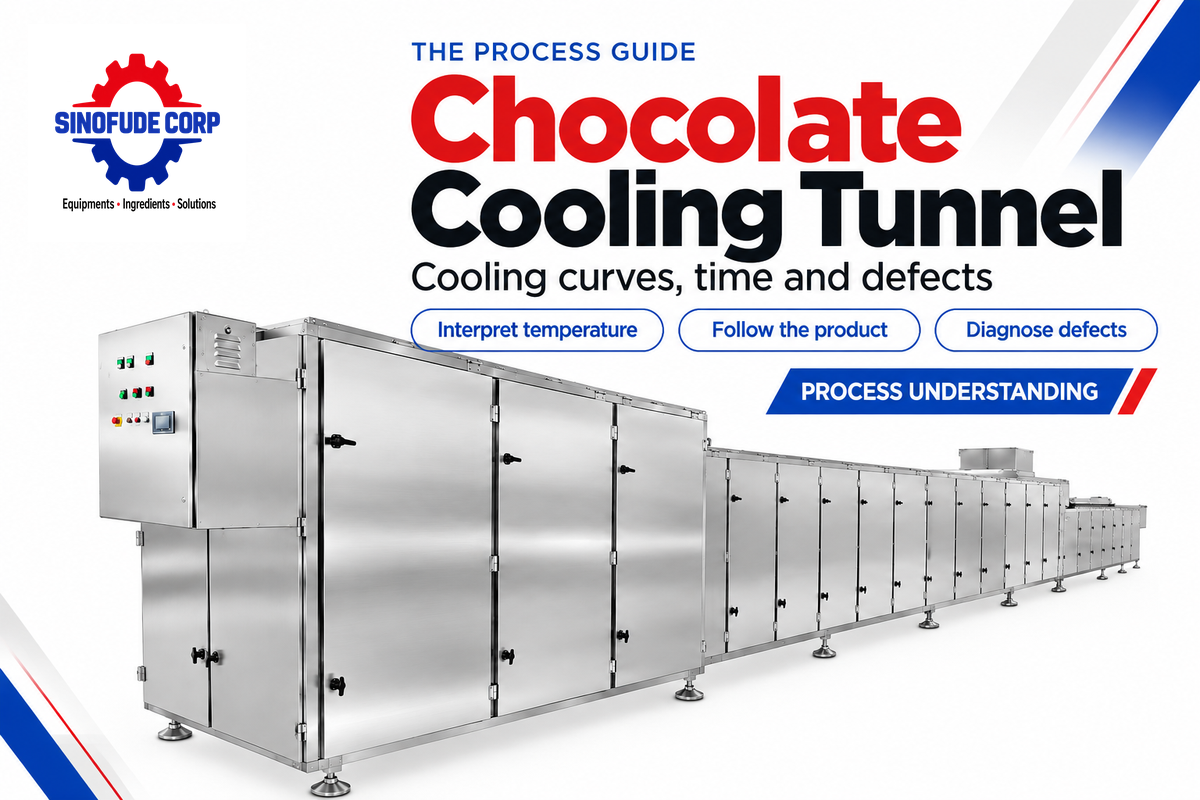
A chocolate cooling tunnel transports moulded or enrobed products through the controlled cooling air stream to enable the chocolate to set before demoulding or packaging. Good results are obtained by matching heat removal to the chocolate and the geometry of the product and next processing step. Belt time is important, as are temper, air flow and humidity around the outlet.
This guide will discuss what happens internally in a tunnel, how to interpret temperature and time, and where to look when chocolate appears dull or cracked, and/or contains moisture. For the processes that happen prior to and after cooling, please see our forming, cooling and finishing in chocolate production.
How Does a Chocolate Cooling Tunnel Work?
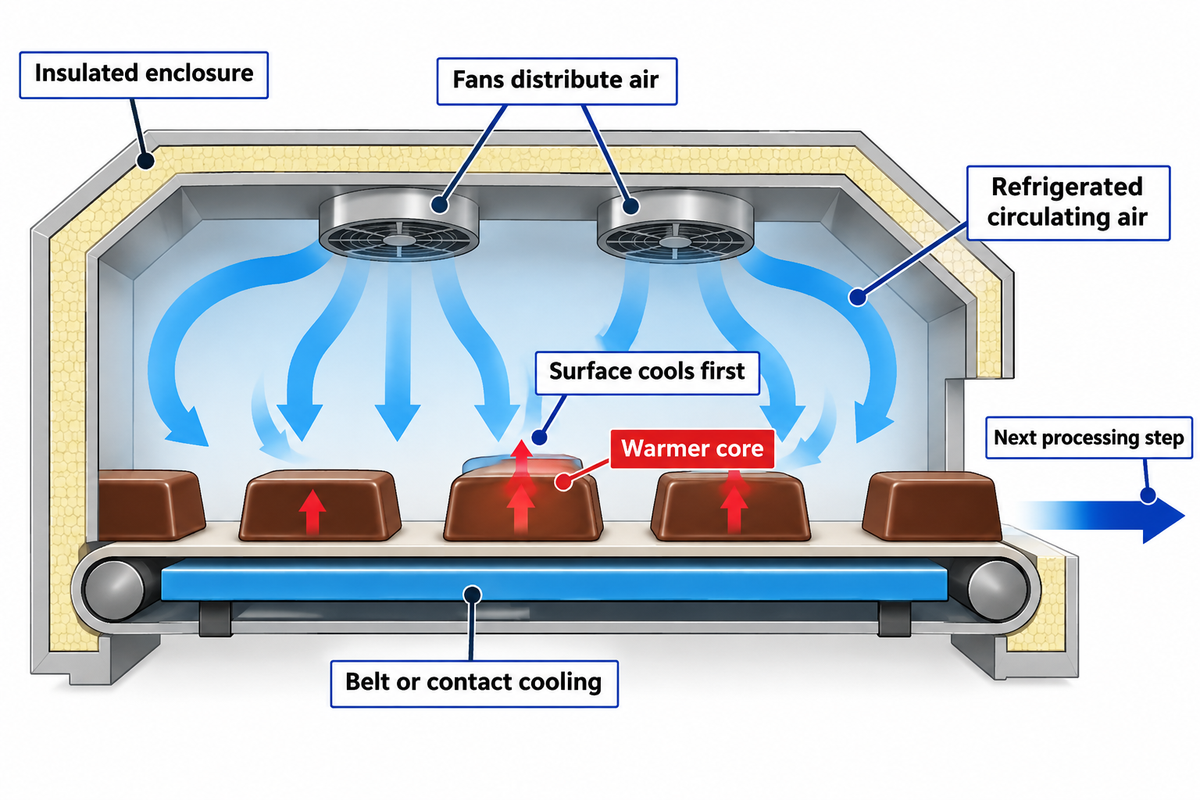
A chocolate cooling tunnel removes heat by conveying product through an insulated enclosure. Refrigeration cools the circulating air, which fans move over the product. In an adequately prepared chocolate, cooling accompanies further crystallization and contraction until the product is ready for the following processing step.
Consider the center of the chocolate and the surface as two locations that are on the same path. Air will always reach the surface first. Heat will be transferred from the warmer core outward and can take longer to do so. As a result, a firm outer shell can surround a warmer core, especially in thicker bars or products that are loaded with a lot of fillings.
Convection transfers heat to moving air. These cooling tunnel systems can also cool products through the belt or a contact surface beneath them. The balance changes with the machine design and whether chocolate sits directly on a belt or inside a mold. An enclosed conveyor helps organize the cooling environment, but air distribution still has to reach the loaded product.
Industrial cooling tunnels may have a horizontal path or a vertical arrangement that carries molds through several levels. Those layouts change the transport route and the amount of floor space required. Uniform cooling requires air to reach the product; spacing, return-air paths and mould handling all affect that access.
Cooling is part of a connected food processing operation. The upstream depositor or enrober establishes the incoming load, and the downstream machine determines how firm the product must be. Our guide to chocolate depositing describes upstream operations that create the shapes and fill weights the tunnel receives.
Tempering, Crystallization and the Cooling Curve
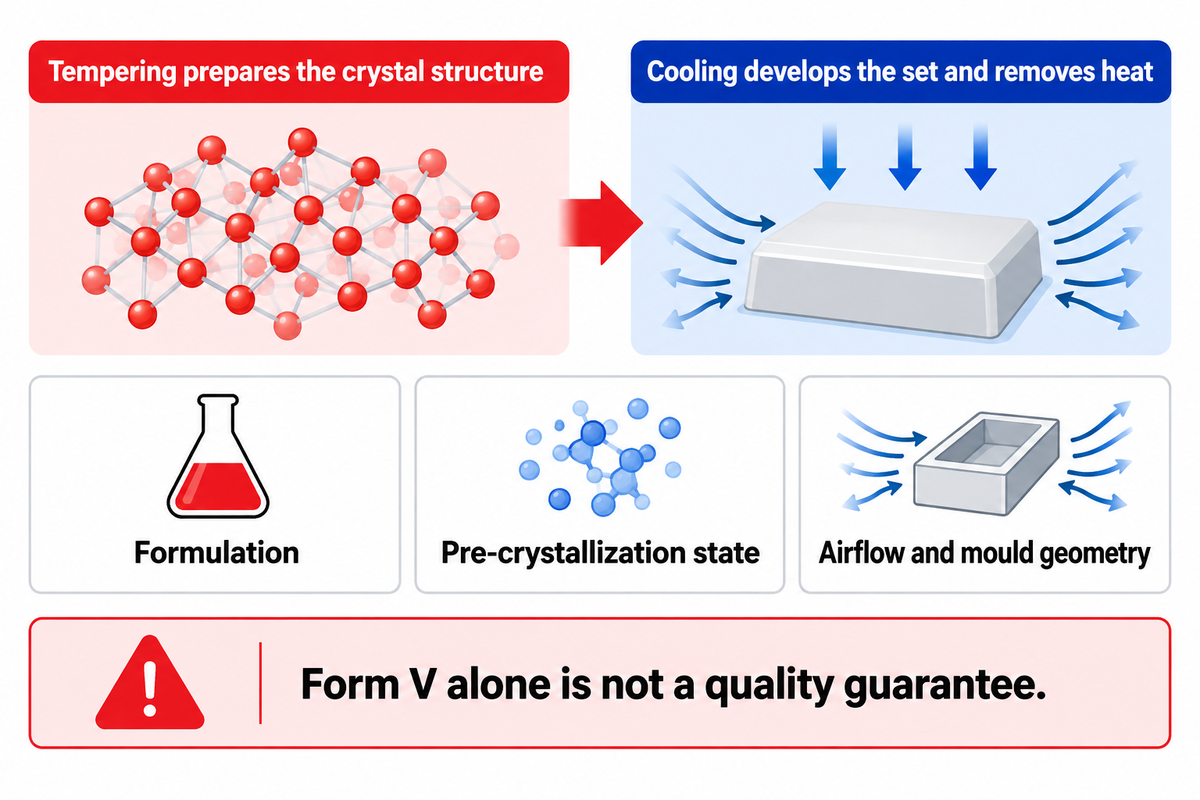
Tempering of the chocolate prepares its crystal structure; tunnel cooling completes the set and removes heat. These operations occur in a given sequence. A cooling curve describes temperature over time, but the final structure also shows what happened before cooling, including the chocolate’s formulation and pre-crystallization state.
Cocoa butter can take on different crystal structures. Form V is predominantly associated with desirable chocolate properties, but naming it so doesn’t describe the complete crystal network. The 2025 academic paper Chocolate tempering: A Perspective contests that Form V in and of itself assures high-quality and bloom resistance in chocolate.
The cooling of chocolate removes sensible heat as temperature falls, and latent heat as crystallization proceeds. The overlap of these processes may be indicated by a change in the slope of a recorded curve. Reading only the final temperature provides no history of this overlap. Two bars with the same surface reading may have taken different routes through crystallization.
Airflow is also part of that route. A 2021 pilot-scale study of moulded dark chocolate related local heat transfer, mold geometry and contraction to wall detachment. Its results help explain why a cavity near an air path can behave differently from one in a sheltered position, even when both pass through the same temperature-controlled enclosure.
For a product that releases poorly, start by comparing the temper entering the tunnel and the position of the sticking cavities. Buying more refrigeration capacity addresses heat removal; however, it leaves an upstream tempering issue in place.
Chocolate Cooling Temperature and Time
ASHRAE’s 2018 Refrigeration Handbook gives about 7–8 minutes as a typical reference for milk-chocolate enrobing tunnels and stresses application-specific testing. For this practice, take that suggestion as a scoped starting reference. Thick moulded bars and different filled and coated products have different heat transfer paths and handling endpoints.
The ASHRAE confectionery chapter describes the process conditions, and doesn’t prescribe one universal cooling recipe. Useful production records identify the product and process conditions: recipe, weight, thickness, incoming condition, mould or belt, and the next operation.
Which temperature am I actually measuring?
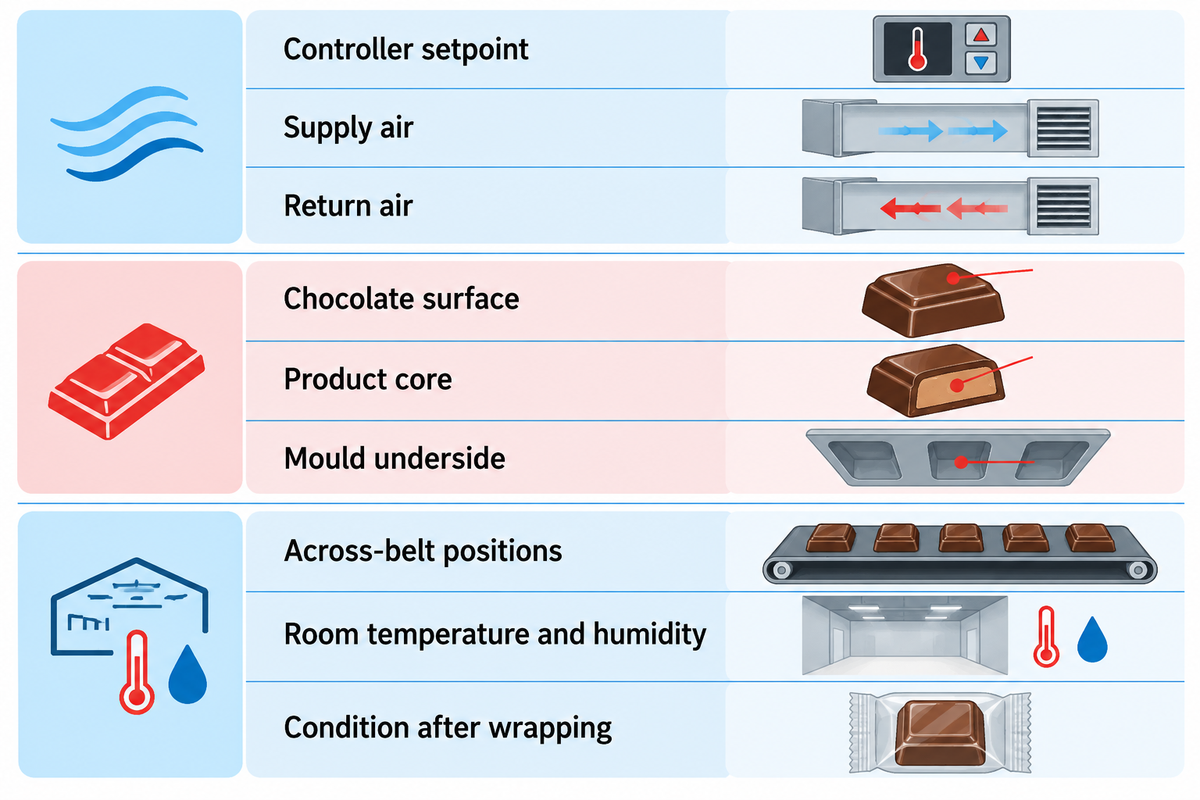
An air setpoint indicates what the control system is aiming for, and a product reading describes chocolate at the location of interest. Precise temperature control of air still leaves the product’s internal response to consider. Supply and return air, surface and core temperature answer different questions. Label the location and instrument before comparing values across batches.
| Observation | What it tells you | How to use it |
|---|---|---|
| Controller setpoint | Requested air condition | Compare with measured air, rather than treating it as product temperature. |
| Supply air | Air delivered toward the load | Record its position within the zone. |
| Return air | Air after passing through the space | Interpret alongside the load and supply reading. |
| Chocolate surface | Condition at the exposed face | Compare with local dew point during transfer. |
| Product core | Internal thermal response | Use an appropriate representative test product. |
| Mould underside | Condition along a contact and airflow path | Compare sticking cavities with release patterns. |
| Across-belt positions | Possible spatial differences | Compare equivalent products at the edges and centre. |
| Room temperature and humidity | Surrounding air condition | Determine dew point near the actual transfer route. |
| Condition after wrapping | Response beyond the tunnel | Check whether a defect develops only after sealing or storage. |
This matrix describes a process and measurement framework that incorporates findings from the cited heat transfer research and dew-point principles. It differentiates observations that are typically lumped together under the term “cooling temperature.”
Should I lower the temperature or slow the belt?
A warm centre with an already firm surface requires a different comparison from an entire row that remains soft because airflow misses it. Lowering the air temperature changes the thermal driving force. A belt moving slower increases exposure time. Select the adjustment that addresses the observed issue.
In the cited pilot study, researchers tested air at 2 °C, 12 °C and 18 °C, with mean air velocities of 1.5 m/s, 3.5 m/s and 6.0 m/s. Those were experimental levels for a specified dark-chocolate and mould arrangement. Transferring the coldest setting directly to a different product would discard the conditions that gave the result meaning.
Keep loading pattern and recipe unchanged when evaluating a process change. Record responses at the same measurement locations. The cooling curve therefore can be useful for control, rather than becoming a set of random or unrelated observations.
Why Condensation Appears at the Tunnel Exit
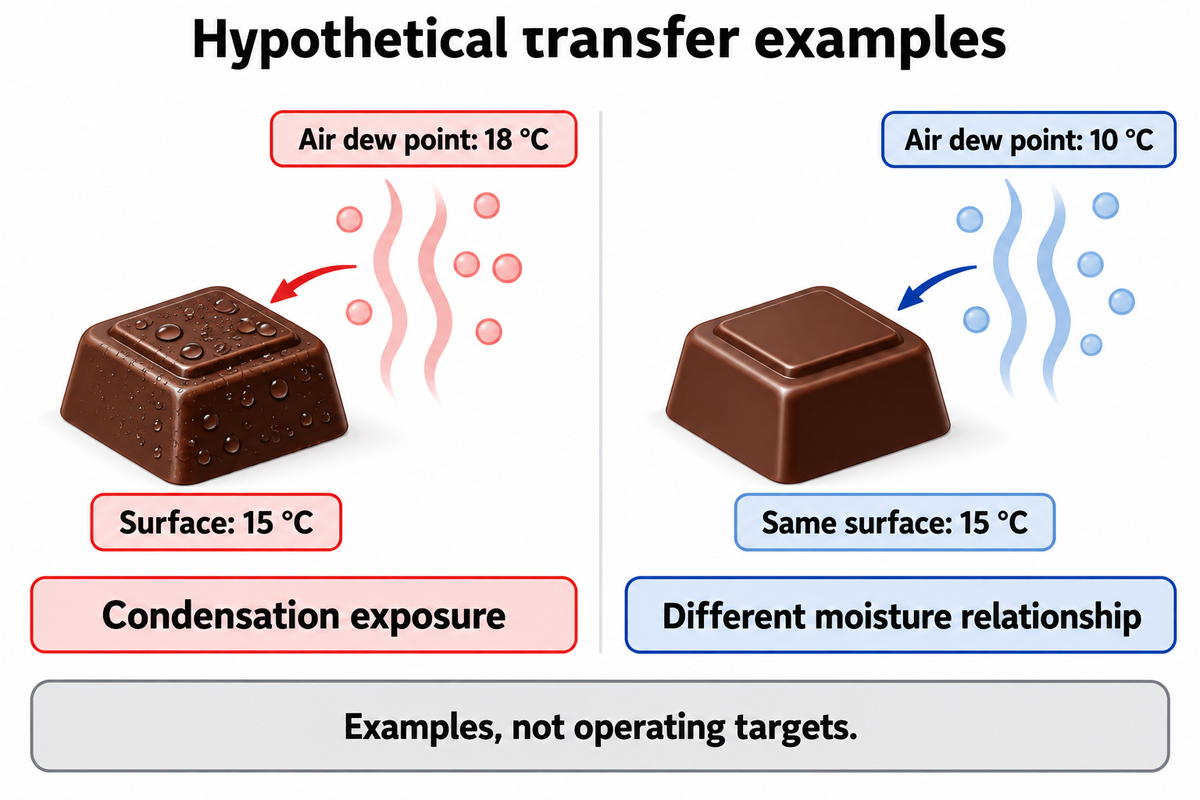
Condensation occurs when a cold chocolate surface comes in contact with air that has a dew point temperature that’s at or above the surface temperature. The critical air may be at the outlet, on the transfer belt or near the wrapper. Relative humidity is useful in combination with the temperature of the air.
According to the US National Weather Service explanation of dew point, dew point is the temperature at which air becomes saturated when cooled at constant pressure. Unlike relative humidity, dew point gives a temperature that can be compared to a product surface.
“The higher the dew point rises, the greater the amount of moisture in the air.”
For a hypothetical transfer, a surface at 15 °C (59 °F) entering air with an 18 °C (64.4 °F) dew point is exposed to condensation conditions. Moving that same product into air with a 10 °C (50 °F) dew point changes the relationship. These examples explain the comparison; they aren’t proposed operating targets.
Therefore humidity control is part of the ambient transfer environment and tunnel. An open doorway, nearby wet cleaning or a different packaging room can change the air the product encounters. Measure air near the product rather than borrowing a distant reading from a wall sensor.
Moisture can leave a visible defect after it disappears. Michigan State University Extension explains that surface moisture draws out sugar; evaporation can then leave white sugar crystals. That mechanism helps distinguish sugar bloom from a problem caused by fat crystallization or migration.
Moulded, Enrobed and Filled Products Cool Differently
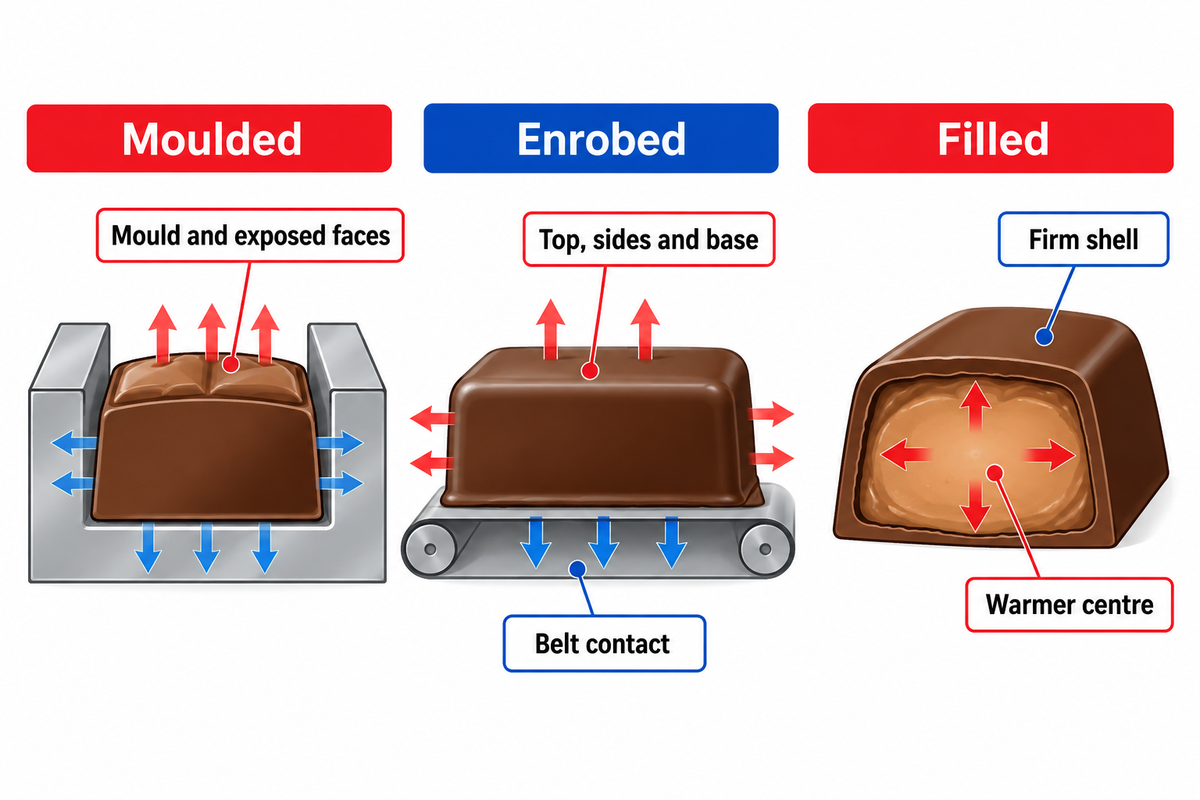
Moulded products cool through a mould and exposed faces, enrobed pieces carry a coating around a centre, and filled bars combine materials with different thermal responses. Product thickness, contact surfaces and the condition of the centre can matter as much as the nominal chocolate type.
In moulding, the chocolate separates from the cavity wall due to contraction. Mould material and geometry influence heat transfer, so changing the mould can alter release behavior even when the chocolate recipe is unchanged. Air reaching the underside of the mould deserves attention alongside air that’s passing over the exposed surface.
The top coating, side coating and base may differ in thickness and contact with the belt.
A decoration can remain vulnerable after the main coating feels firm. Continuous chocolate handling must take vulnerable areas into account at each transfer.
A filled bar may have a firm shell while its centre remains warmer. Filling composition also matters after cooling because migration and storage changes can affect appearance and texture. A 2021 study of filled chocolate bars found that an investigated treatment improved resistance to fat bloom while reducing initial sensory quality. A glossy surface and a bloom-resistant product are separate quality outcomes.
Products such as chocolate-coated cake or pastry add another center to the cooling task. Assess the complete confection, including its base and decoration, rather than applying a plain-bar setting to every chocolate product on the line.
Cooling Tunnel vs Cooling Room
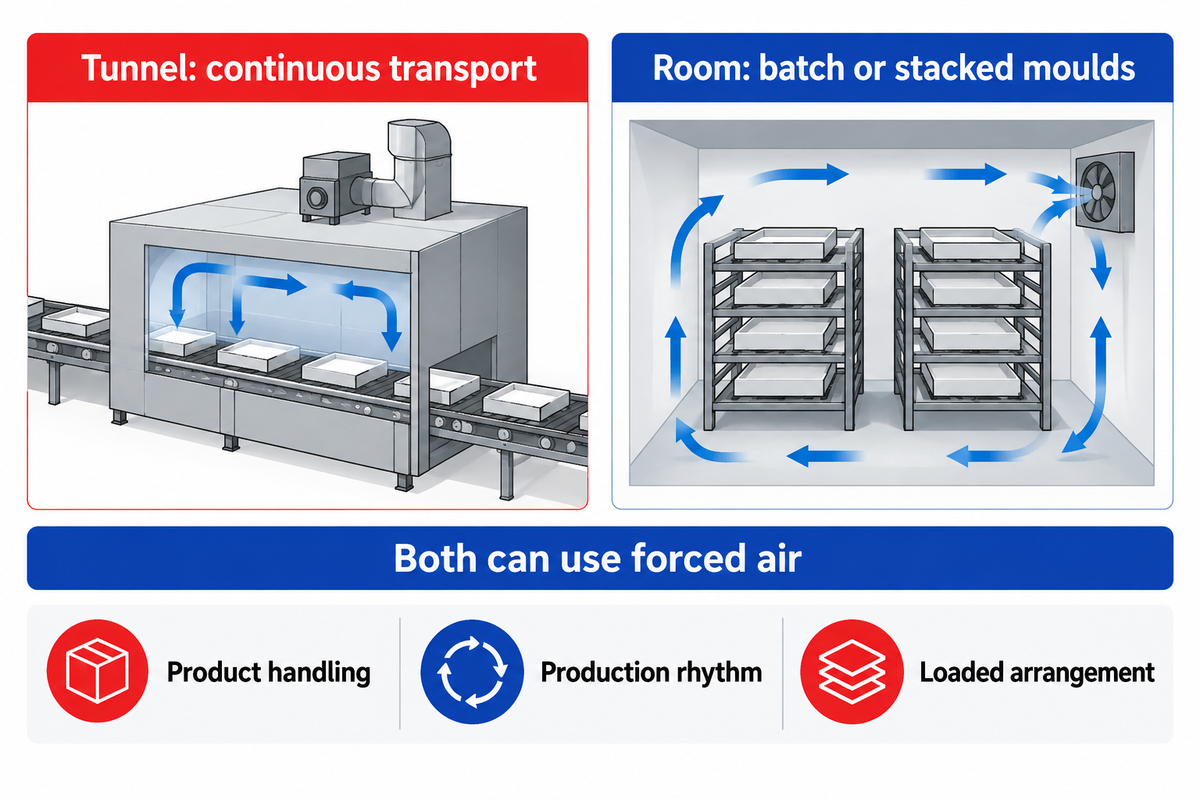
A tunnel supports continuous transport through a cooling path; a cooling room can hold batches or stacked molds. Both can use forced air circulation. The main consideration is product handling, production rhythm and control of the loaded arrangement rather than a general quality edge for one enclosure shape.
ASHRAE defines both continuous mould cooling and stacked moulds in forced-circulation rooms. A room can use fans to circulate air through its load. Likewise, a conveyor system needs to have air move around its load to attain even results.
Batch cooling solutions can adapt to a process that has planned holding periods or frequent changes in product. A continuous path can save repeated handling where depositing, enrobing and packaging already operate as a linked production line. Product movement is the main consideration to evaluate first.
Access and handling should also be included when assessing the effects of space comparisons. A vertical tunnel may take up less space on the factory floor, but it may introduce a different mould transport route. A room should have space for loading, unloading and moving air around the stored product. Before awarding a capacity advantage to either option, compare these working arrangements.
Diagnose Bloom, Cracks and Poor Release
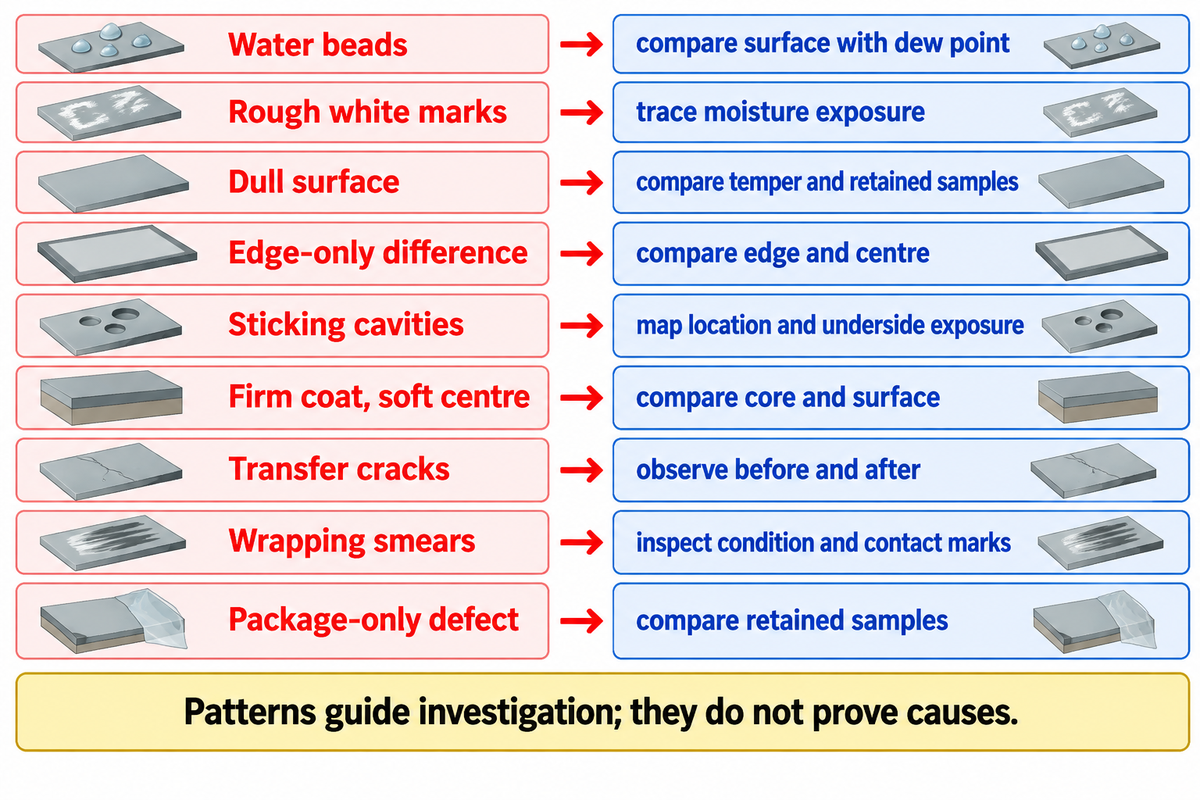
Begin the diagnosis of a chocolate cooling defect with the description of where and when it occurs. There can be multiple causes for white marks, cracks and poor release. A defect that occurs at discharge is to be investigated differently from one that occurs after wrapping. Likewise, an edge-only defect is to be investigated differently from a whole batch defect.
| Defect category and pattern | Competing explanation to examine | Next controlled comparison |
|---|---|---|
| Water beads during transfer | Cold surface meets humid air | Compare surface temperature with local dew point along the route. |
| White rough marks after moisture dries | Sugar bloom following condensation | Trace moisture exposure and when the marks first appeared. |
| Pale or dull surface without obvious moisture | Temper, fat structure or later storage changes | Compare incoming temper and retained samples over the same period. |
| Only belt-edge products differ | Spatial airflow or loading differences | Compare matching pieces at edge and centre positions. |
| Only certain mould cavities stick | Local heat transfer, geometry or mould condition | Map the cavity pattern and check underside exposure. |
| Coating sets but centre stays soft | Unequal internal and surface response | Compare core and surface readings on representative pieces. |
| Cracks appear near a transfer | Thermal history or mechanical handling | Observe the piece immediately before and after that transfer. |
| Smears occur at wrapping | Incomplete set or contact with handling parts | Compare product condition before contact and the location of each mark. |
| Defect develops only in the package | Trapped moisture, migration or storage exposure | Compare sealed and unsealed retained samples under recorded conditions. |
The matrix combines the cited crystallization, mould-cooling and condensation mechanisms into a troubleshooting sequence. The rows don’t represent causes by themselves.
What changes when the defect appears only after transfer?
Investigate downstream. Examine room air, contact points, wrapping, and later temperature exposure. A dry outlet sample only describes that specific moment in time. Compare an undisturbed, retained sample to a sample that has been handled normally to determine when their behavior differs.
There must be instrument checks before a difference is interpreted. Measurement precision begins with a consistent method on comparable pieces and a thermometer within its calibration, as an altered reading may reflect the instrument or location rather than a changed cooling process.
How Belt Speed and Loading Affect Cooling Time
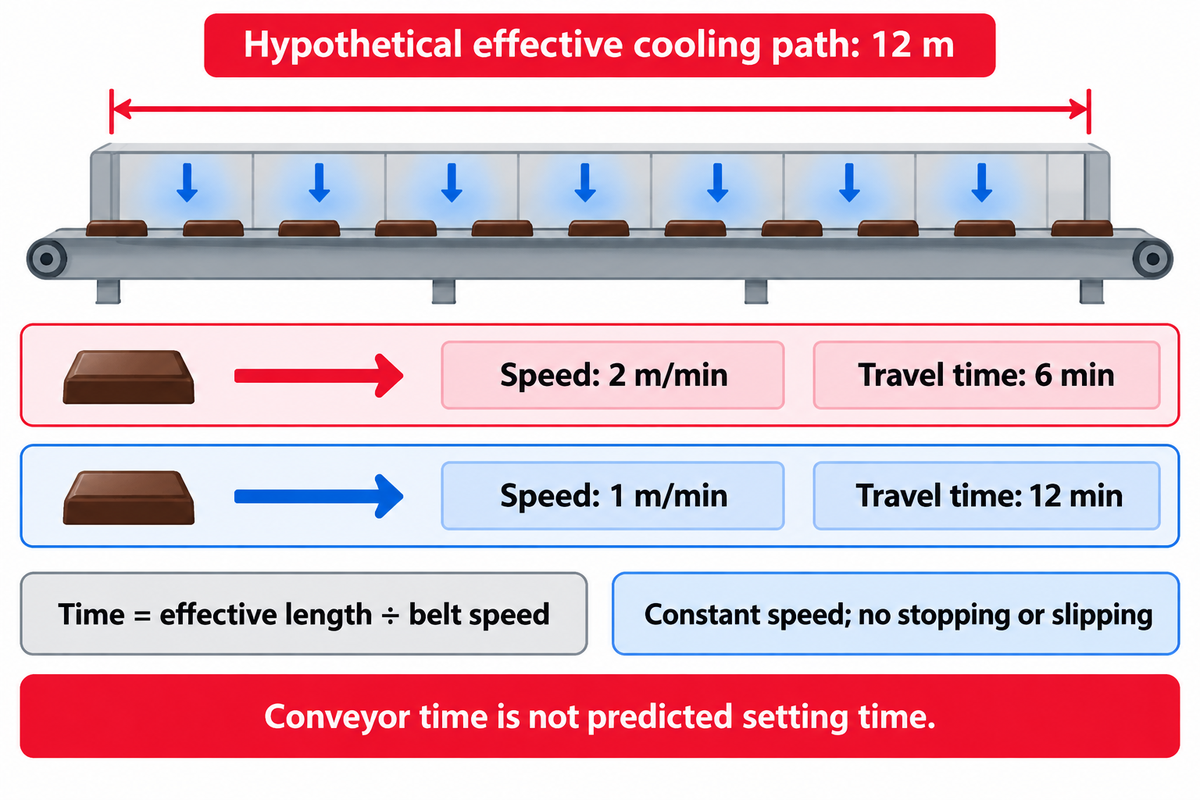
For a product that’s continually moving at constant belt speed, with no stopping or slipping, residence time equals effective travel length divided by belt speed. Residence time and travel time are the same in this case. Adding more products would affect the thermal load on the cooling system and possibly impact air flow to the product.
The basic relation is the well-known distance-speed-time equation (described by NASA’s constant-velocity explanation) for a hypothetical effective cooling path of 12 m at a speed of 2 m/min. Applied to that hypothetical effective cooling path, it gives 6 min of travel. At 1 m/min, travel time would increase to 12 min. These are conveyor times and not the predicted setting times.
Use the actual product route. Length of a cabinet can be different from effective length of cooling. Entry and return paths, and multiple levels can also change the length of effective cooling. Changes in product speed can also affect the simple constant-speed example.
Loading also belongs in the product record: piece mass, lane spacing, occupied belt width and mould arrangement. Loading directly affects how much heat is introduced per minute. An increase in load may block air paths. Wider lane spacing changes exposure without changing the nominal residence time.
Accepted throughput is a line result. If the wrapper damages a fragile decoration or the next transfer smears the base, a higher belt speed hasn’t produced more saleable chocolate. The chocolate production stages around cooling show where cooling connects with the surrounding operations.
Energy Use, Operation and Equipment Selection
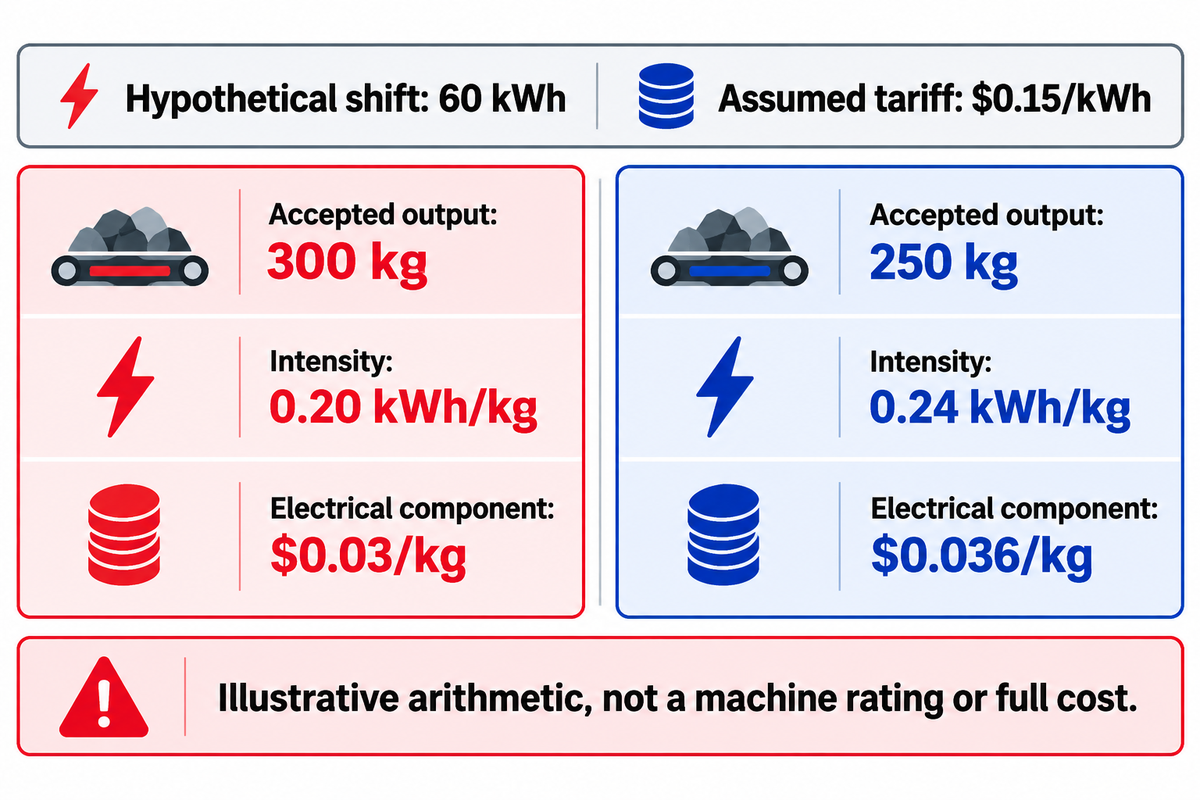
Efficient chocolate cooling uses energy to produce the accepted output rather than repeated rejects. Compare energy per accepted unit of production over the same operating period. Electricity consumption alone gives no idea about the effect of output and rejects and idle running. Keep product and operating conditions alongside the calculation so a change in loading isn’t mistaken for improved machine efficiency.
The US Department of Energy’s energy-intensity explanation uses energy per unit output or activity. For a hypothetical shift using 60 kWh to produce 300 kg of accepted product, intensity is 0.20 kWh/kg. With an assumed electricity tariff of $0.15/kWh, the electrical component is $0.03/kg.
If the same shift accepts only 250 kg, that unchanged electrical use becomes 0.24 kWh/kg and $0.036/kg. The arithmetic illustrates why rejects are important. It isn’t a quoted tariff, a tunnel consumption rating or a complete production cost.
For a producer trying to run efficiently, proper cooling starts with preserving air paths and following the equipment’s cleaning and maintenance instructions. Blocked passages and unintended openings can also impact the environment around the product. Reliable comparisons use the same production period and identify whether refrigeration auxiliaries are included in the meter readings.
Modular cooling can make future changes easier to plan, but an added section would need to align with the product route and the rest of the line. A custom belt width or longer cooling path can change the physical arrangement. Determine the loading or exposure requirement the change is meant to address, before asking a supplier to customize the width or length. Equipment engineering becomes more apparent after the process measurements are understood.
For configuration and project discussions, please visit the SINOFUDE chocolate cooling tunnel solution. That page covers the commercial equipment brief; this guide provides the process background for interpreting it.
Chocolate Cooling Tunnel Questions
Can I cool chocolate without a tunnel?
Chocolate can be cooled in a controlled room or other suitable cooling arrangement.
Batch handling can suit moulds that are placed and removed together. What matters is the product’s thermal history, the air reaching the load and the conditions it encounters afterward. A tunnel becomes useful when continuous transport fits the production sequence. A household refrigerator introduces a different loading pattern and transfer environment from a controlled industrial process.
Should chocolate cooling tunnels be refrigerated?
Industrial chocolate cooling tunnels commonly use refrigeration to control their cooling air.
Refrigeration removes the heat introduced by products and other loads, while fans distribute air through the enclosure. The target condition follows the product and process rather than the lowest temperature the system can reach. Controlled cooling also includes the transfer back into the factory environment, where surface temperature and local dew point determine condensation exposure.
Is a chocolate cooling tunnel worth it?
A tunnel earns its place when continuous cooling improves accepted output or reduces repeated handling.
Compare the complete production route, including labour, transfers, rejects, floor space and measured energy. A batch process with frequent product changes may place a different value on continuous transport than a linked enrobing and packaging line. Purchase price alone misses those differences. Use the required product condition at the next operation as the starting point for the comparison.
Can a cooling tunnel fix untempered chocolate?
A cooling tunnel does not replace the tempering operation.
Cooling develops the set from the chocolate’s incoming condition. When poor gloss or release begins with unsuitable pre-crystallization, changing the tunnel setting leaves that upstream cause unresolved. Check the tempering process before pursuing progressively colder air.
Why does chocolate look dry at the outlet and damp near packaging?
The product may encounter air with a higher dew point after leaving the tunnel.
Follow the actual transfer route and compare the chocolate surface temperature with the air condition at each location. An outlet measurement can miss a warmer, more humid pocket around a doorway or wrapper. Also inspect whether the first moisture appears before sealing or only inside the finished package. ASHRAE describes how air trapped in packaging can condense during later cooling. Retained samples help distinguish those stages: keep one under recorded conditions and let another follow normal packaging and storage. If the defect occurs only after that route, examine the additional exposure rather than immediately lowering the tunnel temperature. Moisture that later evaporates can still leave sugar bloom, so record when the piece first becomes damp as well as when a white surface develops.
How long does chocolate need to cool?
About 7–8 minutes is ASHRAE’s typical reference for milk-chocolate enrobing tunnels; cooling ends when the product reaches the condition needed for its next handling step.
Use the scoped enrobing reference and dwell calculation above to interpret the process, then compare surface, core and handling response for the actual recipe. A thicker product can remain internally warm after its surface sets.
Can one temperature be used for dark, milk and white chocolate?
Dark, milk and white chocolate should be evaluated with their own product and tempering conditions.
A shared air setting may work for particular products, but the chocolate name alone does not establish equivalent cooling behavior. Recipe, thickness, mould, filling and incoming condition remain part of the comparison. Record the actual product response before treating a setting as transferable. A temperature profile developed for a thin enrobed piece is a different starting point from one developed for a thick moulded bar.
References & Sources
- ASHRAE, 2018 Refrigeration Handbook, Chapter 42: Chocolates, Candies, Nuts, Dried Fruits, and Dried Vegetables.
- Influence of local convective heat flux on solidification, contraction and wall detachment behavior of molded chocolate during air cooling, 2021.
- Chocolate Tempering: A Perspective, 2025.
- Texture, color, and sensory changes occurring in chocolate bars with filling during storage, 2021.
- US National Weather Service: Dew Point vs. Humidity.
- Michigan State University Extension: Blooming chocolate, 2015.
- NASA Glenn Research Center: Range, Constant Velocity.
- US Department of Energy: Energy Efficiency vs. Energy Intensity.
Published by SINOFUDE, confectionery and chocolate machinery manufacturer. Written by Karry.