Get in Touch with SINOFUDE Company

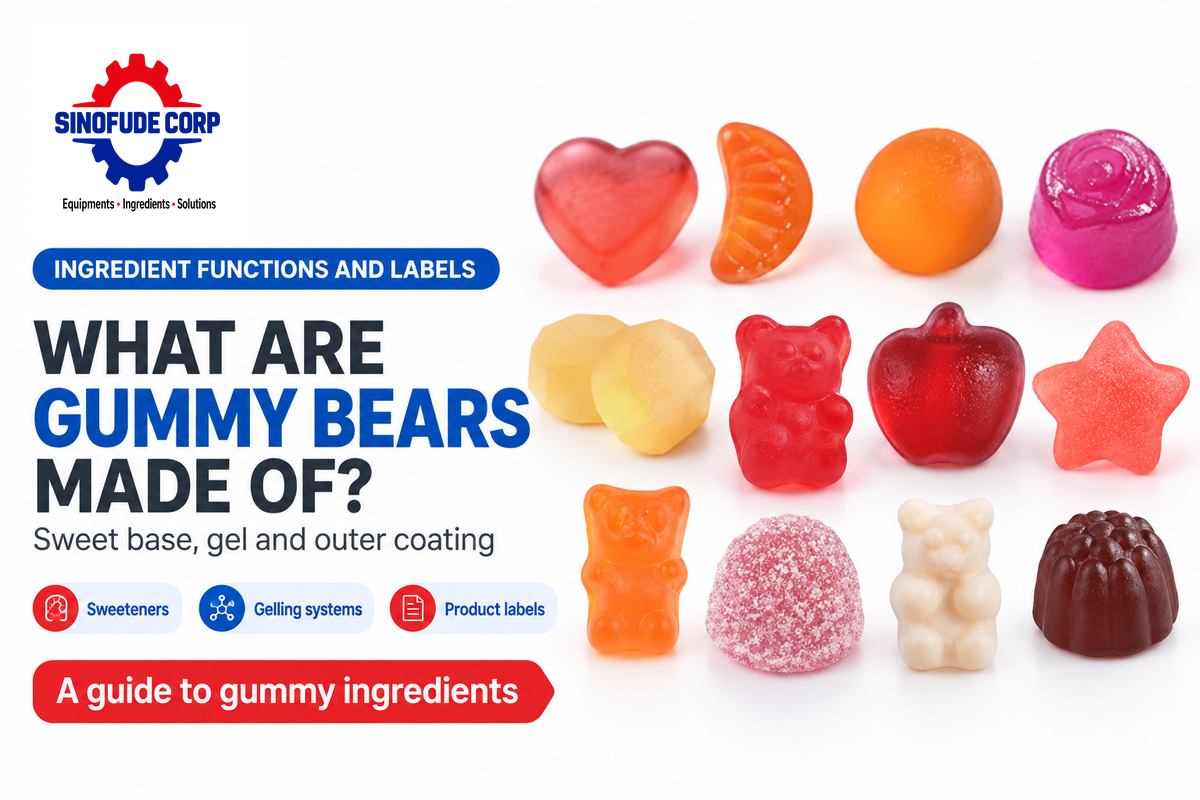
What are gummy bears made of? Most traditional gummy bears contain sugar, glucose syrup, gelatin, water, acids, flavoring and food coloring. Some also contain an oil and wax coating. Others use pectin, starch, or a different gelling system, instead of gelatin, so the ingredient list of a specific packet is more important than its bear shape.
Updated October 2026. Product examples below are based on the named products on their United States websites, checked October 23, 2026.
A gummy bear is a concentrated sweet mixture held in a gel. That description explains the chew and shows why two similarly shaped candies can provide a different experience in the mouth. The sweetener, gel and remaining moisture work together to provide body. Breaking the ingredients down based on their functions makes explaining the ingredients and understanding the list a lot easier.
The main ingredients in gummy bears
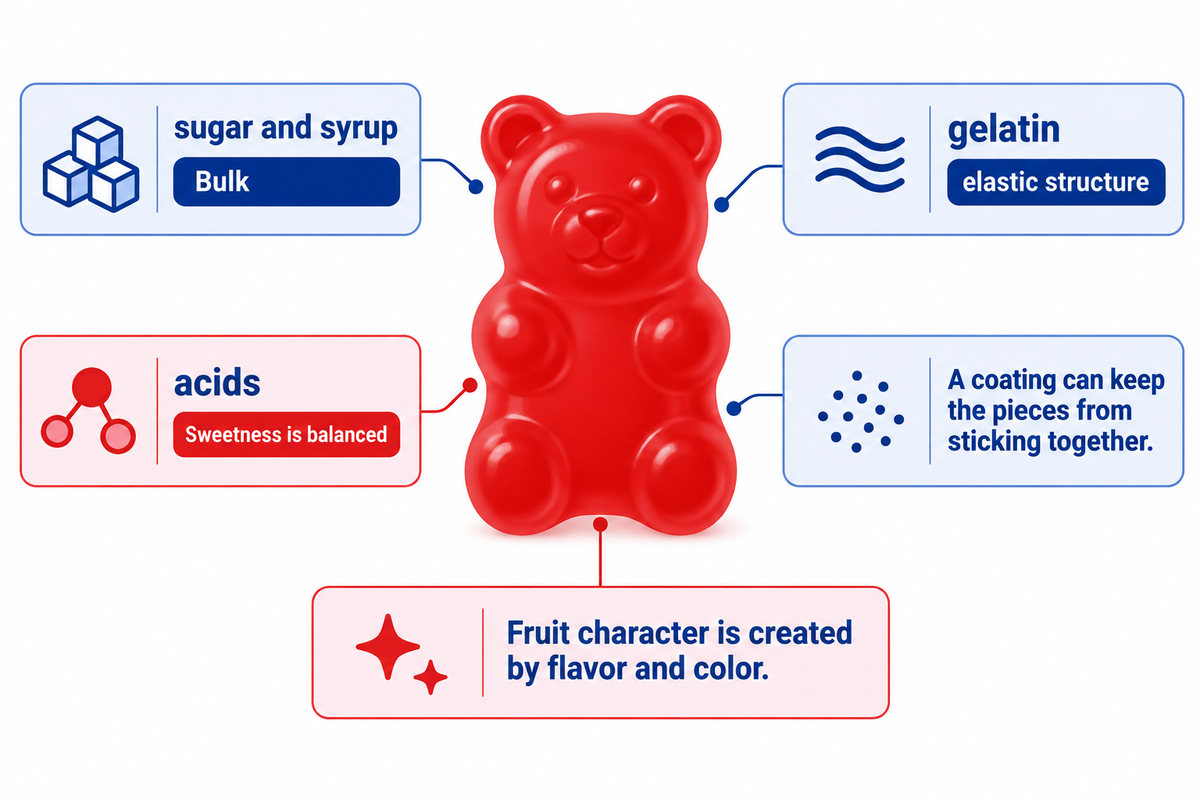
The traditional gummy bear recipe combines a sweet base and a gel that holds the candy together. Bulk is supplied by sugar and syrup, while elastic structure is supplied by gelatin. Sweetness is balanced by acids. Fruit character is created by flavor and color. A coating can keep the pieces from sticking together.
The HARIBO US Goldbears ingredient list begins with glucose syrup, sugar, gelatin and dextrose. Later ingredients are citric acid, flavors, sunflower oil, beeswax and colors. This is one recent example of how gummy bears are made, not a system followed by all manufacturers.
Water plays an important role in the explanation even if the short description of the product doesn’t include it. It dissolves ingredients and transports the mixture during the cooking and forming process. Some water evaporates during the processing. The amount left affects the bite. A bowl of gelatin dessert and a chewy confection can have the same ingredient names without having the same proportions.
Bear-shaped molds provide the outline of the candy, but don’t describe the gel within it. In factory production, a gummy depositor meters the prepared mixture into cavities; the recipe and subsequent setting produce the texture.
What each gummy bear ingredient does
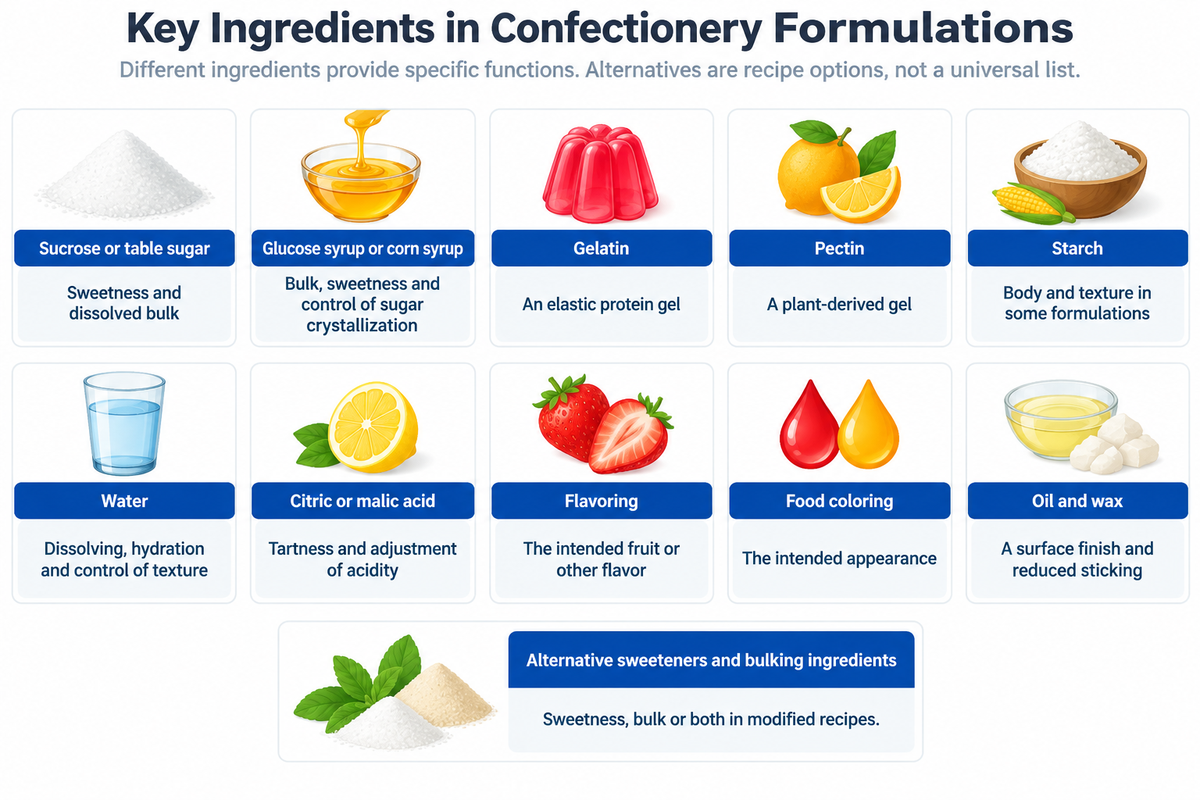
Gummy bear ingredients perform different jobs, much like the roles of flour and water in the context of bread. Gel provides structure and dissolved solids contribute to the firmness of the product. Comparing what particular ingredients do in a product can be an effective method to decide if two ingredients can be used interchangeably.
| Ingredient group | Main job | What to notice |
|---|---|---|
| Sucrose or table sugar | Sweetness and dissolved bulk | Granulated sugar becomes part of the sugar solution during mixing and cooking. |
| Glucose syrup or corn syrup | Bulk, sweetness and control of sugar crystallization | Syrup composition affects the finished chew; it is not simply water with a new name. |
| Gelatin | An elastic protein gel | Check animal source separately when that matters to the purchase. |
| Pectin | A plant-derived gel | Pectin grade and the rest of the recipe affect how it sets. |
| Starch | Body and texture in some formulations | Starch in the candy and starch used for molding have different jobs. |
| Water | Dissolving, hydration and control of texture | The starting water quantity differs from the moisture remaining in the candy. |
| Citric or malic acid | Tartness and adjustment of acidity | A sour gummy can have acid inside, in its surface treatment, or both. |
| Flavoring | The intended fruit or other flavor | Fruit-flavored does not automatically mean made with fruit juice. |
| Food coloring | The intended appearance | Read the named colors or color-source ingredients rather than judging by hue. |
| Oil and wax | A surface finish and reduced sticking | Beeswax and carnauba wax have different origins. |
| Alternative sweeteners and bulking ingredients | Sweetness, bulk or both in modified recipes | A high-intensity sweetener cannot supply all the mass of the sugar it replaces. |
The table integrates the FDA’s ingredient-function categories, product labeling and published gummy candy research. An ingredient can have multiple functions. For example, citric acid changes the taste and acidity of a candy; just because it is on the label doesn’t mean you can tell the final pH of the candy.
“You can change the texture of a candy dramatically by changing its water content,”
A home maker who gets a soft jelly instead of a confectionery chew should examine the entire mixture before adding more gelatin. Increasing the gel concentration alters one variable; it doesn’t replicate the solids balance or conditioning of a commercial gummy. SINOFUDE lists its CHX20 and CLM Baby small-scale gummy pilot line models, and states that each has the production capability of up to 20 kg/h. These published figures are a baseline for recipe trials; actual performance is based on the trial conditions.
Where gelatin comes from
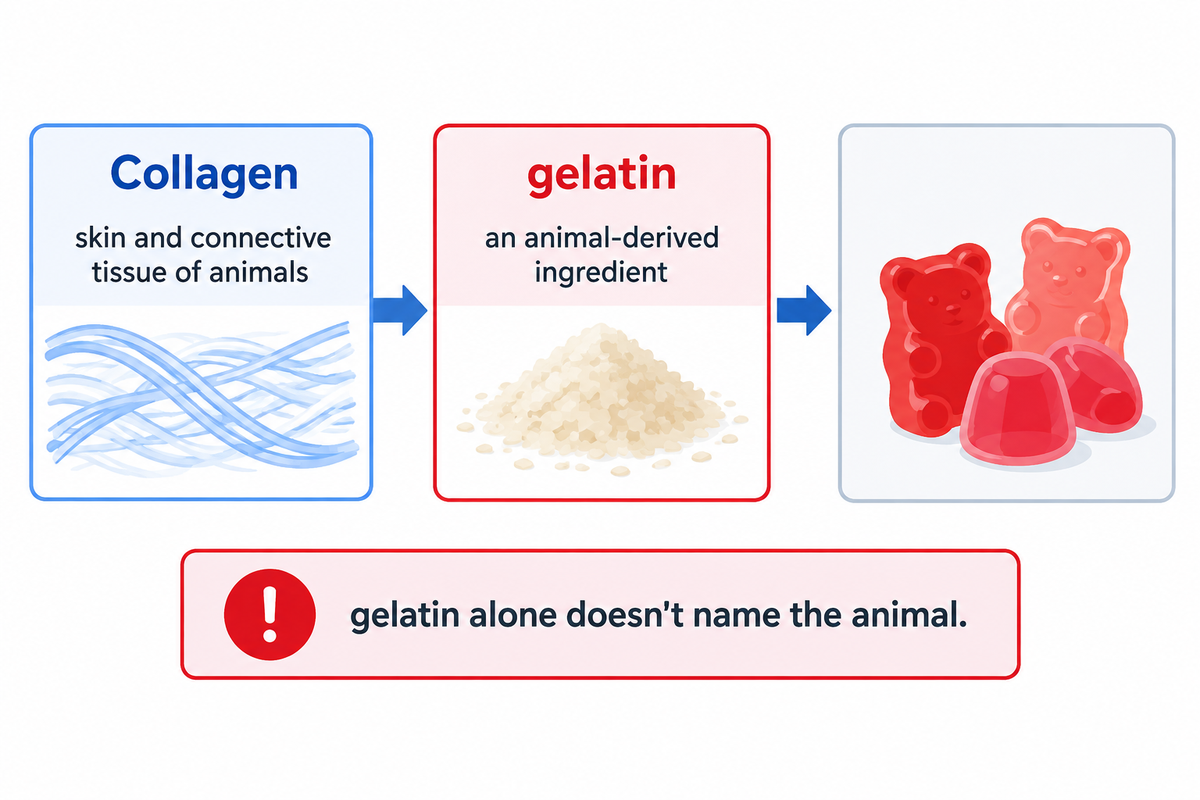
Collagen, the source of gelatin, is a protein in skin and connective tissue of animals. Processing separates collagen into strands that can form a gel in water. Finished gelatin is an animal-derived ingredient rather than a piece of meat, so gelatin-based gummy candies differ from plant-based gelled sweets.
What animal is used to make gummy bears?
Pigs and cattle are sources of gelatin used to make a gummy candy; however, gelatin alone doesn’t name the animal. A manufacturer may identify pork gelatin or another source for a particular product. The Albanese FAQ for example, states that its gummies contain pork gelatin. This statement should not be extended to other brands.
For a customer attempting to avoid a particular animal source, the most helpful details are the exact product and its sales market. A logo on an imported bag doesn’t necessarily help. Look at the product and the package together when checking the manufacturer’s response. Dietary certification is a separate, product-specific concern; a general description of collagen can’t resolve it.
Plant-based gelling options
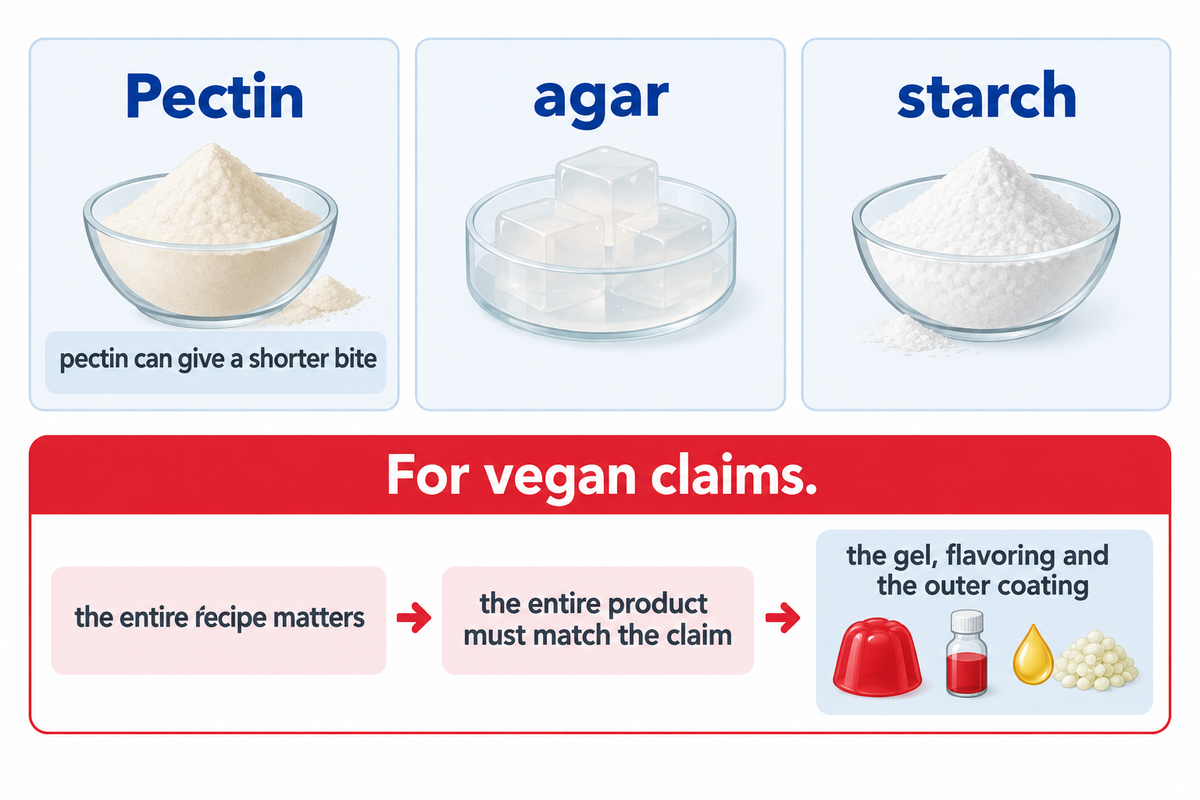
Pectin, agar and starch provide plant-based options for gummy textures, but they don’t mimic gelatin in every way. Gelatin gives an elastic chew; pectin can give a shorter bite. A blend can behave differently from either ingredient alone, so the entire recipe matters when comparing alternatives.
Are Vegan Gummy Bears Made From Pectin?
Many vegan gummy bears use pectin instead of gelatin; however, pectin isn’t the only option. Starch or seaweed-derived ingredients can also be part of the gelling system. For vegan claims, the entire product must match the claim: the gel, flavoring and the outer coating, not just the most recognizable ingredient name.
Formulators who replace gelatin with pectin also alter the way the mixtures set. Cargill’s expert elaborates on the differences between high-methoxyl and low-methoxyl pectin and their respective applications in a Candy Industry Interview. Replacing gelatin with pectin gram-for-gram wouldn’t be an appropriate assumption to make regarding formula predictions.
Gelatin and pectin can also be used together. In DeMars and Ziegler’s mixed-gel study, researchers tested gelatin at 3%, 4.5% and 6%, with pectin at 0%, 0.5%, 1% and 1.5%. Adding pectin reduced the extension before fracture. Those are experimental formulations, not recommended concentrations for every product.
Flavor, color and the outer coating
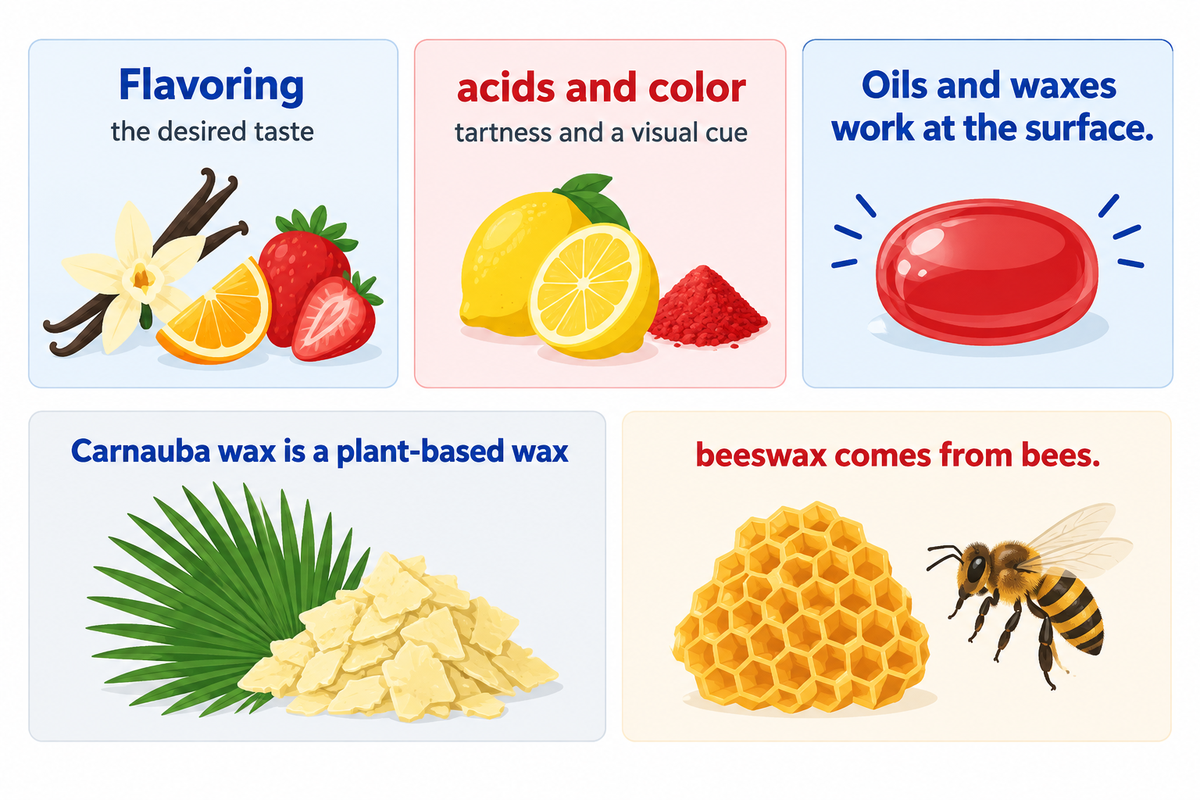
Flavoring contributes the desired taste while acids and color contribute tartness and a visual cue respectively to give gummy bears their sensory character. Oils and waxes work at the surface. Therefore, a raspberry-flavored red bear can get its flavor, color and shine from separate ingredients, and none of those features can tell you which gel forms its center.
Fruit juice or concentrate can be included in the recipe, but a picture of fruit isn’t an indication of recipe proportion. YumEarth’s gummy bear list contains apple juice concentrate in addition to flavor and coloring. Compare the actual wording if real fruit juice is part of your shopping preference.
Carnauba wax is a plant-based wax; beeswax comes from bees. Both are in confectionery’s ingredients list. A shopper choosing a plant-gelled sweet can still find beeswax farther down the list. Stopping at pectin misses part of the product. Sour bears can have a grainy texture unlike glossy bear treats.
Color wording also needs a current reading. In its February 5, 2026 announcement, the FDA described a new approach allowing no-artificial-colors claims when petroleum-based colors are absent. Colors may still be added from other sources. Read the color ingredients if that distinction matters to you; the front claim is not a vegan label.
Real product labels show why recipes differ
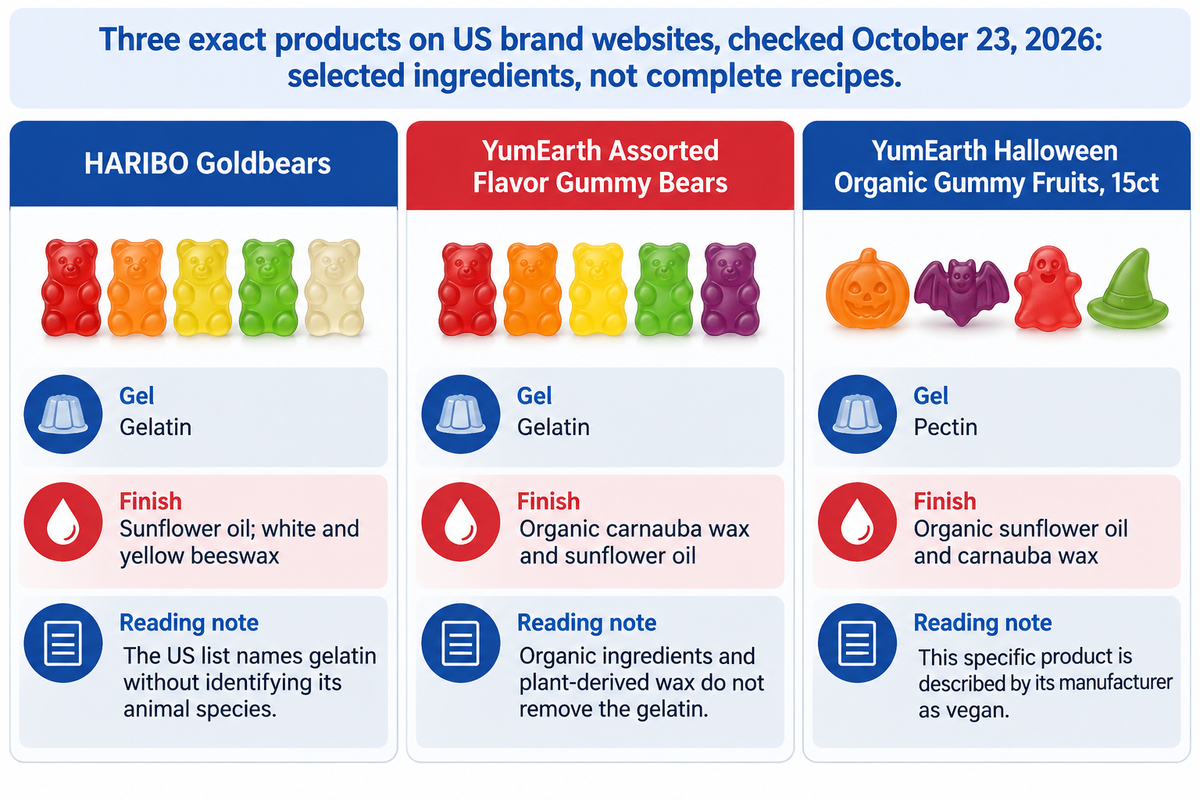
Specific product labels reveal differences that a brand-level summary conceals. Both HARIBO US Goldbears, the HARIBO gummy bears compared here, and YumEarth Assorted Flavor Gummy Bears include gelatin. YumEarth’s separate Halloween Organic Gummy Fruits is a fruit-shaped product that includes pectin, showing why product-specific comparisons matter.
| Product | Sweet base | Listed gel | Listed finish | Practical reading |
|---|---|---|---|---|
| HARIBO Goldbears | Glucose syrup, sugar, dextrose | Gelatin | Sunflower oil; white and yellow beeswax | The US list names gelatin without identifying its animal species. |
| YumEarth Assorted Flavor Gummy Bears | Organic rice syrup and cane sugar | Gelatin | Organic carnauba wax and sunflower oil | Organic ingredients and plant-derived wax do not remove the gelatin. |
| YumEarth Halloween Organic Gummy Fruits, 15ct | Organic rice syrup and cane sugar | Pectin | Organic sunflower oil and carnauba wax | This specific product is described by its manufacturer as vegan. |
Suppose you wish to buy two different YumEarth packs for two different individuals. One likes the familiar gummy-bear chew, and the other likes vegan fruit gummies. Packaging for the two varieties is very similar, but turning the package over reveals gelatin in the bears and pectin plus a whole-product vegan claim on the named fruit pack.
Similarly, the 2026 study of commercial fruit-gum candies found gel, sweetener and coating combinations. The authors state that labels alone don’t often reveal all causes of texture, and there were cases where a gel’s details and ingredient proportions were unclear. Comparing labels is helpful when determining which ingredients to include or avoid. Recreating the bite, however, requires more information.
What changes in sugar-free gummy bears
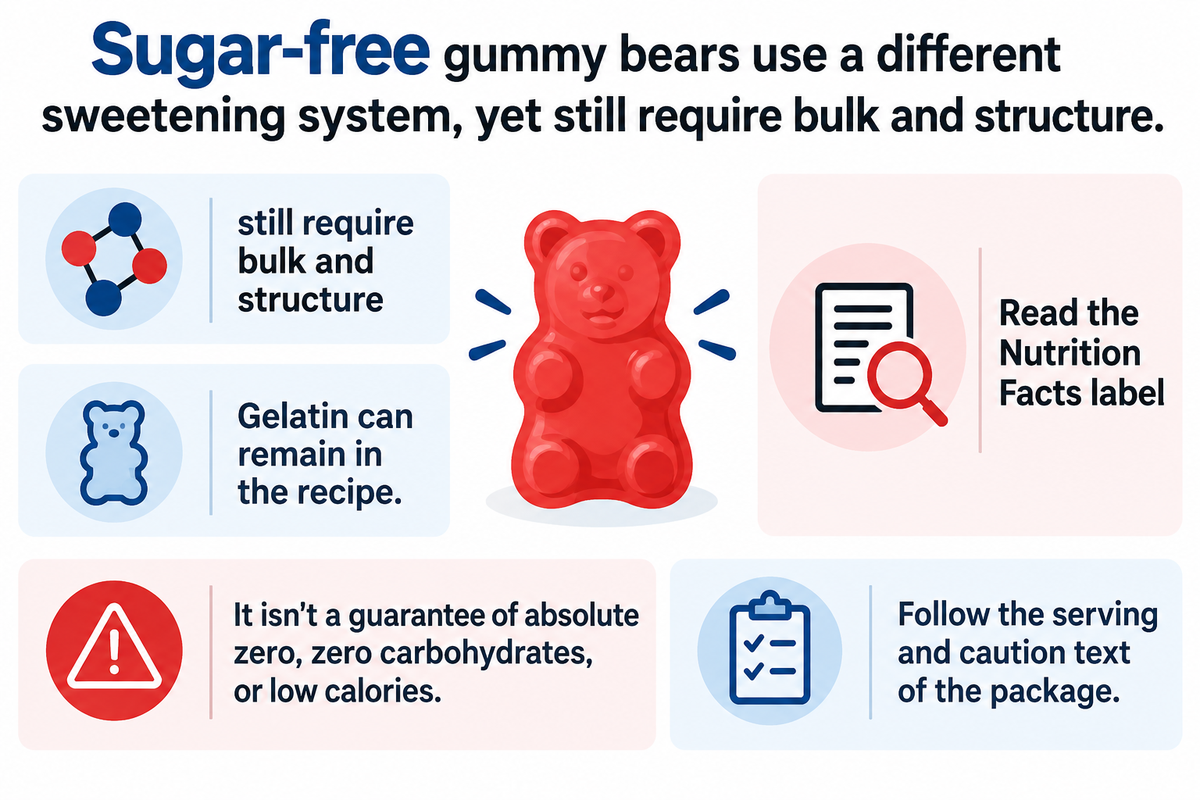
Sugar-free gummy bears use a different sweetening system, yet still require bulk and structure. Sugar alcohols can replace some conventional sweeteners, while other ingredients provide bulk and/or intense sweetness. Gelatin can remain in the recipe. Albanese’s current zero-sugar product and its pork-gelatin FAQ provide insight into why sugar content and animal origin are separate checks.
The US sugar-free labeling provision includes a threshold of less than 0.5 g of sugars per reference amount and labeled serving, alongside further conditions. It isn’t a guarantee of absolute zero, zero carbohydrates, or low calories. Read the Nutrition Facts label, along with the bag’s front label.
Allulose creates another distinction. In the FDA’s differentiation of sugars based on their metabolism it is defined as a chemical sugar that is included in total carbohydrates and may be excluded from total and added sugars. This is different from sugar alcohols like maltitol and erythritol, and manufacturers may count allulose at 0.4 calories per gram rather than the 4 calories per gram used for traditional sugars. This does not pertain to the undisclosed formula of any of the products in our comparison.
Consider a shopper replacing their conventional bag with a zero-sugar one. Only checking the large front claim leaves three questions unanswered: which sweetener supplies the bulk, whether gelatin is still there, and what the stated serving contains. Ingredients and nutrition give different answers to those questions. Health Canada notes that excess polyols or polydextrose can cause digestive discomfort, and this is dependent on the individual. Follow the serving and caution text of the package and don’t treat sugar-free as free rein to eat as much as you like.
How to read a gummy bear label
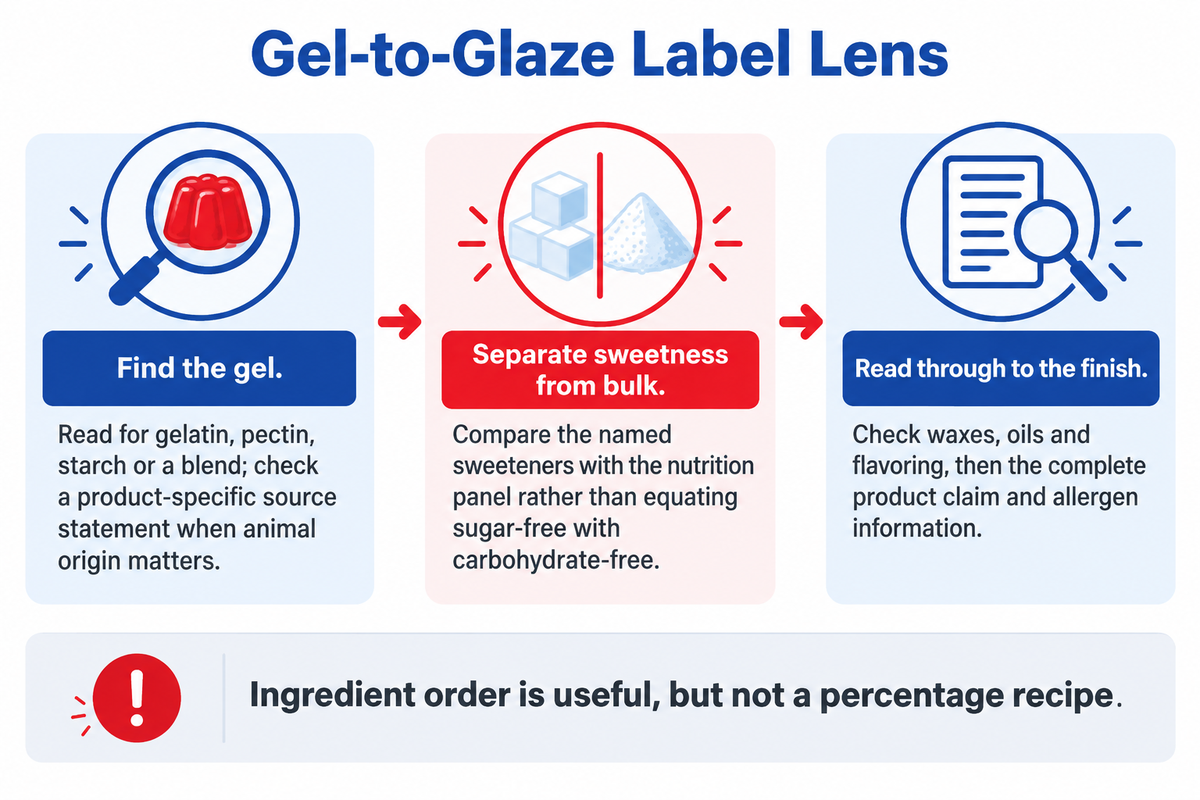
A gummy label is easiest to read in steps. First, identify the gel. Next, check the sweetener system. Last, check the flavors and the surface finish. Remember to keep the exact product and the market in your decision. A short preference like vegan or sugar-free only answers part of the question.
Gel-to-Glaze Label Lens
- Find the gel. Read for gelatin, pectin, starch or a blend; check a product-specific source statement when animal origin matters.
- Separate sweetness from bulk. Compare the named sweeteners with the nutrition panel rather than equating sugar-free with carbohydrate-free.
- Read through to the finish. Check waxes, oils and flavoring, then the complete product claim and allergen information.
Ingredient order is useful, but not a percentage recipe. US ingredient-list rules generally use descending weight. An appropriately marked group containing 2% or less of each listed ingredient has an ordering exception. Don’t rank two trace ingredients by position alone.
Natural flavor also covers more than fruit: the US definition includes plant and animal source materials. Use an explicit whole-product vegan claim when that is your requirement. For allergies, read the full package information; the FDA explains that advisory may-contain statements are voluntary, so their absence is not a product-suitability test.
From an ingredient list to a gummy recipe trial
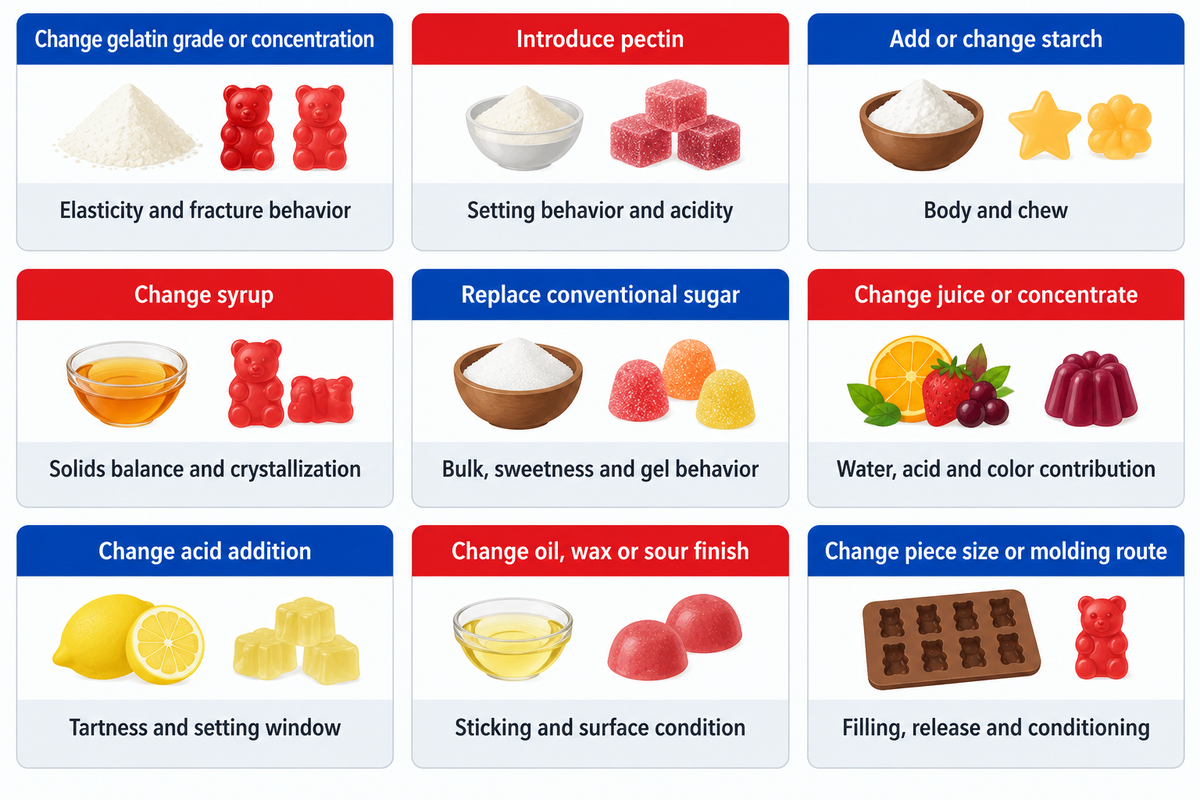
A production brief requires several things in addition to an ingredient list. This includes the intended bite, the gel system, and the piece design. Formulation staff determine the recipe, quality control staff define the comparison, and procurement staff match equipment to the resulting process and output requirement.
| Proposed change | What to compare | Trial record | Owner |
|---|---|---|---|
| Change gelatin grade or concentration | Elasticity and fracture behavior | Gel specification and finished bite | Formulation |
| Introduce pectin | Setting behavior and acidity | Pectin grade, pH and setting observations | Formulation |
| Add or change starch | Body and chew | Starch type and texture comparison | Formulation |
| Change syrup | Solids balance and crystallization | Syrup specification and finished solids | Formulation |
| Replace conventional sugar | Bulk, sweetness and gel behavior | Complete replacement system, not just sweetener dose | Formulation and quality |
| Change juice or concentrate | Water, acid and color contribution | Incoming ingredient specification | Quality |
| Change acid addition | Tartness and setting window | Final pH and addition sequence | Formulation |
| Change oil, wax or sour finish | Sticking and surface condition | Coating result after conditioning and storage | Quality |
| Change piece size or molding route | Filling, release and conditioning | Piece weight, cavity drawing and accepted sample | Production and procurement |
This brief is a synthesis of published formulation research and the product decisions above. In one 2021 gummy-storage experiment, researchers prepared 1,000 g batches and tracked formulations for 12 weeks at 10 °C, 20 °C and 30 °C. Results depended on formulation and the texture measurement. A single fresh sample would have missed changes that appeared during storage.
Picture a private-label buyer changing a gelatin product to pectin while keeping the bear outline. The commercial change may seem small, but the forming window and bite need a new comparison. First agree on a sample, and its recipe. Then note the piece weight, cavity design, setting result, and storage checks. A team using a starch mogul line has a different molding route from a team using reusable cavities. That choice should be made before an output goal is used as a machine selection number.
SINOFUDE’s gummy production lines set the context for that discussion. Send details of the target gel system and forming route, along with a candy sample, to us with your gummy production request to help us determine the product you wish to manufacture.
Frequently asked questions
Are gummy bears made with cornstarch?
Some gummy bears contain cornstarch as an ingredient, while others are formed in starch molds without using the same formulation.
Starch has two distinct jobs in confectionery: it can contribute texture inside the candy, or provide a temporary mold around it. The ingredient list and manufacturing method answer different questions. A maker can use reusable gummy bear molds instead of a starch bed. Check the exact packet for ingredients rather than assuming every gummy contains cornstarch because starch molding exists.
Do gummy bears contain real fruit?
Some gummy bears contain fruit juice or concentrate, while others get their fruit character from flavoring.
Look for a named juice, puree or concentrate in the ingredients in gummy bears. A strawberry picture or raspberry flavor does not state how much fruit is present. The YumEarth gummy-bear example above lists apple juice concentrate, but that does not make it the same recipe as its pectin fruit gummies. Compare the particular products rather than their fruit imagery.
Are gummy worms made from the same ingredients as gummy bears?
Gummy worms can use the same ingredient families as gummy bears, but shape alone does not identify their recipe.
A worm shape changes the mold, not the definition of the sweetener or gel. Two products from one manufacturer can still differ in acidity, coating or gelling ingredients. If you want to make gummies with the same bite in another shape, compare the full formula and the finished piece rather than copying a short product description or assuming all chewy candy is identical.
Who created the original gummy bear shape?
HARIBO credits Hans Riegel with introducing its Dancing Bear in 1922.
The HARIBO company history traces the business to Bonn, Germany, and describes that early gummi bear as larger and slimmer than today’s Goldbear. The history of gummy bears explains the shape’s origin, not every modern formula.
Can gummy bears be made in silicone molds?
Yes, gummy bears can be formed in silicone molds made for food contact at the working temperature, provided the recipe sets firmly enough to release from the cavity.
A reusable cavity holds the mixture until the piece can be removed from the mold. That makes the mold material one part of the process, rather than a substitute for a suitable recipe. Choose a mold intended for the actual food-contact use and working temperature, follow its supplier instructions, and check release on a small batch. A shape that releases cleanly with one gel may need a different setting or conditioning approach with another.
Can you melt gummy bears?
Gummy bears made with gelatin soften and can melt when heated; other gelling systems behave differently.
Once gelatin is dissolved in a warm mixture, cooling allows a gel to form again. Reheating finished candy can also change moisture and surface ingredients, so the original texture may not return.
Are all gummy bears made the same way?
No. Gummy bears share a recognizable shape, but their ingredients and forming methods vary.
Traditional gummies made with sugar and gelatin differ from pectin products or sugar-free recipes. Manufacturers also choose between starch molding and reusable molds, then match conditioning and finishing to the product. For bulk gummies, retain the supplier’s exact product specification and a reference sample. The ingredient list helps identify what is present; the complete recipe and process explain how a maker repeatedly obtains the intended texture and shelf life.
Our perspective on gummy ingredients
SINOFUDE supplies confectionery equipment, so our interest is how a product brief translates into cooking, depositing and forming requirements. This guide combines food-science publications with named manufacturers’ ingredient information. The product comparisons describe those products; they aren’t SINOFUDE taste tests or endorsements. Ingredient sourcing and recipe development remain distinct from choosing a production line.
References & Sources
- ACS C&EN’s 2025 gummy-ingredient feature
- 2026 study of commercial fruit-gum candies
- 2021 gummy-storage experiment
- DeMars and Ziegler’s mixed-gel study
- Health Canada notes
- US ingredient-list rules
- US definition
- US sugar-free labeling provision
- FDA’s ingredient-function categories
- FDA’s explanation of differently metabolized sugars
- FDA explains
- February 5, 2026 announcement
- Candy Industry interview about pectin formulations